The striking title of this far-ranging intellectual and artistic collaboration between Alexander Kluge and Anselm Kiefer comes from Hölderlin’s unconventional translations of the Pindar Fragments:
The lonely school’s capacity for the world. The innocence of pure knowledge as the soul of intelligence. For intelligence is the art of remaining faithful in changing circumstances, and knowledge the art of being sure in one’s understanding in the midst of positive errors. If our understanding has been exercised intensely, it retains its strength even in diffusion; inasmuch as it easily recognizes alien things by its own honed sharpness, and so is not easily confused in uncertain situations.
Although the full passage does not appear until the final section—or Station— of this richly illustrated, interactive volume, the titular statement, that intelligence is the art of remaining faithful under shifting circumstances, clearly reflects the spirit guiding the discussions, observations, and speculations that shape this work. It is set out on the opening pages in an extract from a conversation between Kluge and Kiefer held on July 5, 2023, at the French Cathedral in Berlin, the day before Kiefer was awarded the German National Prize. It is a concept to be understood as realism. The artist insists that intelligence isn’t a skill:
Like all art, it doesn’t arise in your head, but in your fingertips. Intelligence feels things out, makes attempts, has character, it observes, it’s awake and constant, it takes decisions quickly, yet it knows how to wait patiently.
Like a physician, an architect building a cathedral, a mathematician or physicist. Kluge and Kiefer trade ideas and illustrations back and forth as they seek to interrogate what it means to remain true to oneself in a broken world.
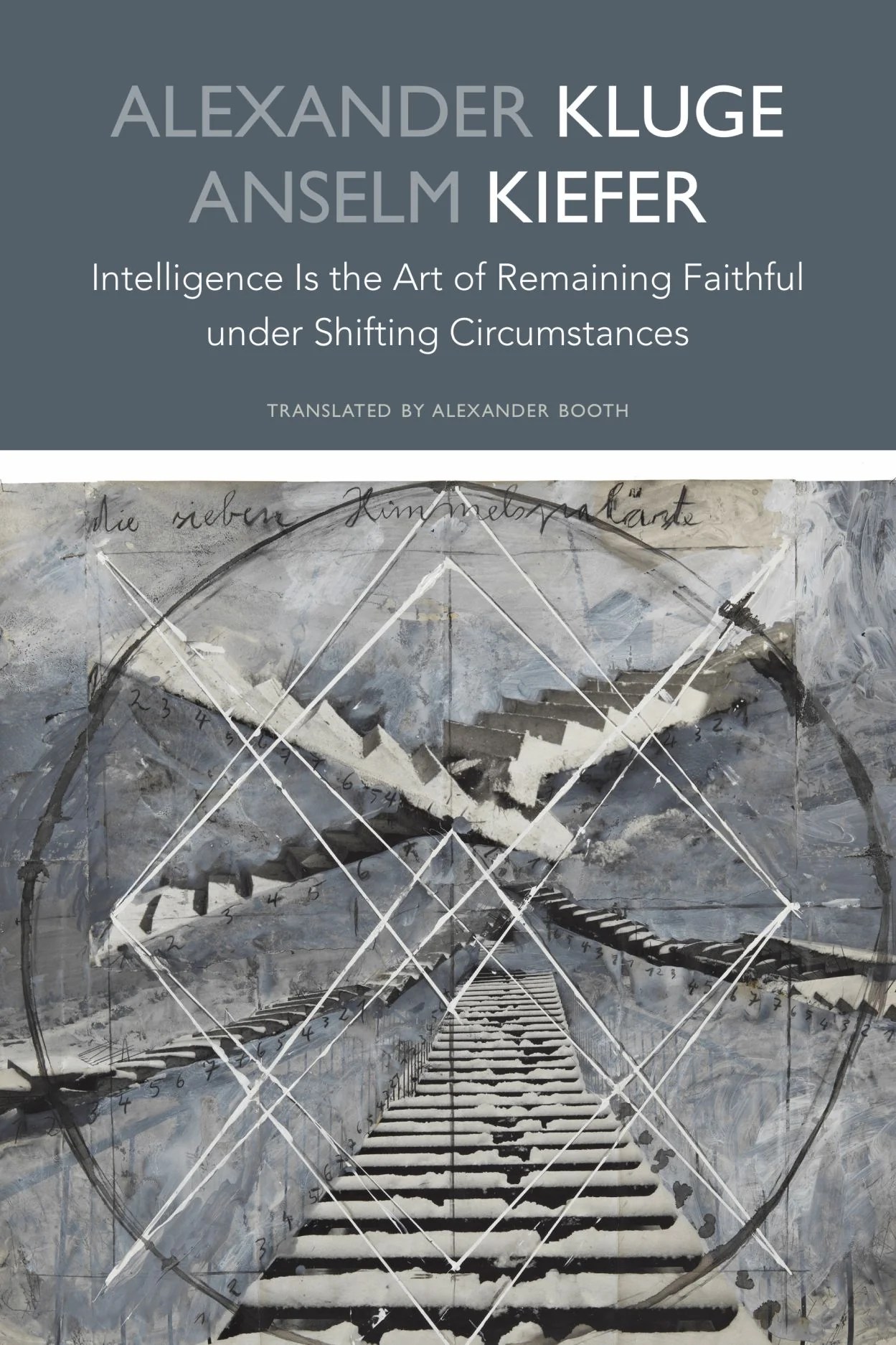
Over the following ten “Stations”—one might describe them as points of intersection of ideas and images—that comprise this volume, Kluge, the writer and filmmaker, and Kiefer, the artist, explore how they and others have endeavoured to exercise their intelligence. Themes and subjects are drawn from Kiefer’s artwork. The inspiration he derives from history, literature, poetry, science, and mysticism is reflected in Kluge’s companion commentaries and experimental short films (accessed via QR codes), and expanded upon in excerpts from the above noted July 2023 discussion between these two important German artists. The result is a dynamic, multi-faceted enterprise.
Kluge and Kiefer each operate in different mediums that combine the ancient, even prehistoric (writing and painting) with the modern (photography and film), and exercise their own distinct understanding of the world with openness, curiosity, and conviction born of experience and experimentation, but their work, in their respective mediums and spaces, meets, as Kluge describes it, tangentially. This is an ideal plane for their collaboration. They discuss, they debate, they agree, they agree to disagree, but throughout it is clear they hold each other in the greatest esteem. Into their collaboration they welcome the contributions and voices of many others, including Hölderlin, Rimbaud, Celan, Joyce, Robert Fludd, and Johannes Kepler. Kluge’s characteristic observations, anecdotal in tone with a tendency to walk a very fine line between the factual and the fantastic, bring in classical mythology, military history, Kabbalistic wisdom, mathematics, and music to provide context and counterpoint for Kiefer’s paintings and sculptures which are reproduced, in detail and in whole (especially meaningful for anyone who has seen Kiefer’s textured wall-sized paintings in person and knows just how difficult it is to capture the experience in any meaningful way with the camera on your phone).
Each Station has one or more themes, for example, “Tractate on Money, Love, Power and Truth / Four Currencies that Rule Our Lifespans,” “Stories of Exodus,” and “Finnegan’s Wake and the Construction Site of Words,” just to name a few. There is natural flow and balance between discussion and direct commentary about Kiefer’s displayed artworks and Kluge’s embedded films, and the wide-ranging reflections and observations that surround them and at times veer off in unexpected angles. As Kluge notes:
One of the most surprising effects of great art is its ability to open up new directions. Emblems, perspectives, groundwater of experience emerge, no matter how old, how lost the underlying basis of experience may be. The panel pictures cannot be large enough. They are works of art, but they are also ‘the street signs of experience.’
If you have not yet encountered one of Alexander Kluge’s books, collaborative or otherwise, especially the latter volumes with integrated multi-media, they can be difficult to contain or adequately describe in a review. There is a sense that they are larger on the inside than one at first suspects. They must be experienced. This particular work, translated by Alexander Booth who has ushered into English a good number of Kluge’s recent publications, is the latest to appear (although Kluge sadly passed away earlier this year at the age of 94, there may be more to come) and the perfectly-matched and well-timed collaboration with Anselm Kiefer makes it especially powerful. And intelligent.
Intelligence Is the Art of Remaining Faithful under Shifting Circumstances by Alexander Kluge and Anselm Kiefer is translated from the German by Alexander Booth and published by Seagull Books.

