2025 Wrap Up: Reading and other stuff


I don’t know what I expected when this year began. Ever since 2020 it seems we have greeted each year with some measure of optimism—I mean how could it be worse than the one that just passed? And somehow, each year has managed to be worse in some new, unanticipated way. 2025 saw the continuation of conflict, famine, destruction, climate catastrophes.  We also witnessed the further escalation of intolerance, racism, sexism, anti-trans sentiment, religious fundamentalism, and autocratic politics. Where I am in western Canada we have witnessed all of this, not just from our neighbours to the south, or distant nations, but right here close to home. It is hard not to lose hope, but giving up is not an option and so, 2026, here we come, preparing for the worst but dreaming of the best.

Personally, I struggled a bit this year. Family stuff, some depression, and, in late November, a car accident that has left me with stiffness and pain that is slow to subside. But, on the bright(er) side, my focus and concentration has returned, and replacing my damaged car proved easier than it might have been. My old Honda Fit had more value than I expected, and I happened to see a (newer) used vehicle that fit my needs for a very good price and was fortunately in the position to buy it. If the police manage to find the impaired driver who hit me (assuming she was insured) I will even get my deductible back. But, quite honestly, I’ll be happy to be able to look over my left shoulder again!

As for reading/reviewing, 2025 was a mixed year. I had a few off times when I struggled to finish books (or gave up altogether), and a number of mediocre reads passed without public mention. At the same time, I read some excellent poetry in English, but could not find the words to write coherent reviews. For some reason, I feel I lack the knowledge and vocabulary to say the “right” thing about poetry in my own language—I feel more comfortable responding to translations. And I did read a lot of poetry in translation this year.

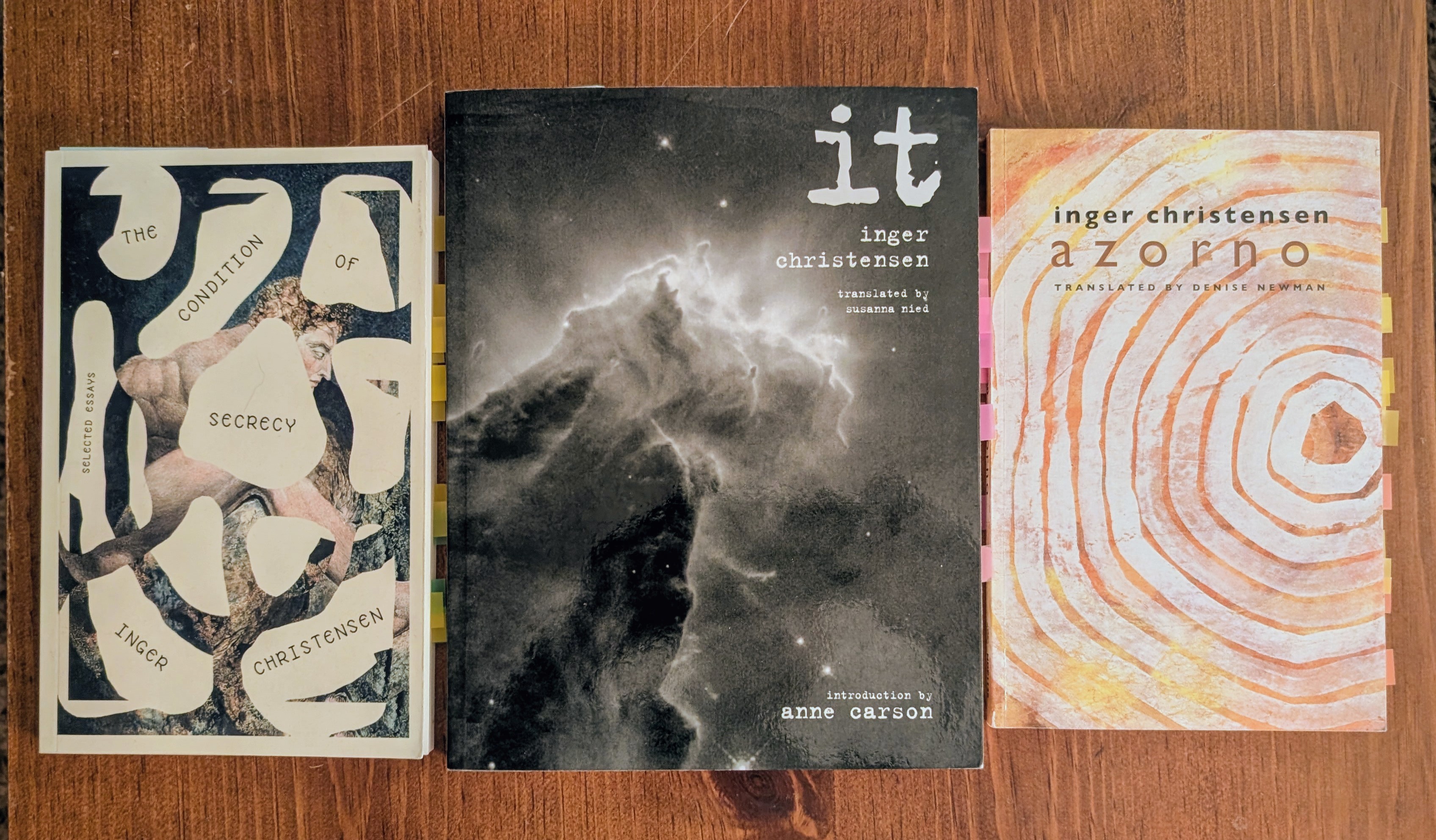
Looking back over 2025, the singular defining force for me was the work of Danish experimental poet and writer Inger Christensen (1935–2009). In January I read her essay collection  The Condition of Secrecy, and I was immediately entranced by her love of language and her view of the world as informed by science, nature, music, and mathematics. I knew I wanted to read all of her poetry and fiction and, throughout the year, that is exactly what I did. I read eight of her translated works and only have one left to obtain although I have a dual language edition of one of the sequences in that volume (“Butterfly Valley”). Along the way I also decided I wanted to learn to read Danish as there are elements of her work that simply cannot be reproduced in translation (mathematical constraints in particular).

And so, I am learning Danish, or, should I say, jeg lærer dansk.

Although I enjoyed all of her books, my favourite piece of fiction was the crazy word play mystery Azorno (1967) and my favourite work of poetry was her monumental it/det (1969), both earlier works. Of course, the wonderful book length poem alphabet (1981) is also amazing. Her poetry and essays are translated by Susanna Nied, her fiction by Denise Newman.
Some thoughts about a few of my other favourite reads from the past year:

 Prose:

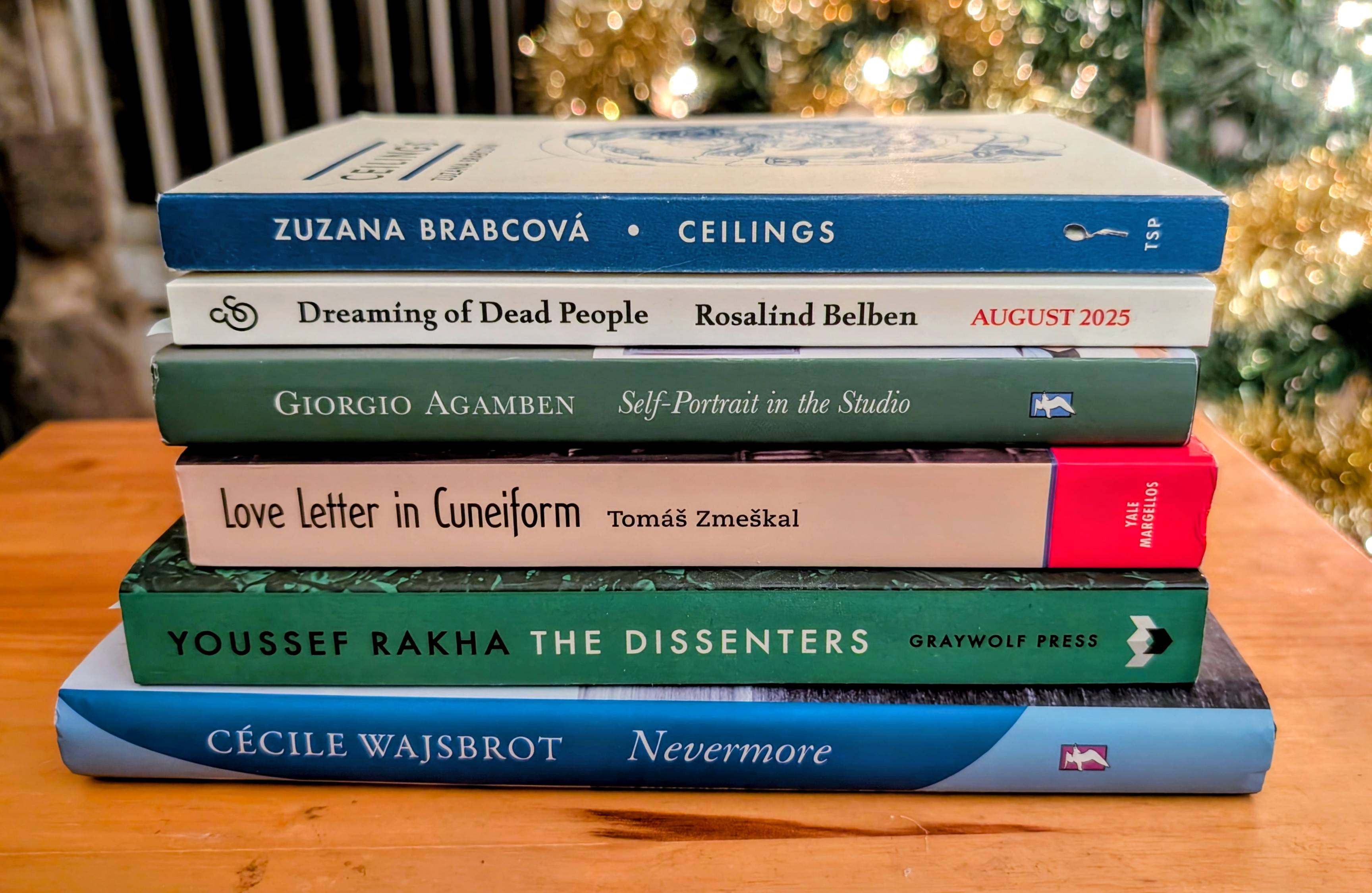
Ceilings – Zuzana Brabcová (translated from the Czech by Tereza Veverka Novická)

Set on the detox ward of a psychiatric hospital in Prague, Brabcová captures the institutional environment and the strangeness of psychotic interludes with the skill only personal experience can provide. This wild and delirious ride pulled me out of a reading slump.

Dreaming of Dead People – Rosalind Belben

I read two novels by Rosalind Belben this year, The Limit which was re-issued by NYRB Classics several years ago and this one which was re-issued by And Other Stories this year. Both are strange in a brutal yet beautiful way, but Dreaming is, to me, a more accomplished, in depth novel.

Love Letter in Cuneiform – Tomáš Zmeškal (translated from the Czech by Alex Zucker)

One of those books I’ve been meaning to read for years and when I finally picked it up off the shelf, I was delighted to find out how funny and weird this multi-generational family drama truly is. Zmeškal lends magical realism and historical reality with a cast of eccentric characters to create a memorable tale.

Self-Portrait in the Studio – Giorgio  Agamben (translated from the Italian by Kevin Attell)

Far from a conventional memoir, Agamben invites his reader on a tour of the various studios he has occupied over the years, reflecting on the people, books, and places that come to mind along the way. A surprisingly engaging work.

The Dissenters – Youssef Rakha

The final two novels on my list are both highly inventive in style and form. Egyptian writer Youssef Rakha’s first novel written in English manages to seamlessly incorporate Arabic expressions without explanation, adding to the richness of this original, multi-dimensional story of one remarkable woman set against the events of recent Egyptian history. Endlessly rewarding.

Nevermore – Cécile Wajsbrot (translated from the French by Tess Lewis)

This ambitious novel is a moving evocation of loss and change. A translator has come to Dresden to work on a translation of the central “Time Passes” section of Virginia Woolf’s To the Lighthouse from English into French. Reflections on change and transformation drawn from her own state in life and various historical events accompany the process of translation.
Poetry:

Of Desire and Decarceration – Charline Lambert (translated from the French by John Taylor)

It is most unusual for a poet as young as Lambert (b. 1989) to see her first four volumes of poetry published together so early in her career, but translator John Taylor felt that the Belgian poet’s books show a natural growth best appreciated as a whole. He is not wrong (he is also a translator whose judgement I always trust).

Psyche Running: Selected Poems 2005–2022 – Durs Grünbein (translated from the German by Karen Leeder)

This selection of poetry rightfully won the Griffin Prize this past year. Grünbein’s work tends to draw on his hometown of Dresden and Italy where he now spends much time, and this selection presents a good introduction to the variety of his mid-career work. One can only hope that the attention he has received with this book will lead to full translations of more of his work.

arabic, between love and war – Norah Alkharrashi and Yasmine Haj (eds)

The first of a new translation series by Toronto-based trace press, this selection of original poems with their translations—most written in Arabic, with some written in English and translated into Arabic, exists as a kind of conversation between poets from across the Arabic speaking world and its diaspora. Vital work.

The Minotaur’s Daughter – Eva Luka (translated from the Slovak by James Sutherland-Smith)

This book, a complete surprise tucked into a package from Seagull Books, is a delight. Luka’s world is a strange and quirky one, transgressive and fantastic. Leonora Carrington is a huge influence, with a number of  ekphrastic poems inspired by her paintings but given life from Luka’s own unique angle. Loved it!

Ancient Algorithms – Katrine Øgaard Jensen (with Ursula Andkjær Olsen and others)

This is the book that marked my return to reading post-accident. And how could it not. Jensen’s translations of Olsen’s poetic trilogy are very close to my heart. This unique work begins with poems selected from those books (in the original Danish), followed by Jensen’s translations, which set the stage for a series of collaborative mistranslations guided by rules set by the various poet translators involved. A wonderful celebration of poetry and translation and the necessary bond between the two.

My Heresies – Alina Stefanescu

Finally, one of the English language poetry collections I read and did not review (I did have a great title though). Alina Stefanescu breathes poetry as a matter of course, as is clear to anyone who has had an opportunity to engage with her online. There is an infectious defiance to this collection which straddles Romania and America, conjures angels and demons, and explores the everyday reality of romantic and parental love. I connected most directly with wry observations of motherhood that resonated with my own less than conventional parental existence.
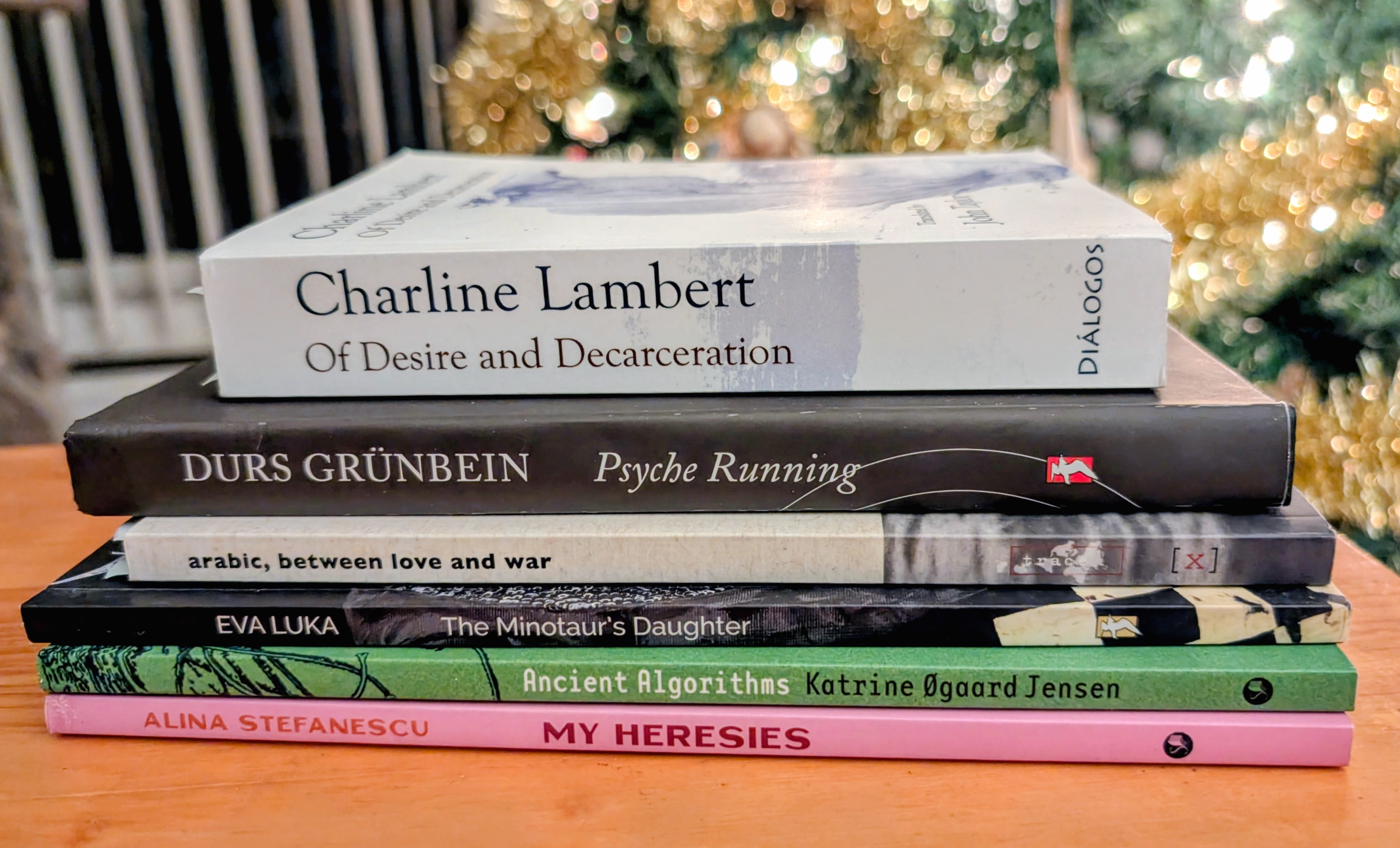
There are, as ever, many other books I read this year that could have made this year end review. You’ll have to check my blog to find them!

Happy new year!

Exercises in poetic alchemy: Ancient Algorithms by Katrine Øgaard Jensen (and friends)

When it comes to the art of literary translation, there are many elements and nuances to which the translator must attend, and in this regard, poetry offers a particularly slippery substrate. If a poem takes on different shapes and meanings every time you come to it as a reader of the same language in which the poet has written, the translator must also be comfortable with a certain openness that will allow others to enter it from the outside. But when a poet celebrates such fluidity in her creative process from its  earliest moments,  what possibilities and potential might that inspire in her translator?  Or might that be translators?

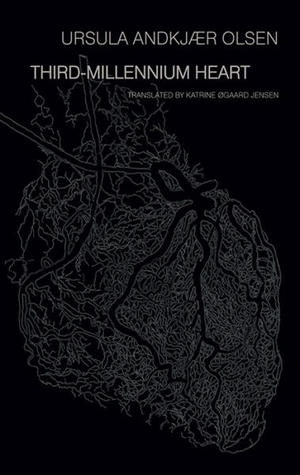
Consider this: poet and translator Katrine Øgaard Jensen has translated the expansive, organic  poetic trilogy of Danish poet Ursula Andkjær Olsen—Third Millennium Heart, Outgoing Vessel, and My Jewel Box (all from Action Books)—a “fairytale of the universe” that explores the body and its internal and external existence, in relation to birth, society, economics, and nature. But their relationship, as poet and translator, rests on, as all translation ideally does, a ground of collaboration and trust.

Consider this: Ursula Andkjær Olsen doesn’t view her poetry as original work, but rather a translation of an idea—an idea of which she is simply the first translator.

But why stop there? For Jensen, Olsen’s thematic and creative approach offered the inspiration for a generative, collaborative project of evolving intentional mistranslations—one that not only involves both poet and translator, but invites other poet translators to engage with the Danish originals (that is, “first” incarnations) and their “second” translations, following their own uniquely rule-defined imaginings to create new, unique poems to which Jensen responds, before returning her new mistranslation back to her collaborator and so on. Ancient Algorithms is the result of this project.

Jenson’s collaborators, or co-conspirators, are Sawako Nakayasu, Aditi Machado, Paul Cunningham, Baba Badji, CAConrad, and of course, Olsen herself. Each collaboration takes a slightly different approach, but most begin with a poem selected from Olsen’s trilogy. The original piece is presented, first in Danish, and then in Jensen’s published translation. The collaborating poet translator then sets the rule or process that will guide their mistranslation. Jensen then takes the resulting poem, sets new rules for further mistranslation, and the collaborator responds again. Where Olsen is the collaborator (an act she seems to really delight in), Jensen makes the first mistranslation. With CAConrad, Conrad’s own work with ancient technologies and rituals in poetry inspires the approach. Suffice to say, the individual poetic styles and sensibilities of the poets involved shape the transformations and reincarnations that arise from each collaborative sequence, but throughout it all, echoes of Olsen’s distinctive worldly—and otherworldy—vision can be detected. Each poet translator, an outgoing vessel, carries signals forward. Stop anywhere along the way and you can hear them:

i do not know if
language must be paid for

it is barely audible

the wind’s currents stir my body’s tissues
which the generalized eardrum
located in the vase of my swollen belly
channels into the uterus and         the world
its box, its ear, its mouth
resounds

(from “i am tasting the sun” – Aditi Machado)

Even when the newly birthed poems may weave in yet other languages as in those of multi-lingual Senegalese American poet Baba Badji, they are present, but lead to new universes and perspectives:

lengthen further my femur, tibia & fibula
for life to relive itself in my body,
maa gni mâgg, dinna mâgg, yeena gni mâgg,
in virtuous reliance and gratuitous strength—

superfluous, luksuriøst, and queer. Without machismo
there are no breaks, there are no tears, there is love,
and bodies, in bodies, we might have a base to stand on

towers of Babel dying de plus en plus rouge
castles, târne, du—moi—long graffiti for a beggar’s memo.

(from “Artificial Culture and Nature  Are Not Luxury”)

It is, of course, impossible to trace the complete transition of any one poetic collaboration and the poems that emerge within the restrictions of a few short quotes in a review, but each one is a dynamic, incantatory act of co-creation emitting an energy that is at once mystical and futuristic. But there is more. In the final section of Ancient Algorithms, Jensen and Olsen craft a series of games for poet translators. Even for readers who are themselves neither poets nor translators but are actively engaged with poetry and literature in translation, these activities spark the kinds of ideas that are fun and worthwhile to think about. And then, in closing, Jensen has gathered a collection of “Inspirations & Further Readings.”

Last, but not least, consider this:

When I first read Third-Millennium Heart I was so completely absorbed by its vision and magic I knew that I would not only write about it, but that my response would have to be both poetic and experimental. (Published on Minor Literature[s] in 2018, if interested the PDF can be opened here.) As Olsen’s trilogy evolved, I welcomed Outgoing Vessel and My Jewel Box in turn, and have read the complete set many times. I even had the honour of speaking with Olsen and Jensen on a live Zoom broadcast several years ago. Now that I am learning to read Danish myself, to be able to begin  with a selection of Olsen’s poems in Danish, read through Jensen’s translations, and on into the permutations and re-imaginings that emerge with such a fine group of poet translators is a special treat.

But one that is also recommended for anyone who loves poetry and the art of translation.

Ancient Algorithms by Katrine Øgaard Jensen with Ursula Andkjær Olsen, Sawako Nakayasu, Aditi Machado, Paul Cunningham, Baba Badji, CAConrad is published by Sarabande Books.

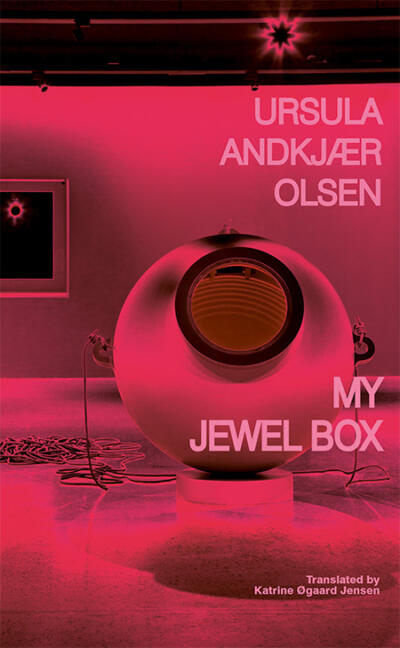
i am so pure and lonely: My Jewel Box by Ursula Andkjær Olsen

infinite energy borrowed from the future
founded everything
out of nothing

like debt  (45)

It has been four years since my first encounter with the work of Danish experimental poet Ursula Andkjær Olsen through her book-length poem Third-Millennium Heart. I was, at the time, grieving the death of my mother a year and a half earlier, and in a process of coming to understand the nature of the particular absence her loss had left in my own sense of identity.

Dramatic and intense, the poem follows an expectant mother-figure like no other, her language pulsing like blood through arteries and veins, her vision pushing beyond patriarchal capitalist dynamics toward a new conception of the body and the kind of life it can nurture and contain.

As I described it in a blog post, “we are held captive by a demanding chimeric voice, witnesses to the realization of a possible future reality which, not unlike the mechanistic hive-mind typically associated with cyborg imagery, envisions a hive-heart existence.” I was so swept up in the flow of this epic, inventively translated by Katrine Øgaard Jensen, that I was moved to create an experimental poetic response of my own which was published at Minor Literature[s]. (The PDF is reproduced here.)

Last year, a follow-up volume, Outgoing Vessel was released in translation. Reading, perhaps, more like a companion piece, rather than a continuation, the enigmatic speaker here is a more isolated, inward focused figure. Through an atmosphere heavy with grief, anger, pain and existential disconnect, her rhythmic chants progress toward the articulation of a radicalized technological ontology. Now, in the place of a new life/lives, the poet talks of an orb, an indestructible object that she carries within her body—a planet of her own that ultimately figures in a re-imagining of a new human beingness. The tone, often harsh and seemingly unforgiving, ultimately leads to an affirming vision, even more boldly futuristic than that of the preceding cycle.

Now, a third work—My Jewel Box—has arrived, bringing with it another striking shift and a remarkable sense of closure. That is, at least in my experience, the three volumes form an echoing, interconnected epic, with a grand operatic arc, one in which the speaker/singer evolves through different ways of seeing and understanding herself—in society, in the universe, and finally as vital link in the ongoing chain of life. She returns to earth, one might say, but as an ever-dynamic force, she bends earth (along with air, water and fire) to her own imagination. The connection with Third-Millennium Heart is possibly the most obvious, but in the move from a gestational to a generational reality, I would suggest that the strongly internalized, starkly solitary exploration of Outgoing Vessel can be read as a necessary recalibration of the individual self in contrast to the communal self that is governed and influenced by our interpersonal and transactional relationships with others. Now, the self is redefining herself once again.

interrupt me in my work

i sat there and

i’m in the deep laboratory
connecting myself to
the unrest, how it feels
it has a pronounced gravity
soft, possibly smooth, and heavy
it calms the body, even though
it isn’t still

is it my child, is it my mother
is it myself

is it alive

an incredible labor (18)

Like its predecessors, My Jewel Box is comprised of a series of poetic sequences that together form a single, book-length poem. Photographic artworks by Sophia Kalkau mark each section, the continuation of creative partnership that has enhanced the entire trilogy. Olsen employs reiteration, chant-like passages, shifts in tense and intention, neologisms and a distinct sonic intensity to propel her poetry forward. Motifs and themes from the earlier works also reappear, drawing on threads that run throughout the trilogy. In Danish, she is lauded for her daring use of language, so, as ever, the trust and chemistry that exists between poet and translator is critical. Olsen sees herself as the first translator of the ideas, and Jensen as the second, granted the freedom to work with the language to capture the inventiveness and spirit of the original. The result is a collaboration that is very special.

My Jewel Box opens with a surreal poem that involves the speaker’s sister and their mother’s body. Her parents and her child will also appear later in the longer poems that close out each sequence, hinting at a somewhat more intimate tone than admitted in the previous works. We catch a glimpse of the dynamic central figure as daughter, sister and mother. Nonetheless, the poetry resounds with bold statements, sharp contrasts—love/hate, pleasure/pain, blame/guilt/innocence, supply/demand—and harsh indictments, but the tone is somehow wiser; the debt ratios and mechanisms of balance are changing. What has been borrowed must be repaid. And the payment will be realized in a new understanding of the relationship between the body and the material world. It will be emotionally and physically painful.

to keep the spirit inside
force it to stay inside the body
despite physical discomfort
despite almost endless physical discomfort

i place the body inside the world
and breathe in
i place the world inside the body
and breathe out
that is what i do
i am

griefbody
ragebody
joybody
lovebody

i identify with everything, with
(fire, water, earth, air)  (131)

The preparation occurs at all levels of the body, from the cellular to the surface and beyond—fleshy and metallic imagery are interwoven leading, ultimately, to what is the beating heart of this poetic epic, the longest sequence, named, like the book, “My Jewel Box.” Here we move into a quieter, more organic, melancholy space, one that increasingly embraces a connection to the natural world, as the speaker enters a new phase of life—the post-fertile. This menopausal suite is, in its early movements, charged with loneliness and loss. Rivers of sweat run, the uterus is reimagined as a container for what? Air? Water? The blood now bled out is invisible.

i am a mother
who does not turn anyone into siblings
who will not be turning anyone into siblings  (183)

Yet, as before, Olsen’s poetic vision is fundamentally life-affirming and, as her speaker begins to come to a fresh appreciation of her newly defined integration with the material world, her language explodes with the most vivid array of colours painted onto a tapestry of stars, gardens and forests. In contrast with the limited palettes of Third-Millennium Heart and Outgoing Vessel, it is blinding and exhilarating. The sadness lingers, the transition is pained, but possibilities are awoken, to be reclaimed as the work draws to a close at the end of the final sequence.

The power of Ursula Andkjær Olsen’s trilogy lies, for me, in her ability to move from the restrictive to the expansive, the biological to the cosmic, and back again. Her enigmatic speaker seems to be seeking a grounding in a vast universe, either pulling it all inside herself or holding herself close against its emptiness. At last, with My Jewel Box, there is a sense that she has reached a more solid footing, at once tentative and secure, a place where she belongs, somewhere between eternity and eternity.

Or, perhaps, that might just be my own translation of my experience of reading this trilogy.

My Jewel Box by Ursula Andkjær Olsen is translated by Katrine Øgaard Jensen and published by Action Books.

Note: I will be in conversation with the poet and her translator on Sunday, May 15, 2022 at 1:00 pm CST. If interested, you can register to attend this virtual event at Brazos Bookstore.

I am the hard one: Outgoing Vessel by Ursula Andkjær Olsen

destructive is my normal state (37)

Danish poet Ursula Andkjær Olsen is a singular force of poetic vision. Intense, strident, futuristic. Outgoing Vessel, newly released from Action Books, is the follow up to her award-winning Third-Millennium Heart, a powerful reading experience I loved so much that I responded in verse with an experimental review published here (open the PDF to read). Translator Katrine Ogaard Jensen is on board again for this new journey and, as with her previous work, Outgoing Vessel unfolds over a sequence of poetic movements to form a 193-page, book-length poem that is both epic and operatic in scope. I was not surprised to learn that Olsen is also a librettist. As with her earlier project, the “singer” here is an enigmatic narrative force—perhaps the same one, I don’t know, though I hear a companion rather than a continuation myself.

no one except me can hate feelings
anyone else who claims to hate feelings:
let it be known how they still succumb to them
anyone else who claims to hate feelings:
let it be known how they, in weak moments
open up to them and

and become soft with longing

among all time’s winners
i am the hardest (8)

The early suites of Outgoing Vessel seem charged with negative energy, often erupting in harsh declarations of hatred that begin with the self and extend outward.  The voice is hard, constrained. Darkness and destruction are evoked frequently. Yet the motion is self-driven, Olsen owns her language, and the direction she is moving toward (and expecting others to align with) is not symbolic, but it is futuristic. She seems to be intent on encasing her darker, grieving being, containing it inside a container—described as an orb:

which I will send off as the outgoing
vessel that it is
after which the new human can arrive in its

incoming (48)

Third-Millennium Heart built on a tension between the clinical and the organic, pregnant with promise, anger and grief, rupturing ultimately into a powerful post-human feminist vision—one which gives birth to the possibility of a cyborg-like hive-heart existence. Heart’s speaker devoured and contained. Vessel’s is more isolated, inward focused and philosophical. Pain, grief, and an existential disconnection drive her rhythmic reasoning as she moves toward the foundation of a technological ontology, a science fiction solution, and a re-imagining of a new human beingness.

we must assume there is an original alienation:
first the estrangement, a person, a stranger to themselves
stranger to others, the person exists deep inside their
distant interior, without knowing, they must escape to the
surface, from inside, to become human (108)

The futuristic tone becomes more prevalent as the sequence progresses, propelled in no small part by the “technoscientic” poems that close each section of the work. As translator Katrine Øgaard Jensen explains in her note, Olsen “created these poems by piecing together lines from each suite, running the text through multiple languages in Google Translate, translating it back into Danish via Google Translate” then, from the resulting document, the final piece was created employing a cut-up method. This mechanical process allows for a new tone, energy and uncertainty to enter the cycle (not mention an added challenge for the translator to meet in a satisfactory measure):

human nature
in the coffin, a
relic, collection of Bones and Hair
encapsulated and stored in
a humane vacuum

this is
the refuge (94)

The strange brutality of Olsen’s poetry, the slogan-like chants, and the tightly-honed anger can be off-putting, but as with Third Millennium Heart, I find it oddly therapeutic. Anger in its shades and intensities can be a positive force—it is the healing movement of the cycle of grief, it pushes you forward, up and out of the sandpit of sadness that follows loss, trauma, heartache. It sounds counter-intuitive but I saw it many times working with survivors of acquired brain injury. Yet it is hard to allow it in oneself, for fear it will erupt in uncontrollable ways. Through the course of Outgoing Vessel we witness the speaker’s emergence as a voice of concern, intent on invalidating loneliness—through her outgoing/incoming vessel she comes to a radicalizing understanding of empathy and experience.

Olsen is a poet who, as her translator Jensen freely admits, cannot be neatly and directly rendered into English—her work is highly inventive, rife with cultural references, puns, neologisms, and experiments with language. Rather than attempting to produce an exact copy, Jensen aims to stay true to the “spirit of the work,” allowing it to find its own form in translation. This is, it turns out, an ideal approach for a poet who sees her own  work as a “translation of an idea”. As such, she is simply the first translator and Jensen is the second. The result is a sequence of poems that carries its own fresh energy. Tight. Terse. Tender. And ultimately affirming in its futuristic vision.

Outgoing Vessel by Ursula Andkjær Olsen is translated by Katrine Øgaard Jensen. It features stark, spare photographic works by Sophia Kalkau and is published by Action Books.

Speaking to poetry with poetry: The background to my experimental response to Third-Millennium Heart by Ursula Andkjær Olsen

I have, in recent months, been reading and responding to poetry with increasing frequency here on roughghosts. I hesitate to say review, perhaps because I lack the vocabulary to classify and analyze poetry in a learned fashion. That is, to speak to other poets about poetry—a task that tends to achieve little more than ensure that poetic appreciation remains a closed circle.

Do not pass Go, do not expect to enjoy poetry on its own terms alone. (Everyone knows collecting $200 is too much to hope for in this particular game.)

I have collected a few books about reading and writing poetry  with the thought that they might enhance my critical appreciation, but they remain unread, perhaps for the same reason that I decided not to study Literature at university. I am afraid of wringing all the pleasure out of the experience of reading with too much analysis.

And so, I have been content to respond, with a measure of innocent ignorance, to the work I read. Gut level. Which is fine, until I venture into the realm of experimental poetry where, in contrast to experimental literatures of other sorts, my response seems lacking. At least to me.

Enter Third-Millennium Heart, the ambitious epic cycle of poems by Danish poet Ursula Andkjær Olsen. This work which, in my reading, traces the evolution of a post-human cyborg being, or state of being, is a glorious evocation of the power of language. Through Katrine Øgaard Jensen’s inventive, sensitive translation, we are held captive by a demanding chimeric voice, witnesses to the realization of a possible future reality which, not unlike the mechanistic hive-mind typically associated with cyborg imagery, envisions a hive-heart existence.

Or, that’s how I think of it at the moment. It doesn’t really matter.  The true joy is in the experience of this series of poems. And when reading it, I simply knew I would want to respond. But prose analysis seemed inadequate, insufficient. I wanted to write in reaction to Olsen’s poetry. To answer poetry with poetry. Keep it minimal. Close to the heart, if you will.

Without question, the work of my friend Daniela Cascella, and in particular her recent book Singed, was essential to shaping my approach. It is unmediated, equivocal, open-ended.

Possibly the only way to fully respond to poetry.

My experimental review/response to Third-Millennium Heart can be found at Minor Literature[s]. The text opens as a PDF; I invite you to read it and welcome feedback.   Minor Literature[s] are currently repairing their archive so the PDF of my review is attached below.

Third Millennium Heart is a joint publication of Action Books and Broken Dimanche Press.

Third Millennium Heart review