Moving fast to slow down

With respect to many fellow bipolar bloggers who are weighed down with depression I am fighting a mixed hypomanic state. This is a more common concern for me and although I have only been fully manic twice in my life, I can run at a heightened level for years. Looking back now I probably was running high over the past few years while I took on increasing responsibilities at work in an increasingly unsupported and dysfunctional environment before landing in full manic mode this past June. I have had access to little psychiatric support since then so between my family doctor and a private psychologist I splurge to see once a month I am trying to stabilize my level of agitation. Hopefully before my disability benefits run out.

At the same time this time has allowed me to unpack a lot of baggage and make some critical reassessments at this point in mid-life. On that level I am making progress. But my brilliant experience volunteering at Wordfest last month, meeting and engaging with so many readers and authors was a high risk experiment with respect to my mood regulation efforts. I barely ate or slept for four days after the event ended.

For all the energy these past weeks have added to my creative efforts, I have trouble concentrating and tend to fall into periods of high energy thought processing without being able to channel the ideas productively. I have been making a point of getting out and spending a few hours writing or reading in coffee shops. Being in public spaces forces me to focus.

However, the word is that winter is truly rolling in tonight with snow and temperatures dropping to the minus double digits celsius. Since I haven’t gotten around to getting my winter tires mounted I am not likely to venture far for a few days. So I decided to spend the last temperate afternoon out, not hunched over a coffee cup but walking off some of my pent up energy.

Typically I walk with my camera and my ipod. It is a slow pace as I find myself regularly stopping to capture scenes or flora. However I hadn’t realized how that actually narrows my experience of some of the locations I regularly visit. When I was working such an activity was a great way to relax and unwind. Since I have been off ill, I have had little enthusiasm for photography and little motivation to visit my favourite natural haunts as if one required the other.

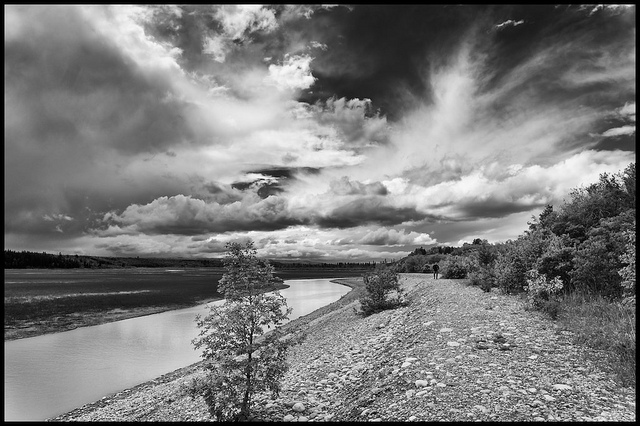
Today when I reached the riverside where I planned to walk I felt momentary regret that I had neither my camera nor my ipod with me. But as I set off on a brisk walk in the late afternoon light of this November day I was surprised to find how freeing and meditative the experience was. The movement helped me slow and focus my thoughts while, freed from the viewfinder of a camera, I was able to take in the fullness of the vista. I watched the changing colours of the slowly fading light reflected in the water and on the glass towers of downtown in the distance. I noted the shifting clouds and birds flying in to roost as the depth of darkness and shadow crept across the fir trees that cover the length of the high embankment across the river.

I returned refreshed, relaxed and calmed.

The path I walked today as it is likely to look in a month or so. Copyright JM Schreiber 2012
The path I walked today as it is likely to look in a month or so.
Copyright JM Schreiber 2012

Good words and a smile (oh and a good book too)

Wordfest, our annual literary festival is underway. After several months struggling with the fall out from a serious mental health episode this week is my first serious self test, my chance to explore my level of stamina and commitment. It is also an opportunity to spend time with people who love books and listen to great writers talk about their work.

I started with two volunteer shifts and some selected presentations I wanted to see and, as you might suspect, the volunteer commitment portion quickly expanded.

Am I exhausted yet? A little. I will likely sleep for a day when it’s all over but I have so desperately needed to get out in the world. Admittedly I am buffered with medication but the creeping anxiety stays in the car when I get into the venues.

Now if I can find a way for the medical system to prescribe a literary solution I might just be able to live with this bipolar beast. I just have to be able to afford to eat too!

Today has lifted my spirits more than I can remember in months. I had one single volunteer shift as a bookseller at one of the smaller venues, but I was nervous simply because I was expecting a panel discussion featuring one of my favourite authors. When I arrived to discover that the other writer had been forced to cancel at the last minute, the presentation had been redesigned as an hour long one-to-one interview with South African novelist Damon Galgut.

The host was scrambling but I could not have been happier.

American edition of Arctic Summer in case anyone is wondering -a nicer cover than the Canadian/UK I think.

I have always been apprehensive about meeting my heroes, for fear of disillusion. Nonetheless I had come prepared to have my books signed and hopeful for even a few words with a writer whose works I admire so much. Although we did have books to sell I noticed that I was not the only person who had arrived with their own copies of his latest work, Arctic Summer, already in tow. This novel is an imagined biographical account of the complex personal and emotional factors that led E M Forester through the extended  writer’s block that ultimately produced his greatest work, A Passage to India. As an historical novel it is a departure for Galgut (and one he admitted he would be in no rush to repeat) but rich with a deep affection for India and the driving forces of unrequited desire.

I confess I abandoned my post presentation bookselling duties early to make sure I didn’t miss out on the opportunity to have my copies of In a Strange Room and Arctic Summer signed. To be honest I have yet to see an unpleasant author at any of the events I’ve helped with, but it meant more than I can measure for Damon to take the time to, ask me about myself and encourage me that it is never too late to start writing. I am grateful for his kind words.

This experience, simple and important for me, has lifted my spirits in a way that feels healthier than the meds alone. It feels good to be human again. I have commitments with Wordfest right through until Sunday evening, but for now I am enjoying this warm feeling.

What fresh yellow is this? (With apologies to Dorothy Parker)

Typically I love autumn – the crisper weather, the bright blue skies, the excuse to pull out sweaters. Normally this is the busiest time of the year as new programs and courses start and activities halted for the summer resume. More than New Year’s, this can be the season for resolutions, goal setting and looking forward.

Copyright JM Schreiber 2014

Unless you are depressed.

Without the structure of work I feel lost. And unlike regular unemployment I am in a holding pattern, uncertain what type of work I may be able to return to when I do recover, if I recover, should I even recognize recovered if I meet it in myself.

I feel tired and agitated. Irritable and unfocused. I try to push myself out every day and have an exciting literary festival to look forward to in just over a week. Yet I am terrified that I have taken on more than I will be able to manage and I find myself fighting off regular amorphous panic attacks.

I feel like a wrung out dish towel. I miss having energy and enthusiasm but I have to guard against a reckless flood of these sensations lest they indicate trouble at the opposite end of the bipolar pendulum arc…

Copyright JM Schreiber 2014

For now I am looking toward the brilliant yellows of the moment. Apparently yellow is the colour of the mind and the intellect, it lifts the spirit, stimulates creativity but can also heighten anxiety and emotional instability.

Sounds like a bipolar hue to me.

Haunted by the unanswerable

Under the bipolar microscope, The who am I? question becomes Which me is me?

The depressed world weary me? The hyper productive hypomanic me? The over the edge manic me? Or that nebulous normal, somewhat sponged and effectively medicated me?

Or possibly all or none of the above.

I don’t remember exactly when I first started to swing between up and down, enthusiastic and anxious, outgoing and withdrawn. I suspect I didn’t really begin to articulate the patterns until my early 20s but I am sure the tendencies were there much earlier.

I was an awkward kid, lonely and odd. My brothers had friends in a our rural area but there was no one my age. I was frightfully shy and unpopular at school. I lived for books and music.

And it was music that offered a hint of another world gleaned through the Sunday edition of the New York Times that arrived each week, belated and a little worse for wear. Although I existed in a place where 70s rock bands dominated the radio and occasionally passed through, New York City was home to The Ramones, Patti Smith, Lou Reed and so much more.

For someone so miserably out of step with others, confused by questions of identity and smart when smart was not something to be, New York seemed like mecca. It was, after all, the city my mother came from and where my parents met even if we had ended up in another country some 2000 miles to the west. I was not the only isolated kid hunting out obscure copies of Velvet Underground albums back in the late 1970s, but in my hometown at the time I sure felt like it.

My mother tried hard to provide me with extracurricular activities upon the advice of a guidance counsellor who had picked up on my round-peg-square-hole. I started with drama lessons and moved on to guitar lessons. Not a natural musician like my son, I needed all the lessons I could get. My teacher was patient, guiding me along from “Jingle Bells”, through a year or two of classical, but his heart was with blues. Not a good move. I was too self conscious to jam and too bored to play twelve bar blues runs ad infinitum. So one day he asked me to bring an album and play for him something I really wanted to learn.

I arrived the next week with The Velvet Underground and Nico under my arm and played my favourite tune, “All Tomorrow’s Parties”. My teacher’s face fell.

That’s just discordant, he told me. I can’t do anything with that.

It was my last lesson.

The timelessness of that album and its influence on decades of musicians has amazed me. Both of my children even fell in love with it in their own time. And in honour of Lou Reed’s death an ensemble of Canadian artists from rock starts to opera singers and our own musical astronaut performed a tribute concert.

This most amazing cover of “All Tomorrow’s Parties” takes me back to a space before my mental health started its slow unraveling and reweaving of my self identity to bring me here. When I listen to this I feel like I am beginning to come full circle. Much older, much wiser but still figuring out who I am.

Enjoy.

The right book at the right time: Just Like Someone Without Mental Illness Only More So

“There are no people anywhere who don’t have some mental illness. It all depends on where you set the bar and how hard you look. What is a myth is that we are mostly mentally well most of the time.”
– Mark Vonnegut, MD 

A couple of years ago I happened to hear an interview on CBC radio, as part of a series on mental illness. I was, at the time, of the mind that my own issues with mental illness were well managed. A present fact but a distant reality. However, something about this conversation stayed with me.

The guest was Mark Vonnegut, son of the late author Kurt Vonnegut Jr. Mark grew up in Cape Cod, in the years before his father’s writing brought fame and fortune. I listened with interest to his very personal account of how, despite diagnosis with a serious mental illness, he applied and was accepted to Harvard Medical School. He went on to become a respected pediatrician. After my breakdown this summer I debated returning to the the fine accounts, like An Unquiet Mind, that had originally guided me to an understanding of my newly acquired label. Then I remembered Mark’s memoir Just Like Someone Without a Mental Illness Only More So and within minutes it was on my Kindle. But I only decided that I really needed to read it this weekend as my symptoms and anxieties continue to persist.
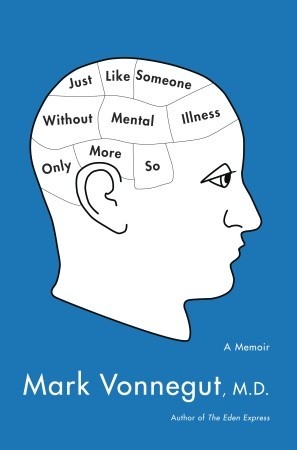
7816284Mark writes in an honest and matter of fact way about the trail madness has left through his family, tracing a legacy of depression, suicide and alcoholism going back generations. His mother heard voices and received message from license plates but once the episode passed she was able to rationalize it. When Mark’s aunt and uncle died within a month of one another leaving four troubled orphans, his parents took them in even though they had neither the money nor the capacity to manage. His oddly prescient mother had been stockpiling supplies for their arrival in advance, as her helpful voices had advised.

Mark was a loner spending a lot of time fishing and playing imaginary games in the woods around his home in Cape Cod. The oldest child of the family he grew up poor in the fallout of the the Depression. His father was a ineffectual used car salesman for many years. Mark was 21 before his father became a rich and famous author seemingly overnight.

Caught up in the hippie movement of the 60s, Mark followed many of his peers to Canada to join a commune in BC. He lived off the land, contemplated the meaning of life and experimented with drugs. And that is where he first encountered his own voices. In 1971, at the age of 23 he experienced three major psychotic breaks that landed him behind the locked doors and plexiglass windows of a Vancouver hospital.

“Among the things I grew up thinking about mental illness was that it was caused by other people or society treating you badly.I also knew that once people were broken they didn’t usually get better and the ones least likely to get better were paranoid schizophrenics, which is what I seemed to be.”

Retrieved by his father, Mark returned to the US where, with ongoing treatment, he continued to recover. The voices faded to the background. He published a book about his experiences and articles advocating for an understanding of mental illness as a biochemical condition, in strong opposition to the RD Laing inspired philosophy that was popular at the time (and has recently resurfaced). Somewhere along the way he decided that he wanted to go to medical school himself. Against all odds, and with pathetic math and science marks, he applied to one school after another. Incredibly Harvard gave him a chance.

Over the years that followed, Mark dedicated himself to his studies and his internship. By this point he had recognized that he was bipolar (not a schizophrenic who responds to lithium as he had been told), but even then, the schedule of an intern is grueling. During these years he also married, bought a house and started a family. The model of normal and healthy he figured his mental health issues were history.

Then 14 years after his third psychotic break, several years into a successful pediatric practice, the voices returned to taunt him. The trigger was his realization that he was fueling his high stress schedule with a two pack a day smoking habit along with 5 or 6 beers, half a bottle of wine, a few shots of bourbon and a sleeping medication to round off the day! Hardly a surprise then that his effort to quit cold turkey should trigger a psychotic break.

Although he sensed things were falling apart he resisted seeking help in a hospital. Driven by an absolutely irrational fear planted in his head by his voices he attempted to throw himself through a third story window. The window smashed but he fell back into the room. Unfortunately he ended up in a straightjacket on a gurney in the hallway of the very hospital where he had completed his internship and taught a course.

Although my own manic resurgence following an extensive period of wellness was somewhat less dramatic than Mark Vonnegut’s, it is only a matter of degree. Yet in time he was able to return to work and it has now been more than 25 years since his last manic break. His ability to rebuild his life and career even in the face of abject humiliation is an inspiration. And I am fortunate that I have neither smoking or alcoholism to contend with. But his story stands as stark reminder that with bipolar you must take the medication that keeps you stable and monitor your own level of energy. If we become complacent we risk an unwanted replay, no matter how long we have been well.

This book was published in 2010, so It was not available when I was first coming to terms with my diagnosis. Perhaps if I had read it when I first heard the interview I might have been able to head off my more recent experience. But then again, a manic person is a slow learner because that high just feel so good. Especially in contrast to the draining and  despondent opposite end of the cycle.

I would recommend this memoir to anyone interested in mental illness, especially those who understand what it is like to experience psychosis. Its casual, relaxed style makes for an easy read but, as a practicing physician, Vonnegut has some depressing observations about the decline of health care in his own country. Most importantly though, he leaves those of us who live with mental illness with a sense that we can get better, we can stay better and if we fall, we can get up and move forward.

That is exactly what I need to remember right now.

The unbearable invisibility of being mentally ill

For years I worked with brain injury. Depending upon the cause, damage to the brain can mark the survivor with more or less obvious physical impairments. But frequently the greatest impact leaves no obvious trace on the outside. The injury takes its most significant toll on memory, behaviour and fatigue.

Not unlike mental illness.

Copyright JM Schreiber 2014

For many who have never had direct experience of mental illness the tendency is to imagine the extreme – psychotic, eccentric, suicidal behaviour. But the reality is so much more complicated, so much more subtle and, on the outside it is often so apparently normal. Especially for those of us who live with anxiety and mood disorders.

We look like other people. We have lives, families, jobs when we are well enough. But sometimes those things are tenuous. And yet there is this inability to step away from the condition and observe it, no CAT scans or MRIs to chart the progress of the illness or mark remission.

Copyright JM Schreiber 2014

Recovery is a slippery concept. It depends so much on how we feel.

And the deeper we look the harder it is to know exactly how we feel.

Thoughts about redemption

Copyright JM Schreiber 2012

“Emancipate yourselves from mental slavery;
None but ourselves can free our minds.
Have no fear for atomic energy,
‘Cause none of them can stop the time.
How long shall they kill our prophets,
While we stand aside and look? Ooh!
Some say it’s just a part of it:
We’ve got to fulfill the book.

Won’t you help to sing
These songs of freedom? –
‘Cause all I ever have:
Redemption songs.”

This song by the late Bob Marley has echoed in my mind frequently over the past month or so. Written after the diagnosis of cancer that would ultimately claim his life, it is thought to speak to his personal reflections on mortality. My own longing for redemption relates directly back to my inability to resolve the circumstances which led up to the extraordinarily manic behaviour that marked my final days in the office. And my inability to let it go.

What is redemption?

Disregarding the financial and transaction contexts by which the term is used, redemption is typically understood as:
n.
1. an act of redeeming or the state of being redeemed.
2. deliverance; rescue.
3. deliverance from sin.
4. atonement for guilt.

Looking at the news over the past few weeks, there are some very public examples of behaviour that can not be easily excused. The videotape of NFL star Ray Rice punching and dragging his unconscious fiancee from an elevator, the resignation of a Vancouver CEO caught on video kicking and abusing a puppy, and most recently another NFL player accused of excessively brutal corporal punishment against his own children are just the latest in a litany of public figures behaving badly. Unfortunately, they might have been met  with relatively minor reprimands had there not been videotapes or pictures and an element of public shaming.

How many sports heroes, businessmen, politicians and celebrities have been brought down by grossly inappropriate, violent and even illegal actions only to eventually find redemption in the public eye? Many, have found such redemption more than once.

But what if your only “sin” is to have become ill due to a mental health disorder, where does redemption come from? I don’t even know what I want anymore. I have tried to apologize for my behaviour which I know was highly agitated and unpleasant, but there is no way to explain how trapped I was within that state,how miserable and unable to even know what was happening to me until a lot of interpersonal damage was done. Because no one from work will communicate with me I cannot have that conversation, no one can appreciate the degree to which I am still struggling and I can’t stop beating myself up inside for not recognizing the warning signs months before mania was in full swing.

If this was as straight forward as having lost a job, as much as there is grief and loss, I could at least busy myself with looking for a new job. But I am still technically connected to my employer and the question of return is unspoken but not denied. Meanwhile I am not able to function well enough to look for another option or contemplate a return. I am also increasingly aware that everything I loved about the job I had is exactly what, over time, made me ill.

The fact is, I am in limbo. I still have a lot of healing ahead. So why is the desire for redemption so important? Or is this really more the need to be heard and understood?

Isn’t that what we all seek in the end?

Lessons from Mother Nature are not always the ones you expect

Maybe it’s the unusually early snow. Tree branches still rich with green foliage weighted to the breaking point under heavy wet snow are decidedly out of place so early in September. If it warms up we may squeeze a little fall out of the year after all. If we get a killing frost the leaves will turn leathery and cling to the trees until spring.

Copyright JM Schreiber 2014  (yes these shots were taken today)
Copyright JM Schreiber 2014
(yes these shots were taken today)

An omen perhaps?

Is it late summer or early winter?

Like trying to define the weather, it can be difficult for me to clearly pin a label on my emotional state. A stable, well medicated state is actually one of relative distance from what I really feel. Blunted at either end of the normal ups and downs. I am not certain if that is a natural or artificial state. It is probably more realistic to call it functional.

Manic? Well, manic is really only recognizable as it recedes. Think of the way that you can become accustomed to a certain level of physical pain and not realize just how severe it is until the painkiller kicks in. But there is no instant relief for a significant manic episode. Manic gradually disappears in the rear view mirror as I creep along and then, just as the road ahead seems to become clear, I hit depression. Or this anxious emptiness that I feel lately.

Copyright JM Schreiber 2014

Like today.

The streets are littered with branches that could not handle the weight of the snow. The power has been off across the western side of the city for hours. As crews manage to restore power to one section, melting snow frees branches that bounce back and knock the wires out all over again. The silence and reduced light has left me alone with my thoughts for much of the day.

There is, however, an important lesson in unexpected situations like this. You have no choice but to ride it out, stay safe and wait until the storm has passed. Only then can you assess the damage, clean up and move forward. After all, we are supposed to be back up to summer temperatures by the weekend.

My own spirits might not lift quite so quickly, but I know from past experience that they will.

With time.

Buying time to recover

Every morning I wake up in the middle of a dream about work. The dreams are surreal and disturbing.

I was at the height of a full manic psychosis at the point of last contact about two months ago. That is not an impression one wants to leave. It has taken a long time to slow down enough to appreciate just how agitated I have been. One can no more pull oneself out of depression than one can throw the breaks on a train running at full manic speed. And my memories of those last few weeks are hazy at best.

Technically I still have the potential of returning to work. I was a senior manager and I worked at this small not for profit agency for nine years without incident until a series of circumstances contrived to create an increasingly dysfunctional, toxic environment. And, well, long story short, the pressures took a devastating toll on my mental health. After a decade and a half of relative stability, I became ill. And as a bipolar person with a strong swing to the manic, I left in a spectacular flourish. So I have no real idea what remains for me there.

In all fairness I was paid out generous sick time and vacation pay and I do have access to a short term disability benefit that should see me through the next few months. The approval process has proceeded with typical government efficiency. But today I finally received confirmation of my application and that is a tremendous relief.

Copyright JM Schreiber 2014

I just hope the dreams about work fade for while.

And I can spend some time reading and reflecting about where I go from here.

Making peace with our ghosts

There is a question tends to haunt those of us who live with mood disorders, especially in the early months of adjusting to a diagnosis or in the aftermath of breakdown:

Who Am I?

There is this persistent fear that, if the highs and lows of this “disorder” should ever hit equilibrium, what will be left?

And will that stable “me” be the real me or a medicated artifact?

Copyright JM Schreiber 2013

The theory is that mood disorders are typically associated with “normal” periods but as most of us know, mania and depression can simmer under the surface, felt rather than observed for a long time. When symptoms burst through resulting in “abnormal” thoughts, actions and behaviours, those around us rarely understand that these are beyond our control. And because insight is impaired, when we are at our most unstable we are often the last to know just how far off the rails we have run. All this is further complicated when a mood disorder exists in conjunction with addictions or trauma or other chronic conditions.

Having a mood disorder is like living with ghosts.

But we own those ghosts. They are us. Everyone has them.

Ours just like to try to steal the stage, set the agenda, write the script and direct the show.

Maybe that is why I am drawn to so much fantastic literature lately… allowing the ghosts of others to distract me from my own.