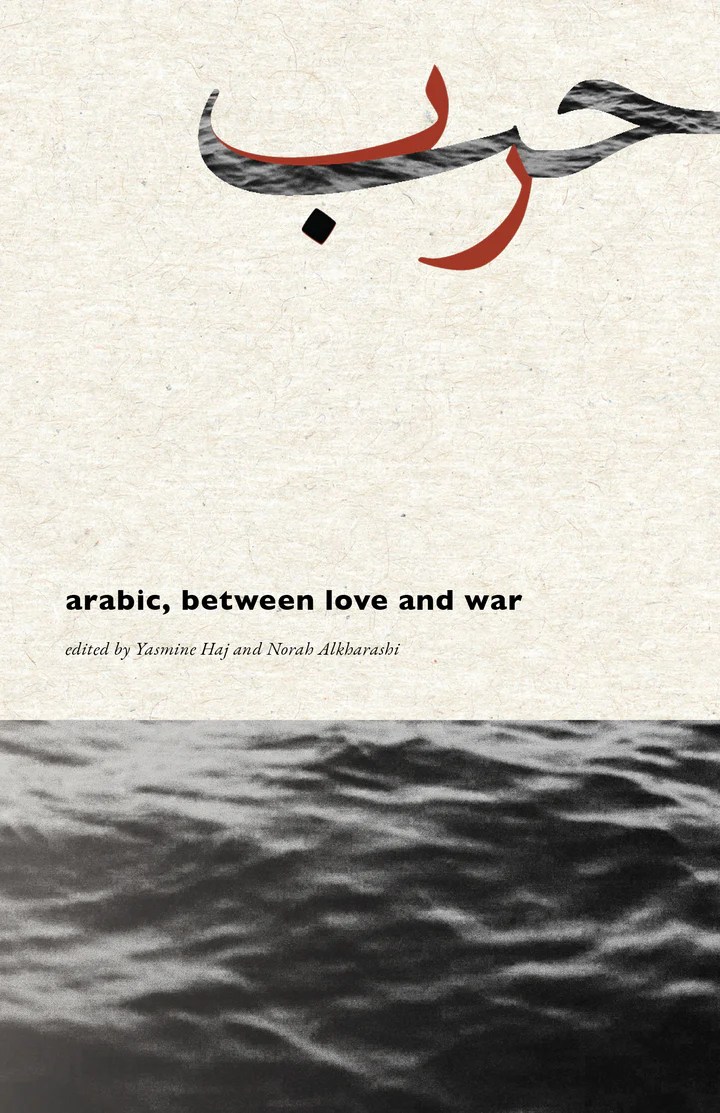
To translate the human experience: Arabic, between Love and War edited by Yasmine Haj and Norah Alkharashi

We live in a world that is always in flux. Conflict, natural disasters, and political destabilization are continually reshaping our world and threatening our future on an intimate, community and global scale. An element of the universality of the human condition unites us in our response to these factors while privilege, culture, and history set us apart. To begin to understand where others have come from, what they have been through, their trials and their dreams, we must be able to speak to one another, learn to listen, and read their words. This is why translation matters.

The art of literary translation is often said to be both impossible and necessary. Impossible because no linguistic code is commensurable with any other—particularly so in the case of poetic language which, being among the most refined and expressive of literary forms, is expected to have myriad and complex nuances. Yet translation remains necessary. Without it there would be no conversation across linguistic and cultural barriers, no prospect of the mutual understanding that remains a prerequisite for the peaceful, emancipated life towards which we are all striving.

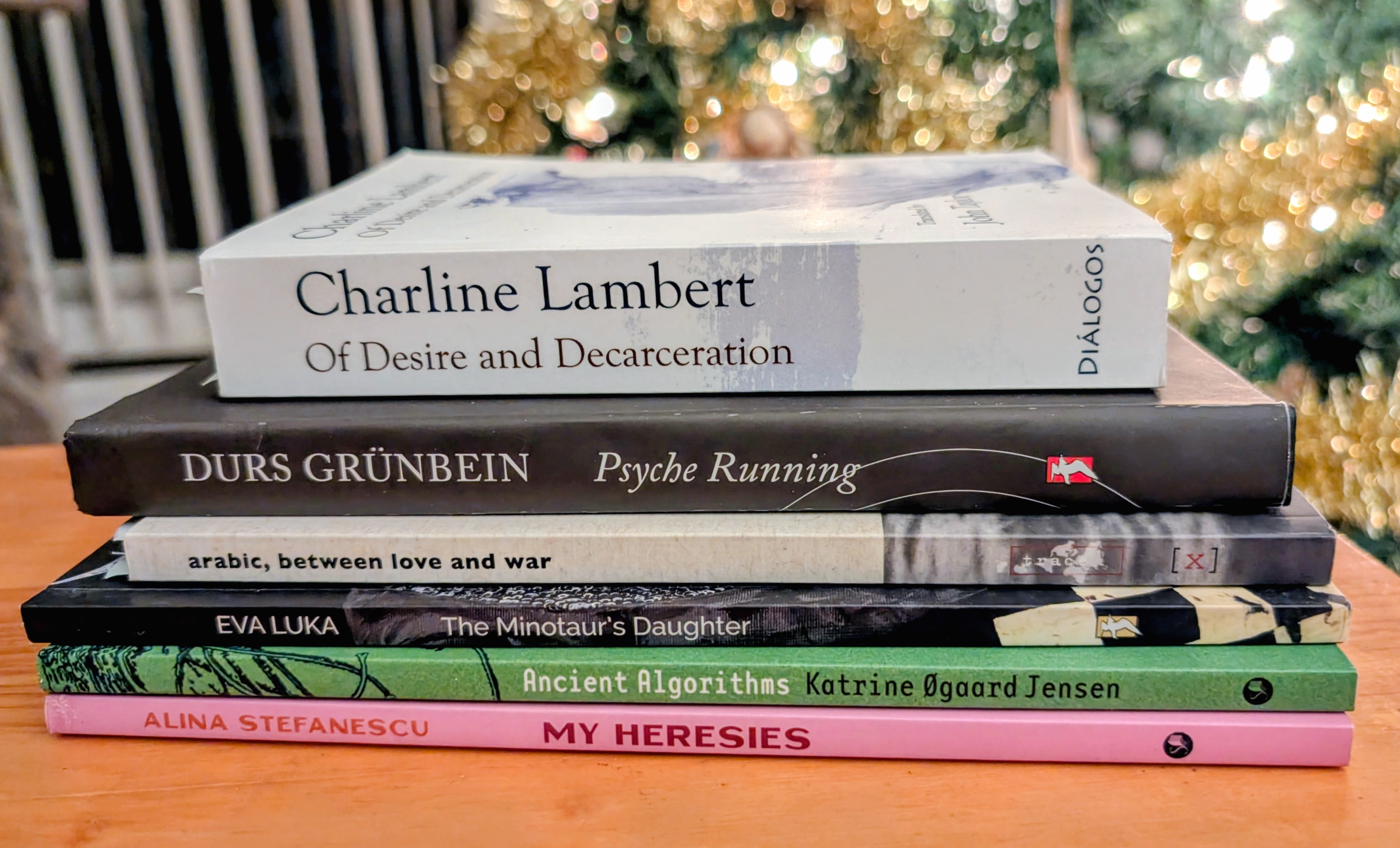
These are the words of translator and scholar Norah Alkharashi from her introduction to arabic, between love and war, a distinctive collection of poetry co-edited with Yasmine Haj and newly released by the independent Canadian publisher trace press. This anthology, which gathers the work of poets and translators from across the Arabic speaking world and its diaspora, arose from a series of creative translation workshops, facilitated by the editors, that allowed translators from varying backgrounds the time and space to explore the “processes of loss and unlearning encountered on their path to translation as critical creation.” This unique collaborative engagement ultimately led to the selection of thirty-seven thematically linked poems, presented alongside their translations—Arabic to English or English to Arabic—that comprise the first release in the trace: translating  [x] series.

The title and theme of this project illustrates one of the central challenges of the art of translation: how to reflect the nuances implicit in one language within the context of another. In Arabic, only one extra letter separates the word for “love” حب from the word for “war” حرب , a distinction that can have many implications in poetic discourse, especially when the two realities are often so deeply entwined in the lived experience of so many in the Arabic speaking world. Here the collected poems are divided into three sections: Love, Interval, and War, but the boundaries cannot be so clearly drawn. War frequently lingers in the background, even when a poet speaks of love; while love is a persistent life force even in the face of loss, loneliness, and displacement. And once again, the memory and fear of war haunts, even in the quiet in between conflicts—in the interval.

The poems of the first section, “Love,” tend to be tinged with sadness and longing, be it for for an imprisoned child or a lost lover:

I remembered you!
.              I remembered the silence growing slightly wet,
             and the trees that shaded us,
             and the fragrance drawing near.

             I didn’t know
that we were on the edge of everything
and that one word
alone was enough to wither a tree,
             that silence turns into shade,
             and the heart a safe haven for pain.

– from “One Word” by Ali Mahmoud Khudayyir
Translated from Arabic by Zeena Faulk

Meanwhile, the longest section, “Intervals,” casts the widest emotional net, speaking to the most fundamental elements of human experience—birth, death, hope, despair—in a world that can seem to turn without reason, or as the epigraph to this part says, those “liminal spaces where wars of flesh and love—ongoing, past, or yet to pass—have lingered. Holding hearts and words in limbo, with beats yet to be translated.” Lena Khalaf Tuffaha’s “Time Travel,” originally written in English, captures this unsettled sense succinctly:

. . . We travel because
motion is more comfort

than settling, calcifying.
We travel because it means

we haven’t gotten to where
we’re going yet, the story

is still being written and
our fractures aren’t done setting.

There is still a chance
we’ll turn out different

or better or—best of all—
like our parents without

knowing we’ve become
who they were. . .

Finally, it is sadly no surprise that the poems in the “War” section are the most direct and unequivocal. But they are not without a promise, however faint, and hope for a future free from the ravages of war:

I wish I could, I wish it were in my hands
to uproot injustice
and dry the rivers of blood
off this planet.
I wish I could, I wish it were in my hands,
to hold for this man, tired
in the path of confusion and sorrow,
a lamp of prosperity and serenity
and grant him a safe life.
I wish I could, I wish it were in my hands,
yet all I have at hand is a ‘but’.

– from “This Earthly Planet” by Fadwa Tuqan
Translated from Arabic by Eman Abukhadra

These are but three brief excerpts. The poems gathered here represent the work of fifteen poets chosen for translation by fourteen translators (some translate more than one poet or are also poets themselves), and together the contributors come from varied Palestinian, Iraqi, Jordanian, Saudi Arabian, Lebanese, Sudanese, Tunisian, Egyptian, Syrian, Canadian, American and British backgrounds. Some of the poets write in English (and are thus translated into Arabic), whereas some of the translators are scholars specializing in Arabic. This rich range of perspectives and differing Arabic literary traditions must have contributed to a vibrant workshop environment which is distilled in this elegant and vital anthology.

arabic, between love and war is edited by Yasmine Haj and Norah Alkharashi, and published by trace press.

Reimagining the question “Why translate?”— River in an Ocean: Essays on Translation, edited by Nuzhat Abbas

I started reading River in an Ocean: Essays on Translation, a generous and provocative collection of reflections on what it means to live, and work, between languages, places and social and cultural identities and realities, as I was preparing to visit India for the first time in four years. I finished it as violence escalated in the Middle East, with the latest and most violent episode of a conflict that has been part of my consciousness for all of the more than six decades I have been on this planet. It marks the evolution of a troubled history that has taken on added depth and meaning for me through the words of Palestinian poets and writers, that I have been able to access through the work of translators. As a result, my recent travel, not only the open conversations with friends about the schisms we are witnessing in our own nations and communities, but the experience of navigating a vast, multilingual country without the ability to easily communicate in so many everyday situations, combined with the explosive events that have absorbed so much of my emotional attention these past weeks, has enhanced my response to the essays contained in this anthology.

Nuzhat Abbas, founder and director of trace press, has described this project, the Canadian publisher’s first anthology, as one that arose out of a desire to “NOT center whiteness” and to examine translation outside the Western conventions that tend to influence what literature deserves to be translated, and by whom. It is a project of decolonial feminism, one that might not always be a typical context for a reader like myself who, like so many other readers, translators and publishers I know, is passionate about translated literature which, in the broader publishing world, is still undervalued and even suspect. Yet, to listen to the voices of translators from the Global South for whom translation is inextricable from essential questions of identity, history, land, dislocation, gender and sexuality offers an invaluable opportunity to expand one’s understanding of what translation can be. Here, crossing linguistic borders is not simply a possible professional endeavour, it is a way of being in the world, of understanding where one comes from and how one belongs.

In her Editor’s Translation to River in an Ocean, Abbas poses the following guiding questions:

What, and where, is the time and place of translation, and of literary translation, in particular? Of the translator as writer, as attentive listener, as co-creator, responsible to what [Gayatri Chakravorty] Spivak calls “the trace of the other within the self”? Or of the editor-publisher as convenor and gatherer in the project? This anthology emerges from such a questioning, and from curious and communal conversation, to offer a space for the soundings of different trajectories—connecting spaces, times, languages and bodies with origins in East Africa, the Middle East, South and Southeast Asia.

With each one of the essays that follow, these and other questions rise, open up, revolve and return, leading the writers toward a fuller sense of self. No two essays are alike, each is unique in form and expression, yet they all speak to a longing to find, not only Spivak’s “traces of the other within the self,” but reflections of the self within the words of the other.

The collection opens with Khairani Barokka’s buoyant and provocative dual language essay “Ava Kabar, Penerjemah?” Paragraphs in Indonesian are followed by the English translation, moving back and forth between tongues, as Barroka directly addresses her fellow translators, asking if they are alright. Her concern is with the emotional and physical well-being of the translator who is marginalized by race, country of origin, illness or disability. In the second essay, Palestinian-born translator Yasmine Haj begins with the notion that translation is an activity we all engage in from our earliest moments as we learn to communicate with those around us, those who can answer our basic needs. But she moves on to reflect on how her first language, Arabic, remains distinct from the other languages that she has come to know—Hebrew, French and especially English:

To survive, we must translate, almost everything into English—sometimes even the rhythm of our thoughts. And so, it becomes the way we think, the way we write, the way we talk to ourselves. The way we dream. And so, Arabic remains a dreamless jumble of love, melancholy, nostalgia, and an inability to properly express ourselves or anything for that matter—an obsession with accents, stumped travels and halted communal growth, mother tongues and beautiful people that we could never meet.

If, in some sense, Arabic is everything that is lost, translation is a way of remapping a history— personal, political, cultural—and of finding and feeling one’s way along a path filled with uncertain obstacles and unexpected discoveries.

The contributors to this anthology include both emerging and seasoned translators, and their approaches to the central theme—why translate?—include epistolatory essays, memoir and, at times, embedded photographs and documents. Their stories are deeply personal, poetic reflections. A passion and commitment to the power of language shines through, as do the many complex dynamics that arise when one’s identity and experience crosses the boundaries between the Global South and the West.

I can attest that there is not a single essay in River in an Ocean that does not turn in a fresh, fascinating and meaningful direction, but to attempt to summarize each offering in a few sentences would be counterproductive. Rather, I will highlight a few pieces that hint at their range, beginning with Suneela Mubayi’s evocatively titled “The Temple Whore of Language.” Born in New York to an American mother of Jewish origin and a Hindu-Kashmiri father, Mubayi was raised between the US and New Delhi by a host of relatives. She (the pronoun in her bio) claims: “I put the trans back into translation.” In addition to providing an excuse to avoid her own writing, she says that she “inhabits” translation because, as someone who is mixed race and nonbinary, her identity is unsettled:

I translate because I am not stably anchored—neither in my origins, nor in my cultural affiliations, sense of belonging, or in my gender. To translate, for me, is to experience being an outsider, a trespasser, a poser— and to be able to revel in that condition.

As a trans person myself, unsettled on somewhat different grounds, I understand this internal sense of balanced imbalance well. For Mubayi, this unsettledness, along with political factors—9/11, the Iraq war and the Palestinian condition—leads her to learn Arabic, a language to which she has no ethnic or geographic connection. As a translator, her linguistic engagement with the language is informed by her unique perspective as a person who exists on the margins of more than one axis of being, and, as such, leads to some very interesting observations.

By contrast, in her essay, “A Tally of Unfulfilled Longing: Translating Dalit Poetry,” Gopika Jadeja returns, as a translator, to her native language, Gujarati, but crosses another distinct boundary. Her own mother, denied an education, was determined that her daughter have an English education. It was not simply a concern for her future, but the more immediate need to have someone at hand to translate what she could not read. This planted the seeds of her daughter’s future occupation, however:

What I choose to translate is perhaps a world that is not hers, and yet hers. I choose to translate Dalit and Adivasi poetry from western India. As a Hindu upper caste woman in postcolonial India, choosing to translate Dalit and Adivasi poetry raises more questions than it answers—both from those whose works I translate and from myself?

What she realizes, once she begins to read and translate this literature, is the full existential impact of the accepted social hierarchy on those at the very lowest rung. This leads to many open ended questions about the relationship between translation and what can be considered decolonial—especially when translating literature from marginalized communities.

In varying ways, translation as a means to engage with one’s cultural and ethnic identity seems to underlie most of the responses to the why translate question, especially for those who were born in or have immigrated to the West. In “Elegiac Moods—Letters to Agha Shahid Ali,” Rahat Kurd, the Canadian-born daughter and granddaughter of Kashmiri women, engages in a moving correspondence with the late Kashmiri-American poet and translator. She opens her first letter:

Dear Shahid,

I’m bound to begin with translation. Whether I’m working within only one language or between two, if I want to convey an experience or an impression, to inscribe the meaning of a text or an event, I will always have to draw on abstractions, memories, dreams, and fears, and hope to make myself intelligible.

Calling on his poetry, especially those he wrote for his mother, she speaks of the enormity of the loss she senses in his words, the loss of a homeland that has, in more recent years, fallen further into a state of crisis. Although Agha Ali was writing in English, Kurd recognizes translation as a “strong, changeable current” running throughout his poetry, especially the sequence of poems that recount the journey to bring his mother’s body home to India, “From Amherst to Kashmir.” Her intuitive tracing of translation as a vital force in this work had me pulling my own collection from the shelf and returning to these poems anew. She goes on to share her own journey to understand how translating can be a means of responding to and resisting the loss that estrangement from one’s past can bring.

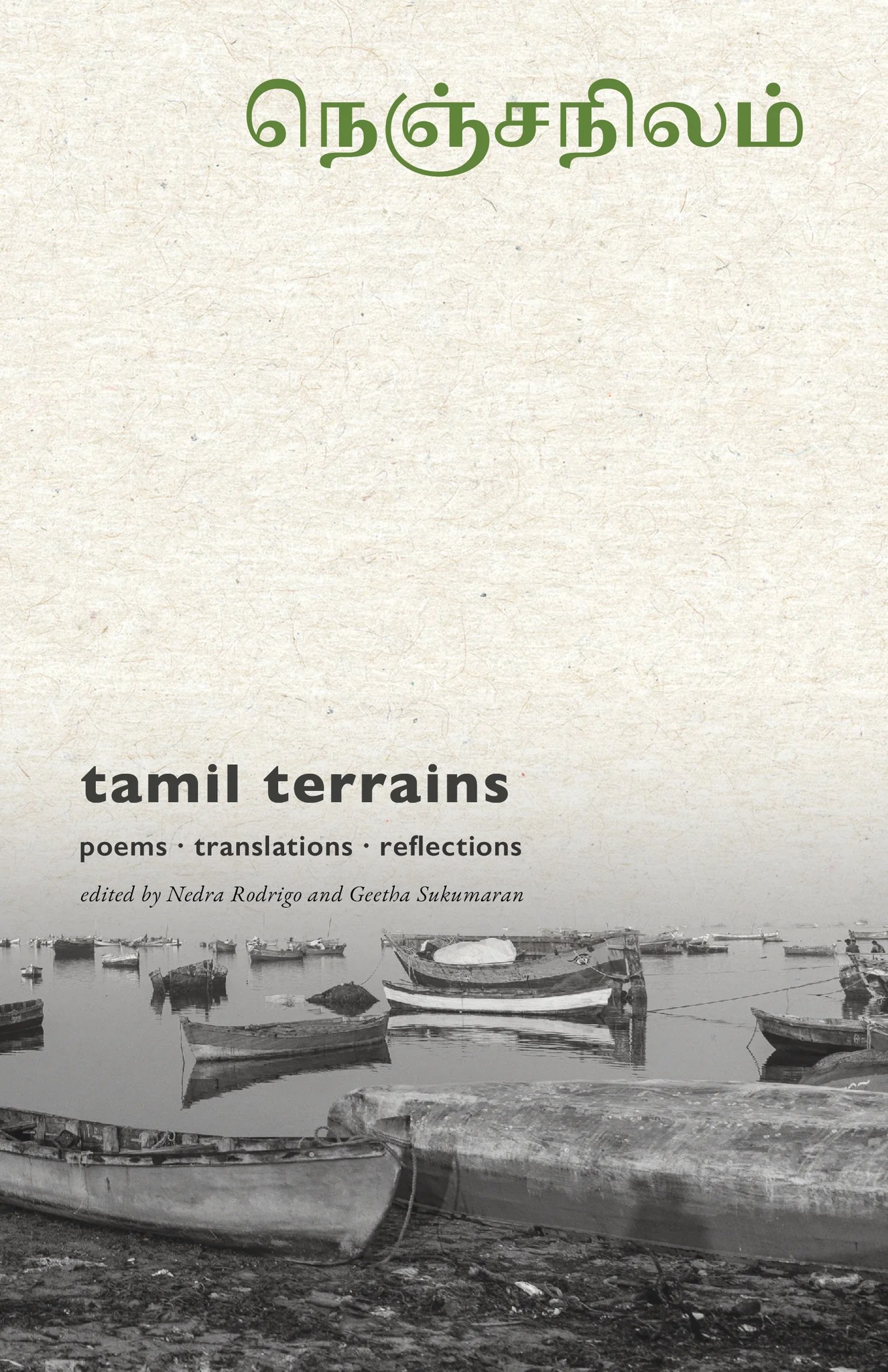
The other contributors to this anthology include Kenyan-born, Ugandan-raised poet and scholar Otoniya J. Okot Bitek, Nedra Rodrigo who was born in Sri Lanka, Ugandan Canadian writer Iryn Tushabe, Tamil poet and translator Geetha Sukumaran, Norah Alkharashi, originally from Jeddah, Saudi Arabia, and Lisa Ndejuru who was born in Rwanda, raised in Germany and came to Canada in her teens. The current of their translations flow between languages, with varying motivations and objectives. As well, the majority of the women involved in River in an Ocean currently live and work or study in Canada and recognize themselves as settlers on traditional Indigenous lands, a reality that adds an extra dimension to the decolonial vision at the heart of this vital project.

River in an Ocean: Essays on Translation is edited by Nuzhat Abbas and published by trace press.