The latest offering from isolarii, the unique publishing venture that produces small—think palm-sized—“island books” that feature the work of novelists, scientists, artists, theorists, and philosophers and others. But don’t let the small scale fool you, these micro-masterpieces can pack a punch. The latest, their sixteenth title, is Ah!merica by Beat poet Allen Ginsberg, a meditation on the visionary genius of William Blake, his influence on several contemporary American poets, and his enduring relevance for our times.
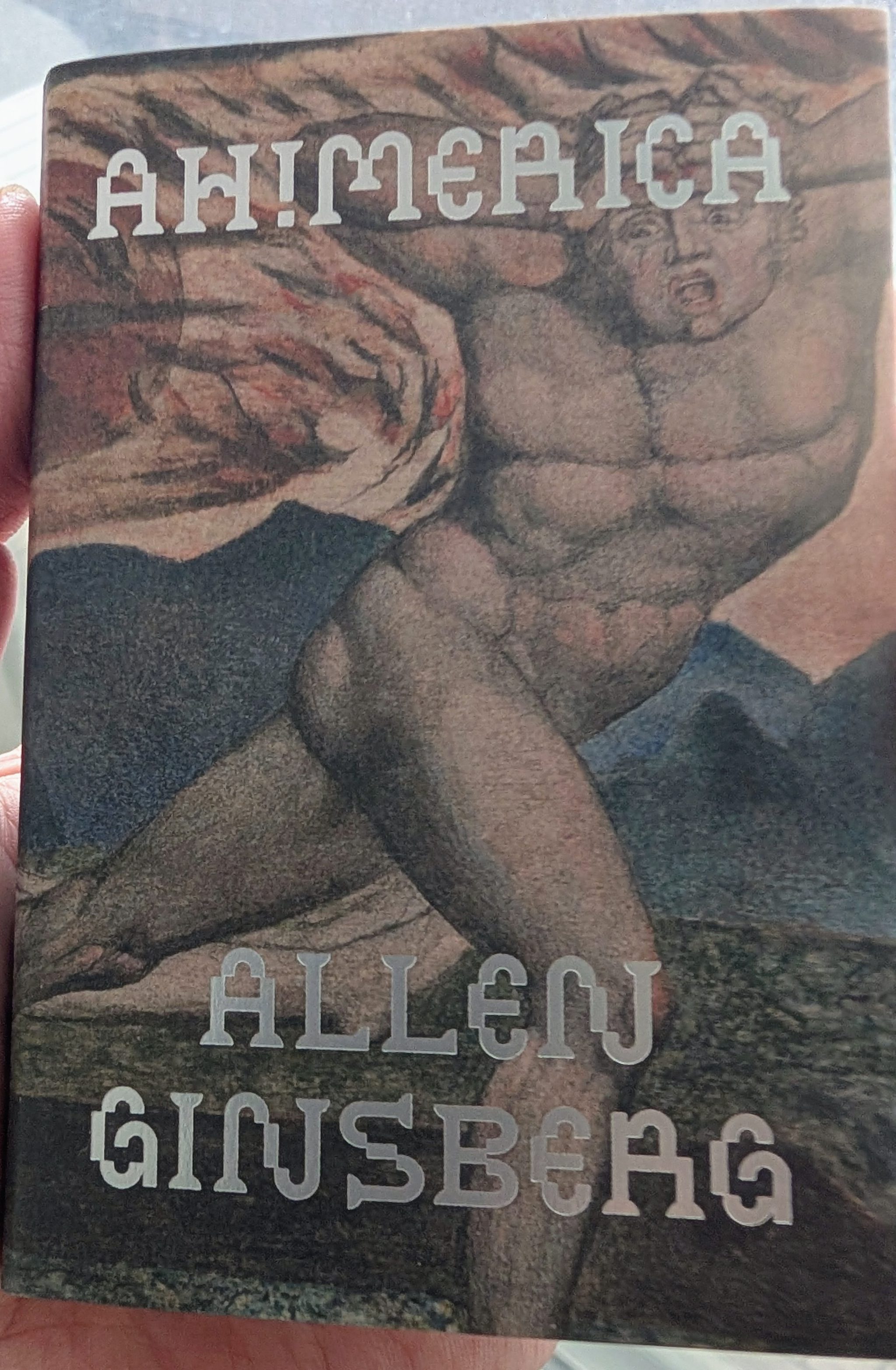 The text of Ah!merica is adapted from the legendary, discursive lectures Ginsberg delivered about or inspired by Blake’s life and work at the Jack Kerouac School of Disembodied Poetics at the Naropa Institute, between the time he co-founded it in 1974 until his death in 1997. On the Allen Ginsberg Project website, editor Sebastian Clark explained their approach to working with such an extensive collection of original material:
We began with a detailed line edit of the collected lectures to ensure coherence, focusing on making Ginsberg’s speech accessible without losing its distinction, spontaneity, or sincerity. Once the text was refined at the sentence level, we shifted to collating the lectures and arranging them thematically. The organizing principle became Ginsberg’s sustained engagement with Blake, particularly the concept of “double vision”- the ability to see, simultaneously, the material world and its deeper, spiritual, dimensions.
Organized into sections or chapters, each headed by a number in Ginsberg’s own handwriting, the resulting 170 page volume is illuminated with an ample selection of Blake’s prints and completed with one of four dust jackets. It’s a delightful work to hold and behold.
He begins by describing the youthful epiphany he experienced at the age of twenty while reading Blake one night (while masturbating of course). This visionary experience, embodied in the New York facades he could see outside his window, completely transformed his attitude towards poetry. In Blake’s prophetic books in particular, Ginsberg recognized a voice that still spoke to the challenges he was observing 150 years down the line: “He was struggling with the same emotions we all face but specifically about the destruction of idealism and radicalism of his time.”
For Ginsberg, Blake is a poet who was ever attentive to the ordinary surface reality of the world, to the details that many tend to overlook, while remaining aware of the profound spiritual currents coursing beneath it. He brings his more contemporary American poetic heroes—William Carlos Williams, Walt Whitman, and Charles Reznikoff—into his lectures to examine the way the ability to truly to see is reflected in their work. He also recognizes within Blake’s poetry, parallels to his own life-long exploration of Buddhist thought and tradition. Further, Ginsberg delights in the playfulness that can be seen in Blake’s singular style and his artwork:
We get a lot of intelligence and humor out of Blake’s illustrations of his ideas, just a much as we get from his prophetic books. We can decipher his mind, visually. How much delicacy he put into each illustration! Just as in the prosody, his punctuation, and eccentric capitalization, there’s tremendous wit in the paintings.
Because this text is adapted from lectures, there is a passion that comes through clearly in what is essentially an extended exploration of what we can learn from Blake about reading and writing poetry. From appreciating the inherent musicality of the form to the necessity to compose without fear. Ginsberg encourages young poets to be willing to break with or ignore the “rules” of composition and be open to the messiness within. “The problem is staying with what you were really thinking, rather than what you believe you’re supposed to be thinking”—that is, resist the temptation to ignore the very unappetizing images that arise in the writing process, for that is where the most interesting and authentic aspects of yourself tend to lie. This leads, ultimately, to a final discussion of the difference between “good” and “great” poetry. It’s no secret what Blake has left us.
Ah!merica by Allen Ginsberg is published by isolarii, a series by Common Era Inc.