Want to write? Start with reading.

It has taken me over a week to come down after volunteering with and attending events at our recent word festival. I entered into the week slightly down and was spiraling up within a few days. If it was a test of my ability to return to regular work, this is clear evidence that my mixed state is still far from stable. But I would not have missed it for the world.

It was an absolute thrill to mingle with people who are passionate about books and listen to Canadian and international authors talk about their craft. Whenever an author was asked about his or her influences, a love of the magic of books and literature shone through in their responses. If asked about advice for want-to-be writers, the common answer was read, read, read… read widely and drink deep from the wealth that books have to offer.

The stash of books I bought at the event, not including the titles I purchased or read in advance. Volunteering in the bookstore can be expensive!

And so there was this man I crossed paths with at various venues throughout the festival. He told me he was a writer. Patting the breast pocket of his jacket he indicated that he felt he was getting ready to pull together his work. He had a gold pass so I saw him a number of times but always alone, ordering a coffee or buying a glass of wine at the bar. He would acknowledge me and we would exchange a few words on whatever interview or panel we was waiting for. But I never witnessed him engaged in animated discussion with fellow attendees.

The solitary man at a venue where excited discussions about books were regularly erupting between strangers is an anomaly.

On Saturday afternoon I encountered him in the lobby. He was carrying a copy of Sweetland by Michael Crummey. I got the impression he was done with the festival regardless of the major authors still to come. He said, “I have decided, this is the one that impresses me. Let’s see if he writes as well as he talks.” I responded that I had recently obtained a copy of his previous work Galore, the novel Crummey described as the one he feels he was born to write and that I wanted to read that first. He looked at me with surprise and said, “You mean you have heard of him?”

Suddenly it dawned on me that this man, the self-described writer, does not read at all. I suppose he thought he he would be able to absorb all the final inspiration and direction from this one book. If he did not know one of the best known Canadian contemporary authors and poets, even if he had never actually read one of his books, I could not help but wonder how he imagined himself ready to pull his accumulated scratchings into a final product.

With a full evening and day still ahead, he had selected his role model. I never saw him at the theatre again.

Even if it left me swinging up on my attempt to stablize this recovery from my recent manic episode, I was deeply inspired by the talks I attended, delighted by the company of fellow book lovers and especially grateful to a few authors who took a little extra time to encourage me as writer. I was regularly reminded that it is never too late to start.

And I am never lacking for books. In fact they seem to multiply in my life on their own as any truly avid reader knows.

Good words and a smile (oh and a good book too)

Wordfest, our annual literary festival is underway. After several months struggling with the fall out from a serious mental health episode this week is my first serious self test, my chance to explore my level of stamina and commitment. It is also an opportunity to spend time with people who love books and listen to great writers talk about their work.

I started with two volunteer shifts and some selected presentations I wanted to see and, as you might suspect, the volunteer commitment portion quickly expanded.

Am I exhausted yet? A little. I will likely sleep for a day when it’s all over but I have so desperately needed to get out in the world. Admittedly I am buffered with medication but the creeping anxiety stays in the car when I get into the venues.

Now if I can find a way for the medical system to prescribe a literary solution I might just be able to live with this bipolar beast. I just have to be able to afford to eat too!

Today has lifted my spirits more than I can remember in months. I had one single volunteer shift as a bookseller at one of the smaller venues, but I was nervous simply because I was expecting a panel discussion featuring one of my favourite authors. When I arrived to discover that the other writer had been forced to cancel at the last minute, the presentation had been redesigned as an hour long one-to-one interview with South African novelist Damon Galgut.

The host was scrambling but I could not have been happier.

American edition of Arctic Summer in case anyone is wondering -a nicer cover than the Canadian/UK I think.

I have always been apprehensive about meeting my heroes, for fear of disillusion. Nonetheless I had come prepared to have my books signed and hopeful for even a few words with a writer whose works I admire so much. Although we did have books to sell I noticed that I was not the only person who had arrived with their own copies of his latest work, Arctic Summer, already in tow. This novel is an imagined biographical account of the complex personal and emotional factors that led E M Forester through the extended  writer’s block that ultimately produced his greatest work, A Passage to India. As an historical novel it is a departure for Galgut (and one he admitted he would be in no rush to repeat) but rich with a deep affection for India and the driving forces of unrequited desire.

I confess I abandoned my post presentation bookselling duties early to make sure I didn’t miss out on the opportunity to have my copies of In a Strange Room and Arctic Summer signed. To be honest I have yet to see an unpleasant author at any of the events I’ve helped with, but it meant more than I can measure for Damon to take the time to, ask me about myself and encourage me that it is never too late to start writing. I am grateful for his kind words.

This experience, simple and important for me, has lifted my spirits in a way that feels healthier than the meds alone. It feels good to be human again. I have commitments with Wordfest right through until Sunday evening, but for now I am enjoying this warm feeling.

Capturing madness on the page

I started this blog in a fit of manic energy not realizing how very close I was to running over the edge into full blown madness. And now I find myself writing in and around the experience as best I can, unpacking and worrying myself into the future with a level of anxiety that seems to greet me refreshed every morning before I even crawl out of bed.

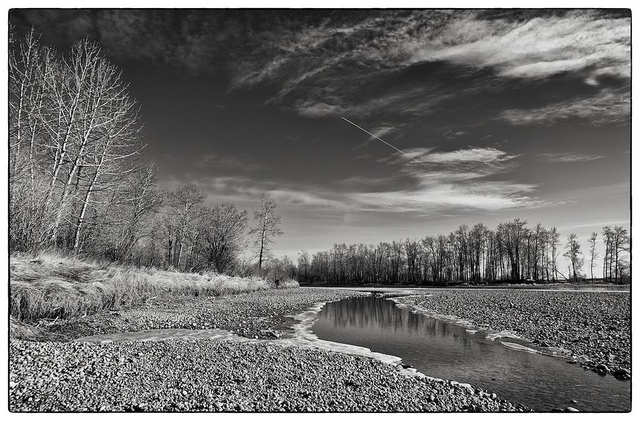
Taken in the aftermath of major flooding last year this looks like how I feel sometimes... Copyright JM Schreiber 2013
Taken in the aftermath of major flooding last year this looks like how I feel sometimes…
Copyright JM Schreiber 2013

With my original diagnosis I read all the available materials and although it was pre-internet (imagine!) I spent a lot of time at the library. This time around I find myself in world where so many fellow travelers on the road in and out of sanity are busy scribbling their way along. I have been and will always be selective in what I chose to share about myself with others. Great for maintaining privacy, not so great for making new friends. So I struggle every day with how or what to add to the dialogue.

I think I am personally drawn to creative expressions… photography, poetry and writing but am not sure where to start. I suspect madness, sanity and that huge area in between is best met sideways. So no memoirs for me. Photography is good outlet but I lack the discipline to take it to the next level. I would like to capture that moment when reality and one’s experience of reality begin to part ways. It is such a subtle process with manic depression the way I experience it and I imagine I am not alone in this regard. To those outside, unless they are highly attuned to changes in your patterns of behaviour, the transition can be unnoticed for a time.

And then before you know it you are picking up the pieces or retreating from the world or both.

To date, the finest literary account of slowly growing madness, that I have read, is William Golding’s The Spire. This novel imagines the construction of a 404 foot spire atop a medieval cathedral (inspired by Salisbury Cathedral in England) and is narrated from within the mind of Dean Jocelin. The dean is a man who has attained his position by curious family connection rather than earning it on a solid foundation of faith. As he envisions and directs the construction of the spire, tuberculosis in his spine advances to the point of driving him into a psychotic state. At first he interprets the sensation caused by his infection as angels at his back, sure evidence of God’s blessings. However as his pain and madness grows he becomes increasingly erratic, unstable and irrational. It drives him to conflicts with the master builder, sexual obsessions with a woman, paranoia, jealousy and possibly murder.

William Golding - The SpireReading with an online reading group added to the richness of the experience of this novel, but for me personally it captured so vividly the sensation of gradually and fully losing grip on reality that I had during my first severe manic episode. By the final moments before the ambulance arrived to whisk me away I was no longer able to distinguish between what I had interpreted as a mental breakdown that I could handle and the creeping fear that the Devil was tormenting me. It was a horrifying moment.

For poor Dean Jocelin because he is not only mad but dying of tuberculosis, his last days and hours are vivid mental and physical torment. It is up to the reader to decide if his soul finds any peace at the end.

Luckily my more recent manic episode did not end with as much drama as the first because someone finally commented on how fast I was talking and I had the shocking realization that I was sick. But the damage was already done all the same. I just wish I could help those who experienced my behaviour understand but I am not certain they wish to listen. And honestly, can I be a more reliable narrator of my own manic experiences than The Spire‘s mad dean?

The courage to write

For some 30 years I have packed and unpacked, shelved and reshelved a library full of books that I have not yet read but would not dream of carting off to a charity sale. Naturally I assume that the day will come when that book will come to my attention and, conveniently I will have it at hand. Of course, in the meantime a wealth of new books have joined my libraries, actual and electronic, so that all those long held treasures run the risk of absolute obscurity. I suspect more than a few book addicts can relate.

And sometimes the tendency to hoard a book pays off, though sadly that time is too often heralded by the death of the author.

20140809_222130I must have purchased Nadine Gordimer’s Burger’s Daughter, in the very early 1980s. I was studying anthropology and working part-time in a bookstore. South Africa and the struggles against Apartheid would have held a particular resonance for me through the presence of a number white South African ex-patriots who had found their way to the Anthropology department of a Canadian university for their own safety. However, had I read this novel when I first bought it, I am not sure if I would have been able to fully appreciate this powerful testament to those men and women, white and black, who risked their freedom and too often their lives to fight for justice. But with 30 year’s perspective, the hard won experience of middle age and the political changes that have marked South Africa in deeply complicated ways both positive and negative – as history tends to unfold in real life – this is one of the most rewarding reads of the year for me to date.

Ms Gordimer’s writing is rich, complex and worthy of a careful read. The shifting perspectives take the reader in and out of internal monologues that Rosa Burger, the daughter of a doctor and Communist activist who has died in prison, holds with the many individuals she encounters or remembers as she struggles to find an identity for herself in the huge shadow cast by her famous father (a fictionalized tribute to the lawyer who defended Nelson Mandela). In the infinite wisdom of Wikipedia, Burger’s Daughter is described as historical fiction. Of course, it is no such thing. Rather it is a time capsule, a deliberately political novel, but written without the advantage of knowing that Mandela would walk to freedom, become President, and pass away leaving a society where so many still live on a razor’s edge even if the tapestry has changed.

The final pages of Burger’s Daughter paints an uncertain future. Yet like life itself, the novel is brimming with vibrant, colourful characters brought to life with keen and loving detail.  The complexity of the politics presented at the time of writing combined with the critical distance of three decades impressed me deeply. It takes courage to speak to injustice. Nadine Gordimer herself knew that her work not only took risks but would also be forever defined by her colour. Moving beyond colour, religion, ethnicity, culture, gender, ability, orientation or the myriad of other divisions we seem to be able to construct as to divide us as humans is a seemingly impossible task. But by taking that one piece to which a writer, by virtue of fate or circumstance, is able to address and telling the stories that matter, small changes may be possible.

“Writing is making sense of life. You work your whole life and perhaps you’ve made sense of one small area.” (Nadine Gordimer)

Nadine Gordimer was a writer of courage and I am ashamed that it took her death to bring her into my focus.

Note to Self

Many years ago I promised myself that someday – someday – I would write. But first I would need to live more, explore more, expand my world so that I would have experiences to draw from. And I would have to read, widely, to learn from the masters.

So I set out to live and I continued to read. The life I have been living has not been the one I imagined. It has been at once more ordinary and more weird that I have ever could have expected. Yet when I think about writing about my own experiences, I am no longer certain just how much I am comfortable sharing. And the more I read, the less confident I am about my own capacity to commit words to page.

Has reading humbled those ambitions of my much younger self?