Words, the most vital gift: Translator’s Blues by Franco Nasi (The Cahier Series, #26)

Charged with the task of bringing a piece of text to life in another language, for another culture, and possibly also for another moment in time perhaps centuries after it was originally conceived and recorded, the translator stands armed with words alone: “imperfect, approximate, or a tad reductive”. But, employed with skill, sensitivity and creativity; words can facilitate a little literary magic.
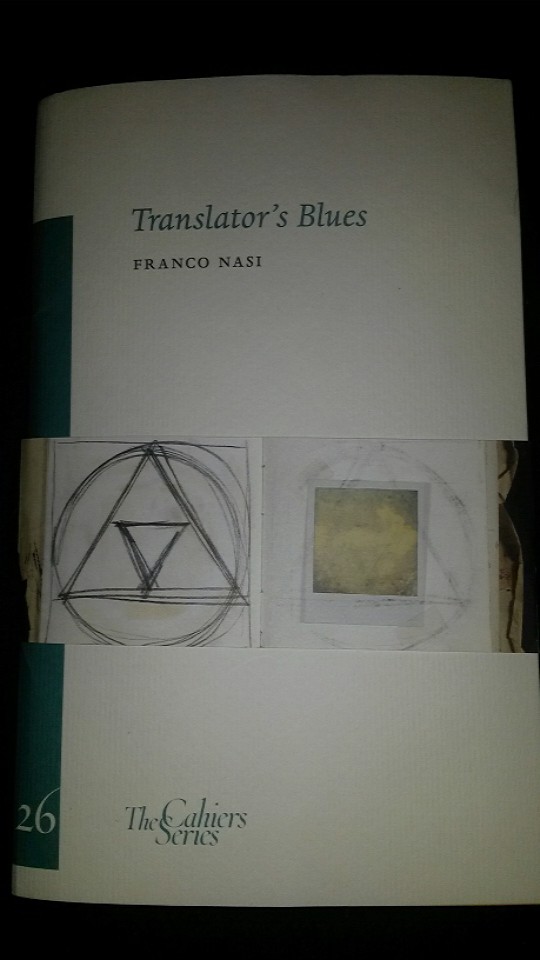
2016-01-18 01.59.14Translator’s Blues, the latest addition to the Cahier Series of the American University of Paris (#26) is an imaginative discourse on the dilemma of translation – a meditation on the interplay between language and culture, facilitated through words; an elegy for what is gained and what is lost in the process. Italian translator Franco Nasi adopts the voice of a naive alter-ego who is, like his creator, a translator who hails from the province of Regio-Emilia where he was born and expects he will die. His home – with its mountains, Parmesan cheese factories, and cemeteries laid out like miniature cities behind high walls – is a place which makes sense to him, a world that is idiosyncratic but familiar. He is grounded there.

When he chances to befriend an American architect who is visiting his fabled region of Italy, he is offered an invitation to travel to the States in return. After a brief visit to Vermont, our translator finds himself in Chicago where his host is presently employed. As our erstwhile hero makes his way through the linguistic landscape of America he finds himself exploring of the boundaries of language that are blurred when one endeavors to navigate the tricky waters that lie between one culture and another. Through an account of his adventures and encounters he orchestrates, with insight and and a measure of impish delight, an argument that translation is, at its best, an inexact art form. However, rather than seeing that as a limitation, he celebrates the challenges, possibilities and rewards of bringing a piece of literature to new audiences that would otherwise be denied access by the borders of both language and culture.

Our narrator’s journey of discovery starts inauspiciously on a snowy Sunday morning in Chicago when he sets out to purchase non-alcoholic beer from a nearby shop. Bemused by his inability to procure alcohol of any description before 11:00 AM, he inquires of his host as to whether this is a daily reality or one confined only to the one day. He learns that it is, in fact, a law applying only to Sundays, to what are known as the “blue hours”. Blue. This is a word that has a special impact for our translator. He had just finished reading William H. Gass’ On Being Blue: A Philosophical Inquiry. He was given the book so that he could assess its suitability for translation. Thus it was with a translator’s eye that he read it, and he found himself rather out of his range. He was inclined to wonder if attempting to translate a book like this, with its multi-layered references to the significance of the colour blue, would be at all possible. References in some instances, such as those with sexual or potentially pornographic overtones, would likely be rendered nonsensical to a culture that tended to associate the same arena with the colour red. It would, he feared, surely induce in him a state of melancholy:

“… a malady that takes hold of you whenever, after a thousand false starts, you find yourself being invested by an overwhelming sense of inadequacy and impotence. This blue-tinged malady makes the translator wish that Babel and the multiplication of languages were only a legend, and that all the various languages in the world did not exist and had never existed. With melancholy comes nostalgia for an ur-language, in which all colours and all their meanings were the same for everyone, in which plants were identical for all and sundry; in which flowers, and sounds, and ceremonies, every object and sensation, and belief was expressed in a single, universal, manner, in which a rose was a rose was a rose.”

All the culturally and linguistically entrenched peculiarities of blue aside, Nasi allows the shade to colour, if you will, much of the exploration of the art of translation that follows. His translator is led, most immediately to a famous Chicago blues bar. As he soaks up the atmosphere and the music, he reflects on the translation of African traditional music to America, facilitated through the songs that black slaves brought with them. Typically based on a pentatonic scale, these songs are echoed in the adaptation of one musical “language” to instruments designed to the specifications and precision of the chromatic scale. As a consequence, notes tend to slip a little out of tune, to bend, and acquire the nostalgic, mournful tone, the blueness, that we associate with the blues. On his way home he contemplates the resonance between the music he has been enjoying and his craft:

“Could it be that any translation, if it seeks to be more than a cold and sterile transposition, must contain blue notes? A translation needs blue notes to hint at an elsewhere, at nostalgia, and with nostalgia the tension provoked by unappeased desire for whatever is distant and unreachable. As William Gass puts it, ‘So it’s true: Being without being is blue.’”

From this point on our hero chances to meet a well-known American poet who, it turns out, is seeking a tutor to help him improve his Italian. So the two begin to meet regularly. Over the course of their acquaintance the poet gives his new friend a volume of his poems. Seeing this as an opportunity to exercise his own English skills, with the added advantage of being able to check his success against the original author’s perceptions, the protagonist asks if he might translate some of the poems. The poet seems pleased with the resulting translations, even if they might at times be less than exacting. So talk of publishing the Italian versions arises and a publisher is sought. Suddenly the poet’s self-appointed “official” translator emerges and demands that a halt be put to the fledgling enterprise – after all, audiences are accustomed to one voice, to offer an alternative would certainly be disorienting.

Nasi’s translator backs down. But at the same time he wonders about the “versions” of writers such as Homer, Sappho or Aristophanes that already exist. He envisions the silence of the library where the respective translations must sit shoulder to shoulder on the shelves, to be broken once the lights are turned off and the key turned in the lock:

“Of a night, there must be some turbulence in the library stacks, what with all those competing voices. And it’s clear that the music does indeed change according to who is playing – and just as well too: what a bore it would be to hear over and over Beethoven’s ‘Eroica’ Symphony in the way it was played in public the first time, on 7 April 1805 in the Theater an der Wien. To translate is to betray – tradurre è tradire – and only through betrayal is a writer’s voice kept alive. To the liveliness of this voice in time will correspond the number of voices multiplying it, so permitting it to dialogue across the ages.”

Nasi goes on to expand on this fundamental idea. Looking at translation close to the source – that is, within the author’s lifetime – has a particular value, especially when the author is engaged in the translation process. However some authors, and Nasi points to a few of his fellow countrymen here, may run the risk of insisting on a degree of literal accuracy, as they perceive it, that could hinder an emotionally and culturally authentic transition to a foreign language. And to round out his argument he allows his alter-ego to experience the shock of receiving a copy of his own translated book, which is, in reality, the very book the reader happens to be reading. He fails to recognize it at first, his child released into the world now returning and standing at the doorstep – changed but somehow the same and possibly richer for the experience of immersion in another language and culture. Just as our Italian narrator returned from his own trip beyond the borders of Regio-Emilia informed and enlightened.

2016-01-18 01.57.27An essay within a most charming story, Translator’s Blues offers an entertaining, thoughtful reflection on the relationship between translators and the works they attempt to realize in another language and culture. With humour and a gentle wisdom, Nasi explores what can be preserved, what is lost, and the responsibilities that, he would argue, have to be surrendered in the process of translation.

Franco Nasi is a writer and translator who has taught Italian language and literature in the United States, and has translated into Italian a number of writers and poets including S.T. Coleridge, William Wordsworth, J.S. Mill, Billy Collins and Roger McGough. Translated by Dan Gunn and paired with illustrations taken from a notebook kept by Italian artist Massimo Antonaci, Translator’s Blues will be released in February, 2016.
Writing to make sense of loss: Stammered Songbook by Erwin Mortier & further thoughts

As a man watches his mother, once so vital and full of life and charm, steadily losing her grasp on the spoken word – fumbling, scratching at the air for the names of people, places, and things – what can he do maintain the fragile flow of words? As uncertain laughter and tears of frustration become the increasingly fragile threads holding a woman, just 65 years-old, to the web of anxious family members spreading out around her – her husband, daughters, sons and grandchildren – is there any way to make sense of the inexorable dissolution of this person who is disappearing, fading, before their eyes? If the man in question is Flemish author Erwin Mortier, the only way to find comfort is to write:

“I realize that I only write to hear sentences dancing without interruption through my head. To make rhythm, acceleration, rallentando, to make pauses sing. Just to be able to hang from the dashes – the trapezes of syntax – weightlessly for a moment from the roof beam of a sentence, I let the words loose.”

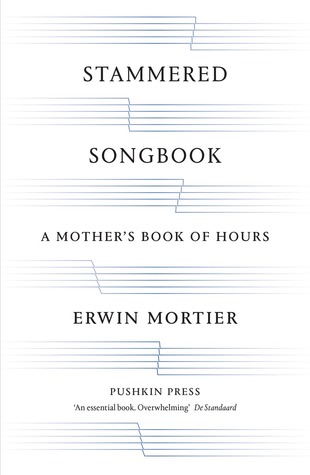
songbookMortier’s passionate, insightful record of his mother’s decent into the unforgiving spiral of fragmentation and decline that marks early onset dementia, is at once a loving memoir and a writer’s thoughtful reflection on the vital role that words play in his own ability to make sense of and cope with the most painful and difficult process of letting go or, as he puts it: “constantly saying goodbye to someone who is still there, yet not.” But the pages of Stammered Songbook: A Mother’s Book of Hours contain much more than a portrait of one woman’s steady regression from independent and vivacious to prematurely helpless, frightened, and lost; it offers an honest, sometimes brutal, account of the challenges of negotiating the surge of conflicting emotions that batter and buffer the individual and the family in mourning. He tracks her illness, from the earliest missteps through to the recognition, so painful for his father, that her needs can no longer be met by her loving husband, or by juggling responsibilities between her five children and their spouses. Even a large, closely knit family cannot provide the support and care she requires in the end – it is too difficult, too draining, and far too painful – especially when the person who once inhabited the emaciated frame of the body that remains has been slowly fretted away into the space of memories and dreams.

Mortier’s writing has frequently drawn comparisons to Proust; powerfully, and I would argue rightly, reinforced by his elegant, sprawling epic set in Flanders during the First World War, While the Gods Were Sleeping. Smaller, more immediate, and intensely personal, Stammered Songbook turns – as his mother in the present recedes into the distance – into a lyrical, poetic sketch of the woman as he remembers her, and a moving reflection on the complexity of our relationships with those we love. Yet as he captures his experiences and emotions, he is aware that, as a writer, it is essential that he is able to fine tune the words he employs so that he may strike the exact note. That is, he is not only writing about his mother, he is writing about the process of writing about his mother.

“Time does not unite us in oblivion but unravels us into memories. I only started writing properly, I suspect, when I began to realize that words are at their best when I can make them vibrate like minute compass needles in response to those elusive magnetic fields that constitute someone’s whole “being” – rather like iron filings form patterns on a sheet of paper under which a magnet is held. From the cloud that my mother is becoming and that in fact she already is, slivers of images will shoot out unexpectedly, strangely sharp – the way she laughed, the gesture with which she arranged a lock of hair behind her ear… And then we will say: yes, that’s how she was.”

Stammered Songbook is a lyrical farewell to a woman lost too young to a cruel relentless thief; but even more powerfully it is a personal meditation on death, mourning, memory, and the myriad emotions – sadness, confusion, anger – that confront those left behind. Yet in reading it I could not help but think about two other books that traverse similar grounds and have informed some of my own thoughts about the project that I am attempting to write into being, so to speak. Both are powerful works that approach difficult emotional experiences arising from the authors’ own lives, each from a different angle.

The first is a novel, This Is Paradise, by UK writer Will Eaves. Here the narrator begins back at a time before his own birth and moves through a childhood account of the unique dynamics that shape and define his family. Then, in the second part of the book, our protagonist is grown and his mother, now increasingly incapacitated by dementia, must be moved into a care facility. The account of the complicated emotions and tensions that pull at the family throughout the painful process of watching their loved one die – especially in the grips of such an unforgiving, emotionally paralyzing disease – was so striking that I kept thinking: There is an authenticity beyond careful research here. And, sure enough, after finishing the book I found an personal essay Eaves wrote for The Guardian chronicling his mother’s battle with Alzheimer’s. Clearly, much of his own experiences were embedded in the novel, but he chose to approach the subject mediated through the curtain of fiction – whether for distance, freedom or stylistic comfort, it doesn’t matter – it works beautifully.

The other book is a memoir, this time a son’s effort to honour his mother in the light of her suicide at the age of 51: Peter Handke’s A Sorrow Beyond Dreams. On the surface it might appear that suicide is the polar opposite of dementia in that it is sudden, but the impact is no less devastating because it raises questions, so often unanswerable, that linger long after death and complicate the mourning process. Like Mortier, Handke is deeply conscious of the importance of writing and the efficacy of adequately capturing a life by spilling words onto a page. However, rather than placing himself at the heart of the memories he is trying to capture, he attempts to step back and maintain an intentional emotional distance. He wants to see his mother, in part, as an exemplar of the rural Austrian women of her generation; to place her life in a broader context to make sense of the very intimate act of her decision to take her own life. And the result is a spare, elegant meditation; but in the end, he cannot help but break the wall between his accounting – which was written within two months of her death – and his own emotions which are still very raw.

These three books do seem to me to fit together, to form a triangle at the centre of which is the attempt, by a writer, to capture the essence of his relationship with his mother, in life and in death. What is of specific interest to me is not the exact nature of the subject at the centre, rather it is the question of the best way to approach writing about a deeply personal experience drawn from one’s own life – memoir from within, memoir with a degree of distance, or memoir turned into fiction. It seems to me that each can be powerful and effective, the challenge, I suppose, is to find out what works best for the writer and his or her circumstances, that is, to find the intersection where the story comes alive.

Stammered Songbook by Erwin Mortier is translated from the Dutch by Paul Vincent and published by Pushkin Press.

In the dark days of winter, searching for words

Normally January and February are my favourite months. The days are growing longer, minute by minute; the days cold and crisp, the ground a snow-covered white, the sky a bright clear blue. A perfect time for reading.

13204111743_c2952b7f51_b
Copyright JM Schreiber, 2014

More than one week into the new year, I have a strange sensation akin to trying to make my way on one of those moving sidewalks that traverse the passageways of major airports. However, because the direction of the sidewalk and I are at odds, I’m making little progress. Lately my weeks have been punctuated by trips to visit my father, 1 1/2 to 3 hours each way, depending on whether or not we pick up my mother. Weather dictates travel, scrambling the best laid plans, and now that my father has moved on to the rehabilitation unit his stubborn determination has returned – for better and, sadly, for worse. Through it all, my mother, now so tiny in her old winter coat, is entertaining the thought that he might someday return home – home to a setting that neither one of them is really well enough to live in anymore. The potential challenges that lie ahead are fraying the less than stellar relationships between myself and my brothers, and these are still the early days. Meanwhile I have dealt with car repairs and a burst hot water pipe. And I don’t even want to venture into the messy, potentially violent eruptions that have threatened peace in my own house as my son struggles with an addiction to alcohol.

To say that my reading has been scattered would be an understatement.

I am afraid that, anxiety and exhaustion aside, I seem to be responding to an internalized sense of guilt that reading, and writing about reading, has no value if it does not generate an income. If your life does not presently include income generating activity – a circumstance that was not by my design but has afforded me the time and energy to read and write – then my literary pastime is even more self-indulgent. Or at least that is what my family members (and their voices that echo in my head) are telling me.

Of course I have been reading, but my focus is off.

I have just emerged from Rafael Chirbes’ forthcoming On the Edge, a testament to internalized guilt, regret and resentment if ever there was one; fuel for my abiding mid-life angst. I’m preparing a review for Numéro Cinq. Otherwise most of what I have read lately is not quite carrying me through. I find myself distracted and picking at pieces, reading on line journals and stabbing aimlessly at collections. As I said, my focus is off.

§ Finish Your Thought!

As in death, we are equalized in thought when we think that every mind in its effort to comprehend the world must come upon the unthinkable.

§ Think for Yourself…

…not others. There is no such thing as thought to spare, only to share.

Matches_Cover_Front_Mockup_07182015-216x346That said, I find that I do have an appetite for aphorisms and fragments. Perhaps that is the ideal antidote for a scattered new year. I am dipping in and out of S.D. Chrostowska’s MATCHES: A Light Book, over 500 pages of illuminating meditative thoughts about the contemporary quality of thinking, reading, and writing. This is not a work intended to be read from cover to cover over a few sittings, rather it is ideal for slow, thoughtful engagement. Light the match, let it burn for a moment, reflect for a while – return again and again, over time. The perfect companion I hope, to lead me back into reading when I feel I am straying and, more critically direct me to writing when fear I am losing my way.

§ New Line of Thought

Every new line of thought is a departure.
Or a new way of arriving where one already is.

11161999254_aee46c0c32_b
Copyright JM Schreiber, 2013

MATCHES: A Light Book is available from Punctum Books.

Closing out the old year with December by Alexander Kluge and Gerhard Richter

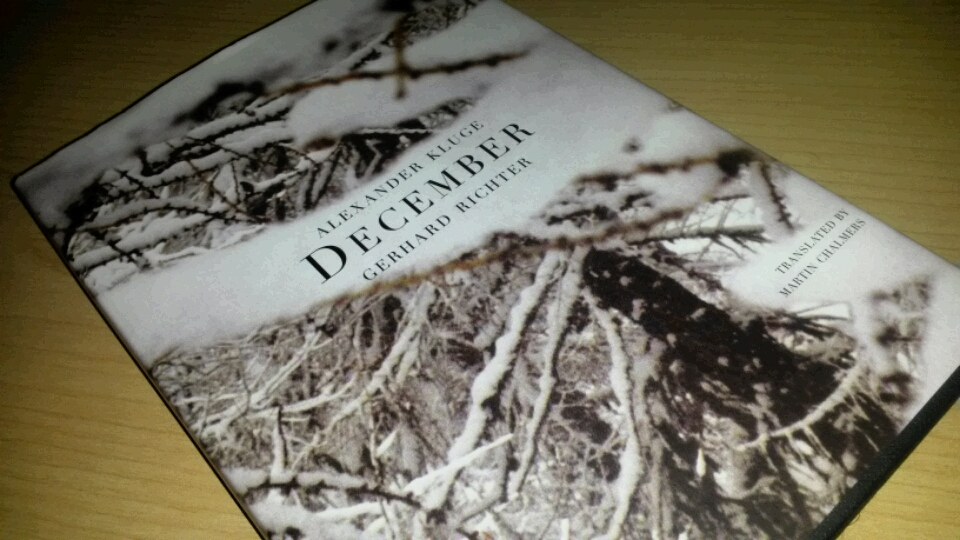
So, my first post of 2016 is a look at the last book I read in 2015. In truth I read it throughout the last month of the year, although not a little each day as intended, my father’s illness has interfered with all of my best laid reading plans of late. However I could not allow the year to draw to a close without finishing this book of calendar stories marking a passage through the month of December in the unique and inimitable style of Alexander Kluge, complemented by the haunting wintery forest scenes captured by Gerhard Richter.

2016-01-01 17.29.52This slim, elegant volume is my first encounter with the work of the German writer and film maker Alexander Kluge. The 39 stories, many less than a page long, are presented in a straightforward manner with a humour so subtle and wry that it simmers below the surface, blurring the perceptual line between history and speculation. Kluge offers a chronicle of an alternate reality so close to our own that it can catch you off guard. A flimic sensibility permeates each entry.

December is divided into two sections. The first part contains a series of dated entries, one story, or a cluster of stories, for each day. The years assigned to the dates vary. Many of the scenarios are set in or around the years of the Second World War. Others tend to be placed in the latter part of the first decade of the twenty-first century. But there are forays far back into prehistory and looking off to a distant future. Characters wander in and out from historical factual reality, war themes of conflict and destruction recur, as do images drawn from concerns about climate change and the fallout from the economic collapse of 2008. The ageless question of the nature of good and evil is a prevalent theme – “evil proves to be good displaced or straying in time” – as is the measure of the passage of time itself, whether measured on a global scale or at a much more personal, intimate level:

“The uncertainty, above all the lack of influence on whether and when someone will be struck down by the war, makes the soul bold. There is nothing to be lost any more.

So, after an air raid in 1944, which went on for hours, Gerda F. did not save herself up any longer. No thought of waiting for one of the returning warriors, whom she still knew and who would ask for her hand. She  didn’t want to get to know any better those left behind in the armament factories of the place. All were looking for closeness. She took a man who was passing through town up to her room. They never saw each other again. There was nothing about it that she regretted.”

The second, shorter section is titled “Calendars are Conservative”. They form a series of reflections on the way time – days, months and years – are recorded, calculated, and, as in certain situations such as during the height of the French Revolution, manipulated and distorted. The revolutions of the earth on its axis and the passage of the planet around the sun may be measurable with relative consistency, but that has not kept humankind from trying to understand, articulate and contain the progress of time, again in both the macro, political sphere and in the individual philosophical context:

“What manifests itself in my story, the story of a living person, is not COMPLETED PAST (what was, because it no longer is), also not the prefect tense of what has been in what I am but instead the OTHER of what I shall have been for what I am in the process of becoming.”

2016-01-01 17.32.15To spend a month, dipping in and out of the stories, anecdotes, and reflections Kluge has assembled to mark the end of the year is a treat. Although the images are often sombre, the atmosphere is contemplative. Gerhard Richter’s accompanying photographs enhance the measured tone. If you have ever experienced a day of heavy and unexpected snowfall, those days in the Northern Hemisphere that can bring all but the most essential services to a halt, granting a welcome reprieve from school or work for many; you will know how time can slow to a leisurely pace while the thick blanket of white muffles the day to day noise of the city. That is the sensation captured in the muted monochrome images of snow laden branches in silenced forests. This is the December we hope for but, caught up with the demands of year end and pressures of the holidays, frequently fail to achieve. A time to contemplate the past, for better or worse, speculate about the future and pull another calendar year to a close.

Translated from German by Martin Chalmers, December is published with the expected fine attention to detail by Seagull Books.