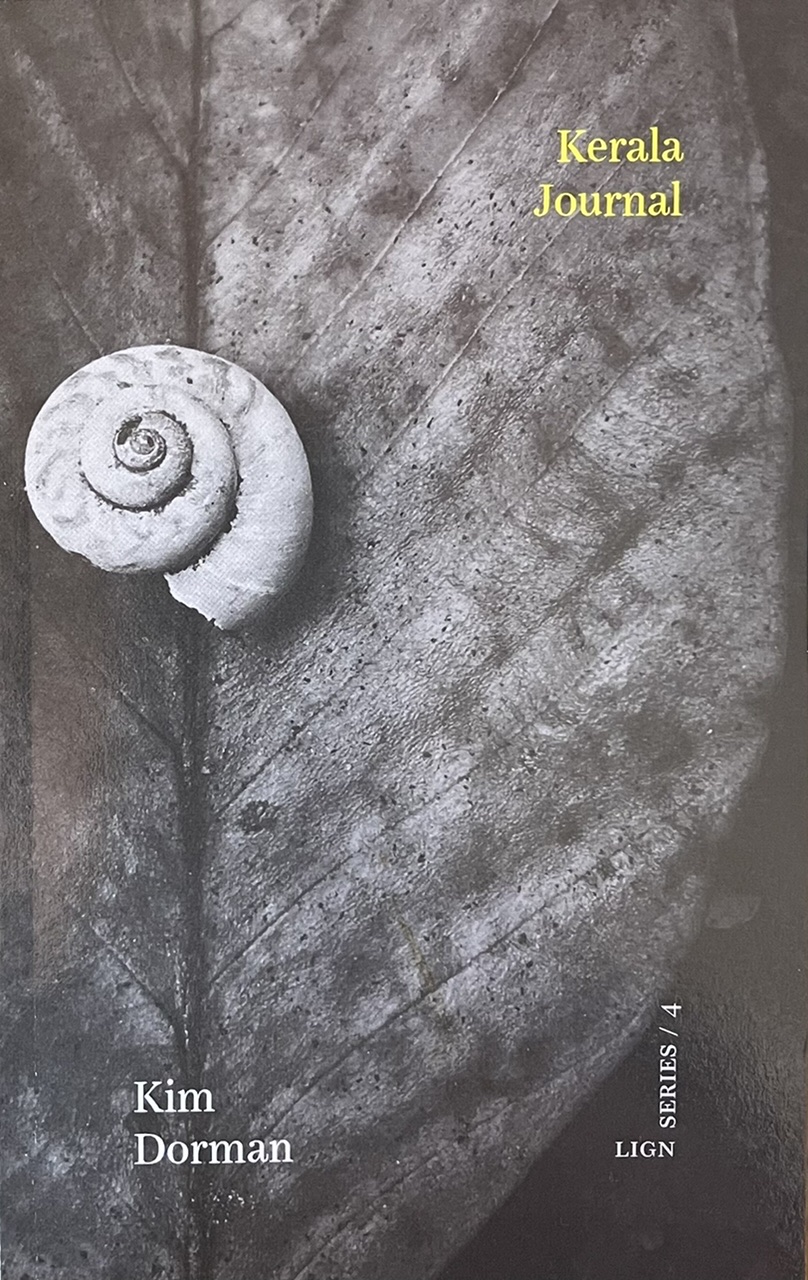
Some nights silver others pale gold: Kerala Journal by Kim Dorman

Rain drips on the
tin roof, frogs
& crickets chant.

The passing days
turn to years.

Lying awake in the
dark, I know the
taste of ash.

The images are simple, rendered with honesty and clarity. Darkness and light. Sound and silence.  Rituals of nature and moments in time.

American poet Kim Dorman was drawn to India as a child, and made his first visit to the country in 1976. He made several more journeys over the years until, after a long absence, he and his wife returned in 2019 to live in the southern state  of Kerala. Drawing inspiration from classical Japanese literature, especially Matsuo Bashō’s travel diaries, he focuses his attention on the small details and everyday routines and rhythms of life—his own and his neighbours—in this tropical environment. Kerala Journal is a collections of his poetic observations, recorded between March 2019 and January 2021.

A farmer clears his field with a sickle.
Fodder for cows.

On the road, a young family goes past
on a scooter.

Man, woman, child.

Certain images—night skies, dust on the road, rats in the attic, cawing crows—appear and reappear regularly, highlighting the rhythms that run through the days but as the poet, who admits to having three versions of Heraclitus among his books, knows well, one never steps in the same river twice. Time flows on.

Solitary path, dust.
Cockcrow sounds far:
All is lost, gained.
Sunrise on the river.

Yet, as Covid strikes, the world beyond the local community enters the immediate environment as newspapers bring news of migrant workers and their families slowly making their way to distant homes, while elsewhere a rhino ambles down an empty road meeting no one. Time during lockdown takes on a different shape for different people based on circumstance just as the reality of a pandemic heightens an awareness of mortality. I do notice that the poet seems ever more conscious of his age as this collection nears its close.

I was already in my late fifties when I first travelled to India and I had the great opportunity to visit a friend in Kerala twice in 2019. I am impressed with the Dormans’ decision to return there later in life. But I understand the perspective only age can bring. To fully appreciate a place takes patience and time and a quiet introspection. These poems observe without judgment. They inspire us to isolate and pay attention to the smallest details in our lives. And, sometimes, even the unexpected humour:

The chemist
hands me a bottle
wrapped in
newsprint—
the obituaries.

Kerala Journal by Kim Dorman is published by Xylem Books, an imprint of Corbel Stone Press.

“I love you. We had a good life. You are a good man.” Remembering my father on his birthday.

Today, April 26th, is my father’s birthday. It would have been his ninety-fifth. Each year, between this date and May 2nd, my mother’s birthday, their loss weighs heavily on me. I have written about my mother several times but, for the past few months, it is my father I’ve missed most acutely—the one I have longed to talk to because, even when someone we love is gone, the conversations do not end. But my father was so difficult to talk to in life, so reticent to share anything of his early years, his youthful dreams, his regrets. I caught a glimpse, distorted in time and detail, as he made his “final accounting” as the palliative nurse called it, the day my brothers and I made the agonizing decision to withdraw food and water. It was five days after his stroke and car accident and two days after our mother had died in another hospital from an unrelated cause. I believe he understood mom was gone, even if he wasn’t sure how, because he seemed ready to let go. His body, however, would hang on for another nine days. Each day as I sat beside him I told him, again and again: I love you. We had a good life. You are a good man.

So simple, the things we say at death that we find almost impossible to say in life.

The following piece, published here on my blog back on December 26, 2015 and re-blogged at least once, was written the day after the children and I had been to see my father after he had suffered what we thought was a stroke but was most likely a traumatic brain injury. At the time his prognosis did not look good, but to everyone’s surprise, he pulled himself back from the edge, making an impressive recovery. Not quite impressive enough to return home however, but he checked himself out of the hospital anyhow. The following six months were stressful. I went up to spend the night at my parents’ place regularly, but he was unstable and erratic while my mother’s health quickly declined. In July, 2016, they died within eleven days of one another.

When I have written about my father in the intervening years, it is always about his books many of which I now have with me. However, this first reflection, composed when he was still alive but with an uncertain future, still captures my connection to him best. So today, once more, I want to remember him in present tense:

* * *

I was standing in my father’s library last night, looking for a book I could not find, but as I scanned the titles I began to read the shelves as life lines, like the lines that always creased his forehead and fanned out from the corners of his eyes as he squinted through the windshield or glanced up into the rearview mirror of the car. For as long as I can remember, my father never drove without a grimace. The shelf lines are deep and distinct. His love of classic literature represented in tattered hardcover volumes with faded lettering on the spines. His life long obsession with Russia marked with rows of history books, discourses on Stalin and Marxism taking up more space than I’d remembered. And the Soviet literature, of course. Then his more recent forays into western American literature, Ivan Doig, Wallace Stegner. I wonder when he ever took the time to read. When other men might have eased into a life of retirement, my father resisted. Retirement is, like false teeth or hearing aids, for old men. He is 87.

My father is one of those men who, living by Dylan Thomas’ dictum not to go gentle into that good night, has spent his life fighting death with massive doses of mega-vitamins, a deep-seated distrust of doctors, and the belief that if one keeps on working, dedicating oneself to physical labour day after day after day, the Grim Reaper will never get a foothold. Ever. That means continuing to struggle with wheelbarrows full of wet cement, devising new projects, and never turning his back on a beloved old Mercedes that has broken his heart and nearly cost his life a few times. No matter how bent and weary, despite occasionally falling into the wood stove (“it’s nothing”), my father shuffled on defiantly until last Sunday morning when he fell and suffered a massive stroke in the simple human act of putting his pants on, as we all do, one leg at a time.

Yesterday, Christmas Day, was my first opportunity to get up to see him. Fate was not conspiring to make it easy—unless I am reading it wrong—but my car collapsed before I even made it out of town. For better or worse, we were across the street from an established mechanic shop and outside the house of a family who kindly took us in out of the -21c weather until we could make arrangements to get up to my parent’s house, a little cottage in the woods outside a village about two hours north of the city I live in. Long story short, one of my brothers was able to drive us when attempting to rent a car proved impossible. From there I drove my mother, in her car, to Red Deer where my father is hospitalized—a further hour each way.

My first reaction to seeing my father helpless and restrained to his bed was, naturally, heartbreaking. But as my daughter and I took turns holding his hand, stroking his now smooth forehead, witnessing the genuine joy in his eyes—so pleased to see us even if he won’t remember—I realized that I have never, in my life, felt closer to this complicated and difficult man. Meanwhile, my son, hung over and fighting a panic attack, held back, not ready yet to come close. And that’s okay. They have had their own challenges over the years (the long hair and beard chief among them), but he and my father are, in their way, remarkably close. They have gone to the opera together and Thomas has already been given some of his grandfather’s most precious books.

A childhood favourite of my father’s. My son keeps it safely in a plastic bag.

My father has never been an easy man, but as I grew older I was able to appreciate how harsh his own upbringing was, and to recognize in him the mood disorder we both share, even if he denies its existence. I learned to leave him space, to meet his outbursts without taking them too deeply. After all, how could I, the intellectually inclined, queer black sheep of the family, not love a man who worked in construction camps in remote Ontario, learning the electrical trade organically, until he could save enough to money to do what his family always discouraged—move to New York City and enroll at Columbia in his late twenties. He studied engineering, but he should have been an academic if he could have justified the path. His greatest thrill was reviewing opera and classical music performances for the student newspaper. His love of all things Russian also stems from this era—I am not entirely certain of the exact genesis, but seem to think it may have involved a woman. Hard to imagine, as my father never struck me as the romantic type but he did, in his younger years, bear a striking resemblance to Humphrey Bogart. Maybe there was smoky Russian woman in his past.

As it turned out, he never finished his degree, in those days it wasn’t necessary for an engineering designation. When he met and married my mother in 1957, school was abandoned for full-time employment and, over time, they would move to rural western Canada where he would pine for the New York of the 1950’s while simultaneously looking for more and more remote locations in which to settle. These last few years, working away in defiance of death in a cottage outside of Caroline, Alberta, have probably been some of his happiest. And now we don’t know what the future holds. In the months ahead as my brothers and I seek to find accommodations for our parents, I want to make sure I can look after the library, because unlike the countless carefully labelled jars of salvaged nut and bolts that insulate his workshop, for me, this is where his heart lies.

I want to curate it for him. Whether or not he is ever able to read again, I know he would want the company of some of his books if possible in the future. And I want to trace and record those shelf lines in his honour.
A bell in the distance: ‘La Clarté Notre-Dame’ and ‘The Last Book of the Madrigals’ by Philippe Jaccottet

When Swiss Francophone writer Philippe Jaccottet died in 2021 at the age of ninety-five, he left two final manuscripts, finished in the final year of his life with the assistance of his friend, poet José-Flore Tappy. These two works, La Clarté Notre-Dame, a sequence of prose pieces, and The Last Book of the Madrigals, a selection of verses, have now been published together in John Taylor’s translation and, in them, we see the poet looking back over certain past experiences, ever asking questions of himself and the world he observes, even as his age weighs heavily on his thoughts.

The first work opens with a remembered outing with friends, when, as they walked down a gentle slope under grey skies, the silence or “deep absence” of the vast open space surrounded them:

Until the little vesper bell of La Clarté Notre-Dame Convent, which we still couldn’t see at the bottom of the valley, began to ring far below us, at the heart of all this almost-dull greyness. I then said to myself, reacting in a way that was both intense and confusing (and so many times in similar moments I’d been forced to bring together the two epithets), that I’d never heard a tinkling—prolonged, almost persistent, repeated several times—as pure in its weightlessness, in its extreme fragility, as genuinely crystalline . . . Yet which I couldn’t listen to as if it were a kind of speech—emerging from some mouth . . . A tinkling so crystalline that it seemed, as it appeared, oddly, almost tender . . .

This bell is the initiation and the subtle motif that binds a series of reflections that carry Jaccottet back to childhood, to earlier travels and, along the way, to inspirations and writings from his past. There is an element of reassessment to this sequence, a restless questioning of the poetic and the political, with frequent parenthetical asides. And though many of the passages date back to 2012, the image of being “at the very end of my life’s path” is ever present. Doubt, not of his accomplishments, but of their faithfulness to some kind of truth and ethical value, creeps into his musings.

There is a slowness, a patience, and willingness to set aside reflections for a time, to let them rest, that lends La Clarté Notre-Dame an organic wholeness in its final form, even if its genesis was more fragmentary. The vesper bells seem to effortlessly feed Jaccottet’s ongoing concerns about the situation in Syria, thoughts about his own poetic influences, memories of subtle details and interconnections arising from his long life of experiences and human interactions, and uncertainty about what lies beyond but, in the end, he is willing to close on an open, unfinished note. This is true to form. When asked what Jaccottet’s writing has to offer to a new generation of readers, John Taylor, one of his long-time translators suggests:

We have entered an age of unequivocal partisan discourse, of linguistic robotization, of tiny symbols standing for complex emotions. In total contrast to this, Jaccottet’s writing constantly shows nuance, attentiveness, perseverance, circumspection, and a genuine quest for essential truths. His hesitations and doubts are salutary because they bring us to a halt and help us to observe and ponder anew, sometimes against our own preconceptions and wishful thinking, as we learn to cast away chimeras but also not to abandon all hopes.

The Last Book of the Madrigals, Jaccottet’s final poetic offering is a return to verse, a form he had moved away from in favour of prose poetry in the 1990s. The dual language text opens with a piece entitled “While Listening to Claudio Monteverdi” which imagines an encounter with the most influential madrigalist of the early 17th century. It opens:

When singing he seems to call to a shade
whom he glimpsed one day in the woods
and needs to hold on to, be his soul at stake:
the urgency makes his voice catch fire.

Then by its own blazing light, we spot a moist
night-time meadow and the woods beyond
where had come across that tender shade
or much better and more tender than a shade:

now there’s nothing but oaks and violets.

The voice that has brightened the distance fades.

I don’t know if he has crossed the meadow.

Their long summer night together continues under the starry sky, becoming a transformative  experience for the speaker.

The poems that follow in this sequence draw on mythic, celestial and natural interactions. Other voices are invited into conversation with the poet on his journey, but an image of a writer nearing the end of his time recur—these are the last madrigals, an allusion to Monteverdi, perhaps—invoking the same sense of solemn awareness haunting La Clarté Notre Dame. After an encounter with an old blacksmith he asks:

Was he delirious when I heard him murmur:

‘If this lamp that is like a beehive
is removed from me,
if this perfume drifts away, companions,
you can carry off these quills and bundles of paper:
where I’m being led, I’ll have no more use for them . . .’

Later in another madrigal, as a summer evening falls, the poet again recalls the “blacksmith of volutes and flames,” whom imagines wishing away temptation only to then wonder of himself:

And he who still writes on the last staffs,
perhaps, of his life:

‘That unknown woman fishing in her lightweight skiff
has struck me as well.

I first thought it sweet to be her prey,
but now the hook tugs at my heart
and I don’t know if it’s the daylight or me
bleeding in these pearly waters.’

These poems are filled with beauty and longing, calling on the stars in the heavens for silent answers and anticipating the turning of the seasons toward autumn and winter. One can well imagine a chorus of voices carrying the final songs of a poet who looked at the world closely, listened to silences and distant bells, and sought the meanings in it all on the page. This volume with his two final works is not only a fitting literary addition to a life of great accomplishments, but can serve as an introduction for those who wish to read more.

‘La Clarté Notre-Dame’ andThe Last Book of the Madrigals’ by Philippe Jaccottet is translated from the French by John Taylor, with an Afterword by José-Flore Tappy, and published by Seagull Books.

A compilation of shadows: Ninth Building by Zou Jingzhi

From childhood till now, I’ve spoken many bold words. Publicly or in private, I’ve proclaimed the kind of person I wanted to be, though it never happened in the end. I feel like someone has somehow taken my place, leaving me to become the person I am now.

When I’m around too many people, I lose myself. In an unfamiliar city, among crowds of strangers, I keep having to stand still—not to ask directions, but to find myself. Even when I’ve done that, I’m still lonely, so I head back to my hotel and listen to the sound of rain.

These lines, drawn from the melancholy and poetic Introduction to Ninth Building by acclaimed Chinese writer, poet and playwright Zou Jingzhi, speak to a fragmented sense of self, a “compilation of shadows,” that has long accompanied him, appearing unbidden on the street or haunting quiet nights. This book, originally published in Chinese in 2010 and now available in Jeremy Tiang’s excellent English translation, is an attempt to give these shadows some of the depth, context and meaning distorted by the experience of growing up during the years of the Cultural Revolution. As Jingzhi says in an interview on the site of the 2023 International Booker Prize for which his book has been nominated:

 In the early 1990s, my childhood felt like it had been a gust of wind behind the trees. I used to spend my days being lost: What should I write? Whatever I wrote was wrong. It was impossible to get rid of my childhood back then. So I just wrote like that. I wrote for myself. I wrote to let go of my childhood.

Ninth Building is a cohesive work with a common narrator, but it is presented as a series of vignettes or very short stories, set between 1966 and 1977, arranged in a roughly but not strictly chronological order. Time, in its experiencing and remembering, has a somewhat fractured quality. After all, the Cultural Revolution was an unnatural period of disruption and upheaval and, as Jingzhi’s stories so clearly demonstrate, many hours of unstructured tedium. The first section “Ninth Building,” takes its name from the housing complex in Beijing where Zou is living with his family when the Revolution begins. He is about thirteen or fourteen at the time. The first story “Eight Days” is a diary format tale set in November 1966 that describes the eagerness and concern with which a group of boys set out to obtain Red Guard armbands. It is not clear that they understand just what they signify, only that they don’t want to be seen without one. Many of the pieces in this part demonstrate the haphazard way that the adolescents try to make sense the objectives of this movement sweeping the country, rejoicing in the death or humiliation of old women labelled part of the “landlord class,” unaware that many of their own families would soon be suspect. Yet amid the increasing levels of violence among their classmates and peers, there is a lot of idle time to be filled with a variety of friends and neighbours. Boredom had company.

There is a lot of humour in the first part of Ninth Building, some of it rather black, even disturbing, but much also reliant on the innocence of the protagonist and his young buddies (it is the 1960s after all). A wonderful early vignette (“Capturing the Spoon”) describes a night patrol during which the intrepid and enthusiastic guards observe, through a lighted window, a naked couple thrashing around in a bed. Alarmed, they rush to report this obvious, if strange, infraction, but the grown-ups from their compound’s “Attack with Words, Defend with Force” Unit are unmoved by this important information:

Nothing came of our waiting. We’d imagined they’d jump up immediately to stop whatever incorrect action was taking place. This was at the height of the Revolution, and the train we were on had switched to another track. What we’d seem didn’t fit the scenery on this route; red armbands and nakedness didn’t go together. The five of us had three flashlights between us, and for more than half a month now we’d stayed awake night after night, fully alert, wishing something would actually happen. Now something had, but the adults didn’t feel about it the same way we did.

The second and slightly longer part of Ninth Building, “Grains of Sand in the Wind,” opens in 1969 when is Zou sixteen and sent to the Great Northern Waste for “re-education through poverty.” He is one of the millions of “educated youth” sent to work in rural areas and learn from the peasant population. He will not return to the city until after the Revolution comes to an end in 1976. These are years filled with long days of back-breaking labour under harsh conditions, yet no more immune to extended periods of boredom than he knew in Beijing. But here the distractions, apart from the required performances of patriotic operas, were limited to gambling, drinking and practical jokes. Innocence is gone; the underlying tone is now one of resignation. Zou and his peers have come of age in a time when their lives and dreams of the future are suspended:

Youth is a concept whose meaning isn’t easy to grasp. You might as well try to wrap your mind around every era, every event. The word doesn’t really evoke any special memories for me. Perhaps I’ll have to wait till the age when every other sentence begins with “back then” before I truly understand it.

The vignettes set against the vast rural landscape are harsher, with more tragic elements. They are not devoid of humour or eccentric characters, but illness, injury and death feature regularly. Life is cheap. However, poetry and increasingly astute observations are woven into Jingzhi’s anecdotes and tales. As his narrator matures and grows more cynical, he also begins to recognize the seeds of his future as a writer that have been sown during these long years.

The Cultural Revolution was a period of great turmoil during which the power of radicalized youth was harnessed against the Communist Party hierarchy, but as illustrated by Ninth Building, the impact on many young people during this time was marked not by heroism or the glory of conflict, but by years of boredom, dislocation and numbly tedious labour. With its brisk pace and refusal to succumb to despair in spite of the countless temptations, this collection of brief vignettes makes for an entertaining and powerful read.

Ninth Building by Zou Jingzhi is translated from the Chinese by Jeremy Tiang and published by Open Letter in North America and Honford Star in the UK.

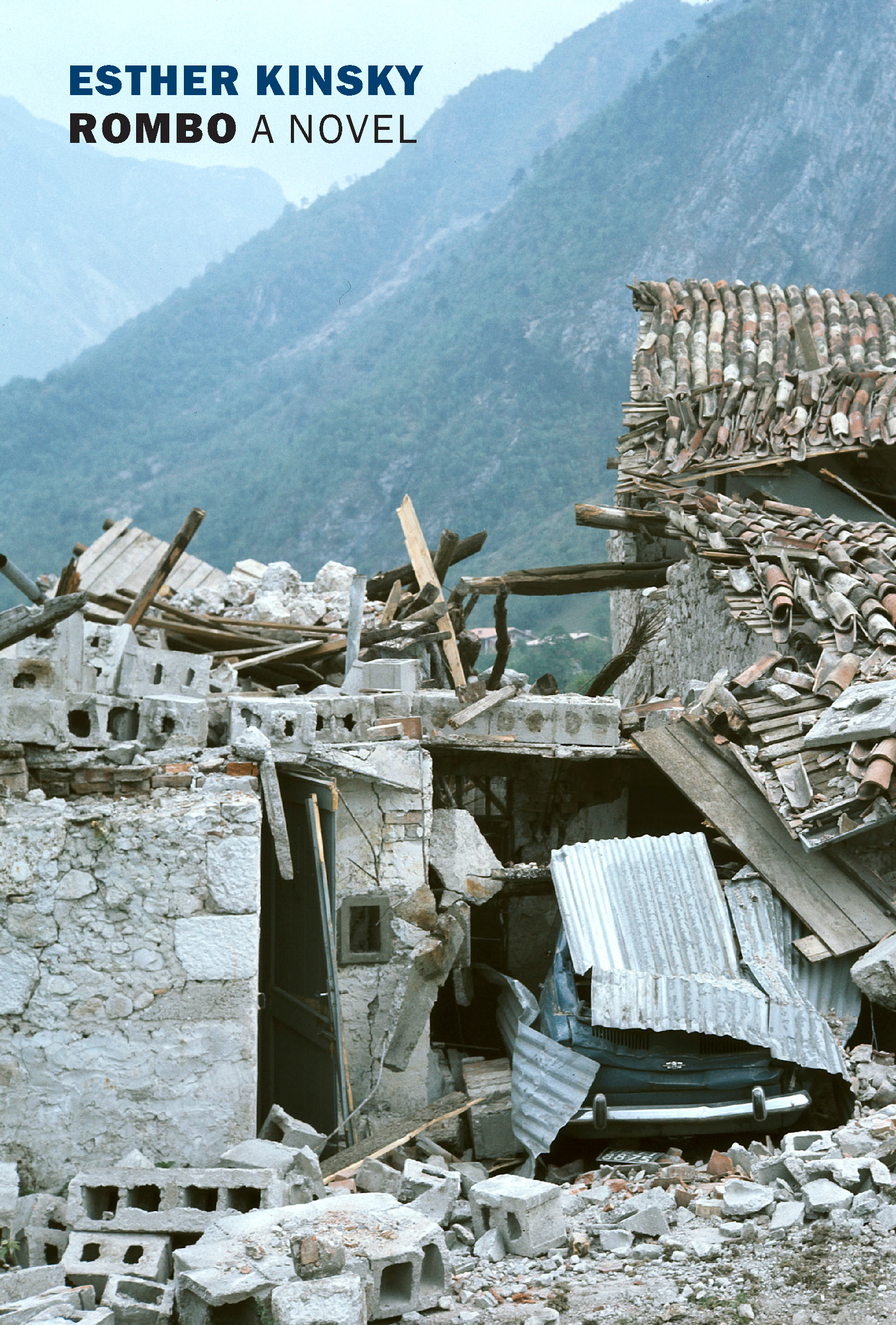
Forever before and after: Rombo by Esther Kinsky

The seismic shocks of May divided life and the landscape into a before and after. The before was the object of memory, stories unceasingly layered and blown over by words. One argued over the form of the cliffs, the course of the brooks, the trees that avalanches rolled over. About the whereabouts of objects, the order of things in the house, the fate of animals. Each of these arguments was an attempt at orientation, at carving a path through the rubble of masonry, mortar, split beams and shattered dishes, to understand the world anew. To begin living in a place anew. With one’s memories.

On May 6, 1976, just before 9:00 pm, a devastating earthquake tore through the Friuli district of northeastern Italy. Several strong quakes followed in September. Bordered, today, by Slovenia to the east and Austria to the north, this region which extends from the slopes and foothills of the Carnic Alps, onto the flat flood plain of the River Tagliamento, would be forever changed, as would the lives and memories of those who survived that year of death and destruction. Rombo, the latest novel by German poet and writer Esther Kinsky, places this event at its centre and turns its attention to the rich and deeply interwoven stories that bind the land and its inhabitants together.

As her novels River and Grove demonstrate, Kinsky is deeply sensitive to and observant of landscapes, urban and rural; her narratives move through environments that are simultaneously emotional and physical—spaces of memory, grief and reconciliation. The same can be said of Rombo, but here, instead of a peripatetic first person narrator tracing a deeply personal journey, a chorus of voices carry the flow of a unique, multi-layered narrative that encompasses the human and non-human, the animate and inanimate alike. The text is divided into seven sections, each opening with a quote from a classic geological work and a coarse black and white illustration depicting a fragment of the remaining frescos from the cathedral at Venzone. A neutral narrative voice describes the landscape and its history—present and past—offering observations of a geological, ecological, folkloric and scientific nature. Woven into this tapestry are the memories and stories of seven men and women—Anselmo, Olga, Mara, Lina, Gigi, Toni and Silvia—who were children or youth at the time of the earthquake, and whose reflections take them back to the events that forever divided their world into before and after.

This choral narrative flows and swirls like a river, rising and falling, turning in eddies, joined by streams and tributaries along the way. Moving back and forward in time, repetition, contradiction and fractured accounts are gradually woven together to create a rich, if heartbreaking, whole. In the beginning we are briefly introduced to the seven survivors, from a third person perspective, on May 6 and in the present, decades later. Then, the dynamics of the seismic event are set up, the unevenness of the impending disruption are alluded to, and the forces of the earth are unleashed:

It is said that animals are much quicker to sense the vibrations that gradually build up in the Earth’s interior and eventually exceed the stress limit in the spreading centre, causing the tectonic plates to snag and tip, irrevocably shifting the order of hollow cavities and mass, the order of emptiness and fullness.

For each one of the survivors, the hours leading up to the May earthquake were marked by unusual observations—an unexpected sighting of a snake, anxious goats, loudly barking dogs, fitfully chirping birds. The day was unseasonably hot, the light oddly filtered. And everyone remembers the otherworldly sound, il rombo, rising out of the ground just before it started to shake. In the moment, they are pushed out of their houses, stand under archways or find themselves crawling out from under collapsed structures. Damage is extensive but, all things considered, their village is one of the lucky ones. Others are almost completely destroyed.

After our first glimpse of that fateful day, the survivors begin to speak for themselves. They talk of their memories of life in the valley, their families, and their later adult years. But mostly they speak of the earthquake and its immediate aftermath—the strange, dislocated summer of freedom for the school-aged children, the stress of rebuilding and rising tensions among the adults and, amid the turmoil, the accommodation of marriages and deaths and the business of life. Then, when things are beginning to promise a return to some degree of normal, the severe September shocks roll through. Everything is unsettled again.

The lives and stories of some of the characters intersect, contradict one another or offer different angles on the same situations or experiences. Their individual histories reflect the historical and economic realities of the region. Fractured, multi-generational families are common as people are forced to leave to search for work, or driven back again by the need for the support of extended family. Anselmo and Olga, for instance, were both born abroad, in Germany and Venezuela respectively. They come to the valley with their locally born fathers after divorce or widowhood finds them stranded in foreign lands and brings them home. Some couples comfortably fall into a pattern of living in different towns or countries, like Silvia’s parents or Lina and her husband. After the earthquake, many will leave the region for good, having lost their jobs and their homes, but for the seven villagers featured here, including those who do leave for a time and return, the valley is and always will be home. As Lina says about the land and her place in it:

The soil is poor here. Limestone ground, the ground of poverty. The flowers are paler here than elsewhere. The winter is long. But winter is alright by us, because it brings snow and whatever grows around here has snow and goat shit to thank for it. The snow saturates the ground differently than the rain does, they always say. On the other side of the mountain, in the south, it only rains, even in winter no snow falls. It’s God’s pisser, the people say.

What is my life? sometimes I ask myself. My life is this place. Here I know everything. Every stick and every stone. The animals and the people. I write down what I want to remember. The weather, the harvest, the comings and goings, misfortunes. Surprises.

As these witnesses, now looking back through the filter of more than half a lifetime’s experience, recall the upheaval of the earthquake and talk about their lives before and since, their reminisces are framed and reframed through the shifting sedimentary layers of accumulated memory. Just like the land around them. Unfolding with an uneven, yet natural pace, the flow of personal stories, woven among the descriptive passages, observations and anecdotes, lends a filmic documentary-like feel to the novel, successfully achieving a Sebaldian balance of truths and fictions imbued with Kinsky’s distinctly meditative poetics. The result is an unusual and highly affecting form of storytelling that follows its own narrative logic.

Rombo: A Novel by Esther Kinsky is translated from the German by Caroline Schmidt and published by New York Review Books  in North America and Fitzcarraldo in the UK.