“keep turning forever, circling round”: Shining Sheep by Ulrike Almut Sandig

.   i have the same number of words inside me
as all of you have words, the exact same number

but how many times can they be combined? you
keep finding words that no one sang before you.

.  your godhead made you after his own image
.   stark naked, blind—wild things that you are.

– from “The Silent Songs of the Walls: l”

German poet Ulrike Almut Sandig’s latest poetry collection, recently released in Karen Leeder’s translation, is the modestly titled Shining Sheep—modest, that is after her 2016 offering, which appeared in English in 2020 as I Am A Field Full of Rapeseed, Give Cover to Deer and Shine Like Thirteen Oil Paintings Laid One on Top of the Other— but it is by no means a more restrained effort. Rather, this new collection, originally published in German in 2022, is an especially dynamic, ambitious affair.

Several of the pieces here were commissioned for performances, films, or arose out of collaborations with fellow artists and musicians. This has been a hallmark of Sandig’s approach to poetry ever since her early days posting poems to lampposts and handing them out as flyers. But that collaborative, multi-instrumental quality is now more pronounced, not only through the visual presentation of the poems, often incorporating shaped or concrete poetry, but with the inclusion of links, where appropriate, to recordings and video performances that bring her poems to life off the page.

Opening with a single word, alone on a black page—“Lumière!”—Sandig’s poetry is a call to light, but one that resonates with a dark exuberance. She draws on a wide range of influences—German folk songs, writers, and history—to address political and social issues, never turning away from difficult subjects, like maternal depression and alcoholism, living with Covid, migration, and climate change.

just let that melt on your tongue:
shining sheep, genetically modified
as night storage for the dark hours

visible in satellite images as little ghosts
their delicate shimmer on the radar
seems to be made to lull

the oppressive darkness between
the great golden bulls of the cities
into a comforting gleam. 

– from “Climate change is here, now. But we are also here, now. And if we don’t act, who will?”

Along with poems that arise out of commissions and direct collaborations with other artists, Sandig is also at times writing in response to, or in conversation with the work of late German authors, filmmakers and poets, including Friedrich Hölderlin’s “Wie wenn am Feiertage” (“As When on Holidays,” 1800). Other pieces have their genesis in more immediate encounters outside the artistic community, past or present.

A particularly moving sequence, “Lamentations in VI Rounds,” arose, poet tells us, out of a chance connection with a young man from Afghanistan who contacted her after she accidentally left her bank card in a ticket machine on the Berlin underground. He and his large family were living in the city as failed asylum seekers. She stayed in contact with them and, from their stories, wrote a piece she called “Five Lamentations,” adding a sixth round for this final version after the Taliban took control of Kabul in 2021.

the little man inside my head, he had
a daughter. he loved the way she boiled
minced beef, the way she answered back.
he loved the wonder of her eftertherain in Omid.

Omid sold his daughter in exchange for the value
of a ticket to Germany. today she called him up.
she sounded like she was sitting in his ear.
the pear tree in the yard was doing fine.

Shining Sheep is Sandig’s third poetry collection to be released in English, and the most inventive and experimental to date. Her long-time translator, Karen Leeder, is well attuned to the nuances of her uniquely playful, yet melancholic verse, bringing this energy and adventurousness to the forefront here. For a taste Sandig’s poetry and performances(with Leeder’s subtitles where available), her YouTube channel is well worth a visit.

Shining Sheep by Ulrike Almut Sandig is translated from the German by Karen Leeder and published by Seagull Books.
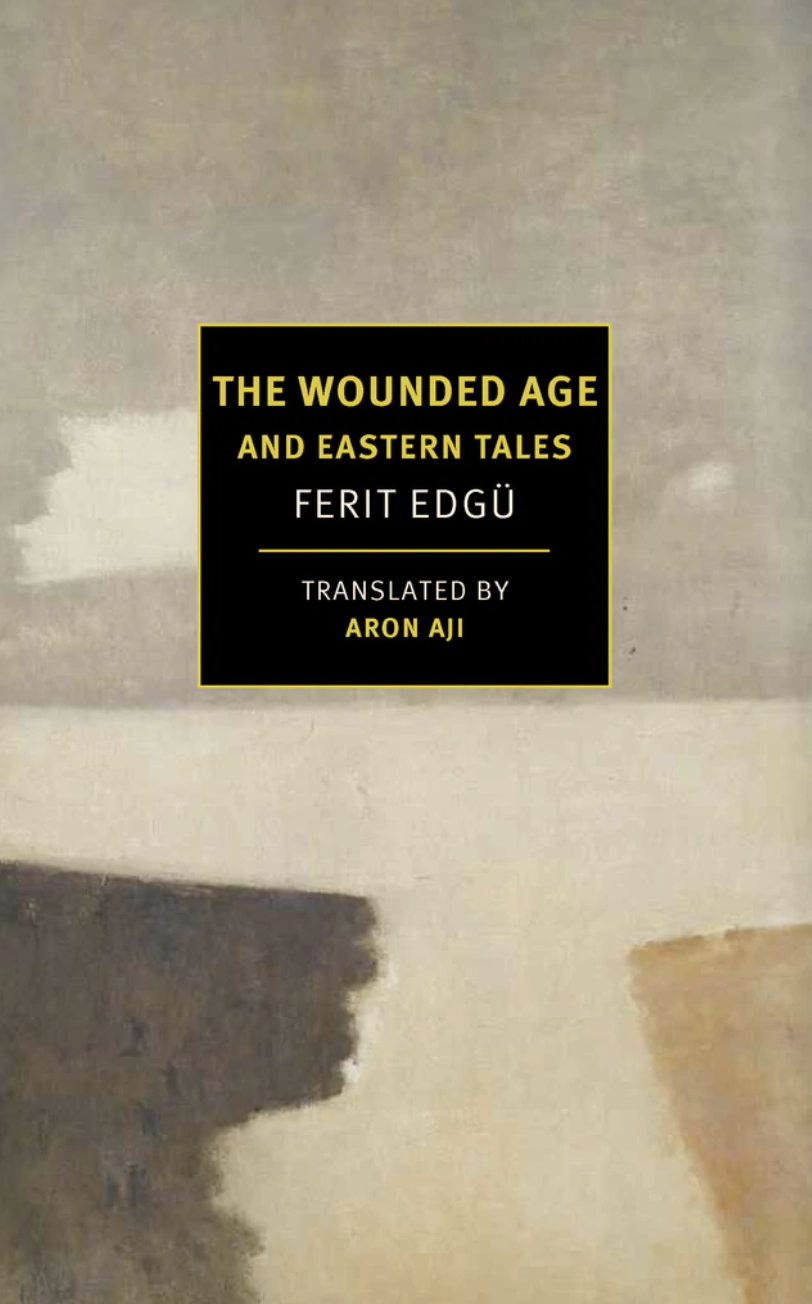
“Here, on this mountain, there’s the living and the dead.” The Wounded Age and Eastern Tales by Ferit Edgü

Years later, as I leaf through the notebooks,
I see that these people and I,
who didn’t speak each other’s languages,
had understood one another.
I don’t know what language we had I common,
nor do I want to know.
Our common language didn’t change them
but it changed me. I’m sure of it.
Every passing day returns to me the traces
of our shared life in that mountain village;
I see them. I live them.
And these words I’ve been scrawling through the years
are those traces, words wounded like me.

Hakkâri is a province in the southeast corner of Turkey with an overwhelmingly Kurdish population and a long history of violence and displacement amid the various ethnic and tribal communities that have called the area home over the years, up to the present military subjugation of insurgents fighting for an independent Kurdistan. It is a rugged region comprised of mountains, steppes and deserts drained by the Great Zab River and it is the setting, a character in its own right even, in much of the fiction of Turkish writer Ferit Edgü, including the two texts published together by New York Review of Books Classics as The Wounded Age and Eastern Tales.

In 1963, after graduating with a degree in fine arts and philosophy, the then twenty-four year-old Edgü was assigned, in lieu of military service, to a nine-month teaching post in the village of Pirkanis in an area of Hakkâri so remote it could only be reached on foot or by horseback. The experience would be, by his own frequent admission, the most transformative of his writing life. For a young man raised in Istanbul who went on to study in France, it must have been a shock to arrive in such an isolated location, but, as the quote above, taken from the preface to his 1995 collection of short fiction, Eastern Tales, shows, the differences between himself and a people with a culture and language so foreign to him somehow melted away. He was never able to return in person, but his characters, narrators and stories have continued to find a life there.

Edgü’s narratives are, in manner that seems appropriate to the harshness of the environment and the simplicity of the lives of the people of Hakkâri Province, characteristically stripped to the bare essentials. His language is spare and unadorned, often reading as a kind of prose poem, with each sentence or two appearing on a new line. He is quoted in the translator Aron Aji’s Afterword as follows:

I want nothing superfluous in my writing. Texts cleansed of details; the event giving rise to the story distilled to its concisest form…. I’ve tried to do away with narration, fictionalization, similes and metaphors…. I cannot stand metaphorization… [or] descriptions built with ornate words, long, unbearable sentences that serve as signs of an author’s mastery…. Just as we have freed writing from psychology, we must free it from metaphors and similes (nothing resembles anything else).

He relies rather on voice, perspective, and tone, allowing dialogue—internal or external—to carry the narrative force. Meanwhile, the same words tend to appear again and again—bear, wolves, dog, snow, mountain, people—this repetition or, if you prefer, intentionally limited or controlled vocabulary has an incantatory effect.

The present volume consists of a novella, The Wounded Age (2007) and Eastern Tales (1995), a collection of four short stories and seventeen minimal or micro-fictions. The reverse chronological placement is apparently designed to foreground “the trajectory of stylistic distillation” typical of Edgü’s work. The novella is the account of an unnamed narrator who returns to report on a crisis in the same mountainous region he once visited in his youth. According to an essay in The Nation, the inspiration was the Halabja Massacre on March 16, 1988, when Iraqi troops attacked the Kurdish town of Halabja with mustard gas and nerve agents, killing up to 5000 residents and injuring many thousands more. As survivors tried to flee over the border into Turkey, they were blocked by the army. Edgü had wanted to cover the situation but his editors felt it was too dangerous for him. So he relied on his memories of the place and its people. Thus, the incidents depicted in The Wounded Age do not reference any specific event or location (although the border is a key element), and the horrors captured on the faces of the adults and children the reporter encounters and their accounts of rivers of blood filled with corpses speak volumes.

They come in wave after wave. Down the mountains, down the rocks.
Women, men, children. A human deluge.
Some come carrying saddlebags. Others, rifles. Their women and children on mules. Or their wounded.
Not their dead. Those they’ve buried.

Unfolding in short segments, through conversations he has with survivors, army officers, and his patient guide and translator, Vahap, the reporter gradually pieces together a larger tapestry of loss, dislocation, and destruction. He listens. He photographs. His dreams and nightmares attempt to fill in the gaps.

Where’s my mother? Where’s my father? My brother, my sisters?
Where’s my dog? Where’s my house? Where’s my village?
Where are my mountains? Where am I? Where’s here?
Desolate. Eerie emptiness. But a voice kept screaming these questions.
I wanted to photograph this voice. The one asking the questions. That’s why I was sent here. I could hear the voice but saw no one to whom the voice belonged.
Since I couldn’t photograph the questioner, I’ll photograph the questions, I said to myself. And so I did.

The stories collected in Eastern Tales tell of a proud people, with simple lives shaped by landscape and tradition. Sometimes the narrator is an outsider, a teacher or in one instance an architect, who has come into the community with a particular role to fulfil, but other tales belong solely to the people themselves. The longer pieces tend to contain somewhat more descriptive detail than the spare and poetic novella, but most still rely on dialogues—with the attendant confusions that tend to arise between villagers and anyone from outside, be it a larger town or a distant city—or unaffected monologues to carry the thrust of the narrative. In the ultra-short pieces, this is stripped down further. Life in this corner of the world is hard, but it is met by its inhabitants with a stoic fatalism that is well honoured through the sharp focus and stark beauty of Edgü’s prose.

The Wounded Age and Eastern Tales by Ferit Edgü is translated from the Turkish by Aron Aji and published by NYRB Classics. It has been short listed for the 2024 ERBD Literature Prize.

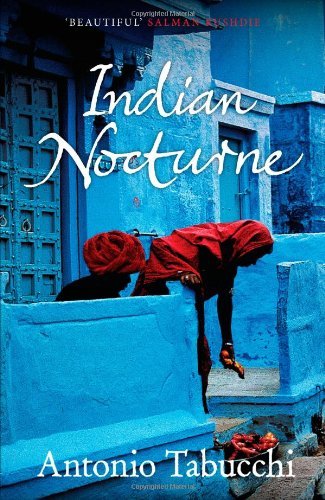
In search of a shadow: Indian Nocturne by Antonio Tabucchi

When the murky waters that obscure any tangible connection between an author and his or her “unnamed protagonist” are intentionally stirred in the opening lines of a text, it is a not-so-subtle cue that that things may not be what they seem. Add an ostensibly exotic foreign location into the mix and there is plenty of space for the edges to become blurrier. Indian Nocturne, by Italian writer Antonio Tabucchi, is a case in point. He describes this book as an insomnia, but also a journey—the insomnia his own, the journey that of his protagonist. Yet, should one wonder, he has himself passed through the places that will be described so, in lieu of titles, he provides a brief index of the settings of each of the novella’s nine chapters for the sake, perhaps, of some wayward traveller who might wish to follow a similar trail of shadows.

The story opens in 1980s Bombay as the narrator is making his way into the city from the airport with a map spread across his knees and a copy of India, a Travel Survival Kit in hand. The taxi driver seems determined to disregard his requested destination, certain that this European gentleman has made a common tourist’s error and is mistakenly bound for a most undesirable area. Angered, our hero insists on getting out and making his own way. The neighbourhood is he reaches is certainly rough, worse than he’d imagined, but he is hoping to find a woman, a prostitute, who might have some information that will help him on his mission. He’s looking for a friend, someone who seems to have disappeared. What little he gleans at this first stop takes him, on the following day, to the office of a tired doctor at a busy public hospital:

‘What was his name?’

‘His name was Xavier,’ I answered.

‘Like the missionary?’ he asked. And then he said: ‘It’s not an English name, that’s for sure, is it?’

‘No,’ I said, ‘it’s Portuguese. But he didn’t come as a missionary; he’s a Portuguese who lost his way in India.’

The doctor nodded his head in agreement. He had a gleaming hairpiece that shifted like a rubber skullcap every time he moved his head. ‘A lot of people lose their way in India,” he said, “it’s a country specially made for that.’

Spare and elusive, the tale unfolds as a series of encounters with places and people, as the narrator travels from Bombay to Madras by train (published in 1984, the British names for Mumbai and Chennai are still in use), then back across the country by bus to Goa. He shares a railway retiring room with a Jain bound for Varanasi, meets with the strange leader of a spiritualist movement, shares a bus shelter with a crippled fortune teller, and finds an American lost by choice, shall we say, on a Goan beach. Add to that a couple of women who happen to cross his path and you have the makings of a dreamy, subtle mystery with more empty spaces than solid clues, enigmatic conversations that drift off unresolved, and a healthy metafictional twist.

Always economical, Tabucchi excels at creating atmospheric settings, enigmatic characters, and cryptic dialogue. He captures the strangeness of being in an unfamiliar country surrounded by unintelligible languages, and the passing, often odd, communion with other foreigners who each have their own reasons for being far from home. And no one, not even the first-person narrator, is  ever really showing themselves fully. Indian Nocturne is my first experience with Tabucchi, a writer I have long been meaning to read. This novella, which almost seems slight at first blush, lingers vividly in the imagination so I will be definitely be reading more of his work soon.

Indian Nocturne by Antonio Tabucchi is translated from the Italian by Tim Parks and published by Canongate in the UK and New Directions in North America.

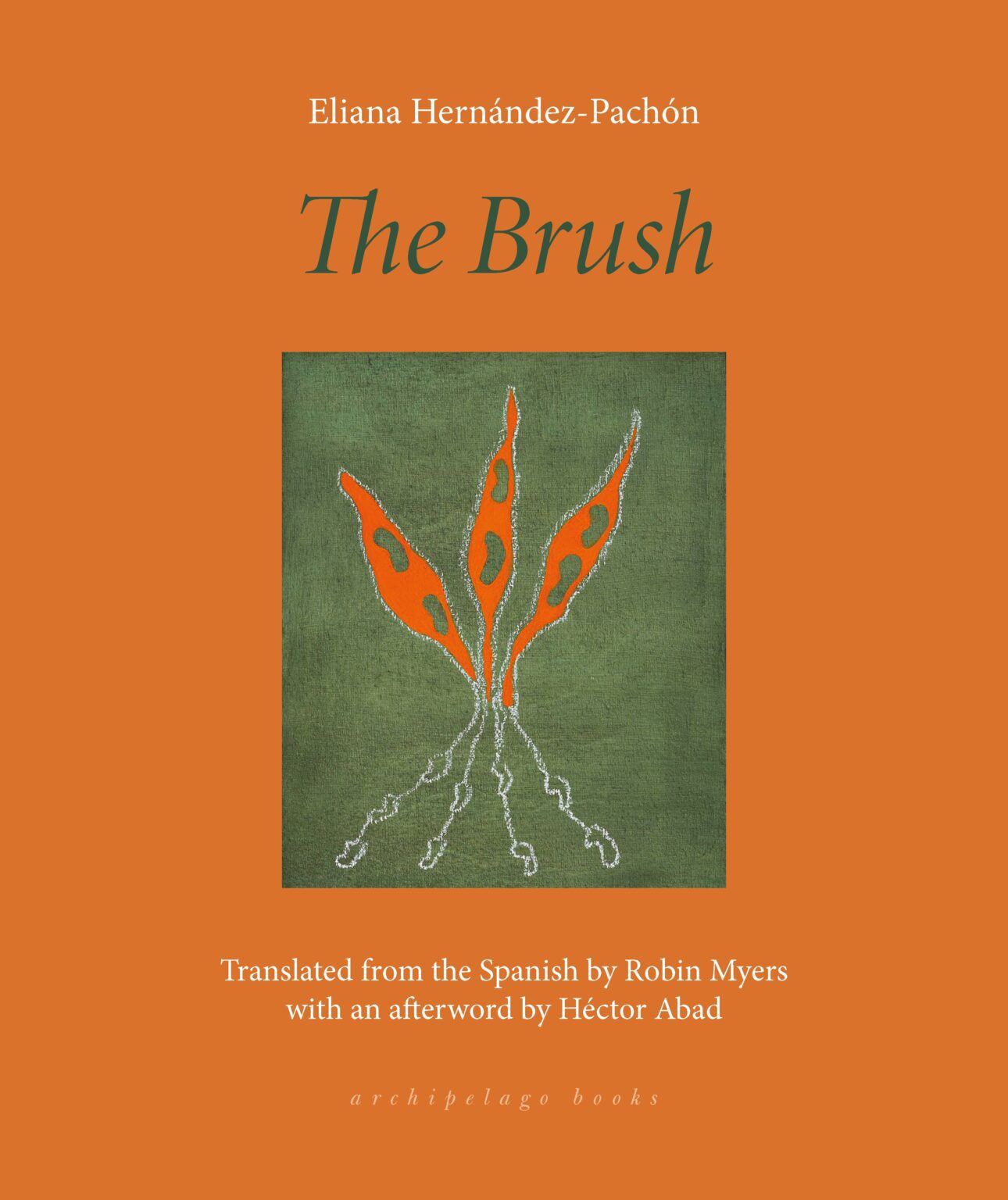
After the night, day breaks: The Brush by Eliana Hernández-Pachón

Pablo and Ester live in the hills. Their children are grown. Their lives are simple, bound to the land, but lately there have been signs, omens. Pablo is concerned:

For some time now
he’s felt a heavy change pressing the air,
and can’t explain it.
Like when
he walks through town at night,
and when he hears the animals
can’t sleep.

Sensing danger, he gathers some papers and items in a box and goes out to bury it while Ester sleeps. And then they come.

Between the 16th and the 21st of February, 2000, members of the United Self-Defense Forces of Colombia descended upon the Montes de Maria region and attacked the people:

During this incident, known as the Massacre of El Salado, paramilitary forces tortured, slashed, decapitated, and sexually assaulted the defenseless population, forcing their relatives and neighbors to watch the executions. Throughout, the militiamen played drums they found in the village cultural center and blasted music on speakers they took from people’s homes.

Sixty people were killed. The Colombian Marine Corps battalion charged with protecting the area was nowhere in sight—they had withdrawn the day before the massacre began. With The Brush, a taut work of narrative poetry, Colombian poet and educator Eliana Hernández-Pachón draws on the official 2009 report on the massacre to bring the story of this brutal event into focus in an unusual and affecting manner.

The tragedy of this horror exists on many levels—the unimaginable terror of the attack itself which was not an isolated event, the lingering trauma of the survivors, and the years of fighting for a formal apology and reparations from the government. As a story well-known within Colombia, the poet says in an interview that “if I was going to tell it anew, then I would need a new form.” Her approach is to pass the account on to several distinct characters or voices and allow these diverse perspectives to carry the varied layers of this tragedy.

The first of three sections belongs to Pablo who has reason to be worried about the growing tensions. He will not survive the attack. The second part belongs to the thoughts of Ester, his wife, in the days that follow. She wonders where Pablo is, what might have happened, heading out into the brush to try to find him. And then…

Crossing the glade, she sees
a shadow vanish
in a glimmer of undergrowth.
Hey! she shouts.
And the woman approaches warily
leading a little girl by the hand.
A whisper first, and now her clearer voice:
They did it to me with a knife, the woman says
and points to a mark on her arm.
They also did things
I can’t talk about.

Knowing it is unsafe to return, the two women and child are now forced to keep moving through the brush.

In the third section, the Brush—the dense, living forest vegetation—is granted it own direct, poetic voice. It is The Brush that stands as witness, to sights, sounds and sensations, from the crushing footfalls of the approaching militants and falling bodies in the town square, to the careful movement through the forest of survivors, and, finally, to the blossoms and blooms that will welcome those who eventually return.

In conversation with The Brush’s testimony, Hernández-Pachón engages input from The Investigators and The Witnesses. These perspectives, drawn from official sources, define and correct one another, while the Brush adds its own comments and clarifications. The human choruses are presented in prose, but even if the Witnesses’ offerings are more poetic in tone, both stand in sharp tonal contrast with the lyrical, omniscient voice of the Brush. The Brush, it turns out, can tell a tale of horror and grief that people, especially those who have been victimized, are often unable to fully articulate.

The questions still survive:
what does it think about, the brush, somnambulist,
after it’s seen it all?
The day that follows night returns
its artifice, the well-known
interlocking of the hours:
how is it that time didn’t stop,
why do the grain’s unopened eyes
keep growing?

A disconcerting calmness rests over this book-length sequence of poems that, in a mere 57 pages, manages to capture the contradictions and harmonies that arise in response to acts of extreme violence. That calmness serves to unsettle the reader and honour the survivors, while placing this event within a wider ecosystem and granting a voice to nature, the one force, perhaps, that can truly offer both understanding and healing.

The Brush by Eliana Hernández-Pachón with an Afterword by Héctor Abad is translated from the Spanish by Robin Myers and published by Archipelago Books.