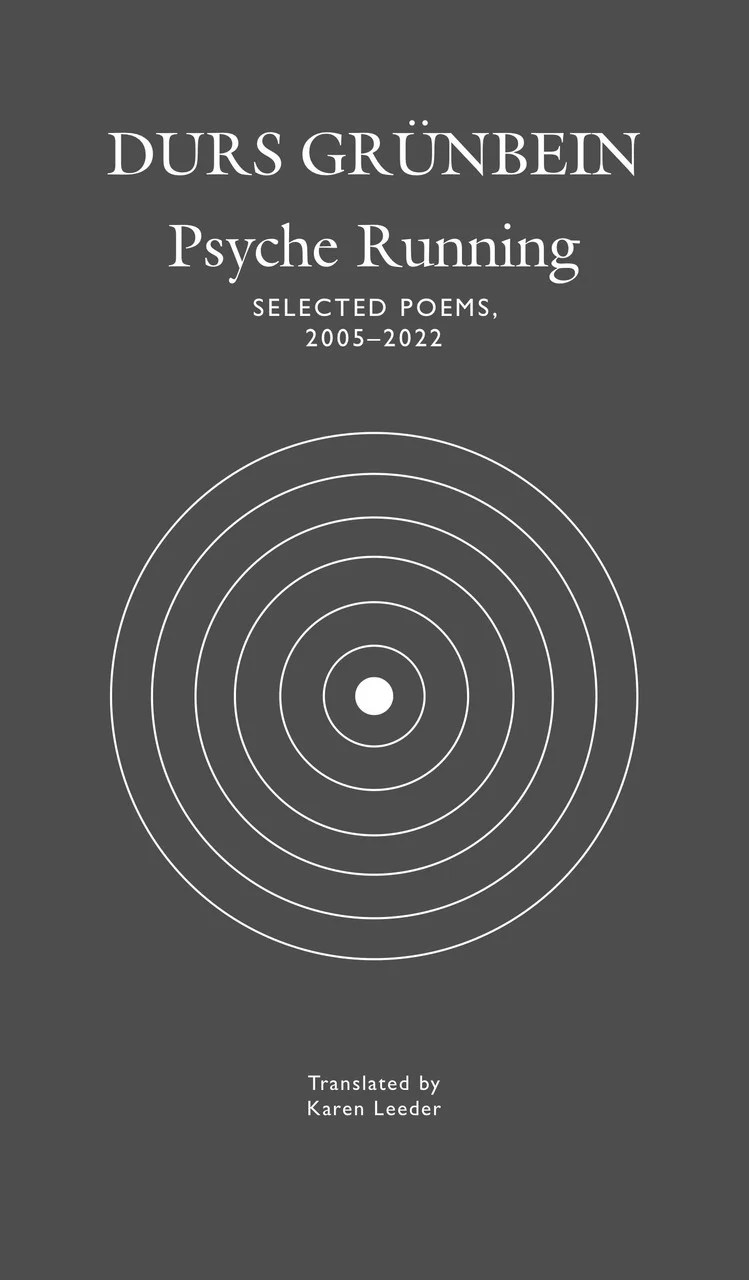
In that strange, that golden light: Psyche Running – Selected Poems, 2005–2022 by Durs Grünbein

And suddenly you saw it, far below
the coast road, after the twelfth curve,
stomach surging from the hair-pin drive.
En route for the south; so we sped on
perched above the drop, windows down.
Sorrento with its villas, its fan palms,
had been swallowed by the plug-hole
of the mirror in a great green swirl.
It hung in the haze, a hulk of bare rock.

The sea dead still. Not a trace of myth,
but for the yachts decked out in chrome
glinting in the sunlight. On a white hull
we made out ‘Nausicaa’ in faded letters.

Infectious energy, shifting, rising and falling. Durs Grünbein is a poet who writes as if regularly navigating the kind of winding roadway described here in “Island without Sirens” from his 2013 collection Colossus in the Mist. This poem, dedicated to Alexander Kluge, which begins with the promise of finding a site with rumoured Homeric association and ends with the view of an island not unlike a mass of barren lunar rock rising out of the water, is a clear reflection of what has made him one of the most important and successful contemporary German poets. Now his most recent release in English translation, Psyche Running: Selected Poems, 2005–2022, has just been shortlisted for the 2025 Griffin Poetry Prize (his second such honour for this prestigious award).
Born in Dresden in 1962, Grünbein moved to Berlin in his twenties to study theatre. Since the fall of the Wall, he has travelled widely and presently he lives in both Berlin and Rome. He has published more than 30 books of poetry, along with translations of classical and contemporary authors, essays, libretti, lectures, and collaborations with artists, composers and filmmakers. His prolific writings cover such a wide scope of literary form and history that he has, as translator Karen Leeder notes in her valuable Introduction, called himself an “unpoet.” Nonetheless, poetry remains central to his work, having won him widespread recognition and a number of major awards. The present collection offers an ample illustration of the breadth and appeal of his poetic vision.

The selections in Psyche Running represent nearly two decades of Grünbein’s output, drawn from ten volumes published beginning in his early forties through to the age sixty. As such, they trace the poet’s growth in mid-life and mid-career, his changes in tone, themes and exploration of form. This collection opens with work drawn from two books published in 2005. Both feature poetry inspired by history, though in very different contexts. Portraits of personalities and scenes from the ancient world figure in The Misanthrope on Capri while his focus turns closer to home with Porcelain: Poem on the Downfall of my City. The latter is a cycle of forty-nine numbered poems, a lament for Dresden, destroyed by Allied bombers in 1945. Yet, even in an elegy, Grünbein’s playful tendencies surface—something that was not necessarily received well by some readers:

Not a rowdy wedding-do. It was The Night of Broken Glass
or, what sharp-tongued folk called: the glazier’s lucky day.
And Ash Wednesday just a hop, skip and jump away.
Fools and Nazis—huzzah!—sure, they had a blast.
What’s that? Innocent? Disgrace came long ago.
Dresden shepherdesses, German bands, where are you now?

–  from “4”/ Porcelain

Twenty-four of the short poems from this sequence are included in this collection, but the complete work, with photographs and one additional poem, has been published as a separate volume, also translated by Karen Leeder and published by Seagull Books. My own review can be found here.

2007’s Verses for the Day After Tomorrow marks a turn to a more personal focus, exploring  themes of memory and human experience, then, after Grünbein began to spend more and more time in Italy, another shift occurs. With Aroma: A Roman Sketchbook (2010) and Colossus in the Mist (2013) classical elements appear, as do poems that draw direct inspiration from Rome and its environs. In a number of the pieces selected from these two works he demonstrates a wonderful sensitivity to the natural world, as in “Island without Sirens,” quoted above, and this magical evocation of a murmuration of starlings moving through the evening skies above Rome in “Aroma XLIX (Starling Swarms)”

How one envied them their nose dives, swooping down on
     gravel lanes,
or taking in Rome from a bird’s-eye view, conqueror style.
In fact, they only wanted a little urban updraft to be transformed
into currents and reflections, as their aureoles appeared
.     before
the rosé of the cloud-shading, in a sky painted by Turner.
It was a dance of veils, a stunt performed by thousands of
     points in synch:
something like the sound of bells, visible in silhouette above
    the domes.

The influence of  thinkers, ideas, and science on Grünbein’s poetic instincts takes centre stage in the next section, the first published translations from 2014’s Cyrano; or, Returning from the Moon. Each piece in this cycle of eighty-four poems, inspired by Cyrano de Bergerac, “takes its cue from a moon crater” Leeder tells us, “and pays homage to a thinker or philosopher known for their study of the moon.” The poems presented here were selected by the author and I, for one, would love to be able to read this inventive work in full. The mood changes once again with the next selection, the long poem “The Doctrine of Photography” from The Zoo Years: A Kaleidoscope (2015). Presented alongside postcards of prewar Dresden from Grünbein’s personal collection, this piece imagines into being scenes from daily life in the community as darker times close in:

Another spring. Imperial gardens on display:
for six months the magic of flowers
serves to ease the effects of the new
constraints, the new laws.
A hymn to existence, a scared hymn
to the beauty of nature around us,
the newspapers swoon in the
grandiose style of the times.
More powerful than any Olympiad,
closer to a feminine aesthetic sense,
like Hitler’s hands, eunuch-white.

A strong selection of poems have been chosen to represent the final two volumes collected in Psyche Running. Sparkplugs (2017) and Equidistance (published in 2022, marking the poet’s sixtieth birthday) build on imagery, sometimes dreamlike, drawn from science, nature, and everyday life to explore more introspective or existential themes that reflect an increasing awareness of aging and remembrance:

Do I know how many summers we have?
Whether we will recognize them as they were,
these  outdoor scenes, where we
slipped quietly past each other like angelfish
in that strange, that golden light?

I only know the day that keeps what
will happen next hidden behind glass.
Things grow more distant, swim up close,
in the film light. And the projector is me.

–  from “The Projector” / Sparkplugs

Altogether, this generous sampling of Grünbein’s poetic work over the better part of the last twenty years, fills in a long overlooked gap—Porcelain notwithstanding—in the availability of his poetry for an English language audience going back to Michael Hofman’s  2005 translation of a selection of poems from his first four collections, Ashes for Breakfast. Karen Leeder, who in addition to Porcelain also translated Grunbein’s Oxford lectures, For the Dying Calves (Seagull, 2022), has come to know the poet well over the years and has a deep affinity for his wry, vibrant spirit. Her informative Introduction and detailed notes provide an overview of the collection, her approach to this translation, and added detail, as required. Although he frequently draws on historical, philosophical, literary, and scientific sources, there is, in Grünbein’s perceptive, witty, and engaging verse, an irresistible quality that naturally invites a closer read. This volume, then, is not only an important addition to his available writing in English translation, but a wide ranging and vital introduction for anyone new to his work.

Psyche Running: Selected Poems, 2005–2022 by Durs Grünbein is translated from the German by Karen Leeder and published by Seagull Books.

To translate the human experience: Arabic, between Love and War edited by Yasmine Haj and Norah Alkharashi

We live in a world that is always in flux. Conflict, natural disasters, and political destabilization are continually reshaping our world and threatening our future on an intimate, community and global scale. An element of the universality of the human condition unites us in our response to these factors while privilege, culture, and history set us apart. To begin to understand where others have come from, what they have been through, their trials and their dreams, we must be able to speak to one another, learn to listen, and read their words. This is why translation matters.

The art of literary translation is often said to be both impossible and necessary. Impossible because no linguistic code is commensurable with any other—particularly so in the case of poetic language which, being among the most refined and expressive of literary forms, is expected to have myriad and complex nuances. Yet translation remains necessary. Without it there would be no conversation across linguistic and cultural barriers, no prospect of the mutual understanding that remains a prerequisite for the peaceful, emancipated life towards which we are all striving.

These are the words of translator and scholar Norah Alkharashi from her introduction to arabic, between love and war, a distinctive collection of poetry co-edited with Yasmine Haj and newly released by the independent Canadian publisher trace press. This anthology, which gathers the work of poets and translators from across the Arabic speaking world and its diaspora, arose from a series of creative translation workshops, facilitated by the editors, that allowed translators from varying backgrounds the time and space to explore the “processes of loss and unlearning encountered on their path to translation as critical creation.” This unique collaborative engagement ultimately led to the selection of thirty-seven thematically linked poems, presented alongside their translations—Arabic to English or English to Arabic—that comprise the first release in the trace: translating  [x] series.

The title and theme of this project illustrates one of the central challenges of the art of translation: how to reflect the nuances implicit in one language within the context of another. In Arabic, only one extra letter separates the word for “love” حب from the word for “war” حرب , a distinction that can have many implications in poetic discourse, especially when the two realities are often so deeply entwined in the lived experience of so many in the Arabic speaking world. Here the collected poems are divided into three sections: Love, Interval, and War, but the boundaries cannot be so clearly drawn. War frequently lingers in the background, even when a poet speaks of love; while love is a persistent life force even in the face of loss, loneliness, and displacement. And once again, the memory and fear of war haunts, even in the quiet in between conflicts—in the interval.

The poems of the first section, “Love,” tend to be tinged with sadness and longing, be it for for an imprisoned child or a lost lover:

I remembered you!
.              I remembered the silence growing slightly wet,
             and the trees that shaded us,
             and the fragrance drawing near.

             I didn’t know
that we were on the edge of everything
and that one word
alone was enough to wither a tree,
             that silence turns into shade,
             and the heart a safe haven for pain.

– from “One Word” by Ali Mahmoud Khudayyir
Translated from Arabic by Zeena Faulk

Meanwhile, the longest section, “Intervals,” casts the widest emotional net, speaking to the most fundamental elements of human experience—birth, death, hope, despair—in a world that can seem to turn without reason, or as the epigraph to this part says, those “liminal spaces where wars of flesh and love—ongoing, past, or yet to pass—have lingered. Holding hearts and words in limbo, with beats yet to be translated.” Lena Khalaf Tuffaha’s “Time Travel,” originally written in English, captures this unsettled sense succinctly:

. . . We travel because
motion is more comfort

than settling, calcifying.
We travel because it means

we haven’t gotten to where
we’re going yet, the story

is still being written and
our fractures aren’t done setting.

There is still a chance
we’ll turn out different

or better or—best of all—
like our parents without

knowing we’ve become
who they were. . .

Finally, it is sadly no surprise that the poems in the “War” section are the most direct and unequivocal. But they are not without a promise, however faint, and hope for a future free from the ravages of war:

I wish I could, I wish it were in my hands
to uproot injustice
and dry the rivers of blood
off this planet.
I wish I could, I wish it were in my hands,
to hold for this man, tired
in the path of confusion and sorrow,
a lamp of prosperity and serenity
and grant him a safe life.
I wish I could, I wish it were in my hands,
yet all I have at hand is a ‘but’.

– from “This Earthly Planet” by Fadwa Tuqan
Translated from Arabic by Eman Abukhadra

These are but three brief excerpts. The poems gathered here represent the work of fifteen poets chosen for translation by fourteen translators (some translate more than one poet or are also poets themselves), and together the contributors come from varied Palestinian, Iraqi, Jordanian, Saudi Arabian, Lebanese, Sudanese, Tunisian, Egyptian, Syrian, Canadian, American and British backgrounds. Some of the poets write in English (and are thus translated into Arabic), whereas some of the translators are scholars specializing in Arabic. This rich range of perspectives and differing Arabic literary traditions must have contributed to a vibrant workshop environment which is distilled in this elegant and vital anthology.

arabic, between love and war is edited by Yasmine Haj and Norah Alkharashi, and published by trace press.

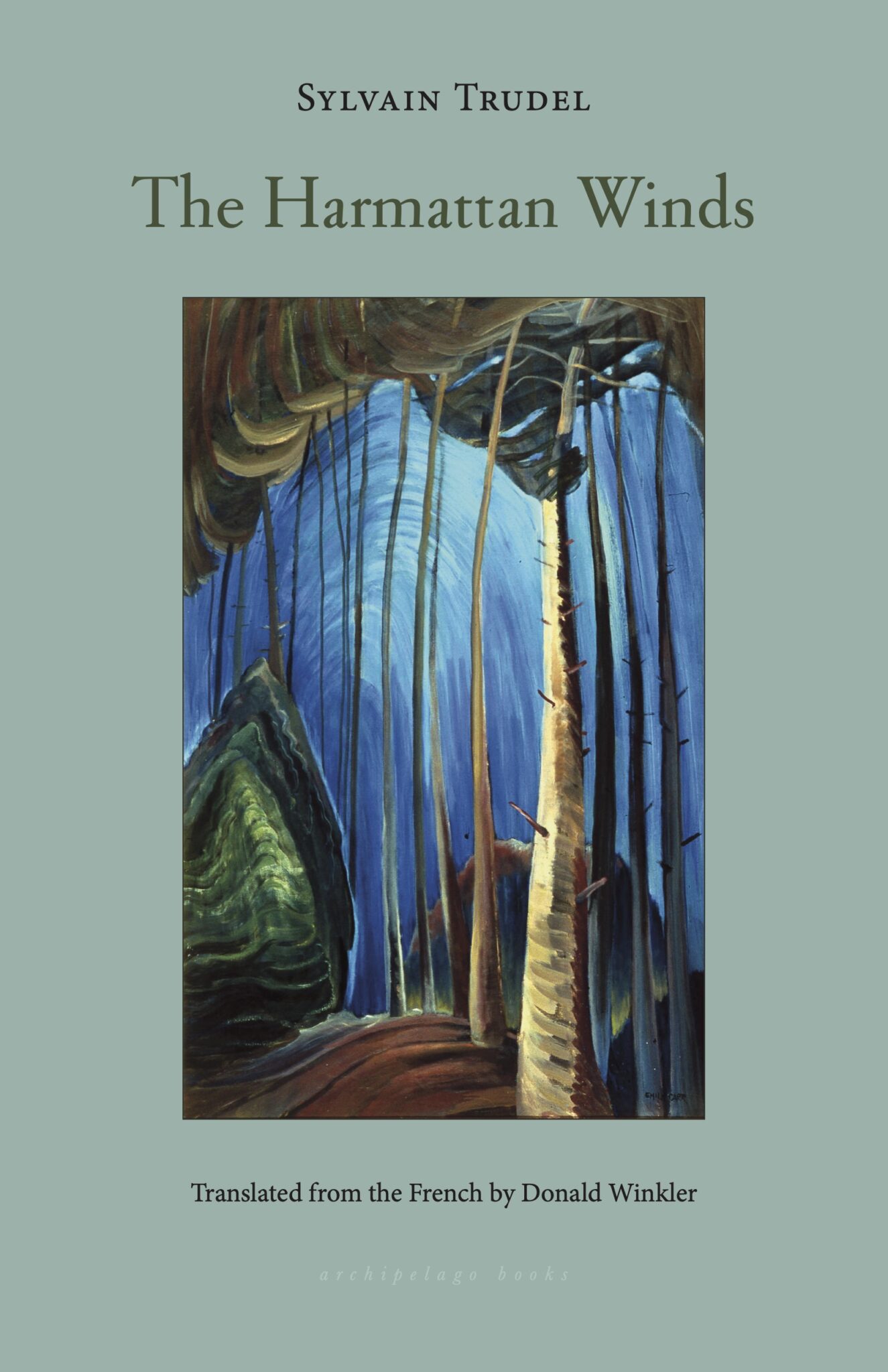
I who dreamed of Africas: The Harmattan Winds by Sylvain Trudel

As for me, I didn’t exist until I was six months old, because up to then no one wanted to be bothered with such a case. Just my luck, I was not an official being, since there was no trace in the records of my coming into the world. Born by the side of the road like a natural disaster incarnate, I had not known the holy oil of baptism, and no one thought to scrawl my name on a government document or anything resembling it, nor even to take an ink print of my tiny foot for a hospital data sheet, even if it was as cute as a tiny goblet. In short, no one dared to believe in me even if I was born bottoms up, like everyone else.

Such is the misfortune of Hugues, abandoned in a shopping cart in a bog of bulrushes by the side of the road, only to be rescued and adopted by Céline Francoeur and her new husband Claude, granting them an instant family, or as he describes it, “they could have all of that indescribable joy, minus nausea or miscarriages, as long as no one went to claim me from the lost property counter.” Despite his unfamiliar appearance, his crossed, slightly almond-shaped eyes, it is not until he overhears his “adaptive” parents arguing over whether he should be told the truth, that the reality of Hugues’ origin story becomes known to him, forever shifting his perspective. Céline and Claude become his semi-parents, his brother and sister his semi-siblings, and his entire existence, in his heart, is rendered incomplete.

The Harmattan Winds, by French-Canadian writer Sylvain Trudel, originally published in French in 1986, is the dramatic, youthful account of a boy who does not know where he really comes from. However, there are two unlikely companions who give meaning and purpose to what might have otherwise been a lonely life in an isolated town in 1970s Quebec. One is a well-worn  collection of poetry by the fictional Gustave Désuet, a flea market find that Hugues carries with him everywhere, reading from it like a guidebook, memorizing the florid and overwrought verses which he admits he doesn’t always understand. He turns to it for comfort and enlightenment—and one also suspects much of his exuberant sense of drama, tragedy and romance are inspired by the poet’s example, even if his misunderstandings and misspelling lend his often enigmatic narrative an internal logic entirely its own. Hugues believes that Désuet, long dead by his own hand (and a rope), helped him to live his life.

He was sort of a paper tiger who one day took up his pen as you would arm to do evil, and poison dripped from his nib. A real viper, that tiger. He said that we, the rich of America and Europe, we’re living in the Accident, curled up in our accidental countries, and the Bible’s Apocalypse is a great idiocy because it has already begun and no one sees it, it’s ongoing right under our eyes that choose to run and hide behind their lids, but it’s there, and, in fact it’s us, yes, the Apocalypse,  it’s ourselves, we are the cataclysm of the poor, seeing that we kill them with one hand hidden behind our backs in the convenient darkness of our heads, so as to stay rich at their expense.

This accidental (that is, occidental) guilt inspired in our hero by his beloved poet, no doubt prepares him to embrace the second companion who suddenly comes into his life. When Habéké, an Ethiopian boy orphaned by famine and adopted by a couple from Montreal, arrives in town, Hugues is naturally drawn to him. They are the same age, and both are potential social outcasts amid the vagaries of early adolescence and the latent racism of the local community, but even though Habéké has already learned the essentials of his new life—to speak French, sing O Canada, and ride a bicycle—he carries within him the dark mysteries of a world beyond the Accident. An irresistible attraction.

I remember that I loved talking with him about Africa, and that is why I know some things today, for example that Africa is a stew of languages and that Habéké’s is full of burgeoning vowels or that in Africa men’s problems, due to their galloping demography, are both acute and grave, high-pitched and low, therefore circumflex, making Africa a kind of quotient, for it is, according to Habéké, the product of divisions between peoples, and over there that’s all there is, peoples. . . . There exist, however, little hooded hats made of soft rubber to rein in the ardor of the peoples, not well attuned to the circumflex dilemmas of Muslims or animists. And then those rubbers look like the moltings of snakes or little caimans, and I’m wondering what a man of this ilk would do with such a device, he who revers the companionship of sacred pythons and crocodiles.

But there is more. Habéké’s exotic wisdom, along with his distinctive appearance, set him apart from the world in which fate had landed him so far from his native land, and in this Hugues finds an echo of his own mysterious dislocatedness.  He sees in him a brother in arms and confesses his own truth: “I told him about my calamity in the bulrushes, my botched birth, my lost invoice, my semi-family, my other man’s eyes, and all and all.” An unbreakable bond is formed—one that sees them through all manner of adventure, outrageous schemes, and some incredibly close calls.

With the spirit of a fairy tale, yet at the same time grounded in small town Quebec (or Canada generally) in an age before video games, computers or many available television channels, this novella surges with energy. Hugues’ willingness to follow Habéké’s increasing desire to connect with his traditional heritage, arising from myth as much as memory, and bound to their mutual desire to escape, not only lands them in more than a few risky situations, but also ends up threatening the safety of two teenage girls they befriend.

Youthful narrators can be hit or miss, but the magic of this coming of age tale rests firmly on the imagination, determination, and entirely idiosyncratic worldview of Hugues and Habéké. The endless forests, rivers, and railway lines that surround them become the African landscape they dream of exploring, and the island of exile they imagine escaping to to live out their naïve utopian dreams. Fast paced and original, it is wonderful to finally have access to The Harmattan Winds in Donald Winkler’s lively English translation.

The Harmattan Winds by Sylvain Trudel is translated from the French by Donald Winkler and published by Archipelago Books.