
When I was a pupil, we learnt to read and write with a primer. When war breaks out, Bertolt Brecht said, we have to learn to read and write again.
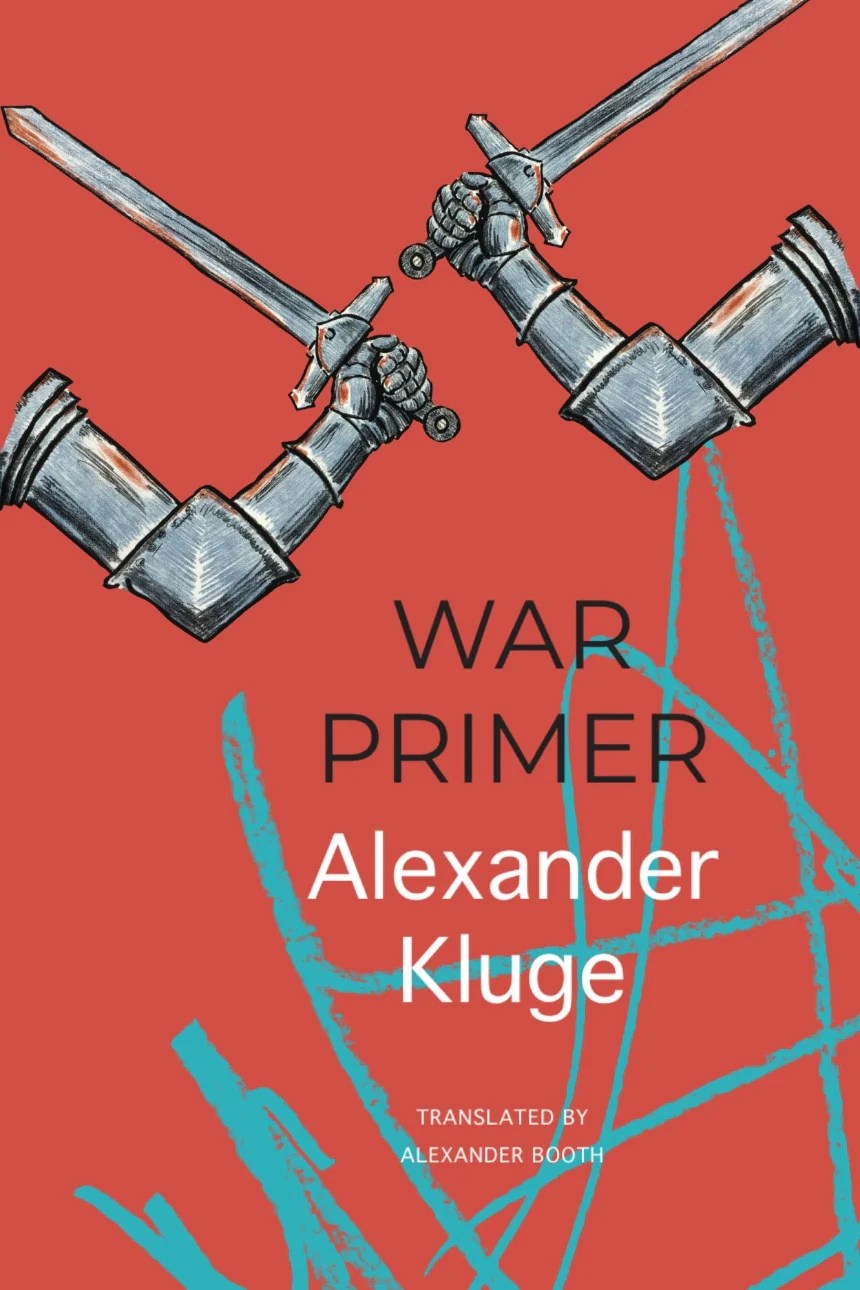
These words, which come from the acknowledgement at the close of Alexander Kluge’s War Primer, reference both the primer as a short introductory book on a subject or informative piece of writing, and Brecht’s famous War Primer, a series of short poems written in response to images the poet collected while exiled from Nazi Germany during the Second World War. Kluge’s own experience of the war, especially the allied bombing of his hometown of Halberstadt when he was thirteen, has had a significant influence on his long career as a writer, philosopher, and filmmaker. And again it appears here in this slender volume, but the instigation for this work is Russia’s invasion of Ukraine in 2022—the return of full scale war to Europe. However, his multi-faceted look at our stubborn propensity for conflict across the western world, is both wide and immediate, and conveyed via brief historical accounts, anecdotes, short stories, and imagined conversations, interspersed with images and film clips.
 The book opens with a personal series of reflections. He thinks of his mother, born in 1908, considers how little he and his fellow students understood of the dangers mounting in late 1944, and recalls the last few months of the war and the burning of his hometown on April 8, 1945 (a subject to which he has devoted an entire book). As a boy whose sense of war was much coloured by the exploits of his tin soldiers on imaginary grounds, he could only have a thirteen year-old’s understanding of what the troops he was observing on those final days meant. From today’s perspective—in the case of this volume, his ninety-first birthday in February of 2023—his knowledge is much deeper, broader, and no less troubled.
Although some of the textual and visual material directly references the current conflict in Ukraine, the overall effect here is to create a mosaic of contextual commentary and musings about the nature of war, the military mindset, and the inevitable, often deadly, dance of diplomacy. Kluge’s short pieces approach moments or aspects of the First and Second World Wars, the US Civil War, the invasion of Iraq, and more. He examines the idea and illusions of armour from different angles, zeroes in on specific battles, and dramatizes often hapless discussions about the dynamics of power and peace. This is not a detailed exegesis, it is rather a collection of vignettes. Kluge’s characteristic approach to fiction that holds close to the borders of nonfiction, allows him to incorporate voices from the past in first person or dialogue. Yet, there are no solutions. As we continue to see, war is endlessly reinventing itself, and its small moments of hope always cling to a thread:
TWO SIDES TO A HAPPY ENDING
In the early days of the Ukrainian war, there was a report of a certain number of villagers, including young people and children, holding up a Russian tank. After a period of hesitation, the tank driver put it in reverse and rolled back out of the village.
This is an urban legend. It was already making the rounds during the Hungarian Uprising of 1956. During the 1991 coup in Moscow, the scene actually occurred several times and led to several tank divisions withdrawing from the city. In Beijing’s Tiananmen Square, however, the same kind of confrontation ended in a massacre.
The report in the case of Ukraine emphasized the bravery of the civilians who opposed the tank. But it takes two to tango, as it were, for an encounter to end happily: the determination of the residents, but also that of the young tank driver, perhaps all of 18, who put the tank in reverse.
The images that illustrate this book come primarily from Kluge’s original film montages, along with a few documentary photographs. QR codes link out to cinematic material of varying lengths, typically triptychs of these same images shifting against musical scores, but other material as well. Most are very short and worth viewing. Taken together, text, image, and sound make this very much is a primer for the twenty-first century. One that, sadly, seems to be still be a necessary resource.
War Primer by Alexander Kluge is translated from the German by Alexander Booth and published by Seagull Books.



 roughghosts