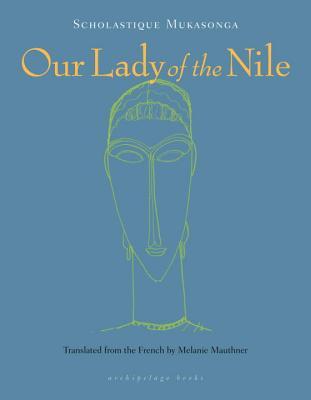
School Days: Our Lady of the Nile by Scholastique Mukasonga

“Our Lady of the Nile: how proudly the school stands. The track leading to the lycée from the capital, winds its way through a labyrinth of hills and valleys and ends, quite unexpectedly, in a twisting climb up the Ikibira Mountains – which geography textbooks call the Congo-Nile range, for want of any other name.”

NileThis first novel by Rwandan born French writer Scholastique Mukasonga imagines life in an exclusive girls’ school high in the mountains of Rwanda close to the source of the Nile. Created by the Belgian Catholic church to nurture and prepare the daughters of wealthier Rwandan families for a future that befits their pedigree in the now independent nation, the lycée offers a well rounded education for a young lady and protection from the undue attentions of the opposite sex. Being a virgin, or at the very least not pregnant, is still key to securing a good marriage. And keeping watch over this small community is a blackened statue of the Virgin Mary enshrined nearby, practically assisted by a rigid Mother Superior, several sisters and a chaplain with a lecherous eye for his female charges. Lessons cover academic subjects, languages, religious studies and finishing school skills such as cooking and sewing.

Our Lady of the Nile opens at the beginning of a new school year. Land Rovers, limousines and buses arrive to deposit students. As one might expect, the girls form alliances, engage in gossip, develop crushes on the French male teachers. Assuming a dominant role among her third year classmates is Gloriosa, the big boned, intimidating daughter of a high ranking Party official. In the Hutu dominated nation, her greatest scorn is reserved for the two Tutsi girls admitted under the quota requirements, Virginia and Veronica.

As the year progresses it becomes clear that for all the Catholic school’s efforts to civilize the young ladies, traditional superstitions, beliefs, and customs have a strong hold over the students at the lycée, blending in with Christian faith and fear. For Veronica in particular, another element comes in to play. An eccentric white man who lives nearby on a crumbling estate, lures her into his obsessive fantasy about the Ancient Egyptians and his belief that the Tutsi are their direct descendants. In her vanity she is willing to entertain his delusions. Virginia is skeptical and uncomfortable by her friend’s willingness to assume a queen’s role and seeks instead to assuage disturbed spirits.

Of course underlying racial tensions are never far from the surface. One student, Modesta, with a Tutsi mother and Hutu father, is caught between the two. She likes to confide in Virginia but cultivates a place of security by playing Gloriosa’s lapdog. Although the Rwandan genocide is still years off at the time this story is set, violence is a real and present threat and each side is aware of where their fate lies and it all comes down to a question of race:

“Because there were two races in Rwanda. Or three. The whites had said so; they were the ones who discovered it. They’d written about it in their books. Experts came from miles around and measured all the skulls. Their conclusions were irrefutable. Two races: Hutu and Tutsi, also known as Bantu and Hamite. The third race wasn’t even worth mentioning.”

As Our Lady of the Nile unfolds, life at the lycée and the adventures of some of the girls in this tiny African nation are sketched out at a slow, simmering pace. However, because each chapter tends to deal with a distinct event, the novel has the feel of interlinked short stories. I did enjoy this book, it reads well with moving, often funny, passages, but the overall effect is somewhat disjointed. I found it too easy to put it down and not pick it up for a day or so. A little more consistency and tension would have helped propel the story toward what is a shocking and violent end.

witmonth15Translated by Melanie Mauthner, the tone is graceful and clear. But I have to say that there was one moment that set the reading experience off and had me wondering where the editor was. Told from an omniscient third person perspective throughout, there is one paragraph that falls into the first person plural, in the first half of the novel. The effect is jarring. One of those times that, as a reader, one wants to have a peek at the original text.

* Our Lady of the Nile was longlisted for the Best Translated Book Award (BTBA) 2015

Reflection: Fishing for memories denied

It is rare that I indulge in sharing a significant quotation simply because it speaks to the space in which I find myself but I keep returning to these words from Intimate Stranger by Breyten Breytenbach (Archipelago Books, 2009).

“Writing is fishing for memory in time. Viscous. Time black. Sometimes you see it flitting just below the surface – memory – miming time. Memory takes on the blackness of time. Memory will be time surfacing. Use word as bait. Beat the water. Beat the weird beat of baited words. Bloated. Wounds. The bleeding words like wounded boats on a black sea. Let the fleet wash up. The coast is the beginning of the sea’s wisdom. It comes with the territory.

Words have their own territory, they return home as in a song. The fish only discovers the water once it is removed from it. This land is a memotory.

But not peaceful. Memory as trigger for territory and tongue. The mind is full of bloody pieces staked out by tongue. Is there room enough? Memory killing memory.”

initmateThis book, a selection of meditations on reading and writing, was waiting for me when I returned home from the hospital just 10 days ago. I have been keeping it close and dipping in and out of it. Breytenbach is a South African poet, writer and painter but his life, his work, his vision is borderless. In this collection he offers practical advice, shares poems and reflections on the power of the word, drawing on his own experiences as well as the wisdom of a legacy of gifted writers.

Memory is the foundation of writing. One draws on experience when putting pen to paper – poetry, fiction, memoir alike. And it is memory that is weighing me down, threatening to drag me beneath the surface; a memory that haunts and obsesses me because although it involves me, I will never access it.

I have lost a space in time. Like a bruise it bleeds beyond the boundary of the injury, reaching backward and forward from the instant a clot in my lung threatened to stop my heart. Days are absolutely gone, the day or two before the incident, the day or so in ICU and the first days after waking. But I can’t let the blackness go. I cannot let it wash out to sea. I want to hold the moments, hours, days in my hands but I cannot. They do not belong to me. They are about me. They will never be mine.

I have read my discharge summary until I know it inside out. I have pestered my anxious son with questions. What was it like to find me in distress? How did you get to the hospital? How did you feel? Stupid questions. I am struck with shocked disquiet to realize that my family did not know if I would survive.

If I had not survived the blackness would be complete. Viscous. Time black. Inanimate from my perspective. My own memories lost. The sole distorted possession of those who knew me, no longer mine.

Sands are shifting. I have some fishing to attend to before the next high tide.

Indian Ocean, Eastern Cape, South Africa Copyright JM Schreiber 2015
Indian Ocean, Eastern Cape, South Africa
Copyright JM Schreiber 2015

Witness to old times: Harlequin’s Millions by Bohumil Hrabal

“…what is human happiness? Whatever it is, unhappiness is always lurking just around the corner…”

One of the last novels by Czech author Bohumil Hrabal, Harlequin’s Millions opens as an elderly woman and her husband have settled into an old Gothic castle which has been converted into a pensioners’ home. This fantastical seniors’ residence, once the resplendent abode of Count Špork, is perched on the edge of a small town, a little place where, we are told, “time stood still”. From the opening pages, the reader is swept into the meditative melancholy reminisces of a once proud and self-centred woman. As she looks back on her own life and the way that history has formed and reshaped her hometown, and in fact, her country; images, phrases, and characters flow through her account echoing the serenade that is piped throughout the premises and lends the novel its name:

“The string orchestra curls gently around the old tree trunks and ‘Harelquin’s Million’s’ climbs like old ivy into the crowns and trickles down along the leaves, the corridors of the home are filled with a pleasant phosphorescent gas, with the scent of cheap perfume, so no one is really aware of the music, only when there’s a power failure and ‘Harlequin’s Millions’ is suddenly cut off, stops short, the way everything stops as if by magic in the tale of Sleeping Beauty, all the pensioners glance up, they look up at the speakers and the sudden loss of the music feels to them like when the lights go out and everyone longs to hear it again, because without it the air in the castle and along the paths in the park is unbreathable.”

HMThe gentle narrative flow will not be rushed. Each chapter is one long languorous paragraph. Our unnamed narrator is by turns sentimental and shrewd. Toothless, wrinkled and defiant, she casts her keen eye on her fellow pensioners and systematically dissects her own life and marriage. Her husband Francin remains glued to the radio, following all the news he can access from afar and looking ever to the future, while she realizes that she has become increasingly enamoured with the history of her town, with the past. Her guides are three eccentric male residents of the seniors’ home, her “old witnesses to old times” who periodically wax lyrical about the milestones that have passed, the characters who have come and gone, the memories that risk being erased like the weathered sandstone statues in the park and the cemetery headstones that are ultimately removed and carted away. It is difficult not to get wrapped up in this reflective monologue, swept away with her musings about joy, vanity and loss.

But be assured that this is not a novel without humour. In one particularly hilarious episode, a handsome young doctor who fills in for the regular octogenarian physician, arrives and shakes up the sleepy environment of the home. He cuts back sleeping medications, advises his male patients to smoke and drink more, and inspires this female patients to powder and preen. Then, as an antidote to the ceaseless string orchestra theme that filters through the grounds, he heads into the former banquet hall with a phonograph and an armful of records. Beneath the ceiling painted with glorious battle scenes from ancient Greece, the music he plays stirs in his ancient patients memories of youth, passion and the glory of war. But it is the doctor himself who snaps from the intensity of emotion, setting off on a wild rampage, trailed by his female admirers, like a hoard of crazed aged groupies. Needless to say, in the end, the medication regime is resumed, “Harlequin’s Millions” once again pours forth from the ubiquitous speakers, and order is restored.

An ode to his own hometown, Hrabal offers, in Harlequin’s Millions, a deeply affecting meditation on collective versus personal memory. For this little “town where time stood still”, time is only standing still for the observer. In the rooms and halls of the Count’s former castle, each elderly resident wanders lost in his or her own thoughts, passing time, waiting until it is their moment to move on. The past belongs to the community but its experience is in the sole possession of the individual. It is at once resilient and transient.

Stacey Knecht’s sensitive translation brings to life the beautiful, hypnotic prose of this wonderful novel – my first encounter with the work of Bohumil Hrabal and with another fine not-for-profit press, Archipelago Books. I am most impressed by both.