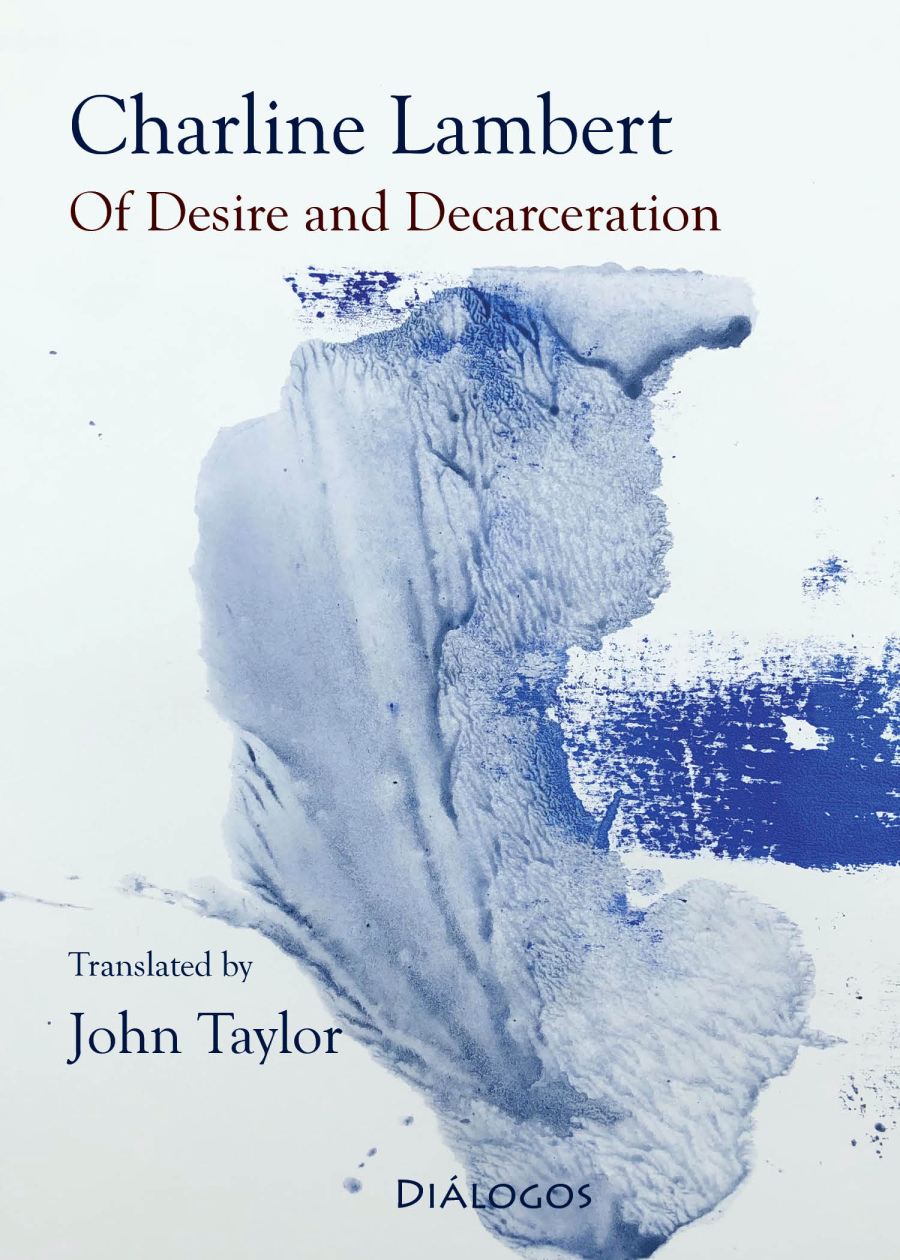
“and every day / you elucidate a knot”: Of Desire and Decarceration by Charline Lambert

When a poet’s work first appears in translation, it is rarely more than a single volume or an edited selection. Even then, it can take decades for a prominent foreign language poet to be finally be translated and published in English. But for young Belgian-Francophone poet Charline Lambert (b. 1989), the situation is quite different—her first four books of poetry (originally published between 2016 and 2020) have recently been released in one single, dual-language volume titled Of Desire and Decarceration. As her translator, John Taylor, explains in his Introduction (an earlier version can be found online here):

The motivation for bringing forth this substantial corpus is that the four books respond to each other, grow out of each other. They are like stages—beginning with the evocations of bewitchment, temptation, restraint, and detention besetting Ulysses, Circe, and Penelope in the poet’s first book, Hemp and Ivy—of an ongoing quest to grasp the mysteries of desire and gain insight into its innermost relationship, not only with the body, but also with language.

Her work is vibrant, ecstatic, alive—rich with imagery drawn from mythology, philosophy, nature, science and physiology. As someone very familiar with Taylor as a translator and a poet, I can see why he was so immediately captivated by her emotionally and linguistically inventive poetry which he has brought into English with such care and attention.
To read Lambert’s first four books—each an extended sequence of verse and poetic prose pieces—in sequence is to experience the poet’s deepening exploration into questions of identity, where an embodied self-expression is examined at the minute, physiological level in concert with an expansive metaphysical self-realization within an external world of earth, wind and water. Although subject, voice, and form shift as one moves from volume to volume, her writing is typically spare, and the same essential human forces—desire, solitude, spirit, joy—are present, even if they may be the source (or the outcome) of struggle and pain, while her occasional use of uncommon, even esoteric, words reflects the limits and the potential of language to capture complex states of being—in the body, the mind, and the world. There is a tension in the interplay of all these elements that courses through her work, finding new expression with each successive book.

Her first book, Hemp and Ivy (Chanvre et Lierre), as noted above, reimagines Ulysses’ encounter with Circe and brings Penelope in to the drama. All three characters struggle with desire and temptation in their own ways. For Ulysses, bound to his mast, his desire and the lengths he must go to avoid a tragic fate is depicted with vivid intensity:

    A desire swarms, coming from even farther
than the esophagus, a desire rounder than the
navel, more burning than the urethra. A resonant
canalizing desire, which widens the dikes of the
arteries and erodes the epidermis. It will later
become a song, if it is not hemp.

.     Circe’s fate is a patient fate.

*

   Naked ivy on the mast, a column of climbing
vertebrae.
   In volutes of breath and nervous arabesques,
he hoists himself into the sky.
.    He unfurls his great back muscles of wing or
verve.

From this mythologically themed excursion, Lambert’s work turns towards a more abstracted poetic examination of the themes and questions that inspire her. Her second book, Dialyzing (Sous Dialyses) turns on her idiosyncratic approach to language. As Taylor indicates: “Lambert’s writing, which often appeals to scientific and medical terminology, also sets into motion a poetic and self-analyzing process of ‘dialysis.’” Akin to the medical functions and procedures associated with the term, her subject here is removing an element from her body—physical, emotional, or mental—examining, processing, purifying it through the act of writing and returning it to the embodied form in which she exists. “She is ‘dialyzing’,” hence the title as Taylor has chosen for his translation. This sequence of poems also begins to hint at the struggle to break down the boundaries between the body and the self, a theme that will be explored more directly in her next book.

Lambert’s poetry is perhaps at its most explicitly scientific here, witnessed in the incorporation of unexpected  natural and physiological terminology in striking ways as her subject explores the intricacies of her own desires in a manner that blurs or escapes the limitations of the physical form and merges with a natural environment:

.    At the edge of a cliff, potent dialysis, she
fights over the infinite with the ocean. But they
breathe at the same gill.

.    Their breath escapes, enters through a crack,
dashes to lose itself in the volutes of her pleura-
colored dress.

There is a breathless intensity to her verse that is especially evident in this sequence as her subject repeatedly loses, dissembles, and reconstructs herself in a windy, watery, earthy space:

    She unstitches each vertebra from her
spine, carries out the denuding of her neck, her
windpipe, her thighbone.
    Erects them into a new nudity of columns.
.     Anchors it in soil, and watches herself grow.

But in the end, she is enveloped once more.

With her third book, Decarceration (Désincarceration), Lambert seeks to redefine identity and existence beyond the prison of embodied existence. The idea of breaking free from an incarcerated state of being (incarnation) is openly explored now in succinct, precise verse, addressed to “You”—a movement, at least in the progressive reading experience, closer to the speaker’s own self. The fleshy matter of the body has a limit that can seem impossible to override, so the first step is to free the language you employ to define your being:

You are a countable solitude.

You are a light shattered
into beams.

You are
A barely recognized fire.

*

You want to decarcerate the language from you,
decar–

cerate these words from your plexus
and every day
you elucidate a knot.

The struggle to emerge is a tension between solitude and longing as a path to both self-identification and transcendence. It is critical to be free to form and shape yourself before being named, defined by a  body and a pronoun.

Before evaluating
the situation,

draw up an inhuman
report

*

Re-forming oneself as meander, winding
into the maze before
the accident,

before having to be called
something.

This poetic invocation is open and affirming, and can be understood in more than one sense. In his introduction, Taylor speaks of the many challenges he encountered in his attempt to preserve or replicate the distinct word choices, puns, and double entendres that Lambert revels in. I would suggest that, as a primarily but not entirely unilingual Anglophone reader, one’s appreciation of her poetry is not dimmed for the inevitable loss of some of the allusions and word play. As for her fondness for unfamiliar words and scientific terms, many are essentially the same in both the French and English versions, and my dictionary did see considerable use, something which only served to enhance my reading experience (and vocabulary).

Finally, with A Salvo (Une salve), Lambert’s fourth—and in this context, final—volume, her poetic quest reaches a certain degree of resolution, and an understanding of Taylor’s impulse to translate and present these works together as one becomes clear. Again the voice shifts, as the poet’s speaker adopts an imperative tone, addressing the sensual and physical experience in relation to a natural and cosmic reality. An intense, incantatory rhythm propels this relatively short sequence, with its recurring double-stranded refrain “Inhabit the night / Enter the sea.” This is established in the opening pages as a rejection of the soul crushing cage of darkness:

Never again sight, its eyes aborting the horizon,
   that rude roughness in the psalms of the hand
.    from which the song of the clouds is removed.

And an invitation to a kind of whole body rebirth in the water:

Washing oneself–while seeking a flesh in which
  to be, a skin to embody oneself in. A swim.
.   A lapse of time. A parturient’s dawn. Then,
  nothing will better express thickness than
  fraying and fleetingness.

The strength of A Salvo lies, not only in its sustained energy—as befits its title—and in Lambert’s own maturity as a poet, but, in the deep satisfaction that arises from reading it as the culmination of the existential quest that unites her first four books of poetry. What a joy it is to have them together in one volume.

Inhabit the night—and these crystals of being,
.   emaciated out of deterioration, become meteors.
Enter the sea—and what you have already
.   experienced, decimated into a thousand
.   scintillations, becomes a sparkling splinter.

Of Desire and Decarceration by Charline Lambert is translated from the French by John Taylor and published by Diálogos.


We live in a gingerbread house: In Life by Eugène Savitzkaya

“In this house, we live relentlessly, filling eternity with our detritus.”

Life sometimes holds the smallest, unexpected surprises. Unassuming, they come along and sit there quietly waiting to catch your attention until one day…

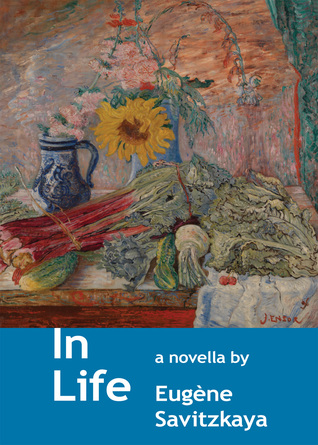
For me, those unanticipated gifts are invariably books. When, several months ago, In Life by Eugène Savitzkaya arrived, I was uncertain what to make of this slight novella with its simple cover featuring a still-life painting of flowers and vegetables. Savitzkaya, the publicity insert advised, is a French language Belgian poet, playwright, novelist and essayist, but what caught my attention was a link to an article about the author in Weird Fiction Review. Weird? That would not have been my first impression, it looks like such a simple text, yet as Edward Gauvin argues in his essay, the prose is minimal rather than abstract, but it is as if :

something has been subtracted from it, making us work harder for a fuller picture of what is being described. The result is a certain destabilization, dislocation, an alienation that does not distance you so much from the text as lock you alone inside it. Hence the usual adjectives: hallucinatory, intense, incantatory… the feel and unease of Weird.

With In Life, weird fiction is rendered domestic if you will, softly surreal, stubbornly anachronistic. In it, nothing happens and, yet, everything happens. Magical imagery, strange and wondrous, is applied to the quotidian ritual of hearth and home—cleaning,  cooking, repair and maintenance,  tending the garden, and nurturing of the soul of the house and its inhabitants. No task, no bodily function is unworthy of attention, often in unlikely detail. This is a book that revels in the minutiae of existence—the shed eyelashes and flakes of skin, the lost buttons, the crumbing walls, the weeds pushing through cracks in the walkway.

Above all, this is the story of a house surrounded by a garden, a neighbourhood, a town, hills, the sea and sky. A self-contained universe, from the crumbs that fall under the dining table to the scents that arrive on the breeze. At the heart of this universe, the house is a physical and metaphysical entity that must be maintained by those who dwell within, its contents sorted and preserved:

There isn’t only one way to tidy, but thousands—each necessary for structuring and mapping out the existence of the house, which is (well before it appears to be a system of doors, windows and walls) a whole system of alveoli. The simplicity of domestic life flows from the vast complexity of these alveoli. Just as you need a place for soap, you need a place for books. A place for sleeping and a place for sitting. A place for thumbtacks and a place for salt. A place for perfume and a place for stench. She who knows the place of each thing is capable of measuring the household’s degree of destitution or richness.

The narrator is a writer, a man with a fiancé and two children, a son and a daughter, echoing Savitzkaya’s own family, but this is not an autofiction, at least not in any biographical sense. His writing seems a secreted activity, gathered in snatches. He is aware of being unusual in that he is home at all hours of the day, actively engaged in caretaking, yard work, cleaning, ironing and, with special attention, preparing meals. His voice, however, is singular and plural, and shifts between perspectives. “We” might be the family, or a more comprehensive designation; second and third person may be employed to speak of others—for example the reader as an imagined guest—or to expand the universal nature of his reflections on the simple, most fundamental elements of life and the art of living.

Reading like an extended prose poem, this novella is a sensually charged evocation of the ordinary moment at its most ephemeral and most enduring. The narrator delights in unexpected imagery, sparking everyday rituals such as the family meal with fairy tale magic:

Thus assembled, we are ready to gobble a mountain of potatoes, loads of lamb, a cow, even an elephant. Animals fear us. But eyes are always bigger than bellies. They have a good sense of excess. As for us, we content ourselves with little, but have a yen to devour the world. We live in a gingerbread house. We drink birch sap from glasses made of sugar and when grief torments us, drops of brine fall from our eyes. We need light to eat—sun, honey or incandescent light.

Victuals are a central feature of life in this house, as one would anticipate. The meditation returns repeatedly to the growing, the preparation, the sharing, the bodily elimination and the disposal of leftover food. For vegetarians like myself, the meat content is considerable and carefully detailed, but, in fairness, the question of the respectful consumption of animals is not overlooked. Still, the passages on food are some of the most wonderful. After all, more than simply seeing to the nourishment of the family, the provision of food is an act of love with existential dimensions. Take for example, the act of peeling apples:

You can watch the blade as it slides under translucent skin. And, in your hand, you see a sort of phylactery unfurl, detailing the surface area of the fruit. This is a job that, if left only to me, would be eliminated evermore from the manuals of domestic life because an apple is a whole; the skin belongs to the flesh, the flesh is complete with the skin. Be that as it may, it’s worth the trouble. No activity, apart from washing dishes, is as soothing. From the instant that children ask for their slices of apples to bestowed on them without the peel, peeling becomes necessary and eminently interesting. Peeling becomes a way of being, a way of weighing the pros and cons, of conducting yourself in relation to objects, of searching under the skin for the illumination of flesh.

Love holds the house inhabited by Savitzkaya’s alter ego narrator and his family together. But the details fleshed out are not personal. It is as present in the cement troweled into cracked walls and the odours, fair and foul, that rise into the air, as it is in children’s laughter, or lovers in their shared bed. And embracing it all, is the garden. Here, as everywhere else in the universe contained within the pages of this small novella, reality is porous. It contains us but cannot be contained.

The garden’s only goal is abandon; it lives on abandon and thrives on the smallest opportunity to liberate itself and break through its imposed limits. Where is the garden? Between four walls or around the house? In the center or surrounding? In which garden am I sitting? In my garden. I am always in my garden, even when I’m not the gardener, and I don’t need anything, neither to move nor to identify what’s mine. It’s my garden because I’m there, because I live in it for just one second. And I part with it the next.

In Life is a small miracle of a book. It is a slippery object. Although it is filled with images and reflections on the tasks of daily life, it offers nothing firm to hold on to. In a way it is exactly like everyday existence—small moments, the beautiful and the mundane alike—slip by so quickly that we struggle to grasp them lest they be lost. We cling to impressions, to bits and pieces. Sometimes, we might even capture a few on the page.

Eugène Savitzkaya’s In Life is translated by Andrew Colpitts and published Quale Press. They have previously published a collection of his prose poetry, Rules of Solitude. In life is the first of his novels to be made available in English .

Writing to make sense of loss: Stammered Songbook by Erwin Mortier & further thoughts

As a man watches his mother, once so vital and full of life and charm, steadily losing her grasp on the spoken word – fumbling, scratching at the air for the names of people, places, and things – what can he do maintain the fragile flow of words? As uncertain laughter and tears of frustration become the increasingly fragile threads holding a woman, just 65 years-old, to the web of anxious family members spreading out around her – her husband, daughters, sons and grandchildren – is there any way to make sense of the inexorable dissolution of this person who is disappearing, fading, before their eyes? If the man in question is Flemish author Erwin Mortier, the only way to find comfort is to write:

“I realize that I only write to hear sentences dancing without interruption through my head. To make rhythm, acceleration, rallentando, to make pauses sing. Just to be able to hang from the dashes – the trapezes of syntax – weightlessly for a moment from the roof beam of a sentence, I let the words loose.”

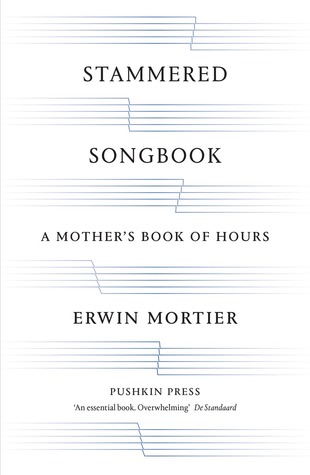
songbookMortier’s passionate, insightful record of his mother’s decent into the unforgiving spiral of fragmentation and decline that marks early onset dementia, is at once a loving memoir and a writer’s thoughtful reflection on the vital role that words play in his own ability to make sense of and cope with the most painful and difficult process of letting go or, as he puts it: “constantly saying goodbye to someone who is still there, yet not.” But the pages of Stammered Songbook: A Mother’s Book of Hours contain much more than a portrait of one woman’s steady regression from independent and vivacious to prematurely helpless, frightened, and lost; it offers an honest, sometimes brutal, account of the challenges of negotiating the surge of conflicting emotions that batter and buffer the individual and the family in mourning. He tracks her illness, from the earliest missteps through to the recognition, so painful for his father, that her needs can no longer be met by her loving husband, or by juggling responsibilities between her five children and their spouses. Even a large, closely knit family cannot provide the support and care she requires in the end – it is too difficult, too draining, and far too painful – especially when the person who once inhabited the emaciated frame of the body that remains has been slowly fretted away into the space of memories and dreams.

Mortier’s writing has frequently drawn comparisons to Proust; powerfully, and I would argue rightly, reinforced by his elegant, sprawling epic set in Flanders during the First World War, While the Gods Were Sleeping. Smaller, more immediate, and intensely personal, Stammered Songbook turns – as his mother in the present recedes into the distance – into a lyrical, poetic sketch of the woman as he remembers her, and a moving reflection on the complexity of our relationships with those we love. Yet as he captures his experiences and emotions, he is aware that, as a writer, it is essential that he is able to fine tune the words he employs so that he may strike the exact note. That is, he is not only writing about his mother, he is writing about the process of writing about his mother.

“Time does not unite us in oblivion but unravels us into memories. I only started writing properly, I suspect, when I began to realize that words are at their best when I can make them vibrate like minute compass needles in response to those elusive magnetic fields that constitute someone’s whole “being” – rather like iron filings form patterns on a sheet of paper under which a magnet is held. From the cloud that my mother is becoming and that in fact she already is, slivers of images will shoot out unexpectedly, strangely sharp – the way she laughed, the gesture with which she arranged a lock of hair behind her ear… And then we will say: yes, that’s how she was.”

Stammered Songbook is a lyrical farewell to a woman lost too young to a cruel relentless thief; but even more powerfully it is a personal meditation on death, mourning, memory, and the myriad emotions – sadness, confusion, anger – that confront those left behind. Yet in reading it I could not help but think about two other books that traverse similar grounds and have informed some of my own thoughts about the project that I am attempting to write into being, so to speak. Both are powerful works that approach difficult emotional experiences arising from the authors’ own lives, each from a different angle.

The first is a novel, This Is Paradise, by UK writer Will Eaves. Here the narrator begins back at a time before his own birth and moves through a childhood account of the unique dynamics that shape and define his family. Then, in the second part of the book, our protagonist is grown and his mother, now increasingly incapacitated by dementia, must be moved into a care facility. The account of the complicated emotions and tensions that pull at the family throughout the painful process of watching their loved one die – especially in the grips of such an unforgiving, emotionally paralyzing disease – was so striking that I kept thinking: There is an authenticity beyond careful research here. And, sure enough, after finishing the book I found an personal essay Eaves wrote for The Guardian chronicling his mother’s battle with Alzheimer’s. Clearly, much of his own experiences were embedded in the novel, but he chose to approach the subject mediated through the curtain of fiction – whether for distance, freedom or stylistic comfort, it doesn’t matter – it works beautifully.

The other book is a memoir, this time a son’s effort to honour his mother in the light of her suicide at the age of 51: Peter Handke’s A Sorrow Beyond Dreams. On the surface it might appear that suicide is the polar opposite of dementia in that it is sudden, but the impact is no less devastating because it raises questions, so often unanswerable, that linger long after death and complicate the mourning process. Like Mortier, Handke is deeply conscious of the importance of writing and the efficacy of adequately capturing a life by spilling words onto a page. However, rather than placing himself at the heart of the memories he is trying to capture, he attempts to step back and maintain an intentional emotional distance. He wants to see his mother, in part, as an exemplar of the rural Austrian women of her generation; to place her life in a broader context to make sense of the very intimate act of her decision to take her own life. And the result is a spare, elegant meditation; but in the end, he cannot help but break the wall between his accounting – which was written within two months of her death – and his own emotions which are still very raw.

These three books do seem to me to fit together, to form a triangle at the centre of which is the attempt, by a writer, to capture the essence of his relationship with his mother, in life and in death. What is of specific interest to me is not the exact nature of the subject at the centre, rather it is the question of the best way to approach writing about a deeply personal experience drawn from one’s own life – memoir from within, memoir with a degree of distance, or memoir turned into fiction. It seems to me that each can be powerful and effective, the challenge, I suppose, is to find out what works best for the writer and his or her circumstances, that is, to find the intersection where the story comes alive.

Stammered Songbook by Erwin Mortier is translated from the Dutch by Paul Vincent and published by Pushkin Press.

The mind remains restless: While the Gods Were Sleeping by Erwin Mortier

“As you get older you no longer see people around you, only moving ruins. Again and again the dead find back doors or kitchen windows through which to slip inside and haunt younger flesh with their convulsions. People are draughty creatures. We have memories to tame the dead until they hang still in our neurons as foetuses strangled by the umbilical cord. I fold their fingers and close their eyes, and if they sometimes sit up under their sheets I know it’s enzymes or acids strumming their tendons. Their true resurrection lies elsewhere.”

Helena Demont, the aged narrator of While the Gods Were Sleeping by Dutch-language Belgian author Erwin Mortier, is a frail bodied but sharp-witted woman intent on employing the only weapon she has ever trusted, language, to rally her ghosts. Tended daily by her Moroccan carer, she fills notebook after notebook with her thoughts and reflections about the power and limitations of words, and the distortions and intensity of the memories that haunt us. She is, even at her advanced age, struggling to reconcile the fraught relationship with her mother whose voice still admonishes her in her quiet moments, come to terms with her envy of the freedom and detachment that her gay older brother Edgard seemed to enjoy, and sculpt into living memory the body and spirit of her long deceased beloved husband.

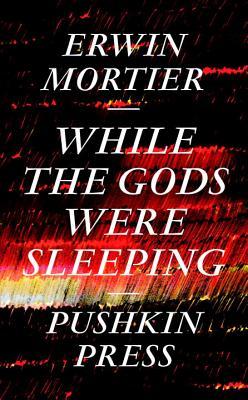
GodsAt the centre of this intensely powerful novel is Helena’s vivid account of her experiences in Flanders during the First World War. The breakout of war happens to coincide with the beginning of her bourgeois family’s annual summer pilgrimage from their home in Belgium across the border to her uncle’s farm in France. As a result, she and her mother end up confined to the farm for the years of the war, separated from her father who is unable to join them and her brother who volunteers and is sent off to the front. She sees much of the war from a distance, with a mixture of awe, adolescent romance, and horror but it will stand as the pivotal experience in her long, long life.

While the Gods Were Sleeping is a not a plot driven novel, highly descriptive language is employed to evoke a mood, to harness an experience, to pull the reader in to a vortex which, in the end, is as powerful as quicksand. Lengthy sentences unwind across the page:

“When I was allowed by my uncle, my mother’s older brother, to use the telescope, which stood up in the attic under a tarpaulin, I could see in those clouds of dust, in places where the roads came up to the same height as the fields, lances reflecting the sunlight, rifle barrels as fine as needles gleaming above a mass of figures marching over the cobbles, or the bustling horses’ hooves of the cavalry, and that dust they dragged behind them like a threadbare veil.”

Some may find the long, reflective (dare I say Sebaldian) transgressions about writing, and the rejection of clear chronological storytelling disconcerting at the beginning, but Mortier employs language, as his narrator wishes she could, like a painter, building up layers, blending colours and textures to create a deeply human experience that pulls together clearly and beautifully in the closing chapters. Paul Vincent’s translation captures the poetic beauty of the language and manages to navigate the contrast between the wartime dialogue as remembered and the narrator’s very contemporary tone when she is reflecting on the nature of writing or complaining about the regrets and annoyances of her life in the present day.

In the end, this novel is a meditation on the way that we remember; how memories are evoked, stored, treasured, and released. In a particularly powerful passage, Helena is following her British photojournalist husband across a bleak ice covered Flemish landscape and decides to take a photograph of him, from behind, simply for her own keeping. When the film is later developed in their makeshift darkroom, corpses are revealed trapped just below the surface of the ice. An horrific image of the aftermath of war for certain, but also a striking metaphor for the way that memories resurface as we look back over time, how ghosts we thought long put to rest can continue to rise up and haunt us.

International Foreign Fiction Prize 2015: Several of the novels in this year’s long list visit the First World War. This is another equally impressive yet unique approach. I would be happy to see this novel on the short list and I know that I will be seeking out Mortier’s earlier work.