Counting, accounting and recounting: The Folded Clock by Gerhard Rühm

two!
one two  –
one two  –  three!
.        two
one two three  –   four
.       two

“a recounting,” the first number poem you encounter in Gerhard Rühm’s The Folded Clock, opens with a lengthy note explaining exactly how the piece should be recited—volume and intensity directed and measured—before erupting across the following five pages as numbers, spelled out, descend, rise, and repeat. Finding the flow and riding it (guided with a few more directives along the way) is not difficult, especially if you allow yourself to read aloud and, there are you are, from the very beginning, not simply reading but actively engaging with the poem.

And there are ninety-nine more, each one involving numerical elements in some shape or fashion. Some are sequential, others visual, still others are in verse form. Clever or funny or profound, it is amazing just how far numbers can take you.

Born in Vienna in 1930, Rühm, who recently celebrated his ninety-fifth birthday, is an author, composer and visual artist. His poems reflect all of these interests. He was an early practitioner of concrete poetry and an original member of the influential Wiener Gruppe. His interest in numbers as “the most pared-down and at the same time most universal element of design” goes back to the early 1950s. When he composed his first number poems in 1954 he was unaware of Dadaist Kurt Schwitters’ own explorations in this area, but he has continued to incorporate numerals and digits into his spoken and visual poetry, expanding the possibilities numbers offer. The Folded Clock, newly released from Twisted Spoon Press in Alexander Booth’s translation, gathers one hundred of these poems in a handsome volume.

Many of Rühm’s poems play with the rhythm and sound of numbers in various sequences and patterns. Others exploit visual qualities and double meanings that arise from the titles and the images or words they are paired with. And a sly humour surfaces throughout, as in “imperfect counting poem”:

one
two
three
four
five
six
seven
eight
nine
toes

one’s missing

Or “sixty-nine pairs of lovers” which depicts, inverted on their side, six rows of ten and one row of nine (sixty-nine) 69’s.

But, Rühm is also inclined to employ numbers and words to make thought provoking statements about the world. “time poem”—another piece that begins with a note on recitation—takes on cosmic dimensions starting with:

1 january, 12:am: bang!
2
3
4

And so on, counting down one calendar year, day by day, marking the significant events, from the Big Bang to the first moon landing. Given that fish don’t begin to swim in water until December 19, the final day of the year opens up, first by hours, then half hours, and by 11:30 pm, minutes, until the final minute opens up into seconds to allow human history from the first cave paintings to space exploration to fall int place. (You can read this poem online here.) Elsewhere he allows climate change, odd historical facts, and interesting news stories inspire poetic creations. Ruminations on living also fit well with the measurement of one’s personal relationship to time as in “sense of time”:

a week ago i was still a child
five days ago i  was an adult
four days ago was the time of the “vienna group”
three days ago i was living in berlin
for two days now i’ve been in cologne
everything since the turn of the millennium happened yesterday
since early this morning i haven’t aged at all

The variety of poems in this collection is wide and endlessly entertaining. They range in length from just a few numerals, to pieces that extend for several pages, to sketches and collages. Even if you fear you might be intimidated by avant-garde or experimental poetry (or poetry at all), this is a work that is not only intelligent and entertaining, but that contains many pieces that you could easily find yourself unable to resist reciting aloud.

The Folded Clock: 100 number poems by Gerhard Rühm is translated from the German by Alexander Booth and published by Twisted Spoon Press. (Excerpt and images can be seen at the publisher’s website.)

Here at the end of the world: The Sorrow of Angels by Jón Kalman Stefánsson

The boy sticks his head all the way out and his black hair whitens, the ground lies everywhere beneath a thick layer of the sorrow of angels, no grazing either in pasture or on beach, all the livestock kept inside and the farmers counting every hay-blade going into them, in some places little remaining but leavings  and the animals bleat and low for a better life, but the clouds are thick and no sound is carried to Heaven.

It is already April in this Icelandic village and there is no sign of anything resembling spring. The snow continues to fall and the winds blow cold. It has now been about three weeks since the unnamed protagonist at the centre of Jón Kalman Stefánsson’s Trilogy of the Boy made his way back to the small community following the tragic death of his best friend on a fishing boat, and he is now settling into a life he never imagined possible, surrounded by new friends—a somewhat eccentric family of sorts—with books to read and his first stirrings of real, if perhaps ill-advised, romantic attraction to the daughter of a wealthy local merchant. But this peaceful interlude will not last long.

The Sorrow of Angels, the second volume of the trilogy, can certainly be read as a stand-alone work, but Stefánsson does not waste time filling in many details to flesh out the events and characters, present or past, as he picks up the boy’s story, so starting with Heaven and Hell would not hurt. Both are great. Intense and thoughtful at once, if that’s possible. The first part of Sorrow is evenly paced, continuing with the same rhythm that marked the second part of Heaven and Hell, as we come to know more about the people who have taken the boy in—the strong-willed, mysterious Geirþrúður, her housekeeper Helga, and the blind old sea captain Kolbeinn—and other local figures. For an orphan tossed from farm to farm who, at nineteen, has already spent three winters out with a fishing crew, having a room of his own, surrounded by people who share and actively encourage his love of reading, is more than he could have ever dreamed of. Yet, when the postman Jens arrives from his latest delivery trip half dead, only to have his superior insist that he head right back out on an unfamiliar route through the endless winter’s storms, the boy is “volunteered” to accompany him.  For the postman, with an aging father and a developmentally disabled sister to support, the promised payout of this journey is too much to pass up. But for his friends, the idea of him taking on this mission alone in such extreme weather is a serious concern, so they decide that he will not go alone.

Once the two men are on their way, the mood of the narrative shifts, acquiring a sweep that echoes the vast landscape to be traversed. It very quickly becomes clear that Jens and the boy are temperamentally mismatched for the challenges that lie ahead. The older man prefers the silence of his own thoughts, while the younger man is inclined to want to fill the long hours with conversation, recitation of verse, and even song. Their trip, through blinding, brutal storms, over an unfamiliar terrain with unseen dangers and few places to take refuge, is long and they will be forced to rely on one another more than once just to survive. Through long, unbroken passages, Stefansson’s penchant for prose that is lyrical and melodic, heightens the inhuman conditions his characters face here at the end of the world—both those who live in this harsh region year round and those forced to pass through. He is a master at evoking ice, freezing skin, and the snow storms can distort time and space, carrying with it the real threat of ghosts that seem to emerge out of the whiteness to lead the lost to their deaths.

He stops, ceases to struggle onwards and stands still, forces himself to stand, though the temptation simply to sink is so alluring; he stands still and shuts his eyes. Now I shut my eyes, and if I’m meant to live, he thinks optimistically, then Jens will be standing before me when I reopen them. He stands with his legs spread wide so as not to be blown over and it’s incredibly good to have his eyes shut, as if he’s made it to unexpected shelter. The wind is certainly still blowing coldly against him yet it’s no longer of any concern to him. It has grown distant, it’s no longer threatening. It would be too easy, perilously easy to sleep like this; open your eyes, he commands himself, and that’s what he does. Opens his eyes to see a woman standing before him, just an arm’s length between them. Rather tall, erect, her head bare and her long, dark hair blowing over and from her stern face, her dead eyes penetrate his skull and drill themselves into the centre of his mind. Then she turns and walks away, against the wind, and he follows.

However, as the boy and the postman will discover, sometimes the dead have other intentions. Before their journey is over, they find themselves joined by a third man, and charged with the special delivery of a most unusual item through the most treacherous terrain they have yet encountered.

Like Heaven and Hell before it, The Sorrow of Angels combines the elements of an epic adventure with a strong musical sensibility. Stefánsson’s language is poetic, his characters are pushed to their limits—physically and emotionally—and the remoteness and ruggedness of the remote reaches of northern Iceland a century ago is portrayed with relentless intensity. A thoroughly enjoyable read. However, as the middle volume of a trilogy,  this book ends on a cliffhanger, it must be said, and it will be another six months or so before the final volume is released in North America in the spring of 2026. (It has been out for a decade in the UK, but it is always nice to have a matching set.)

The Sorrow of Angels by Jón Kalman Stefánsson is translated from the Icelandic by Philip Roughton and published by Biblioasis.

“How many years fit into one day?” Heaven and Hell by Jón Kalman Stefánsson

The sea on one side, steep and lofty mountains on the other; that’s our whole story in fact. The authorities, merchants, might rule our destitute days, but the mountains and the sea rule life, they are our fate, or that’s the way we think sometimes, and that’s the way you certainly would feel if you had awakened and slept for decades beneath the same mountains, if your chest had risen and fallen with the breath of the sea on our cockleshells. There is almost nothing as beautiful as the sea on good days, or clear nights, when it dreams and the gleam of the moon is its dream. But the sea is not a bit beautiful, and we hate it more than anything else when the waves rise dozens of metres above the boat, when the sea breaks over it and drowns us like wretched whelps. Then all are equal. Rotten bastards and good men, giants and laggards, the happy and the sad.

This theatrical landscape, evoked with such poetic intensity, sets the stage for an epic work that combines old-fashioned drama with contemporary literary sensibility, a tale of loss and bravery that makes for a truly glorious read. Somewhat disorienting in the early pages of the first volume of Jón Kalman Stefánsson’s Trilogy About the Boy, it’s not clear when the swirling narrative takes place, and where the protagonist—known simply as “the boy”—and his friend Bárður are in this snow-covered Icelandic terrain. Somewhere between heaven and hell, no doubt.

Heaven and Hell is a tale about the devastating power of the elements and the redeeming power of literature. It has an intentionally timeless, epic quality that is irresistible, thanks in no small part to an overarching narrative voice,  a first person plural chorus of the dead, that relays this story of the past, unfixed in time but set more than a hundred years earlier, “during the years when we were surely still alive.” An epic voice for an epic adventure. But the distinctive lyrical qualities reflect Stefánsson’s natural inclinations as a writer:

Poetry is very important to me; I started my writing career as a poet, published 3 books of poetry before I turned over to prose. In a way, I think that I use, though subconsciously, the technique and the inner thinking of poetry while writing prose; therefore, poetry lies in the veins of my prose. I think as a poet while writing as a novelist. I also see my novels partly as a piece of music, a symphony, a requiem, a rock or hip-hop song. There lies so much music, both in the language and the novel itself: its structure, style, breath. And the structure is for me just as important as the stories; one can sometimes call it one of the characters.

At the centre of this novel is a nineteen year-old orphan, the boy, whose father drowned when he was six, leaving his family separated. He and his brother were sent to board in different communities, while his mother and young sister would die before they could ever see one another again. But although his parents were poor, with limited education, their love of books and his mother’s letters filled with imagery drawn from science, helped foster in her son literary inclinations that would bloom under the right influence. That came through his friendship with Bárður, a young man several years older who introduced him to the beauty of poetry. When Heaven and Hell opens, the two are on their way back from a brief respite in the Village to the fishing hut where they are spending their third winter as part of a fishing crew. In his pack Bárður is carrying a loaned copy of Paradise Lost—a book that will soon cost him his life. As the crew is readying to take to the sea in the early hours of the following morning, Bárður will quickly slip back to commit a few lines of Milton‘s verse to memory, something to share with his young friend during the long hours ahead, but in his haste he will forget his waterproof. When a vicious storm arises, this mistake proves fatal.

When the boat finally returns to shore, the boy is devastated and cannot bear to stay. The captain’s wife helps him prepare for the long walk back to the Village and he slips away intent to return the borrowed book. He intentionally choses the more challenging inland route, haunted by the pain of his loss. He thinks about poetry and he thinks about death:

He trudges into the valley and Bárður is dead.

Read a poem and froze to death because of it.

Some poems take us places where no words reach, no thought, they take you up to the core itself, life stops for one moment and becomes beautiful, it becomes clear with regret and happiness. Some poems change the day, the night, your life. Some poems make you forget, forget the depression, the hopelessness, you forget your waterproof, the frost comes to you, says, got you, and you’re dead. The one who dies is changed immediately into the past. It doesn’t matter how important a person was, how much kindness and strength of will that person had and how life was inconceivable without him or her: death says, got you, life vanishes in a second and the person is changed into the past. Everything connected to that person becomes a memory you struggle to retain, and it is treachery to forget that.

The journey is difficult and dangerous, and the boy does not know what he will do once his mission is complete, but suicide is an option he contemplates. However, once he is back in the Village, he soon finds himself welcomed into what becomes an ad hoc, somewhat eccentric, family of sorts.

What makes this novel succeed so well, and makes it such an entertaining and invigorating experience tp read, lies in the musicality of the language and the strength of the characterization. On one level, there is the fundamental battle between man and nature—the former so small against the enormity and unpredictability of weather, water, and terrain— unfolding in seemingly endless sentences and long breathless paragraphs, followed by short sharp statements that stand alone. The epic sweep of these passages is reinforced by the otherworldy quality of the narrative voice. On the other level, away from immediate environmental threats, individual human interactions have a different tenor. Focus falls on certain striking features—perhaps body size, eyes, or hair—that set one person apart from another, the kind of cues people use to try to assess others. Dialogue is woven into the text without demarcation, much social motivation remains in the shadows, and distrust can be easily kindled. Life is tough in this remote part of Iceland, and so are the people who live here.

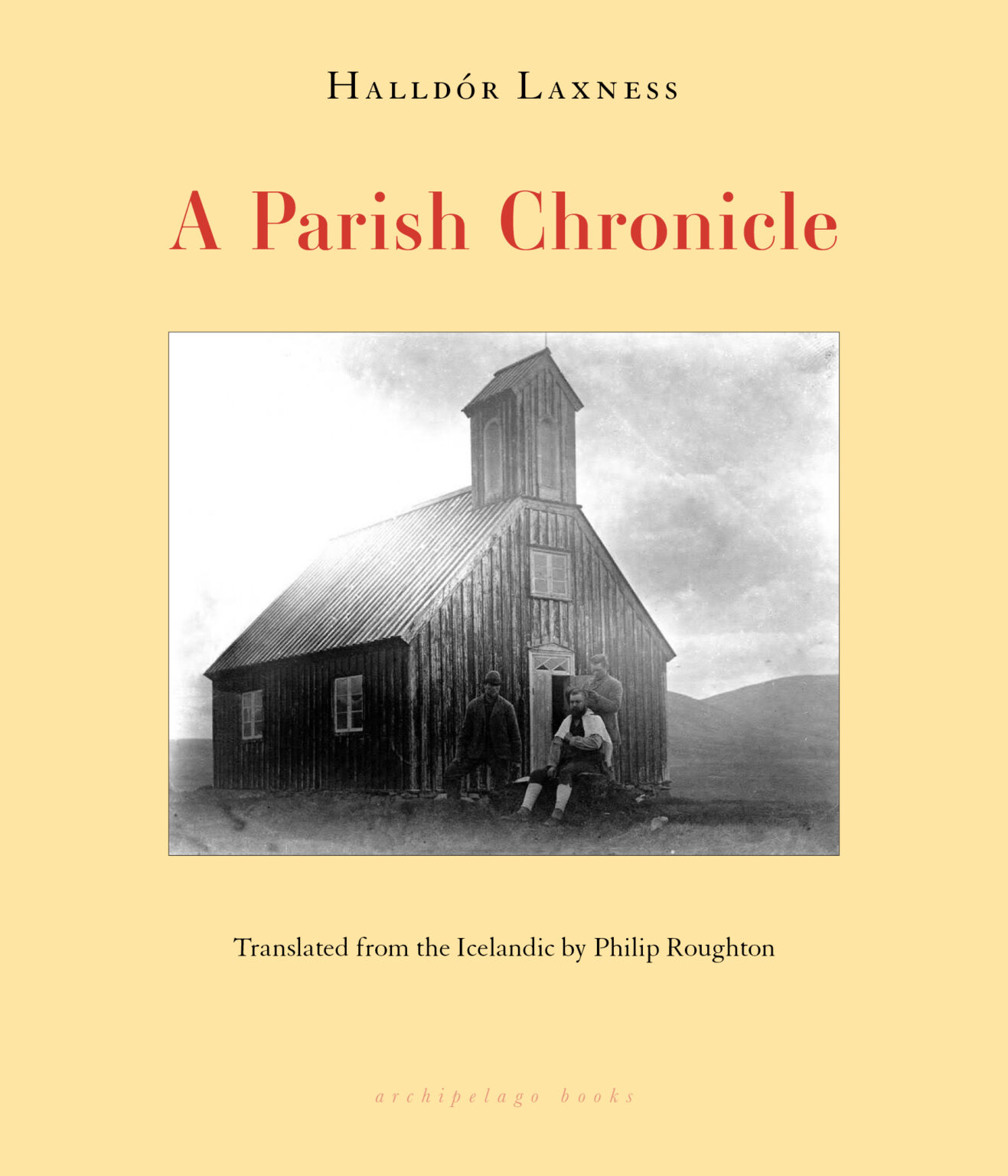
This release of Heaven and Hell has been a long time coming. First published in Icelandic in 2007, Philip Roughton’s English translation appeared in the UK in 2010 (MacLehose Press). Now, in 2025, Biblioasis has released the first two parts of The Trilogy of the Boy for North American readers—The Sorrows of Angels just came out—with the final part due next year. And although the books can be read independently, it doesn’t hurt to start right here with part one of this memorable epic tale in which epic poetry is a driving force, leading to death and reaffirming life.

Heaven and Hell by Jón Kalman Stefánsson is translated from the Icelandic by Philip Roughton and published by Biblioasis.

“Pain is a privilege of the living.” The Last Thing by Leopold Lahola

One day, a hundred thousand years ago, during the Ice Age or soon after, when the world began to melt from below, an iceberg must have carved out this valley, with its body dragging its tail behind it like an enormous scaly reptile. At least according to the long-winded account he heard yesterday from Big Joco as the two of them had been left to their own devices with machine guns aimed at the valley they were watching intently, charged with providing cover for their unit lying low in the woods behind them, and now, rushing hell for leather from the woods back to Big Joco after an endless night when they had not been relieved as planned, Melius concluded that very little had in fact changed, that they had entered another damned ice age and that even the sun, sinking its teeth into him like a cannibal, would also soon turn to ice.

This is the opening paragraph of the title story of the newly released collection of tales by the Jewish Slovak writer Leopold Lahola, available in English for the first time in Julia and Peter Sherwood’s translation. The brutal cold and the  isolation of partisan fighters in the final winter of the Second World War cuts through to the bone in this tale of one man’s efforts to respect the dignity of a friend and fallen comrade. When Melius makes it back to the windthrow where he an Big Joco had been positioned, he finds his companion dead. To leave him there to suffer further indignities should the Germans pass by is unthinkable. But Big Joco is a monstrously huge man, now lying face down, stuck to the frozen ground. When Melius encounters a stray fellow partisan, a miserable character referred to simply as Walrus due to his distinctive moustache, he tries to enlist his support to move his friend. The reluctant recruit balks when he sees Joco’s massive form, and even when the two men combine forces their task seems impossible. So Melius conjures an ingenious, if gruesome plan to divide the load.

This desperate urgency to cling to some measure of humanity under inhumane conditions, with the inevitable conflicts that arise between individuals with different motivations—regardless of whether they are on opposing sides or not—is a key theme running through all of Lahola’s wartime stories. His ability to quickly set a scene, craft strong, often eccentric characters and his keen ear for dialogue give his fiction its unique cinematic intensity. It is not surprising that he was also an accomplished playwright and filmmaker. However, due to his own postwar malaise, he ended up spending much of his life in exile. In fact, the collection from which the stories in the present volume were drawn was not published until 1968, months after his early death just shy of his fiftieth birthday.  However, the Soviet invasion that same year  would lead to the erasure of his work from Slovakian literary history,  not be rediscovered until twenty years later following the Velvet Revolution.

Born Arje Friedmann in northeast Slovakia in 1918, Lahola was conscripted into the Slovak Army in 1940. He deserted in 1942 to avoid deportation, but when he learned that his mother and younger brother had been interned in a labour camp, he willingly joined them. When they were to be taken away on a transport, he again offered to join them, however a friend working in the camp administration removed his name from the list. He then went on to join the armed resistance and engaged in front-line combat during the Slovak National Uprising. The final winter of the war he spent in the mountains fighting with the partisans. After the war he worked as a journalist and began writing for the theatre, adopting his more distinctive Slovak name, Lahola, inspired by a sign above a butcher’s shop. For a time he achieved considerable success in the postwar world, but he found it hard to shake the weight of the recent past. Following the Communist takeover in 1948, he emigrated, first to Israel and then to Germany, before finally returning to Czechoslovakia in the late 1960s in the light of growing liberalization.

Lahola drew on his own wartime experiences in his short fiction, not only the hardships and cruelty, but also the recognition that his enemies, the German Nazis and their collaborators, were human beings too. As he noted in his diary, “I participated in a war against people who were my spitting image.” It is this reality that complicates the emotional and ethical implications of many of the stories collected here. These are not heroic tales with clear black and white divisions between good and evil, shades of both exist on both sides as it turns out. The longest piece in the collection, “A Conversation with the Enemy,” is a prime example. It begins with a partisan, captured by the Germans, anticipating a harsh interrogation and summary execution. He finds, instead, bored officers who ask him nothing. He is then sent off and finds himself followed by an armed soldier who cordially introduces himself as Helmut Kampen. Fully expecting to be shot, the partisan is disarmed by the German’s desire to engage him in conversation, longing for a little friendly debate. As they make their way through the snowy woods, their banter continues—eagerly pursued by the soldier and suspiciously challenged by the partisan. It becomes, over time, an extended interaction between two men who, under other circumstances, might be friends. But ultimately, when the tables are abruptly turned, they each still have a role to play.

The nine stories gathered in this volume were composed primarily during the early years of Lahola’s exile, from the late forties through the mid-fifties, and are set amid rising facsism just before the war, through the years of concentration camps, direct conflict and on into the tragic aftermath. All feature third person narratives, save for one, aptly titled “In the First Person” set during the first summer after the war, in which the narrator, returning to his home community, collects the first person accounts of those who have survived as he seeks his own closure. Among writers chronicling this period,  Lahola’s work stands apart, not simply because he can draw out the humanity in the enemy (not to mention the inhumanity on his own side) but because his narratives tend to adopt a dispassionate, distanced tone. This heightens the intensity of the moral choices he places before his characters, typically driving them to a point at which a decision must be made, and then leaving them there, in the terrible moment. The very clear theatrical quality of his stories, tinged as they are with a dark touch of the absurd, allows for an exploration of the realities of life during wartime intended to raise more questions than it answers. As such, The Last Thing is a long overdue opportunity for English language writers to come to appreciate the work of this remarkable Slovak writer.

The Last Thing by Leopold Lahola is translated from the Slovak by Julia and Peter Sherwood and published by Karolinum Press.

In this violent solitude: Light, Grass, and Letter in April by Inger Christensen

But do not grieve for me
do not grieve for your lonely
to and fro
My hour has rusted
My poem has left
your beaten track
Do not grieve My young poem
is more deeply kissed by life
Deathly it creeps
over under through me
Poetry is murdered hope.

(from “In the wild loneliness of the mountains” / Light)

Having read most of the poetry of Inger Christensen (1935-2009) that is available in English translation, to return now to her earliest published collections, Light (1962) and Grass (1963) is somewhat like experiencing the formative spirit of a writer who will soon make her mark as an original and experimental literary force. And yet, it is clear in these poems composed in her mid-twenties, that she is already exploring the themes and perspectives that will define her most ambitious—and most popular—poetic works. This is perhaps to be expected because only six years separate the publication of Grass from the release of her monumental 200-plus page book-length cosmic poem Det in 1969 (“It” in English translation, 2006).

The present volume contains her first two collections, along with her fourth, A Letter in April (1979), a collaborative project that followed ten years after Det. Light and Grass being only one year apart, share much in common and reflect the time in which they were written. Yet as translator Susanna Nied (who has translated all of Christensen’s poetry and is thus well acquainted with her oeuvre) says regarding these two books:

Her lifelong themes are already evident: boundaries between self and other, between human beings and the world; our longing and struggle for direct connection beyond boundaries; the roles of language and writing as mediators of that connection; the distances between words and the phenomena that they stand for.

Images drawn from nature, domestic settings, and corporeal existence feature throughout these poems, with a strong sense of the landscape, the seasons, and the musicality of her homeland. Many of the pieces in both volumes tend to be shorter and lighter in form, though the not necessarily in content, but notably, the final poem in Grass, the sequence “Meeting,” is longer , closer to prose poetry, and seems to presage  sections that will later emerge in Det/It.

The unknown is the unknown and gold is gold I’ve heard, one
.      winter the birds froze fast to the ice without the strength
     to scream, that’s how little we can do for words with words
the books press close to one another and hold themselves up,
.      backs to the living room, our buttoned-up words huddle
.      on the shelf, the queue-culture of centuries, inexorably
.      built up word by word, for who doesn’t know that the
.      word creates order

(from “Meeting: V” / Grass)

The third work collected in this volume, Letter in April, seems quite different in tone, quieter and more intimately focused. It arose as the result of a collaboration with graphic artist Johanne Foss who began with a series charcoal-on-parchment drawings based on Etruscan artworks. Christensen and Foss had known each other for a number of years and both had spent time at an artists’ residence in Italy and explored Etruscan ruins. Taken by Foss’s drawings, Christensen chose some and began writing responses to her images. These responses began as prose pieces, but she ended up discarding them and beginning again in poetry. Their project developed over two years as they worked together during the summer months while their children played. Several themes emerge in this work including parenthood, wonder, nature, and the account of a woman who travels to a foreign country with a child inspired by a trip Christensen took to France with her young son as part of her writing process.

Unpacking our belongings,
some jewelry
a few playthings
paper,
the necessities
arranged within
the world
for a while.
And while you draw,
mapping out
whole continents
between the bed
and the table,
the labyrinth turns,
hanging suspended,
and the thread
that never leads out
is, for a moment,
outside.

(Section I,  º )

However, more than a series of poems and drawings, Letter in April follows a complex yet unassuming structure. Each of the seven sections contains five segments marked by a sequence of small circles in varying order. For example, Section I follows the pattern: º º º º º, º º º º, º, º º, º º º .  Section II begins with º º º , and likewise each section begins with the same marking as the final segment of the one preceding. These markings link poetic segments with shared motifs, allowing  the entire work to either be read straight through, or by following the each pattern individually (i.e. I º, II  º, III  º, IV  º, and so on).  This flexibility reflects Christensen’s musical and mathematical instincts,  which are also apparent in the arrangement of elements of Det/It, but will be given full reign in her wonderful numerically and alphabetically framed poem Alphabet (1981).

Light, Grass, and Letter in April is a rich compilation of poetry that offers insight into Christensen’s development as a poet from the mid-twentieth century inspired modernism of her earliest work, through to a collaboration (unique in her oeuvre) that incorporates visual and dynamic elements. It is essential for those who already know and love her poetry, but can also serve as an introduction for those who have yet to encounter her masterworks.

So here we sit
in this violent solitude,
where bulbs work
underground,
and we wait.
Around noon
when the mountain rain stops,
a bird stands
on a stone.
Around evening
when the heart stands empty,
a woman stands
in the road.

(from IV  º º º º º)

Light, Grass, and Letter in April by Inger Christensen, is translated from the Danish by Susanna Nied, with Drawings by Johanne Foss. It is published by New Directions.

It was the best of times, it was the worst of times: Call Me Stratos by Chrysoula Georgoula

I’m growing old. Where have all those beautiful years gone, when I hung out with my mates and we roamed the pool halls and sleazy bars on Paission or the cafes in Saint Andrew Square like cowboys, with a Marlboro hanging from our lips and a flat metal hip flask with whisky in the back pocket … There goes youth, there goes beauty, never to return.

When we meet Stratos Achtidis, he is trying to pinpoint where is life went off the rails, but he is not exactly in the mood for soul searching. Rather he recalls that weekend when, irritated and hungover, he got angry at the cats his wife had brought home for the children, and ended up tossing them off the balcony. A horrified neighbour saw them fall to the street. But then horrifying his neighbours, not to mention regularly and generally annoying them, was something Stratos had long perfected. And that incident alone is not the end of his marriage, not yet, but his long suffering wife , Sotiria, will not put up with much more. And it’s as good a place as any for Stratos to anchor the tale he has to tell.

Call Me Stratos by Chrysoula Georgoula is the unflinching portrait of the social and economic dynamics and tensions that have impacted ordinary working-class Greek people  over the past two decades, from the heady run-up to the 2004 Summer Olympic Games, through the devastating years of the economic crisis, to the increased pressures of migration, and the rise of the Golden Dawn. It is a story at once specific to  Athens—defined and traced on the streets of one small area of the city—that is now echoing widely in communities and countries worldwide. However, this not an account relayed and assessed from afar. Rather, Georgoula entrusts the narrative to a man who is proud, stubborn, coarse, and self-destructive. And painfully human.

In his mid-40s at the time of his telling, Stratos is a man who has either lost or thrown away nearly everything positive that has come his way—a marriage and two children, a successful business, countless other job opportunities, and several chances to hold to his values, such as they are. The only person who never gives up on him, through joy and despair, is his mother whom he often refers to as Mrs. Nickie. She repeatedly bails him out, cleans up his messes, tries to reason with him, and, in the end, takes him back into his childhood home when his marriage ends.

Stratos narrates his story in short episodic chapters that read much like vignettes that are generally, but not entirely, chronological. The son of drinkers and bullies, he carries the family legacy on, even though he promises himself he will never hit his wife after the horrific physical abuse he witnessed his father unleash on his mother. Still, he is hot tempered, prone to obnoxious, sometimes violent, behaviour, and every time he manages to pull himself together long enough to achieve happiness and success, he is certain to undermine his gains. And when that happens, he is quick to blame everyone or everything else, typically retreating to his flat to drown his sorrows in alcohol and crank up the volume on his stereo so as to force his personal pity party on the entire neighbourhood.  As a man who whose existence is contained within a particular district of familiar streets and businesses,  and a circle of relatives and close friends, many of whom he has known since childhood, Stratos is both a legend and a victim in his own mind, unwinding an account (or is it a defense?) littered with crude language, sexist comments, and mildly racist remarks. He is not  inclined to poetics or deep introspection—he rarely acknowledges his own agency—but he is conscious of a sensation he describes as brightly coloured pinballs that seem to come alive inside him whenever he is aroused or agitated. Like when his buddy uncovers his wife’s stashed bills and suggests a night out on the town:

“Tap, tap, tap” the happy fuchsia ball started bobbing up and down inside me. As though starting afresh and in better spirits, I put on my faded jeans with the wide black belt, the black sweater and the crocodile boots with the pointed toes, I rinsed and then combed back my curly hair and saw my eyes glowing like coals in the bathroom mirror. “Tap, tap, tap” the happy ball kept bobbing up and down inside me as I walked up Traleon with Memos beside me.

Looking back on the events that have marked his life—entering into the construction trade at an early age, meeting and marrying Sotiria, the birth of his two children, his establishment of a car wash and detailing service—Stratos’s account incorporates, with a measure of nostalgia, the myriad conflicts, pranks, and reckless activities that have arisen along the way. There are run-ins with the police, physical injuries, an ill-advised affair, and an endless string of debilitating hangovers. Through it all everyone smokes so much you can almost smell it. But he is, within the culture of machismo that shaped him, a fairly easy going man, especially in the periods when he manages to curtail his drinking. He holds no hard-line convictions. He even employs an illegal Syrian migrant at his car wash, a man so hardworking and reliable that he is able to keep the shop going and take on a lucrative roofing contract on the side that will, for a brief time, make him a very financially comfortable family man. But when things fall apart, they fall apart quickly and alcohol is frequently both trigger and consolation.

The worsening economic conditions in Greece ultimately take their toll. Stratos’s response to changing dynamics are, at first, primarily localized, related to observed changes in his business prospects and personal grievances.  Then an old school friend roars into his life on his Harley, complaining about migrants taking all the jobs and soiling Greek culture and society, and boasting about his involvement with Golden Dawn. Stratos’s listless younger brother is easily seduced, but as his own marriage collapses and business dries up, he too will find himself looking for meaning and worth. Where he finds it is terrifying.

Call Me Stratos is a novel that offers no sense of closure. It hardly stops to catch its breath. The tone is relentless, and every situation and every character is filtered through Stratos’ biased, sometimes over-glorified, and often intoxicated perspective. He’s as reliable a narrator as he is honest with himself which makes him fascinating and tragic. And when he seems to have lost everything, he throws himself into an even more frightening world. In the end, Georgoula has created an unforgiving portrait that demonstrates how easy it is for one man, a certain type of man, to be drawn into a group he doesn’t really believe in, while indirectly taking into account, but not excusing, upbringing, social class, and shifting economic and political factors.

Call Me Stratos by Chrysoula Georgoula is translated from the Greek by Marianna Avouri and published by Istros Books.

If all happy families are alike, each strange family is strange in its own way: Love Letter in Cuneiform by Tomáš Zmeškal

The novel begins with a wedding.

Alice and Maximilian exchanged rings and kisses, and signed a document confirming that the state of matrimony was primarily a contractual arrangement, which at the moment was of course the last thing on the newlyweds’ minds. After the ceremony, the priest invited the wedding party to the sacristy. Now, whether they liked it or not, Alice and Maximilian were on their own in the world. They answered everyone’s questions,  chatting about the declining quality of sacramental wine under the communist regime. Alice joked and laughed with her friends, while Maximilian drank a toast with  a bottle of slivovice, which, as usual on occasions like these, somebody suddenly seemed to pull out of nowhere, but through it all the metallic lace of their new situation slowly began to envelop them, closing in on them, fragment by fragment. Slit by slit the lacework net descended on them, enveloping them, protecting them, sealing them off.

Actually, there will be two weddings, because only the civil service later in Prague can be recognized by the law. But in the time between the two ceremonies, the couple and their friends and families gather in Alice’s parents’ apartment where her father’s friend, Dr. Antonin Lukavský, has a surprise in store. He has commissioned the eccentric pastry chef Marek Svoboda (who we will soon learn is also the doctor’s patient at the psychiatric hospital where he works) to prepare a cake for the festivities. And what a cake it turns out to be—an elaborate three-tiered marzipan castle of mythic proportions depicting, from top to bottom, the heavenly heights, the earthly realm, and a rich chocolate hell. So although it may be billed as a family sage, it’s clear from the start that  Tomáš Zmeškal’s Love Letter in Cuneiform will be anything but ordinary.

For one thing, Alice and Maximilian’s marriage is not the central focus and the “metallic lace” enveloping their new marriage does not prove very resilient because, after the birth of their son Kryštof, it unravels quickly. Rather, it is the marriage of Alice’s parents, Josef and Květa which runs the course of the novel, from the end of the second world war through to the early years of the 1990s, even if they themselves are separated and then estranged for most of those years. Love is a complicated affair for all, it seems. Meanwhile, as the family drama unfolds in a strange and sometimes disturbing fashion, Svoboda the pastry chef regales his doctor with fantastic visions that span both time and space. The result is an ambitious, layered work that is by turns tragic, philosophical, and absurd.

Zmeškal was born in Prague in 1966 to a Czech mother and a Congolese father. In 1987, he was granted permission to leave Czechoslovakia and travel to London, but when the Iron Curtain fell two years later, he chose to stay on in the UK to study English language and literature. Finally, in 1998, he decided to resettle in his home town where he soon began work on what would become his first novel. Following a lengthy search for a publisher, Love Letter in Cuneiform was finally released to widespread acclaim in 2008, with an English translation by Alex Zucker following in 2016. As Zucker notes in his Afterword, original reviewers responded to this unique, award-winning novel with efforts to place Zmeškal within the context of Czech post-Velvet Revolution literature. But that might be too limiting. Zucker argues that it also makes sense to look beyond the boundaries of the author’s homeland as well, indicating that Love Letter’s distinct labyrinthian construction and mythogenic qualities call to mind Borges, whereas an underlying “paranoia and slippery identity” may even suggest Philip K. Dick. It is, to be fair, a work that defies attempts at simple summaries, and is, in fact, perhaps better approached without an overly detailed road map.

The love story of structural engineer Josef Černý, lover of classical music and passionate devotee of the slide rule, and his wife Květa may be the central thrust of the novel, but the narrative does not proceed chronologically. Rather, it unfolds in fragmented pieces with shifting styles, forms, and voices. Letters of varied types, including a formal appeal to authorities to address a past crimes and lengthy romantic plea in cuneiform script, take up some of the key aspects of the story, while a forged letter does irreparable damage. But this is no epistolatory novel—the letters form only part of the picture and go only one way—nor does it confine itself to Josef, Květa, their daughter, grandson, and a few friends and extended family members. There is also the side story of the pastry chef, the most eccentric character in a cast of idiosyncratic individuals who not only terrifies a would-be thief with his bizarre marzipan creations, but entertains the good doctor with his detailed psychotic visions. He tells of a strange, manipulated existence in the Arizona desert, a journey to ancient Persia, and the assignment to repair a mysterious device in a Prague hundreds of years in the future. By bending expected storytelling conventions, vastly expanding the time scale, and playing with genre, Zmeškal crafts a tale that is not only heartbreaking and human, but that opens up plenty of space for questions of good and evil, immortality and death, belief and atheism, and of course, the endurability of love.

Josef first met Květa when he and his friend Hynek Jánský were at University during the war. Both men took a liking to her, but she chose Josef. Then, in the early years of their love affair, Josef was introduced to cuneiform through an odd coincidence. He learned in a class that his birthday, November 24, 1915, corresponded exactly with the date that Czech orientalist and linguist Bedřich Hrozný announced to a meeting of the German Oriental Society that he had deciphered the language of the ancient Hittites, a people who lived in Anatolia (present day Turkey and Syria) three thousand years ago. This sparks his interest in the curious wedge shaped script that originated in Mesopotamia but was adapted by other cultures, and the idea of solving the riddle of a previously unknown language. When he shares it with Květa, she tells him she is certain he could do the same. “She had a better imagination than I did,” he confesses, “she always has, and over time I learned not to oppose her using logical arguments and facts.” So it becomes his secret mission to crack some as yet untranslated language.  Or at least learn to read cuneiform.

Josef and Květa marry after the war ends and welcome Alice, their first (and only) child, in 1950. But their old friend Hynek soon plots his revenge. The communist government has taken advantage of his “talents” of persuasion and punishment, and promoted him accordingly. He arranges for Josef’s arrest and ultimate imprisonment on obscure charges. As a result, Josef will be gone for the first ten years of his daughter’s life. Uncertain what to do, Květa turns to Hynek hoping he will help her free her husband and thus begins one of the most deeply disturbing aspects of the book—a prolonged and brutal relationship that, when it is later exposed, will drive Josef and Květa  to part shortly after Alice’s wedding. Alice stays in her family apartment to raise her son after her own marriage ends , Josef spends most of his time at the rural house where he grew up, and Květa moves in with her aging Aunt Anna, an outspoken spinster with an opinion on everything. And life goes on, fraught with heartbreak, misunderstandings, and stubborn resolve. Alice is caught between her parents, while Josef forges an increasingly deep bond with his grandson. Finally, the Iron Curtain falls and a newly independent nation and its citizens are left to find their bearings in a world of new possibilities.

Some reviewers of the translated text have suggested that the novel loses its intensity in its later chapters, but it is perhaps more accurate to describe what occurs as a change in tone as threads of the story begin to converge. The central characters—Josef, Květa, Alice, and the seemingly indestructible Aunt Anna are all getting older. Kryštof, now an adult, has become accustomed to the countryside where he has spent so much time and has set his sights on marriage to a girl his grandfather insists on calling “the blonde.” But into the mix comes a distant cousin,  Jíří (or George), a young man of Czech heritage, related to Aunt Anna but born abroad and raised in England, who arrives to experience his ancestral homeland now that the Iron Curtain has fallen. He stays with Alice and works in the city, but his regular letters to his sister offer his impressions of their ancestral nation and its peculiarities (not to mention the oddities of their relatives) often revealing more of the evolution of Czech society and the transition from communism to capitalism than he realizes. This is yet another layer that Zmeškal deftly weaves into his broader narrative tapestry.

Love Letter in Cuneiform is a novel that challenges and exceeds the norms of a multigenerational family saga at every opportunity. Josef and Květa’s love story has a grand, tragic arc to it that mirrors the kind of conditions—unfaithfulness, cruelty, misunderstanding, separation, failed attempts at reconciliation—that often tear lovers apart in mythological traditions. In an interview with Words Without Borders, Zmeškal confides: “I love old stories and myths, and I think that whatever changes in the world, we still live similar lives, though in different circumstances, of course.” That spirit comes through. This is a novel that is on one level very much bound to the history and politics of Czechoslovakia (as it was known from 1918 through 1992) through the second half of the twentieth century, while, on another level, it is a larger-than-life and often very funny tale of love, loss, wisdom, madness, and evil—though not necessarily in that order. Throughout, its unique energy is sustained in translation with Zucker’s careful, and at times creative, attention to the subtleties and playfulness of Zmeškal’s language.

Love Letter in Cuneiform by Tomáš Zmeškal is translated from the Czech by Alex Zucker and published by Yale University Press.

Slipping into the twilight zone: Diving Board by Tomás Downey

The first thing I think to write is this: what’s happening to me is incredible. But immediately, I stop—I’m suspicious of everything. I think about it, reread the sentence, and the pen slips through my fingers and falls to the floor. It bounces and flips in the air, does some involuntary acrobatics. Describing what’s concrete is easier.
(from “Astronaut”)

If there’s a common feature uniting the nineteen stories gathered together in Diving Board, Argentinian writer Tomás Downey’s first collection in English translation, it’s the uncomfortably close focus he places on the experiences of his narrators or protagonists. His lens is so tight that the edges of the world around them becomes  increasingly distorted, leaving them emotionally isolated and alone. Consider “The Astronaut” quoted above, for instance. The narrator is a man who has inexplicably found himself freed from the restraints of gravity, a condition that has literally turned his world upside down. Only at ease resting on the ceiling, every time he returns, even briefly, to the floor he is struck by waves of dizziness and nausea. There is no magic in this altered reality; everyone else, his wife included, remains grounded, unreachable. He decides there is only one means of escape—an open window.

Born in Buenos Aires in 1984, Downey is one of Argentina’s foremost short story writers, a master of a strangely unsettling terrain that his fellow Argentinian writer Mariana Enriquez refers to as bizarro fiction, not a genre but: “a disturbing variant that hides a vague threat, that leaves the reader feeling something between awe and unease.” As such, his stories vary from harsh realism to fantasy to horror to speculative fiction, but regardless of form, he tends to minimize set-up and avoid resolution altogether, intensifying the tension. In most instances, his settings lack excessive detail which allows circumstances, personalities, and interrelationships to take centre stage. As a result, even stories that take place in rural settings have a certain pervasive claustrophobia.

Short story collections, especially those that contain so many titles, can run the risk of falling into either unevenness or sameness. With Diving Board however, even if many of the tales involve either couples or families, no two stories are alike. Each treads a distinct terrain. In “The Cloud,” a thick, damp fog settles on a community, driving everyone indoors as the temperature rises and snails and slugs seem to multiply rapidly. A family tries to wait it out as this strange, heavy, wet plague spreads. In “Horce,” a man buys a seed that grows into a horse, a creature he hopes will offer him an excuse to reach out to the woman he loves, but instead the vegetal animal only increases his isolation. And, in the title story, a divorced father takes his daughter to a swimming pool, but when he finally agrees to allow her to jump off the diving board, she disappears into thin air:

Josefina leans over again, gauging the distance. She walks back to get a running start. She runs, jumps. He closes his eyes for a second, they’re irritated by the sun and the bleach. He hears a scream or a laugh. When he opens his eyes, Josefina should be in the air, about to fall, but she’s not. He hasn’t heard a splash either.

While many of Downey’s stories exist on the edge of the uncanny, reminiscent of Rod Serling’s Twilight Zone and its iterations, others lean straight into horror with characters who harbour cruel and twisted intentions. The action often stops just as things fall apart or in some vague aftermath. No explanations or reasons are ever offered. But sometimes there seems to be a deeper, more serious message. Such is the case with my favourite piece, “The Men Go to War.” Although it is not tied to any specific conflict, Argentina and other Latin American countries have seen their share of uprisings, coups, and warfare, but in truth this tale could take place anywhere, any time. The setting here lies in the shadow of a brutal war. Jose’s husband Manuel is a soldier. Every day she sits at home, refusing invitations to go out or welcome visitors. She is angry at her husband’s willingness to get involved. Then two officers appear at the door with the grim news that Manuel has been killed. They tell her that the incident occurred in a critical battle. They assure her they are winning:

Jose nods, possibly without listening. She’s used to condolences and accepts them with the hint of a smile, trying to downplay their importance, and always responds with a look that’s melancholic and resigned. She waits for the moment to pass, for nothing further to be said on the subject. Whatever it takes, she needs to believe that Manuel’s death is one fact among many, that it’s not of great importance. Thousands have died, all the women are widows, all the children orphans, winter is almost over, and the roofs of the houses need to be repaired. This week there were bananas at the market. When was the last time there were bananas at the market?

Jose’s measured response only cracks briefly when she is given all that remains of her husband, a knife with a mahogany handle and leather sleeve that had once belonged to his father. But when the men have left, she places it in a drawer. Then, as the days pass and winter begins to give way to spring, the official visits continue repeating the same script. Jose seems to be trapped in some kind of time loop, a repetition she responds to with the same questions, the same acceptance, the same self-control. This is yet another story that dissolves into its mysteries rather than revealing them.

Downey’s haunting, weird tales tend to linger, leaving a discomposing sensation in their wake. But they leave one wanting to move on and find out where his imagination will wander next. His stories have appeared in a number of English language publications, but now with this collection, translated in clear, clean prose by Sarah Moses, a broader introduction to the eerie landscape his characters inhabit is available in one volume.

Diving Board by Tomás Downey is translated from the Spanish by Sarah Moses and published by Invisible Publishing.

War is back again: War Primer by Alexander Kluge

When I was a pupil, we learnt to read and write with a primer. When war breaks out, Bertolt Brecht said, we have to learn to read and write again.

These words, which come from the acknowledgement at the close of Alexander Kluge’s War Primer, reference both the primer as a short introductory book on a subject or informative piece of writing, and Brecht’s famous War Primer, a series of short poems written in response to images the poet collected while exiled from Nazi Germany during the Second World War. Kluge’s own experience of the war, especially the allied bombing of his hometown of Halberstadt when he was thirteen,  has had a significant influence on his long career as a writer, philosopher, and filmmaker. And again it appears here in this slender volume, but the instigation for this work is Russia’s invasion of Ukraine in 2022—the return of full scale war to Europe. However, his multi-faceted look at  our stubborn propensity for conflict across the western world, is both wide and immediate, and conveyed via brief historical accounts, anecdotes, short stories, and imagined conversations, interspersed with images and film clips.

The book opens with a personal series of reflections. He thinks of his mother, born in 1908, considers how little he and his fellow students understood of the dangers mounting in late 1944, and recalls the last few months of the war and the burning of his hometown on April 8, 1945 (a subject to which he has devoted an entire book). As a boy whose sense of war was much coloured by the exploits of his tin soldiers on imaginary grounds, he could only have a thirteen year-old’s understanding of what the troops he was observing on those final days meant. From today’s perspective—in the case of this volume, his ninety-first birthday in February of 2023—his knowledge is much deeper, broader, and no less troubled.

Although some of the textual and visual material directly references the current conflict in Ukraine, the overall effect here is to create a mosaic of contextual commentary and musings about the nature of war, the military mindset, and the inevitable, often deadly, dance of diplomacy. Kluge’s short pieces approach moments or aspects of the First and Second World Wars, the US Civil War, the invasion of Iraq, and more. He examines the idea and illusions of armour from different angles, zeroes in on specific battles, and dramatizes often hapless discussions about the dynamics of power and peace. This is not a detailed exegesis, it is rather a collection of vignettes. Kluge’s characteristic approach to fiction that holds close to the borders of nonfiction, allows him to incorporate voices from the past in first person or dialogue. Yet, there are no solutions. As we continue to see, war is endlessly reinventing itself, and its small moments of hope always cling to a thread:

TWO SIDES TO A HAPPY ENDING

In the early days of the Ukrainian war, there was a report of a certain number of villagers, including young people and children, holding up a Russian tank. After a period of hesitation, the tank driver put it in reverse and rolled back out of the village.

This is an urban legend. It was already making the rounds during the Hungarian Uprising of 1956. During the 1991 coup in Moscow, the scene actually occurred several times and led to several tank divisions withdrawing from the city. In Beijing’s Tiananmen Square, however, the same kind of confrontation ended in a massacre.

The report in the case of Ukraine emphasized the bravery of the civilians who opposed the tank. But it takes two to tango, as it were, for an encounter to end happily: the determination of the residents, but also that of the young tank driver, perhaps all of 18, who put the tank in reverse.

The images that illustrate this book come primarily from Kluge’s original film montages, along with a few documentary photographs. QR codes link out to cinematic material of varying lengths, typically triptychs of these same images shifting against musical scores, but other material as well. Most are very short and worth viewing. Taken together, text, image, and sound make this very much is a primer for the twenty-first century. One that, sadly, seems to be still be a necessary resource.

War Primer by Alexander Kluge is translated from the German by Alexander Booth and published by Seagull Books.

The reluctant barber: The Hairdresser’s Son by Gerbrand Bakker

Cut and shave, eat and drink, swim. Dead, unknown father, slightly hysterical mother. Never had a steady boyfriend. It was too easy, maybe, having an occupation thrown on his lap. He’d gone to hairdressing school, of course, but that didn’t mean it was something he wanted to do.

That, in a nutshell, is Simon Weiman. The protagonist of Dutch writer Gerhard Bakker’s novel The Hairdresser’s Son, now available in a meticulous English translation by his long-time translator, David Colmer. He is a middle-aged gay man living in an apartment above the shop he inherited from his grandfather, a once-bustling hair salon that is now a barbershop even though it’s “fancy” name—Chez Jean— and 70s décor have not changed. Simon runs his business at a relaxed pace, focusing on almost exclusively male clientele with no more than a few scheduled appointments per day. He values his privacy and free time, but seems to do little with it.

His  comfortable routine begins to change when his mother asks him to help out with a weekly swim for intellectually disabled adults. It seems that her friend and co-worker has suddenly run off to the Canary Islands with her new beau, a somewhat discomfiting echo of Simon’s father’s own sudden mysterious disappearance before he was born. One morning in 1977, Cornelus Weiman had slipped off without a word to anyone, to board the ill-fated KLM flight that would crash on the island of Tenerife later the same day. His death was a strange silent space in Simon’s life, one that had left him to ultimately assume his father’s place in the family business, an obligation he had accepted with the quiet reluctance that seems to underlie so much of his existence.

So, if he would rather not give up his Saturday mornings to some sort of poolside babysitting task, his mother’s request is one that he cannot turn down—not that she gives him the option—because he is more than qualified to assist. Swimming is the one personal passion he has. Once a competitive swimmer, he continues to work out in the pool three times a week, savouring a solid hour of laps in the quiet of the early morning, sometimes even hooking up with a fellow swimmer afterwards. But he’s not quite prepared for the group of young people he meets when he arrives for is first disabled swim session. For one thing, only one girl swims while the rest splash about or huddle in a corner. And then there’s Igor. He’s the spitting image of Simon’s favourite Olympic swimmer, Alexander Popov, an athlete whose framed poster still graces the wall of his bedroom. However, inside the fully grown man’s handsome body, is a non-verbal adult with the cognitive development of a child. It’s a contradiction Simon cannot square as, week after week, his obsession with Igor grows until this inappropriate attraction starts to slide toward seriously questionable territory.

Meanwhile, the other challenge to Simon’s settled order of being comes from one of his regular customers, a writer who asks if he can observe some of the typical activities and interactions in the shop because he is thinking of bringing a character who is a barber into his next novel. Lucky for him, he happens to stop by on a day when Simon’s gregarious grandfather Jan is in for his monthly haircut, and he is able to acquire far more enthusiastic detail about the profession than he would have gained otherwise. But it is the writer’s expansive curiosity that starts to trigger in Simon a deeper interest in the famous plane crash that apparently claimed his father’s life. This gradually becomes an obsession that begins to consume more of his free time. There are so many unanswered questions, including the absence of any identifiable remains from the accident site. Against this search for some kind of closure, a secondary thread is introduced that reveals the truth about Cornelus’ actual fate. The fiery crash in Tenerife was his official death, but not the end of his life. Rather it offered an unexpected new beginning, and Cornelus’ secret story forms a counterpoint to Simon’s.

Bakker is a slow, precise storyteller and this novel unfolds at a slow simmer. But it simmers for nearly 300 pages. One might argue that this is intentionally a book that focuses on slowly and deliberately bringing a character to life, but one might also question just how much life actually burns inside Bakker’s central protagonist. Almost everyone else in his life—his mother, his grandfather, the writer, the disabled swimmers—appears more vibrant and alive through vivid passages of description and dialogue in which Simon is typically the passive participant. There are moments where the energy and momentum rises, including the integration of the factual details of Tenerife accident and the stories of the victims and survivors.  But the tedium, routine, and internalization of Simon’s days only serve to make him feel even flatter and more repressed. He has difficulty allowing himself to be receptive to others, even men he has slept with. Then wonders why he is alone. His sensuality is primarily channelled into his touching and handing of the heads and necks of his clients, a safer contact perhaps, but one that preserves emotional distance. By contrast, what we come to know of his absent father’s life, its striking similarities and differences, only complicates one’s empathy for the solitary barber, or rather the “hairdresser’s son,” that lingers after the book closes.

The Hairdresser’s Son by Gerbrand Bakker is translated from the Dutch by David Colmer and published by Archipelago Books.