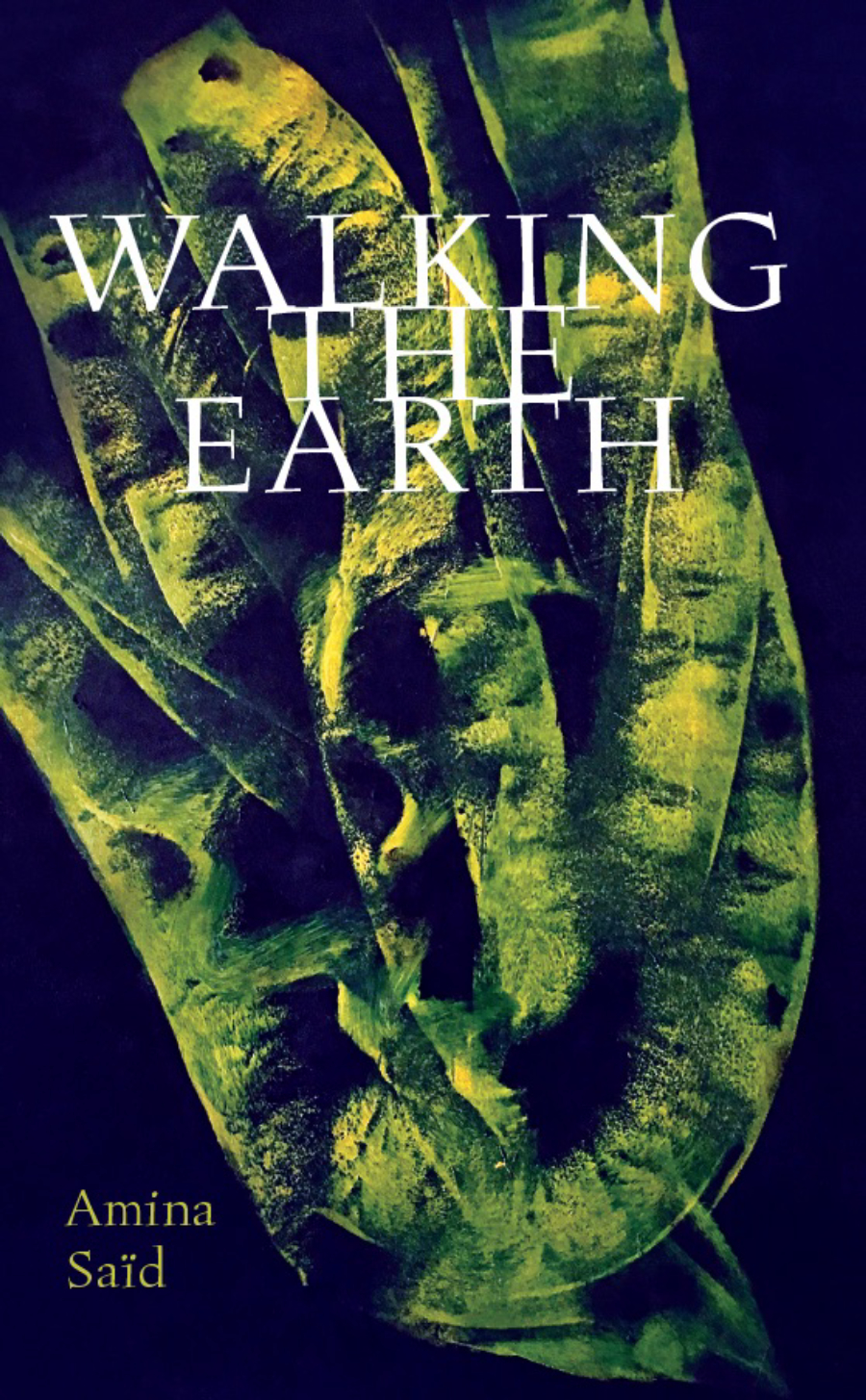
“in the nostalgia of a world / from before this world”:  Walking the Earth by Amina Saïd

all paths
lead to the same place
journey is illusion’s horseback

the world’s embers
blacken its wanton footstep

they burn
our anxious tongues

within its form
the poem seeks itself

Poems for wanderers, or the poem as a series of wandering, emergent forces, Walking the Earth by Amina Saïd hums with an intoxicating, primal energy that speaks to something fundamentally vital and human, in a sense that is too easily buried in the noise and chaos of our constantly plugged-in contemporary reality. Born in Tunisia in 1953, to a French mother and Tunisian father, Saïd was raised in both Arabic and French. At the age of sixteen she moved to Paris with her family where, when she entered university, she decided to study English literature so not to have to choose between her two native languages. Her poetic vision, however, draws on French and Arabic sources and the sunlit Mediterranean landscapes of her birthplace.
Today, Saïd can be considered, according to Hédi Abdel Jaouad, the author of the Preface present text, as the “most potent—and prolific—poetic voice in Tunisia today, if not in the whole of Francophone Africa.” Yet, until this point, no complete, single volume of her work has been made available in English. Now, thirty years after its original 1994 release, Walking the Earth (Marche sur la terre), in Peter Thompson’s translation, finally corrects this oversight.

This haunting sequence of poems, untitled and distinguished only occasionally by dedications, or by shifts in format or theme, has a hushed meditative quality reinforced by the poet’s spare, concise language, subdued and mystical tone, and the recurrence of common motifs. The world her speakers evoke is shaped by primordial elements in concert with journeys across a vast unformed terrain:

earth is this round dream

in its heart
stones fusing

their fire tongues
gouge the pathways of blood
where another fire burns

In her prefatory Note, Saïd writes that this, her seventh book, can be understood as a search for “place”—one that moves from the intimate to the universal—her own journey and that of many who pass through spaces “as much geographical as mental.” She is thinking of the displaced, those driven to move by war or disaster, but also the wanderer and traveller. Wandering is a theme of particular importance in Maghrebi (Northwest African) literature, and one that touches the poet, as someone who writes to hold an intermediary space between the Orient and the Occident, deeply:

My belonging to these two worlds both legitimizes the quest for place and generates a proliferation of doubles: shadows, voices, witnesses, angels, those who keep vigil. . .

This quest for place is born of a profound feeling of exile. Isn’t any creative person “exiled,” a nomad, an eternal wanderer seeking a place—a utopia, a place imaginary, impossible, dreamed of—which poetry can, with a sudden flaring, show in an unforeseeable image?

The quest that stretches across the pages of Walking the Earth is rich in mythological and archetypal images. The recurrence of specific motifs—light, darkness, stones, deserts, shorelines, blood, fire, tongues, voices, screams, silence—contributes to the cyclical feel of the work. Walking is an existential act while language and words are formative elements:

a voice recites
a voice despairs
the choir takes heart

a hand inscribes
ancient alphabets

the light awakens

As the sequence progresses, it becomes clear that the search for “place” is ultimately a search for meaning. The poem itself is the journey, even if the end is but another beginning. It is a path a reader can walk over and over again, and arrive at a different “place” each time.

the poem scents itself
with deepest night

I inscribe myself with sand and dust
in the nostalgia of a world
from before this world

I’m absent
from the mirror of the tribe

Walking the Earth by Amina Saïd is translated from the French by Peter Thompson with a Preface by Hédi Abdel Jaouad and published by Contra Mundum Press.
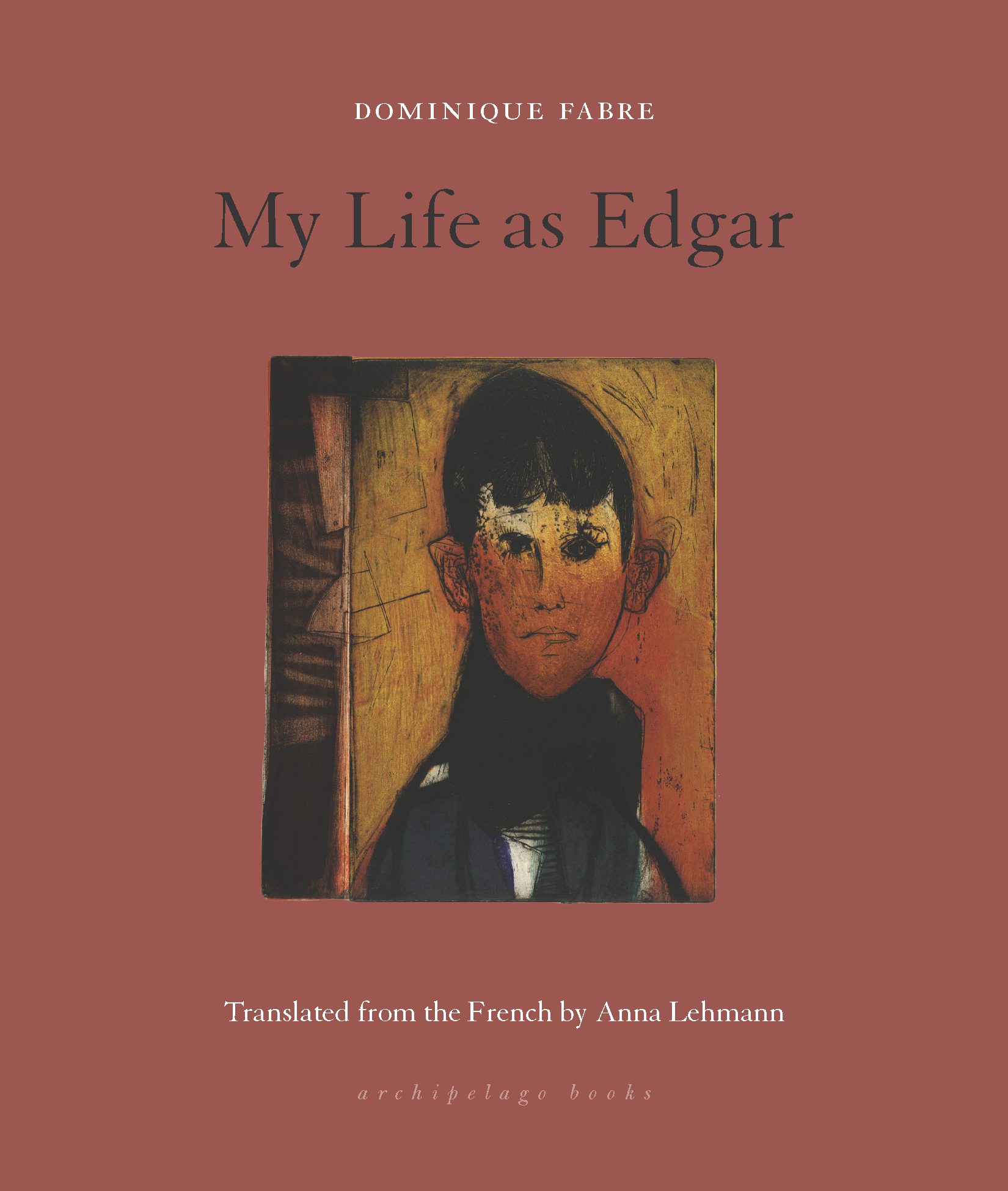
Not all there: My Life as Edgar by Dominique Fabre

With a child narrator it is always a challenge to strike the right note, the right balance of insight and innocence, but when the child in question has a developmental disability it can be even more difficult to create a believable, engaging voice. Or, as in Dominique Fabre’s My Life as Edgar, it can be an opportunity to present the world through an unusually sensitive, yet unfiltered lens. As is clear from the opening sentences, Edgar has a clear sense of what it is that sets him apart from others, even if he and those around him are never really certain just how far apart that truly is:

I was a quiet, unassuming child, but I had features of a kid with Down syndrome—a kind of coldness around the eyes, pale lips, big cheeks, a big butt, though my chromosomes weren’t really to blame. I could hear people around me say He’s not all there, is he? in soft voices, secretively, only I had ears, phenomenal ears, Micky Mouse was deaf compared to me, nature didn’t do me any favors, except for my ears.

When we first meet Edgar it is 1964, he is three going on four and living in Paris with his single mother, Isabelle. Life is pleasant. They go to the park, she takes him to visit a psychiatrist he is fond of, and when she goes to work he stays at a day home. But things start to change when a married man comes into his mother’s life. Suddenly his small world becomes a little uncomfortably crowded, perhaps too crowded. Before long, Edgar is sent to live with a foster family in Savoy. He will remain there for the next seven years, his care paid for by monthly cheque. He will talk to his mother on the phone weekly, write her letters, carefully copying the examples his caregiver prepares for him, and, on occasion, she will come to visit. But in a sense, out in the country he has more attention, freedom, responsibility and companionship than he had at home in Paris. He is even allowed to go to school. With Auntie Gina and Uncle Jos, and the other kids of unwed mothers who pass through their home, he has a second family and freedoms that urban life would never have afforded a young boy who is “not all there.”

On the surface, Edgar’s story is simple, but his telling of that story is neither simple, nor direct. The first section, recounting life in Paris with his mother, has a certain charm. He understands more of what is going on around him—or at least he appears to—and reports his observations and responses with a clarity that belies his age. However, this is a relatively focused period of his life that he may well have replayed in his mind many times over the years that he lived apart from his mother, because, with the second and longest section, the tone changes. Unfolding as an internal monologue addressed to his psychiatrist, Madame Clarisse Georges, he confesses: “I’m still not all there, but I know how to hide it well. I’m grown up now. I’m still quiet and unassuming too, but I’m not sure that won’t change.” He is eleven—a good year for him, he says—it is the year he will return to the city. But he admits that the years before that were also good, and he wants to talk about them. So he sets out to “dive into the past without remembering much actually.” And, sometimes, remembering too much.

As one might expect, Edgar’s efforts to fill in the gaps in his memory leads to a narrative that can be rather disjointed. He reports what comes to mind, moving back and forth in time, from event to event, often unaware of the larger context of what he sees and hears. His foster mother is of Italian descent, while his stepfather apparently doesn’t like Italians “even though he married one and she’s not the first, but I only know that because I let my ears listen.” Uncle Jos is a man who has chosen Stalingrad over the Catholic Church and works for the local municipality:

[H]e has road workers from the Department of Roads and Ditches who are all the time filling the holes of the world so it won’t spill over on all sides. Sometimes at night he goes out in his underwear, wearing his Damart thermals, when the roads collapse  and no one can get through.

His narrative is peppered with stock expressions seemingly incongruous with that of a young child, especially one who is supposedly “not all there.” He talks about his mother’s “dark and traumatized gaze” and accepts that he is the “village idiot.” He calls Italians Dagos and talks of cuckolds without understanding that the terms are being used in a derogatory fashion. His language absorbs and reflects the prejudices and politics of 1960s working class rural France.

As a narrator, Edgar has no filter. He tells what he remembers, the significant and the insignificant alike, from the quality of his bowel movements (especially after the weekly polenta dinner) to the excitement of the Revolution of 1968. What he reveals is often quite telling, even funny, but he his always very serious in his accounting. His is a monologue that invites one to read between the lines, revealing much about the society and the family units within which he exists. And his observations can be quite profound as when he describes his stepfather’s relationship with his adult son on a day when his own mother has come to visit:

They also fought about the Algerian war. I’d often heard the story since being here. Uncle Jos had tried to break Ricardo’s leg so he wouldn’t go back and help the French get killed over there in the colonies, but his leg had held up against the hammer blows, so Ricardo returned to Algeria covered in gauze and bandages. Since then, the two of them didn’t talk much. Me, if we had to go to war for independence, I think I’d go see Ricardo, not Uncle Jos. It feels weird, Madame Clarisse Georges, I’ll always know more about Uncle Jos and Auntie Gina than about Edgar and Isabelle, and all the rest. But today, in case you’re still alive and don’t mind listening to me, I’m like a separated Edgar, I’ve already lived a long time.

In the final section, Edgar, now eleven, returns to Paris and after a few weeks with his mother, is sent off to boarding school. He navigates the dynamics of this new environment for a while, but ultimately  will try to take control of his life in a world which has repeatedly pushed him off to the sidelines.

Dominique Fabre is a writer who is interested of illuminating the lives of people on the margins. This is a brave little book that I suspect may have missed the mark with some readers who fail to connect with narrator. Edgar, for all his concerns about the gaps in his memory, is an endearing child trying to tell his own story as best he can. In the process, he unwittingly tells a much larger tale about the lives of children whose parents are unable, or unwilling, to care for them, the systems in which they find themselves—day homes, boarding schools and foster families—and the value of consistency and support, wherever one may find it.

My Life as Edgar by Dominique Fabre is translated from the French by Anna Lehmann.

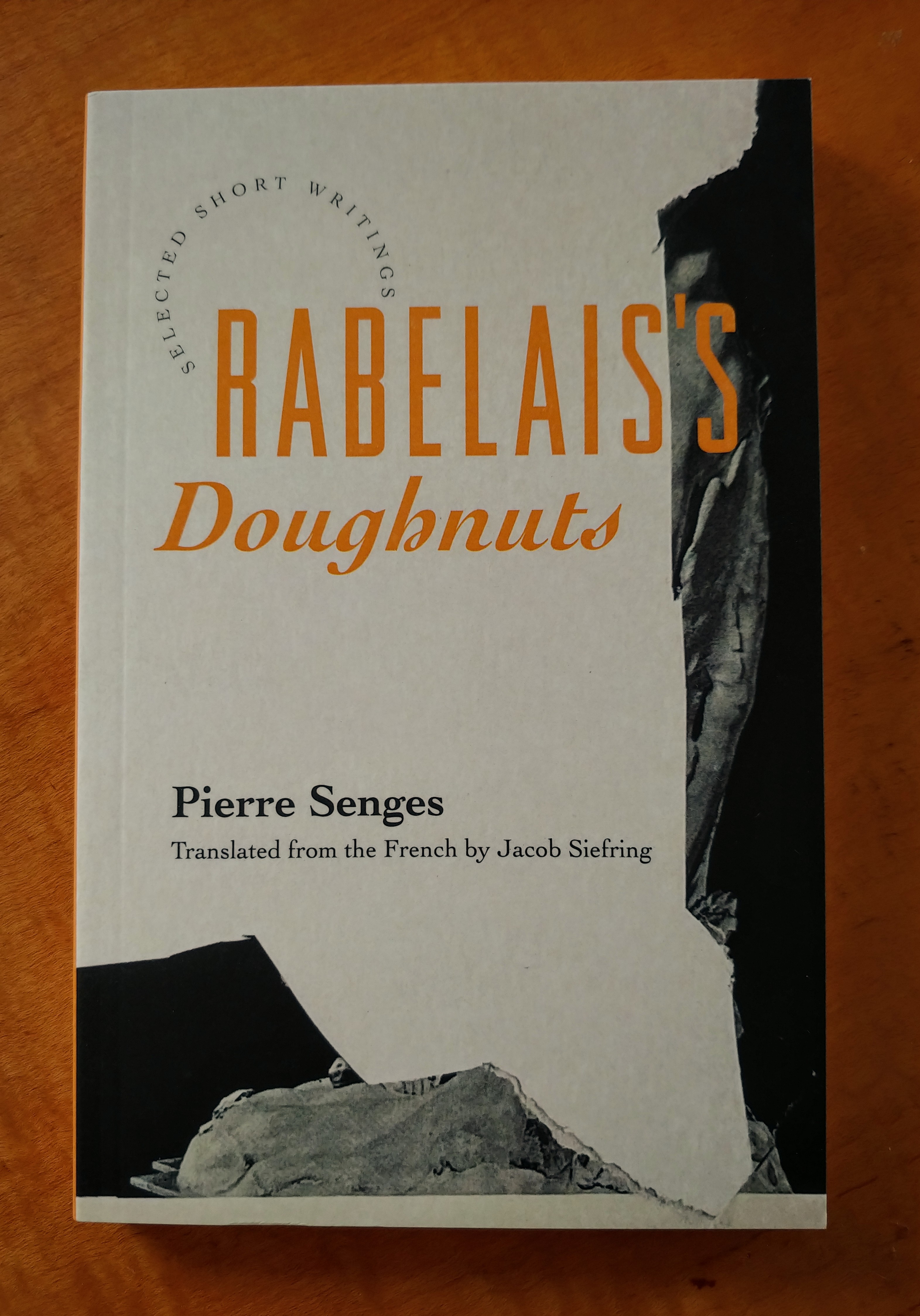
Seven (slightly vain) exercises in style: Rabelais’s Doughnuts by Pierre Senges

French writer and playwright, Pierre Senges, is a most subtle conjuror who casts a sidelong glance and exercises a sharp pencil to bring literary, historical, and contemporary notions together in unexpected intermixtures of fact, fiction and philosophy. An erudite alchemist, he spins extravagant, satirical, richly intertextual essays and imaginings that exploit that hallowed ground between the actual, the probable and the impossible. He may be dancing in the footsteps of Borges and Calvino, but Senges is the choreographer of his own inimitable style.

I have read and reviewed several of Senges’ works—the brilliant The Major Refutation, a conspiracy theory for the ages, the collaborative Geometry of Dust, and the chapbook Falstaff: Apotheosis—but on the menu today is an assortment of his idiosyncratic musings, half a dozen plus one tasty treats gathered together for the first time as Rabelais’s Doughnuts. Translated, like the other works, by Jacob Siefring, a veritable Senges evangelist, this slender volume is published by Seattle-based Sublunary Editions, their third contribution to the mission to bring more of the prolific French writer’s oeuvre into English. Six of the seven titles included in Rabelais’s Doughnuts were previously published in a variety of online and print journals over the past decade, but Siefring’s translations have been revised for this collection.

It tends to be difficult to succinctly summarize a Senges story/essay without tripping over one’s words. The most straightforward pieces here are two that involve Michelangelo’s famed painting Last Judgement. The first, “Last Judgment (detail),” is one of my favourites, revolving around a real person and situation that I was unaware of and would have thought to be entirely fanciful were it not for our friend Google. (One of the great joys of reading a writer like Senges is that he inspires a reader to look up an individual or a circumstance to find out what he is referencing—for those more cultured than myself that might be unnecessary, for those to impatient to seek out the subtext it could be frustrating, but in my mind it is a bonus.) This first Michelangelo piece considers the fate of Daniele Ricciarelli (called Daniele da Volterra or “il Braghettone”) who was commissioned to add tasteful coverings to several of the unsuitably exposed figures in the great artist’s masterpiece. With a certain empathy, Senges considers the task, the betrayal of his master, to which Daniele Da Volterra is committed:

When he draws, he draws, when he paints, he paints: depending on the point of view, the veils of the Braghettone benefit from his skill as the author of a Descent from the Cross, which has since become famous (famous as a reference, not as a celebrity). Or rather, it’s quite the opposite, one hundred and fifty veils fastened like so many pairs of underwear on the men and women of Judgement Day, all stretching towards their salvation or damnation, and disregarding as they would disregard a prune a nakedness that is more or less suited to the gravity of the occasion, one hundred and fifty veils are a valuable exercise for a painter.

The other Michelangelo related piece, “Measure of All Things,” imagines its way into the mind of the influential and critical writer Pierre Aretino who wrote an open letter to the artist offering his opinion on The Last Judgment.

Other works sing the dubious praises of the six hundred page novel, riff on one of Heinrich von Kleist’s prescient anecdotes about possible long distance communication, dragging it piecemeal into our modern world of the internet and Amazon, muse about writing exercises, and take on the character of a counterfeiter baring his sorry soul, such as it is, to a client. Figures from history and literature appear throughout, sometimes even providing a framework for Senges’ wide-ranging reflections. “Many Ways to Stuff a Watermelon” is a perfect example. He wanders through the libraries of a host of real and fictional characters, from the scant collections Russian writer Sigizmund Krzhizhanovsky granted his impoverished characters, to the actual library an aging Giacomo Casanova found refuge in, this tribute to libraries great and small will resonate with anyone who collects more books than they can ever hope to live long enough to read. In this, one English writer’s despair at the incalculable extent of available material speaks volumes (so to speak):

The reader’s tininess signifies the brevity of our lives: it follows that the impossibility of reading everything takes the measure of our mortality, provoking frustration and vertigo at the same time—to Thomas De Quincey, in any case, one hundred thousand forever unknown volumes brought forth tears which he compared to those of Xerxes countenancing the death of his soldiers: not some “fanciful case of misery”, but “as real a case of suffering as ever can have existed.”

Senges’ elaborate language and dry wit allow him to take a small idea and expand it into an intelligent, extravagant exercise, one that takes chances but always steers close to the truth, or a truth, digging freely into the past to make astute observations about the here and now. If you are new to his work (or well acquainted), this short collection is a an ideal way to meet (or spend more time with) this witty, intelligent writer.

Rabelais’s Doughnuts by Pierre Senges is translated from the French by Jacob Siefring and published by Sublunary Editions.

Experimental road trip: Mobile by Michel Butor

Freedomland prospectus:
“Excitement! Adventure! Education!
Cross the centuries from Colonial New England to the pioneer West, from the Mexican border towns to the Great Lakes ports, from Cape Canaveral to the Northwest Passage! Chug the picturesque Old West on an early iron horse, explore the Northwest in a fur trapper’s canoe, soar 70 feet above the earth in a mine oar bucket . . . tour through America’s waterways and wilderness on the most thrilling new rides ever designed!
Over forty authentic themes to make history live again at Freedomland! . . .”

freedomland

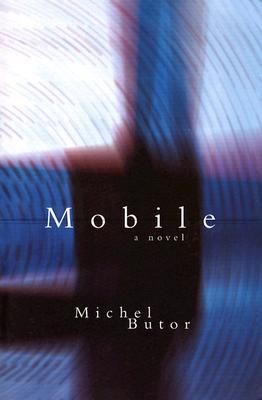
As I write this, the 45th President of the United States has been in office for just over two weeks. Watching the country of my birth from north of the 49th parallel where I have lived since I was three years old, it does feel as if one has wandered into the freak show tent at the Circus-at-the-End-of-the-World. Reading Michel Butor’s Mobile at this moment in American history, frames much of what we are currently watching unfold from an eerie perspective. When the French avant-garde writer was travelling the newly connected highways of America in 1959, he could not have known how very timely all the pieces of information he was gathering, fragmenting, and reconstructing into this ambitious experimental work would still seem more than half a century on. Or perhaps he did. In much of today’s rhetoric, it sounds as if there is a desire to return to some ideal USA, but if Mobile is any indication, that ideal never existed. It is a myth, like the many myths celebrated and reproduced at the grand, but very short-lived, Freedomland Amusement Park.

mobileSubtitled “A novel” in the Dalkey Archives edition I read, the original subtitle offers a more accurate indication of the project at hand: Study for a Representation of the United States. Butor draws from a wide range of materials to create, or allow for the creation of, a representational framework for looking at America. He incorporates substantial excerpts from the writings of Thomas Jefferson and Benjamin Franklin, reports from the Salem witch trials, traditional and treaty records from Native American history, newspaper accounts of the 1893 World’s Fair and more, but one cannot emerge from this journey without an appreciation of an expansive land, rich in history, natural beauty, and diversity.

As eclectic and idiosyncratic as the nation he is attempting to capture, Mobile reads more like a poem than any manner of traditional textual prose. Even the larger textual pieces are broken up and juxtaposed against other materials including an extensive collection of place names, signs, facts, ethnic newspaper and radio programming, travel boards, catalogue descriptions, Audubon bird portraits, and Howard Johnson ice cream flavours. There is a rhythm and an awareness of pattern that binds the work together within a strict overarching structure. He follows an alphabetic rather than geographic guideline from state to state, plays up the seemingly endless recurrence of place names, and links sections across time zones:

The sea,

                    oysters,

razor clams,

                    mussels,

littleneck clams,

                    Washington clams

A white Oldsmobile driven by a young, tanned white man in a pineapple-colored shirt with coffee polka dots (55 miles), “How much longer? Two hours?”—Dead Indian and China Hat Mountains.

The sparkling snow.

SPRINGFIELD. . . . and three o’clock in

SPRINGFIELD, Mountain Time, on the desert plain of the Snake River,
near the lava fields,

WELCOME TO ILLINOIS

                     already four in
SPRINGFIELD, Central Time, where you can order black-currant ice
cream in the Howard Johnson Restaurant.

The Chicago World’s Fair in 1893.
“The New York World,” April 9, 1893:
“Ward McAllister has given careful attention to the question of how New York society will be treated in Chicago during the World’s Fair. He is disposed to think that fashionable persons in this city need not fear anything but the best treatments at the hands of Chicagoans . . .”
Quoted by John Szarkowski: “The Idea of Louis Sullivan.”

The trains coming from New York.
The trains leaving for San Francisco.

Dedicated to Jackson Pollock, Mobile is often described as an unclassifiable work. It is clearly not a study in the formal sense of the word, though by standing back from the flow of fragments, a picture of the country emerges in the patchwork text. There is the sense that Butor harvested this wide range of sources and arranged them to allow the rhythm and flow of language paint a colourful portrait of the United States. It feels dynamic, natural, even when it is the intentional cleverness and humour that catches your eye. But then, it is this same playfulness that makes Mobile such a wonderfully fun read. I especialy enjoyed his use of catalogue listings, as in this pairing of an advertisement for paint-by-number kits with the description of a set of panties:

 “…With this set you receive two Rembrandt water-colors. Panels in pairs, 40 oil-colors in vacuum-sealed glass jars, four superior quality, washable brushes. Net weight: six pounds. . . .”

Or, through Sears, Roebuck & Co., and assortment of seven knitted nylon or rayon panites artistically embroidered with the days of the week:

                      “. . . Choose from

– white for Sunday,

                      – The Last Supper, with The Sermon on the Mount,

– yellow for Monday,

                     – Autumn Landscape, with The End of the Day,

– blue for Tuesday,

                      – Sunset at Sea, with Homecoming,

– pink for Wednesday,

                     – Thoroughbred, with The Foxhunt,

– white for Thursday,

                     – Scenes from Swan Lake, ballet,

– green for Friday,

                     – Venus and Adonis.”

– black for Saturday,
“please include hip measurements,”

This book is not, of course, all light and fun. There are deeply disturbing passages. Segregation is still a reality in many regions (“For whites only”), and the selections from Thomas Jefferson’s writing on the intrinsic inferiority of the black and red races are uncomfortable to read. In the light of the current concern about migrants, the ethnic and cultural diversity captured on Butor’s travels are telling (The Arabs who read “As-Sameer,” The Armenians who read Gochtnag,” The Chinese who read “China Tribune.”) Yet it is all bound together through the repetition of place names from state to state, and the famed ice cream selection at that classic highway stalwart of the era, Howard Johnsons. In the end, filtered through the lens of an outsider, Mobile succeeds in tracing a fractured songline across the heartland of America.

hojo

Mobile is translated by Richard Howard and published by Dalkey Archive Press with a fascinating introduction by John D’Agata.

Of misery and cauliflower: The Author and Me by Éric Chevillard

The tale that unfolds between the covers of The Author and Me by French writer Éric Chevillard is, to be honest, quite unlike anything I have ever read. In fact the tale, or rather tales and other sundry comments exist on two levels: in what might be considered the primary text and in an extensive series of footnotes, which at one point digress into a 40 page story called The Ant. And linking it all is the character’s (and possibly the author’s) explicit loathing for cauliflower gratin. And can the protagonist wax lyrical about his utter contempt for the cruciferous casserole? He can, and does. He also sings the praises of his most desired dish, trout amandine. It would be ridiculous – well perhaps it is ridiculous – if it was not so very funny.

AuthorOh wait, I can sense you backing away now and looking for a quick exit. Would it help if I add that you will also find murder and two shocking twists within these pages?

The book opens with a Foreword in which the author briefly discusses the way his past characters have been conflated with either real individuals or with himself. Questions of the nature of writing and an author’s responsibility for the beliefs and actions of his or her creations continue in the extensive, ongoing footnotes. Meanwhile, on ground level, shall we say, the main character, a middle aged man, collars a young woman sitting on the terrace of a café. With little preamble he launches into what may, or may not, be leading to the confession of a crime predicated on the indignity of being promised trout and being serve a dish of congealed cauliflower and cheese. He contrasts his views about the two dishes with passion:

“On the one hand, the vast openness of space, the loving moon, still more heavens beyond the heavens; on the other, a dull, leaden horizon, the collapsed roof, the flooded basement.

On the one hand, life in all its possibility, benign and, for a few moments – some ten mouthfuls – magnificent; on the other, the wretched gloom of day following endlessly upon day, a longing for death, death as rescue and release.”

As the character’s tale of woe continues, the footnotes run commentary on the author’s tendencies and predilections, muse on the relationship between the author and his character, the author and his reader, and the general nature of writers and their relationship to the world. As you might imagine, the lines between the actual author, M. Chevillard, who continually references his own prevous work, the (presumably) fictional author and the created character blur as the novel becomes increasingly bizarre.

Which all brings us back to this most reviled of vegetable dishes. How serious is the character’s diatribe? How much, against the footnote creator’s protestations, is ironic? Allegorical? To what is it a commentary on the state of literature? On the very state of civilization?

And when is cauliflower gratin simply cauliflower gratin?

For a taste of contemporary experimental absurdist French literature, tuck in your napkin, pray for trout but prepare for cauliflower. Created with finely seasoned humour by Éric Chevillard, carefully prepared and translated for your consumption by Jordan Stump and served up by Dalkey Archive Press, this is a novel that has to be experienced to be appreciated. It has definitely whet my appetite for tasting Chevillard’s earlier work.

This novel was shortlisted for the 2015 Best Translated Book Award.