
“Our Lady of the Nile: how proudly the school stands. The track leading to the lycée from the capital, winds its way through a labyrinth of hills and valleys and ends, quite unexpectedly, in a twisting climb up the Ikibira Mountains – which geography textbooks call the Congo-Nile range, for want of any other name.”
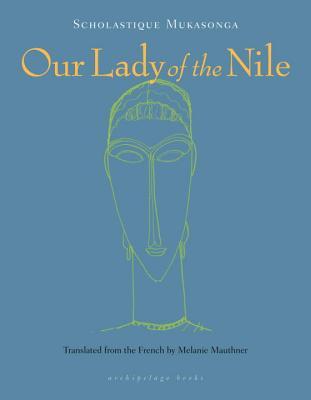 This first novel by Rwandan born French writer Scholastique Mukasonga imagines life in an exclusive girls’ school high in the mountains of Rwanda close to the source of the Nile. Created by the Belgian Catholic church to nurture and prepare the daughters of wealthier Rwandan families for a future that befits their pedigree in the now independent nation, the lycée offers a well rounded education for a young lady and protection from the undue attentions of the opposite sex. Being a virgin, or at the very least not pregnant, is still key to securing a good marriage. And keeping watch over this small community is a blackened statue of the Virgin Mary enshrined nearby, practically assisted by a rigid Mother Superior, several sisters and a chaplain with a lecherous eye for his female charges. Lessons cover academic subjects, languages, religious studies and finishing school skills such as cooking and sewing.
Our Lady of the Nile opens at the beginning of a new school year. Land Rovers, limousines and buses arrive to deposit students. As one might expect, the girls form alliances, engage in gossip, develop crushes on the French male teachers. Assuming a dominant role among her third year classmates is Gloriosa, the big boned, intimidating daughter of a high ranking Party official. In the Hutu dominated nation, her greatest scorn is reserved for the two Tutsi girls admitted under the quota requirements, Virginia and Veronica.
As the year progresses it becomes clear that for all the Catholic school’s efforts to civilize the young ladies, traditional superstitions, beliefs, and customs have a strong hold over the students at the lycée, blending in with Christian faith and fear. For Veronica in particular, another element comes in to play. An eccentric white man who lives nearby on a crumbling estate, lures her into his obsessive fantasy about the Ancient Egyptians and his belief that the Tutsi are their direct descendants. In her vanity she is willing to entertain his delusions. Virginia is skeptical and uncomfortable by her friend’s willingness to assume a queen’s role and seeks instead to assuage disturbed spirits.
Of course underlying racial tensions are never far from the surface. One student, Modesta, with a Tutsi mother and Hutu father, is caught between the two. She likes to confide in Virginia but cultivates a place of security by playing Gloriosa’s lapdog. Although the Rwandan genocide is still years off at the time this story is set, violence is a real and present threat and each side is aware of where their fate lies and it all comes down to a question of race:
“Because there were two races in Rwanda. Or three. The whites had said so; they were the ones who discovered it. They’d written about it in their books. Experts came from miles around and measured all the skulls. Their conclusions were irrefutable. Two races: Hutu and Tutsi, also known as Bantu and Hamite. The third race wasn’t even worth mentioning.”
As Our Lady of the Nile unfolds, life at the lycée and the adventures of some of the girls in this tiny African nation are sketched out at a slow, simmering pace. However, because each chapter tends to deal with a distinct event, the novel has the feel of interlinked short stories. I did enjoy this book, it reads well with moving, often funny, passages, but the overall effect is somewhat disjointed. I found it too easy to put it down and not pick it up for a day or so. A little more consistency and tension would have helped propel the story toward what is a shocking and violent end.
 Translated by Melanie Mauthner, the tone is graceful and clear. But I have to say that there was one moment that set the reading experience off and had me wondering where the editor was. Told from an omniscient third person perspective throughout, there is one paragraph that falls into the first person plural, in the first half of the novel. The effect is jarring. One of those times that, as a reader, one wants to have a peek at the original text.
* Our Lady of the Nile was longlisted for the Best Translated Book Award (BTBA) 2015

 roughghosts