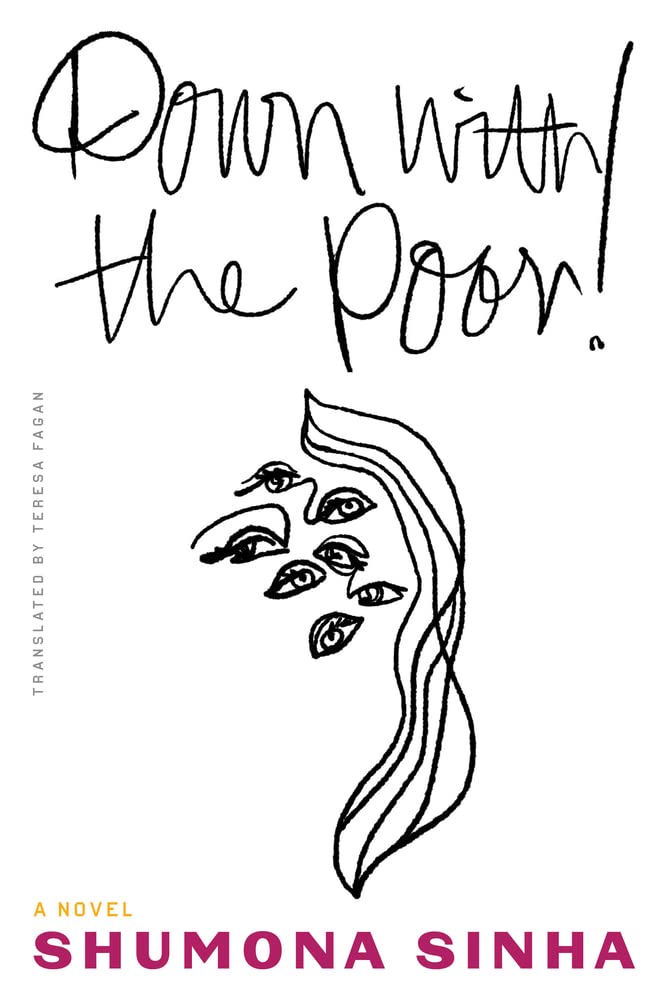
“I’m afraid of myself.” Down with the Poor! By Shumona Sinha

In my half-sleep I saw faces and bodies emerge out of the floor tiles. Blissful, intrigued, tormented people. They appeared when I blinked my eyes. Disappeared when I blinked my eyes. Like this night, in this police cell. To tell the truth, I am still not rid of that shouting and whispering.

Opening with an epilogue from Pascal Quignard about the implication inherent in ancient Greek notions of liberty and freedom of movement that those who defy borders and fences are akin to wild beasts rather than obedient animals, and taking its title from Baudelaire’s narrative prose poem “Assommons les pauvres!” in which a self-enlightened man inadvertently rebalances inequality by violently attacking an elderly beggar, unleashing an equally violent response from his victim, Shumona Sinha’s novella Down with the Poor! is a relentless meditation on the complicated and corrupted system that drives desperate migrants to seek fairer shores, only to find themselves mired in equally, if not worse, circumstances and threatens to destroy the spirits of those who attempt to help them. As she lies in a cell in a Paris police station, a young woman endeavours to untangle the forces that conspired to drive her, an Indian immigrant working as a translator for asylum claimants, to assault a migrant on the metro by smashing a bottle over his head.
Born and raised in Calcutta, Sinha started studying French at the age of twenty-two and moved to Paris a couple of years later. In this award winning novel, her second, originally published in 2011, her unnamed narrator is also from Calcutta. She is a woman who has tried to separate herself from her parents and her hometown, but finds the shadows of Kali, the city’s dark, powerful and protective deity, and Mother Teresa, its symbol of charity, haunt the life she had imagined she had earned, far from memories of poverty, in France, the adopted country she loves. Everything starts to unravel when a series of personal and professional endings lead her to accept employment as an interpreter—a “language gymnast”—in an office on the edge of Paris where ragged petitioners are called to appear before an officer and make their case, or more typically repeat the story they’ve been forced to purchase, in the hope that they might be allowed to stay in a new hostile, unwelcoming land and make some kind of better life.

Unfolding as an intense monologue, poetic and compulsive, the narrator, in light of her arrest and recent interrogation, navigates a flood of feverish thoughts and memories in attempt to figure out how and where things started to fall apart in her world. From early on it is apparent that her role as the conveyor of meaning, from her first language to her second, is more than a simple act of rewording. For her, it is an act of verbal alchemy that carries an emotional cost.

The officer spoke her language, the language of the host country, the language of glass-walled offices. The petitioner spoke his supplicant’s language, the language of the hidden, the language of the ghetto. And I repeated what he said, translated it and served it up piping hot. The foreign language melted in my mouth, leaving its aroma. When I said the words, those of my native language, they turned awkwardly in my mouth, paralyzed my tongue, echoed in my head, hammered my brain like the wrong notes on a wobbly piano. It was a rope bridge, thin, quivering, between the petitioners and me. I had to lean toward each one of them to hold out my hand, lean into their dismembered, chopped-up sentences, fish for their disjointed words and reassemble them, weave them together, make them sound coherent.

The stories she hears, the horrors, real and embellished alike, start to seep into her being. She finds herself carrying their pain. Their desperation. The knowledge that many, if not most, have paid smugglers dearly, become slaves consigned to a poverty much more wretched and inhumane that anything they left behind, builds up inside her. She seeks to shake it in meaningless sexual encounters, while secretly harbouring an attraction for a female officer that she cannot quite articulate.

Over time, her work takes her into other overlooked corners of the city’s margins, while the in the offices of her primary employment, she finds it increasingly difficult to hold herself apart from the stories she hears. Questions of class, colour, gender are never far from her mind, knowing that her own skin, sex and status bind her to and irrevocably separate her from the masses of refugees, while also keeping her apart from those who are driven into work with these populations by charitable passions. She cannot help but absorb the fear she encounters in others. Eventually that fear is transformed into anger and in turn her anger frightens her. She finds she is afraid of herself.

Holding its intensity for a little over one hundred pages, Down with the Poor! is a poetic novella that addresses some of the most pressing and difficult questions we face today in a manner that is shocking, brutal and lonely. This is a very powerful little book.

Down with the Poor! by Shumona Sinha is translated from the French by Teresa Lavender Fagan and published by Deep Vellum in North America and Les Fugitives in the UK.
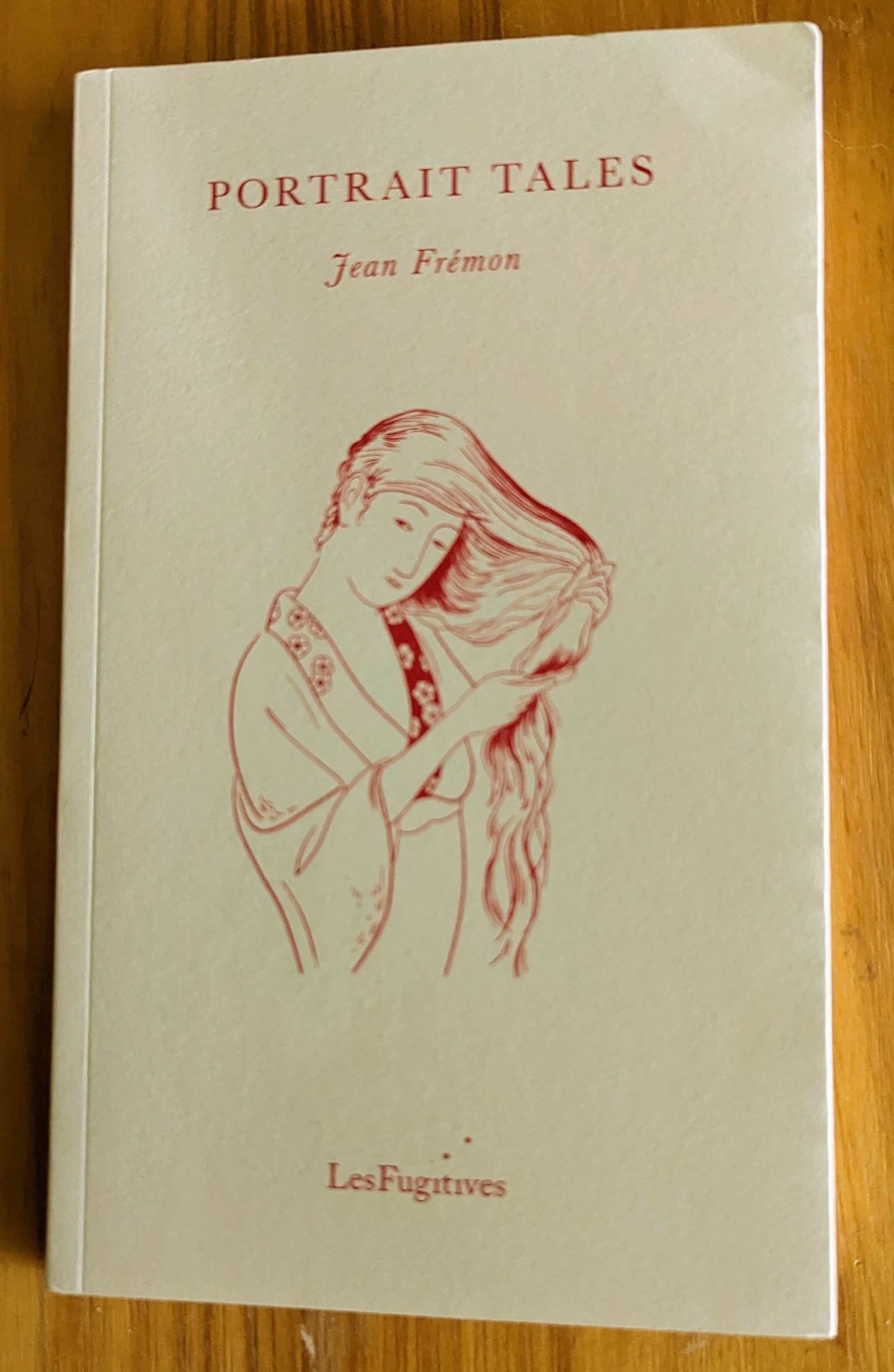
“Ask the light to be clement”: Portrait Tales by Jean Frémon

This book arrived unannounced. An author unfamiliar to me, but on the very first page ten previous titles are listed, complete with translator and publisher. Then, on the title page, a personalized salutation from the author himself and the explanation of how this lovely little book found its way to me—the name of the translator: John Taylor. Over the years, through John’s translations, I have come to know of a number of writers and poets who have quickly become indispensable additions to my library. And now, another.

Jean Frémon is French author who, in the words of the publisher of this volume, Les Fugitives, “has been contributing to a trans-genre tendency in contemporary French letters since 1969.” By day, he is the president of Galerie Lelong, by night a prolific writer of poetry, fiction and essays on art, or, quite often, work that blends all three forms. He has published over twenty books in France and the present text, Portrait Tales is a selection of narratives on portraiture originally published in his 2020 book Le miroir magique. His tales explore well-known and little-known works and artists alike, and demonstrate Frémon’s extensive knowledge and deep appreciation of art whether he is playfully fictionalizing his subject or examining artistic techniques or revealing the historical consequences faced by those who allowed their likenesses to be captured against religious or cultural mores.

These short narratives cover a wide range of subjects. He begins with Lucian Freud’s singular, and less than flattering, portrait of Queen Elizabeth II, travels back in time and across the world to close with a remembered conversation with Louise Bourgeois, the only artist to appear twice and someone he worked closely with as a gallerist. In between—although reading the pieces in order is not prescribed, freedom of movement as in an actual gallery is encouraged—we are invited to learn about an Indian ambassador who paid the ultimate price for allowing Élisabeth Vigée-Lebrun to paint his portrait in defiance of Koranic law and entertain a meditation on the legendary impossibility of rendering a likeness of a young Jewish prophet named Jesus.

We travel back to Imperial China and Japan, to trace changes to ideas and styles of portraiture and conventions about what can or cannot be captured.  Meanwhile in Europe, a number of factual or elaborated tales unfold. Frémon details, for example, the obsessiveness of Maurice Quentin de la Tour who worried his pastel portraits into being and the revenge of a young sculptor who becomes enamoured with the woman he is commissioned to portray.  One of the shortest and most charming essays, is a sketch of the life and remarkable art of seventeenth-century Italian painter Sofonisba Anguissola:

Having withdrawn to Palermo, Sofonisba continued to paint. There is a self-portrait of her at age seventy-five. She is sitting in an armchair, in a three-quarter profile, her arms on the armrests. A large white ruff surrounds her oval face, which she has not tried to make look younger; her cheeks are hollow, her lips thin and tight; two large folds surround her mouth; but the pose is dignified and her bearing is not without nobility.

Ever confident in her ability to capture life in her many noble subjects and in herself, Frémon closes his sketch with an account of her submission to another artist’s pencil, the young Van Dyk, when he visits her at the age of eighty-nine. Her only instruction to him: “Ask the light to be clement.” It almost feels like each of the artists, or artistic moments  Frémon considers here, is presented in a clement light. It is an intrinsic element of his tone.

Varied in spirit and style, every piece in this slim volume is a gem, enlightening and entertaining. As I was reading, I frequently found myself stopping to search the internet to find the portrait or artist in question, if such a record was available. That is a compliment, of course, not a criticism. A sign of a good book is, for me, one that sends a reader down the odd rabbit hole or two, expanding the experience of reading beyond the pages of the text.

Portrait Tales by Jean Frémon is translated from the French by John Taylor and published by Les Fugitives.

Only existing to get away: Eastbound by Maylis de Kerangal

He’s posted at the far end of the train, at the back of the last wagon in a compartment slathered in thick paint, a cell, pierced by three openings, that the smokers have seized immediately. This is where he’s found himself a spot, a volume of space still unoccupied, notched between other bodies. He has pressed his forehead to the back window of the train, the one that looks out over the tracks, and stays there watching the land speed by at 60km/h—in this moment it’s a wooly mauve wilderness, his shitty country.

Aliocha, twenty years old, a boy in a man’s still uncertain body, is onboard the Trans-Siberian railway bound for an undisclosed location in the far eastern reaches of his nation, one of the many Spring recruits too poor, too unfortunate to have otherwise devised a plan to avoid compulsory military service. As Moscow slips farther into the distance and the vast Siberian landscape opens up around him—“this enclave bordered only by the immensity”—he desperately wants to find a way out. The only practical solution he can imagine is to simply get off at one of the many stations on route and disappear, risk everything to lose himself somewhere, anywhere other than on this train packed with anxious recruits and assorted restless travellers.

This is the conflict French author Maylis de Kerangal sets in the early pages of Eastbound, her latest novella to be released in Jessica Moore’s English translation. Of course, Aliocha’s first attempt at escape is foiled and he finds himself back on the train, back in his favourite spot watching the rails roll away behind him into the dark night. But soon he is not alone, the foreign woman he had just seen on the platform joins him, a lonely vigil of her own to keep. Hélène has just left her Russian lover, a man she had followed from Paris to Siberia when he was offered a job he couldn’t refuse, but the isolation and loneliness proved too much for her. Once she decided she had to leave, she had to act fast, catching the first train coming through town—eastbound to Vladivostok—away from Anton, but away from France too.

There is a distance—age, language, culture—between Aliocha and Hélène, but the boy impresses upon the French woman, with a mix of pantomime and force, that he wants to take refuge in her first class compartment until he can escape the fate that awaits him. What develops is an uneasy, unsettled alliance that becomes increasingly tense as the young would-be deserter’s absence is finally noticed. From the opening pages, de Kerangal’s prose carries the emotional intensity swelling in the cramped quarters of the train, the Siberian landscape rushing past the windows, and the increasingly fraught atmosphere of the station breaks without dropping a beat. Long, breathless sentences open across pages, punctuated here and there with short staccato statements. In vivid contrast to the vast expanse unfolding beyond the train, she zeroes in on her protagonists’ minute physical sensations, doubts and fears, effectively playing on the balance between infinite and finite.

Externally, Lake Baikal is an obvious highlight, a treasured vision momentarily uniting everyone  onboard (except Aliocha who, much to Hélène’s dismay, is still in hiding in her compartment when she thought he had disembarked). The excitement rises off the page as passengers hurry out to witness its passage, record it with cameras and cell phones, and celebrate with cake, vodka and song. Baikal is a shimmering source of national pride:

The lake is alternately the inland sea and the sky inversed, the chasm and the sanctuary, the abyss and purity, tabernacle and diamond, it is the blue eye of the Earth, the beauty of the world, and soon, swaying in unison with the other passengers, Hélène, too, is taking a photo with her phone, an image she sends to Anton straightaway, the train is passing Lake Baikal and I am at the window on the corridor side, I’m thinking of you.

But it is the smaller human drama—will Hélène continue to protect Aliocha and can he manage to avoid detection?—that gives this novella its true momentum. The growing tension and affection between the French woman and the frightened but muscular young man, mediated with gestures and limited shared vocabulary, is unfolding in the confined spaces of the moving train. At less than 130 pages, Maylis de Kerangal’s Eastbound is a short, perfect embodiment of the principle that less is more. Not a single word is wasted here, but her characters emerge as full-bodied, conflicted individuals and the suspense, which starts out as a simmer, builds to an intense boil that is likely to have you holding your breath at its peak.

Developed from a short story composed in 2010 when the author was travelling on the Trans-Siberian as part of the French Ministry of Culture’s programme of French-Russian events, Eastbound was originally published in French in 2012. Sadly, her portrait of the rebel Russian soldier is eerily timely now, a decade later. Eastbound by Maylis de Kerangal is translated by Jessica Moore and published by Archipelago Books in North America and Les Fugitives in the UK.