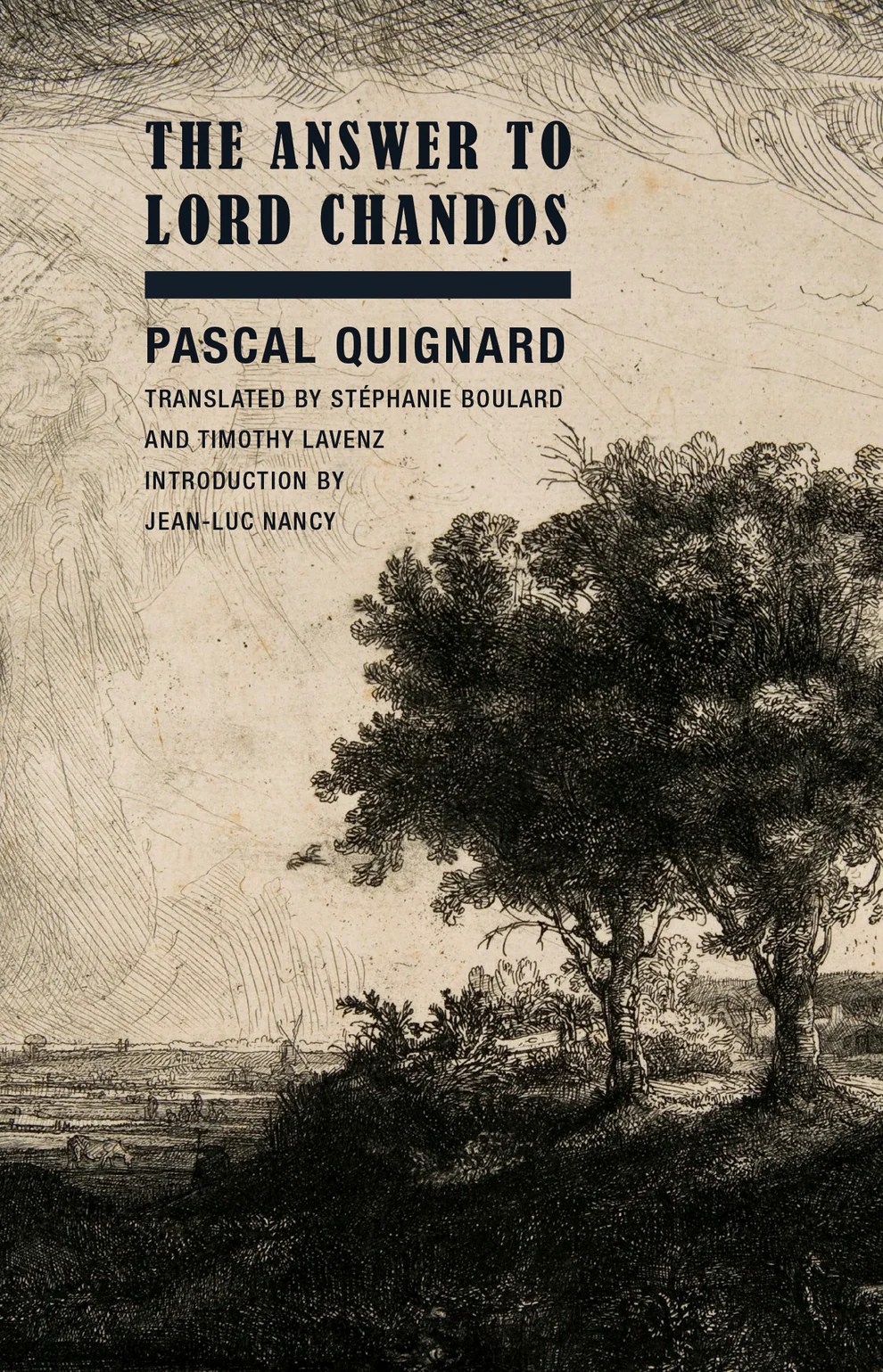
You are neither silence nor language: The Answer to Lord Chandos by Pascal Quinard

Austrian poet, writer and librettist, Hugo von Hofmannsthal signalled a break with his earlier works when, in 1902, he published the story “A Letter,” also known as “The Lord Chandos Letter.” It is presented as a letter to Francis Bacon, dated August 1604, from his (fictional) friend Philip, Lord Chandos, in which the latter defends his abandonment of the poetic life, and society in general, as a result of his nearly complete loss of the ability to express himself in words.  The sentiment expressed in this communication echoes an abrupt change in Hofmannsthal’s own approach to language and the limits of the word so closely that it has been thought to have had at least some autobiographical grounding. But, it is, in fact reflective of the contemporary emergence of new ideas about thought and expression, especially in Vienna, and the impact that would have on philosophy, science and the arts. Although the exact context has been debated, clearly Hofmannsthal was seeking to express some aspects of his own shifting literary  perspective through the existential crisis of faith in language expressed by his character in his fictional letter.

More than a century later, French author Pascal Quinard is not content to leave this influential “letter” as a one-sided communication. So he has picked up the pen of Lord Bacon to respond to Chandos (and presumably his creator) with The Answer to Lord Chandos. In his introduction, Jean-Luc Nancy suggests Quinard may have a wider perspective in mind:

Literature began to distrust itself at the dawn of the twentieth century, beginning with Nietzsche and Mauthner (much read by Hofmannsthal). At the beginning of the twenty-first century, we doubt instead if literature still takes place. Hofmannsthal’s recoil before words responds to the wear and tear of a certain grandiloquence  and literary profusion of the nineteenth century. The vibrant defense of those same words, in Quinard, responds to a banalization and informanization of language ushered in by the twentieth century.

The result is a moving defense of the vital importance of language and poetry that arises from decades of Quinard’s personal contemplation of the original story.

He opens this essay with an imaginative consideration of two artists who preferred to pull themselves away from the world, more comfortable with limited contact with others, but who continued to have faith in their art. He writes about how Emily Bronte’s time in Brussels in 1842, and the necessary social engagement required of her there, only deepened her need for solitude. Her beloved moorlands, which she wandered with her dog and pet bird of prey, served as her inspirational wellspring. Society was not essential for Bronte or for German-born English composer, George Handel. In 1710, Handel travelled to London where he would remain for the rest of his life, becoming in 1718, the director of music to the current duke of Chandos (hmm…) before becoming involved in opera and theatre. But as Quinard describes him, he preferred to live and compose in relative isolation:

Inside Handel’s small living room—according to the inventory made after his death—there was a large secretary made of walnut, a water bowl, a full-length mirror ringed with brass, and two striking wooden heads on which his wigs were placed. Two big heads without eyes or mouth, so that the wigs, reeking with sweat and smoke, could dry out when the evenings were over. So that the smell of society and its solicitations, its judgments, its resentments, its heartbreaks, were not brought any further into the house.

Ultimately, Quinard’s thoughts turn to “A Letter” and its author. Acknowledging that Hofmanthal had suffered a nervous breakdown right as the century turned, fueled by personal matters, Quinard, himself falling under the darkness of depression in 1978, fashioned a response to his fictional young letter writer.

Lord Chandos’ letter to Lord Bacon begins with an apology for taking two years responding to his friend’s last missive inquiring about his well-being. He then goes on to express his conviction that the inspired poet he once was is no more, and explain how he has lost his faith in language and the ability to express himself in any meaningful way. At the age of twenty-six he has abandoned a promising literary career and intends to retreat further from the society in which he was previously engaged. Quinard’s Lord Bacon  opens his own answer to Lord Chandos with a similar apology for taking yet another two years to reply. But his explanation is initially simple—he strongly disagrees with his friend’s argument and has needed time to formulate an answer.

The response is relatively long and passionate, likely longer than the story that inspired it. But it serves as a moving defense of the power of poetry. Bacon’s argument carries an intensity that is sensual, pointed, and persistent. He is intent on chastising and encouraging his friend to pull him out of the abyss into which he has let himself fall and advise him to hold fast to his pen no matter what:

Remember that words only abandon those who have hollowed them out and somewhat devitalized them. And if words resist those who are in the middle of speaking: never do they resist those who write. Those who write have nothing but time for them, nothing but time to go back over their sentence, nothing but time to crack open their lexicons, their chronologies, their dictionaries, nothing but time to seek the help of their old, quite incomplete grammar manual which dates to the end of childhood, nothing but time to revisit, to revive, to re-etymologize, to revise to correct, to surprise. Do not resort to stupor.

Reading the original story before reading this treatise will enhance the experience of Quinard’s response, but it is not essential. This slight volume is a celebration of the expressive force and intrinsic value of literature that will speak to anyone who loves language.

The Answer to Lord Chandos by Pascal Quinard is translated from the French by Stéphanie Boulard and Timothy Lavenz, with an Introduction by Jean-Luc Nancy and published by Wakefield Press.

People look so human: Becoming Animal by Teresa Präauer

Just exactly where can we draw the line between human and animal, man and beast, and exactly how fuzzy (or furry?) is that line? How has our understanding of movement across that line changed over time? And what about those beings, those creatures that have been understood, or imagined to stand somewhere in between? These are the kinds of questions that Austrian writer and visual artist, Teresa Präauer, entertains in her charming, yet focused philosophical and cultural essay, Becoming Animal. The terrain she explores is one populated by a host of liminal creatures—hybrids, monsters, and chimeras— the sort of beings that have continued to inspire both our scientific and artistic imaginations from Antiquity through to the present.

Präauer begins with the harpy, one of the most distinctive figures to appear time and again in early efforts to catalogue all known living beings—factual, mythological, and “exotic” alike—that occupied artists and thinkers from the Medieval era on into the Age of Discovery.

In the Historia naturalis animalism, a seventeenth-century treatise on natural history by John Johnston, there is a bird-like creature with a human head. This ‘Harpyie’ or ‘Harpyia’ has a sceptical, not unfriendly face and long, flowing locks that are gently tucked behind one ear and extend halfway down her body—a bird’s body, of course—the plumage growing thicker and darker towards the back. Compact like a small chicken, the harpy sits atop a pair of enormous talons that could just as easily support a bird of prey.

It’s not her first appearance in natural histories, she has been depicted and evolving for a century. From our scientifically “sophisticated” vantage point today though, such a creature and many of her companions depicted in such volumes seem fanciful, but were they any more so than the angels and demons that also figured in many hierarchical systems? And early Modern scholars often had to work from accounts and drawings made by those with direct experience of the animals in question, as well as reports from travellers often carried second or third hand over time or distance, as they strived to catalogue and categorize all forms of life—mineral, vegetable, animal, and magical. Many of these life forms sat on the edge of classifiably, “pretty monsters” like the harpy and, as time went on and naturalists became more rigorous in their efforts, the fanciful creatures began to be weeded out, but others, like humans with hirsutism, found themselves defined as distinct from their hairless brethren, but like all humans, still very different from other primates. Yet, now, with the ability to study DNA, we know we share 99% of our genes with chimps and bonobos and suddenly the need to once again draw a clear boundary between ourselves and animals has become more important—and more difficult to maintain.

A relatively brief work, only 96 pages long, Becoming Animal is not a chronological survey of the development of taxonomical conventions—although Linnaeus makes more than one appearance—but rather a varied account that moves back and forth, from Michelangelo to contemporary literary theorists, from prehistoric cave paintings to “furries.” It is an engaging flow of ideas that pulls in scientific elements along with literary sources such as Ovid, Kafka, Nabokov, and Inger Christensen to explore the many facets of our connection with and within the natural world. It is the kind of entertaining exercise that can’t quite be pinned down, but Präauer’s primary interest ultimately lies in the space between human and animal, a space that can be approached from either direction. It is a space of movement. She notes that French theorists Deleuze and Guattari, when speaking of “becoming-animal,” perceived it as one of many forms of being, as a “demand for a mode of writing that moves within transitions and liminalities,” however:

Becoming is a verb, a doing that does not mean being. I write ‘becoming animal’ as two separate words, not joined by a hyphen. Animal is noun, and becoming is a verb. When I am becoming animal, I am not an animal. I am in transition. An animal that is becoming human is also in such a transition, albeit in a different way.

This thoughtful essay ends, as it opened, with the author observing the myriad forms of life visible from her window, leaving her reader with much to contemplate about this world in which we are just one element of a much larger whole.

Becoming Animal by Teresa Präauer is translated from the German by Kári Driscoll and published by Seagull Books.

I’m often out of step with the times: An Instinctive Feeling of Innocence by Dana Grigorcea

As if tugged by an invisible thread, I stroll the same old streets—under linden and chestnut trees, past potholes where water or fallen autumn leaves used to gather and kids used to splash and stomp around—breathing more deeply as I walk by the walls enclosing certain yards. Behind one I detect an elderberry bush, or maybe it’s jasmine, or even the more fragrant Japanese honeysuckle. I know there must be rusty garage door in the near courtyard, which will echo the sound of my heels and wake up the neighbour’s dog. And the small starlings lining the now-obsolete rooftop TV antennae will promptly chime in, too, right on cue.

After many years in Zurich, Victoria, the protagonist of Swiss-Romanian writer Dana Grigorcea’s novel An Instinctive Feeling of Innocence, has returned to her native Bucharest, a city now transformed from the Communist-era world in which she grew up into a place reshaped by post-revolutionary currents. It is a place she experienced in flux, as a member of the “so-called transitional generation,” but it has changed even more in her absence. She doesn’t tell us exactly why she has come back, but she is living in her family’s apartment and working at a bank. That is, until the bank is robbed by an old man with whom she will again cross paths as his geriatric crime spree continues. This unlikely occurrence not only knocks her off-kilter, but when her employer insists  she take leave to “process the trauma,” it opens up time and space for her to reconnect with the people and places of her past.

And so, in the stifling summer heat, trailed by the sticky scent of linden blossoms, Victoria fills her newly freed days wandering the city. Bucharest becomes a kind of post traumatic memory theatre with a personal grid superimposed on its layered historical structure. Street names are critical to her ability to orient herself, especially on those arteries that have been renamed, sometimes a number of times, as political currents have shifted. She regularly encounters people from her childhood and adolescence—school friends, former boyfriends, characters from her neighbourhood. Not exactly stream of consciousness, Victoria’s line of thought takes regular digressions as she sees or thinks of something or someone she once knew. Her new boyfriend Flavian will frequently try to navigate this altered landscape with her, offering a frame of reference wherever he can to the many changes that have occurred during her many years in Zurich. And her parents, who have also been living abroad, arrive to visit, further disturbing the unsettled dust of memory. She has an awkward lunch with her mother:

She picks up her knife and fork and continues eating, and I wonder if it would be better for us to talk about her life in the south of France but we tied that last time and it only made her sad. ‘We moved there too late, just too late.’ Or should I tell her about what’s going on here in Bucharest—about her dental practice which is going well? But she already knows. Once again, I refrain from asking her where she parked the car whose keys she’s  left with me, and what it looks like. I’d bet it’s a cream-coloured Peugeot, upholstered in cream-coloured leather. Some day I’ll come across it by accident while strolling about the neighbourhood. The door will pop right open for me, just like in Petre Ispirescu’s fairy tales of eternal youth and everlasting life, stories where the hero returns to his homeland after a long absence and finds that everything has changed, he doesn’t recognize a thing, and even starts to doubt whether he ever had any homeland at all.

As she traverses the city, Victoria notes the heavily weighted history of buildings, landmarks, public squares, and roadways. Her senses are on high alert, yet she is distracted by the smallest details, like the colour of nail polish she has chosen. And there is a constant, uneasy misfit between past and present that unnerves the narrative flow. Sometimes Victoria repeats herself, other times she falls into a side story about someone from her past that may or may not be fleshed out later, or seems to lose track of the thread of events that are—or appear to be—happening in the present. Sometimes the line between truth and illusion breaks down altogether like when a ride on the bus on the same route she used to take every day with her grandmother becomes a surreal, dystopian detour through a decaying urban landscape where cellphone service suddenly disappears and other passengers seem to morph into people Victoria thinks she recognizes.

Of course, she is a less than reliable narrator; her interpretation of reality and her emotional engagement is uncertain. Past lovers continually reappear, leading Flavian to ask “Are you waiting for a lover?” He eyes her with suspicion. “If so, I’ll stay by the door to catch him.” But through it all, Victoria remains an infectiously engaging story teller drawing on a wide range of characters and experiences. From the tale of a philandering neighbour murdered by his wife, to memories of her wildly eccentric grandmother, to details of unconventional tendencies of her parents and their friends, to an account of joining a crowd of thousands to catch a glimpse of Michael Jackson during his Dangerous tour in 1992, the Bucharest that she brings to life is the Ceausescu-era city she grew up in overlayed by a changed, modern metropolis that doesn’t exactly match at the seams. In these cracks she encounters people from her past, both in memory and  in real time. But then, what is real time when life has been disrupted by an unexpected event in a city that has itself been disrupted by more than one political upheaval?

An Instinctive Feeling of Innocence by Dana Grigorcea is translated from the German by Alta L. Price and published by Seagull Books.

2025 Wrap Up: Reading and other stuff


I don’t know what I expected when this year began. Ever since 2020 it seems we have greeted each year with some measure of optimism—I mean how could it be worse than the one that just passed? And somehow, each year has managed to be worse in some new, unanticipated way. 2025 saw the continuation of conflict, famine, destruction, climate catastrophes.  We also witnessed the further escalation of intolerance, racism, sexism, anti-trans sentiment, religious fundamentalism, and autocratic politics. Where I am in western Canada we have witnessed all of this, not just from our neighbours to the south, or distant nations, but right here close to home. It is hard not to lose hope, but giving up is not an option and so, 2026, here we come, preparing for the worst but dreaming of the best.

Personally, I struggled a bit this year. Family stuff, some depression, and, in late November, a car accident that has left me with stiffness and pain that is slow to subside. But, on the bright(er) side, my focus and concentration has returned, and replacing my damaged car proved easier than it might have been. My old Honda Fit had more value than I expected, and I happened to see a (newer) used vehicle that fit my needs for a very good price and was fortunately in the position to buy it. If the police manage to find the impaired driver who hit me (assuming she was insured) I will even get my deductible back. But, quite honestly, I’ll be happy to be able to look over my left shoulder again!

As for reading/reviewing, 2025 was a mixed year. I had a few off times when I struggled to finish books (or gave up altogether), and a number of mediocre reads passed without public mention. At the same time, I read some excellent poetry in English, but could not find the words to write coherent reviews. For some reason, I feel I lack the knowledge and vocabulary to say the “right” thing about poetry in my own language—I feel more comfortable responding to translations. And I did read a lot of poetry in translation this year.

Looking back over 2025, the singular defining force for me was the work of Danish experimental poet and writer Inger Christensen (1935–2009). In January I read her essay collection  The Condition of Secrecy, and I was immediately entranced by her love of language and her view of the world as informed by science, nature, music, and mathematics. I knew I wanted to read all of her poetry and fiction and, throughout the year, that is exactly what I did. I read eight of her translated works and only have one left to obtain although I have a dual language edition of one of the sequences in that volume (“Butterfly Valley”). Along the way I also decided I wanted to learn to read Danish as there are elements of her work that simply cannot be reproduced in translation (mathematical constraints in particular).

And so, I am learning Danish, or, should I say, jeg lærer dansk.

Although I enjoyed all of her books, my favourite piece of fiction was the crazy word play mystery Azorno (1967) and my favourite work of poetry was her monumental it/det (1969), both earlier works. Of course, the wonderful book length poem alphabet (1981) is also amazing. Her poetry and essays are translated by Susanna Nied, her fiction by Denise Newman.

Some thoughts about a few of my other favourite reads from the past year:

 Prose:

Ceilings – Zuzana Brabcová (translated from the Czech by Tereza Veverka Novická)

Set on the detox ward of a psychiatric hospital in Prague, Brabcová captures the institutional environment and the strangeness of psychotic interludes with the skill only personal experience can provide. This wild and delirious ride pulled me out of a reading slump.

Dreaming of Dead People – Rosalind Belben

I read two novels by Rosalind Belben this year, The Limit which was re-issued by NYRB Classics several years ago and this one which was re-issued by And Other Stories this year. Both are strange in a brutal yet beautiful way, but Dreaming is, to me, a more accomplished, in depth novel.

Love Letter in Cuneiform – Tomáš Zmeškal (translated from the Czech by Alex Zucker)

One of those books I’ve been meaning to read for years and when I finally picked it up off the shelf, I was delighted to find out how funny and weird this multi-generational family drama truly is. Zmeškal lends magical realism and historical reality with a cast of eccentric characters to create a memorable tale.

Self-Portrait in the Studio – Giorgio  Agamben (translated from the Italian by Kevin Attell)

Far from a conventional memoir, Agamben invites his reader on a tour of the various studios he has occupied over the years, reflecting on the people, books, and places that come to mind along the way. A surprisingly engaging work.

The Dissenters – Youssef Rakha

The final two novels on my list are both highly inventive in style and form. Egyptian writer Youssef Rakha’s first novel written in English manages to seamlessly incorporate Arabic expressions without explanation, adding to the richness of this original, multi-dimensional story of one remarkable woman set against the events of recent Egyptian history. Endlessly rewarding.

Nevermore – Cécile Wajsbrot (translated from the French by Tess Lewis)

This ambitious novel is a moving evocation of loss and change. A translator has come to Dresden to work on a translation of the central “Time Passes” section of Virginia Woolf’s To the Lighthouse from English into French. Reflections on change and transformation drawn from her own state in life and various historical events accompany the process of translation.

Poetry:

Of Desire and Decarceration – Charline Lambert (translated from the French by John Taylor)

It is most unusual for a poet as young as Lambert (b. 1989) to see her first four volumes of poetry published together so early in her career, but translator John Taylor felt that the Belgian poet’s books show a natural growth best appreciated as a whole. He is not wrong (he is also a translator whose judgement I always trust).

Psyche Running: Selected Poems 2005–2022 – Durs Grünbein (translated from the German by Karen Leeder)

This selection of poetry rightfully won the Griffin Prize this past year. Grünbein’s work tends to draw on his hometown of Dresden and Italy where he now spends much time, and this selection presents a good introduction to the variety of his mid-career work. One can only hope that the attention he has received with this book will lead to full translations of more of his work.

arabic, between love and war – Norah Alkharrashi and Yasmine Haj (eds)

The first of a new translation series by Toronto-based trace press, this selection of original poems with their translations—most written in Arabic, with some written in English and translated into Arabic, exists as a kind of conversation between poets from across the Arabic speaking world and its diaspora. Vital work.

The Minotaur’s Daughter – Eva Luka (translated from the Slovak by James Sutherland-Smith)

This book, a complete surprise tucked into a package from Seagull Books, is a delight. Luka’s world is a strange and quirky one, transgressive and fantastic. Leonora Carrington is a huge influence, with a number of  ekphrastic poems inspired by her paintings but given life from Luka’s own unique angle. Loved it!

Ancient Algorithms – Katrine Øgaard Jensen (with Ursula Andkjær Olsen and others)

This is the book that marked my return to reading post-accident. And how could it not. Jensen’s translations of Olsen’s poetic trilogy are very close to my heart. This unique work begins with poems selected from those books (in the original Danish), followed by Jensen’s translations, which set the stage for a series of collaborative mistranslations guided by rules set by the various poet translators involved. A wonderful celebration of poetry and translation and the necessary bond between the two.

My Heresies – Alina Stefanescu

Finally, one of the English language poetry collections I read and did not review (I did have a great title though). Alina Stefanescu breathes poetry as a matter of course, as is clear to anyone who has had an opportunity to engage with her online. There is an infectious defiance to this collection which straddles Romania and America, conjures angels and demons, and explores the everyday reality of romantic and parental love. I connected most directly with wry observations of motherhood that resonated with my own less than conventional parental existence.

There are, as ever, many other books I read this year that could have made this year end review. You’ll have to check my blog to find them!

Happy new year!

“Here he walked. He walked here.” Advent by Gunnar Gunnarsson

He walked so well here. The snow-covered mountains seemed so low and distant in the moonlight, and here and there touches of starlight glittered against the glossy-black nighttime ice. Such a walk was like a poem with rhymes and wonderful words; it remained in the blood like a poem. And just as with a poem you might learn it by heart, so to speak – and then feel compelled to come and look here again, to make sure that all was unchanged. And so it was alien and unattainable – yet homely and indispensable. And, finally, complete calm fell over Benedikt. A sense of security deep in his heart expanded and became all-encompassing, infallible: here he walked. He walked here.

Compact, compelling, and perfect for the holiday season, Advent is a novella by Gunnar Gunnarson is one of the Icelandic author’s most beloved works. And for good reason. First published in German in 1936, then in Danish, and finally in Icelandic translation in 1939, this tale of midwinter adventure originally appeared in English as The Good Shepherd in 1940. Now, in advance of the  Yuletide season, it has been released under its original title in a new translation from the Danish by Philip Roughton with an Afterword by Jón Kalman Stefánsson.

Born in 1889, Gunnarsson was the son of a farmer in the Fljótsdalur district of East Iceland who showed an early interest in writing. At the time, Iceland was an impoverished colony under Danish rule, so in 1907, like  other Icelanders who wished to pursue a university education, he moved to Copenhagen. Arriving with only a basic reading knowledge of Danish, Gunnarsson quickly mastered the language and would continue to write in it as he pursued a literary career. This had a significant impact on his work. First, although Gunnarsson’s writing was firmly rooted in the Icelandic landscape and culture, readers in his home country typically had to read him in translation (late in life he would dedicate to translating his work into his native language, leading to two—or more—translated texts to choose from). However, his popularity among Danish and German readers, not to mention the continental perspective afforded him by many years living abroad, gives his writing a different tone that that of his Icelandic contemporaries. He was speaking to a wider audience while drawing on themes and settings that brought the rugged—and to some, exotic—nature of Iceland to life.

Advent tells the story of Benedikt, a humble man who works as a farmhand during the summers and stays on during the winters to look after the sheep. He has a small outbuilding of his own for his horse, his sheep and the hay he mows on rented meadows. His is a simple life—half-farmhand, half-smallholder—not quite complete in either direction, yet it suits him. It leaves him, though, little time to himself, save for his annual Yuletide trek into the mountains to look for any sheep that may have been left behind on the high summer pastures. There are always some. This year will be his twenty-seventh trip; an important milestone. He was twenty-seven when he made his first run, and now, as a man of fifty-three, he feels his age. But with two of the finest companions he has ever had—Leó, his faithful dog and Eitill, his even-tempered, reliable wether—he has nothing to worry about, not even the less than favourable-looking winter weather ahead.

Here he was now, walking in snow, white on all sides as far as the eye could see, a greyish-white winter sky, even the ice on the lake was frosted or lightly covered with snow, only the rims of the low craters sticking up here and there drew larger and smaller black rings like a pretentious pattern in that snowy waste. But a portent of what? Perhaps these crater mouths said: Let everything freeze, stone and water solidify, let the air freeze and sprinkle down as white flakes and lie like a bridal veil, like a shroud over the ground, let the breath freeze in your mouth and the hope in your heart and the blood to death in your veins – deep down the fire still lives.

Gunnarsson’s protagonist, Benedikt, as a man for whom church was an integral part of community life, his thoughts often turn to the life of Jesus and his journey carries echoes of Christian imagery, most strikingly the regular reference to “The Trinity,” but here the term describes a man, his dog, and his wether. Our hero is a man long accustomed to a solitary life and even if there are hints that he once dreamed of more, he treasures this annual pilgrimage into the mountain wilderness alone. However, on this particular journey his task is delayed not only by unstable weather, but by men who seek his assistance in their own searches, for sheep in the first instance and for horses in the second. Both times, Benedikt is less than happy with the deferral of his given objective, yet one senses it is his compassion for lost animals that motivates him to divert his attention more than a concern for his fellow man. He is a man on a mission with an anniversary to mark no less.

In this way Gunnarsson builds complex layers into his relatively simple tale of a risky mountain adventure. Benedikt, along with Leó and Eitill, are each distinct and developed personalities. Against the harsh unpredictability of the Icelandic winter they are a well balanced team. Anything less and this particular mission to retrieve any lost or missing sheep could have ended in disaster. In his Afterword, Stefansson remarks on Gunnarsson’s remarkable ability to evoke the intensity of winter storms in the mountains, comparing his gift to that of Conrad’s descriptions of storms at sea, noting that both men left their native homes and wrote in a second language. However, Gunnarsson did eventually return to settle in Iceland and one clearly see that contemporary Icelandic authors, such as Stefansson himself, have learned much from his example.

Advent by Gunnar Gunnarsson is translated from the Danish by Philip Roughton and published by Penguin Random House UK.

Counting, accounting and recounting: The Folded Clock by Gerhard Rühm

two!
one two  –
one two  –  three!
.        two
one two three  –   four
.       two

“a recounting,” the first number poem you encounter in Gerhard Rühm’s The Folded Clock, opens with a lengthy note explaining exactly how the piece should be recited—volume and intensity directed and measured—before erupting across the following five pages as numbers, spelled out, descend, rise, and repeat. Finding the flow and riding it (guided with a few more directives along the way) is not difficult, especially if you allow yourself to read aloud and, there are you are, from the very beginning, not simply reading but actively engaging with the poem.

And there are ninety-nine more, each one involving numerical elements in some shape or fashion. Some are sequential, others visual, still others are in verse form. Clever or funny or profound, it is amazing just how far numbers can take you.

Born in Vienna in 1930, Rühm, who recently celebrated his ninety-fifth birthday, is an author, composer and visual artist. His poems reflect all of these interests. He was an early practitioner of concrete poetry and an original member of the influential Wiener Gruppe. His interest in numbers as “the most pared-down and at the same time most universal element of design” goes back to the early 1950s. When he composed his first number poems in 1954 he was unaware of Dadaist Kurt Schwitters’ own explorations in this area, but he has continued to incorporate numerals and digits into his spoken and visual poetry, expanding the possibilities numbers offer. The Folded Clock, newly released from Twisted Spoon Press in Alexander Booth’s translation, gathers one hundred of these poems in a handsome volume.

Many of Rühm’s poems play with the rhythm and sound of numbers in various sequences and patterns. Others exploit visual qualities and double meanings that arise from the titles and the images or words they are paired with. And a sly humour surfaces throughout, as in “imperfect counting poem”:

one
two
three
four
five
six
seven
eight
nine
toes

one’s missing

Or “sixty-nine pairs of lovers” which depicts, inverted on their side, six rows of ten and one row of nine (sixty-nine) 69’s.

But, Rühm is also inclined to employ numbers and words to make thought provoking statements about the world. “time poem”—another piece that begins with a note on recitation—takes on cosmic dimensions starting with:

1 january, 12:am: bang!
2
3
4

And so on, counting down one calendar year, day by day, marking the significant events, from the Big Bang to the first moon landing. Given that fish don’t begin to swim in water until December 19, the final day of the year opens up, first by hours, then half hours, and by 11:30 pm, minutes, until the final minute opens up into seconds to allow human history from the first cave paintings to space exploration to fall int place. (You can read this poem online here.) Elsewhere he allows climate change, odd historical facts, and interesting news stories inspire poetic creations. Ruminations on living also fit well with the measurement of one’s personal relationship to time as in “sense of time”:

a week ago i was still a child
five days ago i  was an adult
four days ago was the time of the “vienna group”
three days ago i was living in berlin
for two days now i’ve been in cologne
everything since the turn of the millennium happened yesterday
since early this morning i haven’t aged at all

The variety of poems in this collection is wide and endlessly entertaining. They range in length from just a few numerals, to pieces that extend for several pages, to sketches and collages. Even if you fear you might be intimidated by avant-garde or experimental poetry (or poetry at all), this is a work that is not only intelligent and entertaining, but that contains many pieces that you could easily find yourself unable to resist reciting aloud.

The Folded Clock: 100 number poems by Gerhard Rühm is translated from the German by Alexander Booth and published by Twisted Spoon Press. (Excerpt and images can be seen at the publisher’s website.)

Here at the end of the world: The Sorrow of Angels by Jón Kalman Stefánsson

The boy sticks his head all the way out and his black hair whitens, the ground lies everywhere beneath a thick layer of the sorrow of angels, no grazing either in pasture or on beach, all the livestock kept inside and the farmers counting every hay-blade going into them, in some places little remaining but leavings  and the animals bleat and low for a better life, but the clouds are thick and no sound is carried to Heaven.

It is already April in this Icelandic village and there is no sign of anything resembling spring. The snow continues to fall and the winds blow cold. It has now been about three weeks since the unnamed protagonist at the centre of Jón Kalman Stefánsson’s Trilogy of the Boy made his way back to the small community following the tragic death of his best friend on a fishing boat, and he is now settling into a life he never imagined possible, surrounded by new friends—a somewhat eccentric family of sorts—with books to read and his first stirrings of real, if perhaps ill-advised, romantic attraction to the daughter of a wealthy local merchant. But this peaceful interlude will not last long.

The Sorrow of Angels, the second volume of the trilogy, can certainly be read as a stand-alone work, but Stefánsson does not waste time filling in many details to flesh out the events and characters, present or past, as he picks up the boy’s story, so starting with Heaven and Hell would not hurt. Both are great. Intense and thoughtful at once, if that’s possible. The first part of Sorrow is evenly paced, continuing with the same rhythm that marked the second part of Heaven and Hell, as we come to know more about the people who have taken the boy in—the strong-willed, mysterious Geirþrúður, her housekeeper Helga, and the blind old sea captain Kolbeinn—and other local figures. For an orphan tossed from farm to farm who, at nineteen, has already spent three winters out with a fishing crew, having a room of his own, surrounded by people who share and actively encourage his love of reading, is more than he could have ever dreamed of. Yet, when the postman Jens arrives from his latest delivery trip half dead, only to have his superior insist that he head right back out on an unfamiliar route through the endless winter’s storms, the boy is “volunteered” to accompany him.  For the postman, with an aging father and a developmentally disabled sister to support, the promised payout of this journey is too much to pass up. But for his friends, the idea of him taking on this mission alone in such extreme weather is a serious concern, so they decide that he will not go alone.

Once the two men are on their way, the mood of the narrative shifts, acquiring a sweep that echoes the vast landscape to be traversed. It very quickly becomes clear that Jens and the boy are temperamentally mismatched for the challenges that lie ahead. The older man prefers the silence of his own thoughts, while the younger man is inclined to want to fill the long hours with conversation, recitation of verse, and even song. Their trip, through blinding, brutal storms, over an unfamiliar terrain with unseen dangers and few places to take refuge, is long and they will be forced to rely on one another more than once just to survive. Through long, unbroken passages, Stefansson’s penchant for prose that is lyrical and melodic, heightens the inhuman conditions his characters face here at the end of the world—both those who live in this harsh region year round and those forced to pass through. He is a master at evoking ice, freezing skin, and the snow storms can distort time and space, carrying with it the real threat of ghosts that seem to emerge out of the whiteness to lead the lost to their deaths.

He stops, ceases to struggle onwards and stands still, forces himself to stand, though the temptation simply to sink is so alluring; he stands still and shuts his eyes. Now I shut my eyes, and if I’m meant to live, he thinks optimistically, then Jens will be standing before me when I reopen them. He stands with his legs spread wide so as not to be blown over and it’s incredibly good to have his eyes shut, as if he’s made it to unexpected shelter. The wind is certainly still blowing coldly against him yet it’s no longer of any concern to him. It has grown distant, it’s no longer threatening. It would be too easy, perilously easy to sleep like this; open your eyes, he commands himself, and that’s what he does. Opens his eyes to see a woman standing before him, just an arm’s length between them. Rather tall, erect, her head bare and her long, dark hair blowing over and from her stern face, her dead eyes penetrate his skull and drill themselves into the centre of his mind. Then she turns and walks away, against the wind, and he follows.

However, as the boy and the postman will discover, sometimes the dead have other intentions. Before their journey is over, they find themselves joined by a third man, and charged with the special delivery of a most unusual item through the most treacherous terrain they have yet encountered.

Like Heaven and Hell before it, The Sorrow of Angels combines the elements of an epic adventure with a strong musical sensibility. Stefánsson’s language is poetic, his characters are pushed to their limits—physically and emotionally—and the remoteness and ruggedness of the remote reaches of northern Iceland a century ago is portrayed with relentless intensity. A thoroughly enjoyable read. However, as the middle volume of a trilogy,  this book ends on a cliffhanger, it must be said, and it will be another six months or so before the final volume is released in North America in the spring of 2026. (It has been out for a decade in the UK, but it is always nice to have a matching set.)

The Sorrow of Angels by Jón Kalman Stefánsson is translated from the Icelandic by Philip Roughton and published by Biblioasis.

“How many years fit into one day?” Heaven and Hell by Jón Kalman Stefánsson

The sea on one side, steep and lofty mountains on the other; that’s our whole story in fact. The authorities, merchants, might rule our destitute days, but the mountains and the sea rule life, they are our fate, or that’s the way we think sometimes, and that’s the way you certainly would feel if you had awakened and slept for decades beneath the same mountains, if your chest had risen and fallen with the breath of the sea on our cockleshells. There is almost nothing as beautiful as the sea on good days, or clear nights, when it dreams and the gleam of the moon is its dream. But the sea is not a bit beautiful, and we hate it more than anything else when the waves rise dozens of metres above the boat, when the sea breaks over it and drowns us like wretched whelps. Then all are equal. Rotten bastards and good men, giants and laggards, the happy and the sad.

This theatrical landscape, evoked with such poetic intensity, sets the stage for an epic work that combines old-fashioned drama with contemporary literary sensibility, a tale of loss and bravery that makes for a truly glorious read. Somewhat disorienting in the early pages of the first volume of Jón Kalman Stefánsson’s Trilogy About the Boy, it’s not clear when the swirling narrative takes place, and where the protagonist—known simply as “the boy”—and his friend Bárður are in this snow-covered Icelandic terrain. Somewhere between heaven and hell, no doubt.

Heaven and Hell is a tale about the devastating power of the elements and the redeeming power of literature. It has an intentionally timeless, epic quality that is irresistible, thanks in no small part to an overarching narrative voice,  a first person plural chorus of the dead, that relays this story of the past, unfixed in time but set more than a hundred years earlier, “during the years when we were surely still alive.” An epic voice for an epic adventure. But the distinctive lyrical qualities reflect Stefánsson’s natural inclinations as a writer:

Poetry is very important to me; I started my writing career as a poet, published 3 books of poetry before I turned over to prose. In a way, I think that I use, though subconsciously, the technique and the inner thinking of poetry while writing prose; therefore, poetry lies in the veins of my prose. I think as a poet while writing as a novelist. I also see my novels partly as a piece of music, a symphony, a requiem, a rock or hip-hop song. There lies so much music, both in the language and the novel itself: its structure, style, breath. And the structure is for me just as important as the stories; one can sometimes call it one of the characters.

At the centre of this novel is a nineteen year-old orphan, the boy, whose father drowned when he was six, leaving his family separated. He and his brother were sent to board in different communities, while his mother and young sister would die before they could ever see one another again. But although his parents were poor, with limited education, their love of books and his mother’s letters filled with imagery drawn from science, helped foster in her son literary inclinations that would bloom under the right influence. That came through his friendship with Bárður, a young man several years older who introduced him to the beauty of poetry. When Heaven and Hell opens, the two are on their way back from a brief respite in the Village to the fishing hut where they are spending their third winter as part of a fishing crew. In his pack Bárður is carrying a loaned copy of Paradise Lost—a book that will soon cost him his life. As the crew is readying to take to the sea in the early hours of the following morning, Bárður will quickly slip back to commit a few lines of Milton‘s verse to memory, something to share with his young friend during the long hours ahead, but in his haste he will forget his waterproof. When a vicious storm arises, this mistake proves fatal.

When the boat finally returns to shore, the boy is devastated and cannot bear to stay. The captain’s wife helps him prepare for the long walk back to the Village and he slips away intent to return the borrowed book. He intentionally choses the more challenging inland route, haunted by the pain of his loss. He thinks about poetry and he thinks about death:

He trudges into the valley and Bárður is dead.

Read a poem and froze to death because of it.

Some poems take us places where no words reach, no thought, they take you up to the core itself, life stops for one moment and becomes beautiful, it becomes clear with regret and happiness. Some poems change the day, the night, your life. Some poems make you forget, forget the depression, the hopelessness, you forget your waterproof, the frost comes to you, says, got you, and you’re dead. The one who dies is changed immediately into the past. It doesn’t matter how important a person was, how much kindness and strength of will that person had and how life was inconceivable without him or her: death says, got you, life vanishes in a second and the person is changed into the past. Everything connected to that person becomes a memory you struggle to retain, and it is treachery to forget that.

The journey is difficult and dangerous, and the boy does not know what he will do once his mission is complete, but suicide is an option he contemplates. However, once he is back in the Village, he soon finds himself welcomed into what becomes an ad hoc, somewhat eccentric, family of sorts.

What makes this novel succeed so well, and makes it such an entertaining and invigorating experience tp read, lies in the musicality of the language and the strength of the characterization. On one level, there is the fundamental battle between man and nature—the former so small against the enormity and unpredictability of weather, water, and terrain— unfolding in seemingly endless sentences and long breathless paragraphs, followed by short sharp statements that stand alone. The epic sweep of these passages is reinforced by the otherworldy quality of the narrative voice. On the other level, away from immediate environmental threats, individual human interactions have a different tenor. Focus falls on certain striking features—perhaps body size, eyes, or hair—that set one person apart from another, the kind of cues people use to try to assess others. Dialogue is woven into the text without demarcation, much social motivation remains in the shadows, and distrust can be easily kindled. Life is tough in this remote part of Iceland, and so are the people who live here.

This release of Heaven and Hell has been a long time coming. First published in Icelandic in 2007, Philip Roughton’s English translation appeared in the UK in 2010 (MacLehose Press). Now, in 2025, Biblioasis has released the first two parts of The Trilogy of the Boy for North American readers—The Sorrows of Angels just came out—with the final part due next year. And although the books can be read independently, it doesn’t hurt to start right here with part one of this memorable epic tale in which epic poetry is a driving force, leading to death and reaffirming life.

Heaven and Hell by Jón Kalman Stefánsson is translated from the Icelandic by Philip Roughton and published by Biblioasis.

“Pain is a privilege of the living.” The Last Thing by Leopold Lahola

One day, a hundred thousand years ago, during the Ice Age or soon after, when the world began to melt from below, an iceberg must have carved out this valley, with its body dragging its tail behind it like an enormous scaly reptile. At least according to the long-winded account he heard yesterday from Big Joco as the two of them had been left to their own devices with machine guns aimed at the valley they were watching intently, charged with providing cover for their unit lying low in the woods behind them, and now, rushing hell for leather from the woods back to Big Joco after an endless night when they had not been relieved as planned, Melius concluded that very little had in fact changed, that they had entered another damned ice age and that even the sun, sinking its teeth into him like a cannibal, would also soon turn to ice.

This is the opening paragraph of the title story of the newly released collection of tales by the Jewish Slovak writer Leopold Lahola, available in English for the first time in Julia and Peter Sherwood’s translation. The brutal cold and the  isolation of partisan fighters in the final winter of the Second World War cuts through to the bone in this tale of one man’s efforts to respect the dignity of a friend and fallen comrade. When Melius makes it back to the windthrow where he an Big Joco had been positioned, he finds his companion dead. To leave him there to suffer further indignities should the Germans pass by is unthinkable. But Big Joco is a monstrously huge man, now lying face down, stuck to the frozen ground. When Melius encounters a stray fellow partisan, a miserable character referred to simply as Walrus due to his distinctive moustache, he tries to enlist his support to move his friend. The reluctant recruit balks when he sees Joco’s massive form, and even when the two men combine forces their task seems impossible. So Melius conjures an ingenious, if gruesome plan to divide the load.

This desperate urgency to cling to some measure of humanity under inhumane conditions, with the inevitable conflicts that arise between individuals with different motivations—regardless of whether they are on opposing sides or not—is a key theme running through all of Lahola’s wartime stories. His ability to quickly set a scene, craft strong, often eccentric characters and his keen ear for dialogue give his fiction its unique cinematic intensity. It is not surprising that he was also an accomplished playwright and filmmaker. However, due to his own postwar malaise, he ended up spending much of his life in exile. In fact, the collection from which the stories in the present volume were drawn was not published until 1968, months after his early death just shy of his fiftieth birthday.  However, the Soviet invasion that same year  would lead to the erasure of his work from Slovakian literary history,  not be rediscovered until twenty years later following the Velvet Revolution.

Born Arje Friedmann in northeast Slovakia in 1918, Lahola was conscripted into the Slovak Army in 1940. He deserted in 1942 to avoid deportation, but when he learned that his mother and younger brother had been interned in a labour camp, he willingly joined them. When they were to be taken away on a transport, he again offered to join them, however a friend working in the camp administration removed his name from the list. He then went on to join the armed resistance and engaged in front-line combat during the Slovak National Uprising. The final winter of the war he spent in the mountains fighting with the partisans. After the war he worked as a journalist and began writing for the theatre, adopting his more distinctive Slovak name, Lahola, inspired by a sign above a butcher’s shop. For a time he achieved considerable success in the postwar world, but he found it hard to shake the weight of the recent past. Following the Communist takeover in 1948, he emigrated, first to Israel and then to Germany, before finally returning to Czechoslovakia in the late 1960s in the light of growing liberalization.

Lahola drew on his own wartime experiences in his short fiction, not only the hardships and cruelty, but also the recognition that his enemies, the German Nazis and their collaborators, were human beings too. As he noted in his diary, “I participated in a war against people who were my spitting image.” It is this reality that complicates the emotional and ethical implications of many of the stories collected here. These are not heroic tales with clear black and white divisions between good and evil, shades of both exist on both sides as it turns out. The longest piece in the collection, “A Conversation with the Enemy,” is a prime example. It begins with a partisan, captured by the Germans, anticipating a harsh interrogation and summary execution. He finds, instead, bored officers who ask him nothing. He is then sent off and finds himself followed by an armed soldier who cordially introduces himself as Helmut Kampen. Fully expecting to be shot, the partisan is disarmed by the German’s desire to engage him in conversation, longing for a little friendly debate. As they make their way through the snowy woods, their banter continues—eagerly pursued by the soldier and suspiciously challenged by the partisan. It becomes, over time, an extended interaction between two men who, under other circumstances, might be friends. But ultimately, when the tables are abruptly turned, they each still have a role to play.

The nine stories gathered in this volume were composed primarily during the early years of Lahola’s exile, from the late forties through the mid-fifties, and are set amid rising facsism just before the war, through the years of concentration camps, direct conflict and on into the tragic aftermath. All feature third person narratives, save for one, aptly titled “In the First Person” set during the first summer after the war, in which the narrator, returning to his home community, collects the first person accounts of those who have survived as he seeks his own closure. Among writers chronicling this period,  Lahola’s work stands apart, not simply because he can draw out the humanity in the enemy (not to mention the inhumanity on his own side) but because his narratives tend to adopt a dispassionate, distanced tone. This heightens the intensity of the moral choices he places before his characters, typically driving them to a point at which a decision must be made, and then leaving them there, in the terrible moment. The very clear theatrical quality of his stories, tinged as they are with a dark touch of the absurd, allows for an exploration of the realities of life during wartime intended to raise more questions than it answers. As such, The Last Thing is a long overdue opportunity for English language writers to come to appreciate the work of this remarkable Slovak writer.

The Last Thing by Leopold Lahola is translated from the Slovak by Julia and Peter Sherwood and published by Karolinum Press.

In this violent solitude: Light, Grass, and Letter in April by Inger Christensen

But do not grieve for me
do not grieve for your lonely
to and fro
My hour has rusted
My poem has left
your beaten track
Do not grieve My young poem
is more deeply kissed by life
Deathly it creeps
over under through me
Poetry is murdered hope.

(from “In the wild loneliness of the mountains” / Light)

Having read most of the poetry of Inger Christensen (1935-2009) that is available in English translation, to return now to her earliest published collections, Light (1962) and Grass (1963) is somewhat like experiencing the formative spirit of a writer who will soon make her mark as an original and experimental literary force. And yet, it is clear in these poems composed in her mid-twenties, that she is already exploring the themes and perspectives that will define her most ambitious—and most popular—poetic works. This is perhaps to be expected because only six years separate the publication of Grass from the release of her monumental 200-plus page book-length cosmic poem Det in 1969 (“It” in English translation, 2006).

The present volume contains her first two collections, along with her fourth, A Letter in April (1979), a collaborative project that followed ten years after Det. Light and Grass being only one year apart, share much in common and reflect the time in which they were written. Yet as translator Susanna Nied (who has translated all of Christensen’s poetry and is thus well acquainted with her oeuvre) says regarding these two books:

Her lifelong themes are already evident: boundaries between self and other, between human beings and the world; our longing and struggle for direct connection beyond boundaries; the roles of language and writing as mediators of that connection; the distances between words and the phenomena that they stand for.

Images drawn from nature, domestic settings, and corporeal existence feature throughout these poems, with a strong sense of the landscape, the seasons, and the musicality of her homeland. Many of the pieces in both volumes tend to be shorter and lighter in form, though the not necessarily in content, but notably, the final poem in Grass, the sequence “Meeting,” is longer , closer to prose poetry, and seems to presage  sections that will later emerge in Det/It.

The unknown is the unknown and gold is gold I’ve heard, one
.      winter the birds froze fast to the ice without the strength
     to scream, that’s how little we can do for words with words
the books press close to one another and hold themselves up,
.      backs to the living room, our buttoned-up words huddle
.      on the shelf, the queue-culture of centuries, inexorably
.      built up word by word, for who doesn’t know that the
.      word creates order

(from “Meeting: V” / Grass)

The third work collected in this volume, Letter in April, seems quite different in tone, quieter and more intimately focused. It arose as the result of a collaboration with graphic artist Johanne Foss who began with a series charcoal-on-parchment drawings based on Etruscan artworks. Christensen and Foss had known each other for a number of years and both had spent time at an artists’ residence in Italy and explored Etruscan ruins. Taken by Foss’s drawings, Christensen chose some and began writing responses to her images. These responses began as prose pieces, but she ended up discarding them and beginning again in poetry. Their project developed over two years as they worked together during the summer months while their children played. Several themes emerge in this work including parenthood, wonder, nature, and the account of a woman who travels to a foreign country with a child inspired by a trip Christensen took to France with her young son as part of her writing process.

Unpacking our belongings,
some jewelry
a few playthings
paper,
the necessities
arranged within
the world
for a while.
And while you draw,
mapping out
whole continents
between the bed
and the table,
the labyrinth turns,
hanging suspended,
and the thread
that never leads out
is, for a moment,
outside.

(Section I,  º )

However, more than a series of poems and drawings, Letter in April follows a complex yet unassuming structure. Each of the seven sections contains five segments marked by a sequence of small circles in varying order. For example, Section I follows the pattern: º º º º º, º º º º, º, º º, º º º .  Section II begins with º º º , and likewise each section begins with the same marking as the final segment of the one preceding. These markings link poetic segments with shared motifs, allowing  the entire work to either be read straight through, or by following the each pattern individually (i.e. I º, II  º, III  º, IV  º, and so on).  This flexibility reflects Christensen’s musical and mathematical instincts,  which are also apparent in the arrangement of elements of Det/It, but will be given full reign in her wonderful numerically and alphabetically framed poem Alphabet (1981).

Light, Grass, and Letter in April is a rich compilation of poetry that offers insight into Christensen’s development as a poet from the mid-twentieth century inspired modernism of her earliest work, through to a collaboration (unique in her oeuvre) that incorporates visual and dynamic elements. It is essential for those who already know and love her poetry, but can also serve as an introduction for those who have yet to encounter her masterworks.

So here we sit
in this violent solitude,
where bulbs work
underground,
and we wait.
Around noon
when the mountain rain stops,
a bird stands
on a stone.
Around evening
when the heart stands empty,
a woman stands
in the road.

(from IV  º º º º º)

Light, Grass, and Letter in April by Inger Christensen, is translated from the Danish by Susanna Nied, with Drawings by Johanne Foss. It is published by New Directions.