June lengthens, rising toward the longest day of the year. This is my most painful, impossible month and this year my awareness of the layering of repeated circles around the sun is taking on a new intensity.
Like a film flickering at the edge of my field of view, Junes of the past keep rolling in and out of focus. This week. Convergence.
Twenty-two years ago today, I was released from a period of involuntary hospitalization. The psychiatric ward was a strange place, with strange characters from the requisite Jesus dispensing wisdom in the dining room, to the young orthopaedic surgeon on suicide watch. I recall my time on the unit as the first opportunity I’d had in years to worry about no one but myself—and plenty of medication to ensure that I didn’t do too much of that either.
I was a manic patient in the process of coming back down to earth.
*
Eighteen years ago this week I had my first shot of testosterone. My partner of twenty-one years moved out the next morning. I cried for fifteen minutes, dusted myself off and moved on into a new reality. A single parent. A shape-shifter, slowly masculinizing.
Out of madness and into manhood. Or something.
Five years ago this week—summer solstice, 2014—I summited the heights of mania, once more, after a long steady climb over the crumbling rocks of my own sanity. I can only imagine the spectacle I’d become over the final months at the office. I remember trying to hold together an agency that seemed to be coming apart at the seams, everyone looking to me to fix things and ultimately taking the fall when I lost my grip. Nobody intervenes with a madman if that madman is doing a job no one else wants.
Nobody catches him when he falls or helps pick up the pieces. No one sends flowers.
The undignified end of my career forever unresolved. June 20, 2014, a day I can barely remember. A day I will never forget.
Exactly one year later I sought my own closure. Booked a trip to South Africa—the first and sadly only chance I would ever have to spend time with a close friend, queer and bipolar like me, but down a much deeper darker road, one with no escape, as it would turn out.
I timed my arrival so I would be in Cape Town on June 20, 2015. Imagining that I would invert my fortunes by marking winter solstice in the southern hemisphere. That I would stand and face the sun going down and bring to a close a difficult twelve months. Put it all behind me and move forward into a renewed life.
Reinvent myself again.
But of course, closure is a myth and life writes its own lessons. I would have to come to terms with death first. Very nearly my own within a month of returning home. Then my mother’s, my father’s, my friend’s.
I was torn open. Again. I’m still pulling myself together.
*
This June, for all the added hours of daylight, it’s darkness I am fighting. The malaise, the murky waters of the bipolar cycle were never my habitat until these past few years. To feel my spirit and energy ebb as the seasonal shift ushers colour into this dead brown world is difficult to bear. With the added rainbow intensity of Pride Month, ever reminding me of everything I cannot find within my own queered reality, I keep falling further into the dark corners of my own imagination.
All month I’ve been pushing against this current of discontent.
I can’t stop thinking ahead. This October brings my 59th birthday. Next year I turn 60. I don’t even know how I got here. No other milestone has pressed down on me like this one. I have a number of friends who are over 60, but not one of them is facing their seventh decade alone.
Alone. That is what I didn’t expect at this age. Or if I suspected it, I didn’t think it would hurt like hell. Alone is not a lack of people in your life. It is a lack of something you know is missing, that you cannot even fully define so it’s hard to know how to fill it. A close friend? A lover? Something to give your life meaning?
For me feeling alone is something pervasive. Embodied. Written into the physical and gendered trajectory of my existence. Here. In June. Once again.
*
June lengthens, rising toward the longest day of the year.
Passing rain. An image that stirs, the shifting light, sun, darkening skies and sun again, on a wet and glittering world. This is summer. Not quite but almost.
This Mother’s Day marks the third that I have faced alone since my mother’s passing in 2016. Last year was painful; this year, the passage between her birthday on May 2nd and today has been even more difficult. I have been angry, frustrated, agitated, depressed. Beset with a loneliness that is bone-deep, existential, wordless. I debated whether I should even attempt to express it because my specific pain is coloured not only by my loss of a beloved parent, my own mother, but because, although I face the world as a male person, understood as a man even to those who know otherwise, I am also a mother. Mother’s Day opens itself to women who have longed for motherhood (including those born male) or taken on motherlike roles in a wide variety of contexts, but holds no space for a mother like me. Even my own children tend to overlook my desire for just a moment’s recognition.
The only person who fully understood, honoured and respected this incongruous aspect of my being in the world was my own mother. And she is gone.
Up until the week she died, my mother called me, like clockwork, every Saturday night at 7:00 pm. I’m not sure when this pattern was established, but it extended back for decades. We were so very close. I listened to her joys and trials; she listened to mine. But there was never a exchange more difficult than my call, almost twenty years ago, to tell her that, after nearly forty years of trying to make myself into the woman she naturally assumed I was, I could no longer fight a persistent agonizing sense that I was not really female. My thirties had been, she was well aware, a decade of peculiar turmoil; that behind the birth of two children and a dutiful effort to craft a home that resembled the one I’d grown up in, something darker was brewing. I was increasingly, obviously miserable. I had experienced a serious manic psychosis and spent the better part of a month on the psychiatric ward. But nothing could have prepared her for my revelation. I had never shown the slightest masculine tendencies or interests and “transgender” was only just beginning to become a topic of conversation. However if gender roles and experiences—including pregnancy and childbirth— could a woman make, I could have managed to quell the dysphoria. I could not.
My mother, bless her, responded to the news that I was planning to divorce and transition to a life as male, with the promise that she would always love me unconditionally. She asked for no more than a few weeks to adjust to the idea. She became my advocate, quietly, faithfully, unstintingly. If she had her own doubts and grief over the loss of her daughter, she never let me know. And I never got the chance to ask. It was a subject left unaddressed in death.
My mother died from complications of osteoporosis and, as we learned in the final days of her life, post-polio syndrome. In eighty-two years the markers of exposure to that disease had never been detected, but together these conditions had gradually reduced her body to a hunched, frail, crippled cage. Until the very last month, when the lack of adequate oxygen exchange began to impair her thinking processes, she remained alert, intelligent and fresh. When I spoke to her, her age was ambiguous, eternal. Every time I saw her in person, I would be shocked anew. She spent her final years trapped in a delicate, fragile frame that constrained the spirit of a woman who had been so active and physically vital most of her life.
Her body betrayed her.
My mother’s death, followed eleven days later by my father’s death from the complications of a head-on collision, unravelled my reality in ways I am only beginning to fully appreciate. My parents spent their final years in a cottage in the woods outside a small village about two hours northwest of the city I live in. It was the final destination of lives that had started in large urban centres—New York and Toronto—and ended in a place in which they had few, if any connections. To everyone who knew them in this ultimate location, I was the oldest son. To most of the distant and scattered friends and relations I was tasked with notifying of their passing, I was their only daughter. For my brothers, never entirely at ease navigating the decade and a half between my two opposed public identities, I will always be a sister.
My parents’ final home.
For my own two children, I am the parent who transcends and defies gender, who struggled to raise them alone from the ages of eight and eleven, with little financial and emotional support, with one identity at home, but hidden, vague and uncertainly defined to the outside world. I referred to myself as their parent, only explicitly defining the biological reality when medical or educational situations commanded more specific terms. To do so was to invite the question of how much my issues were or were not impacting my son or daughter who each had their own challenges. No one ever asked how the practical emotional distance of their father played a role. I looked like a father and it is difficult for others, even if they are fully aware of my past to hold mother as a reality in the existence and life of someone who looks like a man. I was, more often than not, reduced to that oddity that, even today, is poorly appreciated—a single male parent.
I would be asked: Where is their real parent? Who? Their mother? What could I say? She’s dead? And yet, I resisted revealing my identity unnecessarily. I have long known single fathers, not widowed but left with the care and responsibility while mothers moved on, and I felt it was important to call attention to the fact that not all single parents are women. I also feared negative fallout. As a closeted transgender person I stood in isolation.
Yet raising children through their difficult adolescent years gave my life meaning, value. My own parents stood by me, pitched in, built strong and vital relationships with their grandchildren while the other side of their family, maintained a distance. Only their stepmother, their father’s new wife, made an effort. As I built a new identity and a new history as a man in the world, my children and my parents provided essential continuity. They allowed me to feel whole, to carry motherhood and manhood as part of who I was.
Who I was.
The last few years have not been so easy. The artificiality of this assumed completeness was shattered when I became ill and lost my job. The scaffolding provided by my short-lived career, the years I spent working in social services fully and completely accepted as male, was stripped away leaving me defenseless. By this time, my children were in their twenties, both dealing with their own serious issues, and I had no friends, community or support to fall back on.
In retrospect, the sharp jolt into recognition of the limitations of transition to address the longstanding dislocation of gender dysphoria, has been a blessing. I could have continued to imagine that my artificial existence was sufficient for some time, but in truth, cracks in my carefully tended armour were showing long before the tentacles of mania pried them open. Career success was only a passing indication of achievement. My failure to make friends or forge a sexual identity spoke much more acutely to the truth that I could live as a man, but would never really be a man. Yet, as transgender, my own experience—past and present—is never echoed in the endless stream of gender different narratives that have become so ubiquitous in queer and public discourse. My personal efforts to find comfort, community or safety in LGBTQ space have been a dismal tribute to the heartache of finding oneself doubly alienated among the alienated. I sometimes feel like I have never fit in anywhere.
So I sought to find myself where I had no reason or expectation of fitting in. Where I once sought to ensure protection by building walls between myself and the world, I now seek escape. Through reading, writing , and travel. South Africa. Australia. India.
And again, India.
My mother only lived to know of the first of these journeys, one that in my complete ignorance about the risks of long haul sedentary travel, very nearly cost me my life—blood clot to pulmonary embolism to cardiac arrest—saved against incredible odds, by my son who found me and started CPR. But I know she would never have discouraged my continued travel. In her lifetime she managed to visit Cairo with a friend and Russia and New Zealand with my father, but had she not been constrained by an increasingly brittle body and an increasingly eccentric and intransigent husband, she would have travelled longer and farther. Perhaps I have inherited some of my restlessness from her.
That restlessness is growing. I have never felt “at home” in the city where I have lived for most of my life. I was not born here. I have no roots or connections here. Both of my brothers are married to women with deep histories in this part of the country. But my ex was of the first generation born to migrants, refugees. My own mother was a migrant and, back only two generations of a family of refugees herself. I feel this eternal disconnect enhanced by the embodied dislocation I feel as someone who has navigated womanhood and manhood, but belonged to neither. In this present #MeToo era I am even more adrift. I am torn between a genuine empathy for men—informed by living as a male person in society keenly aware of the ways testosterone has altered my mental and emotional engagement with the world—and the feeling that my own experiences as a girl and woman have lost their currency. I look like a middle-aged white man and that is all that I am allowed to speak to. There isn’t even a language which can adequately address my dual life and my role as a parent. Transgender men who opt to have a child at the beginning of the transitional process engage a queer parenthood that is unlikely to ever be labelled “motherhood” as language now tends to be gender neutralized, distorted. Which is fine for them, but it silences and disowns the reality of my, admittedly less common, hybridized experience.
I want to speak for no one but myself. I do not regret the decision to transition, I am entirely comfortable with the face I see in the mirror. I am male and enjoy a hormonal rightness that grants me a certain completeness. The body, well that is another possibly unsolvable matter. However, of late I find myself wanting to claw back some sense of dignity for my early, pre-transition life. It isn’t easy. It is unsettling, even with my most generous and supportive friends— those who fully accept me but have only known me with this present name, this current appearance. And very often it angers transgender activists because it defies the accepted discourse. I can’t help but fear that the only person who might have ever come close to truly understanding, who might have been able to walk with me through this unending, evolving, shifting, and ever ill-defined journey is no longer here. My mother contained all that I am—all that I have ever been, and all that I ever will be. My absolute alpha and omega. Her love was whole, at times skeptical perhaps, but expansive and complete.
And for that reason, on this Mother’s Day, I miss her with all my heart and soul.
You might as well haul up
This wave’s green peak on wire
To prevent fall, or anchor the fluent air
In quartz, as crack your skull to keep
These two most perishable lovers from the touch
That will kindle angels’ envy, scorch and drop
Their fond hearts charred as any match.
Seek no stony camera-eye to fix
The passing dazzle of each face
In black and white, or put on ice
Mouth’s instant flare for future looks;
Stars shoot their petals, and suns run to seed,
However you may sweat to hold such darling wrecks
Hived like honey in your head.
—from Sylvia Plath, “Epitaph for Flower and Fire”
I have known mania, and the imagery in this poem sparks with an intensity that excites and disturbs. When I encounter the words of one of the many poets known (or thought) to share (or have shared) the same affliction, I often find an undercurrent that causes me to flinch for just a second. Not that it diminishes the beauty or power of their words in any way—it is rather an echo in the dark, a faint recognition flashing by.
Image copyright Joseph Schreiber, 2012
It is World Bipolar Day, and this is the first time I have stopped to recognize the fact. I have spoken in, and around, my own bipolar diagnosis, but I have never addressed it formally in my writing. Even now I find myself uncomfortable discussing it. On the one hand, I am fortunate. I respond well to medication. I am, to use that distasteful term, “high-functioning.” But I do harbor a deep anger toward this condition that was part of my life many years before I finally careened through a brutal month of manic psychosis and found myself committed, and ultimately diagnosed, at the age of 36. I was, in classic bipolar fashion, the last person to suspect that I had a mental illness. Even though I, and those around me, knew something was terribly wrong, the stigma and lack of understanding around mood disorders—not to mention the radically impaired insight the sufferer has when they are ill—stands as a barrier to timely intervention. And then there is the matter of actually accessing care. One almost has to crash completely—by which time it can be too late.
Between my first manic episode in 1997 and the second in 2014, I experienced more than sixteen years of stability. I transitioned, became a single male parent, built a career out of nothing, and eventually became the Program Manager at an agency dedicated to working with survivors of acquired brain injury. I loved my job. Looking back, I can now see how the last few years of that period were marked by an increasing tendency toward hypomania. With my psychiatrist’s support I cut my medication back. And then things started to fall apart at work—things beyond my control, but it fell to me to try to pull things together. Then I started to fall apart at work, until I spiraled into full blown mania. Not psychotic, but it matters little. The damage was done.
The agency I worked for, dedicated as they are to supporting clients with disabilities including co-morbid mental illnesses, treated me with distrust bordering on contempt. My only contact with them has been conducted through a workplace advocate and my insurance worker. When return to work was discussed they refused to consider any possibility that I could work there again. Almost three years later with long term disability finally at an end, they still have my personal belongings.
Nine years of employment and dedication to that job now stand as a gaping hole in my life—a life already filled with gaping holes. And that is one of the reasons I hesitate to talk about mental illness (although I have never hidden my diagnosis). What can I say? Bipolar is not my identity any more than transgender is. Both fuck up your life. Leave wounds that do not heal. Find you fumbling through mid-life with little to show for your years but a lot of things you can’t talk about. And periods of time you cannot even remember.
So this is why I find it hard to write about my experience with mental illness. There was a time, following my diagnosis, that I devoured everything I could find, just as, a year later I hunted for books on gender identity. Two pieces of a puzzle I had inhabited—the periodic mood swings and the persistent, life-long feeling that I was not the female person everyone else knew me to be—had finally fallen into place. I had two, if you wish to be specific, explanations that come neatly labelled and defined within the covers of the DSM. It was, for a while, a source of relief.
Today I rarely read any literature that deals with mental illness or gender. But I am aware, more than ever, of being doubly stigmatized. And, most painfully, within the spaces where you would expect acceptance—in the human services profession and within the queer community. Thus the anger.
And what is this anger? Grief. The deep griefs I carry, layered now with more recent bereavements. It has become, for me, an existential bitterness that plagues me, an inauthenticity that defines the way I intersect with the world.
The legacy of mental illness is this: after diagnosis I was advised not to dwell on the disease, not to talk to others with bipolar; I was not deemed “sick” enough to warrant outpatient support or psychiatric follow up. I was left, like so many others, to flounder in the dark. It would take seventeen years and a spectacular career-destroying crash before I was able to access proper psychiatric and psychological support. I am still lucky. I am stabilized. And the forced detour into what may become an early semi-retirement has afforded me a space to write.
Now I need to find a way to write my way through this weight of grief. And begin to heal.
I’ll leave the last word to Sylvia Plath, with the final (fifth) stanza of the poem quoted above:
Dawn snuffs out star’s spent wick,
Even as love’s dear fools cry evergreen,
And a languor of wax congeals the vein
No matter how fiercely lit; staunch contracts break
And recoil in the altering light: the radiant limb
Blows ash in each lover’s eye; the ardent look
Blackens flesh to bone and devours them.
—You can find out more about the International Bipolar Foundation here, and a prose poem I wrote to honour a dear friend who lost her desperate and brave battle to bipolar last year can be found here.
Granted midwinter in my part of the world is not the best place to find colour in nature. Branches are bare, grass is bunched and brown, snow is patchy and grey. But when I look back over the past year I can see how difficult it has been for me to register any enthusiasm to take my camera out. I walk a lot but I seem to want to stay in my head, maintain a fast pace, measure the rhythm of my boots against the ground. I circle the neighbourhood, walk with purpose on errands, but avoid the pathways and parks I have documented season after season these past few years.
Photography was a diversion, a relaxation and an isolated activity against a busy life at work and home. I would wander forest trails, across grassland parks or along the edges of rivers and lakes, framing and reframing the view and listening to recorded podcasts – discussions about books, philosophy, current events. It was a meandering, escapist pursuit. If I look back I have to wonder what I was escaping and where I had lost the capacity to dream.
Madness, mental illness if you prefer that term, brings back the capacity to dream because all the parameters are changed. For me it has brought words to the foreground but pushed the pictures to the background. Walking has become a means to expel restless energy, drive out the demons of anxiety and despair that keep reaching in. If I want to drown out the city noises I listen to music, the words in my head are my own.
Without being able to return to work at this time, I do feel a certain loneliness. But when I reflect on the years I devoted to a job that I believed validated and defined me, I realize that I was never more isolated than when I was working. Invisibility and an unwillingness to call attention to myself was not a measure of my successful transition. It was denial. To hide the fact that my past contained realities inconsistent with the man everyone knew, I believed I could not afford to allow anyone to get close. I captured colour in the outside world but painted myself with the blandest palatte possible.
A manic episode and all of the reckless behaviour and poor judgment it entails has left me with a professional legacy that I may never be able to salvage. I don’t even know if I want it back. Reclaiming my identity, being comfortable with my own history of sex and gender is a work in progress but I have to trust that it might lead me to a better more authentic place. It might even bring some colour back into my life.
At the beginning of 2014 my world was rapidly spinning out of control. There were clear indications that the extreme stress and toxic work environment I was living under was taking its toll. I was clearly struggling to hold myself together but like any good manic depressive I could not step aside and recognize the crisis that was unfolding. No one else in my life had the understanding to step in either and, in all fairness, I am not sure how I would have responded.
Now, at the end of the year, I have been out of the office for six months. My future is unclear. I had loved my work with brain injured adults and their families. It was challenging, rewarding and I was well respected. At least until I went crazy.
As soon as I walked away from my job I realized the price I had paid to build a career from community field worker to manager in less than a dozen years. I had intentionally alienated myself from people. I have always been a person inclined to isolation, shy in a curiously outgoing way. Public speaking does not phase me at all. I could speak to a crowd of 300, riffing on a theme if necessary, but face to face small talk is uncomfortable. The thought of baring my soul to another person in real time, over a coffee perhaps, is almost unbearable. In my life I have made few friends and had only two significant love affairs. And somehow I had managed to convince myself over the past decade or so that in addition to the challenges of raising children on my own, the social interaction provided by my work with hundreds of clients and professional colleagues would suffice. Close friendships and romantic relationships were not required.
I was wrong. But what now? I am in my 50s. I have repressed the very uniqueness of my history, that which had always set me apart. The very queerness of my being in the world. The ostensible and hard won success of fighting to be true to myself in the world was turned to dust in an instant. The road ahead suddenly looked lonely and long…
Slowly I am recovering. Much slower than I expected perhaps, but this unplanned respite has forced me to explore, re-evaluate and reach out. My therapist (thanks Jane) has been an important sounding board. Blogging and making contact with both bipolar and bookish fellow travelers has been vital. It has allowed a space for cathartic dumping. A medium for strengthening my ability to clearly articulate my thoughts and reflections. It has given me confidence to move out into the world closer to home.
Thanks to the fact that I have not been working I was able to volunteer at our writer’s festival and meet writers I admired from around the world, all of whom are in my age range. Financial constraints encouraged me to cancel my TV since I was generally using it as a mindless distraction. Consequently, reading and music have regained the attention they deserve. And when it is not -20C, like it is at the moment, I make a point to get out every day, frequently just to read and write at a local coffee shop.
So here is a song and a haunting video to carry you into the new year. It goes out especially to my brilliant friend of Blahpolar Diaries fame (infamy?) whose typically colourful ode to the therapeutic value music inspired this post.
I had become, with the approach of night, once more aware of loneliness and time — those two companions without whom no journey can yield us anything. Lawrence Durrell, Bitter Lemons of Cyprus
Five months have passed since I left my place of employment, deep in the manic vortex of a mental health disorder that had been stable for so long that I failed to recognize the indicators that work stress was taking a critical toll. The first thing I did was hire a psychologist, someone I believed would be able to help me address some of the serious realities that the return of bipolar symptoms threatened to expose. I trusted that her experience would provide a safe space for self exploration and I have not been proved wrong. Mind you I was pretty manic when I arrived at her office, but over the months we have worked together to unspool many of the challenges and concerns that I brought to our very first session.
At the core of our explorations over these past months has been the loneliness I feel and my persistent ability to reinforce the very barriers that maintain this loneliness. When there are people in my life on the superficial, safe level; I cherish being alone. Now that I am making some positive and healthy attempts to connect with others, loneliness seems to follow in the wake of each moment like a hangover.
I don’t know the extent to which my mood disorder has impacted this recurring sense of social isolation. Certainly the up and down waves of manic depression have been marked by episodes of outgoing behaviour, often in conjunction with poor judgement, followed by retreat to safety and protection. There are also temperamental and identity factors that have skewed my experiences. Now my son has shared with me personal concerns that mirror my own in a manner far closer than I ever expected but may help explain the much more severe social anxiety from which he has suffered all his life (and treated with alcohol in recent years). I am not even sure what to make of his situation but I also know that as an adult he has to find his answers on his own because I am weary enough carrying my own baggage.
I accept Durrell’s edict about loneliness and time as necessary for growth, but they can weigh heavily because no matter how much we achieve on our journeys, there always seems to be more open road ahead that, in the end, we can only travel alone.
About a month ago I had an opportunity to talk briefly with Damon Galgut following his appearance at Wordfest here in Calgary. He published his first novel at 18 and I shared that I had wanted to write when I was younger but wanted to live first, completely unprepared for the messy and complicated path my life would take. So we spoke about the challenge of winnowing out a story that runs close to bone from the detritus of life lived. He pointed to my newly signed copy of In a Strange Room, his 2010 Booker short-listed novel, and admitted that in this, of all his works, he felt that he had most closely captured the essence of his self. And he achieved it, I later learned, by telling three tales which recount actual events from his life and feature a character named Damon from perspectives that often shift from first to third person to a detached observer, sometimes within the same sentence or paragraph.
So far so good.
The first two sections involve travel and more or less unresolved interactions and attractions between the remembered Damon character and people he meets while he frets and wanders through parts of Europe and Africa with a restless inablity to settle himself. The prose is tight and evocative with the open ended reflections and ambiguity that feature in my favourite of his writings. But I was sucker punched by Part Three: The Guardian. Not only is it harrowing in its intensity, but the devastating action centres around a woman in the throws of a full-blown suicidal manic pychosis. I could not help but relate as a caregiver but more critically as someone who has experienced the full impact of manic psychosis from the inside. My blessing, if there is one, is that I have never been especially suicidal or inclined to self-harm, nor do I drink or use drugs. All of those factors are added to the mix in this account.
And it takes place in India.
It is not a secret that his close friend Anna is not in a good way, when Damon agrees to allow her to accompany him on the first part of a trip to India. He has been before and intends to stay and write for several months, but it is thought that the change of scenery might be a positive and healing experience for Anna. Her life is beginning to unravel around her and the creative, vivacious woman he has known for many years is tipping dangerously close to the edge. With a stock of mood stabilizers, tranquilizers and sleeping pills she promises not to drink or indulge in recreational drugs on this excursion – a vow sullenly defied as soon as they take flight. Her mood escalates, and behaviour becomes increasingly frenzied and unpredictable from there, culminating in an intentional overdose while her already weary guardian is close at hand but not paying close attention.
Throughout this process and the weeks that follow, Damon’s concern is stretched beyond affection to annoyance to guilt and back again. While Anna fights for her life in ICU, a British nurse and another couple from the village where they are staying are co-opted into a tag team to provide support and relief for Damon at the hospital where cockroaches and rats scurry about and, although care is free, all supplies from bandages to drugs to all other medical items much be purchased by friends or relatives who trek back and forth to the pharmacy with lists. As Anna begins to recover and relocate to more crowded and unattended wards, she not only becomes increasingly volatile and unpredictable, but her erstwhile crew of attendants have to attend to all her care including propping her over the bedpan and cleaning up the splashing mess afterwards.
Care for her actual mental health concerns is not part of the treatment plan.
To make matters worse, attempted suicide is a criminal offense in India and the police are awaiting Anna’s release so they can detain her. An escape must be planned and executed. Finally she is safely returned to South Africa, but she and her support network are shattered and strained at both ends. Sadly her successful suicide is only delayed, not avoided. And her traumatic spiral leaves those who love her and even those who get caught up in her whirlwind of self destruction, with wounds that will take their own time to heal long after she finally achieves the rest, or self martyrdom, that her illness drives her to desire.
No one wins.
My own manic psychosis was maintained to my home where the refrigerator filled with inedible meals and my children destroyed the yard while I struggled to make it through the days. As my grasp on reality slipped and the long standing issues I had been fighting off for years bubbled and distorted in my mind, a month of growing horror ended in a morning of escalating fear and violence before the ambulance finally arrived. Diagnosis and treatment of my bipolar disorder helped explain much, but in the end the very real issues of identity that had haunted me for most my life still existed. The difficult years that followed would see the end of a long marriage and, the beginning of a new authentic existence for me.
Anna was committed to death in her madness. In mine I found life.
I finished reading this book late this afternoon at a cafe where I frequently go to clear my mind and write. I could not put it down until I reached the final pages. As I stumbled out of the cafe into the biting cold and snow of this premature winter evening, I felt devastated and emotionally wrung out. As painful as it was to read, for those of us who live with manic depression or care for someone who does (and I do both), the third part of In a Strange Room is essential reading.
Under the bipolar microscope, The who am I? question becomes Which me is me?
The depressed world weary me? The hyper productive hypomanic me? The over the edge manic me? Or that nebulous normal, somewhat sponged and effectively medicated me?
Or possibly all or none of the above.
I don’t remember exactly when I first started to swing between up and down, enthusiastic and anxious, outgoing and withdrawn. I suspect I didn’t really begin to articulate the patterns until my early 20s but I am sure the tendencies were there much earlier.
I was an awkward kid, lonely and odd. My brothers had friends in a our rural area but there was no one my age. I was frightfully shy and unpopular at school. I lived for books and music.
And it was music that offered a hint of another world gleaned through the Sunday edition of the New York Times that arrived each week, belated and a little worse for wear. Although I existed in a place where 70s rock bands dominated the radio and occasionally passed through, New York City was home to The Ramones, Patti Smith, Lou Reed and so much more.
For someone so miserably out of step with others, confused by questions of identity and smart when smart was not something to be, New York seemed like mecca. It was, after all, the city my mother came from and where my parents met even if we had ended up in another country some 2000 miles to the west. I was not the only isolated kid hunting out obscure copies of Velvet Underground albums back in the late 1970s, but in my hometown at the time I sure felt like it.
My mother tried hard to provide me with extracurricular activities upon the advice of a guidance counsellor who had picked up on my round-peg-square-hole. I started with drama lessons and moved on to guitar lessons. Not a natural musician like my son, I needed all the lessons I could get. My teacher was patient, guiding me along from “Jingle Bells”, through a year or two of classical, but his heart was with blues. Not a good move. I was too self conscious to jam and too bored to play twelve bar blues runs ad infinitum. So one day he asked me to bring an album and play for him something I really wanted to learn.
I arrived the next week with The Velvet Underground and Nico under my arm and played my favourite tune, “All Tomorrow’s Parties”. My teacher’s face fell.
That’s just discordant, he told me. I can’t do anything with that.
It was my last lesson.
The timelessness of that album and its influence on decades of musicians has amazed me. Both of my children even fell in love with it in their own time. And in honour of Lou Reed’s death an ensemble of Canadian artists from rock starts to opera singers and our own musical astronaut performed a tribute concert.
This most amazing cover of “All Tomorrow’s Parties” takes me back to a space before my mental health started its slow unraveling and reweaving of my self identity to bring me here. When I listen to this I feel like I am beginning to come full circle. Much older, much wiser but still figuring out who I am.
“There are no people anywhere who don’t have some mental illness. It all depends on where you set the bar and how hard you look. What is a myth is that we are mostly mentally well most of the time.” – Mark Vonnegut, MD
A couple of years ago I happened to hear an interview on CBC radio, as part of a series on mental illness. I was, at the time, of the mind that my own issues with mental illness were well managed. A present fact but a distant reality. However, something about this conversation stayed with me.
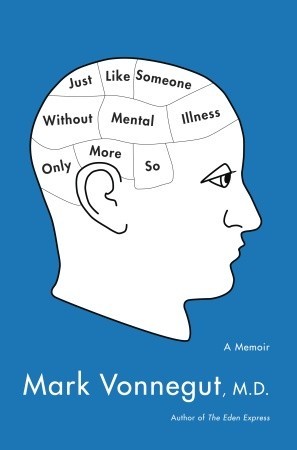
The guest was Mark Vonnegut, son of the late author Kurt Vonnegut Jr. Mark grew up in Cape Cod, in the years before his father’s writing brought fame and fortune. I listened with interest to his very personal account of how, despite diagnosis with a serious mental illness, he applied and was accepted to Harvard Medical School. He went on to become a respected pediatrician. After my breakdown this summer I debated returning to the the fine accounts, like An Unquiet Mind, that had originally guided me to an understanding of my newly acquired label. Then I remembered Mark’s memoir Just Like Someone Without a Mental Illness Only More So and within minutes it was on my Kindle. But I only decided that I really needed to read it this weekend as my symptoms and anxieties continue to persist.
Mark writes in an honest and matter of fact way about the trail madness has left through his family, tracing a legacy of depression, suicide and alcoholism going back generations. His mother heard voices and received message from license plates but once the episode passed she was able to rationalize it. When Mark’s aunt and uncle died within a month of one another leaving four troubled orphans, his parents took them in even though they had neither the money nor the capacity to manage. His oddly prescient mother had been stockpiling supplies for their arrival in advance, as her helpful voices had advised.
Mark was a loner spending a lot of time fishing and playing imaginary games in the woods around his home in Cape Cod. The oldest child of the family he grew up poor in the fallout of the the Depression. His father was a ineffectual used car salesman for many years. Mark was 21 before his father became a rich and famous author seemingly overnight.
Caught up in the hippie movement of the 60s, Mark followed many of his peers to Canada to join a commune in BC. He lived off the land, contemplated the meaning of life and experimented with drugs. And that is where he first encountered his own voices. In 1971, at the age of 23 he experienced three major psychotic breaks that landed him behind the locked doors and plexiglass windows of a Vancouver hospital.
“Among the things I grew up thinking about mental illness was that it was caused by other people or society treating you badly.I also knew that once people were broken they didn’t usually get better and the ones least likely to get better were paranoid schizophrenics, which is what I seemed to be.”
Retrieved by his father, Mark returned to the US where, with ongoing treatment, he continued to recover. The voices faded to the background. He published a book about his experiences and articles advocating for an understanding of mental illness as a biochemical condition, in strong opposition to the RD Laing inspired philosophy that was popular at the time (and has recently resurfaced). Somewhere along the way he decided that he wanted to go to medical school himself. Against all odds, and with pathetic math and science marks, he applied to one school after another. Incredibly Harvard gave him a chance.
Over the years that followed, Mark dedicated himself to his studies and his internship. By this point he had recognized that he was bipolar (not a schizophrenic who responds to lithium as he had been told), but even then, the schedule of an intern is grueling. During these years he also married, bought a house and started a family. The model of normal and healthy he figured his mental health issues were history.
Then 14 years after his third psychotic break, several years into a successful pediatric practice, the voices returned to taunt him. The trigger was his realization that he was fueling his high stress schedule with a two pack a day smoking habit along with 5 or 6 beers, half a bottle of wine, a few shots of bourbon and a sleeping medication to round off the day! Hardly a surprise then that his effort to quit cold turkey should trigger a psychotic break.
Although he sensed things were falling apart he resisted seeking help in a hospital. Driven by an absolutely irrational fear planted in his head by his voices he attempted to throw himself through a third story window. The window smashed but he fell back into the room. Unfortunately he ended up in a straightjacket on a gurney in the hallway of the very hospital where he had completed his internship and taught a course.
Although my own manic resurgence following an extensive period of wellness was somewhat less dramatic than Mark Vonnegut’s, it is only a matter of degree. Yet in time he was able to return to work and it has now been more than 25 years since his last manic break. His ability to rebuild his life and career even in the face of abject humiliation is an inspiration. And I am fortunate that I have neither smoking or alcoholism to contend with. But his story stands as stark reminder that with bipolar you must take the medication that keeps you stable and monitor your own level of energy. If we become complacent we risk an unwanted replay, no matter how long we have been well.
This book was published in 2010, so It was not available when I was first coming to terms with my diagnosis. Perhaps if I had read it when I first heard the interview I might have been able to head off my more recent experience. But then again, a manic person is a slow learner because that high just feel so good. Especially in contrast to the draining and despondent opposite end of the cycle.
I would recommend this memoir to anyone interested in mental illness, especially those who understand what it is like to experience psychosis. Its casual, relaxed style makes for an easy read but, as a practicing physician, Vonnegut has some depressing observations about the decline of health care in his own country. Most importantly though, he leaves those of us who live with mental illness with a sense that we can get better, we can stay better and if we fall, we can get up and move forward.
That is exactly what I need to remember right now.
“Emancipate yourselves from mental slavery; None but ourselves can free our minds. Have no fear for atomic energy, ‘Cause none of them can stop the time. How long shall they kill our prophets, While we stand aside and look? Ooh! Some say it’s just a part of it: We’ve got to fulfill the book.
Won’t you help to sing These songs of freedom? – ‘Cause all I ever have: Redemption songs.”
This song by the late Bob Marley has echoed in my mind frequently over the past month or so. Written after the diagnosis of cancer that would ultimately claim his life, it is thought to speak to his personal reflections on mortality. My own longing for redemption relates directly back to my inability to resolve the circumstances which led up to the extraordinarily manic behaviour that marked my final days in the office. And my inability to let it go.
What is redemption?
Disregarding the financial and transaction contexts by which the term is used, redemption is typically understood as: n. 1. an act of redeeming or the state of being redeemed. 2. deliverance; rescue. 3. deliverance from sin. 4. atonement for guilt.
Looking at the news over the past few weeks, there are some very public examples of behaviour that can not be easily excused. The videotape of NFL star Ray Rice punching and dragging his unconscious fiancee from an elevator, the resignation of a Vancouver CEO caught on video kicking and abusing a puppy, and most recently another NFL player accused of excessively brutal corporal punishment against his own children are just the latest in a litany of public figures behaving badly. Unfortunately, they might have been met with relatively minor reprimands had there not been videotapes or pictures and an element of public shaming.
How many sports heroes, businessmen, politicians and celebrities have been brought down by grossly inappropriate, violent and even illegal actions only to eventually find redemption in the public eye? Many, have found such redemption more than once.
But what if your only “sin” is to have become ill due to a mental health disorder, where does redemption come from? I don’t even know what I want anymore. I have tried to apologize for my behaviour which I know was highly agitated and unpleasant, but there is no way to explain how trapped I was within that state,how miserable and unable to even know what was happening to me until a lot of interpersonal damage was done. Because no one from work will communicate with me I cannot have that conversation, no one can appreciate the degree to which I am still struggling and I can’t stop beating myself up inside for not recognizing the warning signs months before mania was in full swing.
If this was as straight forward as having lost a job, as much as there is grief and loss, I could at least busy myself with looking for a new job. But I am still technically connected to my employer and the question of return is unspoken but not denied. Meanwhile I am not able to function well enough to look for another option or contemplate a return. I am also increasingly aware that everything I loved about the job I had is exactly what, over time, made me ill.
The fact is, I am in limbo. I still have a lot of healing ahead. So why is the desire for redemption so important? Or is this really more the need to be heard and understood?
 Twenty-two years ago today, I was released from a period of involuntary hospitalization. The psychiatric ward was a strange place, with strange characters from the requisite Jesus dispensing wisdom in the dining room, to the young orthopaedic surgeon on suicide watch. I recall my time on the unit as the first opportunity I’d had in years to worry about no one but myself—and plenty of medication to ensure that I didn’t do too much of that either.
 I can’t stop thinking ahead. This October brings my 59th birthday. Next year I turn 60. I don’t even know how I got here. No other milestone has pressed down on me like this one. I have a number of friends who are over 60, but not one of them is facing their seventh decade alone.





 roughghosts