
The ties between animals and human beings can be as complex as those that bind us people. There are some who maintain bonds of reluctant cordiality with their pets. They feed them, take them for walks if need be, but rarely do they speak to them for walks if need be but rarely do they speak to them other than to scold or “educate” them. In contrast, there are others who make of their turtles their closest confidants. Every night they lean in toward their tanks and tell them about what happened to them at work, the confrontation they put off with their boss, their doubts, and their hopes for love.
(from “Felina”)
Guadalupe Nettel is one of those writers I have long wanted to read. The kind that when you finally do get to them, you ask yourself: “Why have I waited so long?” Natural Histories, a collection of five short stories, each exploring a protagonist’s engagement with an animal of some description—from felines to fungus—offers a perfect introduction to her uncanny ability to craft strong characters and compelling narratives that slip seamlessly into the murkier regions of ordinary human existence.
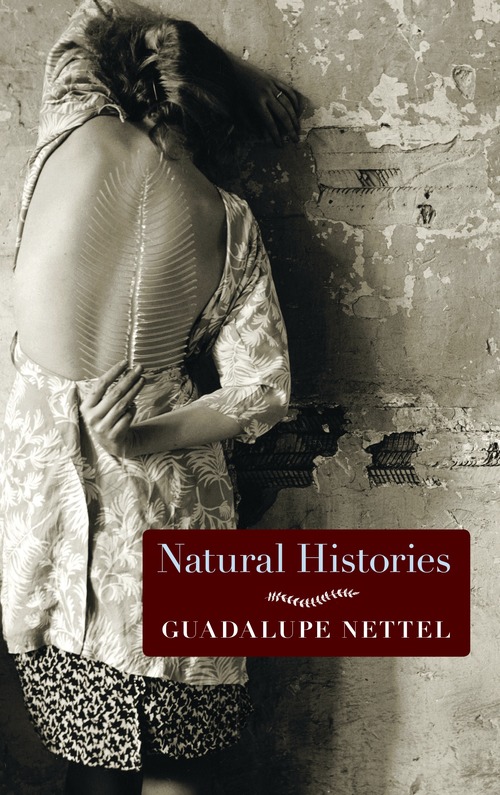 Born in Mexico City in 1973, Nettel spent part of her childhood in France, returning again to Paris to complete a PhD in linguistics. As a result, she is very much at home setting her stories on either side of the Atlantic as this compilation clearly demonstrates. The first story, “The Marriage of the Red Fish” is set in Paris and follows the breakdown of the narrator’s marriage following the birth her first child, a trajectory that seems to be mirrored in the tenuous relationship between a pair of Beta splendens, or Siamese fighting fish, gifted to the couple just months before their daughter was due. Lila’s arrival puts an immediate strain on the professional couple who are not quite prepared for the shift in their domestic situation and it gets worse when the narrator’s maternity leave is unexpectedly extended—she begins to feel trapped at home, her husband feels confined when he has to come home. Like their pet fish who, true to their species, are not inclined to peaceful cohabitation, the new parents find their personal dynamics altered:
As it were, in those stagnant waters in which Vincent and I moved, our relationship continued on its gradual course toward putrefaction. We never laughed anymore, or enjoyed ourselves at all. The most positive emotion I was able to feel toward him in several weeks was appreciation every time he made dinner or stayed home to takr care of Lila so I could go to the movies with a friend. It was a blessing, his relieving me. I adored my daughter and overall delighted in her company. But I also needed to have moments by myself, in silence, moments of freedom and escape in which I could reclaim, even if only for a couple of hours, my individuality.
This story, although it traces a common path of marital dissolution, stands apart by virtue of a strong narrative voice and the magnified role the fate of the unhappy fish play in what we want to imagine should be the happiest time of a new family’s life together.
The tensions evident in the opening story, become subtly darker and stranger in the stories that follow. In my favourite piece, “War in the Trash Cans,” an entomologist recounts her childhood experiences at the home of her middle class aunt with whom she was sent to live after her bohemian parents split and neither was up to childcare responsibilities. For the young narrator, the housekeeper and her mother become her unlikely allies in an otherwise alien environment and, as she puts it, “those two women taught me more things than I’d learned in an entire year of school.” Those lessons, rooted in folklore and traditional wisdom, arise when an invasion of cockroaches sets the entire household on edge.
Other stories involve unwanted pregnancy, a musician who nurtures a strange fungus she acquires from a married lover, and a boy whose father brings home a poisonous snake as part of his obsessive endeavour to reconnect with his Chinese roots. In each case, the protagonist or one of the characters finds in another creature or creatures, something that balances their insecurities, and reflects the unfamiliar circumstances in which they have found themselves. And yet, each story, its characters and setting, opens up new and unexpected territory. As a set of five, loosely thematically linked, longer pieces—ranging from about twenty to thirty pages—this collection is well-paced, always entertaining, now has me keen to read more of Guadalupe Nettel’s work.
Natural Histories by Guadalupe Nettel is translated from the Spanish by J. T. Lichtenstein and published by Seven Stories Press.






 roughghosts