Honouring the unwritten: The Loss Library and Other Unfinished Stories by Ivan Vladislavić

“Not writing is always a relief and sometimes a pleasure. Writing about what cannot be written, by contrast, is the devil’s own job. Yet words on a page make all things possible.”

Central to this collection of brief odes to the fictional inspirations that once planted, failed to germinate, refused to take root and grow, or died off before even hitting the soil; is one full and essentially complete story – the magical titular “The Loss Library”. Surrounding this tale, to either side on the book shelf of South African author Ivan Vladislavić’s imagination lie a selection of meditations on the curious nature of the creative process and the many ways that an intriguing idea can lose its way on the path to realization, finding itself shelved in the place of the might-have-been, filed away in a writer’s own personal loss library. Looking back at the notes and outlines he explored during the late 1980’s and early 1990’s, the unsettling years of transition from apartheid to a democratic state, Vladislavić notes that his inspirations tended to arise from documentary sources – the past perhaps seeming more sound than the bloody history being made on the streets of his country at the time. Moving forward, within the scope of the “case studies” selected for this book, the pieces and fragments he gathers turn to dictionaries, reference materials and the “means to read and write – or not read and not write – books.”

2015-12-09 15.08.34But let us begin in the middle, at “The Loss Library”. With a clear nod to Borges, the master of the library of the imagination, a young man arrives at a most unusual archive, a repository of the all of the unfinished works, possible and impossible of all the writers who have ever lived. He is greeted by an attractive librarian. Fit and tanned she is the antitheses of what he expects. As she guides him into the library she first steps into slippers and advises him to do the same. They literally glide across the polished floors of the rooms and corridors as she directs his personal tour of the premises. The first room contains a single glassed in cabinet containing the books that would have been written had their would-be authors not chanced to die young:

“‘Arranged alphabetically and classified by cause of death.’ A wave of her slender hand. ‘Accidental death. Booze, of course. Disease – those old standbys, consumption and syphilis, and the new one, AIDS, a growing collection. Duels – little sign of growth there. Motor accidents. Murder. Suicide. A disproportionate number of Russians and Japanese, as you’d expect, and quite a few of your countrymen and women too.’”

As our protagonist leans in for a closer look, he can recognize no words on the spines. He tells the librarian he is looking for Bruno Schulz. Filed down with the war dead, six little volumes are found but he is not allowed to see them… after all, opening such a book could have consequences in all the others, in essence I suppose, the way fiddling with the future given access to a time machine might. In this library of potential works, one can’t risk having people “talk them into being.”
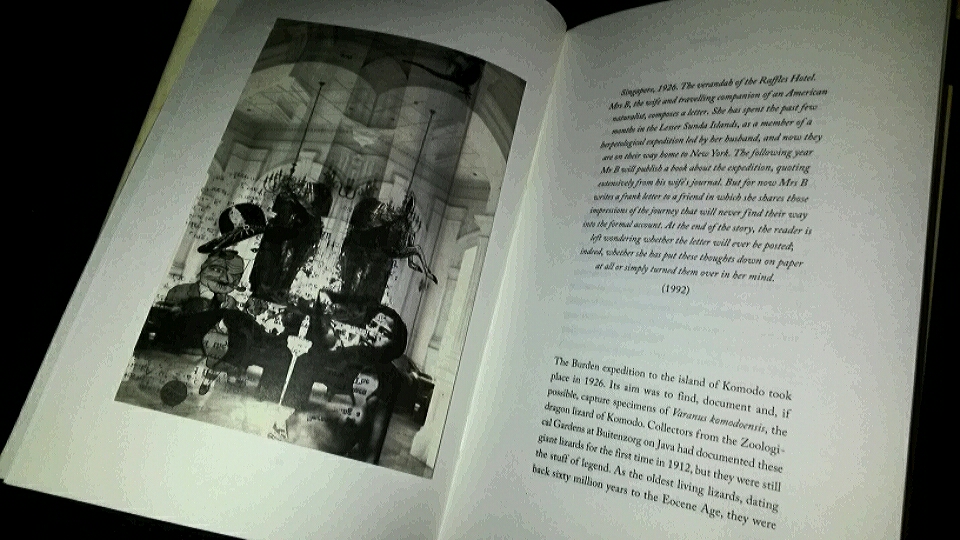
2015-12-09 15.02.54Together they encounter a room filled with books that remain unwritten because their authors lost faith in them, and he is shown a collection of the books that lost their way or were talked out of existence before they had a chance to be realized. They pass through a room containing books that were destroyed, stop at a shelf of books that comes into being by evocation of the proper author’s name (any guesses?) and, finally, enter a room of floating, ghostly, ethereal books – those that presented themselves to their would-be writers in dreams. In the end, is this excursion through the Loss Library a fantasy, the beginning of book that the young man himself will write into being, or another story that might have been, relegated to the back of a notebook, the bottom of a drawer or, in this day and age, lost somewhere on a hard drive?

Returning now to the startling opening essay, Vladislavić describes his attraction to the famous photograph of Robert Walser lying dead in the snow on Christmas Day, 1956, and reflects upon the way that the isolated image fueled his imagination before had even read any of Walser’s work. He contemplates writing a story about the writer’s last days, about that fateful final walk, the curious absence of footsteps or bystanders around the body, the precision the photographer must have employed to capture this solemn record, and with particular fascination, the dead man’s hat lying in the snow. However, before he sits down to write, Vladislavić engages in a little research and finds another photograph, taken from a different angle. From this vantage point he can now see many footprints in the snow, two men off to the side, and realizes that even the hat has fallen differently than he imagined. The curious, romantic and uncomfortable questions – the necessary elements of the creative process – are shattered.

As he continues to rifle through the pages of his notebooks, Vladislavić explores a variety of mislaid ventures, the inspiration or ideas behind them and the reasons they fell off the rails or, perhaps, only flickered for a moment or two. “Gross”, an intended venture into the land of the OuLiPo in which he set for himself a series mathematical constraints within which he would construct a novel, proves unsuccessful. Along the way, the character he was creating to take centre stage, morphed into someone else who would, ultimately wander off to join the cast of another novel,The Restless Supermarket, but more critically, he found himself completely overwhelmed by the prospect of the challenge he had set and decided that this type of approach was best left to Perec, et al.

In a later example, he describes his fascination with an unassuming sign on the side of a building in his Johannesburg neighbourhood that simply reads “Gravity Addict” with a phone number. He begins to wonder what a gravity addict is and how that might be imagined in a story. He thinks about the post 9/11 performance artist in Don Delillo’s The Falling Man, contemplates the structural format of that novel, and eventually imagines a woman, an aspiring writer, sitting on her sofa watching endless episodes of old cartoons – the ones where characters repeatedly chase each other off the edge of cliffs – and then, when one day the innocuous meaning behind the mysterious appellation “gravity artist” is revealed to him, his interest in the story instantly dissolves and he can go no further.

Finally, in light of the recent re-release of Vladislavić’s first novel, The Folly, the story “The Acrobats” special attention. In this outline for a story we see a man in a library reading a book. At some point he closes that book and retrieves a copy of Tristram Shandy from the stacks. He seeks out a particular passage which in turn, is a lengthy quotation from Gragntua and Pantagruel by Rabelais, so he stops and wanders off to fetch that text and goes on to read from the original, or rather a translation of the original, the same quoted passage describing the wild acrobatic exploits of Gymnaste, performed on horseback, as he faces down an enemy combatant. As such, Vladislavić envisions a post-modern inversion of a book within a book within a book, the initial level being, of course, at once the book that both the man and his reader are reading. However, the idea is set aside, in part due to the complication of modern versus contemporary translations of the nested passages.

Several years later, in the writing of The Folly, Vladislavić sees his character Nieuwenhuizen, the eccentric stranger who arrives out of nowhere to take ownership of and build a house on a vacant lot, as a direct descendant of Gymnaste. As he marks out the foundation of the ephemeral house that he will ultimately construct out of imagination and thin air, Nieuwenhuizen engages in his own acrobatic measurements, leaping, somersaulting, and throwing himself around the lot. Could the earlier story now be revived, with The Folly as the third book in the line, he wonders, could he develop the idea that his “ostensibly post-modern novel stood in a pre-modern tradition”? Ah, but for the paradox that his outline for “The Acrobats” was written three to four years before The Folly, how could a story refer to a book that had yet to be written?

Yet Vladislavić was, it would seem, not quite done with his potential story. Several years later he encountered the 18th century French writer, Diderot, who was a contemporary of and acquainted with Laurence Sterne. Although the publication of Rameau’s Nephew would arise through a circuitous route, there was an indication apparently, that Diderot’s initial sketches for the eccentric, rambling character who engages the narrator of his novel could have roughly coincided with the publication of Tristram Shandy. Now he wants to fictionally trace the lineage of Nieuwenhuizen from Sterne via Rameau… except for a new paradox that arises. The Folly was written before his discovery of Rameau’s Nephew. How could his own novel be influenced by a work he had not read?

In his note at the end of this account of the stubborn death of a story idea, Vladislavić can look back and recognize that, as a young writer, he demonstrated too great a concern with precedent. Wiser now, he remarks:

“Every writer belongs to one bastard bloodline or another, and laying claim to one can be a liberating lesson in perspective. But standing on the shoulders of giants is a skill that comes from long practice. When you start out, you are more likely to get under their feet. Don’t be surprised if the giants – or their legitimate progeny – come stomping after you in the playground: ‘We walk straight so you better get out of the way!’”

And herein lies the true gift of this slender collection of artistic musings,and inspirational dead ends – the insertion throughout of the author’s updated reflections on his varied false starts. There is no writer or would-be writer who does not have an accumulated hoard of ideas, outlines and abandoned projects. If they don’t, one ought to be suspicious.

Wandering through The Loss Library and Other Unfinished Stories is a rare privilege to spend time in the company of a thoughtful, gifted writer who truly appears to be without pretensions. This journey, contained within the covers of a finely crafted hardcover from the singular Seagull Books and accompanied by the original collages of Sunandini Banerjee, is a wonderful way to spend an afternoon, and treasure to return to time and again. After all, there may well be, within these pages, the inspirational seeds of other stories just waiting for the right gardener to plant them and bring them to fruition.
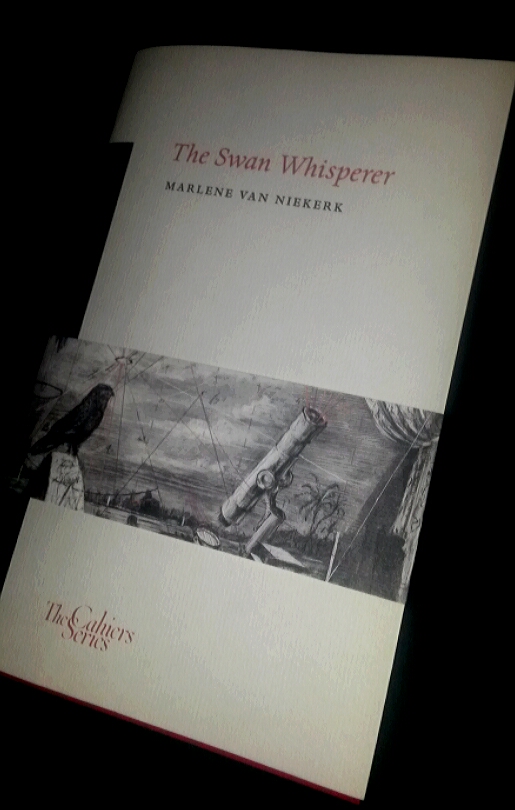
What can or should a story be? The Swan Whisperer by Marlene van Niekerk

The Swan Whisperer by Marlene van Niekerk is the literary equivalent of an impossible space – that is, this 40-page sewn paperback, lush with illustrations by fellow South African, famed artist William Kentridge, contains a tale much larger than its size would suggest. It begins modestly. Subtitled An Inaugural Lecture, van Niekerk opens with a series of questions for her imagined audience:

“What does one teach when one is a teacher of Creative Writing? The true? The good? The beautiful? Should one teach criticism, fantasy, or faith? What is the use of literature? What is its place on the greater canvas of human endeavours? And perhaps I should also ask: Can a story offer consolation?”

Voluminous texts have been penned to examine questions such as these, and yet within the 18 pages that lie ahead once the illustrations have been accounted for, is our esteemed professor at the lectern is planning to explore them all? No, she is going to tell a story, offer a fable within a fable, share an experience that she claims rendered these questions irrelevant for her.

2015-11-11 03.16.04What plays out in this inventive and thoughtful allegorical tale is an exploration of the relationship between language and meaning, meaning and truth, truth and the stories we tell which, in turn, leads back to language. Van Niekerk casts herself in the role of the skeptic. At the outset she is busy with the final revisions on a novel that is almost complete. Around her, the rest of her life and responsibilities have been suspended while she survives on frozen dinners and ignores her untended house and garden. The last thing she is prepared to welcome at this moment is a 67-page letter from a former student who, she discovers, is writing from a hospital bed in Amsterdam. She had recommended him for a student fellowship in the city with the thought that the change of place might finally help this pale, anxious young man finish off his MA and move on. But she is certain without reading beyond the first few paragraphs that there is little hope for him and most certainly nothing in his massive missive for her.

And so it goes. After reading a little further, she tucks his letter into a drawer and forgets about it until an unusual package arrives: a dummy of her new novel in which he has written notes and dates, along with 16 cassette tapes. Gradually she will be drawn into the story he wants – no, needs – to share. Cynically she reads about how her student, Kasper Olwagon, believes he has discovered, quite magically almost, an unusual homeless man who seems to have an uncanny ability to summon swans to himself. He watches the man for a while and ultimately takes this vagrant home. He longs to know how this apparent ‘swan whisperer’ calls to the magnificent birds, but for all of his efforts, Kasper is unable to encourage or help him to speak.

2015-11-11 03.18.55In his long letter, Kasper anticipates his professor’s reaction, but he persists and over time, as she is drawn into the mystery and returns repeatedly to his letter for clues. She reads about his attempts to extract meaning from the murmurings he believes he heard, his desire to translate the language of swans. She hears in his efforts echoes of Afrikaans. Slowly she will begin to understand the meaning of the cryptic note that accompanied his parcel containing the book and tapes. The last words he wrote to her were: “Farewell to the worlds of will and representation!” As readers we are invited to follow the entwined journeys of student and teacher to that place where all of those questions posed at the beginning seem to be archaic, irrelevant. And once those rhetorical questions are left behind, one begins to appreciate the expanse of the impossible space contained in this small book.

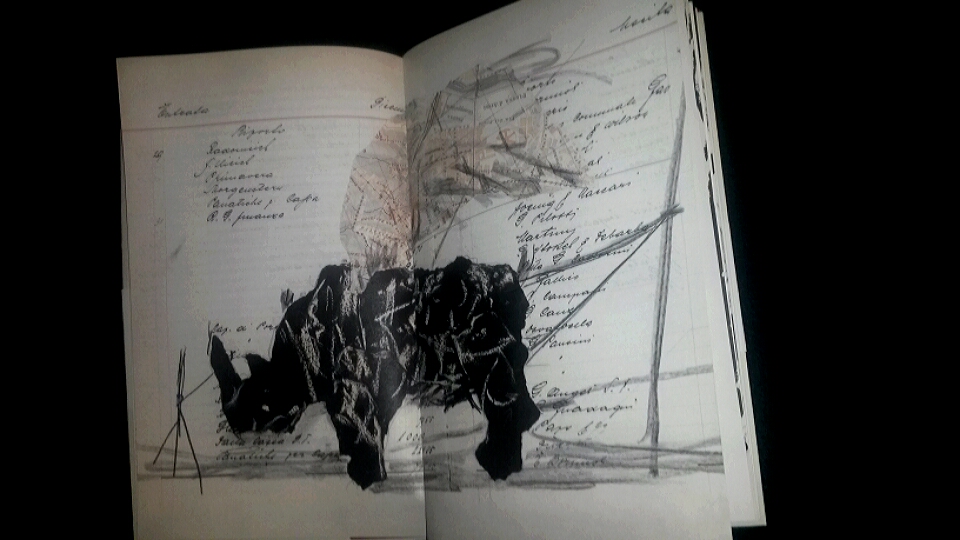
2015-11-11 03.21.17The Swan Whisperer is the latest addition to the “Cahier Series”, a joint project of the Center for Writers and Translators at the American University of Paris and Sylph Editions. Eminent writers and translators are invited to offer their reflections on writing, on translating, and on the intersection between the two activities. Each volume is accompanied by illustrations. Here, the striking black and white drawings by William Kentridge act almost as a visual soundtrack. His work has a tendency to explode off the page. The images complement the story by exploring the relationship between artists, animals and language. The text is translated from the Afrikaans by Marius Swart and the author.

2015-11-11 03.13.44I have to add that this particular volume held a special appeal for me. This spring I read, for the first time, Marlene van Niekerk’s magnificent novel Agaat. Not only is this a complex, deeply moving story; but the way that language is evoked and brought into play presented a challenge well met by the translator, Michiel Heyns. Not long after this encounter I made my first visit to South Africa and I had the singular pleasure of experiencing William Kentridge’s installation “The Refusal of Time” at the National Gallery in Cape Town. It was, I felt, like a command performance as no one else even ventured into the room beyond a quick glance at the door. Their loss and one of my fondest memories of my stay in the city.

And now I have both artists together in this enchanting and thought provoking book.

Castles in the air? The Folly by Ivan Vladislavić

Imagine an empty lot. A curious stranger arrives one evening. He steps into the lot and makes his way across the dry winter grass, stopping when he hits a large anthill.

“It seemed a pity to waste this discovery, so he stood on top of the hill and turned his face ceremoniously to the four corners of his inheritance. It was a big face, with a crack of a mouth and a stump of a nose, with unfathomable sockets, craggy brows and a bulging forehead dented in the middle, altogether suited to the play of moonlight and shade. His survey revealed a single tree in the elbow of the hedge, and he chose that spot for his camp.”

As this newcomer sets up camp, the residents of the house next door are settled in front of the TV consuming prepared dinners on tray tables while they watch the usual turmoil and violence exploding on the evening news. Yet for Mr and Mrs Malgas, the quiet, unassuming domestic existence they have enjoyed is about to be changed – disturbed, unwound and distorted – by the very presence of this most unconventional new neighbour.

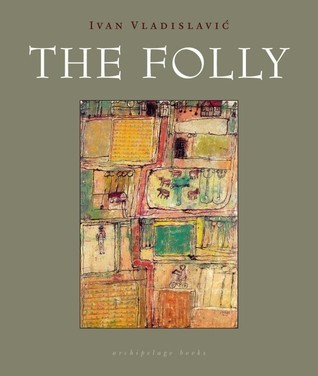
follySuch is the premise of The Folly. Newly released in North America, this haunting modern day fable, originally published in 1993, was the first novel by South African author Ivan Vladislavić. Mr Malgas, the owner of a local hardware store, reaches out to this oddly eccentric character who has suddenly taken up makeshift residency on the dusty patch of veld next door. He imagines the newcomer with the best intentions, excited when he learns that, true to his name, Nieuwenhuizen does in fact plan to construct a “new house” on the vacant lot. The Mrs will not be appeased. She is suspicious at every turn.

When convenient, Malgas’ enthusiastic assistance is welcomed by his fickle neighbour but the building project is unlike anything he has ever known. Nieuwenhuizen is methodical and will not be rushed. He deliberates, meditates and paces around his piece of land, frequently flinging his ungainly long frame about in the most unusual manner. Prancing, jumping, spinning and throwing himself to the ground. All the while Mrs keeps an anxious eye from behind the lace curtains of her lounge. When the “construction phase” finally gets into full swing things get even stranger.

Nieuwenhuizen is an enigmatic character, he can be pleasant and sociable one moment, suddenly turning to shower insults on his eager helpmate the next. Malgas takes it hard. Back at home his wife feels increasingly powerless against this mercurial influence. One evening when her husband, exhausted from a long day working beside his neighbour, collapses in the La-Z-Boy in front of the TV, she confronts the state she has come to:

“Mrs went into the bedroom, seated herself before the winged mirror of her dressing table, and said, ‘Although I appear to be thin and small, and fading away before your eyes, I am a substantial person. At least, it feels that way to me.’

Her pale reflection repeated the lines in triplicate.

Yet she saw through the pretence. It was clear: she was made of glass. And under the bell-jar of her skin, in a rarefied atmosphere, lashed by electrical storms and soused by chemical precipitations, her vital organs were squirming.”

Parable or fable, comparisons to Borges, Calvino and Beckett have been suggested by reviewers, but this timeless allegory owes its intensity to the brilliant descriptive power and sly humour of Vladislavić’s prose. As this tale rises (and falls?) to a stunningly surreal and dramatic climax, we are, as readers, as completely enmeshed in Nieuwenhuizen’s architectural chimera as the hapless Malgas.

Originally published at a pivotal moment in South African political history, it is tempting to read politics into the allegorical dimensions of this tale. I read it more broadly as a parable of our complex anxieties and attractions to others. Malgas is drawn to Nieuwenhuizen immediately. Mystery, curiosity perhaps, but there is a romance in his simple camp life and his creative fashioning of implements out of found objects and trash that evoke the magic of boyhood adventure. As a man ensconced in a secure, if unexciting, domestic life this appeal sets the groundwork that will allow him to be drawn into Nieuwenhuizen’s scheme. The ephemeral success of the envisioning and realization, however fantastic and temporary, of their dream mansion depends on Malgas’ desperate desire to believe and his longing for companionship. For the Mrs however, the new neighbour is a source of fear at first, of danger, and then of loss. He threatens their privacy, their way of life, and ultimately their marriage. The “other” forever holds that mixed appeal and repulsion.

The past two years have seen a growing awareness of and appreciation for Vladislavić’s work outside South Africa. It is well deserved and long overdue. The Folly was released in North America by Archipelago Books in September of 2015, the UK release from And Other Stories is due in November.

Other kinds of exile: The Beautiful Screaming of Pigs by Damon Galgut

“Lives are meant to be separate and apart; when the borders break and we overflow into one another, it only leads to trouble and sadness.”

Last month I had worried about easing back into reading following my recent unexpected cardiac arrest, but, in fact, August went well. September has proved much more difficult. I have picked up so many books I thought I wanted to read only to be unable to get beyond a few pages. So it is probably no surprise that I retreated to the comfort zone of re-reading a book by one of my favourite authors. I chose this book on the expectation that a new paper edition was due to be released today in Canada but from reports of the distributor being low or out of stock, the reality of actually seeing it on the shelves may be a long way out. Too bad because when you know a writer has many excellent books to his or her credit it is a shame to see only one, the latest or best known, in stock. Fortunately this title is readily available electronically.

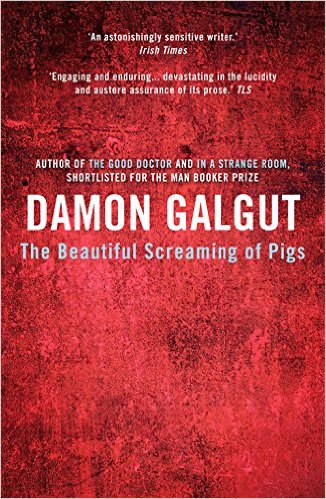
pigsThe Beautiful Screaming of Pigs is the second full length novel by South African writer Damon Galgut. Originally released in 1991 it eventually dropped out of print and, when a new edition was issued in 2005 following the Booker shortlisting of The Good Doctor, Galgut took the opportunity to revise the book, wanting to address his longstanding feeling that the rhythms of the language sounded “discordant”. The result, for whatever it is worth, is a novel that embedded itself into my consciousness with the first reading, and proved to be even richer and more deeply affecting with the second.

Set against the backdrop of the first free elections in Namibia in 1989, 20 year-old Patrick Winter and his mother are heading to the land that he had, only a year before, been fighting for on behalf of the South African Army. That experience has clearly left him emotionally traumatized. He is dependent on Valium to sleep and cope with recurring panic attacks. For his mother the trip is an opportunity to visit her young black lover, the latest of a long string personal explorations she has flirted with since her divorce from Patrick’s father. As the story unfolds he will reflect on his childhood, the horror of his time in the army, his ambiguous feelings about his own politics, and the emerging recognition of the nature his sexuality.

The novel opens as Patrick and his mother arrive at the Afrikaner farm where she grew up and he spent many a summer vacation. His brittle grandmother fusses over his physical and mental health, cannot understand why they are heading north, and stubbornly insists on referring to Namibia as South West Africa, the name by which it was known going back to its years as a German colony. Here Patrick will begin to reveal his family background, his closeness to his mother and his alienation from his rugged, athletic, big game-hunting father and older brother.

When his brother Malcolm joins the army and is killed in a motor vehicle accident, the loss tears the fragile family apart. Patrick and his mother move out, unraveling the tightly wound expectations of marriage by which she had been bound. As she tries to reframe herself with a series of dramatic passions and obsessions, her son is placed in the awkward role of picking up the pieces behind her. So when his own obligation to the army arises, despite the sure knowledge that he is entirely unsuited for the task at hand, he enlists promptly hoping to get his two year commitment out of the way. He won’t last two years, nor will he be able to put the experience behind him.

As he awakes that first morning to a familiar noise on the farm he makes a striking observation about his state of well-being in an unforgettable passage. Outside a pig is being slaughtered:

“There is no sound on earth like the sound of a pig dying. It is a shriek that tears at the primal, unconscious mind. It is the noise of babies being abandoned, of women being taken by force, of the hinges of the world tearing loose. The screaming starts from the moment the pig is seized, as if it knows what is about to happen. The pig squeals and cries, it defecates in terror, but nothing will stop its life converging to a zero on the point of that thin metal stick.”

As a child, the spectacle of a pig being killed never failed to draw him with a fascinated horror. On this day his reaction takes on a different note:

“It was a sign of my state of mind or soul that on this particular morning the screaming of the pig sounded almost beautiful to me. It didn’t evoke violence or fear, but a train of gentle childhood memories.”

After the reverie of a walk around the farm and a hearty breakfast, Patrick and his mother head for Namibia. When they finally reach Windhoek and meet Godfrey in the township where he lives, Patrick is surprised to find that his mother’s lover is not quite what he had imagined and is, in reality, only a few years older than he is. They learn that a white activist who had been working with SWAPO (the South West African Peoples’ Organization) has just been assassinated and Godfrey must attend to details for his funeral and an election rally. This necessitates a further trip on to Swakopmund, a detour that places Patrick in a position to question his own political resolution and bravery, especially poignant in light of the fact that on the border he was engaged in fighting the very forces he is now helping Godfrey support. His mother’s enthusiasm soon wanes into boredom as, for her, the shine starts to come off her latest passion.

Woven into the account of their few days in Namibia, is Patrick’s chronicle of his experiences in the army, beginning with the early days of tedium as the young soldiers pass empty days in their tents “playing cards, writing letters, telling jokes. An old scene, as old as the first village.” Patrick is keenly aware that he does not quite fit into this world of testosterone charged energy. He is hopelessly reminded of the way he felt sidelined as his father and brother tossed a rugby ball on the lawn or boasted about their hunting conquests. He senses a brotherhood of men to which he will never belong. It is not until a young Afrikaner named Lappies arrives that he finds a kindred spirit, makes a friend, and maybe – although he doesn’t realize it at the time – falls in love. Once fighting descends on the camp and strikes with a vengeance; horror, fear and death take their toll. When Patrick’s friend is killed, his grasp on sanity begins to slip. Galgut pulls the reader right into his young narrator’s shattered mind in one of the most intense descriptions of a mental breakdown I have ever read. It happens in fits and starts. Patrick tries to hang on, stubbornly, foolishly until his condition deteriorates to the point that he finds himself hospitalized, first in Pretoria and then in Cape Town. He is discharged from the army.

In the hospital his parents visit. Their responses to their shocked and emotionally injured son are true to form. His father travels to see him Pretoria where he sits awkwardly, shifting from ”buttock to buttock” unable to find anything meaningful to say. His mother has been busy acting in a play and does not make her appearance at his bedside until he is back in Cape Town. She visits him daily and talks about herself. It is here that she will first tell him about Godfrey, hoping to impress or shock him. He has no answer but he remembers the small drama.

“At that moment a shaft of light, blued by the rain, fell on her face: like the actress she was, she turned towards it, finding her spot. Then she smiled, and the smile became a laugh: a round, silvery sound, like a coin, which fell from her throat and tinkled down onto the ground.”

Patrick’s few days in Namibia will not answer all the questions he carries into the shifting sands of the desert one year after his breakdown. But he will emerge from the visit with a sense that it is time for him to define his own sense of personal space and figure out who he is. Borders – those lines between countries defended by force, defined by politics, and blurred between people – feature throughout this novel. True to form, Galgut allows these spaces to exist for the reader to explore. He is a writer of remarkable restraint, a storyteller who matches spare tight prose with simple moments of vivid intensity. In The Beautiful Screaming of Pigs he has created a haunting, intelligent, unforgettable portrait of the relationships between people at a time of great upheaval and impending change in Southern Africa. As Namibians queue with excitement to mark their ballot toward the end of the novel, Godfrey tell Patrick that maybe someday his own country will see the same. That day will still be more than four years away.

What it means to be grown up: Thirteen Cents by K. Sello Duiker

“Grow up. Fast. Very fast. Lightening speed. Everything is always like that. Quick. You must act quickly. Understand quickly. Otherwise someone will fuck you up nicely. They’ll beat you up so that you must always remember.”

Meet Azure. Standing shoeless on of the cusp of manhood, thirteen or about to turn thirteen, he is not really sure when he was born. Both his parents are dead. Murdered. He has made his way from Johannesburg to Cape Town – a mean and ugly Cape Town – where he sleeps near the swimming pool in Sea Point or, later, when that option is denied him, under a bridge in Green Point, home to a wretched collection of thugs and gangsters.

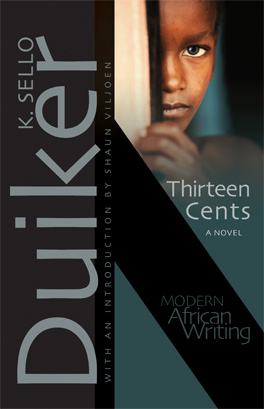
13centsHe makes money primarily picking up tricks, engaging in degrading, often rough sex with closeted married men. He is hardened, tough, able to endure these encounters with a detached resignation. Yet when he looks inside, when he faces the more invisible persistent fears that haunt him as he wanders though the city, past the train station, up Long Street, into the Company’s Gardens; we see what he truly is – a child on the street. His is a coming-of-age story that is relentless, ruthless and, in the end, remarkably redeeming.

As Thirteen Cents, the debut novel by K. Sello Duiker opens, he has taken to looking after nine year-old Bafana, a boy who has run away from home, his life on the streets a drug fueled choice. Azure lectures him on his addictions. The only drug he himself has any interest in marijuana when he can afford it.

“I’m not his father, I say to myself. That laatie is getting under my armpit, under my soft spot. I mustn’t let that happen, I tell myself. I’ve seen too many kids disappear. There’s no point in getting too close.”

Azure knows where to find discarded food, has a few trusted “grown-up” contacts, many of whom will turn out not to be the allies he had thought. In a slice of Cape Town in which each man or woman has to look after themselves first, judging character is a slippery exercise. One that can be brutal, if not fatal, if the shifting rules are not understood or respected. His one friend from home, Vincent, a man who is beholden to the same rules but somewhat older and wiser, manages to impart to young Azure an unusual vision that will ultimately prove more valuable than money or any other form of protection.

In the meantime, his greatest liability is one he cannot control. He has black skin and blue eyes. Hence the name, pronounced he informs us, Ah-zoo-ray. It is a gift he holds from his beloved mother which is stolen when Gerald, the powerful thug currently holding sway over the homeless population, renames him Blue.

“… I can never look at myself too long in the mirror as my blue eyes remind me of the confusing messages they send out to people. I wear my blue eyes with fear because fear is deeper than shame.”

Race is a currency of power in the community in which he has found himself. Gerald who is a coloured man, trading on his lighter skin, straight hair and reputation of exceptional violence, is especially drawn to and maddened by those blue eyes. The punishment he extracts on our young hero is by far the most persistent, horrific, and devastating aspect of this gritty tale. He is beaten, locked up, starved, and abused for days on end for no apparent rational pretext. But the emotional abuse, the attempt to undermine his self worth cuts deeper:

“Why do you feel sad? I ask myself. Because my mother didn’t love me. Gerald is cruel. That is the ugliest thing anyone has ever said to me. It is worse than having a bus crush you. I think of my mother and I feel confused. No. She loved me, I tell myself. And I loved her, no matter what Gerald says.”

As much as Azure/Blue holds to the conviction that he is almost a man, must not cry, must hold within himself the emotions a man can not afford to admit; he continually talks with frustration about “grown-ups”. Their ways allude him, anger him and ultimately drive him on a mission of self healing driven by an almost supernatural desire to destroy all that is trying to destroy him.

As Thirteen Cents moves into its final chapters, the story takes on a folkloric, mythical tone. The stark hyper realism of the earlier account crosses the threshold of magical realism. To escape the horrors existing for him in the city below, Azure makes the first of two ascents up the slopes of Table Mountain where he will spend several nights, have dreams and visions and find, we are led to believe, the beginning of a path out of the life in which he had found himself trapped. The voice that lingers, long after the book is closed, is one of resilience, one of hope.

Sadly his creator could not hold to that same strength. K. Sello Duiker was born in Soweto, South Africa in 1974, raised in middle class black family. His university educated parents wanted to secure a good education for their son. After achieving a degree from Rhodes University he studied briefly in Cape Town where drugs and mental illness disrupted his academic career. He would draw on his experiences in the city to write Thirteen Cents and his other major work, The Quiet Violence of Dreams (TQVOD). Recognized as one of the first important young black voices emerging in post Apartheid South Africa, he ended his own life in 2005 at the age of 30.

The edition of Thirteen Cents that I read, published as part of the Modern African Writing Series of the Ohio University Press, includes an introduction by Stellenbosch University professor of English, Shaun Viljoen which provides an exceptionally helpful context for the placement of Duiker’s work in the evolution of contemporary South African literature along with a glossary of the expressions and slang, mostly Afrikaans, employed throughout the text.

I have not, to date, read many black South African writers, but I brought a selection of titles back from my recent visit to the country. Duiker has long been on my radar and all 600 pages of TQVOD has been stting on my bookshelf for more than a year. I am glad I went back to this novel first, standing as it does in a pivotal context for black South African literature and look forward to reading more of the young voices that have emerged in recent years.

For another positive review of this powerful book, see my friend Penny’s blog.

Reflection: Fishing for memories denied

It is rare that I indulge in sharing a significant quotation simply because it speaks to the space in which I find myself but I keep returning to these words from Intimate Stranger by Breyten Breytenbach (Archipelago Books, 2009).

“Writing is fishing for memory in time. Viscous. Time black. Sometimes you see it flitting just below the surface – memory – miming time. Memory takes on the blackness of time. Memory will be time surfacing. Use word as bait. Beat the water. Beat the weird beat of baited words. Bloated. Wounds. The bleeding words like wounded boats on a black sea. Let the fleet wash up. The coast is the beginning of the sea’s wisdom. It comes with the territory.

Words have their own territory, they return home as in a song. The fish only discovers the water once it is removed from it. This land is a memotory.

But not peaceful. Memory as trigger for territory and tongue. The mind is full of bloody pieces staked out by tongue. Is there room enough? Memory killing memory.”

initmateThis book, a selection of meditations on reading and writing, was waiting for me when I returned home from the hospital just 10 days ago. I have been keeping it close and dipping in and out of it. Breytenbach is a South African poet, writer and painter but his life, his work, his vision is borderless. In this collection he offers practical advice, shares poems and reflections on the power of the word, drawing on his own experiences as well as the wisdom of a legacy of gifted writers.

Memory is the foundation of writing. One draws on experience when putting pen to paper – poetry, fiction, memoir alike. And it is memory that is weighing me down, threatening to drag me beneath the surface; a memory that haunts and obsesses me because although it involves me, I will never access it.

I have lost a space in time. Like a bruise it bleeds beyond the boundary of the injury, reaching backward and forward from the instant a clot in my lung threatened to stop my heart. Days are absolutely gone, the day or two before the incident, the day or so in ICU and the first days after waking. But I can’t let the blackness go. I cannot let it wash out to sea. I want to hold the moments, hours, days in my hands but I cannot. They do not belong to me. They are about me. They will never be mine.

I have read my discharge summary until I know it inside out. I have pestered my anxious son with questions. What was it like to find me in distress? How did you get to the hospital? How did you feel? Stupid questions. I am struck with shocked disquiet to realize that my family did not know if I would survive.

If I had not survived the blackness would be complete. Viscous. Time black. Inanimate from my perspective. My own memories lost. The sole distorted possession of those who knew me, no longer mine.

Sands are shifting. I have some fishing to attend to before the next high tide.

Indian Ocean, Eastern Cape, South Africa Copyright JM Schreiber 2015
Indian Ocean, Eastern Cape, South Africa
Copyright JM Schreiber 2015

Loss and longing: The Elusive Moth by Ingrid Winterbach

“I have been content up to now,” she said at last. I was perfectly content until recently. I could keep everything at a distance. But now, all of a sudden, I can no longer do so. I feel caught up in everything. And detached from everything too. So detached, and so caught up. A strange feeling.” She spoke more urgently. “I don’t know what I’ve done with my life! I don’t know if I can still love someone!” (She started, why speak of love all of a sudden?) “I can’t open my hand,” she said, opening her hand, her palm facing upward, “I can’t let go.”

This is the curious dilemma of Karolina Ferreira, the heroine of The Elusive Moth by South African novelist Ingrid Winterbach. A similar searching ambiguity, complicated tension and hidden motivation runs through the cast of this slowly simmering, cinematic novel. Moving across a finely painted canvass in fits and starts, The Elusive Moth is an evocative exploration of memory, loss and anxiety that almost feels more like an art film, unfolding scenes that repeat motifs, imagery, fragmented conversations, all playing out against racial tensions that are building to a critical point in and around a small Free State town.

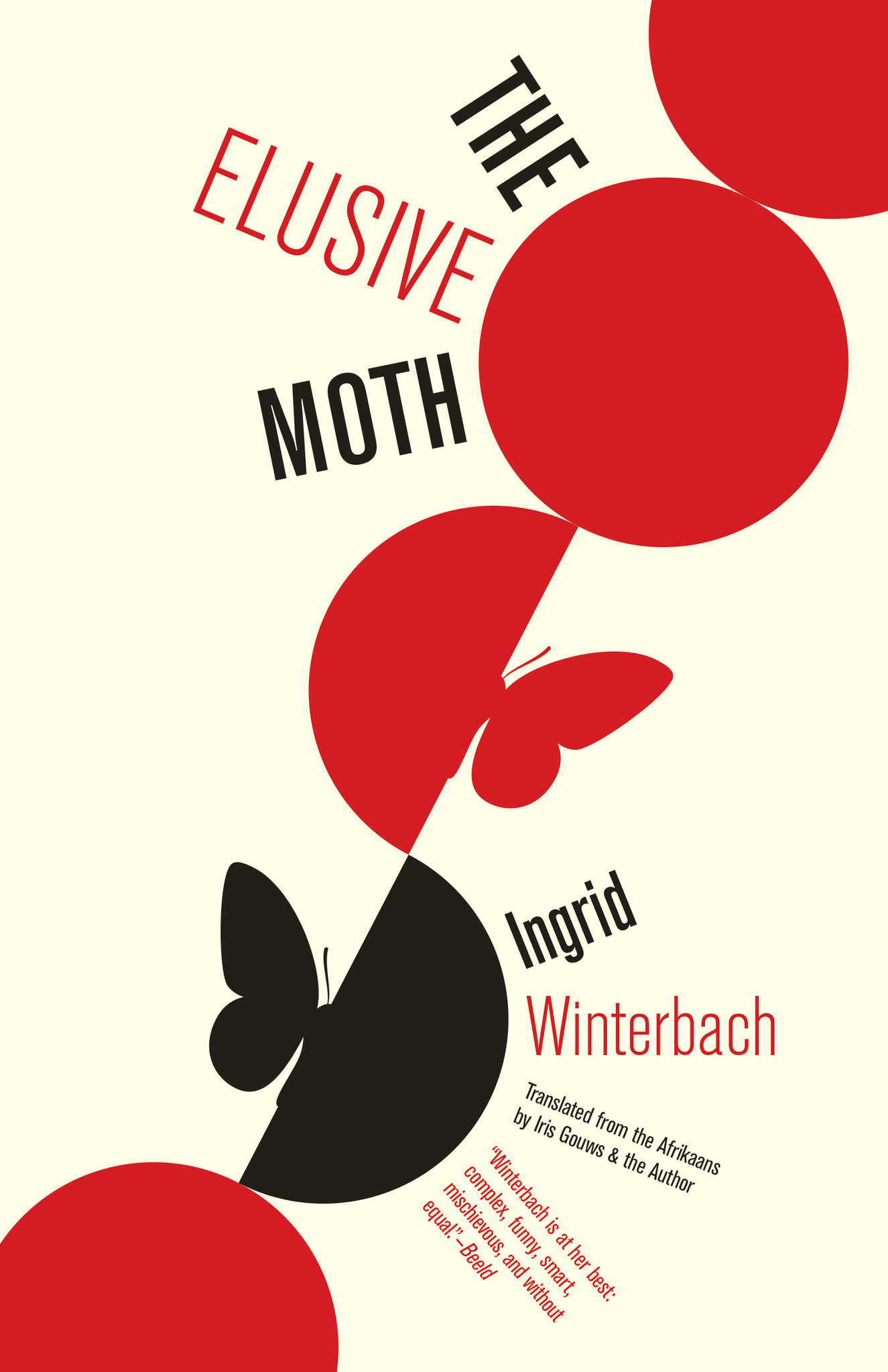
Elusive_Moth_cvrKarolina is an entomologist who returns to the town where her family spent time when she was growing up. Ostensibly she is in pursuit of a rare species of moth that is capable of withstanding extreme conditions and this is a brutally harsh, drought ridden area. However, on her way to her destination she makes two unusual decisions. She stops and picks up a fellow traveller, Basil September, an unusual and enigmatic individual who is on his way to spend time working with his Argentinian mentor, an expert in herbal remedies and medicinal practices. He will become her daily companion out on the dry veld where he collects a vast array of living and non-living samples while she observes insect life. Karolina also, despite her scientific tendencies, stops into a roadside caravan to have her palm read. The fortune teller promises that she will find a man who will love her forever and a woman who will be a close and faithful friend, suggestions she both laughs at and hopes for.

As she settles in to her research, Karolina seems to be increasingly restless. She spies lovers in the cemetery who fascinate her. She begins to frequent the snooker room of her hotel where the regulars, all male, are coarse, frequently lecherous – farmers, policemen, reservists. On Saturday nights she takes to the dance floor to lose herself in the arms of a man referred to throughout as “that Kolyn fellow”, theirs a connection based solely only on comparable tango skills. She tends to drink heavily, retreating when necessary to the Ladies Bar where she regularly encounters Pol, a singing lawyer, delightfully described throughout as amphibious, watery, and humid. He is a source of background information upon whom he she tends to rely as local political undertones begin to rise to the surface. Basil is also a helpful bellwether in this regard, as he possesses an uncanny ability to analyze the natures of others on sight and, as it turns out, foretell death. And then there is Jess, a red headed man who is singled out for her by Basil when they first see him. He is an economic analyst on a sabbatical to study, for himself, Buddhist philosophy, longing to learn to live in the moment and to overcome a persistent fear of death.

It is clear that Karolina is at a tremendous loss as she tries to find a rhythm to life in this small town. Loss intermingled with longing. She has destroyed or divested herself of most of her possessions. She is plagued by a sense that she disappointed and was disappointed by her father, also an entomologist from who she inherited her early and long standing fascination with insects. He had died just hours before she reached his bedside. She had imagined herself capable of dedicating herself to her studies without the bother of emotional entanglements. Now, in her dreams she is haunted by strange visitations and lewd sexual fantasies involving not only past friends and lovers, but characters from her immediate environs. By day her observations and interactions with others are a mix of curiousity, compassion and clinical dissection. By night she struggles with a desire for physical comfort and a need for space. As personal tragedies and political tensions in the town move toward a dramatic eruption, Karolina will ultimately find the ability to surrender and move forward with her own life.

For some readers, The Elusive Moth, may almost be too fragmented and repetitive. I read it slowly, over the last few days, luxuriating in the beauty of the imagery – the stark landscape, sensual descriptions of architecture and artwork, the enigmatic characters. Winterbach is also a painter, she writes in images and scenes. I simply did not want this book to end. I am currently recovering from a trauma that has left me with a mix of loss and anxiety that I recognized in Karolina, Jess, and Basil. I found it to be an exquisite and haunting experience.

witmonth15

* Originally published in Afrikaans as Karolina Ferreira under the pseudonym Lettie Viljoen in 1993, the first English translation by Iris Gouws and the author was published in South Africa in 2005. The edition I read was published by Open Letter Books in 2014.

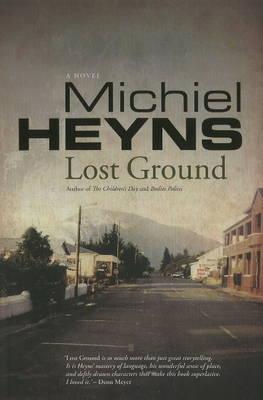
You can’t go home again : Lost Ground by Michiel Heyns

On one level, Lost Ground sets itself up as a crime novel where the elements of the conventional police procedural are bound with deep echoes of the tensions and realities of the new South Africa. But in the skillful hands of Michiel Heyns it evolves into much more – a heart stopping rush headlong into a series of events that will leave its erstwhile hero irrevocably changed.

lost groundIt is a murder that draws Peter Jacobs, an ex-pat South African, back to his hometown of Alfredville, a sleepy little village in the Little Karoo. A freelance writer living in London, he has been away from his native soil for over 20 years. His father’s British citizenship afforded him the option to pursue studies abroad and thus avoid conscription. What finally draws him back is his writer’s sense of a good story. His own beautiful cousin Desirée has been murdered and her husband, the black police Station Commander, is under arrest. This is, Peter believes, the entry point for an examination of the complicated dynamics of post-Apartheid South Africa and, in his neatly planned agenda, a story that he imagines re-envisioning as a New Yorker friendly exposé drawing allusions to Othello. What it opens, in the end, is far more personal and devastating than he can even begin to imagine when he first returns to his hometown.

It is clear from the beginning that Peter is carrying more baggage than the basic wardrobe he itemizes. James, his partner of five years, a Jamaican actor, has just broken up with him and he is not entirely certain how he feels about it. As he settles into his hotel, old locations and familiar faces naturally trigger memories – of school days, childhood adventures and the awkward fumbling of youth. Then, he discovers that his best friend Bennie is also back in Alfredville. He is now a police officer, temporarily the acting Station Commander,  and married with two children. Their reunion is awkward and tentative at first but it slowly warms, reawakening a flood of memories of a past that Peter believed he had, with time and distance, left behind.

Heyns’ gift for language and dry wit bring a rich and detailed world to life. He deftly captures the village and surrounding farmland wilting under the extremes of summer heat and the distant sensations they evoke:

“I open the door of my room and go out onto the balcony. Victoria Street is empty at this hour, but the sullen air is teeming with the smells of a summer night – exhausted vegetation, wilting flowers, wet soil from the gardens being watered, heated asphalt. The blend hasn’t changed in twenty years. To smell it again is to remember not so much individual incident as the tonal value of those summer nights, the vague ache of an imperfectly articulated desire.”

A wide range of colourful characters and personalities pass through the pages, described with the precise care and attention befitting his detail oriented writer narrator. Some are ghosts from Peter’s past, others, like the elegant black female psychologist who becomes his challenger and confidant and the handsome vet who seems to have cast a spell over the bored housewives of Alfredville are either new or passing through. But it is the nostalgic revisiting of his youth, inseparable from the memories of his friendship with Bennie, that anchors the novel, creating the emotional texture and complexities that will ultimately leave the reader gasping for breath as the end nears.

This was, for me, my first read following a significant health scare. It was everything that I could have hoped for at this moment – a smart, well written and tightly paced story woven with literary allusions, significant observations about the current state of South Africa, telling observations about the risks inherent in returning to the past and an unobtrusive but entertaining gay subtext. By turns humorous, heart breaking and dark it was the perfect prescription.

* Published by Jonathan Ball, Lost Ground is one of Michiel Heyns’ books that is fairly easy to access outside of South Africa, at least through special order distributors.

Easing back into reading

As soon as I was coming around a few days after my recent near death encounter (and I don’t mean that in any mystical tunnel of light sort of way) I told my kids that I wanted them to bring me books. I could barely stay alert long enough to get an entire sentence out but I wanted books. They obliged me. Wisely I asked for one of the few books on my shelves which might count as a mystery – Lost Ground by South African author Michiel Heyns – which has proved to be fine company indeed though I have only been able to read attentively for a few days now. They also brought along one of my endless stream of incoming purchases, a gem from Twisted Spoon chosen for Women in Translation Month – Primeval and Other Times by Polish writer Olga Tokarczuk. A surreal and fantastic work it looks good but I may have to push it a little further down the month. Reading is tough work after cardiac arrest. Go figure.

Now that I am at home, facing three blood tests each week and a host of other medical appointments all over the city when I have been told I can’t drive for 6 months, I find myself reading and re-reading my discharge report. I am living on warfarin – rat poison – afraid of bleeding too much or worse, clotting too easily and having a stroke. The devious little pulmonary embolism that triggered this whole adventure (a likely souvenir of a hellish 24 hours of flight time packed tightly into 28 hours on my recent return from Cape Town) is still sitting in my lung and will, they say, eventually be absorbed. My left leg is swollen and bruised due to a hematoma, a probable complication of the resuscitation process. I watch people jogging by outside on this hot summer day and feel like some sort of Frankenstein creature, dragging this heavy black and blue leg around.

Even though my friends have been amazing – I had a steady stream of visitors throughout my hospital stay and have no shortage of offers for rides around town – I feel a despair settling in. I don’t know where to turn, where to dig into the towers of books surrounding me. I wonder what would have happened had I slipped off this mortal coil two weeks ago. What would my family say about all these books on which I have squandered my limited funds? For heaven’s sake my open shelved coffee table loaded with books and stacks of journals – Granta, Paris Review, Music & Literature – came apart when the paramedics tried to pull it out of the way. I feel overwhelmed rather than excited about diving in to all the new books I have acquired in the past month. I had to buy an extra bag, after all, to get my haul of books home from South Africa and now they too sit on the shelf taunting me.

Will the magic of reading come back with my health?

2015-08-09 17.37.38I have also wondered if this experience is that final kick in the behind that I need to get serious about my own writing. I’m in my mid-50s. I’m not getting younger. Coincidentally while in the hospital I signed my first contract for the publication of an essay in a book coming out next Spring. It is a niche project – a collection aimed at gay, bisexual and transgender men – but my first professional publication credit all the same. So how much life with all its mess, joy and agony does one have to drag his or her sorry self through before there is enough fodder for a story? I wrote throughout my youth, being a writer was always my dream, a strength in every course I completed in university and every job I have ever held. But when it came down to creative writing I always insisted that I had to live a little first.

At this moment I feel that I lived so much that I don’t know where to begin. And now I have almost died too.

A Pastoral Dystopia: Trencherman by Eben Venter

“Tears, nearly; heartache that I’m almost able to touch in my chest. Bossieveld stretches around this dorp, as wide as the vulture flies. In rain years the red grass pushes up. The veld surges and flows, with koppies of ironstone and mountains with cliffs where animals find shelter during the cold winters, where ewes search out the warmth of besembos during the lambing season. Elsewhere it breaks open into rivers and streams and vleis full of platannas and bullfrogs and wild geese. But only when the water runs, when the eyes of the springs open. I want to remember it like that one last time.”

I am not typically a fan of post-apocalyptic or dystopian fiction. No matter how intriguing the scenario, I find myself too frequently disappointed with the writing or the realization of the plot, or both. However, when a trusted friend enthusiastically recommended  Trencherman, a harrowing vision of a devastated South Africa by Eben Venter, my interest was piqued in spite of any reservations I might have otherwise held and, quite frankly, I would never have stumbled across this book without her guidance. Even then I was unable to source a copy outside of South Africa so it was high on my wish list for my recent visit to the country. Little could I have appreciated how my experience of this novel would be heightened by the fact that I would read it while my time in the rolling landscape of the Eastern Cape province was still very fresh in my imagination. That is, it happens, where this story is set and, for all the horror it envisions, Trencherman is also very much an evocation to the beauty of the land.

VenterTaking his lead from Joseph Conrad’s The Heart of Darkness, Venter imagines his native country at an undefined point in the near future. Years of civil unrest and socio-political upheaval have rocked the nation which never really found its footing. Now a massive explosion in the southern part of the country has destroyed the infrastructure, left a lawless void in which bribes and syndicates are the order (or lack of order) of the day. Drought has wasted the land, AIDS has has devastated the population. Our protagonist, Marlouw (a contraction of his first and last names Martin and Louw) is bachelor living in Melbourne, Australia. Both he and his sister Heleen had rejected the family farm and homeland two decades earlier. Yet for all the financial success afforded by an uninspiring career selling high end cookware, Marlouw is a rather bitter, self-centred man, crippled with a clubfoot. He has never forgiven his parents for failing to secure the surgery that would have corrected the deformity and, despite his denial, the pain and embarrassment of his disability weigh heavily on him. When his sister calls him one night desperately entreating him to return to South Africa in search of her only son, his nephew Koert, who seems to have gone missing in that dark land, Marlouw feels no immediate obligation to assist. When he does finally agree, he tells himself that he is doing so for his own personal reasons. Without fully understanding his motivations he senses that something unfinished lies in the deep recesses of his memory. His journey to unravel his own baggage will nearly cost his sanity.

As soon as he sets foot on South African soil, Marlouw realizes that he has arrived in a country that operates on cryptic and shifting terms. He adopts a heightened almost mystical approach to the task ahead, attempting to open himself to the “guides” that cross his path, but he rocks between selfish irritation and a deepening alienation as his quest proceeds. As a hero he is deeply flawed and deeply human. When he reaches the family farm, the place where he knows that his nephew has taken refuge and built up some manner of hideous power base, he is routinely thwarted in any attempts to make direct contact. The degree to which drought, disease and apparent apathy have wasted the land and the people he once knew is a shock but he is soon swept into their confined and miserable world. Upon his father’s death, he and his sister had passed the once proud farm on to the black families who had worked it for so many years. After twelve generations of Afrikaner ownership, the thirteenth generation had set their sights on foreign shores. But, as Marlouw will soon realize, he still carries a deep ancestral horror in his bones. He will not only have to confront whatever it is that his nephew Koert has come to represent, he will also have to come to terms with his own ghosts.

This is not the first time an author has turned to the Heart of Darkness to explore the dark corners of humanity. The late Canadian author Timothy Findley placed his own Marlow and Kurtz in the halls of a modern psychiatric institution in the startling and disturbing Headhunters. Trencherman skillfully evokes the darkness of the journey Conrad imagined in the depth of another part of Africa and updates it, raising important issues along the way. Venter takes the opportunity to offer harsh indictments on the divisions within his native country, envisioning an outcome that has its roots in a recklessness and disregard for ultimate risks among the privileged classes. This is, of course, a common context of the dystopian novel, but one which is, for me, often too carefully removed or generalized in some abstract future. South Africa offers a more immediate tableau that Venter does not shirk from, perhaps afforded by the fact that he, like his hero, has been living in Australia for several decades. He aims his sights close to home, directly at his own heritage and at the decision he and many other South Africans have made to leave.

Originally published in Afrikaans, the translation by Luke Stubbs is seamless. IsiXhosa passages are incorporated, and unlike some translations specifically aimed at a broader (i.e. US) English speaking market, common South African and Afrikaans expressions and terms are left in tact. A detailed glossary is included. There is a point where the dialogue degenerates into a bastardized English mixed with German that had me curious as to how these passages exist in the original, but that is only because the translation process itself, especially when it is striking and effective, is of particular interest to me. This topic is, I discovered, covered in an interview with the author here.

The memory of a land once rich, the protagonist’s struggle to balance compassion with self preservation, and the truly horrific, yet oddly contemporary spectacle that awaits Marlouw when he finally confronts his nephew combine to create an engrossing read. The closer a reader’s connection to South Africa, the more intensely this book will resonate or push buttons, but even with distance it paints an unsettling portrait.

And so it should.

Note:                                                                                                                                                                         It is my understanding that Trencherman is scheduled to be released in the UK and Australia in 2016. However, my attempts to obtain Venter’s more recent novel Wolf, Wolf which was similarly released earlier this year leads me to believe that rights do not extend to North America. Even so, once there is wider for release for Trencherman outside of South Africa, it will be easier to obtain through UK distributors.