People can grow old anywhere: Man in the Holocene by Max Frisch

—only human beings can recognize catastrophe, provided they survive them; Nature recognizes no catastrophes.

—man emerged in the Holocene.

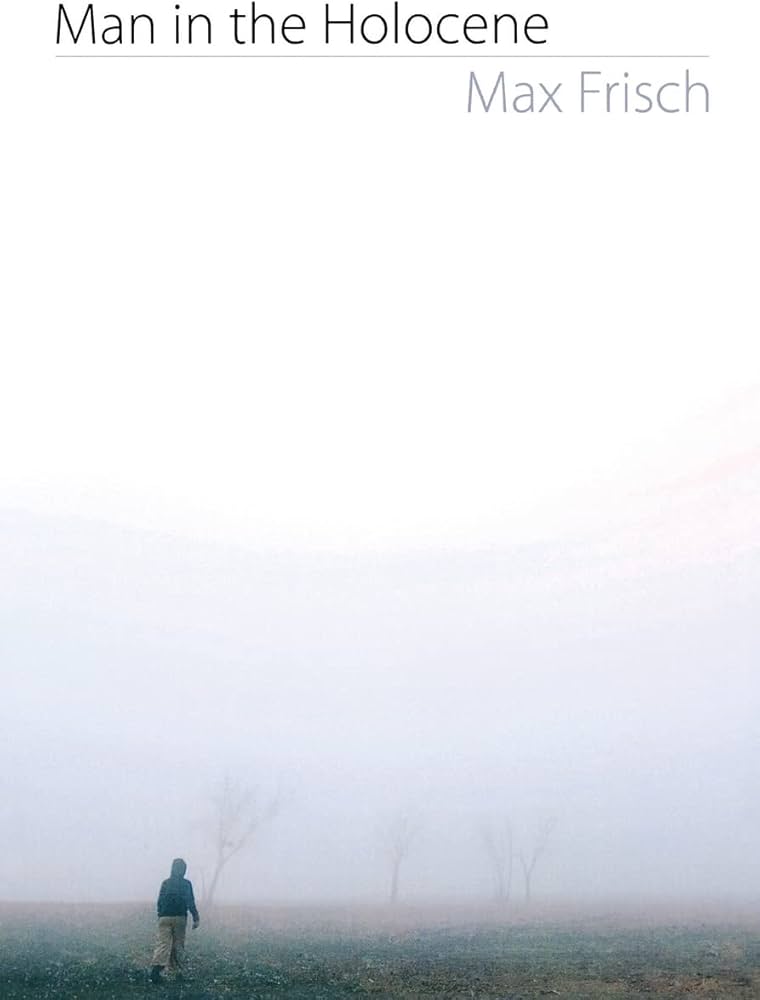
It has been raining for days now, no night passes without thunderstorms and cloudbursts. In fact, Geiser can catalogue more types of thunder than the Encyclopedia which, to be fair, is rather mute on the subject, preferring to describe lightening instead. But, when we meet him, the seventy-four year-old widower is passing yet another stormy night trying to build a pagoda out of crispbread. And worrying the possibility of landslides. The highway through the valley is blocked so the mail bus can’t get through. Periodically the power goes out. To get through, he is intent on keeping his mind active, reading, accumulating facts and endeavouring to remember those details—like mathematical formulas—that have slipped into the dust of his aging memory.

Man in the Holocene by Swiss writer Max Frisch is by turns the funny, unconventional, and bittersweet tale of a man who is waging his own little battle against the dying of the light, and attempting to construct a refuge in a gallery of facts while the storm rages outside his door.

Somewhere a tapping on metal.

He trains his field glasses on the mountainside watching for cracks, and reads up on the meteorological history of the valley he has lived in for the past fourteen years. He  delves into matters of rock formation, studies the measurement of geological time, and records details about dinosaurs. He begins by copying out information, but soon realizes that it is far more efficient to clip out passages of interest from the encyclopedia, the Bible, and other books, and then tape them to the walls of his home. Reproductions of his various cut and paste selections are embedded in the text.

Occasionally Geiser ventures out, umbrella in hand, to examine the state of his garden with its fallen dry stone wall, or once the power goes out for an extended period, to give away all the food in his deepfreeze—“the meat, usually hard as iron, is flabby, and the trout are repulsive to the touch, the sausages soft as slugs.” Only when he returns home, having foisted his thawed goods on his befuddled neighbours, does he remember that he could have at least roasted the meat over the fire in the wood stove.

One is becoming stupid—!

Through a fragmented text, repeated refrains, collected facts, and Geiser’s increasingly muddled meditations, Frisch brings us into the interior world of a truly memorable protagonist. He is a modest, somewhat eccentric figure who, at least since his wife’s death, has tended to keep to himself. Originally from Basel, where his daughter, son-in-law and grandchildren still live, he is an outsider, no matter how long he has lived in the valley. “A valley without through traffic,” as he describes it. A detailed description of the region, its industry, and social history is, if rather nonchalant in tone, not without moments of dry humour:

In the summer there are cranberries, also mushrooms. When it is not raining, the white trails of passenger planes can be seen high in the sky, though one does not hear them. The last murder in the valley—and that only rumored, since it never came to court—happened whole decades ago. Ever since the young men have owned motorcycles, incest has been dying out, and so has sodomy.

Women have had the vote since 1971.

What makes this novella work so well is that it is not simply an assemblage of fragmented passages, repeated refrains, and a collection of assorted facts. It is a well-paced and orchestrated, if crumbling, tragic comedy.  Geiser’s memory may be fading, but the narrative takes us into vivid accounts of the Icelandic landscape he once visited and a youthful attempt to climb the Matterhorn with his brother (a story he’s told so often that even his grandchildren are tired of it). And then there is his possibly ill-advised decision to, due to the blocked highway, head off early one morning with the goal of crossing the mountain pass so he can catch a train to the city. He changes his mind quite late into the adventure and returns home a weakened and diminished soul. A tired, confused man now determined to shut out the world once and for all, but still the reluctant hero of a story that is beautiful, sad, and quite unexpected.

Man in the Holocene by Max Frisch is translated from the German by Geoffrey Skelton and published by Dalkey Archive.

We’re too small for the sky to pay attention to us: Great Fear on the Mountain by Charles Ferdinand Ramuz

In this novel, the stage is set quickly with little fuss. The story opens at a village council meeting in an unnamed Swiss alpine community where the members have gathered to discuss the shortage of available grazing land for their cattle. The situation is acute and the answer seems obvious to some and ominous to others. High on the mountain lies the verdant Sasseneire pasture, abandoned for many years after an event so terrifying that the elders dare not speak of it, warning that to go back would be to invite evil to return once more. But the young, who don’t remember that time, put little stock in what seems more folklore than fact. As the Chairman argues:

“Those are just stories. No one ever really found out what happened up there. It’s been twenty years since then, all that’s in the past. To my mind, the long and the short of it is that for twenty years now we’ve been making no use of that fine grass, which could feed seventy animals all summer long; if you think the village can afford to be extravagant, then say it; myself, I don’t think so, and I’m the one who’s responsible . . .”

The debate is short; the younger folk win the vote. And so begins the process of securing the site, repairing the chalet, and, most challenging of all, finding enough men willing to spend the summer up on the mountain with the herd.

Great Fear on the Mountain, the 1926 novel by Charles Ferdinand Ramuz, is a bucolic tale that takes place in the looming shadow of mystery and death with a hint of the supernatural. Ramuz (1878 – 1947) was a Swiss-French writer who, although he spent his adult years in Paris where he counted Igor Stravinsky among his close friends, continued to look to Switzerland for his fictional landscapes. He set his stories in rural communities, writing of farmers, villagers, and mountaineers often confronting disaster and tragedy. His distinctive style would later influence Jean Giono and Céline. And, it is this style, with its shifting, almost omnipresent, narrative voice, vivid depictions of nature, and the ominous repetition of key phrases, that manages to build the intensely claustrophobic atmosphere of dread that gives this spare  novel its power.

Seven men ultimately come forward to go up to Sasseneire. They include the leaser of the land, Crittin, generally referred to as the master and his nephew, a young man named Joseph who hopes the extra money earned will allow him to marry his beloved sweetheart, and old Barthélemy, a survivor of the last summer on Sasseneire who wears, as a protective talisman, a bag containing a piece of paper on a rope around his neck. Along with an adolescent and another townsman, the team is rounded out with the strange, physically deformed Clou—an odd man who seems to have his own agenda.

Once they are up on the mountain with the herd, a sense of unease quickly settles over the men, becoming especially palpable once night falls:

Outside, it must have been thoroughly dark, and perhaps there were stars, perhaps there were not; they couldn’t know. Nothing could be heard. Listening did no good, nothing at all could be heard: it was like at the beginning of the world, before there were humans, or, at the end of the world after humans had retreated from the surface of the earth—nothing was moving anymore, anywhere, there was no longer anybody, nothing but air, stone, and water, things that do not smell, things that do not think, things that do not speak.

Before long, disease begins to appear among the animals. Just like the last time. The boy comes home shaking with fear, soon followed by another man. The villagers react to news of the sick cattle with alarm. They establish an armed guard on the access road to prevent anyone else from returning and spreading this mysterious  illness. The remaining men and their slowly diminishing herd are essentially trapped and only Clou, who disappears each day, shows no concern about being unable to return to the village. As the men try to cope with increasingly dire circumstances, various shades of despondency and madness begin to take hold.

As the details of the events that originally led to the abandonment of the Sasseniere pasture are alluded to yet never fleshed out, the happenings this time around are equally ambiguous. And potentially much more devastating. A steady sense of dread builds and spreads, up on the mountain and down below, while around them all nature seems to be at once ambivalent and mildly malevolent. It’s a delicate balance:

It was perhaps midday. The sky was arranging itself, without paying any attention to us. At the chalet, they’d tried once again to look into the mouths of suspected animals, grasping their pink muzzle in one hand, introducing the fingers of the other between their teeth, while the animals lowed; up above them, the sky was arranging itself. It was covering itself, was turning gray, with an array of small clouds, lined up evenly spaced from one another, all around the combe, some of them capping the peaks, at such moments they’re said to be putting their hats on, others lying flat on the ridges. There was no wind.

The omniscient third person narrative occasionally shifts perspective, into second and more commonly first person plural. Bill Johnston’s translation traverses this shifting narrative terrain with ease. Great Fear on the Mountain is presented as an allegorical tale that has become part of a larger consciousness, and one that is made more suspenseful by the intentional, almost jarring, repetition of phrases and images, and the depiction of natural phenomena, such as the light and shadows on mountain peaks, as portents of ill fate. You know it can’t end well, but like all the members of this little community, you cannot see what is coming.

Great Fear on the Mountain by Charles Ferdinand Ramuz is translated from the French by Bill Johnston and published by Archipelago Books

Making every word count: The Questionable Ones by Judith Keller

A police car drives slowly along the streetcar tracks in front of the central station. The officers scrutinize the waiting pedestrians through the window. Most of those waiting here are out of the question. But some do come into question. These are the questionable ones.

This simple story, “Casting,” not only provides the title for Judith Keller’s collection of micro fictions, now available in English translation by Tess Lewis, but is a perfect representation of what this young Swiss writer is able to achieve with an economy words and a sensitivity to the multiple meanings that potentially blossom from familiar expressions. A quick glance at this book of short (sometimes very short) stories can be misleading. Some pieces are barely two sentences, a number extend for a page or two, while a few stretch to seven or more pages. One might then wonder how much a of story such an abbreviated form can contain, but as Keller knows well, the careful choice of words and the confidence to leave open space for the reader is key.

Arranged into sections named after stops on the Zurich tram line, the stories in The Questionable Ones offer snapshots into the lives, passions and idiosyncrasies of a variety of characters. Absurd, often humorous, sometimes reaching toward the political, Keller’s micro fictions reflect recognizable human emotions and actions, frequently relying on common expressions taken to their literal extreme, or language that is inherently ambiguous. Of course, this reliance on meaning, especially in such a confined literary space, presents a particular challenge for a translator.

The publisher’s webpage for this book features links to a published interview and a video conversation between the author and her translator, both recorded in April 2020 when the pandemic had intervened in Keller’s plans to attend a festival and a residency in New York City. Although both cover her literary influences—including Robert Walser and Ilse Aichinger—and the reasoning behind her unusual decision to study German as a foreign language in Bogota, Colombia, the video is particularly enlightening. It not only offers anyone interested a taste of Keller’s mini fictions, read by the author herself, but zeroes in on some of the difficult decisions her translator faced when the choice of an appropriate word to convey the nuances implicit in the original was not obvious. At this point, the translations were not necessarily fixed in their final form, so several times, Lewis and Keller discuss possible options for critical words in particular pieces. After all, if every word counts in the initial composition, the same is true for the translation. Further, the opportunity to witness the writer and translator openly examining the subtleties of meaning together is inspiring.

Keller’s playfulness with words and capacity to see things from a slightly odd angle allows her to pack more into a few sentences or a few pages in ways that longer, more conventional fiction might not. Less is more. Each piece is left open for interpretation, encouraging the reader to imagine a larger tale. They are at once sketches and revealing portraits of ordinary people trying to make sense of life, one way or another. As well, the spare prose, focused on the most essential, if unusual, qualities of  character and setting leads to some wonderful images. Take for example, the opening of the two-page story “In a House”:

A band of light lay on a hillside as if a glance from half-closed eyes had fallen from above. On the hill stood a house and in it lived a man whose movements were slow. He slowly raked the leaves. He had a wife and two sons. His wife looked like an owl with her brown and golden eyes. She had taken to standing behind herself and sending her body on ahead and calmly watching what happened to it. Their marriage was a muted one.

The only obvious connection between the stories that comprise The Questionable Ones and the tram stations that denote each section—Bucheggplatz, Schwert, Micafil and so on—is the recurring piece, always called “High Time” that closes out each sequence. The circumstances change, but each instance, begins with a “far-fetched woman” making her way through the city, by day or by night, often reaching the relevant tram station and, ends with the acknowledgement that she, or someone else, has been “waiting for it to be high time for a good while now.” This variation on a theme within which what “high time” is meant to refer to is never revealed, adds an intriguing continuity to this irresistible collection of microfictions.

The Questionable Ones by Judith Keller is translated from the German by Tess Lewis and published by Seagull Books.

A bell in the distance: ‘La Clarté Notre-Dame’ and ‘The Last Book of the Madrigals’ by Philippe Jaccottet

When Swiss Francophone writer Philippe Jaccottet died in 2021 at the age of ninety-five, he left two final manuscripts, finished in the final year of his life with the assistance of his friend, poet José-Flore Tappy. These two works, La Clarté Notre-Dame, a sequence of prose pieces, and The Last Book of the Madrigals, a selection of verses, have now been published together in John Taylor’s translation and, in them, we see the poet looking back over certain past experiences, ever asking questions of himself and the world he observes, even as his age weighs heavily on his thoughts.

The first work opens with a remembered outing with friends, when, as they walked down a gentle slope under grey skies, the silence or “deep absence” of the vast open space surrounded them:

Until the little vesper bell of La Clarté Notre-Dame Convent, which we still couldn’t see at the bottom of the valley, began to ring far below us, at the heart of all this almost-dull greyness. I then said to myself, reacting in a way that was both intense and confusing (and so many times in similar moments I’d been forced to bring together the two epithets), that I’d never heard a tinkling—prolonged, almost persistent, repeated several times—as pure in its weightlessness, in its extreme fragility, as genuinely crystalline . . . Yet which I couldn’t listen to as if it were a kind of speech—emerging from some mouth . . . A tinkling so crystalline that it seemed, as it appeared, oddly, almost tender . . .

This bell is the initiation and the subtle motif that binds a series of reflections that carry Jaccottet back to childhood, to earlier travels and, along the way, to inspirations and writings from his past. There is an element of reassessment to this sequence, a restless questioning of the poetic and the political, with frequent parenthetical asides. And though many of the passages date back to 2012, the image of being “at the very end of my life’s path” is ever present. Doubt, not of his accomplishments, but of their faithfulness to some kind of truth and ethical value, creeps into his musings.

There is a slowness, a patience, and willingness to set aside reflections for a time, to let them rest, that lends La Clarté Notre-Dame an organic wholeness in its final form, even if its genesis was more fragmentary. The vesper bells seem to effortlessly feed Jaccottet’s ongoing concerns about the situation in Syria, thoughts about his own poetic influences, memories of subtle details and interconnections arising from his long life of experiences and human interactions, and uncertainty about what lies beyond but, in the end, he is willing to close on an open, unfinished note. This is true to form. When asked what Jaccottet’s writing has to offer to a new generation of readers, John Taylor, one of his long-time translators suggests:

We have entered an age of unequivocal partisan discourse, of linguistic robotization, of tiny symbols standing for complex emotions. In total contrast to this, Jaccottet’s writing constantly shows nuance, attentiveness, perseverance, circumspection, and a genuine quest for essential truths. His hesitations and doubts are salutary because they bring us to a halt and help us to observe and ponder anew, sometimes against our own preconceptions and wishful thinking, as we learn to cast away chimeras but also not to abandon all hopes.

The Last Book of the Madrigals, Jaccottet’s final poetic offering is a return to verse, a form he had moved away from in favour of prose poetry in the 1990s. The dual language text opens with a piece entitled “While Listening to Claudio Monteverdi” which imagines an encounter with the most influential madrigalist of the early 17th century. It opens:

When singing he seems to call to a shade
whom he glimpsed one day in the woods
and needs to hold on to, be his soul at stake:
the urgency makes his voice catch fire.

Then by its own blazing light, we spot a moist
night-time meadow and the woods beyond
where had come across that tender shade
or much better and more tender than a shade:

now there’s nothing but oaks and violets.

The voice that has brightened the distance fades.

I don’t know if he has crossed the meadow.

Their long summer night together continues under the starry sky, becoming a transformative  experience for the speaker.

The poems that follow in this sequence draw on mythic, celestial and natural interactions. Other voices are invited into conversation with the poet on his journey, but an image of a writer nearing the end of his time recur—these are the last madrigals, an allusion to Monteverdi, perhaps—invoking the same sense of solemn awareness haunting La Clarté Notre Dame. After an encounter with an old blacksmith he asks:

Was he delirious when I heard him murmur:

‘If this lamp that is like a beehive
is removed from me,
if this perfume drifts away, companions,
you can carry off these quills and bundles of paper:
where I’m being led, I’ll have no more use for them . . .’

Later in another madrigal, as a summer evening falls, the poet again recalls the “blacksmith of volutes and flames,” whom imagines wishing away temptation only to then wonder of himself:

And he who still writes on the last staffs,
perhaps, of his life:

‘That unknown woman fishing in her lightweight skiff
has struck me as well.

I first thought it sweet to be her prey,
but now the hook tugs at my heart
and I don’t know if it’s the daylight or me
bleeding in these pearly waters.’

These poems are filled with beauty and longing, calling on the stars in the heavens for silent answers and anticipating the turning of the seasons toward autumn and winter. One can well imagine a chorus of voices carrying the final songs of a poet who looked at the world closely, listened to silences and distant bells, and sought the meanings in it all on the page. This volume with his two final works is not only a fitting literary addition to a life of great accomplishments, but can serve as an introduction for those who wish to read more.

‘La Clarté Notre-Dame’ andThe Last Book of the Madrigals’ by Philippe Jaccottet is translated from the French by John Taylor, with an Afterword by José-Flore Tappy, and published by Seagull Books.

Somewhere between night and day: Trás-os-Montes by José-Flore Tappy

Dark, endless,
lampless
behind the windowpanes

the night

Yet even it
ends up famished
can be heard fidgeting,
shrinking to better flee,
suddenly escaping
over the roofs

Spare, essential in its spirit, the voice of Swiss poet José-Flore Tappy strikes a distinctive note  from the first lines of “The Corridor,” the poem that opens Before the Night, the first part of her book Trás-os-Montes—a note that continues to rise off all the pages that follow. Born in Lausanne in 1954, Tappy is a highly respected writer, researcher and translator. The present collection of poetry, her seventh, was awarded the prestigious Swiss Prize for Literature in 2019 and is now available in a dual language French / English edition in John Taylor’s translation. (Her first six books were released in a single volume as Sheds / Hangars in 2014, again in Taylor’s translation, available from Bitter Oleander Press.)

In his Preface, Taylor provides an overview of the key poetic elements at play in the poems, linking them, where appropriate, to a continuation or development of approaches emerging in Tappy’s earlier poetry. His long association with the poet and her work allows him to contextualize the themes that arise, but a conversation between poet and translator recorded and published in translation in The Fortnightly Review, offers a valuable opportunity to hear Tappy discuss her poetic philosophy and this work in particular. In speaking about her own poetic evolution, she notes that Spanish and Latin American poets have had an abiding presence in her life and writing. Taylor wonders how this influence is reflected and she responds:

Surely natural elements in all their intensity: the Mediterranean, the arid lands, the most deserted landscapes, or the poorest landscapes. This is where my imagination goes and where I recover my roots. I have spent many moments of my life on one of the Balearic islands, and I came of age in the midst of an environment that was at once solar and maritime — and very harsh, where sunlight can be hostile, the vegetation overgrown and inhospitable, where the violence of nature demands a strong existential response from a human being. The southern European landscapes and their inhabitants, the harshness of their daily lives, have always accompanied me: Spain, but also Sicily, Greece, and Portugal.

This sensitivity to the human-natural interplay of intense landscapes is directly evident in Trás-os-Montes which is set in Portugal and Spain, along with an extended poetic epigram set in Greece. The first series of poems, Before the Night, feature a village woman, Maria, as she tends to the tasks of her daily life in “Trás-os-Montes” (which means “on the other side of the mountains”), an impoverished, isolated region of northern Portugal with an aging population clustered in small villages, almost forgotten by the rest of the country, bound to this austere lifestyle by deep ancestral roots.

Tiny and bent over
the sink, so far from us
in her blue apron, lost
in her rain boots, she’s sorting
the black cherries, setting the ripest
off to the side, separating them
from the rotten ones

She seems to be measuring
an old dream from a distance,
visiting it with her fingertips

behind the bare windowpane
the clouds
leave stains

We see her tending her garden, cleaning her home, straightening a fence, heading off to market, engaging in communal activities. But this is more than a quotidian cataloguing of chores or portrayal of a life shaped by the forces of nature and defined by time. The precise, economical language carries its own emotional and existential weight. Through the speaker’s observations of this woman who is at once a real person and someone who stands for a kind of “universal humanity,” Tappy is exercising a form of distanced depiction to ask questions about what life means. She says:

This book does not draw her portrait, nor address her (she will obviously never read me!). It’s actually the opposite that happens. . . Without her knowing so, this discreet hardworking woman holds out a mirror to me, and in this mirror I look at myself. This woman is a lamp for me. She illumines me and helps me to think, to think about myself.

This sequence of poems, then, lays the groundwork for those of the second section, The Blank Hour. Here the tone is more personal, while landscape—natural and man-made—becomes an even stronger feature, as trails and roads lead the speaker into an encounter with an intimate past.  Although in neither section is a location explicitly stated, these poems are ostensibly set in the Balearic Islands of Spain where Tappy has spent much time during her life. The imagery is bleak and beautiful, coloured with an atmosphere of memory and loss that grows deeper as the sequence proceeds.

But for those who go afar
with neither lamp nor landmark
under a sky of black snow,
the earth with its lighthouses,
its bits of bone, its rockets,
the earth so noisy during the day,
every evening closes up
like a wooden chest
over hope

There is, again, a real person at the centre of The Blank Hour, someone Tappy once loved who has passed away. Her speaker, the lyric “I” which she understands as “an ‘augmented I,’ as it were, composed of personal experiences but also of projections of my imagination,” addresses this individual and encounters his absence in the places they once knew together. Her language, so evocative, illuminates the experience of sorrow and grief so perfectly. Our losses always seem magnified, not only by specific locations but by the vastness of the universe itself.

Today the tamarisks
covered with dust from the trucks,
pink stars become gray
that you’ll never see again,
persist,
and the enamel-bright houses
bunch together. In silence
they stand, staving off
absence

A single fault line suffices, however,
and that look from the past returns,
slipping by mistake
into the heart, reopening
what had been locked up so well

a nearby star twinkling
and ripping

In reading Trás-os-Montes, one has a sense of journeying alongside the speaker, yet at the end we are each, poet and reader alike, left alone to understand the destinations we have reached. Tappy’s poetic process is openly existential in a way that prescribes no specific conclusion. The story she is telling, she claims, is not her own but rather a means to self-understanding: “By writing, I get myself going on a path, towards a deeper, renewed self.” As such, the story we read, is, at least to some degree, our own, shaped and coloured by our lives and experiences. And that is the true beauty and power of poetry.

Trás-os-Montes by José-Flore Tappy is translated from the French by John Taylor and published by MadHat Press.

Retracing a snowy path into the past: Twelve Nights by Urs Faes

It seemed to him that a story told, a story from the past, would never truly fade once it had moved someone. The act of remembering, of reading, was like a return, a homecoming into a story. He was never closer to himself than in the remembered and read.

When I made note of this book last year, I imagined it making a nice pleasant read to fill some of that melancholy time around Christmas and I was not wrong. However, there were several things I had not anticipated. This year, as the holiday drew near, with my cat recovering from surgery, my son started drinking heavily, and all of our modest plans started to unravel. Then, once I started reading, the book itself suddenly seemed more timely than I had expected—I was unaware of the superstition, central to the narrative, that the days between Christmas and Epiphany were traditionally seen as a time of hauntings by evil spirits in parts of Europe, nor was I prepared for the bitter darkness that lay at the heart of this simple tale of a man returning to the Black Forest valley, to the home he had fled decades earlier. Thus, while snow fell outside and temperatures plummeted into the minus thirties Celsius, Twelve Nights, by Swiss writer Urs Faes, became a suitably sombre companion for a holiday more sombre than I’d hoped for.

At a scant 84 pages, this novella moves with the economy and steadily building tension of a well-crafted short story. As Manfred, back home after years in an unnamed distant land, wanders through the winter landscape of his youth, his ruminations gradually reveal what he thinks he knows and what he doesn’t want to face. The snow falls and a cold wind blows. Travelling back through a remembered past, the scenery and weather frame his musings. He has long been estranged from his younger brother Sebastian who, for reasons Manfred can neither understand nor accept, was chosen to inherit the family farm and, in doing so, won the hand of the woman he had loved. Now, so many years later, his parents and his beloved Minna are all dead and Sebastian lives the life of a recluse, while the self-exiled son still carries vestiges of his grief and rage that no amount of time can heal:

He had thought he could hear a humming, wings beating, a whimper drifting up from the valley across the treetops, into this frosty stillness which became entangled in his clothes, penetrating his skin; freezing what was inside him, as though even his heart were turning to ice.

Manfred wants to see his brother again, hoping for what, he isn’t sure—reconciliation, perhaps? There is, as we learn, more to this desired and uncertain reunion. A motivation that drives the returning brother, and an act of violence, buried in the past, that may not be forgivable. These facts are revealed, with only the required detail and much open space, yet it is impossible not to recognize one’s own complicated and conflicted holiday emotions in the longing, sadness, anger and guilt that haunt the protagonist. This is a season that carries a lot of weight for many of us. Twelve Nights captures that mood, but does so with solemn beauty and hope. An ideal read for a stressful time.

Twelve Nights by Urs Faes is translated from the German by Jamie Lee Searle and published by Harvill Secker.

Image copyright Joseph Schreiber

Tell stories and let stories be told: Stigmata of Bliss by Klaus Merz

Venturing into the fictional territory defined by Swiss writer Klaus Merz, one immediately notices the lightness of his imagery and the marked economy of his language. His narratives are slowly and carefully crafted, allowed to form one brushstroke at a time. Anchored in a lush landscape mirroring his native canton of Aargau in northern Switzerland, his characters and the lives they live are at once simple and exceptional. Sensitively translated from the German by Tess Lewis, the present volume, Stigmata of Bliss, gathers together three of Merz’s best known novellas, and, as such, offers a fine introduction to his distinctive restrained poetic prose.

The collection begins with Jacob Asleep (Jakob schläft). Originally published in 1997 with the curious subtitle Eigentlich ein Roman—Actually a Novel—this tale of an ill-starred but strangely resilient family won several prominent awards including the Hermann Hesse Prize for Literature. The story opens at the graveside of the eponymous Jacob, the narrator’s older brother, who died at birth and as such was officially named “Child Renz”. Although he is gone, in the heart and imagination of the protagonist, Jacob is ever present as a sleeping angel of sorts to be called upon in times of need. And there will be plenty of those.

The narrator is, from an early age, surrounded by eccentricity and illness. A younger brother, Sunny, is born with hydrocephalus; his father, a baker, develops epilepsy; and his mother grows increasingly despondent as the years pass. His grandfather takes a turn at raising birds and then fish before turning with passionate intensity to beekeeping, while his grandmother becomes a faith healer who is undeterred by any apparent lack of response to her charms. Finally, an uncle, Franz, is a reckless daredevil with an unfettered lust for adventure that takes him, fatefully, to Alaska. But, ever the pragmatist, our hero recounts his family’s tragedies and joys with calm resolve and no small measure of peculiar pride:

In our family, illness had priority over all else. After Grandmother walked barefoot through the snow in her religious frenzy and, weightless as old, brittle leaves, was carried out of the house with the first spring storms, my brother was once again the most seriously ill member of the family, so ill that people gladly came often to visit him. Out on the street, everyone, young and old, turned to stare. They tripped over kerbstones, caught their trousers and skirts on garden fences and knocked their gaping heads on telegraph poles when I pushed him along the road in his high-wheeled cart.

There were only a few television shows at the time and the tabloids were still restrained, so, live and in real time, we satisfied some of the local craving for entertainment.

Given the premise of this novella, there could easily be a tendency to slip into pathos, but such is not the case. The spare prose, vivid images filtered through memory, and the charismatic narrative voice facilitate smooth transitions between scenes of boyish bliss and accounts of loss and pain, between times of happiness and hardship. No moment is oversold. Only the most essential details are offered, often indirectly, set up in such a manner that ultimately a simple sentence is left to carry the weight of all that has been left unspoken. One of the most powerful episodes in the text occurs after the narrator and his father pick up his mother after a stay at a sanatorium. Nothing is explicitly said of her experience. It is not necessary:

The first thing Mother did at home was to get rid of the electric blanket that had always warmed her bed. And she adamantly refused to let us replace it with a better one.

For fear of electric shocks.

What remains, at the end of this finely honed tale, is a sense of the light that lingers in the memory assuring that in a life filled with many hardships, the darkness is not denied but it need not dominate.

*

The second novella, A Man’s Fate (LOS. Eine Erzählung,2005), feels, perhaps, denser and heavier in tone. The style is still spare, but here the third person narrative takes the reader deep into the consciousness of a man, Thaler, who is at a crossroad in his life. A teacher, married with children, he is feeling cramped and constrained. He heads to the mountains hoping a hike will help clear his mind, allow him to figure out what he wants. Armed with his favourite snack—honey and lemons—he travels by train, on his way to a cabin where he plans to spend the night. At the same time his thoughts travel back, digging through his earlier adventures and affairs.

Thaler is a troubled man, weighed down by a certain nostalgia for his youth and a frustration with his present circumstances. Yet it is not clear what it is that he feels he has lost or what potentials he yearns for. The memories he keeps rifling through do not seem that exciting—but, then, mid-life tinges the past with regrets and what-if’s. His restlessness is echoed by the train:

His train gathers speed. Nowhere does he feel as secure as in a train. Surrounded only by chance companions. He finds them to be the most reliable and he feels closest to them.

Travelling divests one. Like a lover. Like a lover who leaves unnoticed after making  love to return to her own life, having washed up only cursorily yet unhurt. And safe elsewhere.

Thaler’s thoughts regularly swing back to women, leaving little wonder that his marriage is in trouble. He seems indifferent to his wife and children. However, there is, of course, more going on, and a chance mishap will upend everything.

*

The final novella in this volume, The Argentine (Der Argentinier. Novelle, 2009) is an account of the life of the colourful “Argentine”, a man who, in his youth, left Switzerland for a life of adventure in the New World. In Argentina he became, so he claimed, a gaucho and a celebrated dancer. Yet, once the desire to escape cooled, he returned to Europe, married his sweetheart, Amelie, and devoted himself to teaching. But he maintained a larger-than-life aura, his tales fueling his own mythology and his assorted wisdoms enlightening both his family and generations of students.

The Argentine’s story, however, is not told directly. It is recounted by his granddaughter Lena to a primary-school friend, the narrator, during a gathering of former classmates. His own memories and observations, as well as brief conversations about his and Lena’s present lives, filter into the narrative which continually circles back story of the Argentine, or simply “Grandfather” as he is called. The result is a portrait conveyed in segments, coloured with multilayered memories. A story within a story within a story and at the centre one remarkable man.

After his return, Grandfather created a different climate in each of his classrooms: an African climate in one, icebergs as in Patagonia in another or the blooming spring of the Wachau Valley in another. He wanted his students to be prepared for any circumstances when they had to face reality—actual or perceived—whether at home, out shopping, before a screen, in Shanghai or in bed. They should have emergency resources that come from worlds described or worlds still waiting to be described. With such inner resources, they will never die alone or of hunger, he always said.

Although published separately, there is a wholeness that can be found in reading these three novellas together. The same spareness marks each one, though the narratives have a different texture and energy. No piece extends beyond 60 pages (including the drawings by Heinz Egger that grace the text), but each offers a rewarding and intimate experience that lingers long after the reading has ended.

Stigmata of Bliss by Klaus Merz is translated by Tess Lewis and published by Seagull Books.

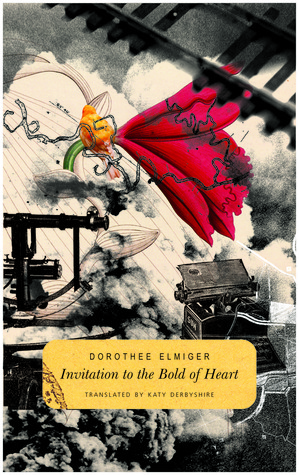
Searching for a future in a devastated landscape: Invitation to the Bold of Heart by Dorothee Ellmiger

There were no maps, no more accurate maps for the northern coal district. It was absent on all the plans, it was one large absence, so to speak, the course of the roads had long since slightly shifted, hills diminished, towns abolished.

Beneath the surface of a once prosperous coal mining district, flames from a fire in the tunnels has been smouldering for decades; above, the land has largely been laid to waste. Pit frames dot the horizon while in some places the land has caved in, sometimes taking livestock or an unfortunate human resident with it. Towns stand nearly abandoned, home to only the stubborn and the eccentric who have held fast. In one such community, two young women—daughters of the police commander and the last remaining youth—have never known anything but this desolate territory. It is their sole inheritance, all they have to look forward to. Their future is bleak, but they are determined to salvage some sense of optimism.

For Margarete and Fritzi, the protagonists of Swiss writer Dorothee  Elmiger’s award winning debut Invitation to the Bold of Heart, an old map indicating that a long-forgotten river once flowed through the region offers a spark of hope that drives a determined search for evidence that it still exists somewhere—even if it has temporarily disappeared below ground. If they can locate this elusive Buenaventura River, they believe they may be able to begin to make sense of a past, including their own family history, that no one wants to talk about and create a base from which they can start to look forward on their own terms. It’s an ambitious and enormous goal.

Bookish and studious by nature, Margarete is the official archivist. She devours the books she finds in the apartment above the police station where she and her sister live with their father. Natural history, science, and literature. On a Remington typewriter lifted from one of the policemen she types her account and makes notes of details that seem relevant. Facts about rivers and deserts, about mines and mining appear and reappear throughout. Moodier and more carefree, Fritzi makes little direct contribution to the narrative. She is the restless explorer. What she adds, however, through her reported observations is thoughtful and wise, such as this reflection on their surroundings:

For a long time, she said, I have been trying to comprehend the landscape here. She said, I look at the pit frames rising up to the sky, and I look at the railway lines running deeper and deeper into the ground because they’re sinking and sinking. I look at the sky, because the sky might also be symptomatic, the sky is also part of this landscape. I count, she said, I count the colours; my vocabulary is exhausted after brown, olive and black, and when I think about it those are all the colours that are here.

Of course, to affect a thorough search both girls have to head out, together or apart, on foot, by motorcycle or car, and eventually, in the company of a horse named Bataille that Fritizi finds and brings home. Meanwhile, the policemen who have little need to patrol, spend most of their time glued to the television set, hardly noticing the sisters’ comings and goings.

Characterized by a spare disjointed style, the novel most often resembles an attempt at record-keeping, a report for a future that is vague and uncertain, set in a surreally dystopic present that seems willfully disconnected from its own past, or simply exhausted by the weight of the space it occupies. The adults are either oddly apathetic or completely absent, like their mother who holds an almost mythological place in their imaginations. A female Hemingway-like character, she smoked cigarettes, cut her hair short, and one day simply drove off into the distance. Together they fantasize a series of daring adventures for her. On the other hand, they typically refer to their father as simply Heribert Stein or H. Stein, reflecting a relationship that seems cool, even antagonistic.

The fractured, loose-limbed narrative is, at one level, rather unsettling. It is, not unlike the sisters own place in the world—ungrounded, suspended somewhere in a geological timeline between oceans and deserts. They have facts and coordinates and maps, but no direct knowledge beyond the borders of the territory they’ve always lived in. One has the sense it has been intentionally cut off, guarded to keep outsiders at bay. This uncertainty which reflects the sisters’ own isolation is never resolved. A wealth of intertextual references woven freely into the text further offset the environment of the novel. It is a daring approach and, for the most part, very effective. Yet, in the innovative voice of Invitation to the Bold of Heart, one in which the narrative often appears to wander, ramble and repeat, pulling in facts drawn from a variety of interconnected sources, one can hear the qualities that Elmiger will develop and refine in her more mature and startlingly impressive second novel, Shift Sleepers. Without question, she is an author to watch closely.

Invitation to the Bold of Heart, by Dorthee Elmiger, is translated from the German by Katy Derbyshire and published by Seagull Books.

Who’s there? Who’s there? Shift Sleepers by Dorothee Elmiger

Question: How many roads can be used to enter Switzerland? Answer: Several hundred.

Imagine a novel that refuses an ordinary logic but contains within its pages a multitude of overlapping narrative accounts from a cluster of speakers sharing a space vaguely defined in place and time.

Imagine a novel that exists on the threshold. A performance art piece rendered in writing. With a cast of characters who bring their memories, experiences and unbound images (The place I’m thinking of is a common refrain) weaving in and out of one another’s stories, through accounts that are sometimes offered within reported letters or phone calls, even though that same character is also apparently present. Or perhaps not.
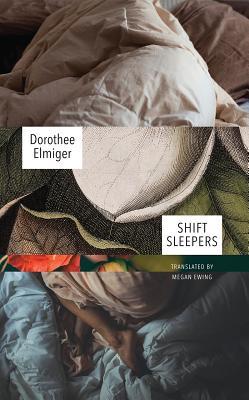
Born in 1985, Swiss writer Dorothee Elmiger won the Ingeborg Bachmann Prize and the Kelag Prize in 2010 for her first novel Invitation to the Bold of Heart. Her second novel, Shift Sleepers, newly released from Seagull Books in a translation by Megan Ewing, is a bold and breath taking approach to story telling that defies expectations, but does so in a seamless and engaging manner that, under a heavier hand, could have read terribly forced and artificial.

Set in a house in some unspecified location, presumably in Switzerland, a seemingly eclectic group has gathered. It includes a translator troubled by dreams of collapsing mountains, a logistics expert suffering from prolonged insomnia, a travelling writer, a female academic named A.L. Erika who talks of a significant period of time spent in Los Angeles, a journalist, a student from Glendale, California, and the restless Fortunat Boll whose pursuits have taken him to Texas, Portugal and other locales. On the sidelines, so it seems, are the logistic expert’s sister and brother-in-law and Mr. and Mrs. Boll. Although a few of the characters carry the bulk of the narrative, their stories are not only interrelated, but as listeners they are actively engaged with and attentive to one another—questioning, urging the speaker on, offering supplemental detail. If that sounds odd, well it is. But it is remarkably effective. This is not a random multilevel conversation so much as it is an orchestrated, open ended meditation on a number of vital, and difficult inquiries that affect us all on personal and political terms.

Their conversations touch on art, music, writing, justice, migration, trade, and belonging. Their discourse rises as a polyphonic hymn to the nature of movement across borders—ideas in language, language to language, country to country, wakefulness to sleep, sleep to dreams, life to death.

But is it readable? I found it endlessly fascinating myself, but I imagined it as a play, as a performance art project rather than any kind of conventional narrative. The voices and their stories are what matter and the author wants to ensure that you listen to what they say. Thus, more than a house, the setting is akin to a stage, or a room into which many doorways or thresholds converge. Characters come and go, retire to their rooms, assemble to share a meal. But the action, if it can even be called that, is minimal. Movement happens elsewhere. In memories and dreams. And it is in these reflections, and the questions that arise, that the novel’s power lies.

Shift Sleepers is a fragmentary work, but one in which the fragments blur and blend into one another. In the course of one paragraph, a number of voices many pick up a thread, carry it for a sentence or two and step back. The key characters slip in and out of singular accounts that go on for a several pages at a time, continually resurfacing through the course of the book.

Each person is essentially exploring the same issues that, in different contexts, ask: What does it mean to be alive? In this moment? At any moment or place in time?

It is human to want to know where one fits in and with whom: Who’s there? the opening words of Hamlet, form a frequent refrain.

The figure of central concern, the one who embodies within himself, the primary focal point of engagement for this ensemble, is the logistics expert who has a background in customs, monitoring the transport of goods across borders. In his recent state of extreme sleeplessness, he describes no longer being able to distinguish between events near or far, or to determine what is relevant. Caught in a state of strange alertness, detached hyperawareness, he experiences himself wandering through streets and towns, bombarded with images from North Africa, particularly Djerba, an island off Tunisia, seeing an owl, images of bees and being routinely distracted by a child playing a flute. Strangers sit in his apartment, people come and go, but he is unable to fall asleep himself. He describes his desperation:

even the attempt to remove myself from the city and the events led nowhere, these things were happening everywhere, I wasn’t dreaming, I wasn’t imaging things, I was continuously awake and saw everything with my own eyes. In Djerba too, in Athens too, in Florida too everything would have continued the same way, everything actually behaves this way, the Customs manager produces risk analyses, two men allow their bodies to be rolled up in rugs to cross the border, the Swiss farmer has no more use for the asylum seeker when he fails to understand for the third time how to pick crops, the mountains form a natural border, the shift sleeper is in search of a new domicile.

The shift sleeper of the title has a historical context stemming from the second half of the nineteenth century when migration into the urban centres of Europe led to a shortage of available and affordable housing. Newcomers might be forced to rent a bed during the hours its regular occupant was out or otherwise engaged. Without an unconditionally secure place to rest, they would grasp at sleep for a few hours at a time. These individuals or transient existences were a source of public distrust. They still exist of course. Today’s homeless person, refugee, and migrant continues to live this way—in streets and alleys, couch surfing, in camps and settlement centres, and too often, wherever they can.

Not surprisingly, the body is a striking and recurring image in this novel. Several speakers admit to their own varying degrees of personal bodied discomfort, and metaphysical disconnect, while the bodies of others—of smugglers, migrants, victims of physical violence—become an object of fascination and concern. Even obsession.

Other motifs that recur throughout the conversations that comprise this work are movement, passages, across bodies of water, through forests, on foot, by train. Safely, legally, or otherwise. Falling is also a frequent image—from the crumbling mountains of the translator’s dream that opens the book, to regular references to the work of Dutch performance artist Bas Jan Ader, who disappeared in 1975 during a solo transatlantic voyage launched from Cape Cod. Encounters with his work, which often deals with falling, sit as a reference point connecting many of the characters to one another. And his fateful final “performance” is echoed with historical references to earlier transatlantic migrations toward North America. Historical themes are blended with contemporary images throughout.

Originally published in 2014 as the migrant crisis was raising alarm in Europe, Shift Sleepers is even more unsettling in light of Trump’s border detention camps and the increasing nationalism and xenophobia spreading worldwide every day. At one point, the logistics expert recounts a phone call from the journalist, wondering how he could be so complacent when so many people were risking everything everyday by simply crossing the national border that ran past his house. These people, he is warned could disappear, find themselves in remote enclaves:

He himself had tried in vain that day to enter a so-called reception centre, even though these centres and cells, these sensitive zones, were easy to find and he could go there without much issue either on foot or by car, as he explained on the telephone—at the same time it was impossible for him to ever actually enter these places for as soon as he set foot inside their rules lost all validity as concerned his person.

These spaces, he explained, essentially established two different categories of persons—and two separate categories of being. Further along, another character, speaking of a visit to the US will wonder why it is easier for some people to cross borders than others? Or rather, why can an American cross a border without changing, whereas a Mexican crossing the same border becomes a different person?

 One of the counterpoints played out against the increasing divisions between people and kinds of people, is explored in the idea of the possibility of harmonious communities. Fortunat Boll, a man who is present with his parents, speaks of his own innate loneliness, his travels to Texas and interest in La Réunion, the utopian socialist colony founded in Dallas by Victor Propser Considerant in 1855 to which his own supposed relative naturalist Jacob Boll briefly belonged, and of his father’s own bee colonies. Both the colonies, human and apian, had in this case failed. Fortunat wonders if he could ever live with others or would he always need to be apart.

Today I live alone, do I feel lonely? Hardly. Over time I have lost a certain vulnerability, I rarely have strong emotions whereas everything weighed heavy in my youth, I was driven by feelings. This tuba tone is finite and vanishes in the air, it means two things that are mutually dependent, the place of my childhood and the distance from it, such antagonisms are beautiful because they are simple, now I see the world as a complicated structure, everything possible exists within it simultaneously.

One has to wonder about unusual ensemble within which, at least for the duration of the book, he has found himself. What strange spell holds it together? There is a sense of cohesion borne of the questions asked and the answers given, in how stories are shared, often the same experience told from different angles, sometimes first- other times second-hand, stories nested with stories—like sets of personal and communal Russian dolls.

Images are echoed and revisited as the book progresses. However, rather than feeling repetitive, these returning accounts add to the density of the narrative, becoming threads woven into a self-referential intertextual tapestry. There are few answers to the uncertainties and concerns the various characters carry with them. There is no explanation as to how they all arrived at this one place or why they’ve gathered. This is a story about questions, not answers, about the personal concerns about our lives, bodies and relationships that are ever evolving, and the broader issues—migration, justice, and global trade—that threaten our ability to share this planet.

Shift Sleepers is a symphony of inquiries. Elegantly composed and executed. A very impressive achievement for a writer who is still very young.

Shift Sleepers by Dorothee Elmiger is translated by Megan Ewing and published by Seagull Books. It is my second read for Women in Translation Month 2019.

To be an outsider who is at home everywhere: The Oblivion Seekers by Isabelle Eberhardt

Long and white, the road twists like a snake toward the far-off places, toward the bright edges of the earth. It burns in the sunlight, a dusty stripe between the wheat’s dull gold on one side, and the shimmering red hills and grey-green scrub on the other. In the distance, prosperous farms, ruined mud walls, a few huts. Everything seems asleep, stricken by the heat of the day. A chanting comes up from the plain, a sound as long as the unsheltered road, or as poverty without the hope of change tomorrow, or as weeping that goes unheard. The Kabyl farmers are singing as they work. The pale wheat, the brown barley, lie piled on the earth’s flanks, and the earth herself lies back, exhausted by her labor pains. (“Outside”)

For Isabelle Eberhardt, the open road was the ultimate image of freedom—a symbol of liberty that called to her again and again. As such, she had a special affinity for vagrants or wayfarers. They feature regularly in her collection of short stories and vignettes, The Oblivion Seekers. To be confined—by physical walls, by obligations, or by the restraints of fin de siècle European society—is unbearable. Her characters give up comfort, security, even love, to find a place where they belong. Quite often it is a life of solitary independence they choose. Singular in her defiance, her passion, and her determination to set her own course, it is impossible to appreciate her writing without at least a cursory look at the remarkable life from which it emerged.

Born in Geneva in 1877, the illegitimate daughter of a Russian Nihilist, Eberhardt was an unconventional free spirit who lived a charmed, if short, life filled with drama and adventure. Her father set the groundwork, insisting she labour alongside her brothers when she was young, learn to handle a horse properly, and appear regularly in public dressed in men’s clothing. He was inadvertently preparing her for the rigors of life in the deserts of North Africa, while his demanding expectations likely fueled her longing to escape. By the time she was twenty, she had already made her first trip to Algeria and converted to Islam.

Apart from a few short trips back to Europe, Africa had claimed her soul. Yet for the French colonists, her lifestyle was nothing short of scandalous. Her preference for men’s clothing—and Arab styled at that—was looked on with suspicion. She adopted a male persona, although she rarely fooled anyone with respect to her gender, and could often be found in the café, smoking hashish, perhaps inviting a soldier home for the night. The colonial officials suspected she was a spy. Meanwhile, she bought a horse and headed off to explore the desert. On her travels she befriended other Muslims in the area including a young Algerian soldier named Sliman Ehnni, who would become her one great love.

Under her male name she joined the Qadriya, a secretive Sufi brotherhood that exercised considerable power over unconquered desert tribes. She subsequently became more openly political, writing articles and stories celebrating North African Arab culture and protesting the French colonial administration. This attracted further unwanted attention, now from rival religious cults as well as the government. In 1901, only a stroke of dumb luck saved her from a would-be assassin when her attacker’s sword bounced off a wire, missing her head but nearly removing her arm. Once she recovered, Eberhardt was ordered out of French North Africa, so she was forced to head to Marseilles. With luck, Sliman was able to join her and the two were married. In 1902, the couple returned to Algeria. They were destitute, but they experienced a few months of peaceful happiness there. It would not last, more challenges, risk and adventure awaited. However, by 1904, hard living, recurring illness, and probable syphilis began to take its toll. After a near fatal bout of malaria, she left the hospital against doctor’s orders to meet up with her husband. They enjoyed one last night together before a flash flood collapsed the mud hut they were staying in. Isabelle did not survive. She was twenty-seven years old.

At heart, writing was the only career Eberhardt had ever truly desired. Sadly, much of her work was destroyed in the flood that claimed her life, but several posthumous collections of her stories were published. And her incredible, unconventional life inspired a biography by Welsh author and explorer, Cecily Mackworth, which drew the attention of Paul Bowles, an ideal translator for the adventurous young writer if there ever was one. The Oblivion Seekers gathers eleven short prose pieces, a brief travel diary, and a defiant letter to the editor in which Eberhardt defends her life among the Arab population. The stories read like parables, feature primarily Muslim characters, and sensual, vivid descriptions of the North African landscape. Yet there is very little sentimentality here; the tone is measured and controlled.

Her characters are typically independent spirits, either restless or unwilling to be bound to the life that is expected of them. “Taalith” tells the tale of a young widow who chooses death over forced marriage to an older man, while “The Rival” paints the portrait of a vagrant who abandons the wandering life to settle with his beloved only to discover that his bliss cannot withstand the pull of the road; his desire for his other mistress, “tyrannical and drunk with sun” draws him back. Under the fragrant flowers of the Judas tree in his garden he looks at his sleeping lover:

Already she was no more than a vaporous vision, something without consistence that would soon be absorbed by the clear moonlight.

Her image was indistinct, very far away, scarcely visible. Then the vagrant, who still loved her, understood that at dawn he would be leaving, and his heart grew heavy.

He took one of the big flowers of the spicy camphor tree and pressed it to his lips to stifle a sob. (The Rival)

Considering the time and her background, Eberhardt’s stories are particularly striking. They reflect her deep connection to Arab populations of North Africa and mark her early contribution to a decolonial narrative. She is not a voyeur, her affections are honest, not romanticized. This is especially powerful in the title story, “The Oblivion Seekers,” one of the few first person narratives, which describes a setting she knew well personally—a kif den in Kenadsa in the Sahara Desert. She describes the patrons, the wanderers and the regular kif-smokers and the course of a typical evening:

The seekers of oblivion sing and clap their hands lazily; their dream-voices ring out late into the night, in the dim light of the mica-paned lantern. Then little by little the voices fall, grow muffled, the words are slower. Finally the smokers are quiet, and merely stare at the flowers in ecstasy. They are epicureans, voluptuaries; perhaps they are sages. Even in the darkest purlieu of Morocco’s underworld such men can reach the magic horizon where they are free to build their dream-palaces of delight. (The Oblivion Seekers)

There is a mesmerizing quality to Eberhardt’s prose. Her life was marked hardship and poverty, mixed with turns of good fortune and great passion, but through it all she retained a self-contained humility and it is this quality that comes through in her prose. As Bowles notes in his Preface: “Her wisdom lay in knowing that what she sought was unreachable. ‘We are, all of us, poor wretches, and those who prefer not to understand this are even worse off than the rest of us.’”

Wise words still.

The Oblivion Seekers by Isabell Eberhardt is translated by Paul Bowles, and published by City Lights Books. An edition is also available from Peter Owen.