
Each person has their own star: The Fiancée Rode in on a Donkey by Vénus Khoury-Ghata

Deep in the desert, excitement is building. Among the Qurayza, a Jewish nomadic tribe, young girls are being readied for the arrival of a special visitor. An important rabbi is coming to select a bride for the great Algerian military and religious leader Emir Abdelkader. He has wives already, of course, but another, a Jewish girl, is to be offered to secure protection for her people.  For the girls, scrubbed and polished and hennaed, to be chosen would mean a chance to escape a prison of sand for a better life. Or so everyone believes.

Just one look around is enough for the rabbi to find the chosen one. He picks Yudah for her name, a contraction of Yahuda, and for her eyes which she lowers when he looks at her. Every woman is beautiful to the rabbi as long as she isn’t one-armed or one-eyed.

Each one of Khoury-Ghata’s spare novellas is different, exploring a different time and place, and The Fiancée Rode in on a Donkey is no exception. Set in the mid-1800s, this tale follows Yudah, the promised fiancée, from her desert home to the streets of Paris in a year rocked by revolution. Although, if time frames are correct, her journey lasts little more than ten or twelve months at the most, it will test the courage and resolve of this young heroine.
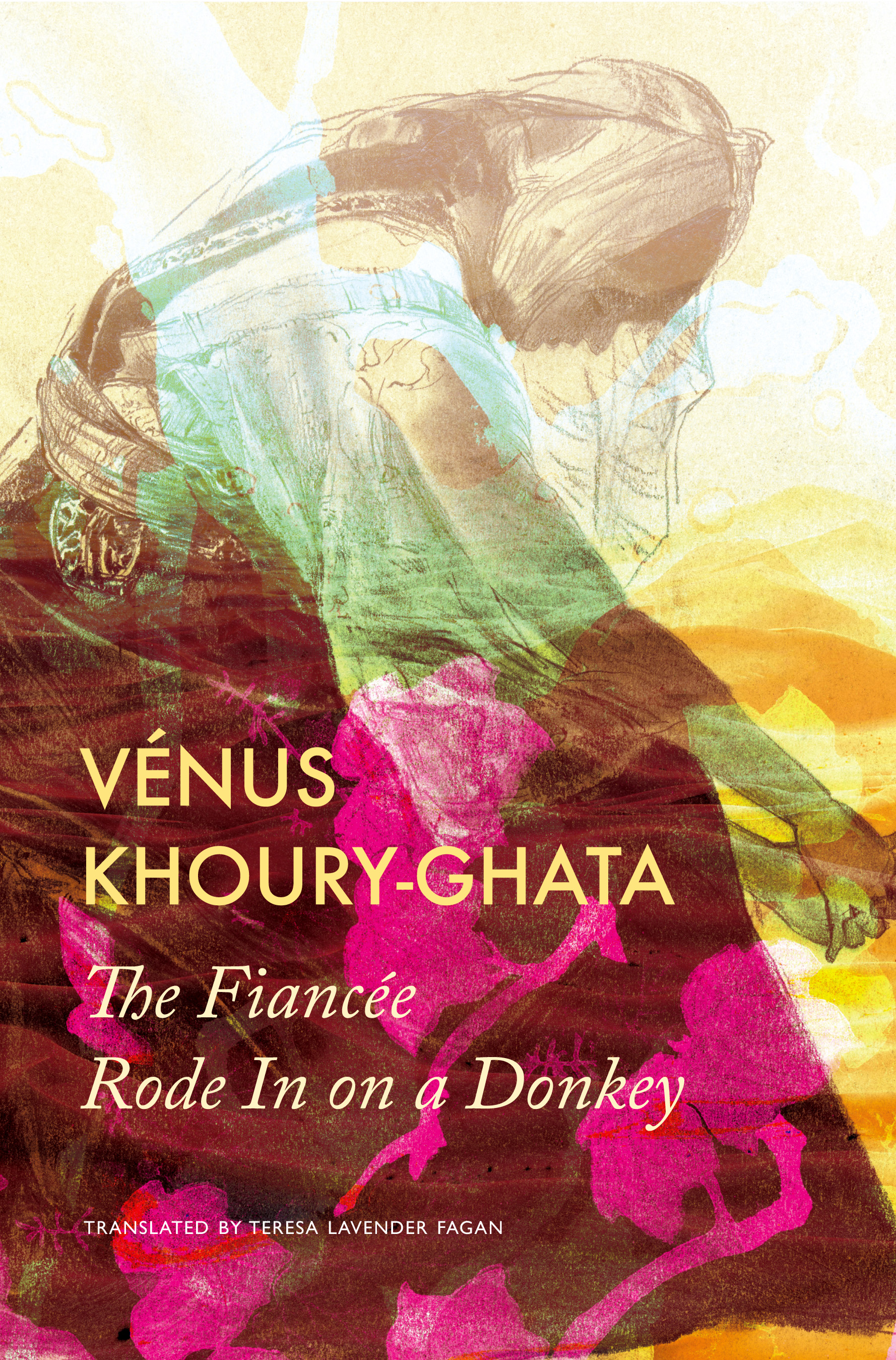
When Yudah arrives on the back of the rabbi’s weary old donkey, she is dismayed to discover that Abdelkader’s entourage is not housed in town, but in an encampment nearby. She realizes that she has traded one kind of tent life for another, but the welcome she might have anticipated is not forthcoming. The Emir is away on campaign, engaged in a battle that he will not win, and no one seems to know what to make of this scrawny teenager who claims she is his bride-to-be, destined for his bed. An outsider trying to find a small corner in the camp or wandering around town alone, she begins to mourn the desert community she has left and the boy, her cousin, to whom she had given her heart. It is but the first of a series of displacements to follow.

Before Yudah has a chance to meet the man she has been led to believe would become her husband, Abdelkader is forced to surrender and exiled to France with his family. Yudah, with no formal connection to him, is taken to Île Sainte-Marguerite with the great man’s followers—hundreds of men, women and children, few of whom will survive the winter on the island. But here, too, the young daughter of the desert is still an outcast. She does find refuge in a convent where she is, for a time, renamed Judith, until her stubborn nature and—at least to the eyes and ears of the nuns—cultural coarseness disrupts the strict order of religious life. She is forced to move on several more times until she eventually finds herself in Paris in the spring of 1848.

Alone and forced to repeatedly adapt to circumstances and customs that her fifteen years of life have in now way prepared her for, Yudah clings to the superstitions of her tribe:

The Qurayzas say that the sound of a badly oiled drum can unleash a war, but who among all these people has ever heard of the Qurayzas? Do they know that the inhabitants of the desert see farther than life? That their gaze goes beyond the horizon that separates the living from the dead? That the parched camel drivers who dream of wells and rain drown in the sand as in the sea? That the palm tree at arm’s length is only a mirage and that what they think is a galloping horse coming to meet them is only the slow steps of the evil spirits crying between the dunes? Female spirits, they point out, the only ones authorized to accompany the lost at the time of their death.

Her conviction that a special destiny awaits her, born less out of any sense of superiority than out of a belief that the well-being and security of her people depend on it, keep her from losing all hope even when she falls into thinking that she is insignificant and could disappear from life without anyone ever noticing. Uneducated and illiterate, Yudah carries a traditional wisdom that belies her age, one that intersects with French society at such a distinctly foreign angle that it allows her to see and measure things differently. This otherworldly charm will lead her into the most unlikely situations, both fortunate and tragic.

What allows this historical, yet slightly magical, tale to work so well is the light touch with which it is told. As a poet, Khoury-Ghata is capable of creating memorable characters, and capturing settings and interactions with a devastating economy of words, whether she is working with well-known figures like Osip Mandelstam or Marina Tsvetaeva, or someone like this young Jewish girl from the Algerian desert. In tracing the fate, not only of Yudah but of the other young men and women she meets, this novella offers an unexpected view of a well-known period of French history, highlighting the challenges endured and the damage that can be done to ordinary people caught up circumstances they cannot control.

The Fiancée Rode in on a Donkey by Vénus Khoury-Ghata is translated from the French by Teresa Lavender Fagan and published by Seagull Books.

A wanderer between two worlds: The Postman of Abruzzo by Vénus Khoury-Ghata

“Rifling through the papers of a dead man isn’t enough to bring him back to life.”

Ten years after her geneticist husband died following his return from a village in a mountainous part of southern Italy, Laure leaves her home in Paris in search of something—she’s not sure exactly what—that will help her understand why he kept returning to this isolated community of displaced Albanians again and again. As Luc travelled to collect samples from populations scattered across the globe, being left behind became such a constant condition of their marriage that Laure can’t quite accept that he is really gone for good. The only way to come to terms with this unsettled absence, she is certain, is to visit the one place he had returned to fifteen times and where, on his last trip, his “heart had broken down.” Armed with a folder of his final notes on the Albanians and her portable typewriter, she arrives in Malaterra in the region of Abruzzo, and rents a house.

This is the set-up of Lebanese-French writer Vénus Khoury-Ghata’s 2012 novella, The Postman of Abruzzo, the latest of her works to be released by Seagull Books in Teresa Lavender-Fagan’s English translation. But, if Laure embarks on her journey under the illusion that she will somehow be able to put names to the anonymous donors of blood, urine and saliva recorded in her husband’s files, as if some code rests in the notes she has yet to transcribe, she soon recognizes the foolishness of that idea. What she encounters instead is an eccentric collection of characters who hold fast to beliefs and traditions long since forgotten back in their homeland, preserved in Abruzzo like a fly in amber, and she discovers she is not the only one mourning an unresolved past.

The first and most essential villager Laure meets is Yussuf, the postman of the title. On her first day, he arrives on the doorstep of her cave-like temporary residence high on the exposed mountainside above the valley where the villagers are spending the hot summer months. He has come, he tells her, to feed a litter of kittens, and promises to return every day regardless of whether or not he has any mail to deliver. As one of the only people in town who can read, having learned in prison, he knows everyone’s secrets and has an opinion on everything, sharing his knowledge and uncanny insights with the newcomer as he see fit. Yet, although he can read, the postman has no time for writing:

Putting words on top of words doesn’t construct a house, doesn’t make a child or a tree grow, doesn’t plough a field or prevent locusts from devouring an entire crop of corn. The pages one writes on a table don’t change the shape of the table but make the brain of the one writing explode. Too many word’s crack one’s skull and shorten one’s life.

With his mailbag and his tendency to hold fast to the letters that he feels are too painful to deliver or too important to release to the vagaries of the postal system, Yussuf plays a critical role linking the residents of Malaterra to one another, and Laure, as an outsider, to the community where she hopes the answers to the questions Luc has bequeathed her lie.

The only person in the village who professes to have a true respect for words is the Kosovar, the sole Muslim in a community of Catholics, who has, over the years, bitterly retreated into the confines of his dusty bookshop. In Laure he hopes he has found a kindred spirit, but his desperation and general state of deterioration unnerve her. The other residents are of a much earthier stock, including Mourad, the lusty baker, who proposes marriage despite the fact that he already has a wife and household full of children and the local women who, guided by superstitions, eye the skinny, short-skirted foreigner with distrust. Most are widows, by fact or fate, as economics have driven husbands and sons away to seek work in cities from which they rarely return. And they all seem to remember a Luc very different from the one his wife thought she knew. But the one person who interests and terrifies Laure most is Helena, the woman who cared for Luc in his illness and sent his washed and ironed shirts to Paris after his evacuation to a hospital in Rome. Helena has been waiting thirty years, rusty rifle at hand, to avenge the deflowering and subsequent death of her daughter—by hanging from a fig tree with her mother’s assistance.

Even the mountains mourned the girl, only the mother’s eyes were dry. She cried inside. Condolences poured in from every direction: plastic buckets of every colour, aluminum pans, wicker baskets, even a nightingale in a cage, but nothing consoled her. The priest who refused to give her absolution because of suicide was immediately replaced with another priest. No people are more solidary than Albanians. It makes sense! The same blood flows in their veins . . .

This blood, O negative, not only binds this community and attracted the interest of the foreign medico, but nurtures a deep-seated tradition of blood tax and blood debt imported and preserved through generations of migrants. Laure’s agitation is heightened when Yussuf reveals that a letter sitting undelivered in his bag indicates that the “boy” Helena has been waiting for, known as the Australian because he was rushed off to an uncle in Sydney for his safety, is finally on his way back to Malaterra. His arrival will affect the entire village, Laure included.

The Postman of Abruzzo reads a little like a fable set in a place caught between the modern world and a past that is filled with a complicated network of ancient traditions and carefully maintained prejudices. Laure is also caught between two worlds, half-underground and half-aboveground as the Kosovar keenly observes. Khoury-Ghata’s prose, characteristically poetic, spare, and unsentimental, is perfectly suited for the telling. Sometimes it is simply breathtaking to experience the way she can conjure a vivid and moving image with just a few well-placed words. With this work she uses this gift for precision to craft a story of loyalty, love and loss that is both tender and gently absurd.

The Postman of Abruzzo by Vénus Khoury-Ghata is translated from the French by Teresa Lavender Fagan and published by Seagull Books.

“I’m afraid of myself.” Down with the Poor! By Shumona Sinha

In my half-sleep I saw faces and bodies emerge out of the floor tiles. Blissful, intrigued, tormented people. They appeared when I blinked my eyes. Disappeared when I blinked my eyes. Like this night, in this police cell. To tell the truth, I am still not rid of that shouting and whispering.

Opening with an epilogue from Pascal Quignard about the implication inherent in ancient Greek notions of liberty and freedom of movement that those who defy borders and fences are akin to wild beasts rather than obedient animals, and taking its title from Baudelaire’s narrative prose poem “Assommons les pauvres!” in which a self-enlightened man inadvertently rebalances inequality by violently attacking an elderly beggar, unleashing an equally violent response from his victim, Shumona Sinha’s novella Down with the Poor! is a relentless meditation on the complicated and corrupted system that drives desperate migrants to seek fairer shores, only to find themselves mired in equally, if not worse, circumstances and threatens to destroy the spirits of those who attempt to help them. As she lies in a cell in a Paris police station, a young woman endeavours to untangle the forces that conspired to drive her, an Indian immigrant working as a translator for asylum claimants, to assault a migrant on the metro by smashing a bottle over his head.

Born and raised in Calcutta, Sinha started studying French at the age of twenty-two and moved to Paris a couple of years later. In this award winning novel, her second, originally published in 2011, her unnamed narrator is also from Calcutta. She is a woman who has tried to separate herself from her parents and her hometown, but finds the shadows of Kali, the city’s dark, powerful and protective deity, and Mother Teresa, its symbol of charity, haunt the life she had imagined she had earned, far from memories of poverty, in France, the adopted country she loves. Everything starts to unravel when a series of personal and professional endings lead her to accept employment as an interpreter—a “language gymnast”—in an office on the edge of Paris where ragged petitioners are called to appear before an officer and make their case, or more typically repeat the story they’ve been forced to purchase, in the hope that they might be allowed to stay in a new hostile, unwelcoming land and make some kind of better life.

Unfolding as an intense monologue, poetic and compulsive, the narrator, in light of her arrest and recent interrogation, navigates a flood of feverish thoughts and memories in attempt to figure out how and where things started to fall apart in her world. From early on it is apparent that her role as the conveyor of meaning, from her first language to her second, is more than a simple act of rewording. For her, it is an act of verbal alchemy that carries an emotional cost.

The officer spoke her language, the language of the host country, the language of glass-walled offices. The petitioner spoke his supplicant’s language, the language of the hidden, the language of the ghetto. And I repeated what he said, translated it and served it up piping hot. The foreign language melted in my mouth, leaving its aroma. When I said the words, those of my native language, they turned awkwardly in my mouth, paralyzed my tongue, echoed in my head, hammered my brain like the wrong notes on a wobbly piano. It was a rope bridge, thin, quivering, between the petitioners and me. I had to lean toward each one of them to hold out my hand, lean into their dismembered, chopped-up sentences, fish for their disjointed words and reassemble them, weave them together, make them sound coherent.

The stories she hears, the horrors, real and embellished alike, start to seep into her being. She finds herself carrying their pain. Their desperation. The knowledge that many, if not most, have paid smugglers dearly, become slaves consigned to a poverty much more wretched and inhumane that anything they left behind, builds up inside her. She seeks to shake it in meaningless sexual encounters, while secretly harbouring an attraction for a female officer that she cannot quite articulate.

Over time, her work takes her into other overlooked corners of the city’s margins, while the in the offices of her primary employment, she finds it increasingly difficult to hold herself apart from the stories she hears. Questions of class, colour, gender are never far from her mind, knowing that her own skin, sex and status bind her to and irrevocably separate her from the masses of refugees, while also keeping her apart from those who are driven into work with these populations by charitable passions. She cannot help but absorb the fear she encounters in others. Eventually that fear is transformed into anger and in turn her anger frightens her. She finds she is afraid of herself.

Holding its intensity for a little over one hundred pages, Down with the Poor! is a poetic novella that addresses some of the most pressing and difficult questions we face today in a manner that is shocking, brutal and lonely. This is a very powerful little book.

Down with the Poor! by Shumona Sinha is translated from the French by Teresa Lavender Fagan and published by Deep Vellum in North America and Les Fugitives in the UK.

“You weren’t made for this life” Marina Tsvetaeva: To Die in Yelabuga by Vénus Khoury-Ghata

It begins as it ends. With a beam, a rope, a chair and a window looking out on a hill, a cypress tree and a potato field. With a heart turned to stone through so many trials.

In her stark, poetic elegy The Last Days of Mandelstam, Lebanese-French poet and writer, Vénus Khoury-Ghata, aimed to bear witness to the final days and hours of Osip Mandelstam’s life that had passed unrecorded in a transit camp near Vladivostok, alternating between the dying poet’s feverish thoughts and delusions and delicately sketched moments from his past. With Marina Tsvetaeva: To Die in Yelabuga, she again begins with the final hours of another great Russian poet whose work was supressed during her lifetime, but her approach here is more direct. Woman to woman, poet to poet, Khoury-Ghata wants to trace the long, troubled journey that led Tsvetaeva to take her own life in 1941 at the age of forty-eight:

Hunched over your huge 750-page journal for months, I try to assemble the scattered pieces of your life, understand the reasons for your infatuations and your disappointments, especially your frantic desire to connect with men, women (some loved with words, others with hands) before you ended up alone, destroyed, bitter, unrepentant, ready to begin again.

Addressing her subject directly, Khoury-Ghata paints a spare, unsentimental portrait of a complicated, gifted woman whose creative intensity and constant need to be loved not only attracted but suffocated those around her. It is an effort to understand her demons and her pain.

Born into privilege, the daughter of a friend of the tsar who founded the Moscow Fine Arts Museum, Marina Tsvetaeva was a prodigy, studying music and French as a child, and publishing her first collection of poetry at age seventeen. She was soon drawn into literary circles where, through critic Max Voloshin, she met Sergei Efron whom she would marry in early 1912. Later that year, she gave birth to her first child, Ariandna (called Alya) just before her twentieth birthday. Her fame as a poet grew over the following years with the publication of further collections. Then, with the October Revolution, her fortunes rapidly began to unravel.

You had to learn how to live humbly, become invisible, not attract attention, expect at any moment to be denounced, arrested, deported shot.

As her late father’s connections become a liability and her husband joins the counter-revolutionary White Army, Tsvetaeva is reduced to begging from friends and struggling to get by, now with two children to support. She finds creative expression through writing plays and physical expression with lovers, but she allows her youngest daughter Irina to die of starvation at an orphanage where she had taken her girls in the hope that they would be fed. Her death is one of the many ill-fated decisions and situations that will haunt her.

Khoury-Ghata follows Tsvetaeva’s escape from the USSR to Berlin in 1922 where she plans to meet up with her husband whom she has learned is alive and studying in Prague. She falls in love while waiting, as is her nature, an act that never seems immoral to her, simply an outlet for the many passions that course through her being. When she and Alya, finally reunited with Sergei, settle near Prague, a new lover, her husband’s friend Konstantin Rodzevich, occupies her day, while writing commands the nighttime hours:

In the evening after supper, only the scratching of your pen on paper can be heard. Your fierce writing coupled with the desire to destroy what you have just written. Alya and Sergei, powerless spectators of your self-destruction. They watch you racing to the abyss but do nothing to stop you. The involuntary tear that you believe you wiped from the corner of your eye dilutes a word in passing. No tenderness for yourself. The horror is behind you.

In 1925, her son Gregory (known as Mur), in Tsvetaeva’s imagination the product of three men—her husband, her lover, and her great, impossible love Boris Pasternak—is born. Later that year the family leaves for France where she will live for more than thirteen years before finally returning to the USSR in 1939. New loves, including an passionate correspondence with Rilke, follow along with important literary output, but, over the years, continued economic strife will drive the Efron family into increasingly desperate situations. When she is unable to find a market for her poetry, Tsvetaeva reluctantly turns her hand to prose. Sergei, and ultimately Alya, who is often treated little better than a servant by her mercurial mother, become more politically engaged. It is impossible to feel safe and settled. The poet, so highly lauded in her teens, so desired by countless friends and lovers, finds herself alone and unloved. Most painfully, her long time supporter, yet elusive love object, Pasternak, is now lost in a new life as father and husband and no longer has time for her letters:

Pasternak has taken back the only gift he ever gave you: exaltation.

You blame your despair on everything around you.

The mirror above the sink is responsible for your wrinkles.

Too narrow, the worktable is guilty of drying up your inspiration.

Too noisy, your neighbours prevent you from concentrating.

Volatile, dynamic and passionate, the woman who comes to light in these pages is hopelessly dependent on the praise of others. She knows that she is not well liked among her fellow ex-pats, she has no qualms about engaging in romantic activities outside her marriage but is shocked and unsettled when she learns Sergei is contemplating divorce. Both her children come to lose patience with her; over time others learn to either humour or avoid her. Yet as with similar human emotional whirlpools, the one she ends up hurting the most is herself.

Khoury-Ghata’s Marina Tsvetaeva is not a strictly chronological account. Although she traces the general course of the journey that leads to the chair, rope and attic window in Yelabuga, because she is addressing her subject intimately, like a respected correspondent, a friend even, time is porous. Thus, a circle of Tsvetaeva’s friends, lovers, fellow poets and their assorted, often tragic, fates are recurring ghosts, living and dead, that delight, distract and trouble her throughout her life right up to that key final moment that is always present in the interrogatory second person narrative. Pasternak, Mandelstam, Mayahovsky, Biely, Akhmatova and more. Fragments of poems, letters and diary entries offer brief insight into the heart and mind of a woman who would come to be known as one of the greatest Russian poets of the twentieth century, whose life sadly coincided with a dramatically turbulent time that was not made for her.

Marina Tsvetaeva: To Die in Yelabuga by Vénus Khoury-Ghata is translated from the French by Teresa Lavender-Fagan and published by Seagull Books.
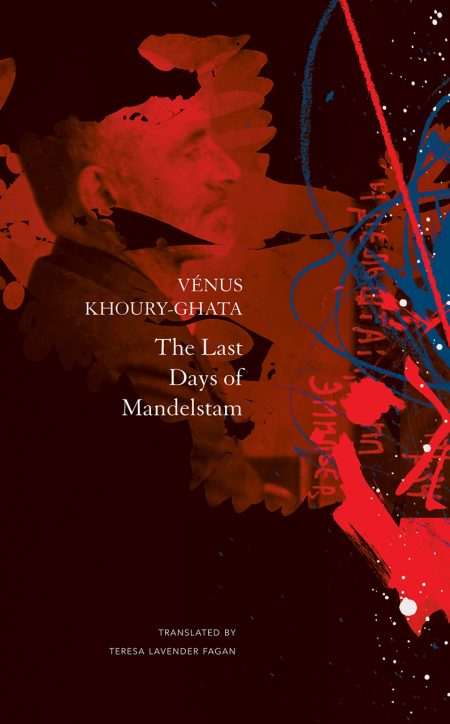
The living dead man: The Last Days of Mandelstam by Vénus Khoury-Ghata

The premise is very simple. It is December 1938. As the year draws to a close, Russian poet Osip Mandelstam lies on the very edge of death in a transit camp near Vladivostok. There he will die, far from his beloved Moscow, away from the friends who have either abandoned him or confronted their own tragic circumstances, and separated from his devoted wife Nadezhda. His body will be tossed into a mass grave. Yet, the final days of this man who stood by the power of the word and the primacy of poetry remain unrecorded, lost to time. This slender volume, The Last Days of Mandelstam, sets out to address this silence, to bear poetic witness.

Such a project is, by its nature, a delicate task. It calls for the right touch—the appropriate sense of drama—for it is probable that the waning conscious hours of a man as desperately diminished by typhoid fever as Mandelstam would have been occupied by memories, dreams, hallucinations and brief moments of awareness. At least that is the way that French-Lebanese poet Vénus Khoury-Ghata imagines them in this haunting novella, originally published in French in 2016 and now available in English, in a sensitive translation by Teresa Lavender Fagan.

Lying for months—how many?—on a wooden plank, his mattress, Mandelstam wonders if he is dead or still alive.

After the first month he stopped counting.

Less ill than he, his neighbours might let him know if he is still alive.

But typhus is decimating the camp.

Three out of four deportees are stricken.

The opening passages offer a clear, unsentimental portrait of a man who knows his end is near. Unable to speak, beyond hunger, he listens to his struggling heart. His conscious thoughts are vaguely aware of the present, but more often tangled in the past. His nightmares and hallucinations are dominated by the figure of Joseph Stalin who stalks, taunts, and berates him, echoing, in the process, some of the regrets and doubts that may have plagued the dying poet himself. In our dreams, the monsters we face reflect our own fears. Two lines from (the original version of) Mandelstam’s infamous satirical poem known as the “Stalin Epigram”—All we hear is the Kremlin mountaineer / The murderer and the peasant slayer—form a kind of subconscious refrain that surfaces throughout the book.

The poet on his meagre deathbed serves as the fulcrum around which the narrative turns, reaching back into his earlier life and, on occasion looking ahead, years beyond his death. As expected, the story that emerges is a sombre one, a tale of exile, poverty and disgrace into which threads drawn from the lives of Mandelstam’s fellow poets and his fellow transit camp prisoners are woven. Carefully chosen vignettes, repeated images—worn-out coat, moth-eaten blanket, boots made from old luggage—together with the choice of present tense and a strong poetic sensibility combine to create a moving tribute to a man who held to poetry and his principles in the face of unspeakable cruelty.

As the narrative moves between the dying poet’s thoughts and delusions and moments from his past, Khoury-Ghata sketches scenes punctuated by strong images. The years Mandelstam and his wife spent in Voronezh after he was banned from Moscow in 1934, are especially poignant. There they share a noisy communal apartment with several families; to find creative space Mandelstam takes to the icy streets:

The sound of the poem composed in the dark the same as that of his shoes crunching in the snow. A suctioning sound, the cold and the words are sucking his energy.

He returns exhausted from his wanderings, and joins Nadezhda under their moth-eaten blanket, reciting the poem written in his head. Nadezhda collects the words like breadcrumbs from a feast, transcribes them, waits for daylight to distribute them among the trustworthy.

Poetry is, of course, the crime that sentences Mandelstam to his fate. Poetry is his weapon against Stalin. As such, fragments from his poems and from Nadezhda’s memoir are incorporated into the text. Anna Akhmatova, Marina Tsvetaeva, and, as a later admirer, Paul Celan also make poetic contributions. Countless artists and intellectuals faced similar persecution under the regime, but this is a story about the power of the poem.

The Last Days of Mandelstam is, for its difficult material, a finely rendered work. Neither morbid nor maudlin, it holds to a tight emotional course as the narrative repeatedly laps at the shore of Mandelstam’s death—imagined, dreamed and finally realized—a quiet passing likely unnoticed for a time. The dramatic energy is sustained, the sparseness of the account gives the sorrow breathing room, and, in the end, Mandelstam’s troubled life is granted the dignity it deserves. A sad, but beautiful book. One that makes you want to return to his poetry, to allow him to continue to live for you again and again.

The Last Days of Mandelstam by Vénus Khoury-Ghata is translated by Teresa Lavender Fagan and published by Seagull Books.