Seeking redemption underwater: Blue Field by Elise Levine—My Rusty Toque review

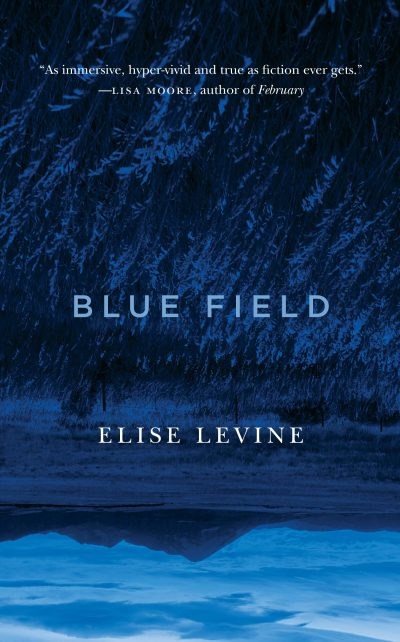
November is destined to go out as it came in, with a link to a review published elsewhere—in this case, my thoughts on Elise Levine’s Blue Field which appears in the latest issue of The Rusty Toque. This is a book that I heard about when it was released earlier this year, and I was immediately intrigued. However, when I finally sat down to read it, having already committed myself to a review, my first impression was that this was not going to be for me. The first few chapters put me off a little, that is, they led me to think I would find Blue Field difficult to assess fairly. I don’t believe that one should avoid negative reviews, but I feel that, if appropriate, they should be constructive, and if a book simply is not to your taste, it’s very difficult to make any judgement about it one way or another. As John Updike said, and I am paraphrasing, you should not accept for a review a book you are predisposed to dislike or obligated to like.

Then I turned to the promotional materials that came with my review copy. Biblioasis, bless them, frequently include an interview with the author or translator and, with an opportunity to learn more about  Levine, her writing process and interests, I was so impressed that I decided to give her book a second chance. Perhaps because it is somewhat different than the type of book I’ve read lately, I found myself caught off guard by this tale of a woman who takes up cave diving in an effort to find healing after her life has been upended. She is not particularly likable, increasingly reckless, and trapped in an vortex of loss and grief that could cost her everything she has. However, the prose—vivid, pulsating with energy, alternately harsh and shockingly poetic—is finely tuned and relentless in its intensity. Won me over.

Blue Field by Elise Levine is published by Biblioasis.

To find out more, I invite you to check out my review at The Rusty Toque. And while you’re there check out some of the other excellent features in this issue.

Live in wonder. Write in wonder: Malina by Ingeborg Bachmann

As far as I’m concerned no one has ever died and very rarely do I consider anyone alive except in the theatre of my thoughts.

Coming to the close of Ingeborg Bachmann’s 1971 novel, Malina, one might be inclined to wonder if there is anything that can be said about the reading experience. The deeply internalized, fragmented, and operatic-toned narrative, can be—has been—parsed, analyzed, and examined and yet it retains a certain incorruptible integrity. It’s not an easy read, not so much for its technical difficulty, as for the absorbing, exhilarating, and disturbing intensity that pulls you in and holds you hostage until the surreal, dramatic finale in which the narrator virtually writes herself out of existence.

Malina is simultaneously invigorating and draining, richly detailed and frustratingly opaque. To read it is to be caught up in the narrator’s increasingly desperate effort to command her own narrative. And there is an uncommon grief that lingers long after the last notes are struck.

The novel, the only one Bachmann completed before her tragic death at the age of forty-seven, begins almost formally, with a list of characters. There is Ivan, born in Hungary, who works with money at a business that, to protect his future, is designated an “Institute for Extremely Urgent Affairs.” His young sons, Béla and András, who live with his ex-wife, spend time with him regularly. The titular character, Malina, is a forty-year-old civil servant who works at the Austrian Army Museum. Reserved and cerebral, and he shares an apartment with the narrator—a woman who refers to herself only as “I” (Ich—a writer of some renown, although, as in all things, she routinely absents herself, even from the opening credits where she describes in her vocation simply as “a profession (crossed out twice and written over).”

The time is: “Today,” the place: “Vienna.” The narrator’s anxious nature is evident from the first pages of the introductory section which sets the stage for the drama that will unfold in three acts. As she sketches out the essential map of her Vienna neighbourhood and draws the basic lines that connect her to Ivan, her love interest, and Malina, her housemate, she finds grounding in Place that eludes her in Time. “Today” is an almost overwhelming quality for her from the outset—an indication that this “today” will become an increasingly unstable measure as the narrative progresses. “I’m just afraid ‘today’” she warns us, “is too much for me, too gripping, too boundless, and that this pathological agitation will be a part of my ‘today’ until its final hour.”

Malina is then, in a sense, a persistent unravelling of time and the narrator’s psychologically fragile relation to it. Its threads, wound around Ivan in the beginning, and lost through the nightmarish middle chapter, will never quite be gathered again as her personality slowly disintegrates in the final part.

In the first chapter, “Happy with Ivan,” the narrator recounts her first fortuitous first encounter with Ivan in front of a florist’s shop and her immediate knowledge that she is meant to be with him. As far as she is concerned he has rediscovered her, reanimated her buried self, and made her feel whole. He completes her, she claims, in a way she longs to be completed:

At last I am able to move about in my flesh as well, with the body I have alienated with a certain disdain, I feel how everything inside is changing, how the muscles free themselves from their constant cramps, how their plain and diagonally striped systems relax, how both nervous systems convert simultaneously, because nothing takes place more distinctly than this conversion, an amending, a purification, the living, factual proof which could also be measured and labelled using the most modern instruments of metaphysics.

It is a relationship of physical convenience, no matter how the narrator revels in the perfection of their mutual understanding. Ivan is an unadventurous man. He offers little, but expects her to maintain a pleasant demeanour, present a feminine appearance, accompany him on outings with the children, and write joyous stories, rather than the morbid-titled tales he notices in her room. One senses he would prefer her to conform without question, and in her insistence that this is exactly what she wants as well, the narrative takes on a forced, uncomfortable tone. Meanwhile, Malina is, initially, an ambiguous presence who together with Lina, the housekeeper whose name curiously mirrors his own, provides order to what would otherwise be a chaotic home. He looks after her with a detachment that belies the long-standing intuitive connection she claims they have. As a result, we encounter a very strange dynamic within which the narrator herself is a continual source of uncertainty. It is at once unnerving and irresistible.

Malina’s fragmented, inventive text continually defies narrative expectations. One-sided phone conversations, unfinished letters, portions of a story the narrator is writing to please Ivan, and the transcript of an interview are woven in to what is at times a frenetic, highly descriptive narrative—an episode where the narrator is left alone to care for the children for a few hours is priceless. Gaps, unfinished sentences, and repeated efforts at composing correspondences leave curious spaces that can’t quite be filled in. Is the narrator being intentionally elusive, or is her memory or concentration slipping? Is she addressing a reader or talking to herself?

In the second chapter, ‘The Third Man,’ everything shifts. Place and Time are no longer fixed and a long series of nightmarish dreams, punctuated by Malina’s bedside interrogations and ministrations, unfolds like an extended feverish psychosis. The narrator’s father is a persistent cruel and violent presence. He repeatedly tortures, rapes and murders her childhood self in scenes that echo the atrocities of the Second World War as much as the complicated emotional brutality of familial dysfunction implied by the recurring allusions to settings from War and Peace. The imagery is relentless, hellish:

When it begins the world is already mixed up, and I know that I am crazy. The basic elements of the world are still there, but more gruesomely assembled than anyone has ever seen. Cars are rolling around, dripping paint, people pop up, smirking larvae, and when they approach me they fall down, straw puppets, bundles of raw wire, figures of papier mâché, and I keep going in this world which is not the world, with balled fists, arms outstretched in order to ward off the objects, machines which run into me then turn to dust, and when I’m too afraid to go on I close my eyes, but the colours, glaring, explosive, raving, spatter me, my face, my naked feet, I again open my eyes to see where I am, I want to find a way out of here, next I fly up high into the heavens because my fingers and toes have swollen into airy, skycoloured balloons and they are carrying me to the heights of nevermore, where it’s even worse, then they all burst and I fall, fall and stand up, my toes have turned black, I can’t go on anymore.

This stream of torment and horrific dreams, is regularly interrupted with segments of dramatic dialogue in which Malina alternately calms and challenges her. There is little comfort to be found:

Malina: You don’t have to believe everything, you better think about it.
Me:        Me?
Malina: It isn’t war and peace.
Me:        What is it then?
Malina: War.

The final chapter, “Last Things,” brings with what appears to be a resumption of calmer, more rational narrative, but the illusion is short lived. The recorded dialogues between the narrator and Malina continue and become a more prominent feature of the text—almost a necessary prop against which she can frame her thoughts. They also take on a denser, more philosophical tone and, as her relationship with her housemate takes on a greater, more threatening quality, Ivan’s influence declines, and her own grip on her own identity starts to slip. Security in her own gender shifts, she finds it difficult to write, and becomes aware of the changing nature of sentences of all sorts. As a writer, she is acutely sensitive to sentences as if they have a tangible existence and are, for her, part of the very fabric of reality. Early on in the novel she marvels at the perfection of the sentences she and Ivan have shared access to—they hoard telephone sentences, chess sentences, sentences about life in general—but she worries, quite tellingly, that they have no feeling sentences. During her dream sequences, when her father has her imprisoned, her sentences take on an animated form, keeping her company and rising up in her defense, and later, arriving as messages inscribed on stones (“Live in wonder,” “Write in wonder”). But as her affair with Ivan grows cold it is reflected in the way their sentences change (“the chess sentences are lying fallow”), and as her fragile personality starts to disintegrate written sentences also begin to fail her.

One could argue, or at least I would, that Malina is, most strikingly, a novel of the marvel, the power, and the betrayal of the sentence. That may sound self-evident, of course, it is after all, composed of sentences. Dazzling sentences. Sentences that call and echo across the whole of the unconventional narrative expanse. There is an inherent musicality at play, not only through the direct musical notation and cuing that infiltrates the text toward the end, rising to a devastating crescendo in the closing passages, but throughout the work which can be read as an elaborately staged performance. Bachmann commands a wide range of sentence styles—long and winding, rushed and impertinent, suspended and unfinished—to orchestrate a rich and troubling exploration of the dynamics between men and women, the limits of personal identity, and the question of what it means to be alive.

Malina was intended to be part of a proposed Death Styles trilogy. The other novels exist in unfinished form and carry elements and  stories of characters that pass through this one. It is unfortunate that the complete effect will forever remain unrealized. That in no way diminishes the power or impact of Malina, or the influence it has had on many other writers including Thomas Bernhard, Christa Wolf, and Peter Handke.

Translated by Philip Boehm with an illuminating afterword, “Death Arias in Vienna” by Mark Anderson, Malina is published by Holmes & Meier.

The cost of words: My submission to the 2017-2018 Seagull Books catalogue

Earlier this month I wrote about the fact that I had not been writing much, despite my pledge to focus on my own work for a year.  Well since that time I haven’t been reading much either, but I have been busy with writing related activity and, fortunately, I have more work written earlier in the year that I am now able to share.

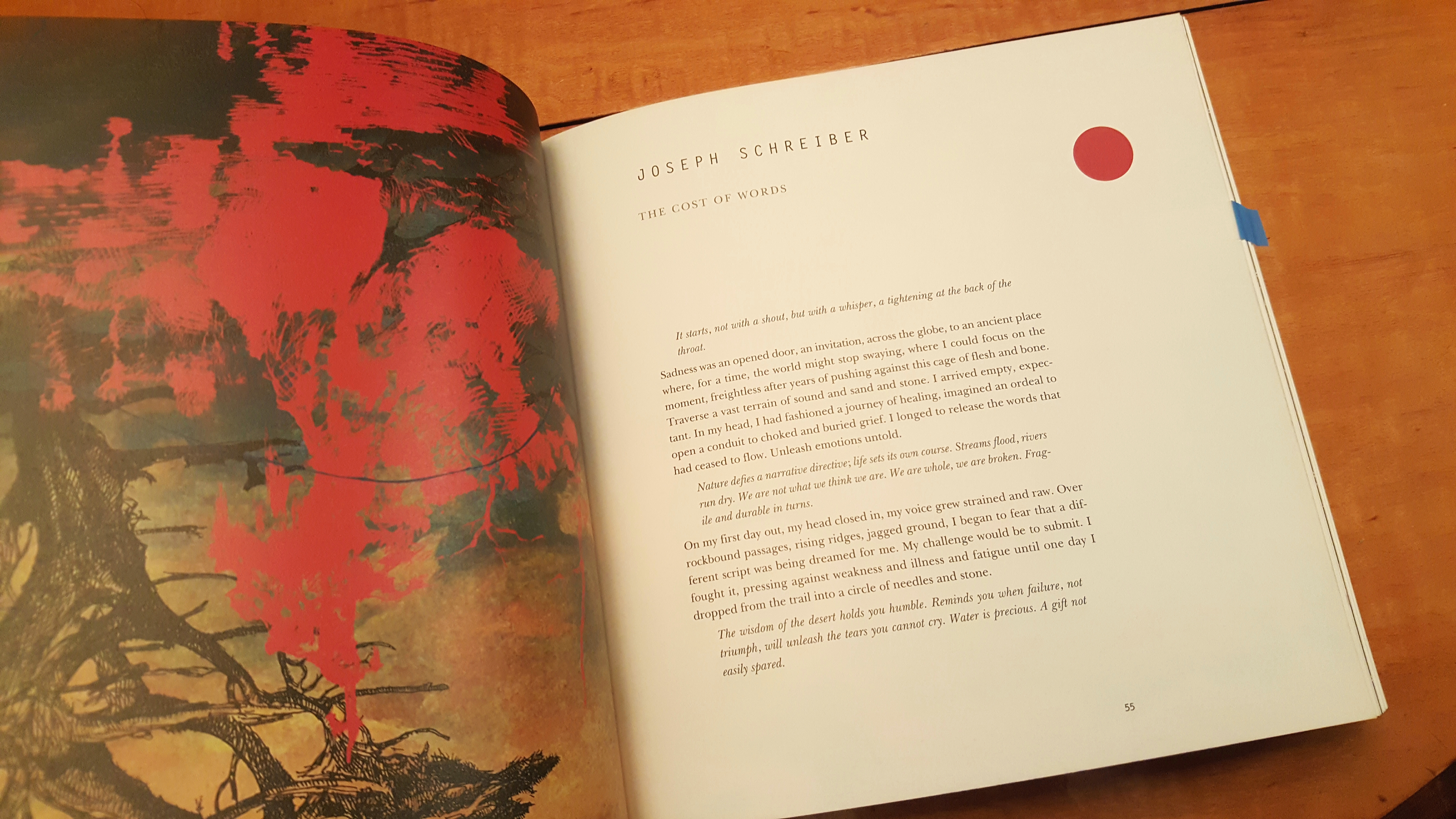
Today my contributor’s copy of the latest edition of the elegant and engaging Seagull Books Catalogue arrived.  I have only just begun to glance through it—this 428-page masterpiece begs to be savoured slowly and carefully—and, for the second year, I am honoured to have a piece of writing included.

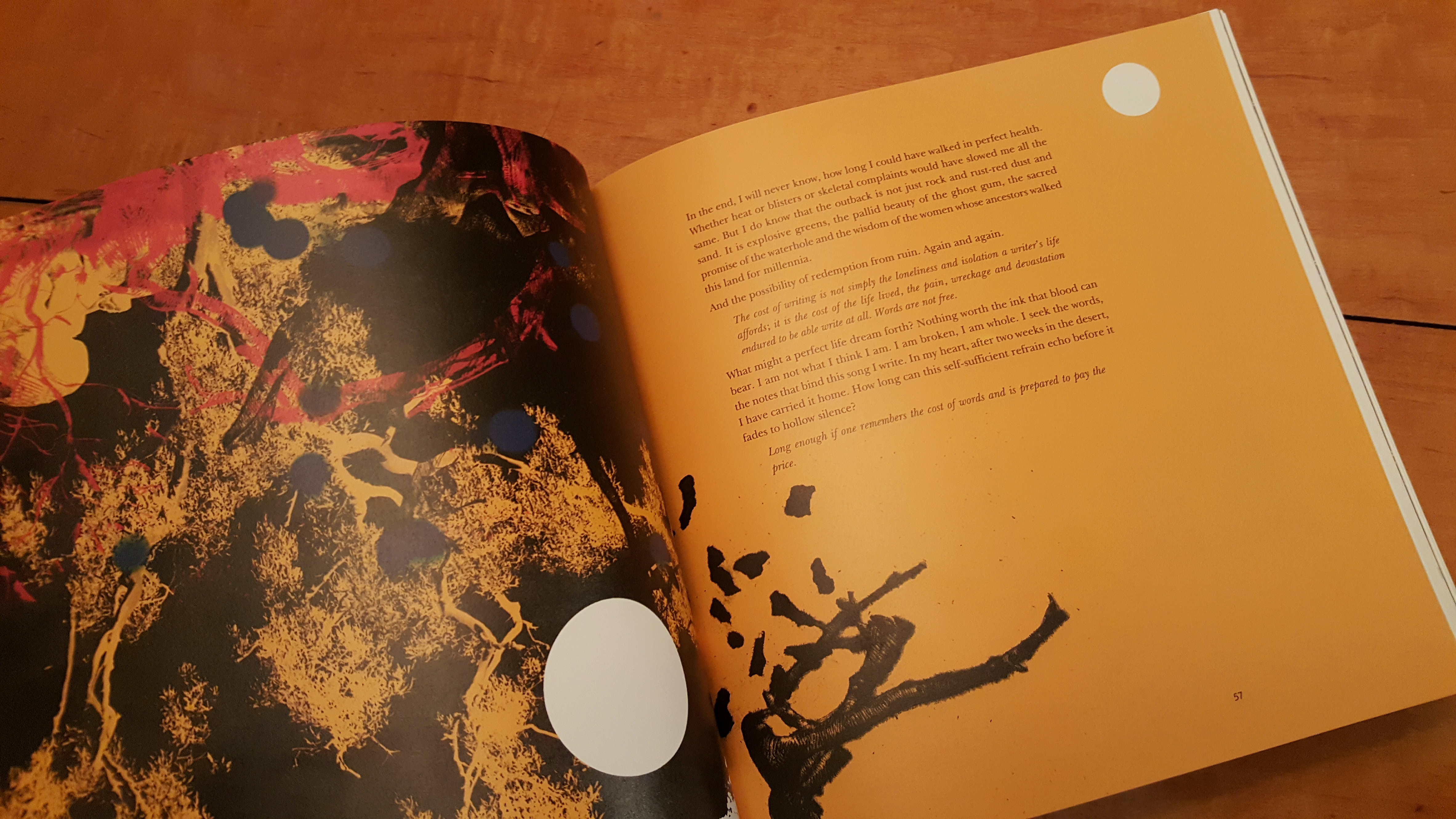
My brief prose poem/essay, “The Cost of Words,” was written upon my return from the trip I made to central Australia in May of this year, to participate in a charity walk on the Larapinta Trail west of Alice Springs.  Thank you, as ever, to Naveen Kishore and the entire team at Seagull Books for this beautiful creation and for once again inviting me to take part.

THE COST OF WORDS

It starts, not with a shout, but with a whisper, a tightening at the back of the throat.

 Sadness was an opened door, an invitation, across the globe, to an ancient place where, for a time, the world might stop swaying, where I could focus on the moment, freightless after years of pushing against this cage of flesh and bone. Traverse a vast terrain of sound and sand and stone. I arrived empty, expectant. In my head, I had fashioned a journey of healing, imagined an ordeal to open a conduit to choked and buried grief. I longed to release the words that had ceased to flow. Unleash emotions untold.

Nature defies a narrative directive; life sets its own course. Streams flood, rivers run dry. We are not what we think we are. We are whole, we are broken. Fragile and durable in turns.

 On my first day out, my head closed in, my voice grew strained and raw. Over rockbound passages, rising ridges, jagged ground, I began to fear that a different script was being dreamed for me. My challenge would be to submit. I fought it, pressing against weakness and illness and fatigue until one day I dropped from the trail into a circle of needles and stone.

The wisdom of the desert holds you humble. Reminds you when failure, not triumph, will unleash the tears you cannot cry. Water is precious. A gift not easily spared.

In the end, I will never know, how long I could have walked in perfect health. Whether heat or blisters or skeletal complaints would have slowed me all the same. But I do know that the outback is not just rock and rust-red dust and sand. It is explosive greens, the pallid beauty of the ghost gum, the sacred promise of the waterhole, and the wisdom of the women whose ancestors walked this land for millennia.

And the possibility of redemption from ruin. Again and again.

The cost of writing is not simply the loneliness and isolation a writer’s life affords; it is the cost of the life lived, the pain, wreckage, and devastation endured to be able write at all. Words are not free.

 What might a perfect life dream forth? Nothing worth the ink that blood can bear. I am not what I think I am. I am broken, I am whole. I seek the words, the notes that bind this song I write. In my heart, after two weeks in the desert, I have carried it home. How long can this self-sufficient refrain echo before it fades to hollow silence?

Long enough if one remembers the cost of words and is prepared to pay the price.

Reflections on the challenge of writing the self, and a link to my essay at RIC Journal

I was lonely child and adolescent. I lived in a rural area, outside a small, but growing, city. There were no children my age in my neighbourhood, and although I had two younger brothers, I spent countless hours alone. A misfit of sorts, I found comfort in the world of words, spending hours reading and writing stories and poems. It was a way of imagining myself elsewhere, fashioning a time or place that I might fit into. However, as I neared my late teens, I became increasingly aware of an inability to inhabit, in reality or in my imagination, the kind of person I wanted to be.

If I couldn’t find my own voice, how could I grant a voice to characters?

So I stopped writing, hopeful that with a little more experience, I would have more to draw from. Gather stories to build on. Live a little first.

But I had no idea how strange and complicated my life would become, so monstrous, too untidy to reduce to words. Ultimately I found my way out of one fiction—the one I was living trying to be the gendered person I was born—and constructed another fiction around myself so that I could exit with some semblance of an ordinary, coherent history.

And then, when my re-orchestrated life was blown apart a few years ago, I was determined that I could no longer afford to hide. Nor could I continue to put off writing. But by then, the only story I had to tell was not the stuff of fantasy or imagination. It was my own. Raw and simple.

For a while I clung to the idea that the only way I could talk about myself was to create a character to carry the weight, bare the secrets, share the pain I was not prepared to own. But every word I wrote circled right back to me. And sounded forced, hollow, and false.

It took me a while to come to a level of comfort with the idea of writing work that I still often refer to as memoirish. I consider everything I write—no matter what form it takes at the end—to be nonfiction because it originates from my experience. But if asked, I simply say I write essay/memoir. I write of the self. On the one hand, I am always afforded a subject. But on the other, it is the most dangerous, difficult, and draining form of writing to do well. Boundaries are critical. The challenge is to touch on the essential and temper the detail.

Because all of my work comes back, in the end, to a lifetime disconnect between body and identity that has shifted but never resolved, I tread a very fine line indeed.

Two days ago, my most recent personal essay was published at RIC Journal. It is a meditation on photography, the body, Barthes, and grief. I wrote it in January for a specific publication and panicked. It was too raw. I didn’t know if it was finished or meant to go further. The thought that it might be part of something larger terrified me. So I put it away.

A few months ago, with my renewed intention to work once again toward a larger memoir project, I pulled it out. With a little distance, I saw it as is complete if rather unclassifiable. Now it is out in the world, another step forward in the ongoing process of writing myself into being.

This piece had no title when I sent it to Saudamini Deo at RIC Journal. As it is presented the first line of the epigraph—my favourite quote from Barthes’ Mourning Diary—has become the title. And it feels perfect.

My essay, “I am either lacerated or ill at ease,” with my own original photographs, can be found here.

Update: Not much writing yet, but there’s always tomorrow. Right?

The calendar may say otherwise, but with the snow and sub-zero temperatures of the past week, autumn seems to be no more than a hazy memory. More than one month into my year of writing fearlessly, precious little Writing has taken place. But’s been a positive, inspiring time all the same.

My city’s annual readers’ festival, Wordfest, was held in mid-October and this year I volunteered as a driver for the first time. What a fantastic way to meet and engage with authors! Whether I was driving children’s authors out to school events, or picking a New Yorker columnist up from the airport, I thoroughly enjoyed the conversations that arose. The programming was impressive as well, including a strong representation of Indigenous writers. But my personal highlight, without question, was the magnificent M NourbeSe Philip. I had three opportunities to talk to this most remarkable woman—a Caribbean-born Canadian poet, writer, playwright, and former lawyer—at some depth. We talked about poetry, writing, and our adult children. She was generous and supportive, especially when I shared with her the nature of my writing about the body. And her performance of excerpts from her seminal, experimental poem Zong! was one of the most powerful readings I have ever attended.

Since the festival ended, I’ve been busy. I worked during our municipal election—an absolute nightmare—we are one of the last paper ballot hold outs, turnout was unexpectedly high, and by midnight during the third recount I found that I was completely incapable of counting to fifty! Add feline dental surgery, writing reviews, editing, and a public speaking engagement (on the intersection of faith and my queer identity, in case you’re curious, a rather uncertain junction to be fair), I have found it difficult to carve out a creative space of my own. But, it’s all good. I even had the opportunity, earlier this week, to attend a book launch for fellow Albertan and Twitter compadre, Steve Passey. To be honest, I went to heckle him, but he’d stacked the house with his friends and family so I decided to be polite. (Just kidding, of course, it was a great night—with wine and cupcakes, what more could you want!)

But, in the midst of all this, the most unexpected and welcome surprise came in the form of an invitation to join 3:AM Magazine as Criticism/Nonfiction Editor. There was a time when just publishing something at 3:AM seemed an impossible dream, and my first effort appeared after the most brutal editing experience—one that almost caused a me to have writerly crisis of faith. I had over-read and over-written a complex postmodern novel. However, I learned so much from the process of working it into shape and I was, in the end, very proud of the result. I firmly believe that being edited myself, editing for The Scofield, and the workshops and training I’ve taken along the way, have all helped make me a stronger writer. And it’s an excellent way to encounter great writers, engage with exciting writing, and help bring it to the attention of others. I look forward to being part of the 3:AM team, I expect it to be both rewarding and inspiring.

So now, to attend to writing. With winter making its presence felt early, it seems the ideal time to settle down and get to work.

Lost in time with Wolfgang Hilbig: Old Rendering Plant

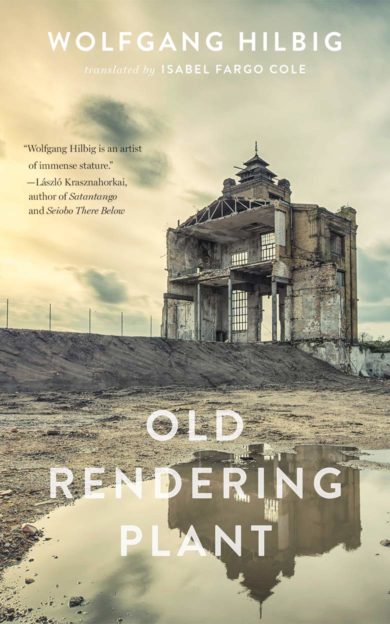
It is easy to become lost in the dense and convoluted narrative Wolfgang Hilbig unspools in Old Rendering Plant, the most recent translation of his work to reach English audiences. This slight novella invites the reader to wander, with the narrator, through the fields and along the pungent waterways that extend beyond his small East German town. As he rambles on, caught up in his memories of the past and hopes for the future, it’s easy to get swept up—and find oneself disoriented—amidst the industrial ruins where he is forced to confront the dark echoes of recent history and the expectations of the socialist state. It may be, especially for those unfamiliar with Hilbig’s idiosyncratic, stuttering prose, a little unsettling at first, but if one is willing to forego linear narrative expectations, an unforgettable, immersive, atmospheric reading experience awaits.

I read this book last summer to write a review for The Quarterly Conversation. In fact, I probably read it three times over to be able to read and articulate an opening into the narrative, but every time my appreciation of this moody, filmic text increased. As a critic, I derive the most satisfaction from writing about complex, unconventional narratives. My goal is not to give a definitive reading, but to explore the possibilities and questions offered by a piece of literature, while leaving a reader to find his or her own answers (or further questions, as the case may be). It was a sheer joy to write about this book.

My review from the Fall 2017 Issue of The Quarterly Conversation is reproduced below:

Old Rendering Plant by Wolfgang Hilbig (Two Lines Press)

Long after he escaped East Germany to settle in the West, where he continued to reside until his death in 2007, Wolfgang Hilbig remained bound to the darkened landscapes of the GDR. He was not one to downplay the bleak and oppressive qualities of life amid the abandoned mines and crumbling factories of his hometown, Meuselwitz, and his dense, swirling prose evokes a world of strange, suffocating beauty. But his emotional attachment to his birthplace and his complicated misgivings about the benefits of reunification, left him forever torn between East and West—a conflict captured clearly in the stories that comprise the second part of the collection The Sleep of the Righteous. By contrast, Old Rendering Plant, the latest Hilbig offering to be released in English, presents a narrative firmly planted in the GDR that does not travel far beyond the immediate environs of the narrator’s home; yet this tightly defined arena affords the perfect space for a multi-layered exploration of one man’s struggle to define himself against the restrictions and expectations imposed by family, class, history, and circumstance.

Wolfgang Hilbig was born in 1941 in Meuselwitz, near Leipzig. His father disappeared at Stalingrad, so he was raised by his mother and grandparents. His illiterate Polish-born grandfather served as an important father figure, encouraging his aptitude for sports. However, as translator Isabel Fargo Cole notes in her afterword to the novel I, his early obsession with reading and writing soon alienated him from his own family. The works of Poe and the German Romantics held a particular appeal for the budding poet. Following his military service he spent years working in local factories, where, at least on the surface, he epitomized the ideal of the worker-writer that the GDR actively encouraged. Yet, unwilling to follow accepted scripts, Hilbig’s writing was seen as too challenging and obscure, and it soon drew the unwelcome attention of the authorities. Ultimately the desire to write would win out, but the tension between duty to work and to literature became a central theme that he returned to again and again.

In Old Rendering Plant, an extended monologue that slips in and out of passages of pure stream of consciousness, this tension is implicit. Originally published as Alte Abdeckerei in 1991, this novella is a meditation on the formation of identity in an environment that contains a complex network of buried secrets. The narrator is looking back from a vague and indeterminate adult perspective at that point of transition from adolescence to maturity. His is a restless narrative; memories and waters sweep by as he traces and retraces a path along a brook that, bordered by stands of willows, carves a channel through the fields on the outskirts of his hometown. As a child he found refuge in this landscape filled with magic, possibility, and adventure, armed with a wooden sabre and an imaginary foe. It was a place to feel safe and protected.

One of his favorite playgrounds was, against all adult admonishments, found in the fragmented ruins of a coal plant. Here he waged countless fanciful battles until one evening he slipped and fell off a concrete platform. He was fortunate to land in the grass, but later that night he remembered hearing people staggering across the platform above him, and he awoke to find on his right leg evidence of the substance that had caused his fall: “a dried mire, a black-green slurry mixed with blood.” This incident marks the beginning of a loss of innocence, the first intimations of the existence of dreadful truths that, as the narrator ages, begin to take on a greater, more complicated and disturbing significance. As the narrative unfolds, his reminisces and reflections trace his movement toward a reckoning. Gradually, as layers of memory are stripped away, he approaches an clearer understanding of the forces that have driven him. It’s not a comfortable space he finds.

The narrator is a solitary personality, both as a child and as a man, given to wandering the pathways on the edge of town during the hours that mark the transition from late afternoon light to early darkness. He speaks of his family without affection, referring to them as “my relatives.” He passes from childhood into manhood almost imperceptibly, when the adults in his life no longer show interest or concern about his habitual lateness, his tendency to come home after dark. There is only one mention of an anecdote involving a friend, someone he visits on a brief, aborted attempt to break free of the house and town in which he grew up—during that visit, an encounter with the bloated corpse of a dead rat, which he is not even entirely certain is not an illusion or dream, sends him hurrying home. It is perhaps the thought that the horror he hopes to escape is bound to his being, rather than his environment, that frightens him so.

Central to the narrative is a rendering facility hidden among the ruins of the former coal plant. The narrator’s fall from the cement platform was his first direct indication that something nefarious existed there, but he had always been aware of the signs of its presence:

As a child I knew it was the smell of the milk-colored current that washed down the brook, bubbling and steaming like warm soapsuds in the evening. I knew that the smell soaked the banks and seeped under the fields; the mist over the river channel was this smell, and the mist that rose from the topsoil too, infecting everything that grew in the fields, and it rose from the meadows, the grass of the paddocks smelled of the river mist’s cloying essence, the bushes on the banks thrived amid this smell, a smell of flesh . . . old, useless flesh relinquished to the waters, washed its smell through the land to the east, I knew this as a child. Tallow sheathed the snarls of grass on the brook’s edge, ancient fat clung indelibly to the slopes of the embankment; it was a brew of rancid fatback, even covering the paths, boiled-out horns, bones cooked to the point of disintegration . . . the old river-willows luxuriated in this nourishment; countless bluebottles, ill from overfeeding, dripping like glossy shapes made of wax, skimmed sluggishly through the foam, and this shimmering foam, rapidly turning black spun lazily on the water by the willow’s dangling roots.

At a later point—he is at a loss to even specify exactly when, the experience was so intense that it remains trapped in a level of reality between dream and waking—he happened to witness cadavers and sick, terrified animals being unloaded at the site. This plant, nestled among the ruins, was named Germania II after the mine that had once supplied the old coal factory, and it becomes, for the narrator, the source of such complicated questions and emotions that he finds himself unable to pass beyond the bridge and railroad embankment he encounters on his regular sojourns. The smells, memories, and anxieties that arise at this location routinely force him to turn and wearily head for home.

The rendering plant was rumored to employ society’s discarded men. At a time when radio reports of missing persons, and rumors of dangerous foreigners hiding in abandoned buildings, were commonplace, the workers belonged to a stratum of mysterious characters, unnamed and unseen by the light of day. The particular autumn forays that form the pivotal thread of this monologue are motivated by the narrator’s concerns about what his own future holds. He is remembering his final year of school when, with graduation approaching, he has a critical decision to make. This is where his fanciful nature, his defiant poetic spirit, begins to stir as he briefly considers becoming a gardener, inspired by the end of Candide rather than by any fondness for the tilling the soil, and entertains an idyllic life as a miller. He seems oddly determined to disturb his family and his teachers, ultimately announcing his intention to work at Germania II. With a mix of horror and fascination he develops an obsession with the process of rendering carcasses to make soap, and attempts to seek out the elusive workmen. But there is something more complex at play.

This is, at its core, a search for identity and the expression of individuality. The question of where one is heading, is necessarily a question of where one has come from:

my strange interest in bad places was an unacknowledged, unclear interest in our origins . . . because I had not actually experienced the affronts that went with the soil we had sprung from.— On reflection, we were actually exiles. Of course, only in the indefinite way in which all our names were sheer hubris . . . all our names, titles, and nouns. So we were not exiles based on some neat solid idea, but exiles out of instability . . . out of ineptitude, ignorance, antisocial tendencies; we hadn’t been torn from our roots, we had lost our rights, we were in exile because we’d never had roots or rights; we’d never even sought to find them, perhaps we constantly sought the world’s most noxious regions in order to rest our rootlessness, like gray vegetation, feeding on the ground’s nutrients but giving nothing back, we settled in the desolate provinces that were the strongholds of evil, we settled between slag and scrap where we could run riot, rank and uncontested.

What, then, do those most reviled of workers say about him, and his people, who are similarly dispossessed? Is it a matter of degree that divides them? Is it destiny? As the narrator’s monologue continually circles back to this place of darkness and all of the memories that point in its direction, he rekindles the oppressive existential crisis that once drew him to fantasize about disappearing into its foul depths.

As the narrative progresses, Hilbig’s characteristic prose, which flows in fits and starts, like eddies in a stream, swirling, reversing, and moving on again, is hypnotic and disorienting. It is easy to get caught up in the beauty and rhythms of his language, momentarily losing one’s temporal bearings. As such, it is especially ideal for this type of lyrical reflective monologue. When, on occasion, he slides into passages incantatory stream of consciousness the effect is exhilarating. Translator Isabel Fargo Cole has a strong sensitivity and fondness for his idiosyncratic style that comes through in this, as in all of her Hilbig translations (including The Sleep of the Righteous and I).

Reading Hilbig, I often find myself stopping to reread a section before moving on. I revel in losing myself in his long, winding sentences and paragraphs that can stretch on for pages. This can, on the surface, draw allusions to Sebald, though, Hilbig’s prose is quite different in quality, and unlike a Sebaldian narrator, the protagonist of Old Rendering Plant, although he sets out again and again, finds it difficult to push beyond the boundaries his memories and fears have imposed. What is similar in the reading experience, however, is that both can stimulate a desire to distinguish points of departure—with Hilbig, to find those moments where reflections, memories, and memories of dreams diverge, reinforcing temporal dislocations.

The narrator’s troubled forays are rooted in his reluctance to bend to the fate that awaits him, choosing a practical apprenticeship and accepting the bonds of adulthood. He harbours a Romantic sensibility that can only find expression in defiance, in word if not in deed. This resistance continues until one evening when he wanders farther afield than intended. Disoriented, he attempts to make his way back to town, only to witness a dramatic event—an apocalyptic cataclysm resulting from the extensive economic hollowing of the land that tears a wound into the darkened recesses of the soul of his nation and ultimately frees one rootless exile whose lonely monologue culminates in a rousing Joycean climax.