Wrapping up another year in reading: Farewell to 2019 and a long decade

The end of a another year is upon us and, at the same time, another decade is also drawing to a close. Both have offered a mix of joy and pain. I have written enough about the personal challenges and the opportunities these past years have brought. Suffice to say I approached the 20-teens, so to speak, with confidence, prepared to face my fifties as a time of increased professional growth as I assumed day-to-day parenting would become less pressing. I could not have imagined what life would look like heading into the year during which I will turn sixty. I still have a troubled now-thirty-year-old child at home, my career imploded years ago, I have lost dear friends and family members, and today I look around the world to see fires raging, Arctic ice melting, right-wing Nationalist movements rising, and hatred and instability spreading, often in countries that have nuclear capabilities.

We are living in interesting times, as the Chinese curse goes.

Thankfully I still have books. And writing. And an international literary community — one that has expanded my horizons in ways I could never have anticipated.
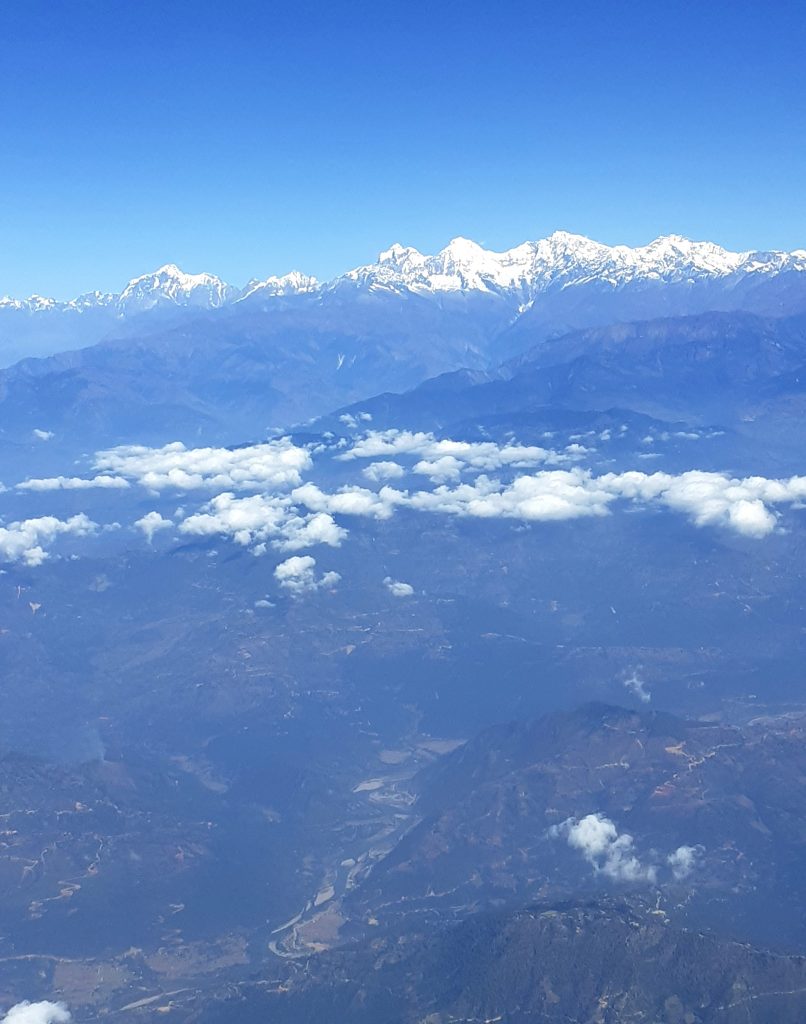
The Himalya on the horizon above Nepal.

As avid readers roll out their annual lists of favourite books of the year, I’ve noticed many efforts to celebrate a personal book (or books) of the decade. I couldn’t even begin to do that. It would be like trying to hit a moving target. My reading has changed a lot, especially since I started actively writing reviews and publishing my own work. Chances are it will change again. Reading, like most things, is dynamic. As it is, it’s hard enough to narrow down a selection of favourites at the end of the year. There are so many that get left out. However, even though I keep promising myself I will give up on the regular spectacle, come the end of December, I find it impossible to resist shining a light on some of the books I especially enjoyed (and to be honest, I always like to see what others have been up to as well).

Now that I have them together, I’m surprised to see that my top reads for 2019  were all published this year save one — I, Lalla: The Poems of Lal Ded. However, reading the poems of a 14th century Kashmiri mystic in the same month the Indian government revoked Article 370 triggering a crisis in Kashmir that is still ongoing made it disturbingly timely. As well, all are translations.
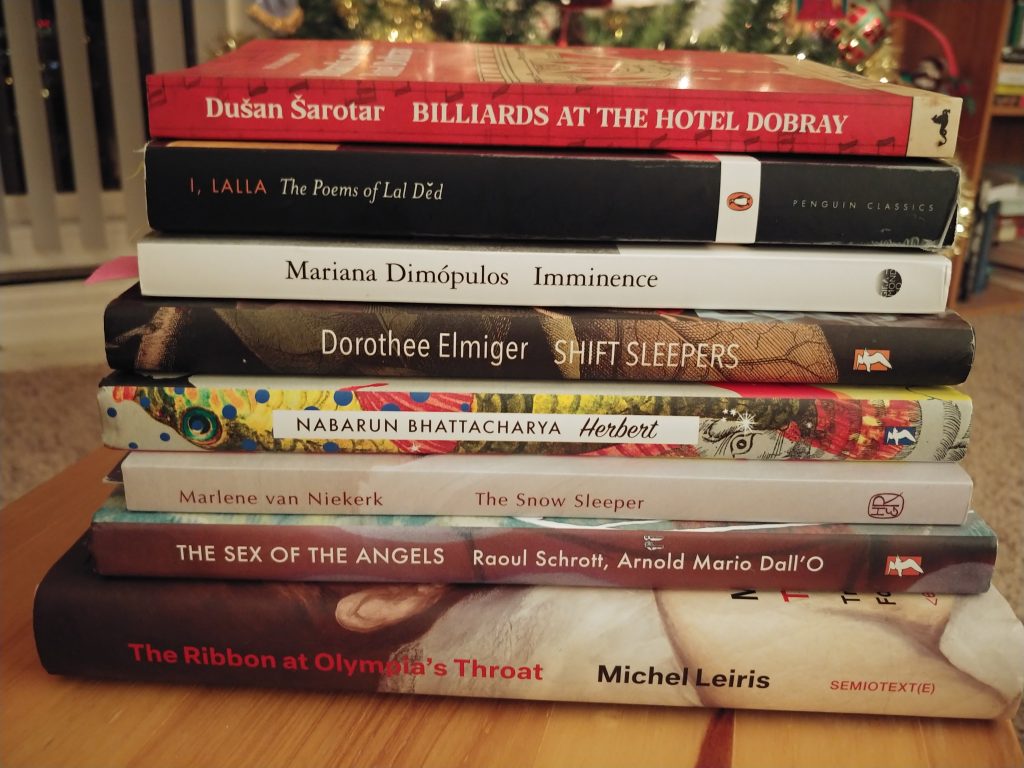
Absent from this photo because I do not own a hard copy is Wild Woman by Marina Šur Puhlovski, tr. by Christina Pribichevich-Zorić from Istros Books, a tale of an unhappy marriage with a wonderfully engaging narrator.

The balance of my selection, arranged for aesthetics not relative value, includes:

Billiards at the Hotel Dobray by Dušan Šarotar (Slovenia, tr. by Rawley Grau) an evocative, filmic Holocaust tale set in the north eastern region of Slovenia lying between the Mura River and the Hungarian border.
I, Lalla: The Poems of Lal Ded (Kashmir, tr. by Ranjit Hoskote). Not only is this book timely given the state of affairs in Kashmir, but because the body of work attributed to Lalla was likely created, in her name and honour, over the centuries by contributors reflecting a range of faith communities, ages, genders and backgrounds. Thus her example is critical at a time when forces are tearing at the threads of India’s diverse heritage.
Imminence by Mariana Dimópulos (Argentina, tr. Alice Whitmore) features a troubled difficult narrator who does not relate to others in a “normal” way — a challenge for author and reader, but I found much to recognize in her lack of social skills. Brilliantly realized.
Shift Sleepers by Dorothee Elmiger, (Swiss/German, tr. by Megan Ewing). Reading like a performance piece rather than a conventional narrative, this confident, complex, intelligent novel circling around the subject of borders and migration is one of the most original works I’ve encountered in a long time. Stunning.
Herbert by Naburan Bhattacharya (India/Bengali, tr. Sunandini Banjerjee). A new translation of this Bengali cult classic was also published as Harbart in North America. Both that edition and the Calcutta-based Seagull Books edit are boisterous and fun, but as an editor I was surprised to see how much was smoothed out of the former.
Snow Sleeper by Marlene van Niekerk (South Africa/Afrikaans, tr. Marius Swart) this wonderful collection of interconnected stories by the inimitable Marlene van Niekerk, one of my favourite authors, is an example of how an English translation can maintain elements of Afrikaans and Dutch without alienating readers — if you trust your audience. These are stories about the magic of language, where the magic is allowed to shine through.
The Sex of the Angels, The Saints in Their Heavens by Raoul Schrott (Austria/German, tr. by Karen Leeder). Undefinable, indescribably beautiful, this text — best described as a prose poem paired with haunting illustrations by Italian artist Arnold Mario Dall’O — is etheral, heavenly and bound to the earth all at once.
Ribbon at Olympia’s Throat by Michel Leiris (France, tr. by Christine Pichini). As soon as I learned of the release of this text, the last major work by one of my literary heroes, I knew I had to have it and write about it.  A moving exploration of art, writing and aging by one of the most important French intellectuals of the twentieth century.
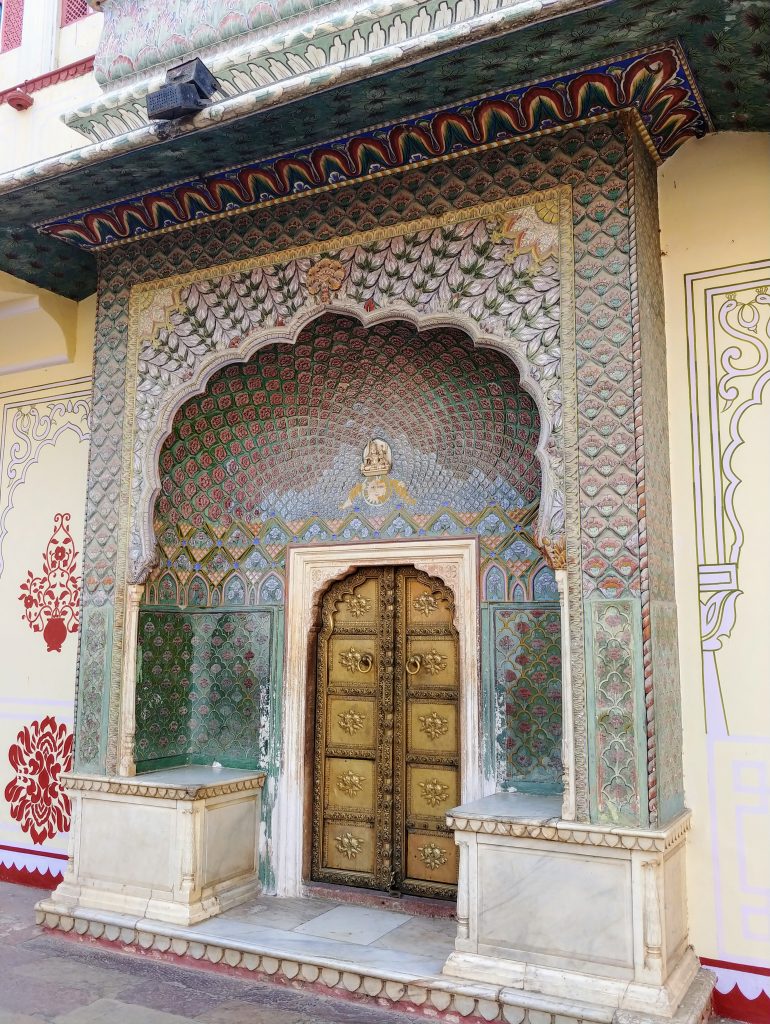
At the City Palace, Jaipur

This year I made two trips to India, both over a month long. Presently I am watching tensions rise there with concern, aware that I am an outsider, but it is impossible to ignore hateful rhetoric no matter where it arises. None of our countries or communities are immune from divisive discontent or politicians prepared to capitalize on it. And yet I still think about going back, about the places I have yet to visit, people I want to meet up with or see again. The restless loneliness of being home settles in quickly and India has become important to me. But I suspect it will be a while. . .

As I look ahead to the coming year, my primary objective is to write. Seriously this time. I know I have said that before, but my writer’s block has eased. I now need discipline. My goal is to have a draft of a nonfiction manuscript of perhaps 100 pages complete before my birthday in October. All other writing, reading, and volunteer editing will have to fit around that goal.

And so I go. Into a new decade.
The music of silence: Billiards at the Hotel Dobray by Dušan Šarotar

Charged with a mournful, aching beauty, the opening passages of Slovenian writer Dušan Šarotar’s 2007 novel, Billiards at the Hotel Dobray, clearly set the tone for the story that will follow. The scene is one drenched with misty melancholy. It is late March, 1945. A grey, foggy sky hangs low over the landscape, and a sense of weary dread has settled over the residents of Sóbota, a quiet town, or varaš, nestled on the plains of an otherwise forgotten region of eastern Slovenia, lying between the Mura River and the Raba Valley. The area which had, until the implementation of the Final Solution almost exactly one year earlier, been home to the majority of Slovenia’s small Jewish population, is presently under Hungarian occupation. Now, with rumours that the Russians are advancing and the Germans retreating, no one is certain what to expect next; no one knows what the currents of history are carrying their way.

That night the story of good men and women could barely stand up to the devious wind dispassionately erasing the words on the faded monuments of the law. This mysterious force was stronger than the storms and deeper than the floods that were once talked about here. It came as a vague feeling, or a long, harrowing dream, which burrowed into people’s souls even before they fell asleep or drank themselves into a stupor.

Available in English for the first time in an attentive and sensitive translation by Rawley Grau who also translated Šarotar’s Sebaldian-styled  epic Panorama, this earlier novel is a tale of remembrance, told from a distinctly cinematic perspective, that of a timeless all-seeing eye hovering above the earth, capable of taking in good and evil alluded to in the brief prologue. Not unlike the lens of a camera.

The result is a simple, painfully human story that revolves around two key dates in 1944 and 1945. Touching on critical moments in the lives of a handful of characters — an Auschwitz survivor and former shopkeeper’s return in search of some semblance of home, a young girl’s first infatuation, the secret an aging prostitute has kept from the only other woman still left at the Hotel Dobray, the complicated emotions of the arrogant but ill-prepared leader of a sorry group of fatigued Hungarian soldiers awaiting certain defeat, and an ambitious and prosperous businessman’s unlikely twist of fate – it is a narrative that glances into hearts but never settles for long. The effect is a slowly simmering evocation of the impact of war on a community ground down, torn apart and ultimately upended by events orchestrated from afar. Inevitable because, in the end, we all know how this story ends, the sleepy varaš is ever altered, its Jewish population is all but decimated, and its national identity rewritten. However, unwinding the story as he does, employing careful repetition, connecting events and characters forward and back in time, and gradually revealing a little more with each passage, Šarotar creates an almost unbearable atmosphere of poetic tension.

Central to the story is Franz Schwartz whom we first meet on the road to Sóbota. It has been almost exactly a year since he and his fellow Jewish citizens had been rounded up and sent off, the men to work themselves to death in camps, the women and children to more immediate termination. He knows he will never see his wife and son again, but having escaped the camp he has no place on earth to return to than the town where he was once a proud and successful retailer.

The cold, gaseous sphere hung motionless over the town. The houses, the plane trees and poplars that lined the streets, the bell towers, the man – all were left without shadow. The sharp, blinding light had painfully imprinted an image of the morning on the consciousness of Franz Schwartz. In a succession of short exposures, one after the other as if he was blinking his eyes, the pages of a large photo album were being turned inside him. He stood in the middle of the intersection, entirely alone.

Images of all the familiar streets, buildings and structures return to him, but he carries neither joy nor despair at the prospect of being back. The town has changed and he knows he cannot risk being seen until he gets his bearings.

Meanwhile, Budapest has recently fallen and the Hungarian occupation is on borrowed time. The small military unit presently housed at the Hotel Dobray, under the incompetent command of József Sárdy, secretary of the Office of the Special Military Tribunal, is despondent and all but defeated. They await the advancing Red Army with apprehension. About the only townsperson holding out optimism for the future is Josip Benko, the owner of the local meat factory, former mayor and indefatigable entrepreneur.

As the story unwinds, evidence of a network of complex emotions, complicated loyalties and chronological connections begins to emerge. When the narrative eventually slips back to April of 1944, Franz’s family background and the heartbreaking magnitude of his loss is illuminated. Piece by piece a portrait of the slow motion tragedy that spread over this part of central Europe is brought to life. It is, at once, part of a much larger story and yet distinct and, to the author, inherently personal.

The power of this tale lies in the telling. The somber but lyrical narrative is allowed, when needed, to “creep along like a low-flowing river.” Words are chosen carefully, emotions are numbed, stifled sounds speak volumes. The strains of a song that can no longer be sung or performed permeates the memories of a number of the characters. The music of silence is a recurring motif.

The omniscient, distanced third person perspective of the all-seeing eye only serves to heighten the emotional intensity. Šarotar masterfully maintains this intensity, letting it reverberate like the a violin strung too tight, right through to the end, as all the threads and stories are wound together but ultimately left unresolved, hanging in the air. He ends his narrative with a timeless, unanswerable question. One that, as nationalism is making a resurgence, we would do well to attend to.

Billiards at the Hotel Dobray by Dušan Šarotar, translated by Rawley Grau, is published by Istros Books.

Solstice, solemn solstice

The sky has closed in around us today. It is warm, but the world feels wrung out and weary as the decade draws to a close. I am aware of an abiding sense of  quiet sorrow, Weltschmerz. This time of year is always difficult. Christmas has become a melancholic, meditative season for me. It has been this way since my parents passed away more than three years ago. I have learned to embrace a degree of aloneness as a time to recalibrate. But this year the “Joy to the World” spirit my religious upbringing taught me to embrace seems especially anachronistic. It seems there is so much hatred coursing through veins of this tired planet.

On a personal level, the passage from last December to this one has been marked by a little more mental instability than I’ve experienced in recent years. Twice I needed medication adjustments while in therapy I began to make some progress opening up channels into exploring grief and trauma. But progress is slow and subject to diversions and setbacks.

In an effort to cope with a variety of stresses at home I sought to escape. Run away, perhaps. To India. Twice. And now I’m back at home anxiously watching political unrest threaten to explode there; worried about my friends and a country I have grown to care about, and worried about the way hatred has been allowed to grow and spread so freely through democratic nations across the globe. Even my own country, still modest compared to its loud neighbour to the south, is not immune. Ignorance of history, distrust of science, and intolerance of difference are fueling fires that won’t be easily extinguished.

Tonight as I decorated my Christmas tree with the many angels my mother collected for as long as I can remember, I tried to call on her presence and only ended up missing her more. Were she here she would be as worried as I am. No, I’m afraid she would despair even more despite the fact she was a believer in a way I have never been able to be.

So, as winter settles in here in the northern hemisphere, all I can do—what I must do—is to try to hold to some faith (even if I am uncertain where it is rooted) that the lengthening days will hold a little promise that things will get better going forward. For all of us. Everywhere.

Travel, writing and poetry: A link to my new poem at RIC Journal

I have a new poem up today at RIC Journal.  I’ve called it “Indian Autumn Elegy.” For some reason, this most recent visit to India, my third in two years, has so far resisted my dedicated efforts to capture it in prose. At least not for this blog.  As I process my cumulative experiences, not simply in India but in the other countries I’ve spent time in over the past few years, South Africa and Australia, I am coming to understand that much of what I want to draw to the surface belongs to another, longer dedicated writing project. One that has long been a vague intention but is now beginning to fill empty pages.

In the meantime though, there are reflections and observations too restless to wait, and those seem to be slipping into poetic exercises.

Like this one.

The first sketches of this poem were composed last month, on the train between Delhi and Jaipur. It speaks to a recognition that something I have often told myself I was seeking through travel—a kind of validation I hoped I might find by losing myself in a crowd—is neither necessary nor possible.

“Indian Autumn Elegy” can be found here.

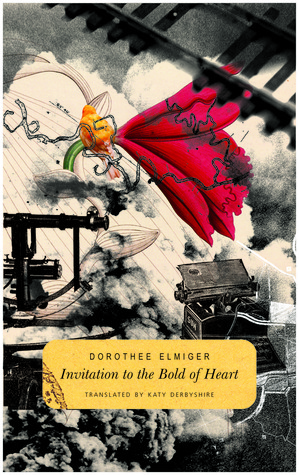
Searching for a future in a devastated landscape: Invitation to the Bold of Heart by Dorothee Ellmiger

There were no maps, no more accurate maps for the northern coal district. It was absent on all the plans, it was one large absence, so to speak, the course of the roads had long since slightly shifted, hills diminished, towns abolished.

Beneath the surface of a once prosperous coal mining district, flames from a fire in the tunnels has been smouldering for decades; above, the land has largely been laid to waste. Pit frames dot the horizon while in some places the land has caved in, sometimes taking livestock or an unfortunate human resident with it. Towns stand nearly abandoned, home to only the stubborn and the eccentric who have held fast. In one such community, two young women—daughters of the police commander and the last remaining youth—have never known anything but this desolate territory. It is their sole inheritance, all they have to look forward to. Their future is bleak, but they are determined to salvage some sense of optimism.

For Margarete and Fritzi, the protagonists of Swiss writer Dorothee  Elmiger’s award winning debut Invitation to the Bold of Heart, an old map indicating that a long-forgotten river once flowed through the region offers a spark of hope that drives a determined search for evidence that it still exists somewhere—even if it has temporarily disappeared below ground. If they can locate this elusive Buenaventura River, they believe they may be able to begin to make sense of a past, including their own family history, that no one wants to talk about and create a base from which they can start to look forward on their own terms. It’s an ambitious and enormous goal.

Bookish and studious by nature, Margarete is the official archivist. She devours the books she finds in the apartment above the police station where she and her sister live with their father. Natural history, science, and literature. On a Remington typewriter lifted from one of the policemen she types her account and makes notes of details that seem relevant. Facts about rivers and deserts, about mines and mining appear and reappear throughout. Moodier and more carefree, Fritzi makes little direct contribution to the narrative. She is the restless explorer. What she adds, however, through her reported observations is thoughtful and wise, such as this reflection on their surroundings:

For a long time, she said, I have been trying to comprehend the landscape here. She said, I look at the pit frames rising up to the sky, and I look at the railway lines running deeper and deeper into the ground because they’re sinking and sinking. I look at the sky, because the sky might also be symptomatic, the sky is also part of this landscape. I count, she said, I count the colours; my vocabulary is exhausted after brown, olive and black, and when I think about it those are all the colours that are here.

Of course, to affect a thorough search both girls have to head out, together or apart, on foot, by motorcycle or car, and eventually, in the company of a horse named Bataille that Fritizi finds and brings home. Meanwhile, the policemen who have little need to patrol, spend most of their time glued to the television set, hardly noticing the sisters’ comings and goings.

Characterized by a spare disjointed style, the novel most often resembles an attempt at record-keeping, a report for a future that is vague and uncertain, set in a surreally dystopic present that seems willfully disconnected from its own past, or simply exhausted by the weight of the space it occupies. The adults are either oddly apathetic or completely absent, like their mother who holds an almost mythological place in their imaginations. A female Hemingway-like character, she smoked cigarettes, cut her hair short, and one day simply drove off into the distance. Together they fantasize a series of daring adventures for her. On the other hand, they typically refer to their father as simply Heribert Stein or H. Stein, reflecting a relationship that seems cool, even antagonistic.

The fractured, loose-limbed narrative is, at one level, rather unsettling. It is, not unlike the sisters own place in the world—ungrounded, suspended somewhere in a geological timeline between oceans and deserts. They have facts and coordinates and maps, but no direct knowledge beyond the borders of the territory they’ve always lived in. One has the sense it has been intentionally cut off, guarded to keep outsiders at bay. This uncertainty which reflects the sisters’ own isolation is never resolved. A wealth of intertextual references woven freely into the text further offset the environment of the novel. It is a daring approach and, for the most part, very effective. Yet, in the innovative voice of Invitation to the Bold of Heart, one in which the narrative often appears to wander, ramble and repeat, pulling in facts drawn from a variety of interconnected sources, one can hear the qualities that Elmiger will develop and refine in her more mature and startlingly impressive second novel, Shift Sleepers. Without question, she is an author to watch closely.

Invitation to the Bold of Heart, by Dorthee Elmiger, is translated from the German by Katy Derbyshire and published by Seagull Books.