“. . . it doesn’t come easily, nor should it.” Own Sweet Time: A Diagnosis and Notes by Caroline Clark

. . . questions I’ll never get any further with the thing that I do. Auto fiction? Essay of the self. I need to do this in fits and starts. Straight to the desk after drop-off. I used to get up in the silence of 5 a.m., write, then go back to bed.

Major life events—the loss of a spouse or parent, serious injury, significant upheaval, illness—often inspire those already inclined to seek understanding through words to want to write about what they have experienced. Cancer, with all of the unknowns and the complex treatment options that come along with it, is a diagnosis as frightening as it is overwhelming. But how to tell the story? Writer and translator Caroline Clark’s Own Sweet Time: A Diagnosis and Notes breaks from the expected breast cancer memoir to offer a very different response to the reality of facing, and living with, the news no one wants to hear.

Her inventive approach to writing about her experience is one that is less about the entire journey, although we see many unvarnished moments, than it is about placing the diagnosis and treatment plans, and the heavily weighted silence that weighs over that first critical appointment with an oncologist against all the unspoken truths of the situation. With permission, Clark and her husband recorded this initial session which is reproduced verbatim, with all the attendant “um’s” and “mm-hm’s” on the right hand page throughout this small volume. On the facing page, individual words are picked up, prompting the author to respond with childhood memories, random thoughts, parenting challenges, and emotional reactions from the past and the post-treatment present. Scattered among these passages and fragments are questions about writing itself, especially in the face of such a life altering experience.

The diagnostic discussion is dense with information, the basics—drugs, treatment schedules, surgery, possible side effects—and, the most unnerving inquiries—what to tell the children, the probability of a full cure, the risk to her daughters in the future—those unknowns that fall somewhat outside the oncologist’s script, no matter how commonly they arise. The words that Clark picks up on are indicated with a faint ° that does not interfere with the reading of the transcript. Where those words take her is occasionally directly related to the context or phrasing of the source, but for the most part her notes have a free flow. They are also deeply personal.

Her notes touch on faith, the body, therapy. Some are passing observations. But two themes seem to take up more space on those open facing pages: memories that go back to an anxious childhood leading into an ongoing struggle with hair pulling (Trichotillomania), and reflections on parenting that lay open the stressful reality of going through such a physically and emotionally demanding process as the mother of two young girls:

. . . time I thumped my fist down hard with all my strength on the duvet next to her. It wasn’t the duvet but her stomach. She was winded. I was scared. Got her out of bed into mine. She tried to tell me it was okay. It wasn’t. Something had to change. Slowly after the cancer year, I realised it wasn’t her that needed changing, it was me. I needed to change. I needed to want to be there with her. How can you make yourself want something? You can’t. Your only hope is to find inner peace.

A disarming dissonance arises in the juxtaposition of the relatively ordered and clinical nature of the appointment against the myriad of thoughts those words trigger as Clark looks back on the most demanding and difficult time she has ever endured. What an oncologist can tell you about the journey will never begin to encompass the physical and mental challenges that lie ahead. For each individual the path is unique. But how to make sense of it all? Caroline Clark’s original, honest work is beautiful, heartbreaking and important.

. . . feel. That wide new space of truth-telling. Is this what writing is? Putting down the truth?

Own Sweet Time: A Diagnosis and Notes by Caroline Clark is published by CB Editions.

Taken, not taken: The Nail in the Tree – Essays on Art, Violence, and Childhood by Carol Ann Davis

I accepted this book as a review copy when it first came out, just over three years ago now. I put on the shelf with all the best intentions, and then forgot it. When I rediscovered it there, lost among assorted volumes of nonfiction, I felt ashamed by my negligence. Surely I could have read it earlier, if not when I first received it, at the very least during the trial of Alex Jones for the outrageous conspiracy theories that hurt so many people and ushered in a whole new form of denial, or a few months later when the tenth anniversary of the Sandy Hook school shooting was marked last December. But The US seems an endless supplier of senseless and tragic school shootings so it’s no surprise that, when I finally did take the time to read The Nail in the Tree: Essays on Art, Violence, and Childhood, I happened to finish it on the one year anniversary of Uvalde.
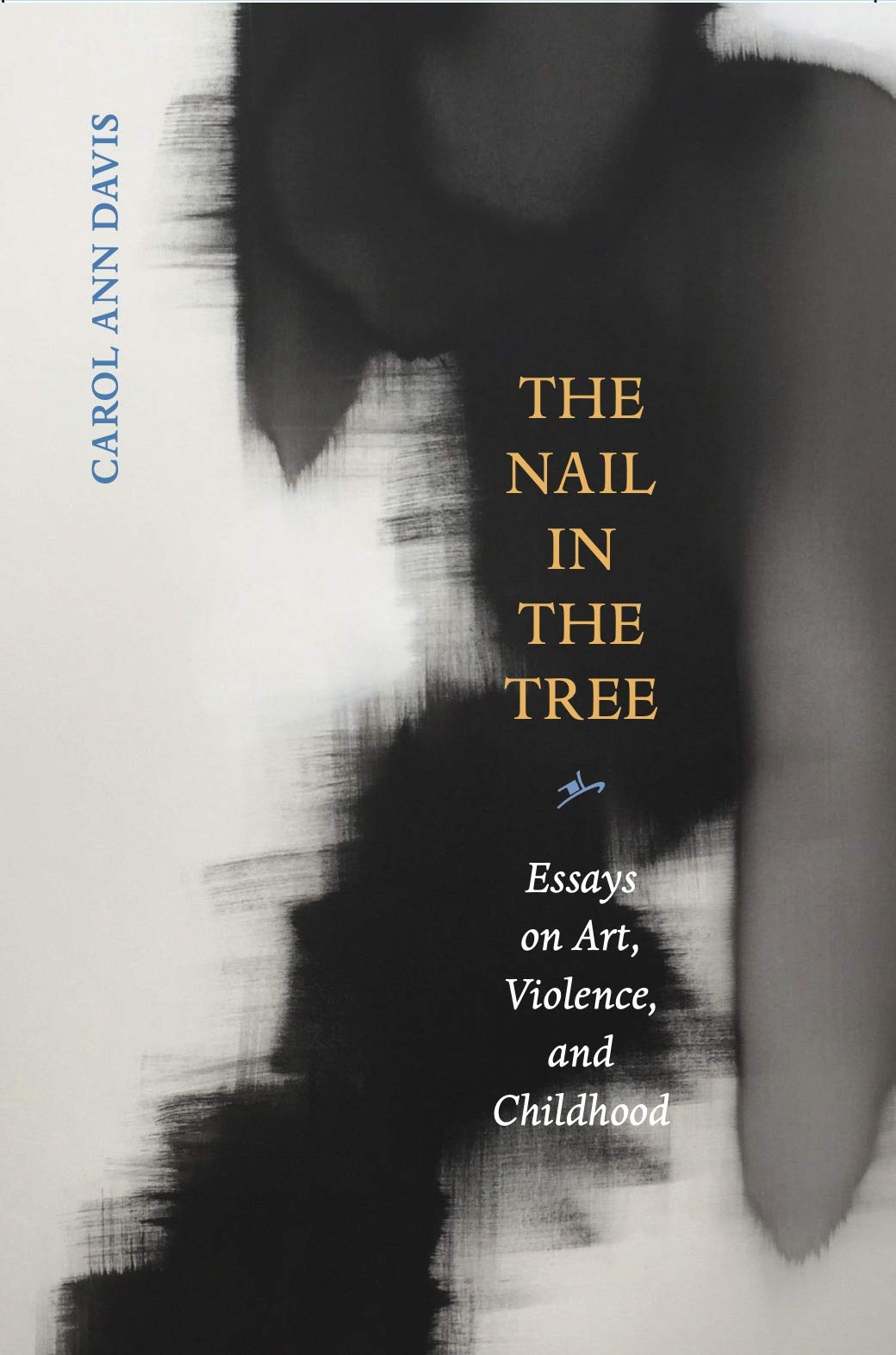
Poet and essayist Carol Ann Davis was newly relocated to Newtown, Connecticut, with her husband and two young sons when the Sandy Hook shooting occurred. They lived close to the site but, due to zoning, the boys attended another school. Willem was in fourth grade at the time, Luke in kindergarten. They were safe, but not untouched. “And this is what it is not to suffer that day,” she tells herself when recalling the shooting, “This is the not-suffering, happy ending story.” But, of course, it’s not that simple. The trauma sends lasting ripples throughout the community in way that leaves no one unaffected:

Sacerdos, from the French and earlier from Latin, literally meaning “offerer of sacrifices.” The children who live here, perhaps it’s strange to say, now glow. They do, they glow. No one can approach unmoved, and the children, understanding their role, shoulder, take on, burden themselves with us. Their skin nearly translucent, they walk around like that, glowing. They offer themselves like bits of mirror, and we accept.

The adults, by virtue of wider perspective, suddenly become acutely aware of the fragility of childhood. For those who still have to send their children back to school, trust them to the school bus each morning, there is the conflicted desire to both protect and prepare. Older siblings want to look out for their younger brothers and sisters. No one wants to trigger memories that may or may not even exist.

It is within the altered dynamic of the six years that follow the tragedy, that Davis endeavours to articulate and make sense of what it means to raise children in the aftermath of violence. In a series of essays that make their way slowly but not strictly chronologically away from the pivotal event, she turns to poetry and art to understand how artistic practice might be a productive way of integrating trauma into life moving forward—for herself and for her sons.

This is not a typical grief memoir, nor does it delve into the specifics of the shooting or the political fallout. The event itself rests as a horror too large to think about directly—it sits, unspoken, in all aspects of community life, especially at the bus stop, in the schools and on the playing field. Yet Davis seeks answers at her desk, beneath the hummingbird feeder, at art galleries and museums and, ultimately swimming in the open ocean, the one desperately longed-for release her newly adopted, landlocked hometown denies her. Along the way, among others, she turns to the work of Hélène Cixous and poet Miklós Radnóti and, for an extended period, she follows the lead of (and argues with) Rumi. She engages with the art of Eva Hesse to better understand the poetic process, and when, four years after the fact she has to fully explain to Luke, now that he is old enough to know, the extent of what happened at Sandy Hook, she draws on Paul Celan and Armenian born artist Arshile Gorky to help her untangle the enormity of her own grief.

Davis’s writing is poetic, pulling images, quotes and refrains through her essays, like threads to link or unravel her thoughts as needed. And she is an astute observer of art who is able to find in a number of artists, their techniques and philosophies about their practice, clues to appreciating how she is growing and, more importantly, how the boys are not only coping, but finding their own ways to thrive. More than once the boys are dragged through exhibitions, like one of Picasso’s sculptures in New York, or shown a show catalogue, like that of American abstract painter Agnes Martin. Davis hopes that Luke, who is a budding draftsman will find some connection in Martin’s geometrically precise but somewhat dissonant canvases (he does not). The message in the artist’s work and her method, however, is less for the child than his mother:

I’m suddenly afraid: I am not ready to admit to myself, as Martin has, that the purpose of art may be to unlock an inner happiness in the viewer. I am doubtful such a happiness is inherent, and unsure whether it is larger than forces with which I’ve engaged in my own work (such as grief and difficulty). I am uncertain I can place the function of art, art-making, its practice, in the category of making-happy, given all I’ve seen and felt in the last five years, all my children have endured in the service of gaining a working understanding of the world into which they’ve been thrown. Of course, any difficulty can be a subset of happiness, Martin’s work virtually shouts at me. Don’t be so narrow-minded.

Throughout these original, thoughtful essays, it becomes clear that the search for meaningful expression—even happiness—after trauma is Davis’s personal journey, one within which her children are her motivation and measure of progress, but not her exactly creative companions. One cannot grieve for anyone else as much a parent might wish shield their child from their own inevitable process. With luck and their parents’ support, Willem and Luke will hopefully have the resources to come, in time, to their own mature understandings of the event that they escaped only by chance. Sadly, with school shootings such a regular occurrence in the US, shadows of the horror that erupted at Sandy Hook on December 14, 2012 may be hard for any of the Newtown residents to fully move beyond.

The Nail in the Tree: Essays on Art, Violence, and Childhood by Carol Ann Davis is published by Tupelo Press.

The poet who learned to fly: The Butterfly Cemetery by Franca Mancinelli

In the years when written words were indecipherable signs, entrusted to a world that I couldn’t even reach on tiptoes, a book would be opened only for its illustrations or because my father’s voice was passing through it, over completely unknown roads, although his index finger seemed to trace them out, leaving short trails in which black letters, like objects in a magical night, came to life, silently spelling out in unison the same story which, open and ready to shift and change its pictures, my father was holding on his chest. It was his voice that brought the stories to us as we three were half-lying in the big bed where my little brother was staying up late, with his tiny ears that would soon close, containing a trail of sound and sense in the warm silence.

– from “The Enchantment of Death: Briar Rose”

If the first books read to us as children opened a world of strange symbols, hypnotic rhythms, and elliptical meanings, translations from foreign languages similarly open a doorway to landscapes and experiences at once distant and familiar. They introduce us to the images and words of writers we might not hear otherwise. Their stories. Their ideas. Their poetry.

The work of Italian poet Franca Mancinelli was first formally made available to English-speaking audiences through a small dual language collection of enigmatic, fragmentary prose poems, The Little Book of Passage, translated by John Taylor and published in 2018. These brief pieces which first appear to explore the vagaries of transit, packing, leaving, travel, soon begin to slide toward the examination of an existential space between internal and external reality—seeking form in that wordless, restless terrain of perception and experience. It was, and remains, a book that speaks to so much of my own sense of groundlessness. A collection containing Mancinelli’s two earlier volumes of poetry, At An Hour’s Sleep From Here: Poems (2007-2019), followed a year later. Once again her work is presented in a dual language format. Like her prose poems, her verses tend to be brief, spare, with an openness and space framing  unanswerable questions of identity, self and the insufficience of our connections with other beings.

Her newly released collection, The Butterfly Cemetery: Selected Prose (2008 – 2021), stands as an illuminating counterpoint and companion to Mancinelli’s poetic work. Her most important stories, personal essays and writings about the poetic spirit are gathered here, including several pieces which have not yet appeared in print in Italian, presented, as before in both languages, and completed with a comprehensive assessment of her work written by Taylor, her long-time translator. For someone who has read her poetry, this collection offers further insight into the creative heart and soul of the poet herself—and that is not to imply that she gives herself away, for Mancinelli is a poet who manages to address the intimate and the universal, by speaking from the essential boundaries of experience—because, in her prose, one can begin to feel how her poetic sensibilities were born and nurtured and share in her vision of where poetry comes from.

Of course, it is not necessary to be previously acquainted with her poetry to appreciate the stories and essays contained in The Butterfly Cemetery (although it may well inspire a reader to seek them out), because this work offers its own rich rewards. If Mancinelli’s poems tend to be very open and spare, in her prose there is a profound lyric intensity. Her writing breathes, deeply and slowly, as her images, ideas and reflections rise, disappear and surface again. The book opens with stories and essays that strike a personal note, evoking memories of childhood and early adulthood, some sentimental, some gently fictionalized, and others tinged with aching and longing. In many of these early pieces, one encounters a sensitive, wistful dreamer, as in the title story about a young child fascinated by butterflies who does not realize her desire to touch their wings will kill them, or the exquisitely simple “How the Fire Loves,” a fable of a little girl who escapes to the comfort of the fireplace after supper:

She had curled up alone on the sofa. The television was turned off, and she was watching the fire in the fireplace, shivering as if it were cold. The fire cannot be caressed by anyone. It is always a little distant from the others, in its own space, alongside newspapers and pieces of wood; they will be in its arms, until they become ashes. This is how the fire loves.

The second section moves further away from the childhood home and the confused pain of first love, to explore the self in relation to natural landscapes and urban environments. Mancinelli wanders, on foot, by ferry and by train, observing and meditating on the landscape and communities that have formed and influenced her. There is a branching out and a cycling back to the people and places of her homeland—the hills, fields, and the waters that have cradled her family for generations. The tension between the desire to leave, the pull to return and the attempt to delineate the fragile borders of a personal geography are recurring themes. One senses that the weight of existence in a land with such a long historical, artistic and intellectual legacy both grounds and troubles the questions of identity and belonging that emerge from the shadows cast by her words. She is ever aware, in her prose as in her poetry, of the importance of darkness as a fundamental source of growth and understanding.

And that brings us to the third and final section of The Butterfly Cemetery. Here, Mancinelli the writer turns her focus to the nature of her own personal, creative relationship with words, and, more specifically, with the existential origins of poetic expression. She writes about the absolute urgency with which she first turned to writing, beginning in adolescence, as a means of “speaking” that which she could not find a way to voice, isolated and alone on the edge of her circle of friends. Feeling she was yielding her words to others, she reclaimed them with her pen:

I wrote within myself, on my body so deeply that ever since, I have taken the road on which I now walk. If had brought that sentence to my mouth, today I would be another person. The part of my life that I have spent up to now would have been different. This is why for me, everything continues to be staked on words. With words I have an unsettled account. (“Yielding Words”)

She speaks about the process of writing poetry with honesty, from the tentative beginnings to the frustrated failures—the lines that will never take flight—in “A Line is a Lap and Other Notes on Poetry” and talks about being mistaken for a traffic policewoman as she stands on a street taking notes in the notebook she always has close at hand. But it is the vital connection to poetry as a “practice of daily salvation” that comes through in the most powerful of these essays. Mancinelli is attuned the essential quality of poetic language, tracing its existence to the moment before it comes into being. In the wonderful piece “Poetry, Mother Tongue” she suggest that writing is the act of trying to translate what is already written within us, of looking into the empty space between “the unknown and nothingness”:

I believe that poetry is a voice that passes through us. For this reason I always begin with a lowercase letter when I write. I’m not beginning anything. I’ve only caught something that I stammer into this broken language, which crumbles and breaks in silence.

Before the words there is a rhythm: a cadence that suddenly reaches us, in silence through a hollow space that we carry inside us.

There is a strong sense in Mancinelli’s view of poetics that writing itself is a dangerous act, one that calls us to face the dark and the difficult, one that takes us into our own “darkroom,” that place where we are most vulnerable. “Writing,” she tells us, “is a soul surgery that calls for a steady hand, and a deep place to which uncertainty and tremor can be convoked. It is an act of internal self-surgery.” And yet in the writing, there is a possibility of decentring and being set free. Poetry (and prose) that arises from within, although grounded in direct experience and observation, allows for space and a measure of abstractedness to guide writer, and reader, from the individual toward the universal.

But, to return, once more, to the ability of translation to open doors to those who lack the fluency to read a writer’s work in its original language, John Taylor’s collaboration with Franca Mancinelli, has brought one of the most compelling voices in contemporary Italian poetry to a wider audience. Unexpectedly that has also come to have a special resonance for me. Shortly after I read and reviewed The Little Book of Passage, I had the opportunity to meet and spend time with the poet in Kolkata when a visit I made happened to overlap with her poetry residency in the city. Her English far outpaced my non-existent Italian and although I felt no lack in our conversations, all of the subsequent interviews, poetry and prose that has become available in English has only deepened my appreciation and affection for her sensitivity and vision. Translation truly expands the world as we know it.

The Butterfly Cemetery by Franca Mancinelli is translated by John Taylor and published by Bitter Oleander Press.