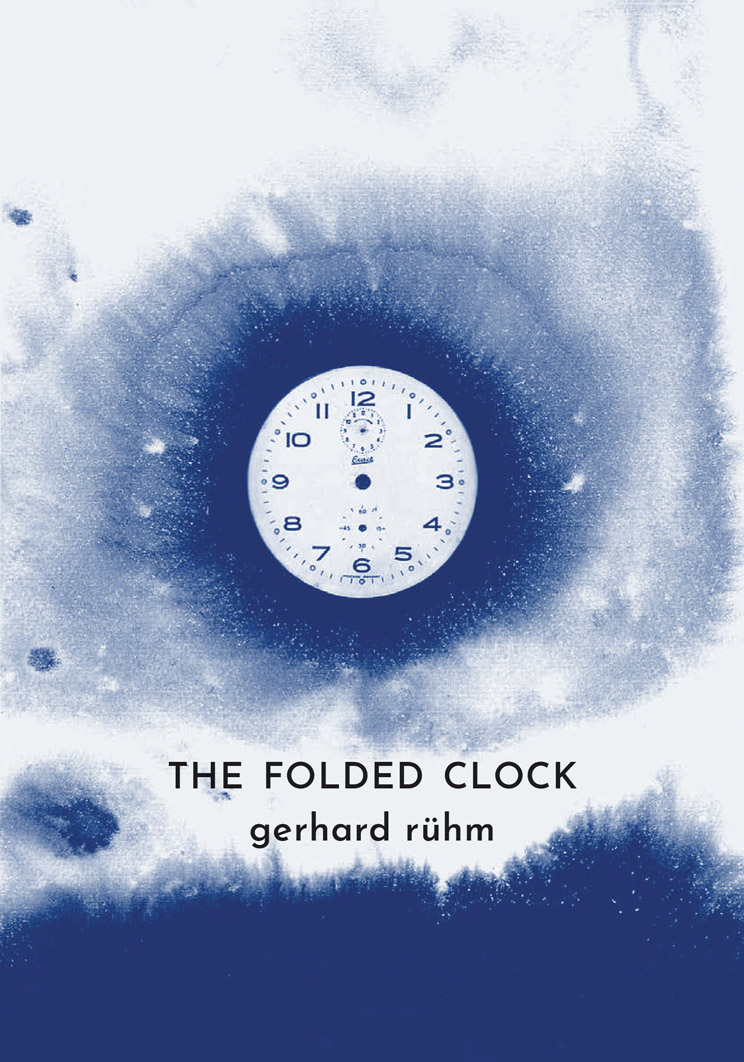
Counting, accounting and recounting: The Folded Clock by Gerhard Rühm

two!
one two  –
one two  –  three!
.        two
one two three  –   four
.       two

“a recounting,” the first number poem you encounter in Gerhard Rühm’s The Folded Clock, opens with a lengthy note explaining exactly how the piece should be recited—volume and intensity directed and measured—before erupting across the following five pages as numbers, spelled out, descend, rise, and repeat. Finding the flow and riding it (guided with a few more directives along the way) is not difficult, especially if you allow yourself to read aloud and, there are you are, from the very beginning, not simply reading but actively engaging with the poem.

And there are ninety-nine more, each one involving numerical elements in some shape or fashion. Some are sequential, others visual, still others are in verse form. Clever or funny or profound, it is amazing just how far numbers can take you.

Born in Vienna in 1930, Rühm, who recently celebrated his ninety-fifth birthday, is an author, composer and visual artist. His poems reflect all of these interests. He was an early practitioner of concrete poetry and an original member of the influential Wiener Gruppe. His interest in numbers as “the most pared-down and at the same time most universal element of design” goes back to the early 1950s. When he composed his first number poems in 1954 he was unaware of Dadaist Kurt Schwitters’ own explorations in this area, but he has continued to incorporate numerals and digits into his spoken and visual poetry, expanding the possibilities numbers offer. The Folded Clock, newly released from Twisted Spoon Press in Alexander Booth’s translation, gathers one hundred of these poems in a handsome volume.

Many of Rühm’s poems play with the rhythm and sound of numbers in various sequences and patterns. Others exploit visual qualities and double meanings that arise from the titles and the images or words they are paired with. And a sly humour surfaces throughout, as in “imperfect counting poem”:

one
two
three
four
five
six
seven
eight
nine
toes

one’s missing

Or “sixty-nine pairs of lovers” which depicts, inverted on their side, six rows of ten and one row of nine (sixty-nine) 69’s.

But, Rühm is also inclined to employ numbers and words to make thought provoking statements about the world. “time poem”—another piece that begins with a note on recitation—takes on cosmic dimensions starting with:

1 january, 12:am: bang!
2
3
4

And so on, counting down one calendar year, day by day, marking the significant events, from the Big Bang to the first moon landing. Given that fish don’t begin to swim in water until December 19, the final day of the year opens up, first by hours, then half hours, and by 11:30 pm, minutes, until the final minute opens up into seconds to allow human history from the first cave paintings to space exploration to fall int place. (You can read this poem online here.) Elsewhere he allows climate change, odd historical facts, and interesting news stories inspire poetic creations. Ruminations on living also fit well with the measurement of one’s personal relationship to time as in “sense of time”:

a week ago i was still a child
five days ago i  was an adult
four days ago was the time of the “vienna group”
three days ago i was living in berlin
for two days now i’ve been in cologne
everything since the turn of the millennium happened yesterday
since early this morning i haven’t aged at all

The variety of poems in this collection is wide and endlessly entertaining. They range in length from just a few numerals, to pieces that extend for several pages, to sketches and collages. Even if you fear you might be intimidated by avant-garde or experimental poetry (or poetry at all), this is a work that is not only intelligent and entertaining, but that contains many pieces that you could easily find yourself unable to resist reciting aloud.

The Folded Clock: 100 number poems by Gerhard Rühm is translated from the German by Alexander Booth and published by Twisted Spoon Press. (Excerpt and images can be seen at the publisher’s website.)

In this violent solitude: Light, Grass, and Letter in April by Inger Christensen

But do not grieve for me
do not grieve for your lonely
to and fro
My hour has rusted
My poem has left
your beaten track
Do not grieve My young poem
is more deeply kissed by life
Deathly it creeps
over under through me
Poetry is murdered hope.

(from “In the wild loneliness of the mountains” / Light)

Having read most of the poetry of Inger Christensen (1935-2009) that is available in English translation, to return now to her earliest published collections, Light (1962) and Grass (1963) is somewhat like experiencing the formative spirit of a writer who will soon make her mark as an original and experimental literary force. And yet, it is clear in these poems composed in her mid-twenties, that she is already exploring the themes and perspectives that will define her most ambitious—and most popular—poetic works. This is perhaps to be expected because only six years separate the publication of Grass from the release of her monumental 200-plus page book-length cosmic poem Det in 1969 (“It” in English translation, 2006).

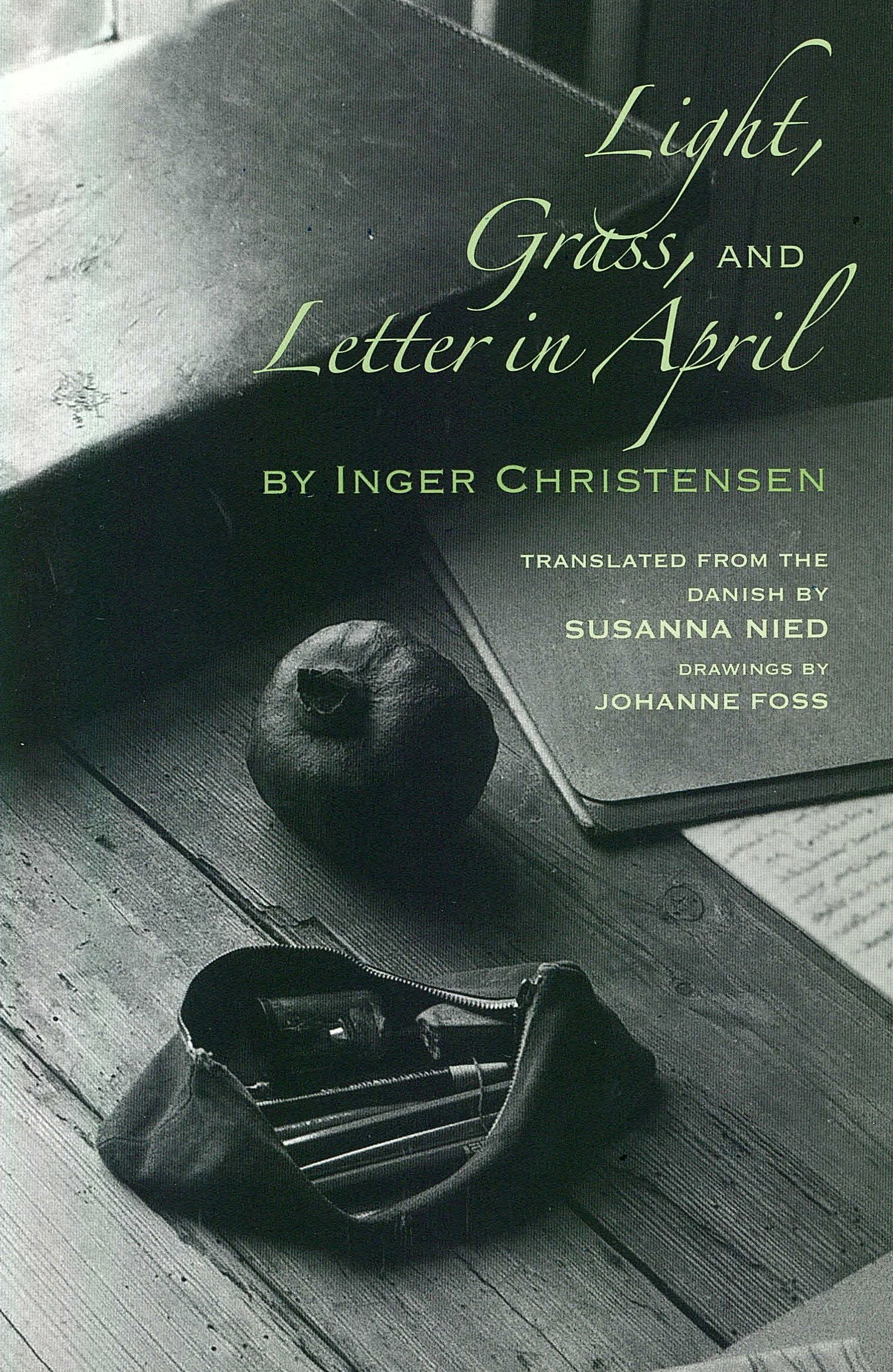
The present volume contains her first two collections, along with her fourth, A Letter in April (1979), a collaborative project that followed ten years after Det. Light and Grass being only one year apart, share much in common and reflect the time in which they were written. Yet as translator Susanna Nied (who has translated all of Christensen’s poetry and is thus well acquainted with her oeuvre) says regarding these two books:

Her lifelong themes are already evident: boundaries between self and other, between human beings and the world; our longing and struggle for direct connection beyond boundaries; the roles of language and writing as mediators of that connection; the distances between words and the phenomena that they stand for.

Images drawn from nature, domestic settings, and corporeal existence feature throughout these poems, with a strong sense of the landscape, the seasons, and the musicality of her homeland. Many of the pieces in both volumes tend to be shorter and lighter in form, though the not necessarily in content, but notably, the final poem in Grass, the sequence “Meeting,” is longer , closer to prose poetry, and seems to presage  sections that will later emerge in Det/It.

The unknown is the unknown and gold is gold I’ve heard, one
.      winter the birds froze fast to the ice without the strength
     to scream, that’s how little we can do for words with words
the books press close to one another and hold themselves up,
.      backs to the living room, our buttoned-up words huddle
.      on the shelf, the queue-culture of centuries, inexorably
.      built up word by word, for who doesn’t know that the
.      word creates order

(from “Meeting: V” / Grass)

The third work collected in this volume, Letter in April, seems quite different in tone, quieter and more intimately focused. It arose as the result of a collaboration with graphic artist Johanne Foss who began with a series charcoal-on-parchment drawings based on Etruscan artworks. Christensen and Foss had known each other for a number of years and both had spent time at an artists’ residence in Italy and explored Etruscan ruins. Taken by Foss’s drawings, Christensen chose some and began writing responses to her images. These responses began as prose pieces, but she ended up discarding them and beginning again in poetry. Their project developed over two years as they worked together during the summer months while their children played. Several themes emerge in this work including parenthood, wonder, nature, and the account of a woman who travels to a foreign country with a child inspired by a trip Christensen took to France with her young son as part of her writing process.

Unpacking our belongings,
some jewelry
a few playthings
paper,
the necessities
arranged within
the world
for a while.
And while you draw,
mapping out
whole continents
between the bed
and the table,
the labyrinth turns,
hanging suspended,
and the thread
that never leads out
is, for a moment,
outside.

(Section I,  º )

However, more than a series of poems and drawings, Letter in April follows a complex yet unassuming structure. Each of the seven sections contains five segments marked by a sequence of small circles in varying order. For example, Section I follows the pattern: º º º º º, º º º º, º, º º, º º º .  Section II begins with º º º , and likewise each section begins with the same marking as the final segment of the one preceding. These markings link poetic segments with shared motifs, allowing  the entire work to either be read straight through, or by following the each pattern individually (i.e. I º, II  º, III  º, IV  º, and so on).  This flexibility reflects Christensen’s musical and mathematical instincts,  which are also apparent in the arrangement of elements of Det/It, but will be given full reign in her wonderful numerically and alphabetically framed poem Alphabet (1981).

Light, Grass, and Letter in April is a rich compilation of poetry that offers insight into Christensen’s development as a poet from the mid-twentieth century inspired modernism of her earliest work, through to a collaboration (unique in her oeuvre) that incorporates visual and dynamic elements. It is essential for those who already know and love her poetry, but can also serve as an introduction for those who have yet to encounter her masterworks.

So here we sit
in this violent solitude,
where bulbs work
underground,
and we wait.
Around noon
when the mountain rain stops,
a bird stands
on a stone.
Around evening
when the heart stands empty,
a woman stands
in the road.

(from IV  º º º º º)

Light, Grass, and Letter in April by Inger Christensen, is translated from the Danish by Susanna Nied, with Drawings by Johanne Foss. It is published by New Directions.

That day was a little bit odd: The Minotaur’s Daughter: Selected Poems by Eva Luka

That day was a little bit odd. After walking down the street
      I stopped in a movement,
at one particular moment of growing older.
And I sensed it (the moment of growing older) like a scientist
     over a microscope:
the precise split-second border between the former and the
      future me.
In that borderline, tangible second, I was nothing; only an echo
of a former self and the germ of the future, the old me.

It lasted for only that one moment. Then the air rustled like
     golden hay
and into the street a horse came.

(from “A Horse Came Into Our Street”)

Odd is one way to describe the poetry of Slovakian poet Eva Luka—deliciously, devilishly, delightfully odd. Her poems open up strange, shimmering vistas filled with fantastic imagery. Born Eva Lukáčová  in Trnava, Slovakia, in 1965, she studied English and Japanese, first in Slovakia and later in Japan. She began publishing poetry under her given name, first in anthologies and then, in 1999, with her first collection Divosestra (Wildsister).  For her second book, Diabloň (Deviltree), published in 2005, she adopted her nom de plume, along with what would become her practice of selecting a poem from each collection to provide the title for the work to follow. In this way, her poems speak to one another within and across collections which also include Havranjel (Ravenangel, 2011) and Jazver (I-Beast, 2019).

With The Minotaur’s Daughter, translated by James Sutherland-Smith, a selection of poetry drawn from her work to date, is now available in English for the first time. In his Afterword, Sutherland-Smith suggests that Lukáčová  may be one of the last great poets of resistance in Europe, citing her:

resistance to conform artistically and [a] resilience against the potential psychological pressures resulting from the circumstances of her life and times. Eva’s resistance to conform to being categorized within a specific poetic movement—particularly those associated with a single gender—reflects the individual nature of her work, and this artistic independence even challenges gender identity in the personae that inhabit her poems.

A transgressive spirit illuminates her poetry, extending beyond matters of gender, to explore questions of personal freedom, sexuality, and desire within a phantasmagorical landscape featuring eccentric figures, mythical creatures, and fabulous flora and fauna. She creates, with her poems, haunting, often dark, scenes or vignettes that can be as intriguing as they are disarming.

Unlike many similar selections that draw from across a poet’s oeuvre, the fifty-nine poems that comprise The Minotaur’s Daughter are not presented chronologically, or divided according to the individual volumes they come from. Rather, the assortment seems to be loosely thematic, with many of the earlier poems coming from more recent collections, and some of the Japanese inspired work from her first book coming later. And, because she sometimes writes companion pieces that appear one or two volumes apart—for example, “Wildsister,” the title poem from her first book, is later answered with “Wildbrother” in her third—here they are presented together. The impact is more powerful this way. It is also evident that Luka appreciates the poetic storytelling potential of triptychs and series, something that may have developed over time, as Sutherland-Smith seems to think that her upcoming fifth collection may include even more.

One of the most developed sequences in this selection begins with an ekphrastic poem inspired by Leonora Carrington’s painting  Portrait of the Late Mrs Partridge. In this piece, the speaker is the artist commissioned to capture the likeness of the wild-haired woman in her odd partridge skirt. He then becomes famous, but is ever haunted by the painting. Four more “Late Mrs Partridge” poems follow, addressing her body, her death, her husband, and finally her wake. Mrs Partridge herself voices all but her husband’s lament from beyond this life, even returning to her own wake, still nursing an internal flame, to drink a toast with the bereaved:

A man sits at the top table, his face,
wrinkled from the tertiary era, with an incalculable expression.
The atmosphere is gloomy, but still audible
is a ubiquitous slurping, gurgling and belching,
as if the whispered stories haven’t had as much power
as unstoppable bodily hunger and thirst.

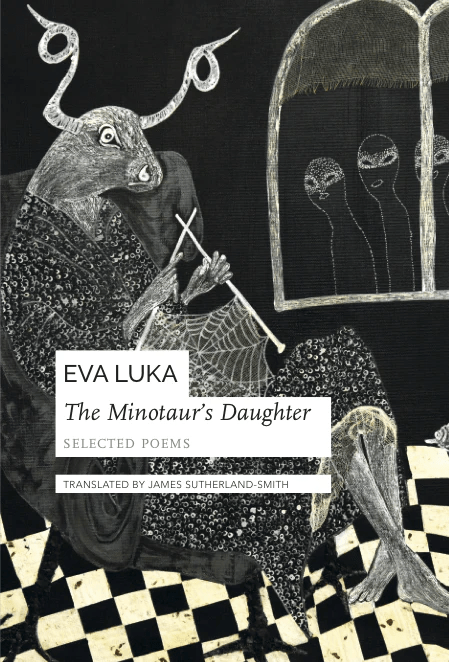
Leonora Carrington’s eerie, fantastic paintings appear again as the stimulus for five other poems in this translation (not to mention the poet’s own artwork which graces the cover). At times, Luka stands as an observer, as in “And Then They Saw the Minotaur’s Daughter”  where she watches  the “two well-behaved boys—somewhere between childhood and doubt” watching the noble horned woman-creature while spirit-like forms fill the room, Elsewhere she animates and engages directly with the scene, even imagining the central figure outside their fixed setting as in the Mrs Partridge quintet and  “Necromancer,”  a poem after the abstracted, surreal painting of the same name.

The images that dominate Luka’s poetry are drawn from nature—water, flowers, birds, reptiles, and animals—but, as with her human beings, the line between the real and the spiritual is fluid. They inhabit a shifting borderland and there is a pagan, pantheistic sensibility at play. Her animals inspire awe and fear, mythological figures speak, and a woman invites an angelic black bird (Ravenangel) into her bed in a dark sequence of desire, longing, and loss. Hers is a magical world, albeit one that accepts that mystery can be tinged with heaviness and pain. But it is not a relentlessly dark place; rather it exists in a kind of intermediate, and yet, ultimately familiar, space:

It’s incomprehensible, that border of yours
between the feverish night and the healing morning; as if you
      didn’t recognize
the differences between frenzied hyacinths and tamed hyenas.
      What you tell me
in the evening, no longer applies in the morning, and vice versa

(from “You and Me When the Cock Crows”)

One might describe the poetry of Eva Luka as akin to richly woven tapestries; the vignettes she crafts are vivid, often disturbing, but they tend to close with a note of promise, that is, with a measure of the resilience that characterizes her work. This quality is evident in The Minotaur’s Daughter. Her striking imagery is well captured in Sutherland-Smith’s translations, while his decision to break with the typical chronological ordering of a “selected poems” collection offers her first English language readers a deeply rewarding introduction to her singular poetic universe.

The Minotaur’s Daughter: Selected Poems by Eva Luka is translated from the Slovak by James Sutherland-Smith and published by Seagull Books.
The words / created their own states of being: “it” by Inger Christensen

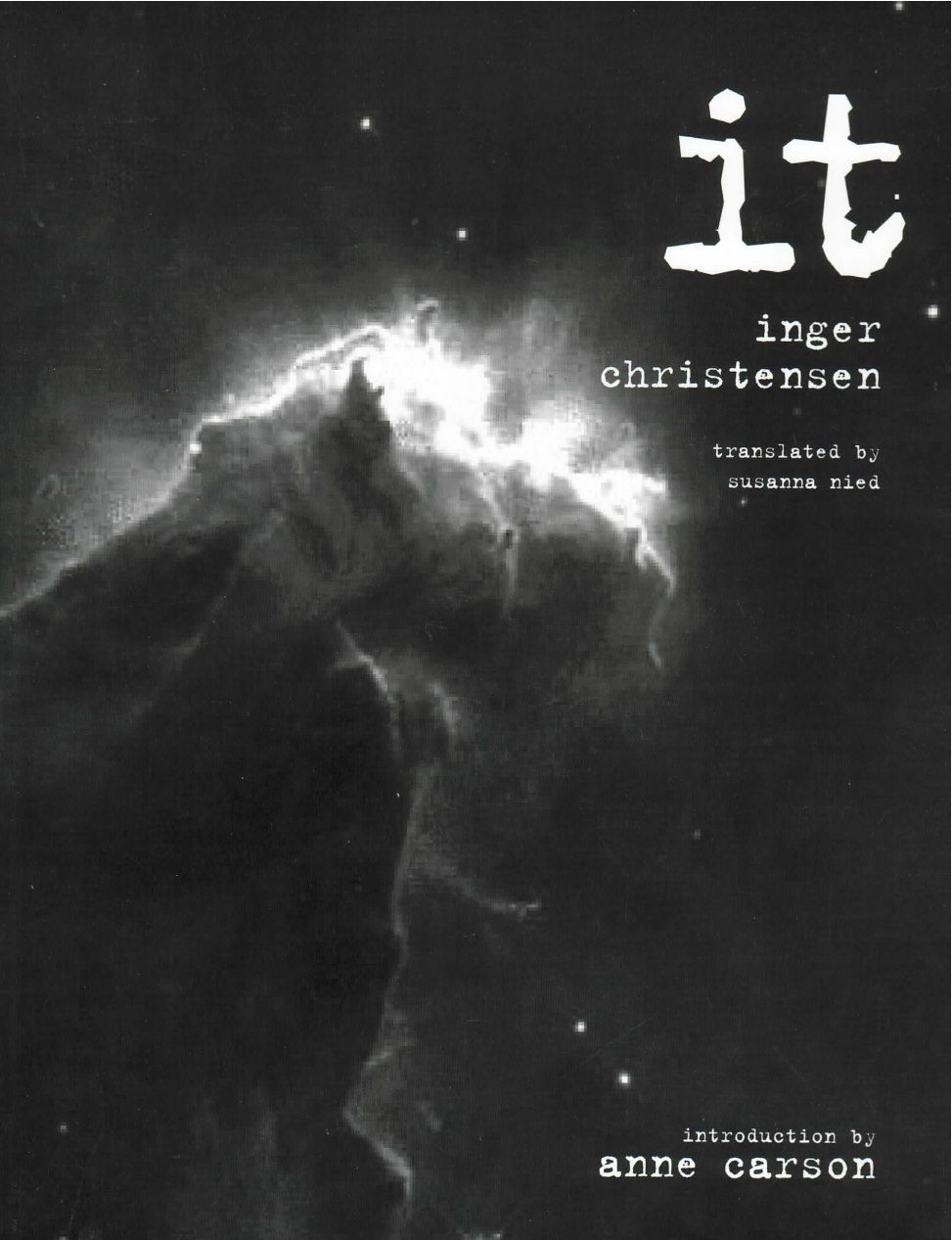
It may seem hard to imagine that a single poem (or sequence of poems) extending over 200 pages could become an instant hit upon publication, embraced by critics and the public alike, but that is exactly what happened when Danish poet Inger Christensen released what would become known as her masterwork, it, in 1969. What, you might wonder, does this simple pronoun, “it,” refer to. It might be simpler to ask what “it” does not refer to, for here it is simply the personal pronoun for the impersonal verb “to be”—as in “it is.” Danish, like English, necessitates such a construction, so this epic, moving as it does from the most basic elements, expanding in relation to one another, on into a world formed and named in its process of coming into being, and finally differentiated into individual, experiential existence, is a grand orchestral exploration of the nature of life. But it is also a piece that pulls you into to its rhythms, echoes and images. In Denmark it has become so iconic that sections have been set to music and certain lines from it have entered the daily lexicon.

In her introduction to the 2006 English translation by Susanna Nied, poet Anne Carson views Christensen as a contemporary counterpart of Greek epic poet Hesiod combining elements of his hymn of creation, Theogyny, and his moral guide, Works and Days: “Her det [it] is at once a hymn of praise to reality and a scathing comment on how we make reality what it is. The dazzled and the didactic interfuse in det.” However, the requirement for a personal pronoun for “to be” which does not exist the same way in Greek, means that her cosmogony is also a cosmology—a condition made explicit in the structure and realization of it. In a 1970 article, “In the Beginning was the Flesh” (quoted by Carson but since made available in its entirety in the essay collection The Condition of Secrecy), Christensen talks about some of the thinkers and artists, including linguist Noam Chomsky, whose ideas contributed to the genesis of what she a began to realize would be a creation poem:

Then I started thinking a little about this sentence: “In the beginning was the Word . . . and the Word was made flesh,” I thought, what if we could think the unthinkable: that flesh could speak, that one cell could signal to another, so that the whole inarticulate world suddenly partook in the following impossible (to human awareness) experience: In the beginning was the flesh, and the flesh was made words . . .

To maintain a hold on the duality of these two paradoxical conditions, she started to write as if she wasn’t there, “as if it (“I”) were just a bit of flesh talking, a bit of protoplasm, acted as if I were just following along, while a language, a world, took shape.” She called this part, the opening of her work, the time before consciousness, PROLOGOS. However, although it first emerges as a pre-sentence entity, the poems that comprise this section follow a strict mathematical formula. Each line consists of 66 characters (in the original Danish) and there is one 66 line poem, two 33-line poems, three 22-line poems, six 11-line poems, eleven 6-line poems and so on until the final set of sixty-six single-line poems. (The translation is unable to preserve the character count of each line, but does keep the number of lines.) Thus, PROLOGOS sets the cosmological grounding for the poem to follow, moving from the most fundamental elements—beginning, of course, with “It. That’s it. That started it. It is. Goes on. Moves. Beyond. Becomes.”—and moving through abstract form and function, slowly evolving over time. Cosmic. Geological. Natural. Communal. And, finally, individual.

It’s come around. Come to stand on its own, confront itself. To disengage from the mass and stand out. It’s engaged in an evolution, shifted its stance, attained eminently engaging expression. Has pursued itself and accidentally found itself. As a natural result. Has come to stand for itself. And can begin by itself. To experiment with sets of freestanding, free-floating expressions. Occasionally with straight-swimming ones. Dreaming. In another world. To imply itself.

(from PROLOGOS)

The main body of the poem, LOGOS, explores the word as creative principle, or, as Christensen puts it: “The place where things are consciously staged, put into action, into relationship.” It contains three sections, STAGE, ACTION, and TEXT which are each further divided into eight subsections of eight poems each (Christensen, as ever, loves mathematical and musical structure). The inspiration for the subsections came from a work titled Præpositioners teori (A Theory of Prepositions) by Viggo Brøndal, an attempt to classify the words languages use to show relationship. She selected:

eight terms that could stay in a state of flux and at the same time give order to the indistinctiveness that a state of flux necessarily must produce: symmetry, transitivity, continuity, connectivity, variability, extension, integrity, and universality.

And thus, the stage was set, so to speak.

It is perhaps not surprising that the poems that comprise the first section, STAGE, are more varied in structure and form than those we will see later, order comes with time. Words are at work: “The words / created their own states of being / made a world out of ‘world.’” (STAGE, symmetries, 7), but it not a smooth operation. Here the imagery moves between descriptions of natural processes, and the intentional creation of sets, painted and varnished to “represent” mountains and scenery. A tension exists between what is and the way it can be expressed:

And when it’s said that words fly
(like birds that fill an end-
lessly vanishing space)
it’s probably to conceal the fact
that words are not one
with the world they describe.
Words do not have wings.
And neither do they flower nor will
but they take potential flowers
and set them in a garden
which they then set
in an image of a garden
in an image, etc.
The words stay where they are
while the world vanishes
This is a criticism of the way language is used
Because it’s a criticism of the way things are.

(from STAGE, connectiveness, 1)

When “I” becomes part of the dynamic, the relationship between humans and language becomes more complex, and existential questions begin to arise. This first part also introduces a wide variety of images, motifs, and refrains that will recur throughout the work as a whole, providing a coherency to it when read and experienced (as it is meant to be) as a single long poem.

With ACTION and continuing on through TEXT, Christensen introduces more structure—employing both formal and experimental forms— to the poems within each subsection, adopting a consistent line count, verse pattern and rhyme, if relevant, for at least the majority of the eight poems (Susanna Nied’s award-winning translation preserves form and rhyme whenever possible), thus adding an ever-shifting musicality to the poetry. Thematically, the net she casts is wide, taking in the natural world (deserts, forests, gardens), human awareness (self-identity, hope, despair, sex, death), and community engagement (cities, hospitals, factories). Her vision encompasses the personal and the political, always returning to the power of language, the fundamental quality of the word, creating and mediating the world as we know it, alone and in relation to others:

A society can be so stone-hard
That it fuses into a block
A people can be so stone-hard
That life goes into shock

And the heart is all in shadow
And the heart has almost stopped
Till some begin to build
A city as soft as a body

(ACTION, symmetries, 8)

Throughout the ACTION section, one can see the influence of the 1960s on Christensen’s  worldview and some of the imagery she employs. Of course, the more political and economic currents change, the more they stay the same. Poetry is timeless and this vibrant, life-affirming epic aims to reach beyond the limits of time—as does language—and as such, the third part, TEXT, offers poems that begin to speak to passion and meaning in living and loving. The tone, if not strictly prescriptive, carries positive energies. There are no promises that things will be easy or pain-free, but it is worth trying, even in a world that contains darkness and corruption.

After the fourth morning I seek
the lips’ speechless expression

Again and again I stand completely
still so the wheel goes around and
there’s no cause for panic

What you gave my thought is no-
where, with a body that’s a
gift to the earth

What you gave me is pure rest / restlessness

My passion:  to go further

(TEXT, variabilities, 4)

By the close of this section, the “I”, the speaker, has come to an understanding of her interconnectedness with the world, and all that it contains.

Then, finally, comes the EPILOGOS. Beginning and ending with “That’s it” this piece works its way through the many shades and facets of fear we encounter as embodied beings, to slowly embrace words as the very cells of the body, and ultimately find freedom in letting go:

Erotic attempts
when the body
in its blind
sexual
activity
strives to be invisible
the cells are words
when the body
is lost
in it all
and lost
as it is
persists
survives
surpasses
itself
and its limits
the cells are words

(from EPILOGOS)

This is a work that, the deeper you get into it, benefits from longer, sustained reading sessions (especially if inclined, as I tend to be, to move slowly through a collection of poems). Although any one of the poems in this extended, structured sequence could stand on its own, they speak to one another, repeating and re-imagining phrases and imagery—a quality that tends to mark Christensen’s poetry and prose—so that the reading builds its own exhilarating momentum. it is an experience.

it by Inger Christensen is translated from the Danish by Susanna Nied with an Introduction by Anne Carson and published by New Directions.

Elegy on the wing: Butterfly Valley by Inger Christensen

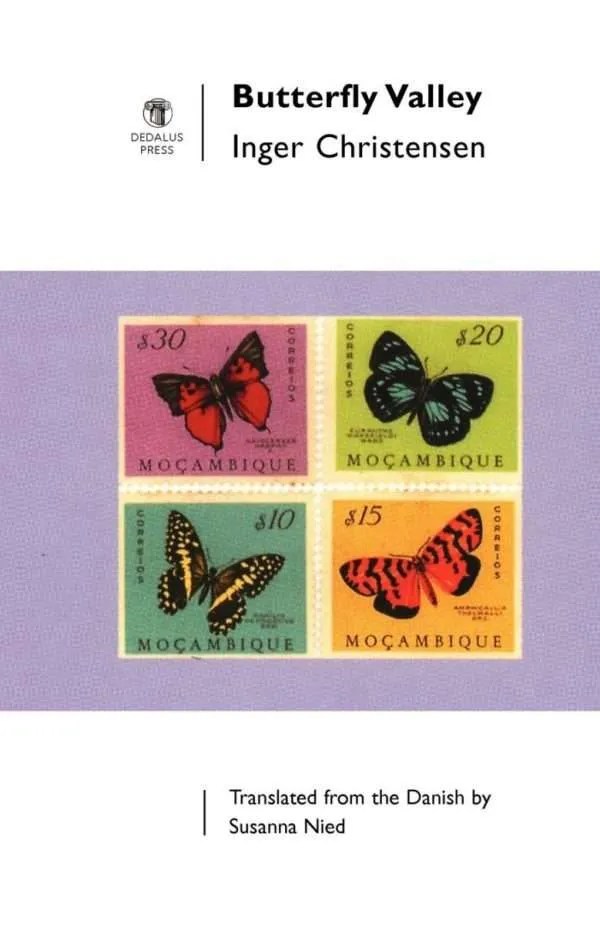
Since reading The Condition of Secrecy, a collection of essays by Danish poet and writer Inger Christensen (1935–2009) In January, I have set out to read one of her works each month until I run out of available volumes. This past month was largely absorbed by working for and worrying about the Canadian Federal election which has just passed, so my reading was scattered at best, and most suited to poetry and short fiction. I am squeezing this brief reflection on this single-poem volume, Butterfly Valley, as National Poetry Month draws to a close. Note that this is a dual-language edition, whereas the US edition from New Directions entitled Butterfly Valley: A Requiem contains this same translation by Susanna Nied, Christensen’s longtime poetry translator, along with three other medium-length poems, but does not include the original Danish. I intend to get that book eventually, however I would suggest that having the original and the translation face-to-face allows a reader to appreciate the complexity of Christensen’s achievement as it is possible to gain a sense of the musicality and rhyme structure present in the Danish, even though it would be unsatisfactory to attempt to reproduce that fully in the English.

“Butterfly Valley” is a fifteen part sequence of sonnets, the first fourteen linked by first and last lines which are then gathered form the final powerful poem. Christensen was a lover of form, structure, and imagery drawn from science and nature. Musicality was also very important. These qualities all come into play with this sequence which features the fourteen lines of the sonnet presented as two quatrains and two tercets with the rhyming pattern: ABAB CDCD EFE GFG (several follow ABBA CDDC in the first two stanzas). The poems are linked by repetition—through the first fourteen sonnets, the last line of each sonnet becomes the first line of the following one. VI, for example, closes with:

Here gooseberry and blackthorn bushes grow;
whichever words you eat, they make
your life butterfly-easy to recall.

Perhaps I will cocoon myself and stare
at the white Harlequin’s sleights of hand,
delusion for the universe’s fool.

And VII begins:

Delusion for the universe’s fool
is the belief that other worlds exist
that there are gods who bellow and roar
and call us random tosses of the dice

The fifteenth sonnet is composed of all of these repeated first/last lines, in order, with the typical rhyming pattern maintained. Each individual sonnet is thus crafted with an eye (and ear) to the finale.

Within this sequence, a host of colourful butterflies rise and fall through the Brajcino Valley’s noon-hot air. Christensen, who believes that poems are composed of words, first and foremost, employs butterfly-related imagery and the names and colours of different species, directly and metaphorically, along with a mythologically-tinged sensibility. But her themes are the very human, even existential, reflections on life and death, love and loss, art and nature.

When with their image-language, butterflies
can use dishonesty and so survive,
then why should I be any less wise,

if it will soothe my terror of the void
to characterise butterflies as souls
and summer visions of vanished dead. (X)

As ever, Inger Christensen’s poetry is an intricate and articulate celebration of language, meaning and life itself. This slender volume highlights these qualities well.

Butterfly Valley by Inger Christensen is translated by Susanna Nied and published in a bilingual edition by Dedalus Press.

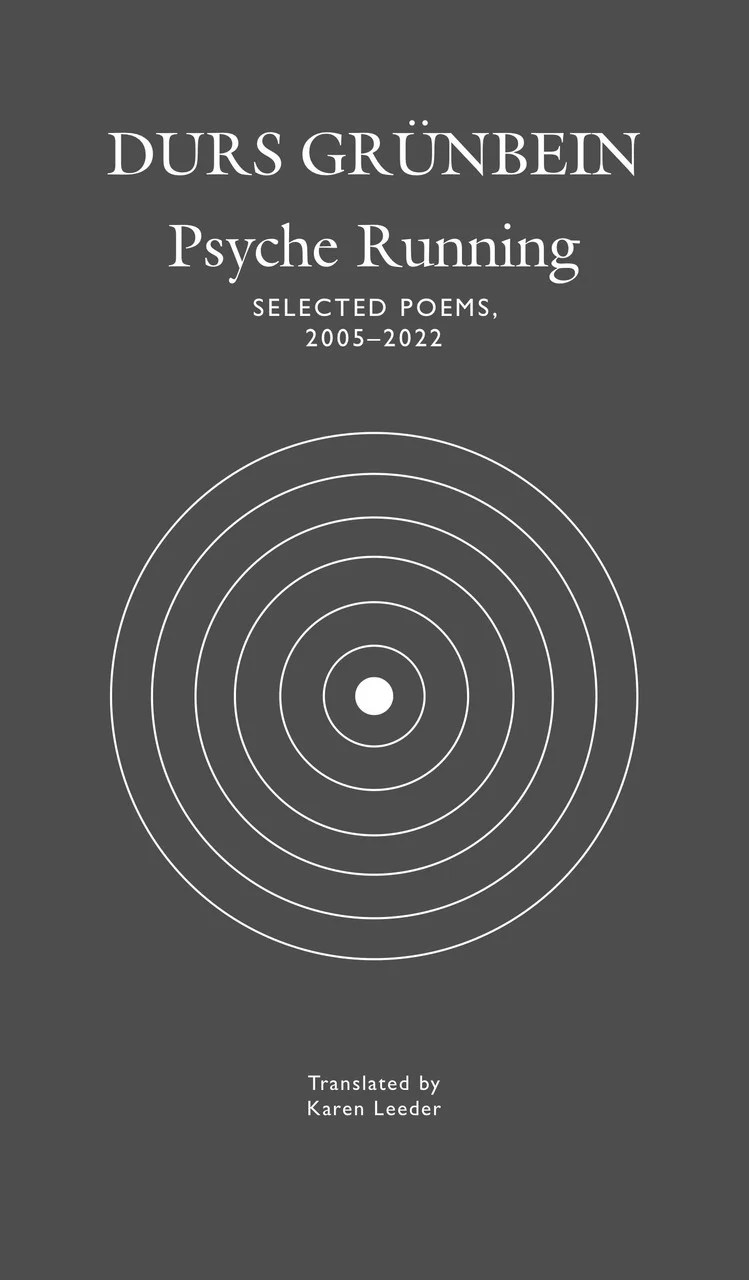
In that strange, that golden light: Psyche Running – Selected Poems, 2005–2022 by Durs Grünbein

And suddenly you saw it, far below
the coast road, after the twelfth curve,
stomach surging from the hair-pin drive.
En route for the south; so we sped on
perched above the drop, windows down.
Sorrento with its villas, its fan palms,
had been swallowed by the plug-hole
of the mirror in a great green swirl.
It hung in the haze, a hulk of bare rock.

The sea dead still. Not a trace of myth,
but for the yachts decked out in chrome
glinting in the sunlight. On a white hull
we made out ‘Nausicaa’ in faded letters.

Infectious energy, shifting, rising and falling. Durs Grünbein is a poet who writes as if regularly navigating the kind of winding roadway described here in “Island without Sirens” from his 2013 collection Colossus in the Mist. This poem, dedicated to Alexander Kluge, which begins with the promise of finding a site with rumoured Homeric association and ends with the view of an island not unlike a mass of barren lunar rock rising out of the water, is a clear reflection of what has made him one of the most important and successful contemporary German poets. Now his most recent release in English translation, Psyche Running: Selected Poems, 2005–2022, has just been shortlisted for the 2025 Griffin Poetry Prize (his second such honour for this prestigious award).

Born in Dresden in 1962, Grünbein moved to Berlin in his twenties to study theatre. Since the fall of the Wall, he has travelled widely and presently he lives in both Berlin and Rome. He has published more than 30 books of poetry, along with translations of classical and contemporary authors, essays, libretti, lectures, and collaborations with artists, composers and filmmakers. His prolific writings cover such a wide scope of literary form and history that he has, as translator Karen Leeder notes in her valuable Introduction, called himself an “unpoet.” Nonetheless, poetry remains central to his work, having won him widespread recognition and a number of major awards. The present collection offers an ample illustration of the breadth and appeal of his poetic vision.

The selections in Psyche Running represent nearly two decades of Grünbein’s output, drawn from ten volumes published beginning in his early forties through to the age sixty. As such, they trace the poet’s growth in mid-life and mid-career, his changes in tone, themes and exploration of form. This collection opens with work drawn from two books published in 2005. Both feature poetry inspired by history, though in very different contexts. Portraits of personalities and scenes from the ancient world figure in The Misanthrope on Capri while his focus turns closer to home with Porcelain: Poem on the Downfall of my City. The latter is a cycle of forty-nine numbered poems, a lament for Dresden, destroyed by Allied bombers in 1945. Yet, even in an elegy, Grünbein’s playful tendencies surface—something that was not necessarily received well by some readers:

Not a rowdy wedding-do. It was The Night of Broken Glass
or, what sharp-tongued folk called: the glazier’s lucky day.
And Ash Wednesday just a hop, skip and jump away.
Fools and Nazis—huzzah!—sure, they had a blast.
What’s that? Innocent? Disgrace came long ago.
Dresden shepherdesses, German bands, where are you now?

–  from “4”/ Porcelain

Twenty-four of the short poems from this sequence are included in this collection, but the complete work, with photographs and one additional poem, has been published as a separate volume, also translated by Karen Leeder and published by Seagull Books. My own review can be found here.
2007’s Verses for the Day After Tomorrow marks a turn to a more personal focus, exploring  themes of memory and human experience, then, after Grünbein began to spend more and more time in Italy, another shift occurs. With Aroma: A Roman Sketchbook (2010) and Colossus in the Mist (2013) classical elements appear, as do poems that draw direct inspiration from Rome and its environs. In a number of the pieces selected from these two works he demonstrates a wonderful sensitivity to the natural world, as in “Island without Sirens,” quoted above, and this magical evocation of a murmuration of starlings moving through the evening skies above Rome in “Aroma XLIX (Starling Swarms)”

How one envied them their nose dives, swooping down on
     gravel lanes,
or taking in Rome from a bird’s-eye view, conqueror style.
In fact, they only wanted a little urban updraft to be transformed
into currents and reflections, as their aureoles appeared
.     before
the rosé of the cloud-shading, in a sky painted by Turner.
It was a dance of veils, a stunt performed by thousands of
     points in synch:
something like the sound of bells, visible in silhouette above
    the domes.

The influence of  thinkers, ideas, and science on Grünbein’s poetic instincts takes centre stage in the next section, the first published translations from 2014’s Cyrano; or, Returning from the Moon. Each piece in this cycle of eighty-four poems, inspired by Cyrano de Bergerac, “takes its cue from a moon crater” Leeder tells us, “and pays homage to a thinker or philosopher known for their study of the moon.” The poems presented here were selected by the author and I, for one, would love to be able to read this inventive work in full. The mood changes once again with the next selection, the long poem “The Doctrine of Photography” from The Zoo Years: A Kaleidoscope (2015). Presented alongside postcards of prewar Dresden from Grünbein’s personal collection, this piece imagines into being scenes from daily life in the community as darker times close in:

Another spring. Imperial gardens on display:
for six months the magic of flowers
serves to ease the effects of the new
constraints, the new laws.
A hymn to existence, a scared hymn
to the beauty of nature around us,
the newspapers swoon in the
grandiose style of the times.
More powerful than any Olympiad,
closer to a feminine aesthetic sense,
like Hitler’s hands, eunuch-white.

A strong selection of poems have been chosen to represent the final two volumes collected in Psyche Running. Sparkplugs (2017) and Equidistance (published in 2022, marking the poet’s sixtieth birthday) build on imagery, sometimes dreamlike, drawn from science, nature, and everyday life to explore more introspective or existential themes that reflect an increasing awareness of aging and remembrance:

Do I know how many summers we have?
Whether we will recognize them as they were,
these  outdoor scenes, where we
slipped quietly past each other like angelfish
in that strange, that golden light?

I only know the day that keeps what
will happen next hidden behind glass.
Things grow more distant, swim up close,
in the film light. And the projector is me.

–  from “The Projector” / Sparkplugs

Altogether, this generous sampling of Grünbein’s poetic work over the better part of the last twenty years, fills in a long overlooked gap—Porcelain notwithstanding—in the availability of his poetry for an English language audience going back to Michael Hofman’s  2005 translation of a selection of poems from his first four collections, Ashes for Breakfast. Karen Leeder, who in addition to Porcelain also translated Grunbein’s Oxford lectures, For the Dying Calves (Seagull, 2022), has come to know the poet well over the years and has a deep affinity for his wry, vibrant spirit. Her informative Introduction and detailed notes provide an overview of the collection, her approach to this translation, and added detail, as required. Although he frequently draws on historical, philosophical, literary, and scientific sources, there is, in Grünbein’s perceptive, witty, and engaging verse, an irresistible quality that naturally invites a closer read. This volume, then, is not only an important addition to his available writing in English translation, but a wide ranging and vital introduction for anyone new to his work.

Psyche Running: Selected Poems, 2005–2022 by Durs Grünbein is translated from the German by Karen Leeder and published by Seagull Books.

To translate the human experience: Arabic, between Love and War edited by Yasmine Haj and Norah Alkharashi

We live in a world that is always in flux. Conflict, natural disasters, and political destabilization are continually reshaping our world and threatening our future on an intimate, community and global scale. An element of the universality of the human condition unites us in our response to these factors while privilege, culture, and history set us apart. To begin to understand where others have come from, what they have been through, their trials and their dreams, we must be able to speak to one another, learn to listen, and read their words. This is why translation matters.

The art of literary translation is often said to be both impossible and necessary. Impossible because no linguistic code is commensurable with any other—particularly so in the case of poetic language which, being among the most refined and expressive of literary forms, is expected to have myriad and complex nuances. Yet translation remains necessary. Without it there would be no conversation across linguistic and cultural barriers, no prospect of the mutual understanding that remains a prerequisite for the peaceful, emancipated life towards which we are all striving.

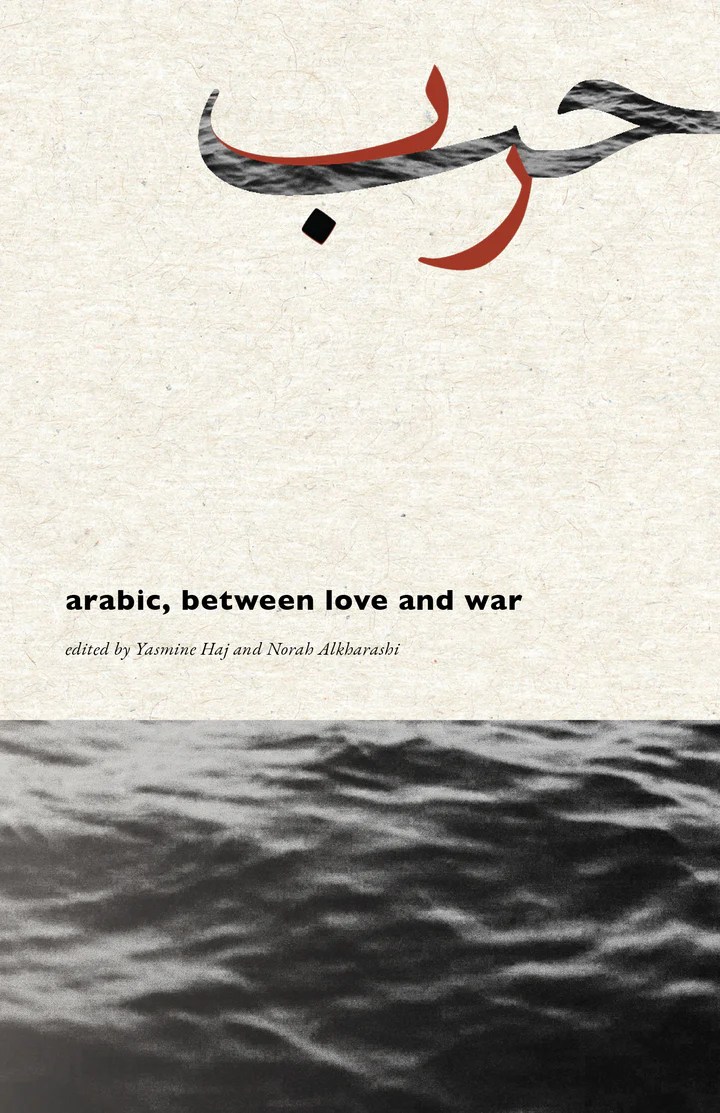
These are the words of translator and scholar Norah Alkharashi from her introduction to arabic, between love and war, a distinctive collection of poetry co-edited with Yasmine Haj and newly released by the independent Canadian publisher trace press. This anthology, which gathers the work of poets and translators from across the Arabic speaking world and its diaspora, arose from a series of creative translation workshops, facilitated by the editors, that allowed translators from varying backgrounds the time and space to explore the “processes of loss and unlearning encountered on their path to translation as critical creation.” This unique collaborative engagement ultimately led to the selection of thirty-seven thematically linked poems, presented alongside their translations—Arabic to English or English to Arabic—that comprise the first release in the trace: translating  [x] series.

The title and theme of this project illustrates one of the central challenges of the art of translation: how to reflect the nuances implicit in one language within the context of another. In Arabic, only one extra letter separates the word for “love” حب from the word for “war” حرب , a distinction that can have many implications in poetic discourse, especially when the two realities are often so deeply entwined in the lived experience of so many in the Arabic speaking world. Here the collected poems are divided into three sections: Love, Interval, and War, but the boundaries cannot be so clearly drawn. War frequently lingers in the background, even when a poet speaks of love; while love is a persistent life force even in the face of loss, loneliness, and displacement. And once again, the memory and fear of war haunts, even in the quiet in between conflicts—in the interval.

The poems of the first section, “Love,” tend to be tinged with sadness and longing, be it for for an imprisoned child or a lost lover:

I remembered you!
.              I remembered the silence growing slightly wet,
             and the trees that shaded us,
             and the fragrance drawing near.

             I didn’t know
that we were on the edge of everything
and that one word
alone was enough to wither a tree,
             that silence turns into shade,
             and the heart a safe haven for pain.

– from “One Word” by Ali Mahmoud Khudayyir
Translated from Arabic by Zeena Faulk

Meanwhile, the longest section, “Intervals,” casts the widest emotional net, speaking to the most fundamental elements of human experience—birth, death, hope, despair—in a world that can seem to turn without reason, or as the epigraph to this part says, those “liminal spaces where wars of flesh and love—ongoing, past, or yet to pass—have lingered. Holding hearts and words in limbo, with beats yet to be translated.” Lena Khalaf Tuffaha’s “Time Travel,” originally written in English, captures this unsettled sense succinctly:

. . . We travel because
motion is more comfort

than settling, calcifying.
We travel because it means

we haven’t gotten to where
we’re going yet, the story

is still being written and
our fractures aren’t done setting.

There is still a chance
we’ll turn out different

or better or—best of all—
like our parents without

knowing we’ve become
who they were. . .

Finally, it is sadly no surprise that the poems in the “War” section are the most direct and unequivocal. But they are not without a promise, however faint, and hope for a future free from the ravages of war:

I wish I could, I wish it were in my hands
to uproot injustice
and dry the rivers of blood
off this planet.
I wish I could, I wish it were in my hands,
to hold for this man, tired
in the path of confusion and sorrow,
a lamp of prosperity and serenity
and grant him a safe life.
I wish I could, I wish it were in my hands,
yet all I have at hand is a ‘but’.

– from “This Earthly Planet” by Fadwa Tuqan
Translated from Arabic by Eman Abukhadra

These are but three brief excerpts. The poems gathered here represent the work of fifteen poets chosen for translation by fourteen translators (some translate more than one poet or are also poets themselves), and together the contributors come from varied Palestinian, Iraqi, Jordanian, Saudi Arabian, Lebanese, Sudanese, Tunisian, Egyptian, Syrian, Canadian, American and British backgrounds. Some of the poets write in English (and are thus translated into Arabic), whereas some of the translators are scholars specializing in Arabic. This rich range of perspectives and differing Arabic literary traditions must have contributed to a vibrant workshop environment which is distilled in this elegant and vital anthology.

arabic, between love and war is edited by Yasmine Haj and Norah Alkharashi, and published by trace press.

“somewhere I am suddenly born”: alphabet by Inger Christensen

I write like the wind
that writes with clouds’
tranquil script

or quickly across the sky
in vanishing strokes
as if with swallows

I write like wind
that writes in water
with stylized monotony

or roll with heavy
alphabet of waves
their threads of foam

(from “alphabets exist”)

In her essay “It’s All Words” (included in the collection The Condition of Secrecy), Danish poet Inger Christensen offers a very simple, yet possibly unexpected, statement about the nature of poetry:

But poems aren’t made out of experiences, or out of thoughts, ideas, or musings about anything. Poems are made out of words.

It’s through our listening to the words, to their rhythms and timbres, the entirety of their music, that the meanings in them can be set free.

This particular essay happens to be about her stunning work, alphabet, a book-length sequence of poems in which each piece builds on, remixes, revisits, and expands upon what has come before. It is project that began as process of collecting words and, as she was foraging through the dictionary, she happened upon what would become her form: the Fibonacci sequence.

The concept was introduced to the western world by the medieval Italian mathematician Leonardo of Pisa (later referred to as Fibonacci by 19th century scientists) in his Book of the Abacus in 1202, although the calculation originated with Indian poetics and mathematics as far back as 200 BC. This sequence in which each successive number is the sum of the two preceding it (0,1,1, 2, 3, 5, 8,13, 21, 44, 65, etc) describes an exponentially increasing mathematical pattern that often occurs in nature as in the spiral growth seen in certain plants.

By combining this formula, or “wordless universal poem of numbers,” with the human-made alphabet, Christensen conceived of a structure (or implied form) for an unfinished sequence of poems. A framework upon which she could weave “a kind of spell”:

A prayer that apricots, doves, melons, and so on could continue to exist in the world. And at the same time, a prayer that atom bombs, hydrogen bombs, dioxin, and so on could disappear.

And herein lies the special charm of alphabet. Fourteen chapters, running from [a] to [n], each containing a single poem or series of poems that total a corresponding number of lines from 1 to 740.

The first poem simply reads: “apricot trees exist, apricot trees exist,” the second: “bracken exists; and blackberries, blackberries; / bromine exists; and hydrogen, hydrogen” and so the essential pattern is set, introducing the existential aspect of the everyday matter around us—that which is good and beautiful, that which is toxic, and an element that can either be vital to life or destructive. As the poems become longer and more complex, these early images reappear and the alphabetic aspects are more or less evident. As each chapter expands there is, as in life, an increasing and startling diversity and variety to be found.

life, the air we inhale exists
a lightness in it all, a likeness in it all,
an equation, an open and transferable expression
in it all, and as tree after tree foams up in
early summer, a passion, a passion in it all,
as if in the air’s play with elm keys falling
like mama there existed a simply sketched design,
simple as happiness having plenty of food
and unhappiness none, simple as longing
having plenty of options and suffering none,
simple as the holy lotus is simple
because it is edible, a design as simple as laughter
sketching your face in the air

(“life”)

Christensen is a poet who delights in form, but prefers to set her own rules. Each poem has its own structure, but the use of repetition and recurring motifs contributes to the overall hymn-like quality of this work. She celebrates the beauty of everyday moments, delights in magic of the natural world and, as in her essays, shows an acute concern for the legacy of the atomic bomb and the nuclear fears of the Cold War (this book was first published in Danish in 1981). Her vision moves back and forth between these poles of existence threading words into verse.

Translator Susanna Nied had translated several of Christensen’s volumes of poetry before alphabet was even written (including her masterpiece It), so when this book was published in Danish, the poet sent her a copy. In an interview in Circumference, she describes how she sat down to read it as soon as it arrived. She read straight through and began to translate almost immediately without telling Christensen.

I did eventually show that preliminary alphabet translation to Inger, who pronounced it flot (high praise) and went over it with me, asking excellent questions, musing and reminiscing about how she had written the poems. We had a long tussle over whether the key verb should be “exist/exists” or “is there/are there.” Inger ultimately won, thank goodness, though it took me several months to capitulate. As we worked together during the six weeks I spent in Copenhagen, I recognized the content of alphabet in Inger’s daily life and in her memories. I recognized its cadences and phrases in her speech. Again, invaluable.

She goes on to describe working on the translation for years and, even once it was published she was still thinking of ways it could be improved. Nonetheless, the long working relationship between poet and translator is reflected in the care with which Nied realized the many intertwined and contrasting elements in this unique and engaging work.

I would like to imagine that this is an experimental poem (or sequence of poems) that is not only original, but accessible to those who might fear poetry. Meaning can be found, or revealed to a reader, in a very natural and yet personal manner. Sometimes the defining letter has a major role, other times less so. Her poems take off and move in unexpected directions before returning to call up familiar images in new ways. It’s a truly wonderful work and a fantastic, award-winning translation.

alphabet by Inger Christensen is translated from the Danish by Susanna Nied and published by New Directions.

“and every day / you elucidate a knot”: Of Desire and Decarceration by Charline Lambert

When a poet’s work first appears in translation, it is rarely more than a single volume or an edited selection. Even then, it can take decades for a prominent foreign language poet to be finally be translated and published in English. But for young Belgian-Francophone poet Charline Lambert (b. 1989), the situation is quite different—her first four books of poetry (originally published between 2016 and 2020) have recently been released in one single, dual-language volume titled Of Desire and Decarceration. As her translator, John Taylor, explains in his Introduction (an earlier version can be found online here):

The motivation for bringing forth this substantial corpus is that the four books respond to each other, grow out of each other. They are like stages—beginning with the evocations of bewitchment, temptation, restraint, and detention besetting Ulysses, Circe, and Penelope in the poet’s first book, Hemp and Ivy—of an ongoing quest to grasp the mysteries of desire and gain insight into its innermost relationship, not only with the body, but also with language.

Her work is vibrant, ecstatic, alive—rich with imagery drawn from mythology, philosophy, nature, science and physiology. As someone very familiar with Taylor as a translator and a poet, I can see why he was so immediately captivated by her emotionally and linguistically inventive poetry which he has brought into English with such care and attention.

To read Lambert’s first four books—each an extended sequence of verse and poetic prose pieces—in sequence is to experience the poet’s deepening exploration into questions of identity, where an embodied self-expression is examined at the minute, physiological level in concert with an expansive metaphysical self-realization within an external world of earth, wind and water. Although subject, voice, and form shift as one moves from volume to volume, her writing is typically spare, and the same essential human forces—desire, solitude, spirit, joy—are present, even if they may be the source (or the outcome) of struggle and pain, while her occasional use of uncommon, even esoteric, words reflects the limits and the potential of language to capture complex states of being—in the body, the mind, and the world. There is a tension in the interplay of all these elements that courses through her work, finding new expression with each successive book.

Her first book, Hemp and Ivy (Chanvre et Lierre), as noted above, reimagines Ulysses’ encounter with Circe and brings Penelope in to the drama. All three characters struggle with desire and temptation in their own ways. For Ulysses, bound to his mast, his desire and the lengths he must go to avoid a tragic fate is depicted with vivid intensity:

    A desire swarms, coming from even farther
than the esophagus, a desire rounder than the
navel, more burning than the urethra. A resonant
canalizing desire, which widens the dikes of the
arteries and erodes the epidermis. It will later
become a song, if it is not hemp.

.     Circe’s fate is a patient fate.

*

   Naked ivy on the mast, a column of climbing
vertebrae.
   In volutes of breath and nervous arabesques,
he hoists himself into the sky.
.    He unfurls his great back muscles of wing or
verve.

From this mythologically themed excursion, Lambert’s work turns towards a more abstracted poetic examination of the themes and questions that inspire her. Her second book, Dialyzing (Sous Dialyses) turns on her idiosyncratic approach to language. As Taylor indicates: “Lambert’s writing, which often appeals to scientific and medical terminology, also sets into motion a poetic and self-analyzing process of ‘dialysis.’” Akin to the medical functions and procedures associated with the term, her subject here is removing an element from her body—physical, emotional, or mental—examining, processing, purifying it through the act of writing and returning it to the embodied form in which she exists. “She is ‘dialyzing’,” hence the title as Taylor has chosen for his translation. This sequence of poems also begins to hint at the struggle to break down the boundaries between the body and the self, a theme that will be explored more directly in her next book.

Lambert’s poetry is perhaps at its most explicitly scientific here, witnessed in the incorporation of unexpected  natural and physiological terminology in striking ways as her subject explores the intricacies of her own desires in a manner that blurs or escapes the limitations of the physical form and merges with a natural environment:

.    At the edge of a cliff, potent dialysis, she
fights over the infinite with the ocean. But they
breathe at the same gill.

.    Their breath escapes, enters through a crack,
dashes to lose itself in the volutes of her pleura-
colored dress.

There is a breathless intensity to her verse that is especially evident in this sequence as her subject repeatedly loses, dissembles, and reconstructs herself in a windy, watery, earthy space:

    She unstitches each vertebra from her
spine, carries out the denuding of her neck, her
windpipe, her thighbone.
    Erects them into a new nudity of columns.
.     Anchors it in soil, and watches herself grow.

But in the end, she is enveloped once more.

With her third book, Decarceration (Désincarceration), Lambert seeks to redefine identity and existence beyond the prison of embodied existence. The idea of breaking free from an incarcerated state of being (incarnation) is openly explored now in succinct, precise verse, addressed to “You”—a movement, at least in the progressive reading experience, closer to the speaker’s own self. The fleshy matter of the body has a limit that can seem impossible to override, so the first step is to free the language you employ to define your being:

You are a countable solitude.

You are a light shattered
into beams.

You are
A barely recognized fire.

*

You want to decarcerate the language from you,
decar–

cerate these words from your plexus
and every day
you elucidate a knot.

The struggle to emerge is a tension between solitude and longing as a path to both self-identification and transcendence. It is critical to be free to form and shape yourself before being named, defined by a  body and a pronoun.

Before evaluating
the situation,

draw up an inhuman
report

*

Re-forming oneself as meander, winding
into the maze before
the accident,

before having to be called
something.

This poetic invocation is open and affirming, and can be understood in more than one sense. In his introduction, Taylor speaks of the many challenges he encountered in his attempt to preserve or replicate the distinct word choices, puns, and double entendres that Lambert revels in. I would suggest that, as a primarily but not entirely unilingual Anglophone reader, one’s appreciation of her poetry is not dimmed for the inevitable loss of some of the allusions and word play. As for her fondness for unfamiliar words and scientific terms, many are essentially the same in both the French and English versions, and my dictionary did see considerable use, something which only served to enhance my reading experience (and vocabulary).

Finally, with A Salvo (Une salve), Lambert’s fourth—and in this context, final—volume, her poetic quest reaches a certain degree of resolution, and an understanding of Taylor’s impulse to translate and present these works together as one becomes clear. Again the voice shifts, as the poet’s speaker adopts an imperative tone, addressing the sensual and physical experience in relation to a natural and cosmic reality. An intense, incantatory rhythm propels this relatively short sequence, with its recurring double-stranded refrain “Inhabit the night / Enter the sea.” This is established in the opening pages as a rejection of the soul crushing cage of darkness:

Never again sight, its eyes aborting the horizon,
   that rude roughness in the psalms of the hand
.    from which the song of the clouds is removed.

And an invitation to a kind of whole body rebirth in the water:

Washing oneself–while seeking a flesh in which
  to be, a skin to embody oneself in. A swim.
.   A lapse of time. A parturient’s dawn. Then,
  nothing will better express thickness than
  fraying and fleetingness.

The strength of A Salvo lies, not only in its sustained energy—as befits its title—and in Lambert’s own maturity as a poet, but, in the deep satisfaction that arises from reading it as the culmination of the existential quest that unites her first four books of poetry. What a joy it is to have them together in one volume.

Inhabit the night—and these crystals of being,
.   emaciated out of deterioration, become meteors.
Enter the sea—and what you have already
.   experienced, decimated into a thousand
.   scintillations, becomes a sparkling splinter.

Of Desire and Decarceration by Charline Lambert is translated from the French by John Taylor and published by Diálogos.


The only possible way: from In Case of Loss to Pitch & Glint by Lutz Seiler (and much more)

Some writers pass through your reading life and move on, perhaps appearing by chance now and then over the years, others ignite a clear desire to read more, if not all, that you can get hold of. That might be a small library of volumes to collect, but for those of us drawn to writers in translation—writers we often discover as a direct result of following a known or trusted translator—it can mean watching and waiting for more work to slowly emerge in English.

For me, one such writer is German poet, essayist and novelist Lutz Seiler. I first encountered his poetry about two and half years ago through Alexander Booth’s translation of his 2010 collection in field latin. At the time, the only other title available was his first novel Kruso which was, when I first checked, out of stock. Yet, when UK publisher And Other Stories announced they would be publishing Seiler’s debut poetry collection, Pitch & Glint, his second novel, Star 111, and a collection of essays, In Case of Loss, in late 2023, I took note. Then, when I had the opportunity to read Star 111 this year in advance of its North American release from NYRB in October, I quickly set about acquiring his other work. And, as these things go, while reading the poetry and the essays, I was inspired to add work by two of the poets Seiler writes about or honours—but more about that later.

Born in the Thuringia region of the GDR in 1963, Seiler’s poetry is rooted in the rural landscape of his childhood, scarred by years of uranium mining, sensitive to place and relationship to family, as child and as a parent. However, unlike many writers, he had no interest in books or literature when he himself was young. He did not start reading poetry until he was completing his mandatory military service in his early twenties, having already trained as a bricklayer and carpenter. He was certainly not writing, not even jotting the odd observation down, but something was brewing. As he says in his essay “Aurora: An Attempt to Answer the Question ‘Where is the Poem Going Today?’”:

Yet a good ten years later, I wrote poems that had been, in that earlier period, when poetry did not feature in my life, gathering and storing their subject matter, their materials. Doubly hidden from me at the time, clearly the poems had been, even then, making their way towards me. What is different these days is that I have become more conscious of the signs of a poem being on its way. I am aware of what situations, materials and substances it might respond to, what it is likely to ingest—for later use.

For a poet who came to literature somewhat unexpectedly, Seiler’s writing about writing, and about the poetic art and process is excellent, presumably of interest to other poets, but also, and perhaps more critically, for those of us who enjoy poetry but sometimes feel inadequate to examine a poem without a strong literary vocabulary and the requisite coursework (assumed to be) required to read and write it. In Case of Loss contains several essays about the work of other poets. One, Peter Huchel (1903–1981), was new to me. I was aware that Seiler is the custodian of the Huchel House in Wilhelmhorst near Berlin, but knew nothing of Huchel himself, one of the most an important German poets of the post-war era who ended up running afoul of the government of the GDR and was eventually allowed to migrate to the West. The title essay is an account of Seiler’s first impressions of the house itself after breaking in with Huchel’s widow’s blessing and his coming into possession of a notebook the poet kept all his life in which he recorded images, metaphors, lines, and tentative sketches, all categorized by theme. The manner in which Seiler traces some of the formative elements that will, often years later, appear as shadows or echoes in a finished piece is fascinating and a testament to the gestation period a poem can have. Of course, I wanted to read more, so I sought out These Numbered Days, Huchel’s 1972 collection, released in 2019 in an award winning English translation by Martin Crucefix (who is also the translator of In Case of Loss). His poetry often draws on the landscape of his youth for atmosphere frequently in concert with mythological, historical, and Biblical images to create crisp, even chilling poems. Although they are generally spare, one can sense that they have been carefully shaped and honed over time, each word or phrase carrying much weight, very often political—something confirmed by both Seiler’s insights, Crucefix’s notes, and Karen Leeder’s Introduction.

At the edge of the village the wind
flung its ton of frost
against the wall.
The moon lowered a fibrous gauze
on the wounds of the rooftops.

Slowly the emptiness of night descended,
filled with the howling of dogs.
Defeat sank
into the frozen veins of the country,
into the leather-upholstered seats
of old Kresmers in the coach sheds,
between the horse tack and grey straw
where children slept.

(Peter Huchel — from “Defeat”)

In addition to an unusual back to front reading of a book by Ernst Meister, the other poet Seiler devotes an essay to is Jürgen Becker. I had already read Becker’s fragmentary poetic novel, The Sea in the Radio, but a dedication to the poet (who very recently passed away) in Seiler’s collection Pitch & Glint, called to mind a collection of selected shorter poems, Blackbirds in September, which I was able to track down and read alongside the essay “’The Post-War Era Never Ends’: On Jürgen Becker.” Here Seiler takes a more personal approach acknowledging Becker’s influence and his own friendship with the older established poet. He traces his own process of learning to read and appreciate Becker’s poetry. Born in Cologne in 1932, Becker was a member of Group 47, the organization formed to promote young German writers after the war. He employed an experimental, open form of writing with an emphasis on landscape and the persistence of memories of the war in German land and history. His language tends to be spare and his poems have a calm, light feel, but that is only the surface.

But the landscape is rather quiet.
Invisible the destruction, if in fact
there is destruction.

And the time is passed
which the subsequent, the subsequent time produced.

But you never speak of Now.

Probably in the summer. At that time of year
we remember. Fence posts follow the paths,
or turned around, all of it belonging
to the landscape . . . who owns it? The landscape
leads into landscapes, from the visible ones
to the invisible ones which await us.

(Jürgen Becker — from “A Provisional Topography”/translated by Okla Elliott)

Other essays of particular interest in this collection (which gathers a selection of Seiler’s nonfiction from across twenty-five years) include “Illegal Exit, Gera (East),” a return in memory and in more recent years to a landscape that is being transformed and remediated, and “The Tired Territory” which begins as an exploration of the history of uranium mining in his home state, but turns into a meditation on the distinct poetic sensibilities that he had to define for himself after what he describes as the difficulties encountered in his “brief  career as a doctoral student in literary studies.” The categories that hold his fascination are intangible: heaviness, absence, tiredness. Understanding this for himself is essential:

Writing poetry: a difficult way to live and, at the same time, the only possible way.

One aspect of all this is that the poem engages specifically with what cannot be verbalised. The mute and non-paraphrasable and its unique, existential origin: the particular qualities of any poem arise from these two subtly interwoven elements. The poem travels towards the unsayable, yet this is a movement without an end.

It is not only the reading and writing of poetry that slips into Seiler’s essays—to a greater or lesser extent—but the final piece tackles his slow transition to prose. “The Soggy Hems of His Soviet Trousers: Image as a Way into the Narration of the Past” chronicles the year he moved with his wife and children to Rome for a period of dedicated novel writing. He dragged along boxes and boxes of books, research and paraphernalia he had gathered in preparation for the writing of his first novel. He’d planned to draw heavily on his own experiences moving to Berlin in the aftermath of the fall of the Wall and the more he describes his intentions, the more it sounds like what would eventually become his second novel, Star 111. But it’s only 2011 and our would-be novelist is staring at an empty page day after day. It is not until he finally gets out of his room, into the city, that everything changes. A suggestion that he write a short story set in a location he had not previously considered soon conjures forth an image so strong that ten pages become 500 and he has what will ultimately become his first novel Kruso.

Finally, if I return now to own Seiler’s poetry, in field latin and his debut collection from 2000, Pitch & Glint, more recently released in Stefan Tobler’s translation, many of the allusions in individual poems become clearer in light of having read his essays and the autobiographically influenced novel Star 111. But neither is necessary. Seiler’s poetry has a natural appeal. I wrote about in field latin here, and this earlier work (ten years separate the two volumes) is likewise rooted in the East Germany of the poet’s youth—the wildness, the strict schools, the land with its slag heaps and detritus of mining. Yet, for Seiler, the sound and rhythm are critical, as is the construction of images that move beyond the mere biographical. Darkness, frost, echoing footsteps recur. You can feel the chill:

wind came up the border
.   dogs were rising on
their delicate branching skeletons

whistled a bewitching witless
wanderlied. the snow came in
& tore the iron

curtain of their eyes, a
blunted gaze towards the hinterland
and made plain that we do.

(— from “in the east of the land”)

Seiler’s characteristic use of lower case letters and ampersands (especially striking in German where nouns are capitalized) adds to the mood and intensity of his poetry. One of the blurbs on the back of Pitch & Glint describes it as “a real-world Stalker with line breaks.” That captures the feel well.

The beauty of reading a number of works—nonfiction, fiction and poetry— that intersect like this is that each individual experience is heightened. Seiler’s poetry and fiction easily stand on their own, but the essays add an extra dimension. To be fair, one’s enjoyment of this collection may depend on whether one is a poet, or interested in poetry and the process of poetic inspiration/creation, or familiar with his other work. Nonetheless, his essays are thoughtful with a very strong personal flow and reflect the mind and experiences of a man for whom poetry is central to his very existence—in his memories, in his specific creative pursuits, and even in the everyday act of taking his daughter to dance lessons or son to football practice.

In Case of Loss and Pitch & Glint by Lutz Seiler are translated from the German by Martin Crucefix and Stefan Tobler respectively and published by And Other Stories. These Numbered Days by Peter Huchel is translated from the German by Martin Crucefix with and Introduction by Karen Leeder and published by Shearsman Books, and Blackbirds in September by Jürgen Becker is translated from the German by Okla Elliott and published by Black Lawrence Press.

Other titles mentioned and reviewed earlier on this site are Star 111 (And Other Stories/NYRB Imprints) and in field latin (Seagull Books), both by Lutz Seiler, translated from the German by Tess Lewis and Alexander Booth respectively.