Seeking release in the séance: The Unfinished Life of Phoebe Hicks by Agnieszka Taborska

Was it something in the air? In the history of the seaside town? Providence, Rhode Island in the mid-nineteenth century was, this curious biography assures us, famous for its abundance of unsettled spirits:

It is true that other towns also have their ghosts — nowhere, however, are they so noisy and restless. So many phantoms live in Providence they fill up every nook and cranny. Saturated with their breath, the air grows oppressive and causes headaches. You don’t so much walk down the streets as fight your way through invisible throngs.
(from “The Female Presence”)

And a plethora of phantoms makes it easier for a medium to conduct a séance that will satisfy the spiritualists gathered in her parlour. For an attentive and innovative medium like Phoebe Hicks, a successful séance was almost guaranteed, night after night.

Her story, and that of the rise of Spiritualism in America, unfolds through a series of episodes recorded by Polish writer Agnieszka Taborska, and paired with stunning collages by Selena Kimball, in The Unfinished Life of Phoebe Hicks, new from the inimitable Twisted Spoon Press. If it seems odd that Taborska, an art historian specializing in French Surrealism has chosen to turn her attention to Rhode Island and placed her fictional heroine there, it shouldn’t be. She divides her time between Warsaw and Providence, and her affection for the town and its ghostly history comes through in this imaginative biographical endeavour.

Phoebe Hicks, medium extraordinaire, stumbled into her unlikely profession through the most peculiar circumstances. On November 1, 1847, she found herself violently ill with a bout of food poisoning triggered by a meal of clam fritters. Were it not for a nosey photographer who happened to peer into her window and catch her vomiting into the bowl on her washstand, the incident would have passed into Phoebe’s feverish memory and stayed there. But instead, the invasive images—coincidentally captured with a recently patented photographic method that allowed for an exposure of only three minutes—would be reproduced and widely interpreted as evidence of ectoplasm spewing from her mouth. Although ectoplasm, the manifestation of spiritual matter, would not be officially described until 1894, Phoebe would prove to be ahead of the curve in so many ways—so far ahead in fact that she would even entertain the ghost of Harry Houdini years before his birth—but for some reason her notable achievements have fallen from the records of the history of Spiritualism.

This book aims to rectify that oversight.

Phoebe’s first séance was awkward, but she quickly learned from her mistakes and as her gatherings grew in sophistication, her fame spread. Of course, as the interest in séances increased, so did the number of practitioners, both sincere and false. Yet, as ever, Phoebe was a class act. Her guests would be greeted by the cook’s son, and then ushered into the parlour by her maid, Miriam, a woman so dignified in manner and appearance that some would mistake her for the mistress. Others, however, mused that she may have been the true secret to Phoebe’s  success.

They accused her of practices employed by accomplices of other mediums to gain information about clients: bribing servants, placing “their people” in noisy inns where alcohol loosened tongues, studying gravestones — the most reliable sources of information about family relationships. They forgot that it sufficed to reside in Providence a little while to know enough about one’s neighbours to imagine the rest. For the inhabitants of the magic town were strangely alike.
(from “The Maid”)

Now, Phoebe was not content to simply summon the spirits of the locally departed, she also welcomed figures from history, and is reported to have performed a number of impressive feats during the course of her gatherings. But more critically, she established standards for the practice of conducting séances, strengthening the acceptance of the role of medium. For not only was Spiritualism a practice that held particular appeal for women, the profession of medium offered some of these same women an opportunity to support themselves outside of the traditional bonds of marriage. And for some that was a very worrying trend:

A few ill-disposed doctors claimed that Spiritualism was no more than a safety valve for madness and old-maidenhood, that participation in séances was conducive to hallucinations, that the fashion for the table turning, spreading at dizzying speeds, was responsible for madhouses bursting at the seams, that instead of a parlour with its round table a more fitting place for mediums was a hospital isolation ward.
(from “Something That Might Be Called Hysteria”)

Behind the accusations of madness, of course, lay the fear that in the communion with spirits might lead to emancipation.

Twisted Spoon publishes some of the most delightfully strange books and The Unfinished Life of Phoebe Hicks is no exception. Presented as a serious account—albeit with a healthy amount of wry humour—of the role of this somewhat mysterious medium in the early years of spiritualist practice, the portrait that emerges is of a woman for whom the boundary between the world of the spirit and the world of the flesh has become somewhat permeable. She ultimately disappears, not only from history, but from the town of Providence itself, her final whereabouts unknown. But the insinuation is that, unlike the many impostors and charlatans who flocked to the profession in its heyday, there was something uncanny about Phoebe. Something wise, practical, and well, just possibly, genuine. . .

The Unfinished Life of Phoebe Hicks by Agnieszka Taborska with illustrations by Selena Kimball is translated from the Polish by Ursula Phillips and published by Twisted Spoon Press. It is available now in the UK and Europe, and will be released in November 2024 in North America.
In a hidden corner of the world: In Red by Magdalena Tulli

Whoever has been everywhere and seen everything, last of all should pay a visit to Stitchings. Simply take a seat in a sleigh and, before being overcome by sleep, speed across a plain that’s as empty as a bank sheet of paper, boundless as life itself. Sooner or later this someone—perhaps it is a traveling salesman with a valise full of samples—will see great mounds of snow stretching along streets to the four corners of the earth, toward empty, icy expanses.

It begins like this, with the sketch of a town isolated against a fanciful landscape of an unending winter, each gloomy day broken only for a moment at lunchtime between soup and the main course. It is sometime after the turn of the twentieth century, when Poland was divided among three empires—Austria-Hungary, Russia and Prussia—but Stitchings exists in an imaginary fourth partition under the control of a Swedish garrison, a condition the residents consider most favourable. As the years pass, however, conflict and commerce from the outside world will exert influence on the community of Stitchings for better or worse.

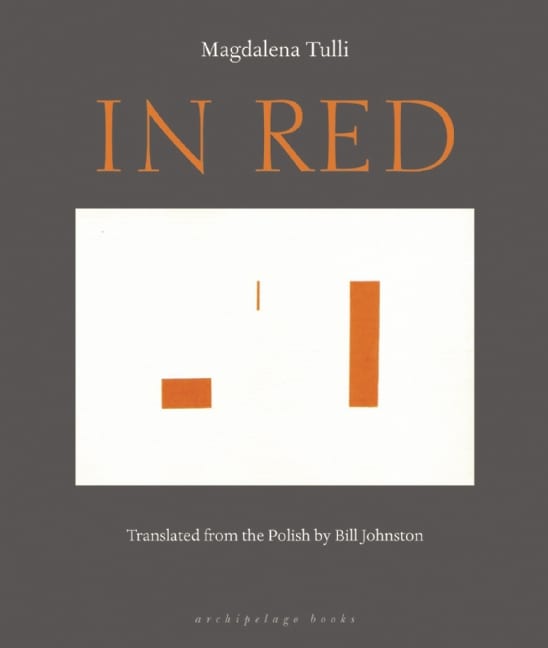
In Red, the 1998 novella by Polish writer Magdalena Tulli is a celebration of the power of stories to create a world that is at once magical and a microcosm of the early decades of the twentieth century in her native country. Echoes of Calvino and Saramago can be heard in her portrait of Stitchings and the many eccentric characters who pass through it and strange circumstances that arise in its streets, structures and public places. Defined by its industry and modes of approach—or exit—the town is, when we first arrive, home to three factories and a salt mine and, should one not approach by sleigh, a railway station to welcome newcomers. The primary businesses, all longstanding family concerns, are Strobbel’s porcelain works, Neumann’s phonograph record factory and Loom & Son who manage the flow of money and goods, and manufacture fine ladies’ corsets for the local and international market. Meanwhile, the salt mine and its miners hold an economic role that is essential to the very lifeblood of the town:

But it was to them alone that the factories, stores, banking houses, and law firms owed their prosperity. Any kind of enterprise would have run aground in a heartbeat if there’d been a lack of salt, which, as everyone knows, is the essence of tears. For along with riches, success in industry and commerce brings weeping. A boom requires weeping if it is to last. Otherwise it will dry up. A certain number of tears are needed to fill the channels of trade and allow the expeditious flow of assets and liabilities, just as water under the keel is essential for ships with holds full of cargo.

This town is no stranger to weeping. As war brings destruction its commercial strongholds, and death and injury to a generation of young men, the function of the various business and the visions of their new owners and managers evolve. Cycles of poverty and prosperity follow and the seasonal nature of the environment around Stitchings grows warmer. Eventually the snow is but a distant memory, a port is open to ships ferrying goods and visitors, and the daylight hours begin to expand until night is reduced to a brief daily moment of dimness. In the sweltering heat, sailors roam the streets and frequent the brothel. Life in Stitchings goes on. And, sometimes, it does not, as charcters fall prey to injury, illness and despair.

For a reader accustomed to following the path of an individual protagonist or collection of individuals, In Red might feel underdeveloped. But the primary character is the place, Stitchings. It evolves, with changes in development, climate and atmosphere rising and falling over the course of this short novella. People, as the framing reinforces—regularly describing how prospective visitors can approach or exit this mythical space—are transient figures whether they are born and die there or brought by commerce, external factors or familial obligation. They fall into routines, often emotionally destructive for themselves and those around them. There is, it seems, little true happiness in the streets and hallways of Stitchings. For that a person really needs to escape.

This fantastic fable moves forward with the inexorable pressure of forces that come from outside and from within. With a tumultuous flow of images, Tulli’s narrative never stops to take stock. It is up to the reader to catch references and pick up on the wry commentary woven into the account. Following the detail is less important than riding the flow, and appreciating the wisdom and humour woven into this dark tale. In the end we are reminded that the story is an entity with its own ontological motivation, but formed as it is on a community caught in the ebb and flow of larger world currents, it carries the best and worst of human nature in its wake.

In Red by Magdalena Tulli is translated from the Polish by Bill Johnston and published by Archipelago Books.

Thoughts on writing about Witness by Robert Rient for Minor Literature[s]

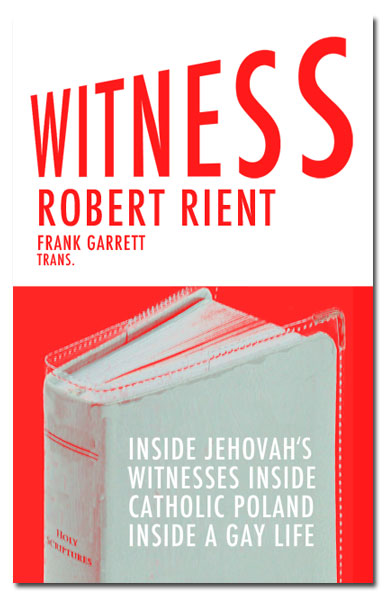
For all its sins, Twitter is still a terrific way to connect with readers, writers, translators and small publishers and, in the process, hear about books you might otherwise miss. Witness by Polish writer and psychologist, Robert Rient, is a case in point. I came to know of it by way of the translator, Frank Garrett, and was immediately intrigued by this story of a man who grew up gay and Jehovah’s Witness in Catholic Poland. I ordered the book and, as soon as it arrived, I had a quick look and immediately knew it was the type of book for which I would want to pitch a critical review.

I am intrigued by original approaches to memoir writing, that is, rrient-witnessintentional writing about ones’ own experience. In Witness, the story is carried by Luke, the writer’s younger self—the boy and young man torn between his faith community and his sexuality—and Robert, the grown man who marks his break with his past and his rebirth as a whole person, true to himself, by taking a new name and identity. Woven through these two narratives is a fascinating look inside the Jehovah’s Witness church. As someone with a dual identity history, albeit different in nature, I found a lot to admire in the telling of this story, as well as in Robert’s honesty and the powerful transformation he chooses to make to mark his move forward into a new authentic life.

My review is now live at Minor Literature[s]. Thank you to Tomoé Hill for entertaining my contribution.

Minor Literature[s] has been repairing its archive so I have reproduced my review here:

Witness by Robert Rient (trans. Frank Garrett)—Joseph Schreiber

Not yet fourteen years old, Luke Zamilski is waiting his turn to climb into a garden swimming pool set up in the middle of a large stadium. Thousands of people fill the stands. He has endured months of interrogation by the elders of his church congregation. He has memorized the precepts of his faith and the Biblical justification and ammunition afforded each one. He is ready. With his baptism, Satan will come to know of his existence, but Luke is eager and enthusiastic because he also knows that, on this day, he will be granted a clean slate. With this expurgation, he trusts that Jehovah will remove the thorn that has been working its way into his flesh through these early years of puberty.

Or maybe not.

Luke’s story begins with the dramatic retelling of a fire that destroys his family home when he is just shy of his fourth birthday. As part of the small Jehovah’s Witness community in Poland, the aid and support of fellow church members is immediate, as is the curiosity and derision of their Catholic neighbours. When the family is eventually settled into a new house, Luke is given a used briefcase in which he is to store his important papers should he ever need to escape a similar circumstance in the future. That same case will also go on to hold his precious diaries, his poetry, and eventually, he tells us, his porno mags, letters, newspapers and more. A place to contain both his documented and his hidden life. Thus, this event sets the stage for the account of a life that is destined to be doubly isolated. He is cut off from the normal social activities and celebrations of his peers by his “feline faith”, and then, as he struggles with his sexuality, he risks being denounced by his church community for falling prey to a sin thought to be worse than murder.

Witness, by Polish psychologist and writer Robert Rient, is at once an original and engaging chronicle about growing up gay, and a disturbing look deep into the manipulative and damaging environment of a religious organization that shares many similarities with other fundamentalist Christian churches, and yet is its own strange entity. However, this is not a case study or a psychological essay. It is, rather, an autobiography in three voices.

Luke carries the immediate and emotional core of the narrative. He agonizes over his inability to refrain from masturbating, and the curse of the ‘thorn’ he carries. He begs to be relieved of his affliction and prays for the imminent arrival of Armageddon, for release from worldly temptation and the corruption of Satan. He throws himself into the church, preaching and witnessing, and yet he is also drawn to the arts, to writing and drama, and eventually chooses to study in the city of Poznan after graduation from high school. There he will vacillate wildly between fanatical commitment to his faith, a desire to succeed in his studies, and a dangerous entanglement with drugs, alcohol and self-harm. Guilt and shame dog him, throughout his youth and on into early adulthood, intensified by the very real threat of disfellowship from the church, and rejection by those he knows and loves. His desperation becomes intense. At the age of sixteen, for instance, he makes the very Biblical pledge to cut off his offending appendage:

I take a knife from the kitchen. I go upstairs to the second story. I enter the bathroom, turn on the light. I drop my pants to the floor, pull down my underwear. I apply the knife to the base of my penis. Wait. I’m scared of the pain, that I’ll bleed to death. I gently drag it across the skin. It stings. It leaves a red line on the flesh. I won’t do it. I’m too weak even for that.

His first confidant is Robert, whom he ‘meets’ at the age of eleven. Somewhere between an alter-ego and an imaginary friend, Luke first summons Robert ‘out of nothing,’ a new identity to step in when the waters become too rough, someone to pick up the pen and write in his journal the thoughts and feelings that he dare not own. Robert carries the second narrative voice, looking back from the present with a certain, almost clinical, detachment at his troubled younger self, providing a grounded counter perspective. His measured tone speaks to his own hard-won peace, but a fondness and affection seep through, along with an abiding sense of loss. Although his parents will ultimately stand by him, and his older brother who also leaves the faith, the rejection of the friends and relatives who stay behind is cold, harsh and unforgiving. The cost is very real.

The third narrative, “Witnesses,” details the inner machinations of the Jehovah’s Witness enterprise—bringing to light textual materials, facts and figures, and unwrapping many of the arcane and disturbing beliefs promulgated within their organization. What is revealed is a misogynistic, sexually repressed, hierarchical system that denies celebration of holidays and birthdays, but permits limited alcohol and abortions (Armageddon is ever imminent after all), and encourages the physical discipline of children as a sign of affection. The church is widely spread across the globe and supported by vast quantities of written materials, most recognizably The Watchtower and Awake!, which are translated into a multitude of languages and distributed by members who are required to spend long hours knocking on doors and standing on street corners.

What we have then, is a memoir presented as an uncanny collaboration between the author, Robert, and Luke, the boy and young man he used to be, along with an exposé of the secretive church ‘they’ were born into. As an affectation, it would risk sounding overly theatrical, but this approach allows a much deeper, more genuine narrative to develop. In Luke’s account, supported by frequent excerpts from his diary, we hear of his youthful enthusiasm for his faith, his anguished attempts to fight his homosexuality, and his pull toward all the temptations and possibilities of a ‘worldly’ existence. By contrast, Robert’s perspective sounds at once insightful and limited. He wants to fill in the gaps, seek out the views of Luke’s former friends, and try to analyze, interpret and defend his fate. He knows how the story will end. In describing his first encounter with Luke, Robert says:

I suppose we already knew that we would meet again and that I would have to live. That he had to die. I didn’t kill him. But had he not died, I wouldn’t have been. Everything that happened to him, every torment, was convenient for me. His weakness and self-loathing were my justification and my provocation. Besides, he wanted to die. He talked about it again and again. I have evidence. I am the witness regarding this matter.

As the narrative alternates between the three voices, the mood shifts. The Witness sections are delivered with neutral authority. At times Luke’s actions are used to illustrate a point, and occasionally the reader is addressed directly, as, for example, in: ‘There exists an informal list of banned books which includes the one you’re reading.’ Both Luke and Robert speak in the first person, and refer to each other as ‘he.’ At times, when appropriate, first person plural is also employed. Luke longs for the comfort of his alternate identity most when he feels isolated and depressed, leaving Robert effectively sidelined, observing from a distance much of the time—a tone that comes through clearly in his sections, setting them apart from Luke’s. As Luke battles addiction, the loss of self-esteem, and suicidal thoughts, one can sense a growing friction between the two voices, as if Robert is slowly coming into sharper focus within their dual existence.

At the end of this powerful account of transformation and rebirth, Robert Rient emerges from the restraints of a religion that rejects his very being, and comes, over time, to accept and love himself as he is. It is his conscious disassociation that provides protection and allows him, with the support of friends and his academic training in psychology, to survive the very tumultuous break with his faith. Once the internal division is no longer required, he sheds his name and identity, along with his past, to claim a new wholeness. And in telling his story in this way, with equal respect for his past and present lives, Rient is able to capture a conflicted, painful journey with a fresh authenticity that reaches beyond the specifics to touch the universality of the experience of striving to be true to one’s self.

It is of note that Frank Garrett’s translation effectively captures the shifting tenor of the narrative, something which is essential to the success of this multilayered approach. He also includes a guide to assist with the pronunciation of the Polish names in the text, and in his afterword, he details the choices that were made with respect to language, and the challenges of accessing the original resources required to render this unique memoir into English.

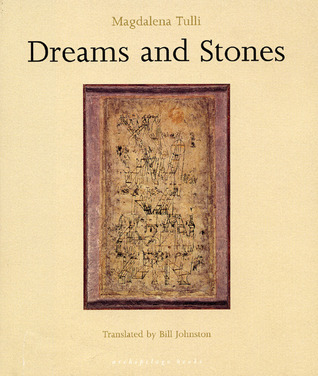
Dreams and Stones by Magdalena Tulli

I am very pleased to have my first review published at The Quarterly Conversation. Dreams and Stones by Polish writer, Magdalena Tulli, is a poetic meditation on the city as an organic entity, essentially an urban cosmology. I read it through twice before writing my review and in my second encounter its nonlinear, cyclical quality was even more apparent. Thinking about it now, two months later, its fantastic, mythic qualities still have a strong hold on my imagination. But there is more that haunts me when I think about this book.

dreamsstones

I had been aiming to submit this review in mid-July, my first reading was in late June, but before I could put pen to paper, so to speak, my father had a stroke and car accident and my mother became ill and died. As one might imagine, I struggled to write, let alone read. During times like this words fail us. But, as my father’s death neared I returned to this short book, for distraction, comfort and, above all, to know that I could still write. The ability to sit down and pull together a critical review was an important turning point. In times of immediate crisis and grief when family members find themselves trudging back and forth to the hospital, the advice is to try to return to some measure of routine. The answer, for me, was to write.

Dreams and Stones is translated by Bill Johnston and published by Archipelago Books. My review, originally published at Quarterly Conversation is reproduced below:

“There are more things in heaven and earth,” Hamlet famously says to Horatio, “than are dreamt of in your philosophy.” So might Polish writer Magdalena Tulli be imagined to warn readers entering her enigmatic first novel, Dreams and Stones: to be prepared to open your minds to an urban cosmology that envisions the city—its evolution, destruction and rebirth—in the light of two seemingly opposite notions of the world. Paragraph by paragraph, Tulli’s images are startling and fresh, and they become the building blocks of a fanciful metropolitan vision that overflows with both magic and sorrow.

Born in 1955, Tulli is one of Poland’s most original contemporary writers. She has received three nominations for the prestigious Nike Prize, and four of her novels translated into English to date, including In Red which was longlisted for the 2012 Best Translated Book Award

Recently re-issued by Archipelago Books in paperback (they published a hardcover edition over a decade ago), Dreams and Stones truly defies simple classification. From the opening passages, the contemplative poetic imagery reads like a re-invented Book of Genesis, sketching out the life cycle of the metaphorical tree upon which a fruit ripens, falls to the ground, and germinates; it holds in its core the seeds of a great city and the parameters of the human system that surrounds it. This archetypal city is fundamental to the vision of the world that Tulli proposes, but herein lies the tension that motivates and propels the narrative: Tulli’s calmly disconnected narrator ponders, never committing to one conception over the other, how the world is to be understood: as a tree or as a machine? Is the city borne of the dreams of its citizens? Or is it grounded in the faith and certainty of its master builders?

Be it natural or mechanical, the city is created by an inextricable combination of thought and the appearance of objects. Necessity and a restless urgency drive this process onward. Tulli’s narrator describes the lines of the city as ordained to appear through the pens of the draftsmen, inspired by the builders’ unshakable belief in one possible truth.

Though it remains a supposition it is not hard to interpret. It proclaims that it is not the power of germinating seeds and not the pressure of juices circulating between the roots and the crown that give the world life, but that it is set in motion by motors, gears, and cogs, devices that keep the sun and stars rotating, pull the clouds across the horizon and drive water along the bed of the river. The clarity and simplicity of this notion may prove salutary. They will make it possible to dismantle, repair and reinstall every broken component—so long as the world is composed only of separate and removable parts . . .

However, as the narrator goes on to speculate, how can one be certain the world is a machine when it resembles a tree in so many respects? This continual pull between the two poles of this dichotomy suggests that the way one chooses to view the world influences, even governs, the way one attempts to exist in it. Both views, it is argued, are true. And both have their limitations.

Tulli spins webs of interconnected realities and counter-realities. As a tree has a network of roots that spread, like the branches of its crown, in the dark depths of the soil, the city and every object in it ideally has its counterpart. But as the inexorable progress of the mechanized world rushes forward, the city is easily separated from the counter-city and, like a tree cut off from its roots, everything begins to spiral out of control, break down, fall apart. The builders that once seemed so assured failed to leave room for fate, chance, and fatigue—not only of materials but of the legions of flesh and blood workers required to build, repair, and maintain the metroplis in its glory.

Eventually time begins to run short and the power required to hold the counter-city at bay outstrips demand. The city, and the framework of the world that surround it, enter a period of cosmic decline. Here the narrative registers a distinct shift in tone:

No one knows where sorrow comes from in a city. It has no foundations; it is not built of bricks or screwed together from threaded pipes; it does not flow through electric cables nor is it brought by cargo trains. Sorrow drifts amongst the apartment buildings like a fine mist that the wind blows unevenly across the streets, squares and courtyards. There are long streets and short ones, there are broad ones and narrow ones. The gray of some bears a trace of ochre while others are bluish from the sidewalks to the roof tiles. Each of them has its own peculiar shade of sorrow.

The city of thoughts is now precariously maintained in the dreams of its inhabitants, their memories. The city of sorrow grows increasingly disordered and fragile. When war threatens to level it forever, the survivors, like their forbearers who constructed the original city, attempt to reconstruct one of memories. For, as the narrator assures us, “nothing in the world—even imaginations—can be destroyed completely and finally.”

Although Tulli never names the city at the heart of her story, recent Polish history, the massive destruction of Warsaw during the Second World War, and the systematic rebuilding and redesign of that place all seem to be woven into Dreams and Stones; but, these threads need not be traced in a linear fashion. This is a fable, one that essentially folds back on itself, a poetic meditation on the soul and heart of a city built, rebuilt and kept alive in the imaginations of its people. A metropolis that is connected to the rest of the outside world, to those shifting, almost fantastic municipalities that exist elsewhere, and yet stands as a self-contained ideal. One has to be aware though, that such an ideal can become distorted over time. Warsaw was reconstructed, with great attention to detail on the one hand, but altered to accommodate the new pressures of a steadily increasing population on the other. Memories and the rebuilt reality do not always align:

It is possible to imagine a city perfect in its entirety, a city that is the sum of all possibilities. In it nothing is missing and nothing can perish, every china teacup comes from somewhere and is destined for somewhere. But precisely this absolute city is eaten away by the sickness of never-ending disasters. Change invariably brings confusion to the lives of the inhabitants. One has to pay attention so as not to drive accidentally onto a bridge that was demolished years ago, so as not to sit on the terraces of torn-down cafés once known for their unparalleled doughnuts.

An obvious counterpart to Dreams and Stones can be found in Italo Calvino’s Invisible Cities. Tulli has translated Calvino and admits to his influence. But in so far as this book can be understood as referencing Warsaw, it retains a sharply central European feel. I was especially reminded of Pavel Brycz’s  I, City.[1] Originally published in Czech in 1998, Brycz    honors the history and people of the industrial city of Most in northern Bohemia, by giving the narrative voice to that place, setting the stage for a melancholic meditation on an urban center widely understood, at the time, to be in a state of unemployment, decline, and despair. In Tulli’s urban landscape it is the city’s inhabitants who maintain, generation after generation, the idea of their home, even as its proud stone edifices are turned to rubble. In I, City, the concept is reversed. It is the city that retains the memories and affections for its people and its past—it dreams, keeping its spirit alive despite repeated historical destruction, occupations, and finally as its neighborhoods are leveled to mine resources and replaced, not by stones, but by prefabricated concrete slabs.

While Tulli regards Dreams and Stones as a novel, her translator, Bill Johnston, respectfully disagrees. He sees it as prose poem.[2] It is, essentially, a series of images and reflections, and there are no individual characters apart from the measured and detached narrator. Yet either way, novel or poem, the piece is endowed with an overwhelmingly orchestral quality. The dynamic life of the city, builds up speed, slows down, becomes erratic, falls into an abyss, and is reconstructed anew. Tulli is playful with her imagery, intentionally pushing her metaphors to the edge. Even the moods—pride, sorrow, nostalgia—that course through her streets are imbued with a mythic intensity. This motion and fluctuating energy, combined with the fundamental philosophical tension at its core, gives the work its flow, draws the reader in, and, in the end, offers a richly provocative experience that invites and rewards rereading.

[1] Brycz, Pavel. (2006) I, City. (J. Cohen & M. Hofmeisterová, Trans.) Prague: Twisted Spoon Press (Original work published 1998) – Link to publisher page for book: http://www.twistedspoon.com/city.html

[2] Interview with Bill Johnston on Magdalena Tulli. Polish Writing. Retreived from https://web.archive.org/web/20111106183056/http://www.polishwriting.net/index.php?id=125

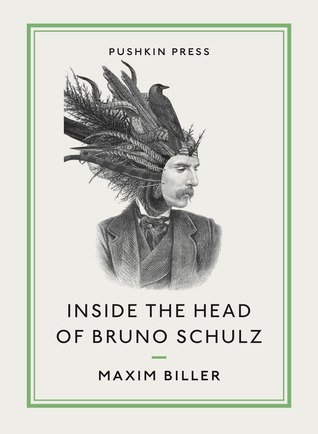
Probing the fantastic imagination: Inside the Head of Bruno Schulz by Maxim Biller

“Schulz was incomparably gifted as an explorer of his own inner life.”
– J M Coetzee

The year is 1938. In the dull light of a basement apartment in the town of Drohobycz a man is anxiously penning a letter to his literary hero Thomas Mann. He works at a desk that is too low for him. When he is disturbed and distressed by the sound of birds pecking at the high windows he slips down onto the floor and continues working there until the falling autumn light forces him back up to the desk. On the walls of his room hang drawings he has made – fantastic dark sketches of domineering women and desperate men.

bruno_schulz_paintingThe man is famed Polish writer and artist Bruno Schulz. As he composes his missive to Dr Mann, German author Maxim Biller is conducting a guided tour to the interior thoughts, fantasies and fears – make that Fear with a capital F – that he imagines fueling Schulz’s surreal and creative imagination. The resulting novella, Inside the Head of Bruno Schulz serves as a delightfully inventive introduction to an original and influential writer.

“Ever since he could remember Bruno – for that was the name of the man with the face like a paper kite – had awoken every morning with Fear in his heart. Fear and he had breakfast together in Lisowski’s tearoom, Fear accompanied him to the High School and looked over his shoulder as the boys put their unsuccessful sketches of animals down in front of him, as well as plaster models, covered with black fingerprints, of their sweet little heads.”

Biller paints a portrait of a deeply anxious man… a character that would be at home in one of Schulz’s own stories. When he meet him he is unsuccessfully struggling with a novel. He lives with his sister and her two sons. She still believes her dead husband will return. His students whom he thinks of as “bird-brained” literally appear to him as birds, at his window and in his room. He has a conflicted affection for a sado-masochistic sports and philosophy teacher whom he describes as beautiful despite her hairy monkey face and filthy matted hair. But more critically, he carries an impending sense of doom as it increasingly seems inevitable that Germany will be moving toward Poland. It is with that in mind that he is writing to Thomas Mann.

inside headA most curious and twisted fellow claiming to be the great writer has turned up in this small town, charming the residents with enticing stories and grotesque gatherings. The fictional Bruno is anxious to alert Dr Mann to the existence of this impostor whom he suspects is actually a Nazi spy, and to beseech him to consider offering a poor Polish writer critical assistance. With an opportunity to publish in a prestigious journal or an introduction to an important publisher, the timid Bruno believes he might find the courage to leave Poland. He has even written a story in German to include with his appeal.

Combining biographical facts with a wildly fantastic vision that echoes Schulz’s own dark, dreamlike work, Inside the Head of Bruno Schulz is a lateral approach to the writer’s restless creative energy. A brief biography and two of Schulz’s own short stories, “Birds” and “Cinnamon Shops” follow the primary text, making this short book which clocks in at under 100 pages, an irresistible invitation to explore more of the work of this important Polish writer. Unfortunately a number of stories and the unfinished novel he was at work on in this tale were lost after his death so what remains is limited. However, Schulz himself has resurfaced and been has been re-invented and re-discovered as a writer and artist time and time again in novels by Cynthia Ozick, David Grossman and Philip Roth among others, as well in plays and film. (See the essay “The Strange Afterlife of Bruno Schulz” by Jaimy Gordon for an excellent overview.)

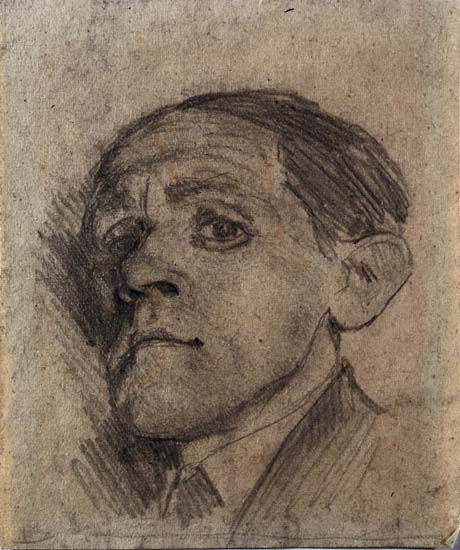
SchulzBruno Schulz was a Polish-Jewish writer born in 1892 in Drohobycz, a town historically part of the kingdom of Poland,  now part of the Ukraine. During his lifetime he published two collections of short stories, The Street of Crocodiles and Sanatorium Under the Sign of the Hourglass. He was known to be at work on a novel, The Messiah, which has not survived. He worked as an artist and an art teacher for many years. When the Germans moved into Poland during the Second World War, his artwork granted him temporary protection under the auspices of an admiring Gestapo officer in exchange for the painting a mural in the officer’s home. On November 19, 1942, walking home with a loaf of bread, he was shot in the back of the head by another Gestapo officer, a rival of his protector. He was 50 years-old.

Published by Pushkin Press (April, 2015 in the UK/October 2015 in North America), Inside the Head of Bruno Schulz is translated from the German by Anthea Bell. The stories “Birds” and “Cinnamon Shops” from The Street of Crocodiles, were translated from the Polish by Celina Wieniewska and originally published 1963.

Ode to the soul of the world: Primeval and Other Times by Olga Tokarczuk

“God sees. Time escapes. Death pursues. Eternity waits.”

Welcome to Primeval, a mythical village that exists, if it exists, somewhere in Poland at the very heart of the universe. Watched over by a somewhat irresolute God and His angels, the people of Primeval and the surrounding communities live out lives filled with love and loss, joy and pain, birth and death. In her unusual and affecting novel Primeval and Other Times, Polish writer Olga Tokarczuk introduces a world endowed with a cosmology that skews conventional Christian wisdom, placing God on the sidelines of His creation. In this world view, matter and spirit are tightly bound at all levels of existence and imagination is a vital force driving life forward.

“Imagining is essentially creative; it is a bridge reconciling mater and spirit. Especially when it is done intensely and often. Then the image turns into a drop of matter, and joins the currents of life. Sometimes along the way something in it gets distorted and changes. Therefore, if they are strong enough, all human desires come true – but not always entirely as expected.”

This is not, as you might suspect, a conventional novel. Three generations of the Niebieski/Boski family form the backbone of the story but there is no overriding or direct narrative. Rather it dips in and out of the “Times” of a collection of archetypical characters, places, even objects; sweeping the reader along on a stream of vignettes plaited together to build a chronicle of the experiences of the residents of Primeval through the twentieth century, from the advent of the First World War to the rise of Solidarity. We meet Genowefa Niebieski, the wife of Mikał, the miller, who has been called up to join the Tsar’s forces. While he is away at war she gives birth to a daughter, Misia, and years later, a second child Izydor, a son born with hydrocephalus. Misia will, in time, marry Paweł Boski, a man of ambition who eventually rises to the role of Health Inspector under the Communist Party. Together they will have four children. Some secondary characters recur throughout, like Cornspike, a fallen woman who has retreated to a ramshackle old house where she lives, close to nature, with her daughter, Ruta, and the eccentric Squire Popielski. Other characters pass through, especially during WWII when the greater forces of the outside world penetrate the borders of Primeval bringing terror and destruction with them.

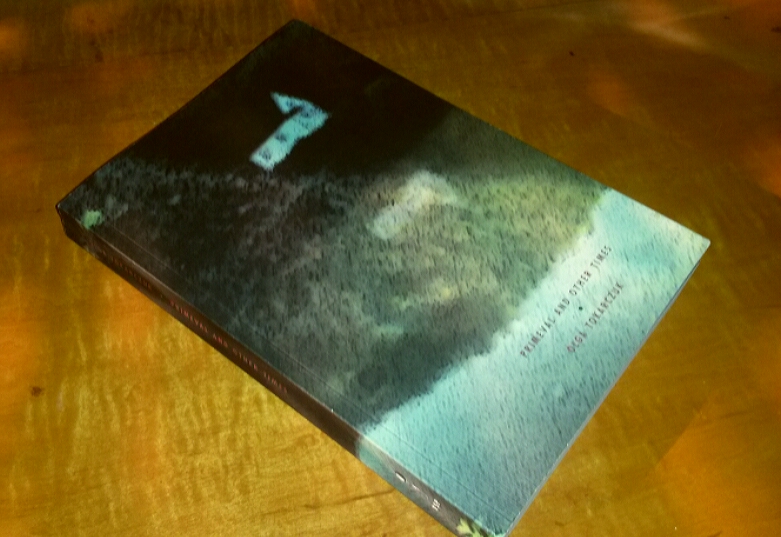
2015-08-29 18.47.59With the magical tone of a fairytale for adults, the world of Primeval is brought to life with a keen sensibility for botanical detail and the cyclical flow of months, seasons and years as they pass. It is a rural community. However, the close bond to nature defines not only village life, but the world beyond its borders where modernity increasingly stands in its opposition. At one point, as Misia, reflects on the mutability of the blossoms on her fruit trees, the orchard itself becomes an analogy for the broader patterns of human existence. There are apple-tree years and pear-tree years. In the former conditions are harsh but the brief blossoms intense and the animals that do survive are strong and aggressive.

“Apple-tree summers give birth to new ideas. People tread new paths. They fell forests and plant young trees. They build weirs on rivers and buy land. They dig the foundations for new houses. They think about journeys. Men betray their women, and women their men. Children suddenly become adult and leave to lead their own lives. People cannot sleep. They drink too much. They take important decisions and start doing whatever they have not done until now. New ideologies arise. Governments change. Stock markets are unstable, and from one day to the next you can become a millionaire or lose everything. Revolutions break out that change regimes. People daydream, and confuse their dreams with what they regard as reality.”

By contrast, nothing happens in a pear-tree year. Plants lay down deeper roots, animals and people grow stronger. Larger litters and healthier babies are born.

“People think about building houses, or even entire cities. They draw plans and measure the ground, but they do not get down to work. The banks show enormous profits, and the warehouses of large factories are full of products. Governments grow stronger. People daydream, and finally notice that each of their dreams is coming true – even once it is already too late.”

It is very difficult to describe the experience of reading this book. Ordered with Women in Translation month in mind, it arrived from the wonderful Prague based Twisted Spoon Press when I was in the hospital recovering from cardiac arrest. Once I could hold my thoughts together long enough to entertain the idea that I needed some books to read, Primeval and Other Times was one of two books that I asked my son to bring. In the opening passage, “The Time of Primeval”, the geographical boundaries of the village are laid out along with the risks and dangers personified by the features marking each direction and the Archangel assigned to guard the borders. I panicked, imagining that I would need to sketch out a map to keep all these relevant facts in mind. All month I have looked at this gorgeously bound volume sitting on my stack of books until I felt I was ready. My concerns, as it turns out, were for naught.

This is a captivating tale, rich with ideas and emotion. The constantly fluctuating threads of the tale are not disruptive. Rather they work smoothly together and allow the story to progress over such a vast time span with ease and forge an unforgiving and unforgettable vision of the world that is poignant, heartbreaking and gorgeous.

witmonth15Olga Tokarczuk is an award winning, highly respected Polish author. Born in 1962 and trained as a psychotherapist it was little surprise to find out that she frequently cites Carl Jung as a significant influence on her work. Primeval and Other Times was first published in Polish in 1996. This translation by Antonia Lloyd-Jones was published by Twisted Spoon Press in 2010.