These are anxious times. It is easy, if you think too much, to wonder about the value of putting pen to paper with an atmosphere of doubt lingering so heavily in the air. But then, if you think a little further, wavering gives way to urgency. Reading and writing become acts of resistance, distraction, and revitalization. Or, that is what I remind myself.
I don’t want to venture too far into politics, but it would be naïve to pretend that we are not facing an unpredictable future. This uneasiness has been heightened for me over the past few weeks by an unproductive job search and increasing concern about my financial security as I’ve watched my cash buffer dwindle. The truth is though, with a will awaiting grant of probate, I stand to eventually find myself in a much better financial position than I had ever could have imagined. It doesn’t mean I won’t have to secure some outside income, hopefully some of that ultimately coming from writing related services, but I do dare to dream of finally having more freedom after years of struggling with identity, mental illness, and the challenges of a state of single parenthood that has extended far beyond my expectations.
 So, world affairs aside, what right do I have to be anxious and insecure about writing? I suppose it’s enough that I am human, but I am also plagued by the unshakable feeling that I’m an impostor. All my life, the only thing I ever really wanted to be was a writer. And no matter how difficult writing is (and always has been), I still feel deliriously guilty to have been afforded, over the past two years of stress leave, the time and space to connect with writers, readers, translators, and publishers. It is a gift I am not ready to give up, rather I want to mould a life that will allow me to continue to read, write, edit, and grow.
And yet, every time I sit down with a pen and paper, or open a blank Word document the same fear that I will never write another solid review or creative essay sets in. Impostor.
I have two longer term projects—an extended personal essay/memoir and a constraint-driven experimental piece—in the early formative stages. Consequently, much of my present reading is directed towards exploring the ways ideas can be developed and stories can be told. But every now and again I come up against a work that triggers my insecurity.
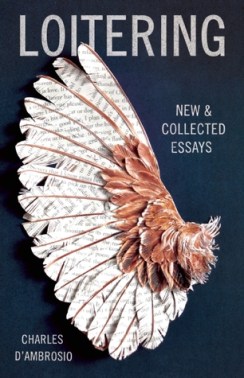 Case in point: I am slowly making my way through Loitering by American essayist and short story writer, Charles D’Ambrosio, and after each essay I feel temporarily overwhelmed. I can easily see why the friend who kindly sent me this book speaks of it so highly. Rather than attempting to review the entire collection at once, I want to pull out and look at some of the individual pieces along the way. They are that good.
First of all, D’Ambrosio notes in his Preface that, for him, the right to doubt is essential to the successful personal essay. “Loitering,” the title piece, is a perfect illustration of how and why this works. The setting: The middle of the night, outside a residential complex in the Belltown district of Seattle. Yellow police tape cordons off several blocks, while a large contingent of policemen and a cluster of journalists and TV news reporters wait in the rain. D’Ambrosio arrives at the scene around 2:00 AM, drawn by the reports of domestic violence and a possible hostage taking. With a Hollywood-tinged sarcastic romanticism, he imagines the scenario:
This guy—the Bad Guy—apparently thought he was just going to drink a few beers and bounce his girlfriend against the walls and go to sleep, but instead of a little quiet and intimate abuse before bed he’s now got major civic apparatus marshaling for a siege outside his window. No sleep for him tonight, and no more secrets, either, not at this unholy intersection of anomie and big-time news.
The clichés he arrived with quickly fall away as he joins the vigil. Quite frankly he is in rough shape himself. One of the key drawing cards for D’Ambrosio on this night is simple lack of human contact. A recent fishing trip has left him with severe atopic dermatitis due to contact with neoprene and he’s just spent a week isolated at home—his fingers, neck, feet, and legs swollen and covered with weeping sores. Medication and the constant tingling sensation prevents him from sleeping, crackheads have stolen his duffle bag from his truck leaving him without a belt or a raincoat and now, armed with file cards and a pen lest he find a story, he is standing in the dark, soaking wet with his pants falling down. Nothing like setting a memorable scene.
As the night wears on he spots a man, angry, looking a reporter, someone to listen to his story. He makes his way through the crowd of journalists but no one wants to hear him out—a wretched resident displaced by the hostilities unfolding in his building, he is not on their agenda:
He’s now caught in between, trapped in some place I recognize as life itself. It’s obvious he hasn’t been sober in hours and maybe years. If it could be said that these big-deal journalists have control of the story… then this guy is the anti-journalist, because in his case the story is steering him, shoving him around and blowing him willy-nilly down the street. The truth is just fucking with him and he’s suffering narrative problems. He began the night with no intention of standing in this rain, and his exposure to it is pitiful. As he moves unheeded like the Ancient Mariner through the journalists I feel a certain brotherly sympathy for him, and I’m enamoured of his utter lack of dignity.
Our hapless would-be reporter knows the man will be back and knows that he alone will listen to him. And so he meets Dennis, a vet, and his friend Tom, a Native American man. Through them he will learn more, in so much as anyone knows anything about the armed man holed up inside in one of the sparse low-income units, and the story, through the eyes and words of this most astute and sensitive observer becomes one of the tragedy of the poor and dispossessed rather than a dramatic shootout and fodder for the six o’clock news. After years of working in human services, the tableau D’Ambrosio paints of the evacuated residents relocated to a city bus to wait out the proceedings rings true—a scene that could easily be played out in my city, or any other North American centre for that matter:
Inside this bus what you see is pretty much a jackpot of social and psychic collapse, a demographic of bad news. Everybody in there’s fucked up in some heavy way, dragged out of history by alcohol, drugs, mental illness, physical decrepitude, crime, old age, poverty, whatever. Riding this bus in your dreams would give you the heebie-jeebies big-time. There are maybe ten or fifteen people on the bus but between them if you counted you’d probably come up with only sixty teeth. In addition to dental trouble, there are people leaning on canes, people twitching and barefoot with yellow toenails curled like talons, gray-skinned people shivering in gauzy nightgowns, others who just tremble and stare. They’ve been ripped out of their bedrooms and are dressed mostly in nightwear, which is something to see—not because I have any fashion ideas or big thesis about nighties and pj’s, but rather because, this surreal dawn, the harsh, isolated privacy of these people is literally being paraded in public. The falling rain, the bus going nowhere, the wrecked up passengers dressed for sleep, the man with the gun—these are the wild and disparate components of a dream, and I haven’t slept, and it’s just weird.
This passage, in fact the entire essay, left me breathless. This is not beautiful. It is raw, honest and real. In telling the story D’Ambrosio allows himself to be vulnerable and despite flashes of humour, one senses he is defeated by the sheer sadness of the whole affair. The reporters will head off to other stories, but he will be left on hold, filled with doubt, open to questions. Upon first reading I felt a sense of writerly inadequacy descend on me; returning to write about it and copy out significant passages I feel re-invigorated, inspired even.
I don’t know when this essay was originally published but it doesn’t matter. It contains a certain urban timelessness that stretches back through the twentieth century, yet is especially relevant today, with the pending threats to affordable healthcare and Medicaid in the US under the new administration. And so, I’m back where I’m started… uncertain times…
Loitering by Charles D’Ambrosio is published by Tin House Books.

 However, not all my concerns are so grand and worldly. I am human. My fears also lie close to home. I worry about my daughter’s safety at the computer shop where she works—an apparently essential service that has reduced hours but, at last report, not instituted safety measures—and because she lives across town I cannot even see her. Despite our challenges, I am grateful to have my son at home. I would not want to be alone right now. But I am otherwise inclined to isolate these days—I find it hard to find the energy to write an email, make a phone call or send a message. Everything seems to take so much energy. Fortunately I can still get out and walk and editing, or writing rejection letters, occupies a lot of time. Somewhere people are finding it possible to read and write and fill my inbox with their offerings.




 roughghosts