Rain like this doesn’t wash away the filth: Hawa Hawa and Other Stories by Nabarun Bhattacharya

The gleaming wet road, the rusty tin roof of a motorcar repair garage, behind it an old paint-peeling stunned-still old house and a chimney precariously propped up with haphazard wires—the sky can see all this. And, not as clearly, the burnt-black tin-backed shops and buses and the in-between blocks of darkness that were Matador sheds and not the half-rotten bellies of fish but the shells of banged-up taxis. There were crumbling and dead accident cars too, their mouths full of dirt. The sky view mists over every now and then, for it has been raining continuously.

This is the setting of “Last Night,” one of the pieces in Hawa Hawa and Other Stories, the recently released collection of inventive short stories by Bengali writer Nabarun Bhattacharya. As the angry rain beats down on the trash-filled water logged street, two young men are fighting. They are unevenly matched, a condition mediated by sheer intoxication, but they are each intent on doing damage to the other. And in a very unexpected way they are also best friends.

Bhattacharya (1948-2014), the son of writer and activist Mahasweta Devi and actor and playwright Bijon Bhattacharya, worked as a journalist from 1971 to 1993, before turning his attention to writing fulltime. His magic realist tales tend to feature eccentric characters drawn from the shadows—dirty cops, nostalgic former revolutionaries, unsavoury figures and an assortment of anxious souls. His Calcutta is gritty, pungent, dark and unforgiving. The scenes that unfold, on these streets and beyond, range from sharp political and social satire to strange meditations on violence, madness and love. Set primarily in the 1970s and 80s, but reaching back as far as the 1940s, there are stories that play out against the early Communist-led peasant movements in West Bengal, the Naxalite uprising and the 1975 Emergency, as well as more intimate dramas set in family homes, trains and, of course, on the street.

Bhattacharya excels at creating memorable characters, and rapid, witty sequences of dialogue peppered with English words (indicated in the translation with the use of italics) and references to popular Indian films and songs. A number of his stories rely heavily on a steady back and forth between two people who happen to meet up and share some kind of common past or current circumstance. Others unfurl under surreal conditions, influenced by alcohol, madness or some impending fear. There is an immersive quality to these dark tales.

Take, for example, “Mole,” the story of a seemingly unrepentant cop with a patch of skin on his neck that begins to itch and become inflamed just before he murders someone—“murder” being an accepted language for the state-sanctioned killing his investigative role entails. The itch causes his restless right hand to fumble in his pants pocket where his pistol awaits. The sweat, the smells and the agitation grow. We follow him on a mission to a nightclub. Once the job is done he kicks at the corpse bouncing on the floor of the police van and emotionally decompresses as he returns to the station. A bleak and grim premise perhaps but for the banter in the office (with its water tank filled with bombs to be deactivated), the pointed parenthetical commentary on authorized violence, and the insatiable demons that haunt the protagonist:

Back home, he usually takes a bath, uses soap—puts some ointment on the itch—the sweat from his body and the dirty soap-lather swirl into the drain and disappear. He rubs scented oil on his hair. He is very sleepy, but sleep never comes without dreams. Dreams have eyes, they ask questions, they laugh, they beat on drums. Their limbs are ripped and shredded, bits and pieces bloody. His family has told him he sometimes talks in his sleep, groans, slurs out orders. Sometimes he scratches his back so furiously that he wakes up in the morning to find it bleeding.

There is a deeply embedded hallucinatory fear that follows him down the darkened Calcutta streets and adds a spark of troubled humanity to his situation.

Fear and superstition mark several of the tales, most tragically perhaps in “A Piece of Nylon Rope” in which two men meet outside a hospital on a rainy night. The narrator is there to look in on a colleague who had a stroke at the office, while the other is waiting for news of his son who suffered a serious football injury. The latter, Jagadish-babu, has a uncertain confidence despite the poor prognosis. He feels his fate has turned. He explains that he was already inclined to seeking fortune tellers and good luck charms when he learned that what he really needed was to get a piece of a hanging rope:

‘Hanging rope?’

‘Yes. Suppose someone hangs themselves to death. If you can get a piece of that rope and keep it with you, then boom!—whatever you want is yours. All the evil eyes on you, the vexing, the hexing—the whole fucking lot will vanish. Khoka’s injured so badly. But do you see any fear in me?’

Jagadish shows the narrator the length of nylon rope he has acquired and carries with him everywhere, but admits that the good fortune it promises comes with a steep price. He cannot be alone, for fear the suicide victim will return and demand the rope back. For a man with a trusted talisman, he is a nervous wreck.

Several of the stories in Hawa Hawa, including the title tale and “Mole,” highlight the brutality of the West Bengal police, while another demonstrates the inability of a newly elected politician to protect an old friend and revolutionary comrade. Elsewhere we meet a child with a cruel streak, the brother of an accused murderer who holds to his belief in his innocence, a businessman offering the perfect suicide—for a price—and a gangster who prophetically spends the evening with a headless prostitute. Inequality, injustice and the abuse of power are common themes driving the world that Battacharya wanted to bring to the surface through his darkly humorous, weirdly engaging fiction. And if his comfortable contemporary Bengali audience was disturbed by what they found in his work, he was hitting his mark.

Notably, this translation is the work of a young translator, Subha Prasad Sanyal, and his ability to bring Battacharya’s subversive and playful writing to life is impressive. He pays careful attention to rhythm and tone. As mentioned, the English words transliterated in the original Bengali text are italicized, yet many Bangla terms are left intact where context is sufficient to imply meaning, a choice that helps maintain a distinctive narrative feel. Meanwhile, any cultural, political and place references that enhance understanding are explained in the Translator’s Note.

Hawa Hawa by Nabarun Bhattacharya is translated by Subha Prasad Sanyal and published by Seagull Books.

A few thoughts about language and reading in translation

I am presently reading Herbert, the Seagull edition of the Bengali cult classic by Nabarun Bhattacharya. I just finished reading in the New Directions American edition, published as Harbart. I will write a review after this second reading, not as point of comparison because both are publishers I greatly admire and strongly support. However, it is impossible to read both and not wonder what, if any, small changes are made in making a text more, shall we say palatable, for a particular English language audience. Don’t worry, the ribald, piercing vibrancy of Sunandini Banerjee’s translation shines through in both editions celebrating a work that is gritty, funny and tragic in equal measure. That’s not the issue, but so often when one sees a critical assessment of a translation by someone familiar with the original, the translator is the larger and obvious target of an attack, one often illustrated with specific examples that are seen as muting or distorting the original. Invisible in the equation is editorial input. Translations, like any literary work, are subject to editing before they are published.

The differences here are, so far as I can tell, primarily language choices—what do you leave in a vernacular, what do you edit for the ease of an American or a British audience (as relevant)? This is a frustration I have long had with translation, something that  bothered me, for example, with South African books edited for audiences outside South Africa, especially translations from Afrikaans. With my favourite writers I have tried to obtain the original South African translation if possible. One that hasn’t been sanitized for an “average” English language reader (whatever the editor  feels “average” is).

Why is so hard to imagine a readership unable to guess at the meaning of a word from context? For the purist there is always Google, but that is ultimately as fallible as trusting any one editor’s word preference. Even in our native languages we often encounter words whose meaning we are at best vague, if not entirely off course with as to the exact definition. With learning a second language this disorientation is increased, but it should not necessarily be a barrier, students are encouraged to try to fill in the gaps from what they do know about vocabulary and grammar as their fluency improves. Is it an extension of some skewed political correctness that we should never meet a word we don’t recognize?

This is why I love Michel Leiris. I am currently working on a critical essay about his work. He loved language, delighted in meanings. And misunderstandings. In the way an assumed meaning is sometimes more magical than the actual one. Or how a door is opened when we take it upon ourselves to become enlightened as to the nuances of a word or expression’s meaning. Or it’s relation to root forms or variations in other languages.

In a translation there is a place for a glossary, but it ought to be a carefully mediated tool. Broader political references or identification of figures of importance mentioned in the text are one thing, especially in a novel as socially and politically charged as Bhattacharya’s. However, deciding  which idiosyncratic word or expression must be defined or replaced is a question of balance. Less is more, I’d argue. If you read literature from foreign cultures, don’t you want your equilibrium challenged a little along the way? I suppose it is, in the end, a question of what kind of traveller one is—of how one wants to experience the world. You can pop in, hire a car and see the main tourist attractions then fly off to the next stop. Or you can find a path or two and navigate it until it feels, even for a few days, familiar. I am of the latter sort.

My first few days in Calcutta in February of 2018—my very first days in India ever—were ones of complete and total culture shock. I was aware of nothing but the mangy dogs, the tired poor, the crumbling footpaths, the incessant noise. It took a few days of making my way through the city on foot to begin to see it. To begin to open my heart to it. I spent a full two weeks there and didn’t go anywhere else. I took the Metro, rode ferries and yellow cabs. Met up with friends, sat in restaurants, coffee shops and parks.

I returned to the city again this year fresh from my first encounters with a wider range of Indian cities—Bangalore, Bombay and Kochi—and saw Calcutta from a new angle once again. Everything is relative. The traffic that had horrified me on my first visit now seemed remarkably—or almost—orderly (albeit still incredibly loud).

Granted, I read books from many countries I have never visited, translated from languages I have not even a passing acquaintances with, so I rely on the wisdom of translators and their editors. It’s a tricky thing, I know. I was once faced with editing an excerpt from the translation of an Arabic novel, a situation in which I respected both the original author and the translator very much. But I was afraid to question anything, for fear of showing my ignorance. Surely the process leading to a final published book would ideally be one that engages the editor, translator, and if possible, the author (or those who knew him or her well). Should I be tasked with taking on that entire manuscript—one of the most startling and discomforting I have ever read—I would have to overcome that fear.

Herbert or Harbart is a very special little book, one that is inextricably bound to the city in which it was birthed; its power is not lost in either edition for the very minor differences. It is also a book that benefits from a re-read, beginning as it does with the end of the story some of the magical elements can be lost on a first encounter.

Why read both editions? Why not?

So that is where I am at the moment. I’ll be back to write more about this wonderful book soon.

Women in Translation Month 2019: Some off-the-radar reading suggestions and my own modest proposal

Each August is Women in Translation Month, a time set aside to promote women writers from around the world who write in languages other than English and, of course, encourage increased translation of these authors into other languages so that they may be more widely read.  This initiative, started by blogger Meytal Radzinski, is now in its sixth year.

My best ever effort to participate was during 2015, my first year as a blogger. Not only was this before writing critical reviews and editing commitments started to creep into my reading time, but I was also recovering from a cardiac arrest and could stretch out on the sofa and read without guilt. Doing much else was painful! Since then, each year I have made public or private commitments to toss a few extra appropriate titles on the TBR pile and, if lucky, read one or two.  I console myself by remembering that reading women in translation is something that naturally seems to occur throughout the year in the course of my normal reading. As so it should.

This year I have a few books earmarked for the month (fingers crossed), but I thought I would take a little time to suggest some titles that might not be so well known. They’re all taken from my own bookcases and most are (as of yet) unread.

I’ll start with those that I have in fact read and reviewed. First up, poetry:

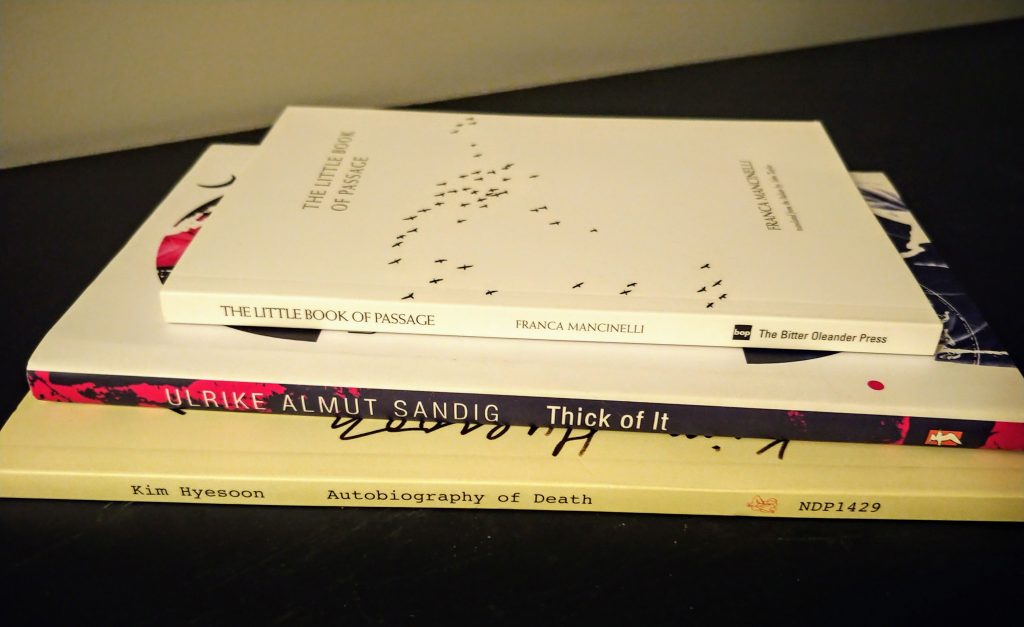
From the bottom up:
Korean poet Kim Hyesoon won the 2019 International Griffin  Poetry Prize for this book Autobiography of Death, a cycle of 49 poems and one longer piece inspired by national tragedies and personal experience. Her daughter’s distinctive illustrations accompany this powerful collection translated by Don Mee Choi.

Thick of It by German poet Ulrike Almut Sandig, translated by Karen Leeder, is a wonderful blend of the magical and the everyday. Fresh and alive.

Finally, Italian poet Franca Mancinelli’s The Little Book of Passage, translated by John Taylor, is a spare and delicate collection that invites rereading. Earlier this year she and I were able to meet and spend a few days together in Calcutta when my visit happened to overlap with a residency she was doing in the city—evidence that reading the world makes the world smaller in unimaginable ways!

*

Second, I wanted to highlight a book I recently reviewed that I am afraid has not had the attention it deserves:

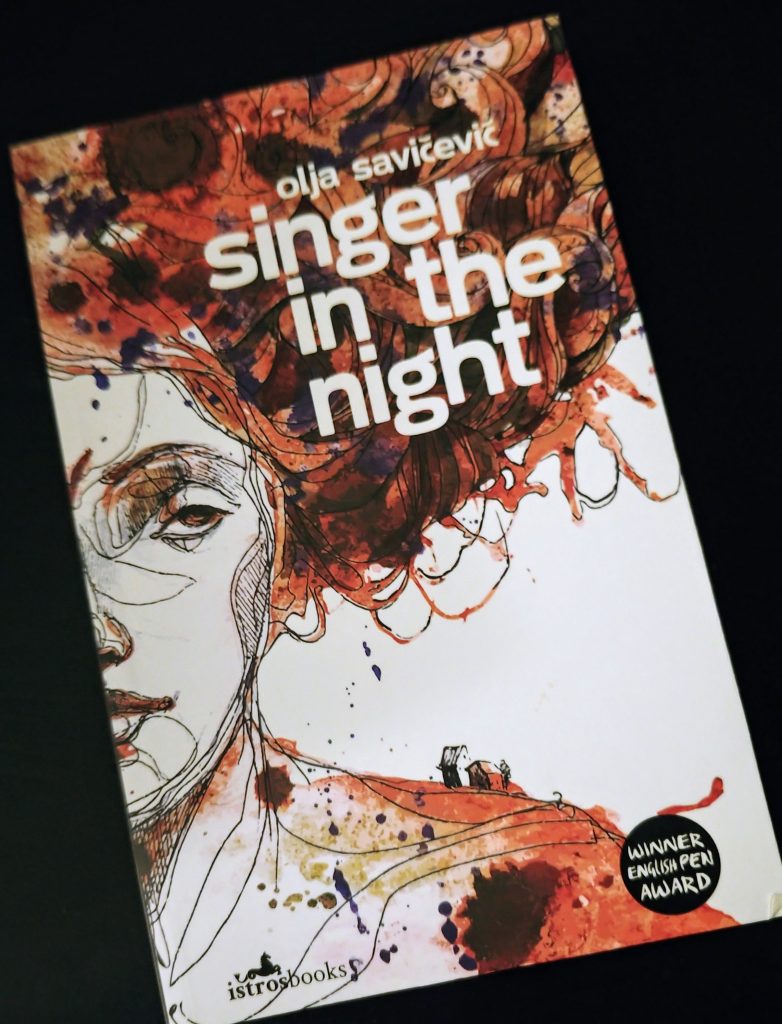
Croatian writer Olja Savičevič’s Singer in the Night features a wildly eccentric narrator and a highly inventive style to tell a story that paints a serious portrait of the world that her generation inherited after the break up of the former Yugoslavia. Translated by Celia Hawkesworth, this book is already available in the UK and well worth watching for when it comes out on October 1 in North America.

*

Third, I have an impressive stack of Seagull Books by female authors that I am ashamed to say I have not read yet (save for the poetry title tucked in here). The interesting thing for me about this selection is that although I did purchase many of these books, other titles arrived as unexpected—but very welcome—review copies by writers previously unknown to me.

Most of the above are German language writers; two, Michele Lesbre and Suzanne Dracius are French, the latter from Martinique. The review copy at the bottom of the stack is East German writer Brigitte Reimann’s diary I Have No Regrets.

*

Finally, I wanted to include a couple of translated titles by Indian women writers. Two vastly different offerings.

Translated by Kalpana Bardhan and published by feminist press Zubaan, Mahuldiha Days is a novel by Anita Agnihotri, one of West Bengal’s best known writers. She draws on the decades she spent in the Indian Administrative Service in this story of a young civil servant caught between her obligations to the tribal community she is working with and the state.  By sharp contrast, I Lalla, gives a fresh voice the poems of fourteenth century Kashmiri mystic poet, Lal Děd. A detailed introduction by translator Ranjit Hoskote provides a fascinating background to her life and the tradition to which she belonged, opening a world little known to most Western readers.

*

So, what are my best laid plans for this month? I would like to read one or two titles from my Seagull stack—not sure which—and I have a new Istros title Wild Woman by Marina Sur Puhlovski on my iPad in PDF format, but the following three books have been patiently waiting for August:

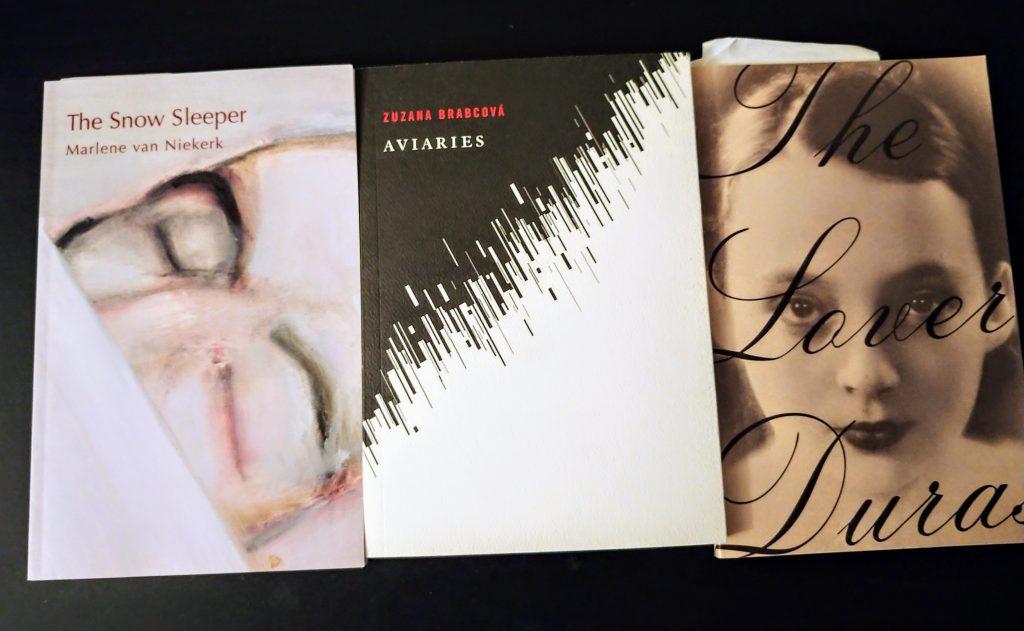
The Snow Sleeper by Marlene van Niekerk, translated from the Afrikaans by Marius Swart, is a recently released collection of short pieces, including “The Swan Whisperer” which was published as part of the Cahier Series.  I ordered it as soon as I heard of it—new van Niekerk is a rare and special treat.  Aviaries by Czech writer Zuzana Brabcova caught my attention when fellow readers and reviewers started talking about it so it’s another title I sought out when it was released here this spring. And last but not least, Marguerite Duras’ The Lover is a book I’ve been meaning to read for years now. Will I fit it in this August? Time will tell. And, of course, I reserve the right to change my plans altogether…

The nice thing about books is that, at least with the old fashioned solid form variety, they don’t vanish at month’s end if you don’t get to them. They will still be there on the shelf waiting no matter how much time I do or do not have to read amid all my other projects on my plate this August!