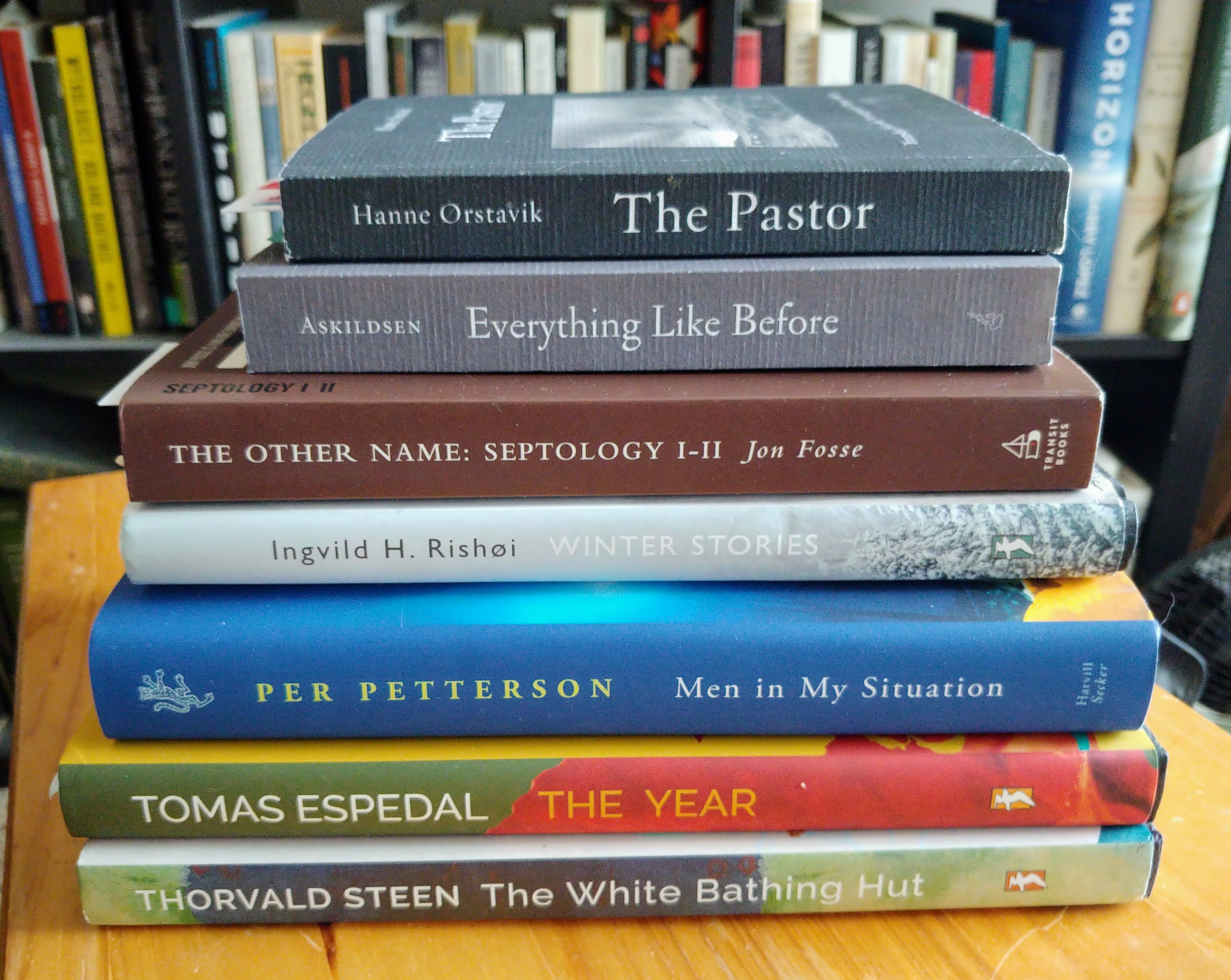
“We know something of ourselves, but not much.” The White Bathing Hut by Thorvald Steen

Beneath my clothes there is 1.8 square metres of skin stretched over five litres of blood, thirteen billion nerve cells and twenty-five billion red blood corpuscles.

I’ve got twenty-three chromosomes in each cell.

The chromosomes in each pair are the same length, apart from the fourth. There, one of the chromosomes is fractionally shorter than the other.

That’s why I can’t get up and walk out of this text.

One might hope that, at this point in time, especially more than two years into a global pandemic, that illness and disability might be understood as something that could strike anyone, at any time, even you or someone you love. But, as we have seen, human beings have a stubborn capacity to blame those who fall ill, experience extended symptoms or die for their outcomes, citing age, lifestyle, or co-morbidities. The stigma and shame well known by those of us who live, love someone and/or work with people who have a disability, has been replayed and reinforced  during this extended period of co-existence with a persistent, evolving virus with unknown long term consequences.

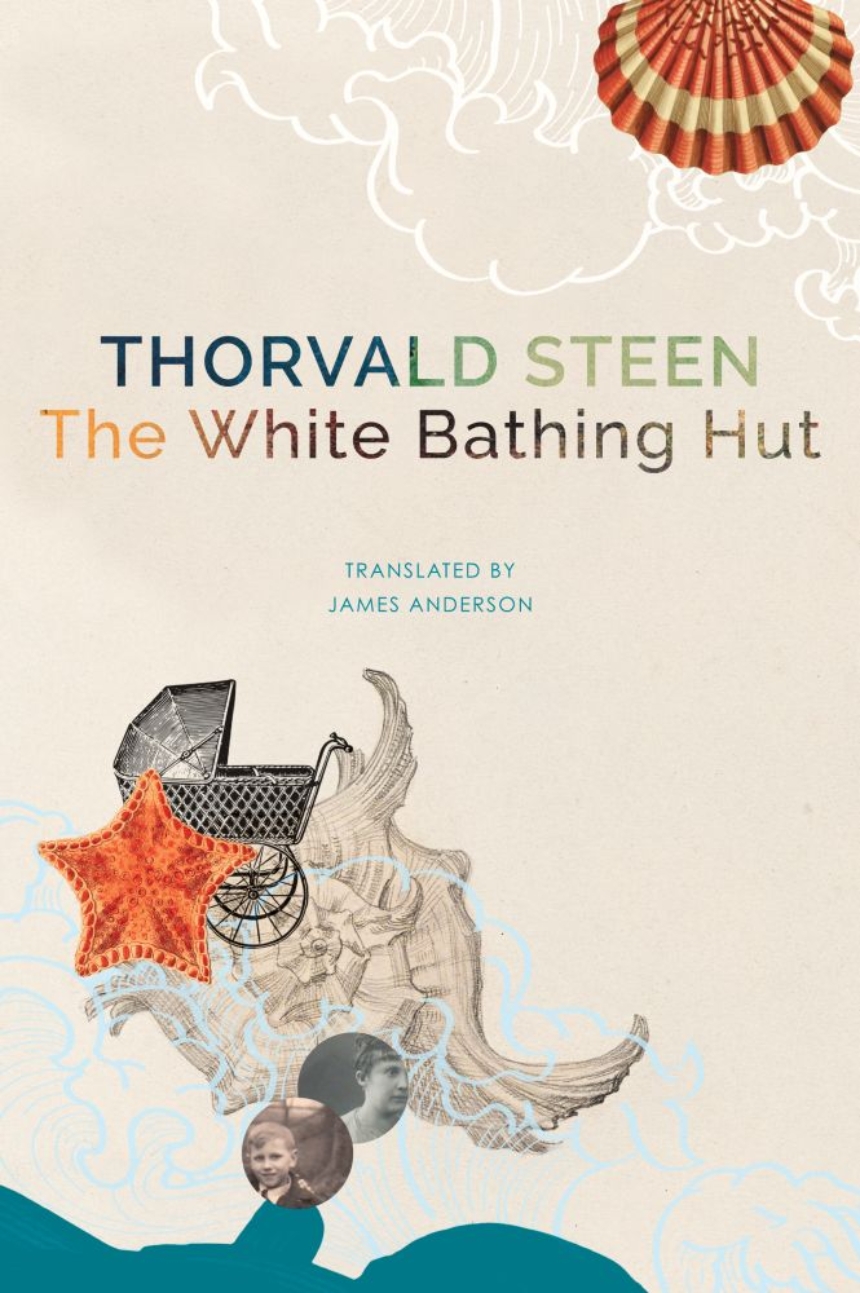
The events chronicled in Norwegian writer Thorvald Steen’s The White Bathing Hut illustrate the extent to which societal attitudes toward disability can lead to deception and family dissolution. The unnamed narrator is a man nearing sixty whose deteriorating physical condition has left him dependent on a wheelchair. One day, with the Christmas season approaching, he receives a call from a woman who identifies herself as his cousin, the daughter of his mother’s brother. The existence of an uncle and a cousin come as a complete surprise to him, but, as this woman, Eline, explains, his family had refused to have anything to do with hers and she had only come to know of him by chance. She also reveals that her father and their mutual grandfather both died of the same disease he has. This unexpected information leaves him wondering if his entire life was constructed on a web of lies and sets off a chain of urgent inquiries. His account unfolds through a spare, tight narrative reported from an unusual perspective, so to speak.

Several weeks after Eline’s call, while seated at the table trying to find a location on a map of Norway, our narrator leans forward, realizing too late that he’s forgotten to apply the brakes of his wheelchair, and he and the chair topple over as if in slow motion, each movement described and dissected in poetic and anatomical detail. “I land in a heap. / Soft and hard. / Textiles, hair, flesh and bones. / That’s all there is.” His wife has just left for a week-long business trip, his daughter is away for the weekend and his caregiver is off for the holidays. His phone and alarm are on top of a shelf out of reach and he is now consigned to a new vantage point… the floor.

Unable to get up, his thoughts turn to his own past, to the development of his disease, and the more recent investigations and interrogations triggered by his cousin’s phone call. He had been diagnosed in his teens with a progressive form of muscular dystrophy that causes gradual muscle degeneration and eventual paralysis—news that was a terrible blow to him as an athletic young man with a promising future as a ski jumper. But the reaction of his parents was even worse. They warned him to tell no one. They refused to speak about it. Tried to wish it away. So he was burdened with a secret that slowly unveiled itself as his muscles weakened. Now, armed with new information there is a further significance to his desire to better understand his place within the broader context of his family history: his daughter Karoline appears to have inherited the same crippling condition.

The spare, tight narrative proceeds in short, nonchronological chapters that move between the protagonist’s childhood, youth and adult years, and the few weeks that have just passed. He has recently made two visits to his recalcitrant mother who informs him she is dying of cancer but refuses to answer his questions. What little he can glean guides his search through archival sources for biographical details about his uncle and grandfather. As he looks back over his personal life experiences, his efforts to conceal his pain and growing weakness—often by putting himself at risk—is contrasted against the demonstrations of physical strength that marked his earliest years. The increased awareness of body difference and stigma lead him to believe he will be forever unloveable. As a young man, his future, as he sees it, looks bleak:

How could I make a plan of any kind? I didn’t know what I’d look like or be able to do in a few years’ time. I hated my body. If anyone had told me that I ought to think positive, I’d have hit them. The weekends were the worst. Sometimes I lay in bed the whole of Saturday and Sunday without the energy to sit, eat or drink. In the mirror I could see that a few of the little muscles around my eyes and mouth had completely disappeared.

This is a very physical text. A story that is bound to the body. Driving this physical aspect home are the poetic interludes, often containing minute skeletal and cellular descriptions, that regularly relocate the narrative in the immediate space, on the floor, where the narrator observes his surroundings and struggles to shift his reluctant limbs into a position that might enable him to push himself up. It is an exhausting, futile effort. With a steady resolve he returns to his account.

Although the disability central to this novel is explicitly visible, The White Bathing Hut manages, without ever exercising a heavy hand, to call attention to the extent to which any disability—physical, cognitive or mental—is met with a social stigma that extends beyond the afflicted individual to the family and their contacts. It also alludes to an even darker subtext, that of Norway’s difficult historical relationship with eugenics. Of course, neither of these factors are unique to Norway, nor are they entirely behind us. Shame associated with disability still exists, and the ability to selectively control for desired sex, against congenital conditions, or even for other qualities raises serious ethical questions. Through this book’s very honest, resilient and endearing narrator, many of these critical issues are brought to light.

The White Bathing Hut by Thorvald Steen is translated by James Anderson and published by Seagull Books.

Suspended between human and animal: In the Eye of the Wild by Nastassja Martin

The sounds I hear are enhanced. I hear like a wild animal, I am that wild animal. I wonder for a moment whether the bear will come back to finish me off, or to be killed by me, or indeed for us both to die in a final embrace. But I already know, I sense, that this will not happen: he is far away now, he is stumbling through the high steppe, blood dripping down his pelt. As he is farther away and I look deeper into myself, we each regain our self-possession.

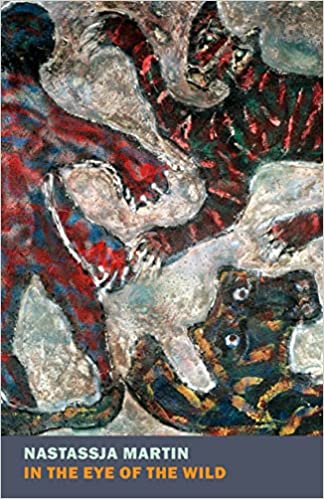
The opening passages of French anthropologist, Nastassja Martin’s In the Eye of the Wild are strangely surreal. She has just had a violent encounter with a bear on the Kamchatka Peninsula region of the Russian Far East, awaiting rescue. She is in a lucid state, numb, acutely aware. but her preternatural sense of connection with the animal who has wounded and disfigured her sets the tone for the account of physical and psycho/spiritual recovery that follows. Devoid of pathos, it is a tale of self-observation, ethnographic insight and the drive to understand what has happened—not from the angle of Western medical science, but from that of the Evens, the Indigenous people she had lived among and worked with in Siberia for four years.

Martin’s voice is most striking. Throughout her often quite horrific hospital ordeal, first in Russia and later in Paris, she does not hide her anger, frustration and physical agony. Her injuries are extensive, to her face and leg. Her jaw needs to be reconstructed—twice because the French doctors don’t trust the Russian work—and there are serious complications. Following a visit from the surgeon after a successful operation, she reflects on her body, her being, as an occupied territory under siege:

Recovering from this clash is not only an act of self-focused metamorphosis, it is a political act. My body has become a territory where Western surgeons parley with Siberian bears. Or rather, where they try to establish communication. The relationships being spun within the little country my body has become fragile, delicate. It’s a volcanic country, landslides can happen at any moment. Our work, hers and mine, and that of the indefinable thing the bear has left deep in my core, consists from now on of “maintaining the lines of communication.”

Existential questions drive the narrative—not why did I survive?—but a deeper examination into the intrinsic meaning of the experience. In this, dreams become essential to piecing together an understanding and acceptance of the relationship she has forged with the bear.

As soon as she is allowed, Martin retreats to the solitude of her mother’s home in Grenoble. Here she reads, speaks with her therapist on the phone, and tries to articulate the symbolism of what has occurred. She seeks precision in her choice of words—an attention that shines through in Sophie R. Lewis’ translation—but something deep has been destabilized that is not conforming to her intellectual instincts. She is not, as her therapist has advised, at peace. In truth she knows that she has not been inclined to seek to facilitate peace in her life or social interactions. “I have never known what to do with peacefulness or stability; serenity is not my strong suit,” she says. This self-evident prickliness, casts the narrative in a light not typically found in survival memoirs while her years spent among Indigenous communities, first Alaska and then Kamchatka, and her academic study of animism, have informed her encounter with the bear in a way another unfortunate hiker on a short excursion into the mountains would likely not. There is a notion of destiny and an element of suspension at the threshold of human and animal that cannot be explained by the park warden or naturalist. The anthropologist can only begin to heal by returning to the wild.

Her mother is decidedly unenthusiastic when she announces that she must go back to Russia. Barely recovered physically from her multiple surgeries, she is determined to leave. So, only a few months after the original incident, Nastassja Martin is again deep in the forests of Kamchatka, staying in a small cabin with Daria and her son Ivan who have become like family over the years, and other relatives that come by. It is the middle of winter; she joins in the necessary tasks and activities of the day, fetching water, setting traps, and gathering the wisdom and answers she needs to finally begin to process the journeys—internal and external—she and the bear have taken since their paths first crossed.

In the Eye of the Wild is an account that captures the way that the intellectual and the emotional can be at odds in the attempt to put meaning to a major trauma or loss. Martin is, by turns, angry, philosophical, and numb. The ethnographic has suddenly become profoundly personal and no amount of book knowledge can resolve it. The boundary has been blurred. This fuels her relentless determination to face down, if not the bear itself, the dreams he has bequeathed her. The result is an inspiring account that demonstrates an abiding respect for both the animal and the only people she knows can truly help her understand not what happened, but why.

In the Eye of the Wild by Nastassja Martin is translated by Sophie R. Lewis and published by New York Review of Books.

Two poetry collections read in January: Losing Touch by Magda Kapa and Small Talk by Stephan Delbos

Blogging, reviewing, and online book banter has brought writers, translators, and small publishers into my life that I may never have encountered otherwise. This is the beauty of a community of readers and book lovers that knows no borders. Last month I read two new collections by poets I came to know through this virtual literary network, both of whom I have read before: Magda Kapa and Stephan Delbos.

Greek-born Germany-based poet, photographer and teacher Magda Kapa captures small, finely observed moments in her poetry, sharing it on her blog I Was Not Born in English along with her photographs. Her new collection Losing Touch features spare poems that follow a form she credits to poet George Szirtes—3 stanzas of a haiku-like form followed by a single stand-alone 5-syllable line. As Covid came into our lives in early 2020, following Szirtes’ lead, she began capturing her response to the pandemic through these small structured poems. I have long followed her posts and have her earlier collection, All the Words, so as I read this new volume which chronicles the days, perhaps 8-10 times per month, from March 2020 to February 2021, I felt like I was sometimes encountering old friends in poems and lines that I myself had quoted and shared with others. Her images are sharp, her verses visually and emotionally astute:

8th June

Late afternoon light
falling sideways through gate doors,
marking lines on walls.

Inside us, self-drawn
lines too, implacable bars
that one gets used to.

As light shapes darkness,
lines like tears, marked days,
years, marked centuries.

Our secret sketchbooks.

Although deceptively simple, these poems carry the poet’s immediate response, in the moment, to the way the pandemic has strained and altered our connections, our expectations and our dreams. As they evolve across the first year of Covid, they capture changes we can all relate to. There is the inability to understand, and the fear and uncertainty of the early days marked by anxious nights, an increasing focus on the interiority of our individual existences and necessary distance from loved ones. Alongside the changing pandemic reality, other realities also intrude, marked as appropriate, by hashtags denoting BLM, climate change, the Lebanon explosion.

When Covid hit I was editing for an online journal and it seemed we were inundated with pandemic submissions. We even ran our own series. It felt like a quickly saturated market, but now, as we move into the third year, I am grateful for records like this that speak to the early ebb and flow of emotion, but I know well that the final story is yet to be written. Losing Touch, beautifully illustrated with drawings by Elizabeth Adams, is a moving testament to the distanced, sometimes surreal and melancholic, unwelcome new normal we are still navigating two years later.

Losing Touch by Magda Kapa is published by Phoenicia Publishing.

* * *

I first became aware American poet and translator Stephan Delbos as co-translator of Vitězslav Nezval’s The Absolute Gravedigger. I then read and reviewed Light Reading, his collection of sparse, fragmentary poems. Long based in Prague, he was named the first Poet Laureate of his hometown of Plymouth, Massachusetts in 2020 and his new collection, Small Talk, spans both of his homes in Europe and the US. In doing so, it also covers a broad range of themes and settings. Vivid images from the streets of European cities meet childhood Cape Cod memories meet poetic tributes to Michael Jackson and Aleksandr Solzhenitsyn and a chilling nursey rhyme style memorial to four boys killed on Gaza Beach.

However the highlight and centrepiece of this volume is the extended sequence “A Child’s Guide to Candor,” dedicated to his first child. By turns domestic, nostalgic and hallucinatory, a new father marvels at the wonder of a new life, a new role, and all of the dreams and fears that entails.

I dream of weeping on ice skates,
Olympiad Chorus swarming,
knife-bearing ceremony;
dream of burglars tearing books
and wake to the slumber of my son;
silence
of midnight hockey rinks
hovers in the house.

He implodes the luscious
fruit of dreams
fists tight as figs.

As he adjusts to his new role as a parent, the poet is flooded with an array of images drawn from his own boyhood, the adventures and the anxious moments, with knowledge that his child will have to face his own formative experiences—in time. He watches as his own parents settle into their new roles as grandparents and reflects on the generational shifts.

What is family?
Blood architecture.
Seasons of mind.
Rooms and furniture.
Bottles of words.
Charted worries.
Bookshelves of names.
Living photographs.
Lost property.
A story written.
of flesh and forgiveness.

The surreal strangeness of the early months and years of parenthood are so beautifully captured in this series of segmented poems— a personal celebration of new life in the world that reminds us that the future belongs to our children, in an individual and collective context, something we cannot afford to forget in these volatile times.

Small Talk by Stephan Delbos is published by Dos Madres Press.

“I wanted to bind up a wound”: The Pastor by Hanne Ørstavik

Who was I? Everywhere I went, something broke or became distorted. What had I thought? That by travelling to somewhere else on the map I would arrive at some new place in myself? A place in me that was good and warm and worthy of love?

Set deep in the endless night of an Arctic winter, The Pastor by Norwegian writer, Hanne Ørstavik, is a novel that pushes into that darkness—on an emotional, spiritual, and historical level—in search of some glimmer of clarity, some sense of meaning in an uncertain, insensible world. Yet, rather than reaching any absolute truths, the internally focused narrative rides on a current of relentless speculation and questioning, becoming a melancholic testament to the inadequacy of language to isolate and contain our thoughts and feelings, and the barriers we often erect that keep us from being able to communicate what cannot be articulated in words. Yet out of this sombre landscape emerges a tale of quiet beauty.

The troubled narrator, Liv, is a theologian who has abruptly abandoned her PhD studies in Germany, following the tragic death of her friend, Kristiane, and accepted the position of adjunct pastor in a small town in the far north region of her native Norway. When we meet her, she has been in this new role for one year. She seems to have achieved a certain state of equilibrium with her skeptical parishioners, and a companionable relationship with the recently widowed woman she has invited to live on the main floor of the parsonage with her two daughters. As well, the relative proximity to the site of the 1852 Kautokeino Rebellion, the Sami uprising against Norwegian settlers, allows her to continue her longstanding academic investigations into the events and the role the understanding of Biblical language might have played in inspiring the Sami’s attack. But it has not been easy. Her brief friendship with Kristiane and the circumstances surrounding her suicide continue to haunt her while she worries that she will always be an outsider, emotionally distant from others and from God.

Unfolding over the course of one week, the novel opens with our unlikely pastor officiating communion. Her thoughts go back to Kristiane, to her decision to move, her hopes for her new home, and the very unfortunate first impression she made in the church. This continual cycling of memories, sometimes shifting from present to past and back in the same paragraph, drive the narrative forward, slowly filling in more of the details, discomforts, and unresolved doubts she carries. An imagining of the Sami rebellion, augmented with historical records, is also woven into the broader tapestry. In the present moment though, it is a call to attend to the parents of a suicide victim, a nineteen year-old girl who has hung herself from a fish drying structure out on a barren piece of land, that triggers Liv’s immediate crisis of identity and faith. By the end of the week, she will have been tested, or rather, will have tested herself against a variety of circumstances that she  struggles to meet.

The challenges Liv faces all revolve around her inability to physically bridge the gap between herself and others—to reach out a hand to a grieving parent, respond to a man to whom she is attracted, recognize signs of depression in someone close to her—a skill she perhaps imagined the priesthood would magically confer upon her. She recognizes what she wants to do or say, imagines it, but fails to follow through. Again and again. Key to understanding her crippling inhibition, she believes, is her brief friendship with Kristiane. At forty-one, seven years her senior, the German woman was a puppeteer with her own workshop and theatre. A definite counterpoint to the serious theologian. Liv saw in Kristiane a lightness of spirit, and an apparent self-confidence that she craved. She seemed at ease in her body and her being, quick to laughter, her crooked teeth flashing—an image Liv cannot forget. They only knew each other for forty days, but Liv is obsessed by the fear that she failed her friend:

Weightless. I was so heavy myself, and all I saw in her was what I needed. Was that it? I didn’t realize that the light in her was turned up too bright, like a film going completely white until the image disappears. Was that the way it was?

If she was aware of an intrinsic “heaviness” before encountering Kristiane, her death untethers her completely. She carries this disconnect with her all the way back to Norway. Recollecting the long drive north she says:

I drove slowly. The flat, open vista seemed to make everything so plain, but still felt like I couldn’t get a hold on anything, as if I was so very far away. The road, stretching out in front of the car, the landscape, the steering wheel I gripped between my hands. My mind was a haze, as if there were no thoughts left to think. It was like I was driving over the back of some great beast that could get to its feet at any moment and shake me off. I wasn’t attached to anything, wasn’t a part of anything.

Liv is wounded. She is ever aware of her failure to connect, feeling outside, separate. She reminds herself that she is a pastor, that people depend on her for comfort, and then wonders again whatever possessed her to choose the ministry as a career when she herself is so uncertain, so ungrounded, so afraid that she will fall and that there will be nothing or none there to catch her. Isn’t that what everyone needs to have? Some kind of faith?

As it moves through the vast, eerily lit northern Norwegian landscape, The Pastor relies on the reader’s ability to connect with a protagonist so estranged from herself. Some might find Liv frustrating, but in its winding, lyrical passage, her narrative contains great depth and mounting tension. As someone who has experienced difficulties with mood regulation, I found Ørstavik’s portrait oddly familiar. I was not surprised to hear in an interview that the author was coming out of a serious depression when she wrote the book almost twenty years ago—she captures the disjointedness of thought so well. And it’s a sensation most people have probably known at some point or another. For example, when Liv is rushing back to town having learned of another tragic incident, this one much closer to home, her thoughts are suspended, frozen: “I tried to think about what I was thinking about. My thoughts wouldn’t think.”

Martin Aitken’s sensitive translation maintains an atmosphere of profound longing for connection and contact, for the touch to fill the unspeakable space, a gesture that can be so hard to give or accept. That is at the core of Liv (and her name means “life”)’s existential discontent. There are many unanswered questions in The Pastor, but small cracks appear and spread slowly, and there is the hope that what one tragedy broke open, a second tragic occurrence a year later might finally begin to heal.

The Pastor by Hanne Ørstavik is translated by Martin Aitken and published by Archipelago Books.

Each to his own “green truth”: Ponge, Pastures, Prairies by Philippe Jaccottet

Ponge, Pastures, Prairies is more than a simple tribute to French poet and essayist Francis Ponge by fellow poet Philippe Jaccottet, it is a deeper examination of the way creative influences sift through a writer’s own process of literary development. The two men first met in 1946, when the latter was barely twenty years-old and, as Jaccottet recounts, he imagines that, though he said nothing, the older man likely had his reservations about his youthful lyric enthusiasms. Nonetheless, a friendship between them would form and continue for over forty years. When Ponge died in 1988 at the age of 89, Jaccottet was among the mourners at his funeral in a rustic graveyard in Nîmes. It is with his reflections that day—a piece intended to stand alone—that this small, special book has its origin.

The funeral was a modest affair on a bright summer day, but it was not one without qualities that seem to Jaccottet oddly fitting for his friend. The pastor arrived quietly by bicycle and chose to recite the 23rd Psalm beside the family vault, “because the deceased was a poet.” King David’s ode to his heavenly shepherd and “green pastures” was followed by a simple reading of Ponge’s “The Meadow” by actor Christian Rist:

“Carried away suddenly by a sort of peaceful enthusiasm / In favor of a truth, today, which is green. . .” This kind of albeit distorted echo, over some thirty centuries, was thus perhaps even stranger and more striking than the rest (the vast, noble, abandoned cemetery and this burial, as if for an unknown person, of a writer so legitimately famous).

This juxtaposition sets the scene for Jaccottet’s homage to Ponge—a poet whose domain was the minute examination of the everyday—calling attention to his commitment to a “green truth” and the remarkable vigour with which he defended it. A sketch of a strong character, given to both “excessive intolerance” and “most generous enthusiasms” emerges, composed in the emotion of the moment of loss. It is not surprising, then, that despite the many formal arguments he had offered in praise of his friend over the years, Jaccottet felt a personal need to articulate what essentially separated him from Ponge’s work. So he started to write a follow up.

However, the expansion of this text into its final form was not an immediate or obvious project. In his Postface, written in 2013 when he was preparing for the original French publication, Jaccottet admits that he was not inclined to work his sentiments through to a natural end. Others encouraged him to think otherwise, but still he delayed, out of laziness or, perhaps, out of fear that entertaining his reservations might be disrespectful to a man he had continued to admire and think of with great affection. But this recognition of the complex interplay of influence and divergence, explored with a perspective stretching over more than two decades lends depth to this slender volume.

Jaccottet begins with a consideration of two of Ponges’ heroes: François de Malherbe (1555-1628), the French poet and critic who insisted on strict form, restraint and purity of expression, and composer Jean-Philippe Rameau (1683-1764) whom Ponge proclaimed as the artist who interested him more than any other with a style “of the kind that awakens: male, energetic, and  ardent.” If these men spoke to the inspiration that charged his friend, Jaccottet takes care to look at how his own response and tendencies diverge. As he moves on to discuss the way their approaches to writing start from contrasting points of view or ways of looking—one precise and object-oriented, the other lyrical trial-and error experimentation open to the “fleeting impression.” However, even if the origin and ends differ, he can acknowledge that his thinking on questions, such as the “enigma of purity” has been influenced by Ponge’s concern with that which is “pure” or “true.” One’s questing can be furthered, after all, in discourse with those whose creative inclinations deviate from one’s own. And throughout this text, Jaccottet is careful to reiterate his respect and fondness for Ponge, a feeling that he is assured in reviewing the volume of correspondence they exchanged over the years, was returned.

Ponge, Pastures, Prairies offers a tribute and a uniquely honest, yet sensitive critique. Jaccottet writes very thoughtfully, entertaining ideas about poetry, death, and the particular dynamics of the relationship between himself and Ponge in a manner that does not require a deep familiarity with the work of either man. In this regard, the extensive footnotes, based on Jaccottet’s own but expanded by translator John Taylor, are helpful and informative. I will confess that I have acquired more than a few volumes of Jaccottet’s work over the years, but until this time I’ve not seriously engaged with any, feeling, perhaps, a little intimidated or uncertain where to start. This book has ignited my interest and opened the door or, as Jacottet might say, a crack in that wall.

Ponge, Pastures, Prairies by Philippe Jaccottet is translated by John Taylor and published by Black Square Editions.

The seasons of love and death: The Year by Tomas Espedal

When something hurts
you shouldn’t avoid it
no
you should meet the worst
with all your weakness
and allow yourself to be destroyed.
You should seek out loneliness
to feel that you are alone
to feel that you are desolate
to feel that you have loved
to feel the love
that can obliterate you entirely.

Norwegian writer Tomas Espedal’s uniquely autobiographical fiction rests close to his own life. From one work to the next, his narrator, ever aging as he does, is restlessly questing, his explorations at once intimate and yet maintaining a certain personal distance, or opaqueness. In his last book, Bergeners, his protagonist, in his early fifties, is seeking to understand the meaning of home as he tries to adjust to both the departure of his adult daughter and the unexpected loss of his girlfriend. He wanders the streets of his hometown and travels abroad, but cannot escape the deep loneliness that settles into his bones. Now, with The Year, his most recent work to be released in English, a few years have passed but Espedal’s fictional Tomas has been unable to let go of his love for his former girlfriend, Janne, and now, wondering if he is destined to spend the rest of his life alone, he seeks advice from another man who loved only one woman, from his first sight of her to the end of his life—Francesco Petrarch.

Thus, The Year begins on a meditative, melancholy note. Our narrator states that he wants to write a book about love, with the initial objective to record the events of each day for an entire year. Ah, but where to start? He decides upon the sixth of April, which is, appropriately, the day in 1327 when Petrarch first set eyes on his beloved Laura, the date in 1348 that she died, and the framework within which he structured the 366 poems that comprise his great Canzonniere—his celebration of his boundless affection for the woman he loved so faithfully, from afar and forever. So, on the sixth of April, seven centuries later, another lovelorn man is making his way by train to Avignon, and then by foot to Fontaine-de-Vaucluse to stay for a time near the house that Petrarch built there. And we are with him, riding along on the flow of his thoughts. Bergeners combined a mix of fragmented poetry and prose, but The Year is a novel written entirely in free verse, a compulsively readable style that very effectively captures the protagonist’s reflective, frequently repetitive and increasingly neurotic consciousness.

Having already spent a year immersing himself in Petrarch’s writing, the narrator is on a sort of pilgrimage. If the Italian poet could love so completely and purely, he must have known something about living with the one he loved. After several weeks living in the area, it is time for him to approach the master directly. On Easter Sunday, an imagined encounter and walk along the river occurs, echoing the Petrarch’s imagined discourse with Saint Augustine recorded in his deeply personal Secretum. They even stop at a café where the narrator’s ghostly companion challenges him, accuses him of being banal, and shares some of the wisdom the saint disclosed to him. Still, the unanswerable question remains: How is it possible that love remains, year after year, even after the one you love has left you and hurt you so deeply? How?

After tracing and retracing Petrarch’s steps and agonizing over his peculiar predicament and the way it has left him emotionally paralyzed, it is time for the protagonist to move on. There’s a writer’s festival to attend in Montpellier where he drinks heavily, has a brief encounter with a woman, and escapes from the hotel the moment she starts to talk about catching up with him once he is back home in Norway. He catches the first southbound train. The atmosphere and mood has shifted.

There’s nothing better than being inebriated
on a fast train at such high speed racing away
from everything you’ve done as a stranger
in a strange city it’s almost
as if you’d never been there I say
aloud and drink some wine
write in my notebook I’m back
to normality writing and drinking
on a journey on the train
the first of May
under way
to or from
it makes no difference
it’s good to be on the move
it’s good to be nobody.

In Barcelona he has arranged to meet his father, for a time panicked that he won’t find him among the mass of tourists arriving, then disappointed to see how old he looks when he does. Together they board a luxury cruise ship, a self-contained city of its own where the days pass, their calendar designations blurring. Our middle-aged narrator seems to view his father with a mix of admiration and contempt. The older man, who has lived by himself since his wife died seventeen years earlier, now clearly shows the weight of his age. This triggers a range of complicated emotions in his son who is secretly fretting about his own life unfolding empty and alone to the end. When, sitting in the ship’s casino, his father says something he knows well—all my life I’ve loved just one woman—the truth suddenly hits home:

He’s always been what I shall become.
All my life I’ve loved just one
woman they’re my father’s words and
they’re Petrarch’s words in a letter
to Boccaccio
and as I’d searched for Petrarch’s history
I had without knowing it
searched for my father’s history
I’d searched for a love story
which I thought was my own.
I’d searched for my father
here he sits
and I hardly see him at all.

I know only too well
why I don’t see him
it’s because I
resemble him.

Father and son, hard-headed, each with a fighter’s instincts and a stubborn inability to let go of love, are an odd, yet endearing pair. The narrator cannot help measuring himself against his father, for better and worse. The dynamics of their relationship plays out while we learn more about the circumstances that led to Janne’s leaving and discover our protagonist is nursing not only an unhealed broken heart but an unresolved grievance. The tension rises as he hatches a plan to resolve it.

The Year is book that, by virtue of its internalized poetic narrative, moves swiftly, swirling around a core set of ideas or, shall we say, obsessions, but shifting and changing shape along the way. In the early pages I took a little time out to glance sideways into Petrarch’s life and writing, but as the narrator’s short pilgrimage draws to a close one soon comes to understand that although he can be meditative and thoughtful, he can also be neurotic, edgy, and a man with a tendency to drink too much. Through this year, spring to autumn, Petrarch continues to surface, as does the initial reflective tone and, amid the ongoing questioning of life, love and death, profound, wide-reaching observations are raised, anchoring Espedal’s work, as ever, in the world in which we all exist.

The Year by Tomas Espedal is translated by James Anderson and published by Seagull Books.

A special type of perception: Responses · Kafka’s Prague by Jiří Kolář

I first encountered the work of Jiří Kolář (1914-2002), one of the most important poet/visual artists in post-war Europe—a man for whom the two descriptors very often went hand in hand—through A User’s Manual, first published in English translation in 2019. This intentional pairing of his so-called “action poems” written in the 1950s and 60s with collages from the series “Weekly 1967” was originally published together in 1969 and reproduced handsomely by excellent Prague-based indie press Twisted Spoon. Now, with the release of Responses · Kafka’s Prague, another of the Czech artist‘s idiosyncratic pairings, an intriguing overview of his opinions and reflections on the intersection of literature and art is set against a collection of his distinct “crumplages.” Again it makes for an unusual yet beautifully presented volume which also speaks to his creative processing as displayed in both this and A User’s Manual.

Responses is a sort of one-sided investigation, or what Kolář called an “imaginary interview,” a set of seventy-one answers without questions. Compiled in Prague and Paris in 1973, the topics covered include the development of his artistic sensibility, the writers, artists and movements that had an influence on him, and a discussion of technique. It has a thoughtful, conversational, musing-out-loud sort of feel and a sense of direction that is not explicit or artificial but gives the work a natural flow.

From the outset,  Kolář makes it clear that he sees art as part of the “general drive toward universal knowledge” and as such there can be nothing extrinsically new that is not a departure from that which is already innate to the practice. Art and literature are disciplines that do not create anything new so much as they create new ways of looking at (and using) what is already there, a “special type of perception.” As in science, artists are engaged in exploration and investigation, and those he admires, such as Mallarmé and those who followed in his footsteps, are those who become dissatisfied with the status quo. For Kolář this leads him to analyze and reflect upon what various poets were doing with language, and ultimately realize he had to dismantle language itself:

For me the destruction of poetic language followed the same path and the same type of perception as did a new and different perception in other disciplines. As I’ve already said, this is primarily the case in [modern] music and the visual arts. I was speaking about a type of perception — what I mean is that I couldn’t keep seeking poetry in the written word. I had to go beyond the written word. It meant finding another, living language.

There is a distinct restlessness to Kolář’s self-described poetic and artistic evolution, accentuated by the casual style of this particular discourse, but then he was working in trying times. Deemed publicly undesirable by the Communist government in Czechoslovakia he spent time in prison, saw the publication of much of his work delayed, and would eventually end up living in exile. Responses, however, is not concerned with political revolution, but rather with his artistic interests and endeavours, past and current. As translator Ryan Scott points out in his Translator’s Note, this work “should not be read as Kolář’s final word but as capturing a particular moment in time amid his creative flux.” Nonetheless, it makes for an interesting look into an original creative mind.

Kolář’s international reputation rests largely on his innovative collage techniques. He is so fond of printed materials—newspapers, letters, tickets, receipts—not only as raw materials but for the moment-in-timeness captured in them that one wonders how he would have adapted artistically to our increasingly digital environment. The present volume contains a series of “cumplages” constructed from photographs of buildings and landmarks in Prague, paired with brief quotes from Kafka’s writings. In these images, the shapes and angles of the structures are distorted, twisted and bent out of shape. The effect is quite striking and perfectly “Kafkaesque.” The process follows a specific routine, starting with moistened paper:

Crumpling must be done fast and carefully, and it’s difficult to predict results with this technique because it’s always the brother of chance. Because the moist paper is crumpled and the work has to be finished fast, hardly any adjusting can be done.

Later on he mentions that his “best crumplages were created from reproductions that readers had coloured themselves.” He delights in the touches human hands have left behind coming through in his art. Among the thirty-four images employed in Kafka’s Prague are buildings directly associated with the writer’s life, and other structures Kafka would have known well. (You can get a sense of the book here.) To have this work so beautifully reproduced in this book is a treat in itself, together with Responses it is an enriched experience.

Responses · Kafka’s Prague by Jiří Kolář is translated from the Czech by Ryan Scott and published by Twisted Spoon Press.

Saying farewell to 2021 with some of the books I loved and best wishes for the future

If 2020 was the year that my ability to read and write felt the numbing impact of a medicated mind, 2021 was the year I had to decide what was really important. My mind is still medicated, but with a drug that does not leave me mentally spongy like the one that I lived on for more than a year. There are pros and cons with any maintenance drug, but I realized that, all things considered, I was better off with the devil I know than the one that was pulling me under. So, by mid-September I began to feel a welcoming release from the haze I’d been struggling against and it became easier to engage fully with literature once again. My reading never stopped, of course, it only slowed, and as I gather my thoughts on my favourite books of 2021, I can see that half of the works I remember most fondly were read in the first two-thirds of the year. But I will admit that every review I wrote during that time was painful, as if pulling my own words together to talk about the words of others was a huge task. In the end, reading only feels like a complete activity if I can articulate a response to each book, regardless of whether it comes out in a “review” of some sort. It is only now that my capacity to read has been restored do I realize how truly impaired it was.

With 2021 and all its global and personal challenges slipping into the rear view mirror, I wanted to take a moment to consider my favourites of the books I read this year. I skipped this readerly ritual last year and, as ever, I am troubled by the fact that each such list necessarily leaves out so many excellent works because, quite honestly, if I am not enjoying a book I rarely feel inclined to finish it, let alone write about it here. So with that in mind, but sticking to a strict ten titles, here’s my contribution to the discussion.

First, my top three. One will be no surprise to anyone who follows my blog: The Last Days of Mandelstam by Vénus Khoury-Ghatta (tr. by Teresa Lavendar-Fagan). Probably the last book I read before transitioning off the troublesome medication, this imagining of the final moments of Osip Mandelstam against a tight, poetic flight back through his life thrilled me with its confident sense that sometimes less truly is more. In the reading I would regularly stop to think: How did she say so much with so few words? This is the work of an accomplished, mature writer. Apart from singing this book’s praises at every opportunity on Twitter, I spoke about it about on this video and recommended it in the December issue of The Bangalore Review.

The Book of Sleep by Haytham El Wardany (tr. by Robin Moger) is one of those books that defies classification—standing somewhere between fiction and nonfiction, it can best be considered an imaginative meditation on sleep and the sleeper that leans toward the philosophical in its grounding, but is unbound in its scope. Thoughtful, intelligent, inspiring.

Finally, I read some amazing poetry this year and as usual I found my limited formal understanding of the literary form a barrier to confident articulation of a response, but with Lost, Hurt, and in Transit Beautiful by Nepali-Indian Anglophone poet, Rohan Chhetri, I just wanted to scream READ THIS BOOK! It has disappointed me to see that this collection seems to have been under-appreciated in its US release (it was published simultaneously in India) because it is not only accessible, but gorgeous, and shockingly violent. Stunning.

The balance of my top ten (in the order that stacked best for the sake of a photograph) are:

If You Kept a Record of Sins by Andrea Bajani (tr. by Elizabeth Harris), is the story of a young Italian man who travels to Romania to attend to the affairs of his deceased mother from whom he has been long estranged. It presents a simmering, spare narrative—the kind of read that I responded to especially well with reduced focus and concentration—that resists the need for any tight resolution.

Outgoing Vessel by experimental Danish poet Ursula Andkjær Olsen (tr. Katrine Ogaard Jensen) is perhaps a little more brittle and restrained than Third-Millenium Heart but once again her work takes you on an operatic post-human, yet humane, adventure. Excellent.

Slipping by Mohamed Kheir (tr. by Robin Moger) offers a different kind of adventure into an otherworldly Egypt that is very much informed by a fragmented post-Arab Spring reality. Hard to follow at first, yet fun to read, with much uncertain resolution.

The Desert of Lop by Raoul Schrott (tr. by Karen Leeder). I had been saving this dreamy little volume, knowing that little of this Austrian poet’s work is available in English. The tale of one man’s relationships with three women, it is also a meditation on deserts and the search for home. Exactly the kind of undefinable book I treasure.

Wolfgang Hilbig’s The Interim (tr. by Isabel Fargo Cole) was an unexpected surprise. I’ve read almost all of his work available in translation, and was a little apprehensive about this novel, knowing that he is perhaps at his best in his meandering, surreal shorter works. But this much more conventional narrative featuring another iteration of the classic Hilbig protagonist felt somehow closer to the man himself—a hard drinking, socially awkward, reluctant literary “star” who cannot find a home on either side of the Wall.

With The Promise, South African writer Damon Galgut has finally won the Booker Prize after three nominations and somehow I fear that certain readers might eschew this book because he won this prize (yes we literary folk are a fickle lot). I have long been a fan, and although this book will never replace some of his smaller, quieter efforts in my heart, The Promise is a sweeping portrait of four decades of South African history through the lens of a mischievous high modernist narrator who is by turns, funny, caustic and clever.

And last, but not least, I was offered an opportunity to read a couple of fascinating MIT Press titles by virtue of ending up on a publicist list, and without that I would never have stumbled across Sandfuture by Justin Beal. This is one of those unlikely hybrid essays—a biography of Minoru Yamasaki, the Japanese-American architect who designed the World Trade Centre that is also a reflection on art, illness, urban planning and more—and it works remarkably well. I had so much fun reading and writing about this book that I can only hope that it comes to the attention of the audience it deserves.

For the New Year, I have no specific reading intentions, aside from a small winter project to read some Norwegian literature—no particular reason, I just have a few things piling up and it seems a suitable goal for the cold, dark  months ahead. I’m also hoping to ease back into writing again after a dry spell. Ideas are starting to trickle to the surface, I’ll see if they lead me anywhere. And otherwise I will probably continue my idiosyncratic literary meanderings and savour the ability to read at a faster, yet deeper pace than I was at this time last year.

Oh yeah, and if travel feels feasible again, I hope I might be able to pack my bags and catch up with distant friends by the time this old earth makes its way around the sun once more.  May you be warm, well, and have plenty of light to read by.

Image copyright Joseph Schreiber

Words are rocky tears: Alphabets of Sand by Vénus Khoury-Ghatta

Where do words come from?
from what rubbing of sounds are they born
on what flint do they light their wicks
what winds brought them into our mouths

Their past is the rustling of stifled silences
the trumpeting of molten elements
the grunting of stagnant waters

– from “Words”

My first encounter with Vénus Khoury-Ghata was with her novella, The Last Days of Mandelstam, a spare, poignant portrait of the Russian poet’s life and lonely death that I read several months ago. It left me keen to explore her poetry and prose further. I soon discovered that American poet and translator Marilyn Hacker has released translations of several collections of her poetry and one novella, so, uncertain where to begin, I opted for the evocatively titled Alphabets of Sand (2009) from UK publisher, Carcanet. A wise choice it turns out, because this collection draws on material from three of Hacker’s earlier US translations along with an insightful introduction.

If poets dwell in language, Khoury-Ghata exists in a world threaded with letters of alphabets scattered like sand in the wind or like stars cast against the blackness of the sky. Born in Beruit in 1937, into a French-speaking Maronite Christian family, the dual French and Arabic cultural and linguistic influences of her childhood animate her poetry and colour the world that she imagines—a place filled with magic and marred by misery. Although she has lived in Paris since 1972, much of her writing looks back to the country of her birth and its tragic history.

Alphabets of Sand gathers five poems or sequences and selections from a sixth. The title of this collection comes from the wonderful piece “Words” which plays with and celebrates language as a primal life form, born and nurtured in the soils of the continents of the earth, taking shape, searching for and finding tongues, mouths and speakers to breathe words into being. As such, language is a collaborative magic between nature and humankind:

Language at that time was a straight line reserved for birds
the letter ‘i’ was the cleft of a hummingbird
‘h’ a ladder with one rung necessary to replace a charred sun before nightfall
‘o’ a hole in the sole of the universe

Unlike the consonants with their rough garments
the vowels were naked
all the weaver’s art consisted of humouring them
in the evening they counted each other to make sure no one was missing
in the rocky countries men slept without dreaming

Khoury-Ghatta’s native Arabic and French speak to one another in the course of this sequence, their respective alphabets moving from left to right and right to left, but the Word she evokes, belongs to neither language but to all languages living and lost.

As translator Marilyn Hacker describes it: “Khoury-Ghatta’s work bridges the anti-lyrical surrealist tradition which has informed modern French poetry since Baudelaire, and the parabolic and communal narrative with its (we might say Homeric) repetitions of metaphors and semi-mythic tropes of poetry in Arabic.” She writes, as she herself puts it, “in Arabic through the French language.” The confluence of these traditions is especially evident in the poetry collected here. “The Darkened Ones,” for example, written during the 2006 war in Lebanon, adopts a communal voice of unfathomable depth—a chorus of women speaking to generations of the dead, displaced and disrupted—echoing the unanswered questions that accompany the sorrow and pain of senseless conflict.

An idiosyncratic personal mythology permeates the most powerful works here, a magical sense of place that pays tribute to a world where ghosts mingle with a shifting present. “The Seven Honeysuckle Sprigs of Wisdom” paints a portrait—by turns affectionate, coarse and funny—of the eccentric cast of characters who people a village where time is “in a hurry,” but the river “turns back toward its source.” The hairdresser, cemetery caretaker, beggar, shepherdess, prostitute, schoolmasters and others appear, alongside saints and spirits and a host of struggles and dreams.

However, it is the sequence of poems from “Early Childhood” that carry, for me, the most weight and shimmering energy. Central to these pieces, most of which are dedicated to individuals including the author’s sister, the writer May Ménassa, is an enigmatic mother figure:

I write Mother
and an old woman arises in the uncertainty of evening
slips into a wedding dress
stands on tiptoe on her windowsill
calls out to the hostile city
addresses the haughty tribe of streetlights
bares her chest to the clocks
shows them the precise site of her sorrow
disrobes gently for fear of creasing her wrinkles
and unsettling the air

My mother had her own way of undressing
as one would strip the medals from a disgraced general

The poems that comprise this sequence move from a familial to a wider universal sense of mother as teacher, keeper of wisdoms and memory. Language again features prominently, not simply as a alphabets deciphered in books, but as read in nature:

The books we browsed in came from the forest that watched us read
from the peeled bark’s shriek which continued under the pages’ skin
We read in the darkness of August
when the galaxy disposed of its excess stars
when, without  margins, night stretched itself out until night.

As presented, the lasting sensation that this collection leaves me with is one of the kindling of a connection with the roots of Khoury-Gatta’s poetic sensibility. Her love of language and her comfort with repeated metaphor—dead leaves, pebbles, wind, streetlights, stars, trees, alphabets—make sense within the context of her dual language, culturally rich upbringing. Again, I am left wanting to read more and know more. Now in her 80s, she has many honours and an extensive body of work to her name, most of which is yet to be translated into English. Nonetheless, I plan to explore more of what is out there in the new year.

Alphabets of Sand by Vénus Khoury-Ghatta is translated by Marilyn Hacker and published by Carcanet Press.

Retracing a snowy path into the past: Twelve Nights by Urs Faes

It seemed to him that a story told, a story from the past, would never truly fade once it had moved someone. The act of remembering, of reading, was like a return, a homecoming into a story. He was never closer to himself than in the remembered and read.

When I made note of this book last year, I imagined it making a nice pleasant read to fill some of that melancholy time around Christmas and I was not wrong. However, there were several things I had not anticipated. This year, as the holiday drew near, with my cat recovering from surgery, my son started drinking heavily, and all of our modest plans started to unravel. Then, once I started reading, the book itself suddenly seemed more timely than I had expected—I was unaware of the superstition, central to the narrative, that the days between Christmas and Epiphany were traditionally seen as a time of hauntings by evil spirits in parts of Europe, nor was I prepared for the bitter darkness that lay at the heart of this simple tale of a man returning to the Black Forest valley, to the home he had fled decades earlier. Thus, while snow fell outside and temperatures plummeted into the minus thirties Celsius, Twelve Nights, by Swiss writer Urs Faes, became a suitably sombre companion for a holiday more sombre than I’d hoped for.

At a scant 84 pages, this novella moves with the economy and steadily building tension of a well-crafted short story. As Manfred, back home after years in an unnamed distant land, wanders through the winter landscape of his youth, his ruminations gradually reveal what he thinks he knows and what he doesn’t want to face. The snow falls and a cold wind blows. Travelling back through a remembered past, the scenery and weather frame his musings. He has long been estranged from his younger brother Sebastian who, for reasons Manfred can neither understand nor accept, was chosen to inherit the family farm and, in doing so, won the hand of the woman he had loved. Now, so many years later, his parents and his beloved Minna are all dead and Sebastian lives the life of a recluse, while the self-exiled son still carries vestiges of his grief and rage that no amount of time can heal:

He had thought he could hear a humming, wings beating, a whimper drifting up from the valley across the treetops, into this frosty stillness which became entangled in his clothes, penetrating his skin; freezing what was inside him, as though even his heart were turning to ice.

Manfred wants to see his brother again, hoping for what, he isn’t sure—reconciliation, perhaps? There is, as we learn, more to this desired and uncertain reunion. A motivation that drives the returning brother, and an act of violence, buried in the past, that may not be forgivable. These facts are revealed, with only the required detail and much open space, yet it is impossible not to recognize one’s own complicated and conflicted holiday emotions in the longing, sadness, anger and guilt that haunt the protagonist. This is a season that carries a lot of weight for many of us. Twelve Nights captures that mood, but does so with solemn beauty and hope. An ideal read for a stressful time.

Twelve Nights by Urs Faes is translated from the German by Jamie Lee Searle and published by Harvill Secker.

Image copyright Joseph Schreiber