Unanswerable questions: On Wing by Róbert Gál

“That which we let come in and that which we never allow to enter. The flood of words. The word, like smoke. Always too late. Always already different. The word as a question, not to be posed, the word as an answer, not even given. The word as the only possible testimony, always unquestioned. The fracture, unable to be prepared, always ready to speak out. The fracture of the heart that, cut out of itself, still feels.”

Billed as fiction, On Wing by the Slovak poet-philosopher Róbert Gál eschews all the common precepts of narrative story telling. You might say that this slim volume delights in turning language and ideas inside out, offering a parade of aphorisms, queries, dreams and anecdotes. It might sound disorienting, and if you are looking to impose your preconceptions or to demand an objective truth, you may well be frustrated. Or worse. But I would argue that you don’t want to enter this work as a blank slate. You want to enter it with an openness, and a willingness to be engaged.

gal_on-wingConsider this. The avant-garde musician and composer John Zorn makes a cameo in a dream segment within the first few pages of the book. Gál revisits Zorn at the end. On Wing reads like an improvisation, an exploration of recurring motifs and themes: memory, pain, death, love, identity, faith and all the idiosyncrasies of living. Grounded through stories and recollections he rolls over ideas with an immediacy and recognizable humanity. The aphorisms, the rhetorical questions, and creative reconstructions of language weave in and out of the text; holding their own at times like extended jazz solos.

The attentive reader has to pay close attention. Marvel at the inventive word play:

“Nirvanization.
Sorting out the sporadic.
Undeception.
The transparency of sorrow.
Unexbirthed.”

Wonderful. I want those words.

But you might wonder, does this work? I will confess that I am intrigued by experimental writing, I am interested in exploring the ways that ideas can be entertained outside the traditional narrative. But for a fragmentary exercise such as this one to work, there needs to be an intrinsic continuity, even if, on the surface, there seems to be certain randomness. Humanity and restraint are important, the work must say something about life; raising questions, but not pretending to have the answers. I don’t want a writer, even in more conventional literature, to give me answers. Life doesn’t work that way.

“He: A living question mark, a question mark so full of life as a question can be. The question of who could draw no breath, the question with each suppressed tendency to breathe out. The question to an answer which yields no answer to a question. The question to a question that doesn’t answer, even when it does.

Being asked what he was doing, he answered that he had no time.

Spontaneous obligation.

For everything he is grasping for (as a drowning man) constitutes a breakthrough in his life.

Prior to that which was and after that which shall be.

Empathology.”

Reading On Wing is a singular experience. And unique, I would imagine, to every reader. One reviewer I read seemed to make much of an apparent preoccupation with suffering, anguish, pain. I did not read that book. I was especially drawn to the questions about questions, the musings about memory. Gál presents a humble, somewhat neurotic contemplation of those unanswerable questions of life creating an intimacy with the reader. I thought he was being a little lyrical about death and my marginalia bear me out. But then, less than two months ago I very nearly died. With distance I may feel different.

Somehow words seem to fall short when I try to capture the experience of reading this book. The blurb on the back describes a “restless, searching, ‘improvisational‘ prose whose techniques reflect those of Bernhard, Nietzsche, and Kierkegaard”. But if that sounds heavy, fear not. This is a pocket sized book of 109 pages. 109 pages of of ideas, humour and wisdom.

Translated by Mark Kanak, I must make a comment about the translation. I don’t know anything about Slovak, but this is a work that frequently relies heavily on word play and tautological statements, not to mention the re-envisioned words that occur in the text. I could not help but wonder how much the process of translation may have altered the intent or effect of the original. One does not have the sense that this is a translated work, it flows so smoothly. Much of the subject matter is intended to strike a note of universality, presumably in the narrative pieces as well as in the more philosophical elements, and that may contribute to this effect. I don’t know. Maybe that is another one of those questions that is not meant to be answered.

Róbert Gál was born in Bratislava, Slovakia in 1968. He spent time in New York and Jerusalem before settling in Prague. On Wing is published by Dalkey Archive Press.
Other kinds of exile: The Beautiful Screaming of Pigs by Damon Galgut

“Lives are meant to be separate and apart; when the borders break and we overflow into one another, it only leads to trouble and sadness.”

Last month I had worried about easing back into reading following my recent unexpected cardiac arrest, but, in fact, August went well. September has proved much more difficult. I have picked up so many books I thought I wanted to read only to be unable to get beyond a few pages. So it is probably no surprise that I retreated to the comfort zone of re-reading a book by one of my favourite authors. I chose this book on the expectation that a new paper edition was due to be released today in Canada but from reports of the distributor being low or out of stock, the reality of actually seeing it on the shelves may be a long way out. Too bad because when you know a writer has many excellent books to his or her credit it is a shame to see only one, the latest or best known, in stock. Fortunately this title is readily available electronically.

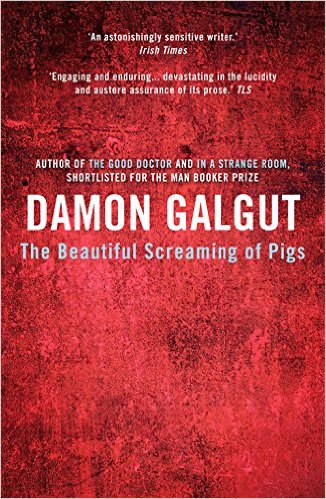
pigsThe Beautiful Screaming of Pigs is the second full length novel by South African writer Damon Galgut. Originally released in 1991 it eventually dropped out of print and, when a new edition was issued in 2005 following the Booker shortlisting of The Good Doctor, Galgut took the opportunity to revise the book, wanting to address his longstanding feeling that the rhythms of the language sounded “discordant”. The result, for whatever it is worth, is a novel that embedded itself into my consciousness with the first reading, and proved to be even richer and more deeply affecting with the second.

Set against the backdrop of the first free elections in Namibia in 1989, 20 year-old Patrick Winter and his mother are heading to the land that he had, only a year before, been fighting for on behalf of the South African Army. That experience has clearly left him emotionally traumatized. He is dependent on Valium to sleep and cope with recurring panic attacks. For his mother the trip is an opportunity to visit her young black lover, the latest of a long string personal explorations she has flirted with since her divorce from Patrick’s father. As the story unfolds he will reflect on his childhood, the horror of his time in the army, his ambiguous feelings about his own politics, and the emerging recognition of the nature his sexuality.

The novel opens as Patrick and his mother arrive at the Afrikaner farm where she grew up and he spent many a summer vacation. His brittle grandmother fusses over his physical and mental health, cannot understand why they are heading north, and stubbornly insists on referring to Namibia as South West Africa, the name by which it was known going back to its years as a German colony. Here Patrick will begin to reveal his family background, his closeness to his mother and his alienation from his rugged, athletic, big game-hunting father and older brother.

When his brother Malcolm joins the army and is killed in a motor vehicle accident, the loss tears the fragile family apart. Patrick and his mother move out, unraveling the tightly wound expectations of marriage by which she had been bound. As she tries to reframe herself with a series of dramatic passions and obsessions, her son is placed in the awkward role of picking up the pieces behind her. So when his own obligation to the army arises, despite the sure knowledge that he is entirely unsuited for the task at hand, he enlists promptly hoping to get his two year commitment out of the way. He won’t last two years, nor will he be able to put the experience behind him.

As he awakes that first morning to a familiar noise on the farm he makes a striking observation about his state of well-being in an unforgettable passage. Outside a pig is being slaughtered:

“There is no sound on earth like the sound of a pig dying. It is a shriek that tears at the primal, unconscious mind. It is the noise of babies being abandoned, of women being taken by force, of the hinges of the world tearing loose. The screaming starts from the moment the pig is seized, as if it knows what is about to happen. The pig squeals and cries, it defecates in terror, but nothing will stop its life converging to a zero on the point of that thin metal stick.”

As a child, the spectacle of a pig being killed never failed to draw him with a fascinated horror. On this day his reaction takes on a different note:

“It was a sign of my state of mind or soul that on this particular morning the screaming of the pig sounded almost beautiful to me. It didn’t evoke violence or fear, but a train of gentle childhood memories.”

After the reverie of a walk around the farm and a hearty breakfast, Patrick and his mother head for Namibia. When they finally reach Windhoek and meet Godfrey in the township where he lives, Patrick is surprised to find that his mother’s lover is not quite what he had imagined and is, in reality, only a few years older than he is. They learn that a white activist who had been working with SWAPO (the South West African Peoples’ Organization) has just been assassinated and Godfrey must attend to details for his funeral and an election rally. This necessitates a further trip on to Swakopmund, a detour that places Patrick in a position to question his own political resolution and bravery, especially poignant in light of the fact that on the border he was engaged in fighting the very forces he is now helping Godfrey support. His mother’s enthusiasm soon wanes into boredom as, for her, the shine starts to come off her latest passion.

Woven into the account of their few days in Namibia, is Patrick’s chronicle of his experiences in the army, beginning with the early days of tedium as the young soldiers pass empty days in their tents “playing cards, writing letters, telling jokes. An old scene, as old as the first village.” Patrick is keenly aware that he does not quite fit into this world of testosterone charged energy. He is hopelessly reminded of the way he felt sidelined as his father and brother tossed a rugby ball on the lawn or boasted about their hunting conquests. He senses a brotherhood of men to which he will never belong. It is not until a young Afrikaner named Lappies arrives that he finds a kindred spirit, makes a friend, and maybe – although he doesn’t realize it at the time – falls in love. Once fighting descends on the camp and strikes with a vengeance; horror, fear and death take their toll. When Patrick’s friend is killed, his grasp on sanity begins to slip. Galgut pulls the reader right into his young narrator’s shattered mind in one of the most intense descriptions of a mental breakdown I have ever read. It happens in fits and starts. Patrick tries to hang on, stubbornly, foolishly until his condition deteriorates to the point that he finds himself hospitalized, first in Pretoria and then in Cape Town. He is discharged from the army.

In the hospital his parents visit. Their responses to their shocked and emotionally injured son are true to form. His father travels to see him Pretoria where he sits awkwardly, shifting from ”buttock to buttock” unable to find anything meaningful to say. His mother has been busy acting in a play and does not make her appearance at his bedside until he is back in Cape Town. She visits him daily and talks about herself. It is here that she will first tell him about Godfrey, hoping to impress or shock him. He has no answer but he remembers the small drama.

“At that moment a shaft of light, blued by the rain, fell on her face: like the actress she was, she turned towards it, finding her spot. Then she smiled, and the smile became a laugh: a round, silvery sound, like a coin, which fell from her throat and tinkled down onto the ground.”

Patrick’s few days in Namibia will not answer all the questions he carries into the shifting sands of the desert one year after his breakdown. But he will emerge from the visit with a sense that it is time for him to define his own sense of personal space and figure out who he is. Borders – those lines between countries defended by force, defined by politics, and blurred between people – feature throughout this novel. True to form, Galgut allows these spaces to exist for the reader to explore. He is a writer of remarkable restraint, a storyteller who matches spare tight prose with simple moments of vivid intensity. In The Beautiful Screaming of Pigs he has created a haunting, intelligent, unforgettable portrait of the relationships between people at a time of great upheaval and impending change in Southern Africa. As Namibians queue with excitement to mark their ballot toward the end of the novel, Godfrey tell Patrick that maybe someday his own country will see the same. That day will still be more than four years away.

What it means to be grown up: Thirteen Cents by K. Sello Duiker

“Grow up. Fast. Very fast. Lightening speed. Everything is always like that. Quick. You must act quickly. Understand quickly. Otherwise someone will fuck you up nicely. They’ll beat you up so that you must always remember.”

Meet Azure. Standing shoeless on of the cusp of manhood, thirteen or about to turn thirteen, he is not really sure when he was born. Both his parents are dead. Murdered. He has made his way from Johannesburg to Cape Town – a mean and ugly Cape Town – where he sleeps near the swimming pool in Sea Point or, later, when that option is denied him, under a bridge in Green Point, home to a wretched collection of thugs and gangsters.

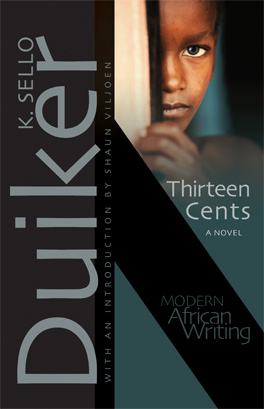
13centsHe makes money primarily picking up tricks, engaging in degrading, often rough sex with closeted married men. He is hardened, tough, able to endure these encounters with a detached resignation. Yet when he looks inside, when he faces the more invisible persistent fears that haunt him as he wanders though the city, past the train station, up Long Street, into the Company’s Gardens; we see what he truly is – a child on the street. His is a coming-of-age story that is relentless, ruthless and, in the end, remarkably redeeming.

As Thirteen Cents, the debut novel by K. Sello Duiker opens, he has taken to looking after nine year-old Bafana, a boy who has run away from home, his life on the streets a drug fueled choice. Azure lectures him on his addictions. The only drug he himself has any interest in marijuana when he can afford it.

“I’m not his father, I say to myself. That laatie is getting under my armpit, under my soft spot. I mustn’t let that happen, I tell myself. I’ve seen too many kids disappear. There’s no point in getting too close.”

Azure knows where to find discarded food, has a few trusted “grown-up” contacts, many of whom will turn out not to be the allies he had thought. In a slice of Cape Town in which each man or woman has to look after themselves first, judging character is a slippery exercise. One that can be brutal, if not fatal, if the shifting rules are not understood or respected. His one friend from home, Vincent, a man who is beholden to the same rules but somewhat older and wiser, manages to impart to young Azure an unusual vision that will ultimately prove more valuable than money or any other form of protection.

In the meantime, his greatest liability is one he cannot control. He has black skin and blue eyes. Hence the name, pronounced he informs us, Ah-zoo-ray. It is a gift he holds from his beloved mother which is stolen when Gerald, the powerful thug currently holding sway over the homeless population, renames him Blue.

“… I can never look at myself too long in the mirror as my blue eyes remind me of the confusing messages they send out to people. I wear my blue eyes with fear because fear is deeper than shame.”

Race is a currency of power in the community in which he has found himself. Gerald who is a coloured man, trading on his lighter skin, straight hair and reputation of exceptional violence, is especially drawn to and maddened by those blue eyes. The punishment he extracts on our young hero is by far the most persistent, horrific, and devastating aspect of this gritty tale. He is beaten, locked up, starved, and abused for days on end for no apparent rational pretext. But the emotional abuse, the attempt to undermine his self worth cuts deeper:

“Why do you feel sad? I ask myself. Because my mother didn’t love me. Gerald is cruel. That is the ugliest thing anyone has ever said to me. It is worse than having a bus crush you. I think of my mother and I feel confused. No. She loved me, I tell myself. And I loved her, no matter what Gerald says.”

As much as Azure/Blue holds to the conviction that he is almost a man, must not cry, must hold within himself the emotions a man can not afford to admit; he continually talks with frustration about “grown-ups”. Their ways allude him, anger him and ultimately drive him on a mission of self healing driven by an almost supernatural desire to destroy all that is trying to destroy him.

As Thirteen Cents moves into its final chapters, the story takes on a folkloric, mythical tone. The stark hyper realism of the earlier account crosses the threshold of magical realism. To escape the horrors existing for him in the city below, Azure makes the first of two ascents up the slopes of Table Mountain where he will spend several nights, have dreams and visions and find, we are led to believe, the beginning of a path out of the life in which he had found himself trapped. The voice that lingers, long after the book is closed, is one of resilience, one of hope.

Sadly his creator could not hold to that same strength. K. Sello Duiker was born in Soweto, South Africa in 1974, raised in middle class black family. His university educated parents wanted to secure a good education for their son. After achieving a degree from Rhodes University he studied briefly in Cape Town where drugs and mental illness disrupted his academic career. He would draw on his experiences in the city to write Thirteen Cents and his other major work, The Quiet Violence of Dreams (TQVOD). Recognized as one of the first important young black voices emerging in post Apartheid South Africa, he ended his own life in 2005 at the age of 30.

The edition of Thirteen Cents that I read, published as part of the Modern African Writing Series of the Ohio University Press, includes an introduction by Stellenbosch University professor of English, Shaun Viljoen which provides an exceptionally helpful context for the placement of Duiker’s work in the evolution of contemporary South African literature along with a glossary of the expressions and slang, mostly Afrikaans, employed throughout the text.

I have not, to date, read many black South African writers, but I brought a selection of titles back from my recent visit to the country. Duiker has long been on my radar and all 600 pages of TQVOD has been stting on my bookshelf for more than a year. I am glad I went back to this novel first, standing as it does in a pivotal context for black South African literature and look forward to reading more of the young voices that have emerged in recent years.

For another positive review of this powerful book, see my friend Penny’s blog.

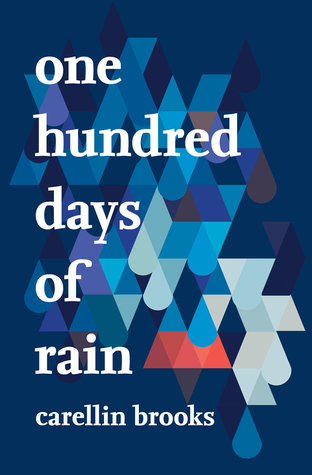
Nothing but grey skies? One Hundred Days of Rain by Carellin Brooks

It begins abruptly with a domestic dispute, loud enough to alert the neighbour. The police are called. Our unnamed heroine is led away and will soon face a restraining order. This is Vancouver. Rain starts as her marriage ends.

“She is not fallacious enough to connect this with her circumstances. She confines herself strictly to the facts. She leaves. It rains.”

rain100What we find in One Hundred Days of Rain, the spare, reflective novel by Canadian author Carellin Brooks, is a poetic meditation on the unraveling of a relationship and the displacement of a woman and her small child in a city famous for its wet face, soaked streets, and days – no, months – of rain. The moments are ordinary: work, finding a place to live, stretching meagre resources. The dissolution of the marriage is bitter, acrimonious and manipulative. But much of the time the protagonist is numb, detached, preoccupied. The rain, in its infinite guises, stubborn ubiquity, tireless assault on the bodies and minds of the city’s inhabitants, is the central character. It has the starring role.

Rain is both vital and villainous:

“Outside the big front windows the rain has begun in earnest. This is the rain the denizens of the city know best, the rain they have cause to know. In the days before the weather began to change there would be weeks of it at a stretch. It is said of this rain that it drives people to suicide, that the sodden winter tried the hardest.”

It defines clothing and footwear:

“The skies drip, that’s all, and the relentless drip soaks silently into the land. She walks to the café to pick up her son. It’s a long walk but she won’t take the bus. Once again she is thankful for her thick soled shoes. The misery of bad shoes, ones that let the weather in, so that your feet when you peel off your squishy socks have a pale, pinched look of reproach. She hopes her son will be wearing boots.”

It becomes a distant memory when the summer brings sunshine. And then with autumn it is back:

“Collective amnesiacs who stare each autumn in unfeigned dismay, faces blank. What, this again? It’s raining? Forgetting as an act of self preservation. Nonsense, they say. It doesn’t rain like that. It can’t. There’s no way. A hundred days of rain one after the other? Certainly not. And the thing is, nobody lies, not consciously.”

As the sloppy, damp, year slides by, our heroine will move several times, balance visitation for her poor confused son between her ex-wife and the child’s father. Her relationship with M, the ex, is roughly fleshed out in a series of bitter vignettes. Other regular female lovers come and go. She seems at times to direct more emotion to the grey, unforgiving skies than to the people around her. She is on autopilot. It is almost as if the incessant rain risks drowning out her ability to make sense of what she really feels, thinks and wants in life. Perhaps it is simply granting time to start to heal.

Played out in a chorus of 99 short chapters, this novel, as a rumination on rain and a sketch of the endless end of a relationship, draws to a close, as it begins, with the first drops of rain. However there is a sense of a new beginning, however faint. The restrained third person narration has an arms length quality that is surprisingly engaging. The observations are sharp, precise, and often very funny. We don’t ever learn too much about the characters, we learn what we need to know. The fact that it is a same sex marriage that is coming apart is of little significance. Divorce is divorce. But we are invited to endure the Vancouver rain, appreciate it’s kaleidoscopic nature and, for some of us, remember why we live on the other side of the Rocky Mountains.

One Hundred Days of Rain is published by Canadian indie publisher BookThug.

The only thing constant is change: Call Me By Your Name by André Aciman

“I look back to that summer and can’t believe that despite every one of my efforts to live with the “fire” and the “swoon”, life still granted wonderful moments. Italy. Summer. The noise of the cicadas in the early afternoon. My room. His room. Our balcony that shut the whole world out. The soft wind trailing exaltations from our garden up the stairs to my bedroom. The summer I learned to love fishing. Because he did. To love jogging. Because he did. To love octopus, Heraclitis, Tristan. The summer I’d hear a bird sing, smell a plant, or feel the mist rise from under my feet on warm sunny days and, because my senses were always on alert, would automatically find them rushing to him.”

When I find myself struggling to find the words to write a review, it is typically a situation where I feel lukewarm or worse about the book I have just read. This is not one of those situations. Quite the opposite. Wanting to read a few diverse offerings with LGBT themes in honour of the fact that it is, in my city, Pride Week, I wanted to begin with a novel I imagined would fall into a conventional coming of age/coming out tale, something I do tend to enjoy. André Aciman’s Call Me By Your Name is that, but as a beautiful, elegant, emotional, and intelligent piece of literature it offers much more for anyone who has ever been hopelessly infatuated, experienced a brief passionate affair, or lost a love that has left a hollow space in their heart and imagination.

call meThe setting is lush, a mansion on the Italian Riviera in the mid-1980s. Our narrator’s father, a distinguished academic, is in the practice of inviting a young scholar to spend six weeks with the family each summer – in return for assisting the professor, the chosen candidate has an opportunity to further his own studies and experience a taste of Italy. When Oliver, a handsome, carefree American post-doc who is working on a book about Heraclitis arrives for his stay, the entire household is captivated. For seventeen year-old Elio though, it marks an intimation of so much more; an instant, devastating attraction that will consume and obsess him for weeks to come.

The atmosphere is richly intellectual. Elio, an only child, is precocious and he knows it. But he is still a teenager. He is transcribing Haydn’s “Seven Last Words of Christ”, quotes Paul Celan and references Star Trek. His father is always encouraging him to get out, see friends. But once Oliver walks into his life his attention has a new focus – a focus he strains to hide under a guise of indifference while secretly noting every gesture, glance and inflection he perceives from this seemingly casual, self-assured houseguest. Their relationship seems to slide from hot to cold from day to day. Elio continues to see and sleep with a female friend, in part in reaction to Oliver’s tendency to disappear to town at night, but also to try to quell his own uncertainties about his sexuality and his complicated feelings for the 24 year-old man who is likely unattainable, unavailable and uninterested. Yet as much as he tries to push his feelings away, they continue to dominate his waking and sleeping hours.

“Let summer never end, let him never go away, let the music on perpetual replay play forever, I’m asking for very little, and I swear I’ll ask for nothing more.”

Awkwardly and uncertainly Oliver and Elio do eventually acknowledge their mutual attraction and move toward what will become a few scant weeks of deeply passionate, sexually explicit consummation. Their love represents a perfect, intense summer drenched affair. The frantic attempt to have and to hold as time slips away. Ultimately Oliver will have to leave to return to Columbia where he teaches, Elio will be heading back to boarding school. The space they have to share is defined but within those limitations they experience an intimacy that is timeless and create small, immutable memories that will endure. Like life, nothing is perfect, and it is inevitable that time and circumstance will soon take Oliver and Elio in different directions. For one man their affair will serve as a confirmation of where his attractions lie; for the other, the outcome will differ. But 15 years later when the two men meet again, they have to acknowledge that the experience was profound and has not been forgotten.

Given my rough, romantic précis it is difficult to appreciate the sheer beauty of Aciman’s prose. A memoirist, essayist and Proust scholar, Call Me By Your Name, was his first novel. It stands as a rich evocation of memory, youth, and the unquenchable desire to possess and be possessed by one’s beloved. He brings to life the sultry seaside beauty and character of the Italian Riviera in language that delights in nuance and detail, rich with allusions to literature, music and philosophy. Latin and Italian passages are seamlessly woven in to the text, adding atmosphere. Elio’s endlessly convoluted, adolescent passions contain a tension that pulls the reader in and the story forward until, looking back years later he wonders about the trajectory his life has taken against the alternate life have might have lived had someone other than Oliver turned up at his home at that fateful summer. We have probably all wondered about those potential parallel lives we carry inside us.

Desire, possession, loss, resolution. Time passes, and as Heraclitis would remind us, everything is constantly in flux.

Wrapping up a month of healing with Thomas Bernhard and Wittgenstein’s Nephew

As I look back on a month which began, at least as I can best remember, in a hospital bed on the cardiac unit, it seems oddly serendipitous that my final read for August is a book that begins in the chest clinic of an Austrian hospital. I did not know much about Wittgenstein’s Nephew in advance beyond the fact that it dealt with madness, one of Bernhard’s common themes. I had ordered it, in all honesty, to reach the free shipment minimum on an Amazon order for a quality adaptor for my trip to South Africa. It’s long been on my wish list so I just tucked it in. I picked it up off the pile on my coffee table yesterday and could not put it down.

nephewBernhard is a favourite. I always find him, in his characteristic vitriol, to to be funny and wise. But this book is less caustic and more sentimental than I could possibly have anticipated. It is also a tribute to his real life friendship with Paul Wittgenstein, in truth a relative of the famous philosopher. In one singular paragraph that extends over a mere 100 pages, the narrator, one Thomas Bernhard, orchestrates a grand meditation on health and illness, sanity and madness, and the singular power of a friendship grounded in common interests and mutual intellectual respect.

As this novella opens Bernhard is recovering from surgery to remove a tumour from his thorax. While he lies in his hospital bed tormented by his roommates and ignored by the nursing staff, he comes to learn that his dear friend happens to be confined to the mental ward of the same facility, ironically in the Ludwig Pavilion. Paul, who may well have suffered from manic depression, is given to recurring bouts of madness. For Bernhard, the causes and courses of their conditions are analogous:

“Paul went mad because he suddenly pitted himself against everything and lost his balance, just as one day I too lost my balance by pitting myself against everything – the only difference being that he went mad, whereas I,  for the selfsame reason, contracted lung disease. But Paul was no madder than I am: I am at least as mad as he was, as he was said to be, though I have lung disease in addition to my madness. The only difference between us is that Paul allowed himself to be utterly dominated by his madness, whereas I have never let myself be utterly dominated by my equally serious madness; one might say that he was taken over by his madness, whereas I have always exploited mine. Paul never controlled his madness, but I have always controlled mine – which possibly means that my madness is in fact much madder than Paul’s.”

A blend of fiction and memoir, fans of Bernhard’s trademark crankiness will still delight in his rants against psychiatrists, German newspapers, simple minded people, literary prizes, actors and in the end, the cruel inevitability of death. But the beating heart of Wittgenstein’s Nephew is an ode to the life sustaining value of a true friendship. Paul is remembered as “the only man I had ever been able to talk to in a way that was congenial to me, the only one with whom I could discuss and develop any topic whatever, even the most difficult.” They shared a passion for music, an inherent restlessness of spirit, and a love of philosophical discussion and debate. A most rare and precious bond.

Ultimately, especially after the death of his wife, Paul’s spirit deteriorates. He starts to die long before his final breath is drawn, and as his friend witnesses this decline he finds it increasingly difficult to be in his presence. Bernhard pulls away, a rejection driven perhaps by the fear of dying engendered by those on death’s doorstop. This slender volume is a eulogy to a man of wisdom and spirit who could not maintain his grip on a world that is perhaps more mad and unstable than he ever was.

Thanks to the fallout from the clot sitting in my lung and the cardiac arrest it triggered, I am presently experiencing a faint taste of what chronic sufferers of lung disease like Bernhard might have known; yet, like Paul, I have also been diagnosed with a serious mental illness. At one point, Bernhard talks about returning home from the hospital and the reckless urge to do more than one is physically capable of managing. This leads to a rant about how the healthy fail to understand the chronically ill. This is an unfortunately valid observation, one that is especially true when the illness is psychiatric. A year ago this spring I suffered a serious manic break after 16 years of stability and although I am still “technically” employed, no one from my former workplace is allowed to contact me. I am a leper. Admittedly I have built a new community of support since that time, but I have had many more offers for assistance after my recent health problems than I can handle. It is quite a contrast. Last year I was prone to a few rants of my own about how I suspected that my employers would have been much more sympathetic had I had a heart attack.

A month out now from an event that still haunts my thoughts and emotions, I am gaining strength each day. Sometimes I overdo things and have to rest. A high level of smoke in the air from distant forest fires kept me housebound for week causing me to feel a little edgy. But I have read a decent number of books, including a few that may be among my best of the year thanks to the Women in Translation challenge. Winding up August with this heartfelt ode to friendship is perfect, after all there a couple long distance calls to South Africa on my cell phone bill. There were a few moments in those very early days in the hospital that there was only one voice I needed to hear.

Originaly published in 1982, Wittgenstein’s Nephew translated from the German by David McLintock was first published in 1989.

Time, space, and truth: Till Kingdom Come by Andrej Nikolaidis

“Windows, even those with heavy shutters, were no help against the rain. It came with a wild westerly one moment and with a sirocco the next, constantly changed the angle at which it fell, attacking now frontally, now from the side, until it had crept through every invisible opening in the walls and woodwork. In their rooms, people made barriers of towels and babies’ nappies beneath the windows. When they were sodden they would be wrung out in the bathroom and quickly returned to the improvised dykes.

Roofs let through water like a poorly controlled national border. Like in a bizarre game of chess, families pulled out pots and pans across the floor: Casserole to f3, frying pan to d2.”

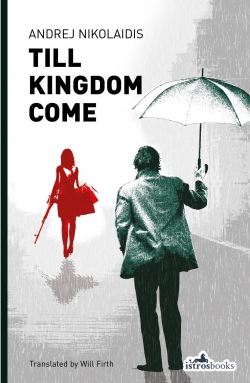
till-kingdom-come_5595626c38d7b_250x800rAs befits its title, Till Kingdom Come – the latest novel by Montenegrin author Andrej Nikolaidis’, his third to be released in English by London based indie publisher Istros Books – opens with a deluge of Biblical proportions. The heavens above the historically rich tourist town of Ulcinj have unleashed an extended season of torrential and relentless rain. As water rushes down the streets and seeps through walls and floorboards, the reader is quickly introduced to the narrator, a freelance journalist, a man who faces the world with reserved and stoic humour. Or so it seems. But then nothing is what it seems, and for our poor narrator most of all.

It soon becomes apparent that our hero has long suffered from periodic lapses in temporal/spatial reality. He has been known to just drift off, seeming to have lost consciousness to those around him, while he finds himself in some distant country or city previously strange to him that he suddenly knows intimately, until he wakes up back where he started. This dissociative tendency which has haunted him for years has left him with a rather slippery sense of self that, more than anything, seems to engender an abiding sense of ambivalence. That is, until the arrival of a man claiming to be his uncle causes him to have reason to doubt the veracity of his entire existence. He had believed that his mother was dead and he was raised by his grandmother, a belief supported with stories, photographs, a history and an unusual Jewish name. Discovering that his past was faked, sets him off on a passionate journey of speculation and self discovery, assistsed by a police inspector, directed by an anonymous email source and fueled by an obsessive fascination with serial killers and conspiracy theories.

Biting in intensity, taking broad political and historical swipes at medieval and modern history – poking the bones of Oliver Cromwell and stirring up the horrors of the Balkan War – Nikolaidis is in fine form, building upon and expanding the canvases he painted in his previously translated works, The Coming and The Son. Ah yes, Thomas Bernhard would be proud. Yet, for its sarcastic humour, metafictional wanderings through Red Lion Square in London and up the stairs of Conway Hall to the tiny second story office of Istros Books, and the endless speculations about the role of the black arts in the exceptional acts of cruelty and violence perpetrated by mankind that have littered history; Till Kingdom Come is a starkly serious book. The narrator exists on a plane of his own, while his friends succumb to pressure of feeling too much, of being unable to cope with a world that is fundamentally uncaring. As he muses at one point:

“Alas, there is only one happy ending – the Apocalypse – even if it is only a promise. Everything else is just an open ending, a continuous series of open endings, whose resolution not only resolves nothing but further complicates already unbearably complicated things.”

For my money, Till Kingdom Come is a more mature and demanding work than The Coming and The Son, both of which I thoroughly enjoyed. Nikolaidis is a highly political journalist and here he is clearly intent to skewer politics and economics with more direct, at times shocking, barbs. The Bernhard inspired intensity of The Son is dialed back a little while the historical diversions that provided an intriguing counter commentary to The Coming have been worked back into the narrative. As in these first two Istros releases, translator Will Firth captures the mood and intensity seamlessly. And, on an entirely personal note, it was a delight to see Red Lion Square and the Istros Books office worked into the text. However when I visited this summer I did not magically find myself strolling down Oxford Street. I got hopelessly lost and had to be rescued from the Tube Station by the editor herself, but then London on a map and London on the ground for someone who has never been there is, well, a metaphysical rather than metafictional experience to say the least!

Red Lion Square, London UK Copyright JM Schreiber 2015
Red Lion Square, London UK
Copyright JM Schreiber 2015

Listening to the voices of Afghan women: I am the Beggar of the World

“In my dream, I am the president,
When I awake, I am the beggar of the world.”

With a long history, passed down through generations, landays are traditional two line poems recited or sung by the mostly illiterate Pashtun people who live along the border region between Pakistan and Afghanistan. They are composed of twenty-two syllables – nine in the first line and thirteen in the second. For the women in this area who face social and cultural restraints that define and restrict their lives, these anonymous couplets have become an important medium for self expression. Sometimes they gather to share or perform the landays they have learned, updated or re-invented; but radio and the ubiquitous social media and cell phones have also been worked into a new modern network for sharing.

beggarI Am the Beggar of the World: Landays from Contemporary Afghanistan, a collaboration between translator and poet Eliza Griswold and photographer Seamus Murphy, is a sensitive and moving collection of landays, brief essays, and photographs. Upon hearing of the death of a teenaged poet who had been forbidden by her family to write poems and burned herself in protest, Griswold was inspired to journey to Afghanistan to explore the role of landays in the lives of Pashtun women. She returned to collect some of these poems, assisted by native speakers and a Pashta translator, Asma Safi, who sadly died of a heart condition before the project was complete. Arranging meetings as an American was not always easy – being under occupation is a difficult, deadly environment – but along the way she collected the words and stories of some very strong, fascinating women.

Divided into three sections, the first is dedicated to Love. Many of the couplets are brazenly racy, teasing and modern. Yet because landays are by their nature anonymous, no woman can be held responsible for sharing them or for the contemporary imagery has been worked into the more traditional versions:

“Embrace me in your suicide vest
but don’t say I won’t give you a kiss.”

“Your eyes aren’t eyes. They’re bees.
I can find no cure for their sting.”

“”How much simpler can love be?
Let’s get engaged. Text me.”

The second section is dedictated to the themes of Grief and Separation. Suffering and servitude are enduring features of the lives of Pashtun women. Marriage implies both. Curiously love also features throughout the poems in this section because romantic love is forbidden. If a young woman is discovered to be in love with a man she can be killed or driven to take her own life to preserve her family’s honour.

“Our secret love has been discovered.
You run one way and I’ll flee the other.”

Once married, having one’s husband take another wife is emotionally painful, but being passed over altogether or married off to an old man can be worse.

“Listen, friends, and share my despair
My cruel father is selling me to an old goat.”

The final section explores War and Homeland. Complex, mixed emotions, anger and sorrow rise up here in poems that are moving and, again, shockingly modern. A long legacy of occupation under British, Russian, and American forces has placed the women of Afghanistan in a difficult position, torn between the brutality of American protection and the combined threat and promise of the Taliban. The landays and the images in this section are especially powerful and represent sentiments that women would not be able to express so readily in any other forum:

“Be black with gunpowder or bloodred
but don’t come home whole and disgrace my bed.”

“Beneath her scarf, her honor was pure.
Now she flees Kabul bareheaded and poor.”

“May God destroy your tank and your drone,
you who’ve destroyed my village, my home.”

This slim volume is a testament to the resilience of the Pashtun women in the face of the violence, threats and restraints they live with every day. These traditional two-line poems provide a framework for illiterate women to express themselves and share their sorrows, joys and wisdom with their sisters. In Afghanistan they still face risks in committing their own poetry to paper when they are able, so this oral tradition remains important, even if modern devices like cell phones have expanded their network. This beautiful book which pairs the simple landays with muted black and white photographs documenting the people of Afghanistan, the sparse landscape and the violence of war, provides a rare opportunity to hear the intimate voices of women that might otherwise be silenced.

Loss and longing: The Elusive Moth by Ingrid Winterbach

“I have been content up to now,” she said at last. I was perfectly content until recently. I could keep everything at a distance. But now, all of a sudden, I can no longer do so. I feel caught up in everything. And detached from everything too. So detached, and so caught up. A strange feeling.” She spoke more urgently. “I don’t know what I’ve done with my life! I don’t know if I can still love someone!” (She started, why speak of love all of a sudden?) “I can’t open my hand,” she said, opening her hand, her palm facing upward, “I can’t let go.”

This is the curious dilemma of Karolina Ferreira, the heroine of The Elusive Moth by South African novelist Ingrid Winterbach. A similar searching ambiguity, complicated tension and hidden motivation runs through the cast of this slowly simmering, cinematic novel. Moving across a finely painted canvass in fits and starts, The Elusive Moth is an evocative exploration of memory, loss and anxiety that almost feels more like an art film, unfolding scenes that repeat motifs, imagery, fragmented conversations, all playing out against racial tensions that are building to a critical point in and around a small Free State town.

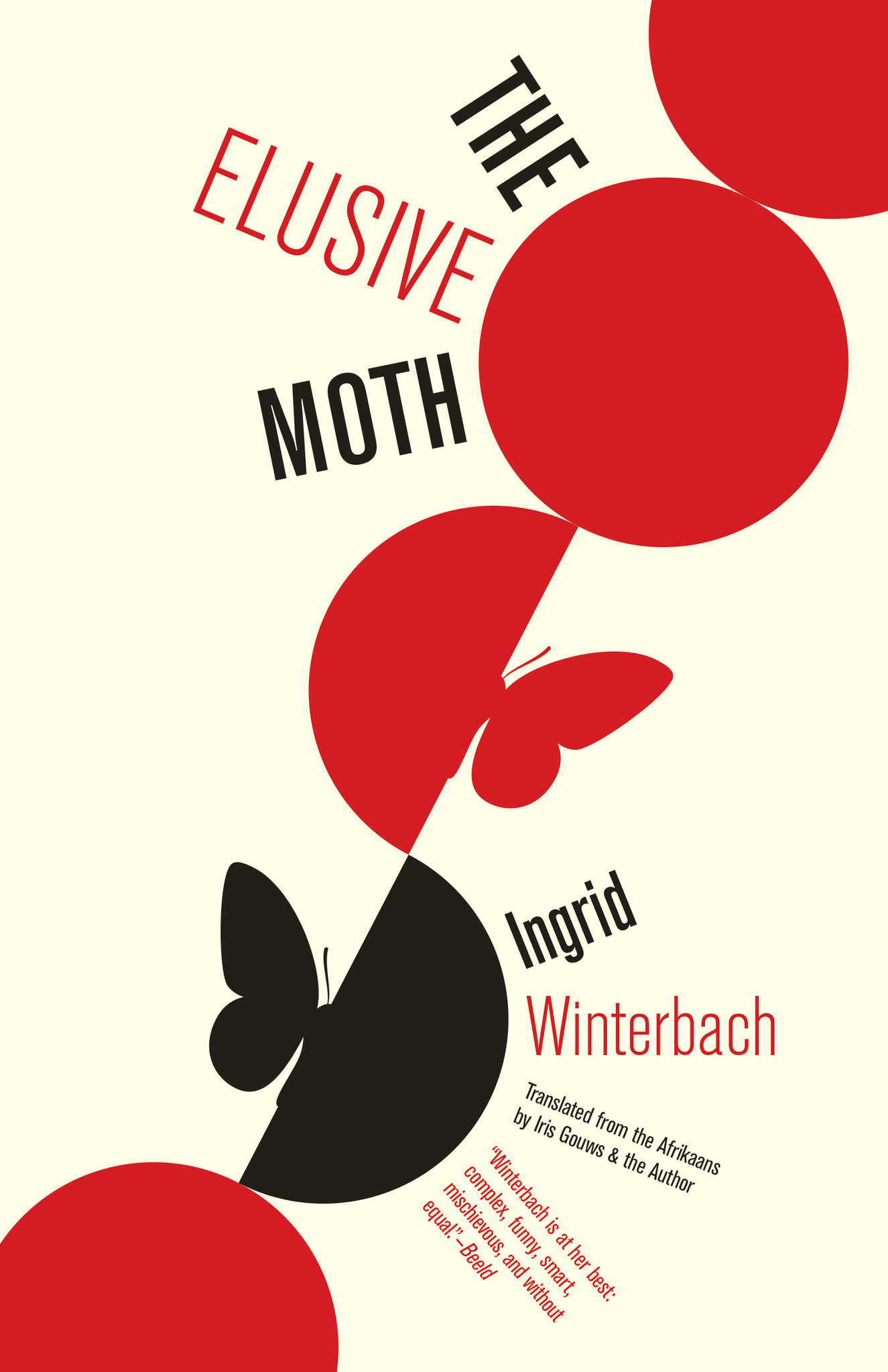
Elusive_Moth_cvrKarolina is an entomologist who returns to the town where her family spent time when she was growing up. Ostensibly she is in pursuit of a rare species of moth that is capable of withstanding extreme conditions and this is a brutally harsh, drought ridden area. However, on her way to her destination she makes two unusual decisions. She stops and picks up a fellow traveller, Basil September, an unusual and enigmatic individual who is on his way to spend time working with his Argentinian mentor, an expert in herbal remedies and medicinal practices. He will become her daily companion out on the dry veld where he collects a vast array of living and non-living samples while she observes insect life. Karolina also, despite her scientific tendencies, stops into a roadside caravan to have her palm read. The fortune teller promises that she will find a man who will love her forever and a woman who will be a close and faithful friend, suggestions she both laughs at and hopes for.

As she settles in to her research, Karolina seems to be increasingly restless. She spies lovers in the cemetery who fascinate her. She begins to frequent the snooker room of her hotel where the regulars, all male, are coarse, frequently lecherous – farmers, policemen, reservists. On Saturday nights she takes to the dance floor to lose herself in the arms of a man referred to throughout as “that Kolyn fellow”, theirs a connection based solely only on comparable tango skills. She tends to drink heavily, retreating when necessary to the Ladies Bar where she regularly encounters Pol, a singing lawyer, delightfully described throughout as amphibious, watery, and humid. He is a source of background information upon whom he she tends to rely as local political undertones begin to rise to the surface. Basil is also a helpful bellwether in this regard, as he possesses an uncanny ability to analyze the natures of others on sight and, as it turns out, foretell death. And then there is Jess, a red headed man who is singled out for her by Basil when they first see him. He is an economic analyst on a sabbatical to study, for himself, Buddhist philosophy, longing to learn to live in the moment and to overcome a persistent fear of death.

It is clear that Karolina is at a tremendous loss as she tries to find a rhythm to life in this small town. Loss intermingled with longing. She has destroyed or divested herself of most of her possessions. She is plagued by a sense that she disappointed and was disappointed by her father, also an entomologist from who she inherited her early and long standing fascination with insects. He had died just hours before she reached his bedside. She had imagined herself capable of dedicating herself to her studies without the bother of emotional entanglements. Now, in her dreams she is haunted by strange visitations and lewd sexual fantasies involving not only past friends and lovers, but characters from her immediate environs. By day her observations and interactions with others are a mix of curiousity, compassion and clinical dissection. By night she struggles with a desire for physical comfort and a need for space. As personal tragedies and political tensions in the town move toward a dramatic eruption, Karolina will ultimately find the ability to surrender and move forward with her own life.

For some readers, The Elusive Moth, may almost be too fragmented and repetitive. I read it slowly, over the last few days, luxuriating in the beauty of the imagery – the stark landscape, sensual descriptions of architecture and artwork, the enigmatic characters. Winterbach is also a painter, she writes in images and scenes. I simply did not want this book to end. I am currently recovering from a trauma that has left me with a mix of loss and anxiety that I recognized in Karolina, Jess, and Basil. I found it to be an exquisite and haunting experience.

witmonth15

* Originally published in Afrikaans as Karolina Ferreira under the pseudonym Lettie Viljoen in 1993, the first English translation by Iris Gouws and the author was published in South Africa in 2005. The edition I read was published by Open Letter Books in 2014.

You can’t go home again : Lost Ground by Michiel Heyns

On one level, Lost Ground sets itself up as a crime novel where the elements of the conventional police procedural are bound with deep echoes of the tensions and realities of the new South Africa. But in the skillful hands of Michiel Heyns it evolves into much more – a heart stopping rush headlong into a series of events that will leave its erstwhile hero irrevocably changed.

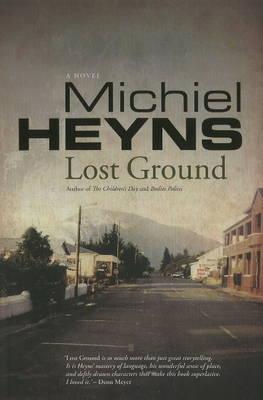
lost groundIt is a murder that draws Peter Jacobs, an ex-pat South African, back to his hometown of Alfredville, a sleepy little village in the Little Karoo. A freelance writer living in London, he has been away from his native soil for over 20 years. His father’s British citizenship afforded him the option to pursue studies abroad and thus avoid conscription. What finally draws him back is his writer’s sense of a good story. His own beautiful cousin Desirée has been murdered and her husband, the black police Station Commander, is under arrest. This is, Peter believes, the entry point for an examination of the complicated dynamics of post-Apartheid South Africa and, in his neatly planned agenda, a story that he imagines re-envisioning as a New Yorker friendly exposé drawing allusions to Othello. What it opens, in the end, is far more personal and devastating than he can even begin to imagine when he first returns to his hometown.

It is clear from the beginning that Peter is carrying more baggage than the basic wardrobe he itemizes. James, his partner of five years, a Jamaican actor, has just broken up with him and he is not entirely certain how he feels about it. As he settles into his hotel, old locations and familiar faces naturally trigger memories – of school days, childhood adventures and the awkward fumbling of youth. Then, he discovers that his best friend Bennie is also back in Alfredville. He is now a police officer, temporarily the acting Station Commander,  and married with two children. Their reunion is awkward and tentative at first but it slowly warms, reawakening a flood of memories of a past that Peter believed he had, with time and distance, left behind.

Heyns’ gift for language and dry wit bring a rich and detailed world to life. He deftly captures the village and surrounding farmland wilting under the extremes of summer heat and the distant sensations they evoke:

“I open the door of my room and go out onto the balcony. Victoria Street is empty at this hour, but the sullen air is teeming with the smells of a summer night – exhausted vegetation, wilting flowers, wet soil from the gardens being watered, heated asphalt. The blend hasn’t changed in twenty years. To smell it again is to remember not so much individual incident as the tonal value of those summer nights, the vague ache of an imperfectly articulated desire.”

A wide range of colourful characters and personalities pass through the pages, described with the precise care and attention befitting his detail oriented writer narrator. Some are ghosts from Peter’s past, others, like the elegant black female psychologist who becomes his challenger and confidant and the handsome vet who seems to have cast a spell over the bored housewives of Alfredville are either new or passing through. But it is the nostalgic revisiting of his youth, inseparable from the memories of his friendship with Bennie, that anchors the novel, creating the emotional texture and complexities that will ultimately leave the reader gasping for breath as the end nears.

This was, for me, my first read following a significant health scare. It was everything that I could have hoped for at this moment – a smart, well written and tightly paced story woven with literary allusions, significant observations about the current state of South Africa, telling observations about the risks inherent in returning to the past and an unobtrusive but entertaining gay subtext. By turns humorous, heart breaking and dark it was the perfect prescription.

* Published by Jonathan Ball, Lost Ground is one of Michiel Heyns’ books that is fairly easy to access outside of South Africa, at least through special order distributors.