
. . . I want to record all this, I want to write down that everything is all right, the end of the world is behind us anyway, no machine guns in sight, only the signs of another oncoming flood, it’s early, and at the other end of the train tracks she’s gradually woken up by the seagulls, and the room in which she opens her eyes looks different, in her slumber she may not even comprehend what’s made this difference, she looks around and realises I’m no longer there, I’m gone at last. . .
The early hours of his journey to Berlin are intentionally cinematic: the protagonist of Ivana Sajko’s short but intense novel, Every Time We Say Goodbye, is on a train, notebook in hand, imagining his present circumstances—he has just left his long-time partner behind—as an echo of a scene from Lars von Trier’s film Europa, dramatic and tragic. He longs for a message to come through on his phone, but he knows it won’t, the relationship he has left was already as good as over after unravelling for a long time. As the hours and days pass he will have plenty of time for self-reflection, regret and heartache. He is on his way to the city where their romance began a decade earlier, hoping to try to start his life over again.
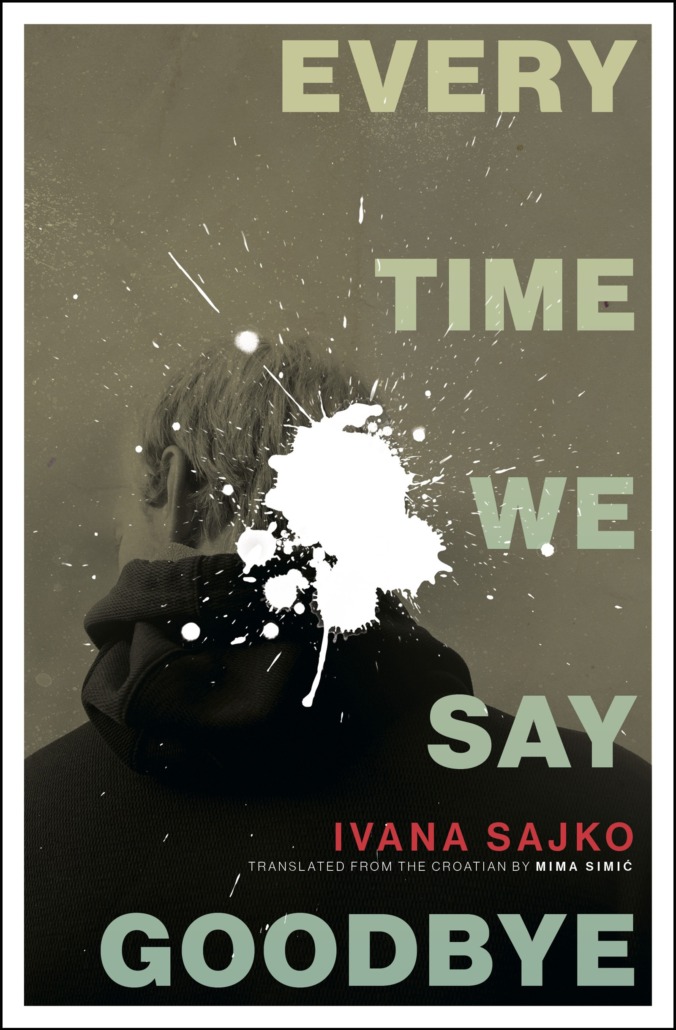 Unfolding in long unbroken sentences that stretch, section break to section break, for four, five, six pages or more, our narrator, a former journalist and self-described failed writer, will attempt to put together the broken pieces of his life, from childhood through to the painful dying days of the love he has lost, hoping that the words coursing through his mind will somehow find their way to the page and break the drought that has crippled him, professionally and emotionally for a long time. It is as if he is slowly and systematically acknowledging and letting go of the unfinished fragments of his past:
. . . every goodbye is a little death, each one clinging tightly to what it leaves behind, and each deserves its own photograph, its own legend, its own notebook. . .
Moving from the immediate observations and interactions that mark his journey, to experiences that shaped his near and distant past, his soliloquy sweeps through many personal, social, and political themes as the miles and stations pass. He recalls his dysfunctional family, the father who left home only to meet a sorry, isolated end, the grinding poverty that forced his mother to seek work in Germany, leaving her sons with their grandmother, and the once-close relationship he shared his brother, now lost to a small-time criminal existence somewhere, he’s not sure where. On a broader plane, war in the Balkans, the migrant crisis, economic upheavals destroying communities, the impact of the pandemic, and the question of his own failure to hold to a commitment to fight injustice all come in and out of view along the way.
The relentless nature of the narrative style heightens the emotional intensity of this novel, allowing for an in depth portrait of one man’s past and present to emerge in a relatively limited space. But there is, at the same time, a certain vagueness to the locations of the events that occur outside Germany. Beyond Berlin, where in his memories her protagonist maps out a network of named streets and intersections, Sajko avoids particularity in reference to exactly where he lived when he was growing up or in the years immediately prior to his departure (we only know it was a coastal community). She says she prefers to write about Europe more generally rather than her native Croatia specifically. But the wars and displacements that have shaped recent Balkan history inevitably shaped her narrator’s younger life too. At one point his internal monologue vividly captures the visceral experience of life under military and psychological siege:
At first, a mass was compressed into the shape of a wall, and only later, in this wall’s shadow, did individual fates and names gradually become detectable, could we observe how the war disintegrated into its elementary particles, infiltrating homes and corners like the bubonic plague; nights and days fused into a constant half-sleep, the mattresses grew soggy with sweat and worry, small apartments constricted, their toxic air smothered the inhabitants, these conditions bred fear and infection, movement was curtailed, curfews were enforced, civil guards patrolled the streets; suffering was collective, yet on the elementary particle-level each person grappled with their own fate while they monitored everyone else and anyone could turn against anyone. . .
The unending sentences and deeply internalized nature of Sajko’s style not only grants Every Time We Say Goodbye its power, but also presents a special challenge for a translator. Mima Simić, who previously translated Sajko’s earlier Love Novel, has known the author for a long time and both are Croatian women living in Berlin, but she admits that capturing, in translation, the intensity of the content and form of her work can be a demanding experience. Nonetheless, the lengthy passages flow very smoothly, losing none of their impact. However, one quality that is lost in English is the specifically gendered nature of the narrative. Croatian, as a Slavic language, has three genders—masculine, feminine, and neuter—that shape the way one has to speak, but open the possibilities for how one can write. Sajko, who is also a playwright, chose to write this first person monologue in the masculine gender which, she admits, “altered the course of the novel as it unfolded” and “helped me to step outside myself” and appreciate the way language “truly makes us who we are.” For her writer on a train, words will be, he hopes, a life line to new existence.
Every Time We Say Goodbye by Ivana Sajko is translated from the Croatian by Mima Simić and published by Biblioasis.











 roughghosts