Look closely, wait: Seeing Further by Esther Kinsky

Early in her latest novel, Seeing Further, German writer Esther Kinsky sets out the parameters for the narrative ahead, for the story she intends to tell, the theme she wishes to explore:

There are two aspects of seeing: what you see and how you see it. This investigation into seeing further will involve only the question how. It pertains to the place that the viewer takes. It concerns point of view and remove from things and images, from the action, proximity and distance, vastness.

She, or rather her narrator, goes on to discuss this aspect of seeing, especially in relation to the cinema, but also with respect to other means of framing what we can view—windows, binoculars, open vistas—but it is the shared experience of the cinema that holds special attraction for her. This fondness began in childhood and has accompanied her throughout her various travels and relocations over the years, even as she acknowledges that it is competing with the convenience and privacy of smaller personal screens. But, of course, this is Esther Kinsky, and if the cinema is a space ideal for an examination of the how of seeing, her strong sense of place, sensitivity to natural or manmade landscapes, and generous appreciation of unique individuals also allow for perceptive descriptions of what her protagonist sees around her and the people she meets.
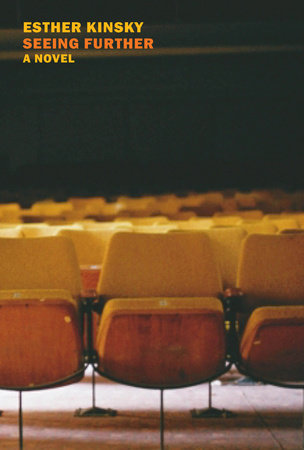
The narrator is living in Budapest when she comes across an abandoned cinema that seems to present her with an irresistible opportunity in a village in the open flatlands of southeastern Hungary known as the Alföld.  She had set out on a weekend adventure with the intention of taking photographs, but found herself confronted with a landscape that defied the camera’s frame. A vastness that presented a certain unphotogenic emptiness. She finds a place to spend the night while a storm rages outside. The next morning, uncertain where she is, she to explore the small town in which she has awoken. It is a Sunday:

A few cyclists, most of them women, rolled quietly past and then turned around to face me and stared, which nevertheless did not upset their equilibrium; unperturbed they proceeded onwards, skilfully balancing on their shoulders or the handlebars of their bicycles their hoes, rakes and spades. I felt foreign under their gaze, cut free from all contexts of familiarity and belonging. A strange sensation, yet it pleased me.

In this strange community she is aware of a sense of having seen similar scenes before. A sort of memory or images called from the past—perhaps somewhere in the Po Basin area of Italy, perhaps in a book or a film. And then she finds the old cinema building. A relic of a time gone by, now standing forgotten: “A splendid cinema in a no-man’s land of possibilities.”

Back in Budapest, a city with a wealth of cinemas, she becomes absorbed in thoughts of the magic of film, and before long she is back in what she refers to as the mozi village, mozi being the Hungarian word for cinema. She walks back and forth in front of the abandoned building until someone inevitably stops and asks if she needs help. She tells him she would like to see the cinema and he asks if she wants to buy it. With little hesitation she responds that, yes, perhaps she would like to buy it.

This is, then, the story of one woman’s dream of reopening a cinema and rekindling an interest in the forgotten joy of gathering together to share the experience of watching a film, engaging the act of seeing further. Jószi, the cinema’s former projectionist turned bicycle mechanic gets caught up in her enthusiasm and becomes her accomplice. She devotes herself to getting the building cleaned, repaired, painted and ready for its revival. Parts are sourced for the projectors. It’s a slow process, one that involves her eventual relocation from Budapest to the village. An interlude tracing the life of the mozi village’s original projectionist and the founder of the larger, now disused cinema, serves as a history of film in the region, from the early days of silent films as a travelling attraction carried from village to village and projected in tents, to the introduction of talkies, the impact of the Great Depression, and the eventual expansion of cinemas from the cities into smaller towns where they became vital venues for community entertainment. But times have changed. And so have people.

There were no spectacles to help me decipher it all, but I could see, observe, look closely, wait. Wait and see. Yet I still had faint doubts about whether this cinema would ever again be a space where one could sit, look closely, see, wait and see, in order to learn something about what once took place here between the screen and the gaze. The consensus today was that everyone came from far away, from a world unaccustomed to the cinema gaze, all of them projectionists at their own private screens, who chose the cinema as an exception, who were accustomed to seeing in their own private space, alone or with a few trusted fellow viewers. The cinema was always a place to which you brought your own solitude, but it used to be that you did so knowing you would take your place among other solitary people; you travelled to the cinema, hungry for film, and left sated, brushing against the outside world along the way.

Slow moving and inevitably Sebaldian, with many original black white photographs, this is a work that combines the narrator’s love of the cinema and appreciation of the possibilities that watching a film with others on a large screen offers, with a fictionalized account of the birth, death and attempted resurrection of a small town cinema. Kinsky’s work is often called autofiction and although there is always a strong sense of place, landscape, and experience running through her narratives, it is not wise to conflate the author with her narrators. The setting of this work, the endless plains of eastern Hungary is familiar. Her more conventional first novel Summer Resort is set there, so Kinsky is no doubt drawing on a real-life sojourn in this region, perhaps in the mid-2000s, and an actual cinema project of some sort (as the photographs attest), but as ever, very little of the narrator’s (and by extension the author’s) personal background or history is revealed beyond a few childhood reflections. Why is she in Hungary? What does she do for a living? Kinsky’s narrators tend to shadow her own life, but clear boundaries are invariably retained. Autofiction, on the other hand, tends to be a much more self-focused, sometimes even self-obsessed medium. It is Kinsky’s ability to focus on her attention on familiar emotions—leaving, grief, loss, nostalgia—within a richly detailed landscape while maintaining a measured invisibility that makes her narrators and her novels so intriguing.

Seeing Further by Esther Kinsky is translated by Caroline Schmidt and published by New York Review Books in North America and Fitzcarraldo in the UK.
Forever before and after: Rombo by Esther Kinsky

The seismic shocks of May divided life and the landscape into a before and after. The before was the object of memory, stories unceasingly layered and blown over by words. One argued over the form of the cliffs, the course of the brooks, the trees that avalanches rolled over. About the whereabouts of objects, the order of things in the house, the fate of animals. Each of these arguments was an attempt at orientation, at carving a path through the rubble of masonry, mortar, split beams and shattered dishes, to understand the world anew. To begin living in a place anew. With one’s memories.

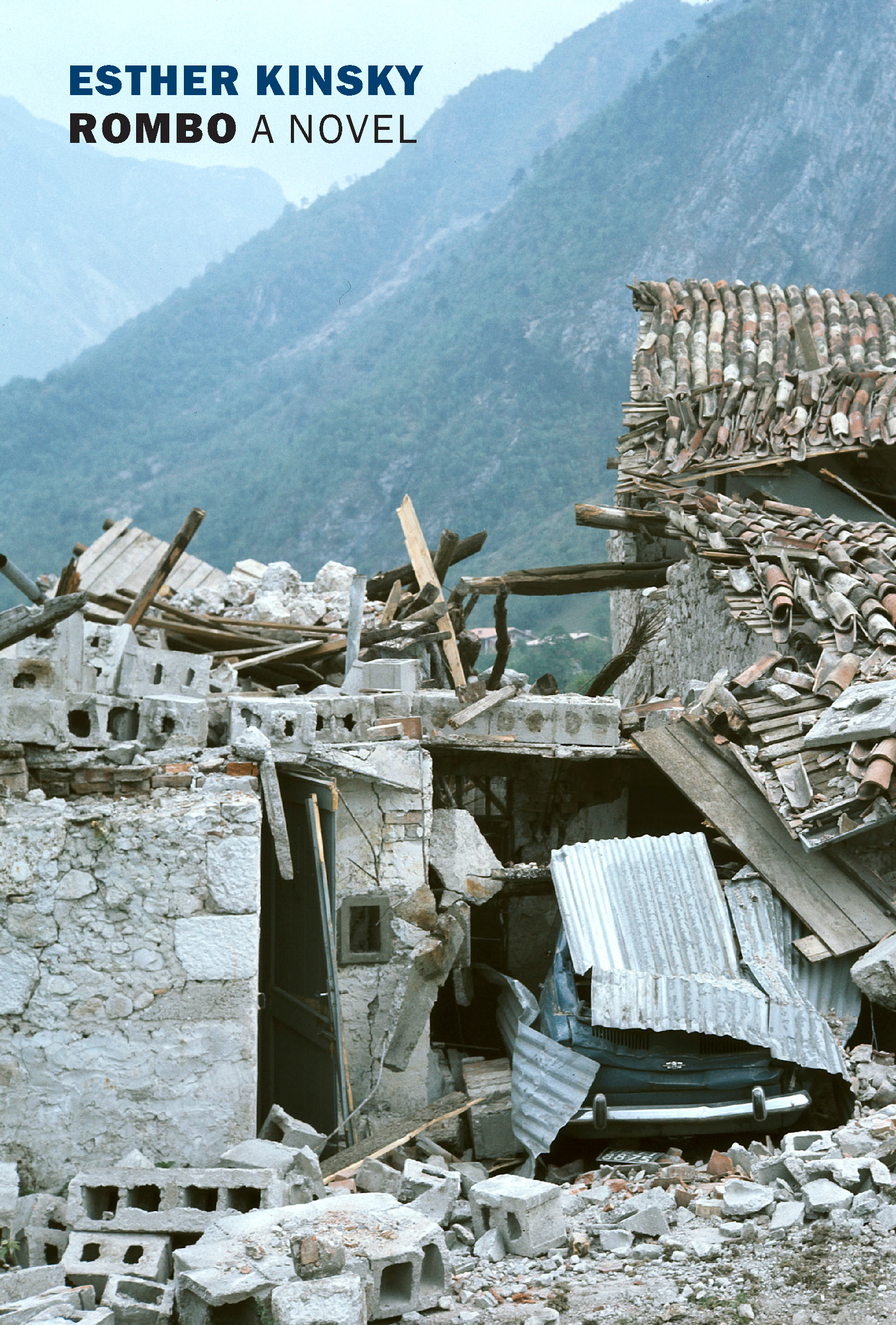
On May 6, 1976, just before 9:00 pm, a devastating earthquake tore through the Friuli district of northeastern Italy. Several strong quakes followed in September. Bordered, today, by Slovenia to the east and Austria to the north, this region which extends from the slopes and foothills of the Carnic Alps, onto the flat flood plain of the River Tagliamento, would be forever changed, as would the lives and memories of those who survived that year of death and destruction. Rombo, the latest novel by German poet and writer Esther Kinsky, places this event at its centre and turns its attention to the rich and deeply interwoven stories that bind the land and its inhabitants together.

As her novels River and Grove demonstrate, Kinsky is deeply sensitive to and observant of landscapes, urban and rural; her narratives move through environments that are simultaneously emotional and physical—spaces of memory, grief and reconciliation. The same can be said of Rombo, but here, instead of a peripatetic first person narrator tracing a deeply personal journey, a chorus of voices carry the flow of a unique, multi-layered narrative that encompasses the human and non-human, the animate and inanimate alike. The text is divided into seven sections, each opening with a quote from a classic geological work and a coarse black and white illustration depicting a fragment of the remaining frescos from the cathedral at Venzone. A neutral narrative voice describes the landscape and its history—present and past—offering observations of a geological, ecological, folkloric and scientific nature. Woven into this tapestry are the memories and stories of seven men and women—Anselmo, Olga, Mara, Lina, Gigi, Toni and Silvia—who were children or youth at the time of the earthquake, and whose reflections take them back to the events that forever divided their world into before and after.

This choral narrative flows and swirls like a river, rising and falling, turning in eddies, joined by streams and tributaries along the way. Moving back and forward in time, repetition, contradiction and fractured accounts are gradually woven together to create a rich, if heartbreaking, whole. In the beginning we are briefly introduced to the seven survivors, from a third person perspective, on May 6 and in the present, decades later. Then, the dynamics of the seismic event are set up, the unevenness of the impending disruption are alluded to, and the forces of the earth are unleashed:

It is said that animals are much quicker to sense the vibrations that gradually build up in the Earth’s interior and eventually exceed the stress limit in the spreading centre, causing the tectonic plates to snag and tip, irrevocably shifting the order of hollow cavities and mass, the order of emptiness and fullness.

For each one of the survivors, the hours leading up to the May earthquake were marked by unusual observations—an unexpected sighting of a snake, anxious goats, loudly barking dogs, fitfully chirping birds. The day was unseasonably hot, the light oddly filtered. And everyone remembers the otherworldly sound, il rombo, rising out of the ground just before it started to shake. In the moment, they are pushed out of their houses, stand under archways or find themselves crawling out from under collapsed structures. Damage is extensive but, all things considered, their village is one of the lucky ones. Others are almost completely destroyed.

After our first glimpse of that fateful day, the survivors begin to speak for themselves. They talk of their memories of life in the valley, their families, and their later adult years. But mostly they speak of the earthquake and its immediate aftermath—the strange, dislocated summer of freedom for the school-aged children, the stress of rebuilding and rising tensions among the adults and, amid the turmoil, the accommodation of marriages and deaths and the business of life. Then, when things are beginning to promise a return to some degree of normal, the severe September shocks roll through. Everything is unsettled again.

The lives and stories of some of the characters intersect, contradict one another or offer different angles on the same situations or experiences. Their individual histories reflect the historical and economic realities of the region. Fractured, multi-generational families are common as people are forced to leave to search for work, or driven back again by the need for the support of extended family. Anselmo and Olga, for instance, were both born abroad, in Germany and Venezuela respectively. They come to the valley with their locally born fathers after divorce or widowhood finds them stranded in foreign lands and brings them home. Some couples comfortably fall into a pattern of living in different towns or countries, like Silvia’s parents or Lina and her husband. After the earthquake, many will leave the region for good, having lost their jobs and their homes, but for the seven villagers featured here, including those who do leave for a time and return, the valley is and always will be home. As Lina says about the land and her place in it:

The soil is poor here. Limestone ground, the ground of poverty. The flowers are paler here than elsewhere. The winter is long. But winter is alright by us, because it brings snow and whatever grows around here has snow and goat shit to thank for it. The snow saturates the ground differently than the rain does, they always say. On the other side of the mountain, in the south, it only rains, even in winter no snow falls. It’s God’s pisser, the people say.

What is my life? sometimes I ask myself. My life is this place. Here I know everything. Every stick and every stone. The animals and the people. I write down what I want to remember. The weather, the harvest, the comings and goings, misfortunes. Surprises.

As these witnesses, now looking back through the filter of more than half a lifetime’s experience, recall the upheaval of the earthquake and talk about their lives before and since, their reminisces are framed and reframed through the shifting sedimentary layers of accumulated memory. Just like the land around them. Unfolding with an uneven, yet natural pace, the flow of personal stories, woven among the descriptive passages, observations and anecdotes, lends a filmic documentary-like feel to the novel, successfully achieving a Sebaldian balance of truths and fictions imbued with Kinsky’s distinctly meditative poetics. The result is an unusual and highly affecting form of storytelling that follows its own narrative logic.

Rombo: A Novel by Esther Kinsky is translated from the German by Caroline Schmidt and published by New York Review Books  in North America and Fitzcarraldo in the UK.

The disquieting terrain of loss: Grove by Esther Kinsky

I arrived in Olevano in January, two months and a day after M.’s funeral. The journey was long and led through dingy winter landscapes, which clung indecisively to grey vestiges of snow. In the Bohemian Forest, freshly fallen, wet snow dripped from the trees, clouding the view through the Stifteresque underbrush to the young Vltava River, which not had even a thin border of jagged ice.

As the landscape past the cliffs stretched into the Friulian plains, I breathed a sigh of relief. I had forgotten what it is like to encounter the light that lies behind the Alps and understood, suddenly, the distant euphoria my father experienced every time we descended the Alps.

The unnamed narrator of Grove arrives in Italy, fresh from the loss of her long-time partner, planning to spend three months contemplating the possibility of forcing her life “into a new order that would let me survive the unexpected unknown.” As she travels down from Germany, she stops in Ferrara, a town she had and M. had planned to visit on the Italian trip they would never manage to take together. But the literary landscape of Georgio Bassani will have to wait, at this time her destination is further south, a small village south-east of Rome. There she will walk the streets and roadways of the rolling landscape, orienting herself in relation to the house where she rents an apartment, the nearby cemetery and grove of trees. An anchor for an unanchored time.

German author and translator Esther Kinsky’s books cannot be rushed. They unfold slowly and linger in the imagination. Like her acclaimed novel, River, this meditation on grief offers an intimation of autofiction but I prefer to see her work as fiction bound to real-life experience and location that conceals as much as it reveals. Intimate yet not overtly confessional in nature. The focus is on immediate response to encounters, observations and memories, while autobiographical details tend to be limited, leaving both the author and her protagonist in the shadows. The narrator has recently lost her husband after a serious illness; Kinsky’s husband, Scottish-born German translator Martin Chalmers, died in October, 2014. The grief, the loss, is palpable, yet still too recent to be fully articulated, not only in the first section chronicling those early months alone, but in the third part set exactly one year later. M.’s memory haunts the narrator’s dreams, her attachment to an article of his clothing, his image. However, we learn very little of anything about him or their life together. Likewise, what the narrator is looking for and what she finds is unclear—as in River, it is the journey, or rather journeys, not the destination that guides the narrative.

In the first part of Grove, “Olevano,” one has the sense that the narrator is attempting to find herself in the landscape of a place where death is never far away. Cemeteries, the sellers of fresh and plastic flowers to mark graves, the sight of a body being removed from a house, memories of the Etruscan tombs her father loved, even trees being felled to combat the spread of disease all summon thoughts of morti, followed by sounds of vii—bird song, children’s voices, the daily ordinary routines of life. It’s a slow unfolding, gradual emergence from winter to the early signs of spring, that accompany the narrator’s wandering through the village, the countryside, to Rome, to the sea and back to her temporary refuge on the hillside. She is learning how to live again, awaking in an alien place, a stranger to each new day:

When after sweeping the landscape my gaze fell to my hands on the window ledge, I thought I saw M.’s hands beneath them, in the space between my fingers – white and delicate and long, his dying hands, which were so different from his living hands, and they lay beneath mine as if on a double exposed photograph. Then the coffee maker hissed, and the coffee boiled over, and my living hands had to break away from M.’s white hands in order to turn off the stove and remove the pot, but I inevitably burned myself, and this pain made me aware that I hadn’t relearned anything yet.

The flowing language, poetic, careful and observant, traces a slow burning existential pilgrimage. Kinsky paints a rich portrait, not only of the landscape and urban areas, but of the people—from the reticent village population to the groups of African migrants who cluster around marketplaces and bus stations, barely surviving on the outskirts of society, unable to leave, with no home to return to. As in River, a novel set on the edge of London along the Lea River, her narrator here similarly is attentive to the character and quality of place; she does not simply see, she feels her way through the misty months of early disorienting grief and necessary solitude.

I became dizzy looking at this unfurled country which was laid so bare yet remained so incomprehensible to me. A rugged terrain with a restless appearance – it presented itself differently from each side. On each side the routes drew a different script, the mountains cast different shadows, and the plains, foregrounds, midgrounds, and backgrounds shifted. A terrain that left traces in me, without a recognizable trace of myself remaining in it. Something about the relationship between seeing and being seen – between  the significance of seeing and being or becoming seen, as a comforting conformation of your existence – suddenly appeared to me as a burning question, which defied all names and acts of naming. If on that hillside some had told me that I might die from the inability to answer or simply even phrase this question, I would have believed them.

It is clear from the beginning that she is no stranger to Italy. Her father spoke Italian, was fascinated with the history of the Etruscans, and year after year family holidays were spent exploring the country. The second section of Grove begins with her father’s death, then revisits memories of trips taken over the years. Grief, through the lens of time and distance becomes an attempt to understand a somewhat elusive man against the backdrop of his knowledge of architectural sites, landscapes and bird calls, his tendency to disappear for hours and his penchant for outings that often led to the family getting lost. In the end though, this fascinating and recognizable account of lengthy family car trips reminds anyone with a similarly enigmatic parent that we can ever fully know them when so much of our experience rests deeply in childhood. Loss and mourning is perhaps always incomplete.

So we come to the third and final part of the novel which finds our narrator returning to Italy exactly one year after her stay in Olevano. Again it is January when a certain colourlessness and frosty otherness mutes the land. She travels first to Ferrara, orienting herself by the landmarks of the life and characters of Georgio Bassani, haunted more by the fictional environs of the Finzi Continis. From there she moves to Comacchio, on the Adriatic, where she spends her days walking through the stark salt pans, observing flamingos and other shore birds, and seeking out the site of a fabled necropolis. It’s a sad and lonely time to be wandering this place devoid as it is of tourist activity, but she seems to be approaching a new, peaceful meditative relationship with loss. If she set out to consider how she might force her life into a new order one year earlier, the apparent bleakness of this last stop in Italy carries the quiet promise of moving forward anew even if where she is heading and what she has learned is not clear, or not for sharing.

Grove by Esther Kinsky is translated from the German by Caroline Schmidt and published by Fitzcarraldo Editions in the UK and as Grove: A Field Novel by Transit Books in North America.

From both sides now: A History of Clouds: 99 Meditations by Hans Magnus Enzensberger

There is a glow, a particular confidence that emanates from the poetry of German essayist and writer, Hans Mangus Enzensberger. It is manifested in his uncanny ability to take the smallest, even mundane, observations and transform them into poems that catch one unaware. I want to call it an earnestness, but it is more than that, it is the  capacity to reflect with equal humility and humour on both the simple and the profound  moments, an ability  that can only come with time and a long, full life. The second of the ninety-nine poems or meditations that comprise his collection, A History of Clouds, is an early example. “Sins of Omission” is a confession of sorts—a list of presumed shortcomings that begins with the aging narrator admitting to being absent, not hurrying over “when the need was greatest,” but closes with a wide range of “sins”:

Forgot to confess,
shied away
from improving the world,
never dropped out or in at the right time,
failed to take my pills
three times a day.

Yes, I abstained from
killing people. Yes,
I didn’t call.
For the time being I have even
refrained from dying.
Forgive me, if you can.

Or just let it be.

(trans. by Martin Chalmers)

From the outset then, the appeal of his clear uncomplicated verse and his gently sarcastic tone is clearly evident; making it easy to see why he is generally considered to be Germany’s most important living poet.

Born in Bavaria in 1929, Enzensberger’s poetry covers a vast range of subject matter, and he is also an editor, translator, and  a vital, often controversial, essayist. This collection was published in its original German in 2003, in the early years of a new century, when the poet was in his seventies. The opening section frequently touches on private moments and emotion, and includes some wonderful images of the simple intimacies of long-term relationships, of shared beds and lives—the wonder of a breath, a touch, proximity—while the second turns its attention to the lives of others, conjuring portraits that are historical, political or literary.  A particularly poignant piece is the haunting elegy to fellow countryman WG Sebald “Who touched us, / who seemed to have come from afar / to the sinister, unhomely homeland. / Little kept him here. / Nothing but the search for traces / with a divining rod of words / which twitched in his hand.” (From “For Max Sebald”, trans. by Martin Chalmers)

Enzensberger’s curiosity for the world, his far flung interests and experiences provide fertile backdrops for his wry commentaries on life. In later sections, he often appeals to science, philosophy and cosmology to illustrate an idea, making his poems them feel at once timely and out of time. One of my favourite pieces is the rather beautifully blunt “At Times” which begins:

When you meet someone
who is smarter or more stupid than you—
don’t make too much of it.
The ants and the gods,
believe me, feel just the same.

And goes on to remind us of our humble place in nature, insisting we are all relatively average in the grand scheme of things, insisting that is good, because:

Somewhere or other you’re always discovering
an even more radiant beauty,
someone even more worse off.
You’re mediocre,
luckily. Accept it!
Seven degrees centigrade more
or less on the thermometer—
and you would be beyond saving.

(trans. by Martin Chalmers)

Unassuming, but delightfully perceptive, it is possibly the single entry I return to more than any other. But this book is filled with many such everyday wisdoms. An appreciation of irony is, perhaps essential for the full impact of Enzensberger’s poetry, however, I have come, over the years, to believe such an appreciation is almost a basic life skill.

And then there are, of course, the clouds. In various of incarnations, clouds pass through many of these poems, often unexpected, but in the twelve-part title piece that closes out the collection, their presence is rendered more explicit:

Their wanderings high up
are quiet and inexorable.
Nothing bothers them.
Probably they believe
in resurrection, thoughtlessly
happy like me,
lying on my back and
watching them for a while.

(trans. by Esther Kinsky)

This meditation on clouds, or an “Archaeology of clouds—a science for the angels,” explores the wonder, the wanderings, and human response these meteorological phenomenon, cursed and loved for both their presence and their absence, one that is ultimately “A separate species, transient, but older than our kind.” A fitting end to a book that begins with the most essential and down-to earth aspects of life, and through ninety-nine short poems, reminds us that we are bound to this planet, and then leaves us, in the end, quite literally  hanging in the air.

A History of Clouds: 99 Meditations by Hans Magnus Enzensberger is translated by Martin Chalmers and Esther Kinsky, and published by Seagull Books.

Neither here nor there: Esther Kinsky’s River and a link to my review at Music & Literature

Since I finished Esther Kinsky’s magnificent novel River, it has been difficult for me to contain my enthusiasm for this work, and yet, with a major review on the way, I wanted to refrain from talking at length about my reading of this languid, mesmerizing meditation on the relationships we have with place—those we live in, pass through, or linger in uncertainly during points of transition.  That review is now live, and yet Kinsky’s book is still working its way through my system.

River is a slow read; immersive, poetic, attentive to detail. It creates an atmosphere of intimacy with the spaces the unnamed narrator traverses during a time of restless displacement in a community on the edge of London; a time of gathering and preparation for leaving the city where she has lived for a number of years. Some of these spaces are immediate, defined by the course of the river Lea. Others exist in the distance, temporally and physically. And yet, although there are clear parallels between Kinsky’s own life history and the locations her narrator visits, River occupies an intentionally indistinct borderland between fiction and memoir, focusing on experience in the moment over biographical background and detail, resulting in a narrative that flows, organically, like the rivers than run through it.

My review of River can be found at the online site of the singular journal Music& Literature. The opening passages are reproduced below, you can read the rest of it here.

A mood, an atmosphere, rises up from the opening pages of Esther Kinsky’s River—a melancholy that unfolds so softly, so insistently that I repeatedly had to remind myself that I was reading words that originally existed in German. I found myself wondering: What would the German feel like in my hands? How would its texture taste, guttural tones against the back of my throat? These are questions that, in their asking, underscore how River is a text to linger in, to touch, to absorb, and recognize one’s self in. We follow the narrator as she temporarily suspends her life, settling for a time in a marginal community on the edge of London, so she can slowly disengage herself from a number of years spent in the city, and prepare, mentally and emotionally, to take her final leave. The process she details seems to be one we, too, undergo in reading River.

Under a pale sun and in the whitish, shadowless light peculiar to this place and these seasons, I took to following tracks which, time and again, led me back through the alder grove. This partly mutilated wetland wood with its childhood flowers and wild birds secretly appealing to my memory was my gateway to the lower reaches, to the path downstream that gradually taught me, during the final months of my stay, to find my own names for a city I had already spent many years labouring to decipher—names only walking and looking could force me to extract and reassemble from a web of trickling memories, a debris of stored images and sounds, a tissue of tangled words.


River by Esther Kinsky is translated from the German by Iain Galbraith and published by Fitzcarraldo Editions in the UK and Transit Books in North America.

Heat wave: Summer Resort by Esther Kinsky

It’s summertime, somewhere in the vast Hungarian plain, and this one’s a scorcher. The heat presses down on the residents of an unnamed village and threatens to reduce the river—the refuge and solace toward which the winter weary turn to enjoy what little holidays they can scavenge—into a fetid stream. But at the nearby üdülő, the local holiday site with its beach and bar and holiday homes on stilts, seasonal activities will not be curtailed:

On weekdays it was still quiet in the üdülő, but the bar already smelt of what had been left behind from the weekend: spilt beer, sweat, the girls’ summer perfumes, the exhaust clouds of the motorcyclists and helpless chlorine bleach with urine. Around midday clouds appeared over the bend in the river. The sky turned white, the river dark, the heat did not abate, became dense, bright, the poplar leaves rustled, sounded like whirring metal scarecrow strips. The small boats lay pale grey by the bank, motionless, congealed into a river panorama, from which only a powerful gust of wind or the hand of a wrangler or rower could awake them.

On the beach and back in town this will be a summer filled with drama, heartache, and melancholy—business as usual, but with a twist. This year there is a stranger in their midst, the New Woman, who has arrived from afar and settled in with Antal, the mason, who has in turn abandoned his wife and son. Such is the basic outline of Esther Kinsky’s first prose work, the novella, Summer Resort, a short, playfully poetic fable filled with a seemingly endless cast of tragicomic characters and bursting at the seams with striking and delightful wordplay.

With the attention that has come with the publication of River (see my review at Music & Lietrature), Kinsky’s only other translated work to date is likely to attract renewed interest. Compared to River, this earlier novel lacks the emotional resonance and meditative depth that one looking backward might hope for, but what it does offer deserves to be appreciated in its own terms, as an exuberant display of highly-charged linguistic energy, and a clear indication of the animated imagination, attentiveness to nature and the astute eye for detail that will characterize the prose in her longer, more serious work.

Summer Resort is an exercise in tight, contained story telling peopled with eccentric characters. Many exist almost as caricatures, like the Kozac boys who maintain a certain status in town and at the beach—admired, tolerated and resented in turn—the Onion Men, and the generic Marikas and Zsuzsas in their bikinis and glitter sandals. Others fall into closer focus. Lacibácsi the scrap yard dealer who runs the bar at the üdülő each summer aspiring to be a “manbytheriver, a poplarshadowman, a confidant of drunks,” his wife Éva (christened Ruthwoman by the New Woman) and Krisztí, the leather-clad woman who settles herself at the bar, a welcome if uninvited assistant. But at the heart of the story are Antal, his ex-wife Ildi, and son Miklós who each take a brief turn directly narrating pieces of their lives, now forever changed by the insertion of the mysterious New Woman into their midst.

More than anything though, this village and its inhabitants serves as a broad tapestry for Kinsky to weave her poetic magic. Her characters are the ordinary folk, the policeman, the railwayman, the small-time hustlers, the day labourers and the farm workers. Victims of shifting economies, closing industries and faded hopes. The üdülő is a place to lose themselves, to play and dream, but this year of heat and drought, is marked by fires, a shrinking river, and restless bodies tossing between sweat soaked sheets. There is an affectionate sadness that rolls across the surface of the narrative, and a quiet resignation that seeps into the dialogue. But the language is fierce, the imagery vivid: “Katica’s mouth was rose red with lipstick, there was so much red on it that it stood out in the üdülő like a wound.”

This is a startlingly sensual work. Here we find the elements that will later become so essential to the absorbing intensity of River. Kinsky has an unwavering awareness of detail, colour, scents, and sounds. Nature contains both the beautiful and the bleak, the lighthearted and the devastating. As is the case with the river that here, on this flat, unforgiving landscape, is a primal force:

What belongs to the river, what to the land? The floods come swiftly and silently. The river swells up, in the course of a night it casts of the sham cloak of gentleness, bursts its banks, spills over tops of embankments, carries off objects, animals, people. The undertow and thrust of the water changes the landscape. Sky, water, destroyed treetops, helpless house roofs as far as the eye can see. Then the river creeps back into its gentle course, trickles sweetly between the devastated rampant undergrowth of the bank which sticks this way and that, reflects the sky and sun, has long ago secretly discarded in the bushes what it has snatched away, where it is transformed, missing persons first become foul impediments, the vermin of the riverbank and water meadows gathering around them in great clouds, then pale, hollow bodies, through which the wind blows the quiet music of melancholy, which always lurks here in the undergrowth.

Esther Kinsky is a German poet, writer and translator. She has translated literature from English, Russian and Polish, including works by Olga Tokarczuk and Magdalena Tulli. Folkloric tones, reminiscent of some of their work come through here, perhaps, as does a pure poetic sensibility. A restless incantation for the loves and lives that collide in the course of one brittle, unrelenting summer, Summer Resort is a work well worth visiting for anyone interested in tracing the headwaters of River. And anyone else who simply enjoys a good tale.

Summer Resort is translated by Kinsky’s late husband, Martin Chalmers, and published by Seagull Books.