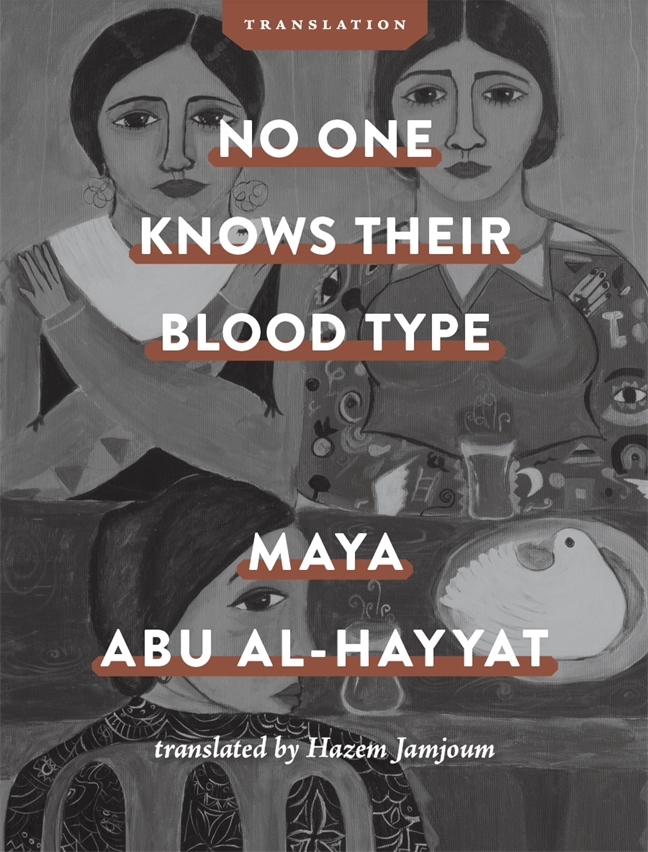
The truths we know and those we don’t: No One Knows Their Blood Type by Maya Abu Al-Hayyat

I don’t know which night I was conceived, but I do know that when nine months had passed, my life started to get complicated. All that I will relate here is not confirmed truth—these are stories I pass on from motley sources. None of them are entirely correct or straightforward, they follow the meandering intentions and motives of the storytellers.

Jumana, the central figure of Palestinian poet Maya Abu Al-Hayyat’s debut novel No One Knows Their Blood Type is,  as she tells us in an account of her early years living with an unloving aunt in 1980s Amman, a collector of secrets. The more she discovers, be it the rumour that her mother did not in fact die in the war in Lebanon, or the unwanted advances of a male cousin, the less certainty there is in her life.  As the story unfolds, shifting speakers and perspective backward and forward across more than three decades, it becomes clear that she is not the only member of her family haunted by secrets, doubts, and insecurity.
This slender, fragmented, nonchronological novel opens in a hospital in Jerusalem in 2007 where Jumana is assisting with the cleansing of the body of Malika, the gregarious midwife who has just passed away. She only knew this elderly Greek woman for less than two weeks—the time that she has been coming to visit her own dying father—but already she has fallen in love with her nephew Suheil, so she is almost family, so to speak.  However, when her father dies shortly after, the shock of attending to his body causes her to collapse and end up in emergency—a detour that will suddenly call into question her own relationship to the family she grew up in. Her father’s death certificate and her lab results reveal his blood type is O positive whereas hers is AB positive. While Suheil calmly shrugs it off as an error, Jumana is not so sure.

From here the novel moves back to Jumana’s account of her childhood in Amman. She and her older sister Yara were born in Beruit, but, at the ages of nine months and three years respectively, they are shipped off to live with their father’s sister in Amman. Their aunt treats them very poorly and the fate of their mother remains a mystery, while their father who in Spain with the PLO, is little more than a voice on the phone and a very occasional visitor. Then, in the early nineties when he has been exiled to Tunisia, the girls are packaged up and sent to join the father they barely know.

From here the narrative shifts to Tunisia in 1993. First, from the perspective of Abu al-Saeed, we see a man struggling with sudden single parenthood, anxious to protect—and if necessary, control—the honour of his two teenaged daughters. He goes to head with the eldest who is as stubborn as he is and, as a result, often incurs his wrath, while Jumana remains an enigma. He can’t figure her out, so he resents her. Meanwhile at work and among his fellow exiles he is frustrated, resentful, at odds with the world, and in turn he carries this frustration back home. When Yara picks up the thread, still in Tunisia, she details the close bond she and her sister have as security against their father, but even she notes, often with jealousy, how different Jumana seems. And then, when the signing of the Oslo Accords cements her father’s intent to return to Palestine, she not only feels despair at the thought of leaving her first love, but she wonders what it means to go “home” to a place she has never been.

Yet another angle to the story of this splintered and displaced family is offered from Amhal, the girls’ mother, as she gives her account of her life in Beruit from 1979 to 1982. She speaks of her unwanted and unhappy marriage to Abu al-Saeed, his disappointment with her failure to produce sons, and her longing to be with Omar, the young Lebanese man she truly loves. When her daughters are sent off to Amman she makes some effort to follow, but borders are difficult to cross and her direct account comes to an end. Jumana will later be in contact with her mother, but answers to the question that haunts her as she marries and has her own child, can only be addressed through DNA testing, but even then the whole question of her identity, not to mention her nationality, will be at risk if her father, or the man she knew as her father, was not related at all.

In his Afterword, translator Hazem JamJoum explians that his immediate attraction to this novel lay not in what was, but what it was not. Rather than writing to make grand statements against colonialism and oppression, or illustrate victimhood, he says: “It just assumes the grotesque facets of the workings of power, and conducts its conversation with whoever recognizes themselves as already in the fight.” He goes on to consider the questions might be more appropriate to ask, including:

Why do we lionize the figure of the revolutionary militant when that militant is, however understandably, transformed into a monster when it comes to those they supposedly love and cherish? Why aren’t questions about motherhood and fatherhood, sisterhood and kinship, love and friendship at the core of conversations about liberty and freedom? If they were, how would that change our notion of emancipation . . . should it change our notion of resistance?

If we ask such questions, and we should, this is a novel that raises more concerns than it settles. Which is okay. It is a story that is inextricable from Palestinian history, occupation, war, and exile, but its focus is on one girl and woman in particular, and the complex and delicate balance of relationships within the extended family network that surrounds her. The fragmented nature of the narrative gives us often conflicting interpretations and perspectives, and as such does not inspire an immediate empathy with any one character, even the primary protagonist. Siblings clash as much as they conspire, mothers struggle to connect with their infants, fathers respond in ways that often reflect their own upbringing, and decisions are made that may or may not be justified. But, in the end, what No One Knows Their Blood Type demonstrates so clearly, is that so often truth is not only relative, but ultimately elusive and perhaps there are times when it is better to leave it that way.

No One Knows Their Blood Type by Maya  Abu Al-Hayyat is translated from the Arabic by Hazem Jamjoum and published Cleveland State  University Poetry Center.
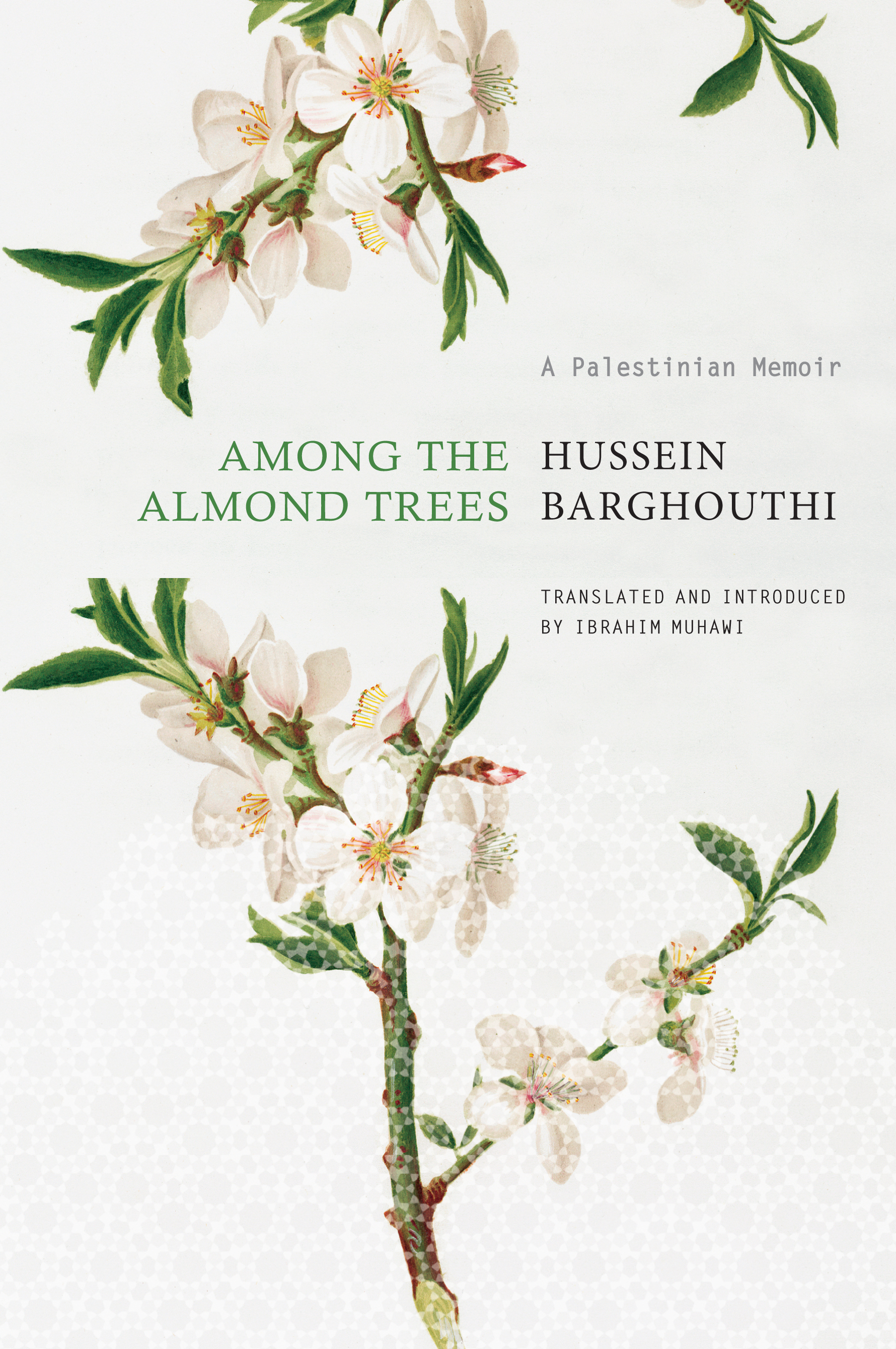
God is in the details: Among the Almond Trees – A Palestinian Memoir by Hussein Barghouthi

Nothing comes to the surface in solitude except that which is already deep within us. I suddenly became aware of many fears. In front of me was a meadow, ploughed and moonlit, reaching all the way to the wall of the Monastery. And a human being, any human being, is afraid of emptiness. I was afraid to enter the meadow that was exposed from every direction. There were some olive saplings that looked like faint shadows, like ancient monks in their dark habits…

In his mid-forties, with the bittersweet weight of a cancer diagnosis on his heart and mind, Palestinian poet, writer, and philosopher Hussein Barghouthi made the decision to return to the village near Ramallah where he was born after what he describes as thirty years of self-imposed exile. If “bittersweet” seems an unlikely adjective for such a serious circumstance, it is appropriate only because Barghouthi was initially led to believe his symptoms might be indicative of AIDS—a condition he feared he would have most certainly passed on to his wife and young son. So when news that he was, in fact, dealing with cancer came, he greeted it with joy. At least at first. But as someone who had, by his own admission, “perfected ‘beginnings,’” his journey home would be an “imperfect ending.” Among the Almond Trees, his meditation on life, death and rebirth, captures his thoughts and experiences as this ending nears.

Barghouthi’s only other work currently available in English translation is The Blue Light, a weird and wild account of his years as a graduate student in Seattle in the late 80s and early 90s, interspersed with recollections from his childhood and earlier adult years. But with the off-beat urban terrain he frequents, the eccentric, marginalized characters he befriends, and the exploration of mysticism and madness that he pursues, it can best be described, as I noted in my review, as a memoir with hallucinations.  By contrast, Among the Almond Trees, composed around the same time, has a much more contemplative, grounded tone. This is still a work with strong spiritual, mystical and philosophical elements, but here he is focused on memory, family mythology, and the longing to understand himself within the cycles of life and death. All of this is deeply rooted in the land.

Having intentionally kept himself apart from the village of his birth for so many years, Braghouthi’s return inspires him to embrace his ancestral connection this location, with its mountains, valleys and trees. He is seeking to reinforce a spiritual connection to his family history, a line which reaches into the past and will extend into the future. Central to this exploration is Qaddura, an uncle of his family’s, who had adopted his mother when she was orphaned. Qaddura is a near mythical character, an imposing figure, known to have been a robber, who lived, it was said, with his brother in an abandoned Byzantine monastery on the mountain above the village. The stories of Qaddura and Snuffie, the woman who was married to both brothers in succession, run through this meditation, and the Monastery itself, as an actual ruin and as an inner mystical space, is an important image. The other key figure is the almond tree, notably the orchard outside his mother’s house.

This is, then, a lyrical monologue steeped in memory and emotion (including the occasional exclamation mark), woven with the history and folktales of his family and his people, insights drawn from Sufism, Buddhism, Egyptian mysticism and Western literature, and threaded with lines of poetry and song—especially that of Mahmoud Darwish and the Lebanese singer Feiruz. Much of the “action,” such as it is, takes place on moonlit nights, like the account of a nighttime pilgrimage Barghouthi makes to the Monastery during which he reflects not only on the importance of this site in his family lore, but on his childhood memories of the mountain, its promises and legends. Yet there are also the realities of the present day—the settlements ever expanding in the valley, the ongoing second intifada, and the disease spreading through his body that often keeps his moonlit wanderings closer to home:

As for why I am now recalling these tales of the Mountain while walking, as always, among the moonlit almond orchards around our house, barely breathing and facing the spectre of death because of a new swelling in my lungs—that is another matter. Perhaps with these tales I can breathe the air of other places and other times in order to sense another moonlit space inside my being and return to whatever inner monastery there was in my spirit that would grant me the strength of beginnings so as to face the cruelty of endings. For imagination is power.

Subtitled A Palestinian Memoir, Among the Almond Trees is, of course, more than one man’s search to come to terms with his “beginnings” to prepare for what is coming, it is the story of a husband and father thinking beyond his death, no matter how painful the idea may be. As someone with a longstanding interest in Buddhism and Sufism and ideas of reincarnation, Barghouthi looks to his young son Áthar, as a guide, so that he may “return to the dormant child” within, “so as to walk the earth as a child-prophet, if not in this life then in the next one.” He marvels at the enchanted eyes through which a child sees the world, and the ability to ask, as Áthar does, magical questions even when an Israeli warplane is passing overhead. Peace is, he knows, elusive, but when he decides he wants to build a house for his wife and son to live in, below the Mountain, he has come full circle and will be leaving them in the best place he knows of. Rather, he won’t be leaving them at all, he will be resting nearby, among the almond trees

As a poetic text rich with literary and traditional allusions, Among the Almond Trees benefits from (but does not strictly require) a detailed translator’s introduction and extensive footnotes. Ibrahim Muhawi, as a Mahmoud Darwish scholar and a folklorist, is perfectly suited to bring to the reader’s attention some of the finer details of the material Barghouthi is referencing. This is a short work—the text is only about 80 pages long—but filled with so much wisdom and beauty, even with the shadow of cancer looming over it, that it welcomes and rewards rereading on its own and alongside The Blue Light.

Among the Almond Trees: A Palestinian Memoir by Hussein Barghouthi is translated from the Arabic by Ibrahim Muhawi and published by Seagull Books.

Poetry as an act of resistance: A River Dies of Thirst by Mahmoud Darwish

A great poet is one who makes me small when I write, and great when I read.

A River Dies of Thirst, the last volume of Mahmoud Darwish’s work to be released in Arabic, just eight months before his death in 2008, offers a precious opportunity to spend a little more time with a great poet as he casts a sorrowful eye at his beloved Palestine, and reflects on love, life, time, and memory. But more than anything this collection of poems, reflections, and journal fragments is a meditation on what it means to be a poet. And for him that is a distinctive vision, for Darwish was not only one of the most remarkable and humane poets of our time, but he gave  voice to the Palestinian consciousness and was someone who believed that “every beautiful poem is an act of resistance.”

To read this final collection now, more than eleven months into the longest, deadliest sustained attack on Palestinian citizens since the creation of the Israeli state, is to hear that voice of resistance resounding so clearly that it is almost unsettling. So many of the pieces here feel as if they could have been written yesterday, beginning with the opening poem “The girl/The scream”:

On the seashore is a girl, and the girl has a family
and the family has a house. And the house has two windows
      and a door.
And in the sea is a warship having fun
catching promenaders on the seashore:
Four, five, seven
fall down on the sand. And the girl is saved for a while
because a hazy hand
a divine hand of some sort helps her, so she calls out: ‘Father
Father! Let’s go home, the sea is not for people like us!’
Her father doesn’t answer, laid out on his shadow
windward of the sunset
blood in the palm trees, blood in the clouds

The girl becomes the endless scream, echoing without echo across the land, as an aircraft returns to bomb the house with two windows and a door, silencing her family’s story.

This heartbreaking  image is followed by a series of poems and short prose pieces that speak to war and Palestinian suffering in Lebanon, Gaza, and the West Bank. The uncanny timelessness of his poetry betrays the truth: there is nothing new about what we are witnessing today save for the intensity. And as Darwish reminds it, the violence is not just directed at people—it is an attack on the land, on nature, and the memory held in the soil. Consider the olive tree, the venerable grandmother-like figure, “modest mistress of the hillside.” She is spoken of with reverence: “In her restrained silvery greenness is a colour too shy to declare itself openly, a glance toward something beyond description, for she is neither green nor silver. She is the colour of peace, if peace needs a colour to distinguish it.” It is message lost on the occupying forces:

But these soldiers, these new soldiers, surround her with bulldozers and uproot her. They crush our grandmother, so that now her branches are in the earth and her roots in the air. She did not weep or shout, but one of her grandsons who witnessed the execution, threw a stone at a soldier and was martyred alongside her. When the soldiers left triumphantly, we buried him there, in the deep hole, our grandmother’s cradle. For some reason we were convinced that after a while he would become an olive tree, spiky and – green!

(from “The second olive tree”)

As a late work by a poet who is simultaneously conscious of his timelessness and his mortality, it feels as if Darwish is allowing himself to focus his attention on what is most important to him as he knows, not necessarily that his own end is as near as it would happen to be, but that time, and the heart, has its limits. As such, the themes that recur throughout these pieces reflect elements common to all his work, but are tinged with the melancholy that comes with age and a long life marked by exile and the ongoing occupation of his homeland.

Amid the poems that reference war and occupation directly—the more political pieces—are quieter reflections on the poetic existence, that is, on poetry as a way of being and engaging with world. Darwish is a poet immersed in his environment, the sights, scents and sounds all echoing longing and loss, but now the atmosphere evoked is more ephemeral, his awareness more attuned to the spaces between sleep and waking, in the flickering shadows where words might be found:

Leaves in summer whisper modestly, call out shyly, as if to me alone, stealing me away from the burden of material existence to a place of delicate radiance: there, behind the hills, and beyond the imagination, where the visible equals the invisible, I float outside myself in sunless light. After a short sleep like an awakening, or an awakening like a short sleep, the rustling of the trees restores me to myself, cleansed of misgivings and apprehensions.

(from “Rustling”)

There is also a more direct engagement with the idea of writing  poetry and recollections of his past encounters with other prominent poets, their conversations and interactions. And the two sections of fragments that round out this collection contain many wise observations about the  life, identity, perception and, of course, poetry.

With a total of 127 short pieces—including fully finished poems (both prose poems and verse), commentaries, and assorted observations and aphorisms—A River Dies of Thirst is a collection that may be best read slowly, taking in a little at a time. There is so much beauty in the language and so much to reflect on. It might also serve as a good introduction for those who have yet to hear Darwish’s masterful voice. And this certainly is the time to listen.

A River Dies of Thirst by Mahmoud Darwish is translated from the Arabic by Catherine Cobham and published by Archipelago Books.

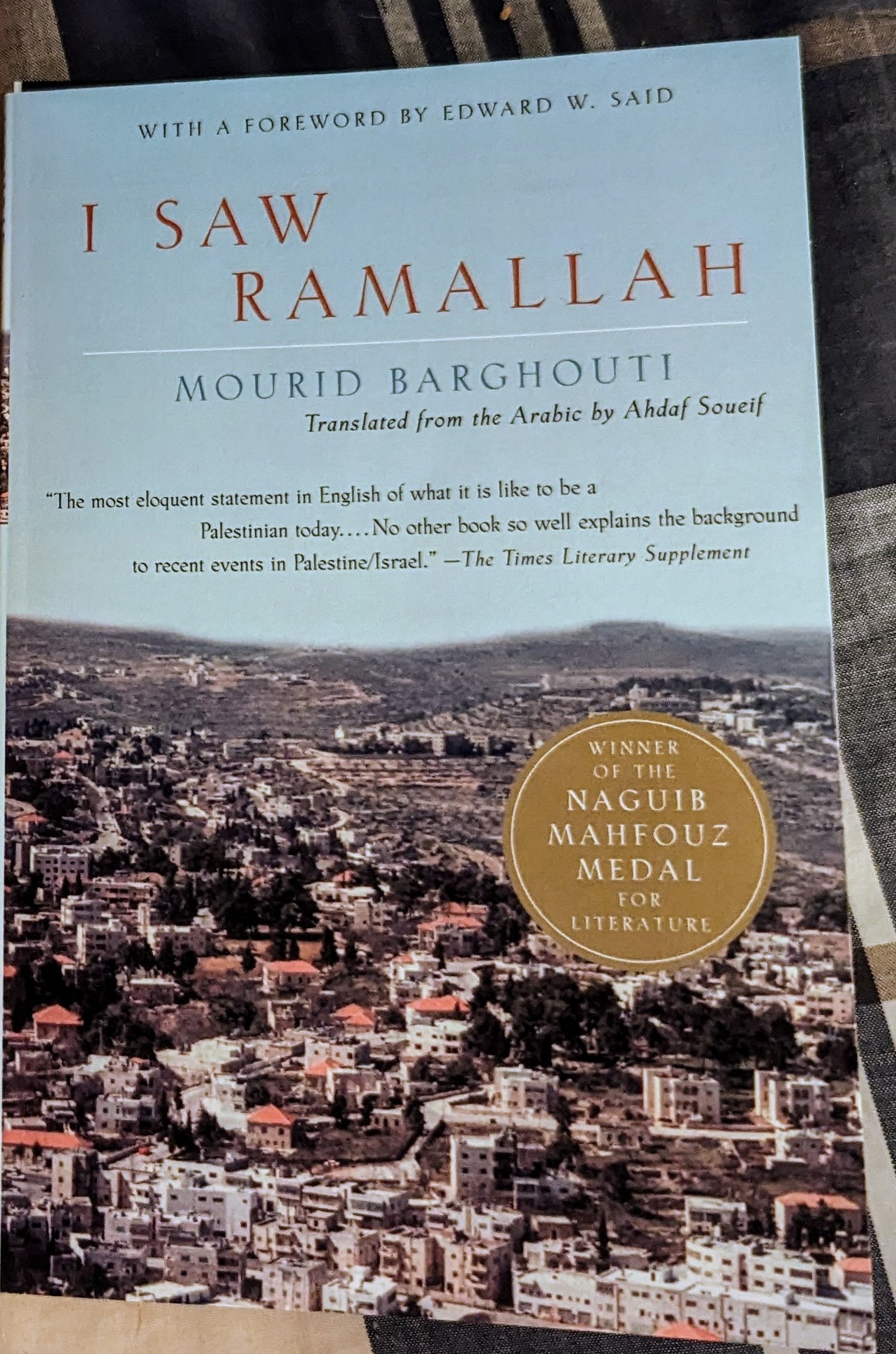
“I do not live in a place. I live in a time.” I Saw Ramallah by Mourid Barghouti

When his name is finally called after waiting for hours, he grabs his small bag and steps on to the Allenby Bridge to cross, for “the first time in thirty summers,” from Jordan to the West Bank:

Is this a political moment? Or an emotional one? Or social? A practical moment? A surreal one? A moment of the body? Or of the mind? The wood creaks. What has passed of life is shrouded in a mist that both hides and reveals. Why do I wish I could get rid of this bag? There is very little water under the bridge. Water without water. As though the water apologized for its presence on this boundary between two histories, two faiths, two tragedies. The scene is of rock. Chalk. Military. Desert. Painful as a toothache.

Palestinian poet Mourid Barghouti’s thoughts are flooded with questions as crosses into the land he has been barred from entering for three decades. The year is 1996. His account of his visit, one that necessarily looks back on his many years of exile and the changes to his homeland that confront him on his return, is vividly captured in his memoir I Saw Ramallah. First published in Arabic in 1997 (and three years later in Ahdaf Soueif’s English translation), this is a work that speaks passionately and unapologetically to the reality of existence of the Palestinian people today, of their displacement and their lives under the Occupation.

Barghouti does not enter the West Bank alone. He carries the weight of the memory of the long years of exile, of family and friends scattered near and far. And he’s haunted by the ghosts of all of those who are buried in distant lands, those who never managed to return, either as a visitor or as a resident, especially his older brother Mounif:

After how many more thirty years will the ones who never came back return? What does my return, or the return of any other individual mean? It is their return, the return of the millions, that is the true return. Our dead are still in the cemeteries of others. Our living are still clinging to foreign borders. On the bridge, that strange border unmatched on any of the world’s five continents, you are overwhelmed by your memories of standing at the borders of others.

As he takes in the altered landscape, the ever expanding Israeli settlements, and the once familiar hills, now alien, the connection and disconnection is profound. He stays with a family member, explores the city, and visits his birthplace, Deir Ghassanah, where he reads poetry to an assemblage of villagers unfamiliar with poetry readings but responding to his words and images nonetheless.

But, of course, thirty years does not vanish just in the act of returning. As much as Palestine and her people have changed and are continuing to be changed under the forces of Occupation, Barghouti’s life has been impacted by his identity no matter where he has lived. Nor is it his first return from exile, so to speak.  In the 1970s, his involvement in earlier student protests against Sadat in Cairo led to his forced separation from his wife and infant son when all non-Egyptian participants were deemed to be infiltrators and removed from the country. The prohibition lasted seventeen years, his family-time suddenly telescoped into winter and summer holiday breaks wherever he was living at the time. By the time he was able to return to live in Egypt, his child was long out of diapers and ready to start shaving! And when that exile within exile came to an end he realized:

You do not arrive unchanged at the moment of joy dreamt of for so long across the years. The years are on your shoulders. They do their slow work on you without ringing any bells for you.

Now, one of his primary goals during his time in Ramallah is to obtain the necessary permit to allow his son Tamim to finally see the land of his ancestors.

Moving, poetic, and beautifully written, this is, nonetheless, a narrative dotted with question marks. Barghouti regularly questions the descriptions, the emotions, and the meanings that he grasps at as he tries to articulate the strange in between state in which has found himself over and over throughout his life—in Occupied Palestine, Cairo, Budapest, Amman and elsewhere. So many places, so many pillows beneath his head:

My relationship with place is in truth a relationship with time. I move in patches of time, some I have lost and some I possess for a while and then I lose because I am without a place.  I try to regain a personal time that has passed. Nothing that is absent ever comes back complete. Nothing is recaptured as it was.

A memoir recounting the return to one’s homeland after thirty years, is necessarily a story of exile, of the Diaspora, and of the way the Occupation has closed in on the land and claimed the freedom of the Palestinian people. Focused as he is on the present moment, that of his precious time in Ramallah, Barghouti is also continually looking back—to the Nakba, to the 1967 War, to the Intifada. Yet to read this book in 2024, one cannot but look ahead through further wars to the escalating incursions into the Occupied West Bank, to the conflict in Gaza. To genocide. For a book first published twenty-seven years ago, it reads like it could have been written yesterday. Netanyahu was prime minister then, he is still prime minister now.

After the popular Intifada on the land of Palestine we went to Oslo. We are always adapting to the condition of the enemy. Since ’67 we have been adapting. And here is Benyamin Netanyahu, prime minister of Israel, calming America’s fears for the current agreement by saying that the Arabs will in the end adapt to his harshness because they always adapt to whatever they have to.

And what if they refuse to adapt? When speaking to the spirit and resilience of his people, Barghouti often calls attention to the Palestinian inclination to seek the comic in the tragic, but he is keenly aware that for the generation after his—those who grew up in the aftermath of the 1967 war—the tone has shifted, something he witnesses in the appeal of resistance movements: Fatah, Communism, the Front, and Hamas. This is the legacy of the Occupation itself.

I Saw Ramallah is not exactly a work infused with nostalgia. It is searching and existential in nature, a memoir tinged with sadness and a measure of grief. And as he nears the end of his account, he refuses to hold his anger at bay. He is blunt in his assessment of his people’s circumstances and the history that has been thrust upon them, as a man born four years before the Nakba who, now in his fifties, is determined to ensure his son’s right to a space in a land that now carries two conflicting and interconnected stories:

But I cannot accept any talk of two equal rights to the land, for I do not accept a divinity in the heights running political life on this earth. Despite all this, I was never particularly interested in the theoretical discussions around who has the right to Palestine, because we did not lose Palestine in a debate, we lost it to force. When we were Palestine, we were not afraid of the Jews. We did not hate them, we did not make an enemy of them. Europe of the Middle Ages hated them, but not us. Ferdinand and Isabella hated them, but not us. Hitler hated them, but not us. But when they took our entire space and exiled us from it they put both us and themselves outside the law of equality. They became an enemy, they became strong; we became displaced and weak. They took the space with the power of the sacred and with the sacredness of power, with the imagination, and with geography.

This is an important, affecting, and highly readable memoir for anyone who wishes to have a clearer understanding of the situation in the Middle East. But, if you have read other Palestinian literature, it may sound eerily familiar. These stories are not new; they have been expressed in literary works—poetry, fiction, nonfiction—for many decades now and, as we have seen, Palestinian voices continue to refuse to be silenced.

I Saw Ramallah by Mourid Barghouti  with a Foreword by Edward Said, is translated from the Arabic by Ahdaf Soueif  and published by Anchor Books. In the UK, a new edition is forthcoming from Daunt Books in August 2024.

The vanished railway station: An Old Carriage with Curtains by Ghassan Zaqtan

In the western foothills of the Hebron Mountains, about forty kilometres southwest of Jerusalem, lies what remains of Zakariyya, a village with a history stretching back millennia. It was the birthplace of the parents of Palestinian poet and writer Ghassan Zaqtan. When the community was occupied and depopulated by Israeli forces following the Nakba, they were forced flee to Beit Jala near Bethlehem. That is where Zaqtan was born in 1954. Seven years later, in 1961, circumstances compelled his family to move again, this time to Karameh refugee camp in the Jordan Valley, across the river from Jericho. Though the settlement was destroyed during the 1968 War of Attrition, Zaqtan would return to it as the setting for his 1995 novella Describing the Past (published in English in 2016), the tale of three teenagers coming of age and dealing with love and loss in a world haunted by war, death, and dislocation. With Where The Bird Disappeared (2015), Zaqtan’s second prose work to appear in translation in 2018, the village of Zakariyya comes into central focus. This lyrical, almost fable-like story follows the fate of two boys, Zakariyya and Yahya, who grow up in the village. They are both in love with Sara. However, the arrival of “armed Jewish forces” changes everything.

Now, with the English release of Zaqtan’s 2011 novella, An Old Carriage with Curtains, the three works—all translated by Samuel Wilder—can be seen as a loosely linked trilogy, or as being in conversation with one another. Each is different, and, as such, not need be read in any particular sequence, but they are bound by a common spare, poetic, dreamlike narrative style, and by echoing images and motifs. Yet, this third book seems closer to the author’s own life, suggesting that it is somewhat more autobiographical. Here the protagonist is an unnamed middle-aged man living in Ramallah. His aging mother, who lives in Jordan, longs to see her birthplace again for the first time since the “migration.” It is the place that has always loomed large in his family’s history, its existence nearly mythical, its sudden loss impossible to put into perspective:

He arrived late to Zakariyya, his village, occupied since 1948, where his father and mother were born. Somewhere in a drawer inside the house there was a faded, tormented picture that redeemed nothing, but which kept in place the stories that amassed in the family home. The picture showed a distant spectre of forest trees, and the ghosts of houses at the far-right edge of the frame. This was all it contained. It looked tired, faded, closed; nonetheless, it asserted some incredible forbearance. Under the pressure of the cruel importance placed on it, it could hardly go on existing, pressed down by the dependence of all those contradictory memories, all the longing that pervaded their stories.

By the time of the key events traced in this novel, the protagonist has passed through or near the abandoned townsite a number of times, but he has resisted sending his mother any photographs, as he had promised. Now, as her anticipated visit nears, her descriptive recollections of Zakariyya take on new dimensions and details. For the first time, she talks of a railway station and a Palestinian Jewish friend she used to meet there as a child, but her son has seen no sign of a station or tracks. This disconnect causes him to feel that the images and memories he has been trying to preserve for her are hollow, “not convincingly alive, because the railway station was gone. Its absence diffused through life, evaporating everything.”

Absence, the mutability of memory, and the importance of stories to sustain individual and collective identity are common elements of Zaqtan’s fiction. In An Old Carriage with Curtains, the nonlinear narrative proceeds through short scenes that move between a number of themes or threads. Some are conceptual, others more practical. Because movement is restricted, there is the matter of obtaining the required permits, a frustrating, complicated and time-consuming process that becomes, for many Palestinians, a fruitless life-long ritual. For the protagonist, his current application for a Visitor’s Permit that will allow him to travel to see his mother in Ammam has taken three tries; his efforts to secure one to allow her to visit her homeland just once has taken much longer. But, what he does finally manage to obtain for her, sadly, does not include either Jerusalem where she had hoped to pray, or Zakariyya; nor is it the prize she had long dreamed of, the right to return for good.

Permit in hand, there is then the question of making the passage between the West Bank and Jordan across the Allenby Bridge. The protagonist’s somewhat surreal experiences on his way to see his mother form one of the novel’s central threads. Broken down into snapshot vignettes, there are the queues, the restless waiting travellers, an old man who makes repeated and increasingly desperate attempts to pass through a mechanized gate, and a woman soldier who, when checking his documents, betrays the recognized agreement he maintains between himself, a Palestinian, and them. She simply asks him a question: Do you like to travel? Innocent enough in any other reality of human interaction, her unexpected transgression unnerves him.

Another thread that appears throughout the narrative features Hind, an actress friend with whom he has a relationship he does not fully understand, though he senses that his role is primarily be that of a listener, an audience. Thus, her voice enters his narrative directly, in first person, as he recalls stories she has told him about her own life or family, even if he is not always certain whether he has remembered them accurately or added his own embellishment. She seems to carry an anger that she accuses him of lacking whereas, by contrast, he tends to exhibit a more contained, thoughtful, and melancholic perspective.

Finally, as a tale of journeys—across borders and into the past—passages, landscapes, and the idea of home play an important role. The novel opens with the protagonist making his way along the Wadi Qelt , following the ancient path between Jerusalem and Jericho, aware that he is walking in “the valley of the shadow of death,” en route  to the Monastery of Saint George which he had visited as a young school boy. Yet, when he reaches it, he finds it closed to visitors for the day, and he is denied a chance to reclaim his memories. Later, an intellectual detour will take him on an exploration of the exile literature of Naim Kattan, Emile Habibi, Imre Kertész, and Muhammad al-Qaysi. And, more than once, his thoughts turn back to the first time he returned to his homeland in 1994, to the trip by road from Gaza to Ramallah, past Zakariyya and nearing, but not passing through, his own birthplace near Bethlehem. He knows that any specific location, a house or community, can be emptied, reoccupied or left to fall into decay, but a history inextricable from the landscape—its hills, valleys and roads—cannot be destroyed:

The story of Palestine was hidden inside the roads, he thought, where the depth and necessity of things appear, where cold description was overturned, yielding to a depth found in trails that connect, vectors passing through the mountains and strange wadis. It was not the quest for exaggerated aesthetics of poets and romantic novelists, but a scene of painful, violent, uncontrolled energy, cold and bitter directions that course through astonishing, contradictory forms, forging ways through the alloy of fear, belief, rebellion, contentment and self-annihilation. The lote tree of the lowlands connected to the olive tree the hills. All this confusion, he thought, was like some rough draft of wisdom thrown on the shoulders of this country.

The story of Palestine is still being written, in defiance of the forces that have escalated the attack on its right to exist. This novel, with its maze of checkpoints, permits, and restrictions is only more relevant now than it was a dozen years earlier. In fact, in one scene the protagonist says to Hind, “I didn’t sleep well. They are bombing Gaza.” Thus, on its own or in concert with Describing the Past and Where the Bird Disappeared, An Old Carriage with Curtains evokes a contemporary portrait of a world attuned to the voices of the past, facing an uncertain future, where the preservation of the spirit of memory against its inevitable tendency to shift and transform itself may be the only way to move forward. And, if one continues to listen to the stories of others, that vanished railway station might even be found.

An Old Carriage with Curtains by Ghassan Zaqtan is translated from the Arabic by Samuel Wilder and published by Seagull Books.

The wisdom of madness: The Blue Light by Hussein Barghouthi

Blue is a colour with multiple manifestations and meanings in various contexts and traditions—the light of the sinful self for the Sufis, the colour of creative energy in Tibetan Buddhism, the destructive enemy of the God of Wisdom for Zoroastrian Persians. Blue is also said to be an antidote to sexual excitation and it is said to calm the nerves. That may explain some of the hold that the colour has on Hussein, the narrator of The Blue Light and a man beset by questions about his own sanity, but the roots of his attraction run much deeper:

For me, blue is the color of estrangement, the unknown, and of the childhood sky. And there is, also, blueness to all my ill wishes. When I learned to play the piano, I composed a short magical piece, played it for a while, day after day, without knowing the secret of my love for it, until one day I read a book by a Black musician who claimed that each note has a specific color to it. And each composition, too. One of Mozart’s sonatas arouses in the listener green or blue or . . . anyway, I looked around for the color of that magical note of mine and was astonished to find that it was blue.

This posthumously published novel by Palestinian poet, writer and essayist, Hussein Barghouthi (1954 – 2002) walks along that troubled path between fiction and autobiography, arriving at what might best be described as a memoir with hallucinations. It is a delirious account of a man desperate to make sense of himself and his unusual way of thinking. Or, as Mahmoud Darwish says, on the blurb on the back cover: “[a] peculiar mix of confession and contemplation, hallucination and mythology, reality and the unrevealed. A mix of personal stories and mystic leaps, of madness that claims wisdom, and wisdom that only madness can transubstantiate.”

The Blue Light is inspired by Barghouthi’s time in Seattle, Washington where he pursued graduate studies in Comparative Literature in the late 1980s and early 1990s. As someone who had long felt different from others, he finds himself, in this foreign land, frequenting three establishments—Grand Illusion Cinema, Last Exit Café and Blue Moon Tavern—attracted by their names and by the company of the mad, eccentric and disenfranchised characters he finds there:

Strange how a place seems like a ruse, sometimes. I found myself wandering these three joints looking for myself, not among books, I was sick of books, but among the shady and the crazy, the homosexuals and the punks, where maps are clearer, more precise, and more exciting, or where at least I, as one of them, didn’t have to talk to anyone. For a whole nine months I talked to no one. I knew no one.

Terrified of madness and hiding his fears beneath a mask of sanity, Hussein does begin to engage with some of the offbeat, often homeless, regulars and even falls, briefly and cynically, into the bizarre world of the Church of Dianetics, but his search for his real identity changes course dramatically when he meets Bari, a Turkish-American Sufi from Konya. Introduced through a mutual friend, he is dynamic and given to loud laughter, strange stories and odd mannerisms. From their first encounter, Bari’s intensity and sea deep voice, “free as a roar,” reminds Hussein of an early experience of  his near drowning that birthed a recurring dream of being chased by a giant wave from a beach in Beruit to his childhood mountains in Ramallah. Among other memories, the Sufi’s laughter woke up the sea.

But Bari is elusive. He responds indifferently to Hussein’s questions and speaks little about his past. The two men often play chess at Last Exit Café, an environment where most of the patrons are mentally ill and he is thought to be just another “space case.” Yet Hussein becomes convinced that his madness “was something more than the usual madness.” He is drawn into Bari’s world even if, or perhaps because, it seems inaccessible. The secret he thinks is one of language, reasoning that: “Words meant something entirely different for him than they did for me.” So, he dedicates himself to deciphering Bari’s meanings and falls into a strange project to create a dictionary. For example, one day Hussein is confronted by the Sufi who says: “Man, your blue bird came to me last night. Stop him.” Caught off guard, Hussein fashions a response that appears to satisfy him, but the question remains—what does blue mean to Bari? What about his odd chants and expressions?

After much reading and exploration, an endeavour tinged with as much madness as those of anyone else around him, Hussein discovers what he believes is a key, a phrase he’d heard from the Sufi before. Waiting until the right moment presents itself at the end of a chess game he exclaims: “Return the blue light naked to its house.” The arrow strikes its target. Bari demands to know what he wants. Hussein holds his own, and in response confesses that he is afraid of losing his mind. The door is opened, Bari invites him in.

Thus begins a closer relationship. One damaged soul to another, Hussein seeks answers from the enigmatic, often volatile, Turkish American through what unfolds very much like a game of riddles that forces Hussein into a closer examination of his own past and a dissection of the history of his own fear of madness. Memory, mythology and cultural heritage merge as he engages with and responds to Bari’s mystic pronouncements. His Palestinian identity and experiences living under occupation have only heightened the estrangement and alienation he cannot escape, no matter where he has lived. In Seattle, this Sufi who proudly claims to belong nowhere, may finally trigger Hussein to loosen the tangled threads of thoughts threatening the clarity of his mind. Consider an early discussion about physical bodies and the mental bodies—spirits—that can visit one over great distance, during life or after death. This reminds Hussein of the culture of the dead in Palestine where death is so readily at hand. The ghosts or mental bodies of the dead are frequent household guests:

These spirits visit me long after their bones had turned to eyeliner dust in a land where the dead dominate the living, the past governs the future. That’s the authority of memory in a region whose depth is measured not by centuries but by millennia. Memory is a dangerous thing, a laboratory of ghosts. Didn’t Ishtar, a few thousand years ago, in the epic of Gilgamesh, didn’t she threaten to “open the gates to the underworld” and let the dead share their meals with the living? We can’t live with this kind of deep memory and can’t live without memory either, so what’s the solution?

The community of outcasts and assorted spiritual personalities, Bari included, that Barghouthi brings to life in The Blue Light, a rich, sometimes wild, creation of fiction and memoir, is a brilliant backdrop against which he, through his narrator, is able to navigate a personal crisis of identity within the cultural and historical crisises of his people. In a foreign country, with a foreign language, and a sage with a vocabulary of mysterious provocations and commands, he inches toward self-understanding. Along the way, there’s a plenitude of wisdom and insight for anyone travelling alongside him.

The Blue Light by Hussein Barghouthi is translated from the Arabic by Fady Joudah and published by Seagull Books.

The revolution isn’t a rocket but a river that flows and pours forth: Passage to the Plaza by Sahar Khalifeh

Each summer night in Nablus was just like the next: breezes pregnant with the scent of jasmine, dew and whiffs from the sewers. The municipality went to great pains: every morning the marketplace smelt like a freshly cut bouquet of the most fragrant flowers; however, by the time the afternoon rolled round—when the hustle and bustle had died down and the shops had closed and the rugs and carts had disappeared along with the cries of the hawkers—the city became a rubbish tip: crumpled papers, plastic bags, used tissues, piles of trampled fruit.

This is the setting of Sahar Khalifeh’s Passage to the Plaza. But Nablus is a city on edge. Originally published in 1990, this novel is not only set during the First Intifada (1978–1993), it was written and published in the middle of this period of upheaval marked by sustained Palestinian protests and rioting in Gaza and the West Bank. Born in Nablus in 1941, Khalifeh is one of the most prominent Palestinian women writers. As the fifth of eight daughters, she was well aware of the fate that awaited members of her sex but sought early refuge in reading and writing. Married off against her will, she endured a difficult thirteen year marriage in Amman, Jordan, during which she found it impossible to write. This changed in the aftermath of the Six-Day War in 1967—she not only published her first novels, but returned to school in her early thirties. Her work, which is centred around the lives of women, offers a wider female narrative than that often associated with resistance literature.

Passage to the Plaza, translated from the Arabic by Sawad Hussain, is a very immediate response to the circumstances of the Intifada through the intersection of the lives of three women and one man who come together in one unlikely location. There is Sitt Zakia, the midwife, an older woman who, by virtue of her chosen profession, is at once on the margins of society and yet central to the lives of the countless children she has brought into the world. She crosses class boundaries but, at the end of the day returns to the comfort of her hookah and her prayers. Her beloved nephew, Hussam, is a freedom fighter whose political indoctrination began young, inspired by his infatuation with a fashionable teacher. Samar, the baker’s daughter is a young woman with a university education and decent job. She is also an activist with a women’s movement. And, finally, Nuzha, living alone in a house rumoured to be a brothel, is the daughter of a woman who was accused of being a spy and publicly murdered. She is a true social outcast with a complicated past. When Hussam is wounded and finds himself at her door, her home becomes an unexpected sanctuary.

The three women in this novel represent different facets of the conditions women face in Palestinian society. Samar, a patriotic and hopeful twenty-six year-old, is conducting research into the impact of the Intifada on women’s lives and the answers her questions elicit from Sitt Zakia and Nuzha are telling. When asked how her life has changed, the midwife responds: “Honestly nothing much has changed for us except more worries. More worrying means more burning hearts. I pray for God to help us women!” She sees women out on the streets protesting, throwing stones and protecting the militants. But all of the old worries women have always carried still exist. Sitt Zakia’s own daughters are married and living in other countries and she hasn’t heard from them at all since the uprising began. Her more immediate worries involve her militant nephew who is on the run.

When Samar arrives at Nuzha’s house, survey in hand, her inquiries are greeted with anger and bitterness directed at Palestine, at the men who have let her down and at a community that has rejected her. Only one year older than Samar, her life has been impacted by a very different set of circumstances beyond her control. She is defiant and combative and slow to trust any kindness. Her greatest concern is for her younger brother Ahmed, a resistance fighter who is hiding somewhere outside the city; she longs for his return. While she shares her past with Samar, the wounded and feverish Hussam is in another room, listening from behind the door.

Hussam comes from a “family that was mediocrely rich, educated to a mediocre standard, mediocre in their claims to nobility and prestige.” His uncles went abroad and achieved success while his father took unethical advantage of their portions of the family land to present himself as a much richer man then he was. For Abu Azzam, his unconventional sister Zakia and rebel son were his sole sources of shame, not his own duplicity. For Hussam, his rebellion was fueled not only by his unrequited love for the beautiful and politically active Sahab, but reinforced by a series of arrests and periods of administrative detention—”a rite of passage for all young men”—that freed him from his boyish fears, ultimately pushing him toward the resistance. However, as the situation in Nablas deteriorates with an increased presence of Israeli soldiers, the imposition of curfews, establishment of checkpoints and construction of barriers, Hussam’s condition worsens, leaving him bedridden in Nuzha’s house, drifting in and out of consciousness. The female characters are the ones who must negotiate the challenges and dangers of the streets and the social expectations of their gender on their own.

As in all of Khalifeh’s work, women’s enslavement, lack of rights and fight for equality are important themes, but her female characters are complex, their motivations often at odds with one another. The pious Sitt Zakia, for example, despite her independence and estrangement from her brother, worries about protecting his reputation when her sister-in-law arrives begging for refuge from his cruelty. She sends Um Azzam back to her own house, insisting that it is where she belongs. Nuzha, abused by the men in her life, has been forced into a situation that causes her and her late mother to be despised by other women. She is rightly fed up with both sexes. Meanwhile, Samar, for all her ideological optimism, still dreams of love and a handsome husband to come home to her each night.

Khalifeh allows much of her story to unfold through interactions between her primary protagonists, occasionally punctuated with direct access to brief internal monologues that reveal emotions that often contrast with what is otherwise expressed or described. A natural tension builds by virtue of the complicated emotional responses the characters have to one another and to their own predicaments, but outside the particular house where most of the engagement takes place, action explodes in periodic episodes of violence—the women’s collaborative efforts to dismantle a barrier the soldiers have built, a beating Samar receives at home from one of her brothers, a deadly ambush—that raise the tension suddenly and intensely. This narrative style has an almost theatrical feel; the story moves quickly, shifting in unexpected directions. It is all reflective of Khalifeh’s in-the-moment manner of setting a story in motion amid critical historical events as they are happening rather than waiting for the dust to settle. If it creates a degree of uneasiness, if certain details are left unexplained, so be it. Through it all, the voice of the poet of resistance rings out, reminding us what is most critical:

Golden days like those of a birthday. In a revolution, one is born a hundred times and dies a thousand more. The revolution isn’t a rocket but a river that flows and pours forth. Sometimes foreign aid sinks, rain becomes scarce, the river goes through difficult times, drying up, seeming fine as a silk thread. Other times it breaks forth, like a turbulent volcano, sweeping away all in its path, deafening. Oh generous sky, oh angry earth, anger that, like a storm, chooses its hour. Then the cycle comes to an end and goes back to how it was: the river becomes an oscillating thread again, the revolution returns to reality, the boulder tumbles back to the bottom of the river and Sisyphus picks up his load once more.

Reading this book while Israel is waging war in Gaza offers a reminder that nothing is new. One is forced to remember this novel was published in 1990. There are lines uttered here, during the Intifada, that could just as easily appear on social media today. The desperate plea Nuzah utters toward the end of the book hits especially hard, some thirty-three years later: “Enough of God, Mohammed, Essa, Musa, Red Cross and the UN. No one sees or hears. Since when has the world thought of us as humans?”

Passage to the Plaza by Sahar Khalifeh is translated from the Arabic by Sawad Hussain and published by Seagull Books.

A tale of two travellers, You and I: In the Presence of Absence by Mahmoud Darwish

Allow me to see you, now that you have left me and I have left you, safe and sound like pure prose on a stone that may turn green or yellow in your absence. Allow me to gather you and your name, just as passersby gather the olives that harvesters forgot under pebbles. Let us then go together, you and I, on two paths:

You, to a second life promised to you by language, in a reader who might survive the fall of a comet on earth.

I, to a rendezvous I have postponed more than once with a death to whom I had promised a glass of red wine in a poem. A poet is at liberty to lie, but he only lies in love because the heart’s promises are open to alluring conquests.

The celebrated Palestinian poet Mahmoud Darwish was aware that his own death was nearing when he composed In the Presence of Absence, an intimate synthesis of memory and meditation that not only turns its attention to the past, but looks ahead to contemplate what words can carry into a future that he knows he will not see. It is a self-elegy, an established genre in classical Arabic poetry, re-imagined, reshaped and realized through a unique “convergence” of prose and poetry in which, as translator Sinan Antoon puts it in his Preface: “[t]he living ‘I’ bids farewell to its imagined dying other in a sustained poetic address divided into twenty untitled sections.” Presented as a dialogue between the poet’s present self and his absent self, each section explores a particular experience or theme.

Early on, Darwish invokes his younger self, a mischievous child caught up in the magic of the natural world, lured by curiosity toward adventure and injury. However, another love was also nurtured at a young age: the love of language. The third section is devoted to the endless possibilities that the future poet discovers in the wonder of letters and words. It will become his life:

You become words and words become you. You do not know the difference between utterer and utterance. You will call the sea an overturned sky and the well a jar to preserve sound from the world’s tinkering and the sky a sea hanging from clouds.

There is something that assumes the obscure. It cannot be smelled, touched, tasted, or seen. It is what makes childhood a sixth sense. They called you the dreamer because you often gave words wings invisible to grown-ups.

Darwish devotes several sections to this time of dreams and dreaming before, at the age of seven, dreams turn into nightmares. The Nakba’s destructive force drives him and his family from their homeland under the cover of darkness at a time when his absent self was:

Still too young, you could not imagine your own death. You did not yet grasp that children could die.

Life will go on but, but this sudden, unprecedented displacement  will cause him to hate the second half of his childhood and foreshadow the circumstances that will shape the rest of his life.

In the Presence of Absence is not a memoir in the familiar sense of the word, but significant life experiences—imprisonment, exile, heart surgery, a visit to his mother—shape his reflections. Yet, at times, he turns to more open meditation on themes like love, loss, dreaming and what it means to return. These meditations turn on the poetic as poetry is always, for Darwish, more than a vocation, but an essential means of making sense of the world. Ever the dreamer, his dreams are soaked in a melancholy that reveals itself in imagery bound to a land and a life forever lost:

Longing is the absent chatting with the absent. The distant turning toward the distant. Longing is the spring’s thirst for the jar-carrying women, and vice versa. Longing allows distance to recede, as if looking forward, although it may be called hope, were an adventure and a poetic notion. The present tense is hesitant and perplexed, the past tense hangs from a cypress tree standing on its rooted leg behind a hill, enveloped in its dark green, listening intently to one sound only: the sound of the wind. Longing is the sound of the wind.

The more you delve into your loneliness, like that tree, the more longing takes you with motherly tenderness to its country, which is made of transparent, fragile fibres. Longing has a country, a family, and an exquisite taste in arranging wildflowers. It has a time chosen with divine care, a quiet mythical time in which figs ripen slowly and the gazelle sleeps next to the wolf in the imagination of a boy who never witnessed a massacre.

Darwish plays presence and against absence through this text, the image surfaces and reshapes itself in endless variations, including the confrontation with his own absence when he visits the ruins of the village he was born in. For, to articulate an absence that is present or a presence that is absent is not only the task of this self-elegy, it is, for Darwish, a poet’s role. This is, then, more than anything, a book about language—as a means to express, to understand, and to exist in a world that has been torn apart. His prose is rich with metaphor and sensual, even sexual, imagery, but the pain of a man who was denied the ability to live freely within the land of his birth, and witnessed, by the time of his death in 2008, the impact of sixty years of occupation and conflict on the Palestinian people, is never far from the surface.  It is, sadly more timely than ever.

Sinan Antoon’s translation honours the poetic energy of this work, aiming, he tells us, to preserve, where possible, the pulse and rhyme of the original. Endnotes supply necessary context, as required. This text, like Journal of an Ordinary Grief and Memory for Forgetfulness, is classified as poetry, but, as poetic as these works are, I prefer to consider them closer to prose lest a potential reader who is apprehensive about poetry be inclined to avoid them. Darwish’s meditative, incantatory prose is neither elusive nor intimidating. He writes from the heart and with the heart his words are best met.

In the Presence of Absence by Mahmoud Darwish is translated from the Arabic by Sinan Antoon and published by Archipelago Books.

The weight of emptiness: The Dance of the Deep-Blue Scorpion by Akram Musallam

This is my life, my story: it has a lot of drama, successive doses of profound distress, and a lot of peculiarity, to the extent that I continually imagine myself a mere character in the novel, choreographed by the hand of a brilliant writer, but he overburdens me with unusual loads. I don’t mean in a literary sense—that’s for the critics—I’m talking on a human and personal level. He always puts me in the most complex scenarios, boiling over with seemingly cosmic plots, or at least in pivotal points of tearful collective historical plots, always overturning places on my head.

The narrator of The Dance of the Deep-Blue Scorpion, Akram Musallam’s metafictional meditation on loss, identity and emptiness, is at the mercy of his own pen as he endeavours to commit his own story to the page, a story which finds him at the intersection of a lineage bound by village and familial legend and a series of events that define the history of Palestine in the first decade of the twenty-first century. He is his own anti-hero, haunted by successive losses, disappearances and absences that undermine his efforts to write himself into being. The resulting novel-about-a-novel-about-loss, by turns melancholic and absurd, thus becomes a mirror of much larger questions haunting the Palestinian imagination.

Born in 1972 in Talfit, near Nablis in the West Bank, Musallam is a journalist for the Ramallah daily Al-Ayyam. The Dance of the Deep-Blue Scorpion, first published in Arabic in 2008, is his second novel, his first to be translated into English. And although its premise may sound bleak, this playful tale manages to be both sorrowful and fun to read. The magic lies in its charming and determined narrative voice.

The novel opens with a dream-like account of a night in late 1988 when our protagonist, a teenager working in a hotel across the border in Israel, has his first sexual encounter with a young woman who has a freshly tattooed scorpion at the base of her spine. At one point he asks her to stand, naked, facing the mirrored wall behind the carpeted stage in the “dance hall” where he slept each night. He traces her hips on the reflective surface with lipstick. The girl, a visitor from Paris, would leave for home the next day, disappearing from his life forever. However, she and her scorpion would begin to revisit him in his dreams, lying beside him once more. As he stroked the deep-blue design on her lower back the creature would come to life, slip off her skin and struggle to climb up the mirror to find its place between the lipstick lines drawn there. This scorpion in its desperate attempts to reclaim a perch on something that no longer exists, haunts the narrator, who adopts it as an identity for his story’s hero. “Isn’t this a novel-esque dream, or a dream of a novel?” he asks himself and the answer, he knows, is yes. Which I suppose means it’s both.

It is mid-2006 when he finally commits himself to realizing this novel-esque dream. He arrives at a parking lot in Ramallah and offers to rent a particular stall although he has no car to park there. He simply wishes to sit there, on the ground or on a plastic chair, think and maybe even write a novel. The attendant is uncertain, but the parking lot manager, a former political “prisoner” jailed for his actions during the Uprising, is smitten by the idea of hosting a writer. As the author-narrator’s story unfolds—that which we are reading and/or that which he is writing—the “prisoner” becomes his audience, his cheerleader and his challenger to the truth of the narrative as presented. But, just as real-life has dictated the narrator’s story, the liberties he takes in recording it are often the only way to begin to adequately—and safely—address the huge gaping holes that fate and history keep placing in his way.

‘Names aren’t that important, believe me, usually there are no names in my novel, haven’t you noticed that? Names are constraints for the characters and me, I don’t like them. I prefer to describe my characters according to what sets them apart. Then, my friend, you want a novelist to write “real-life things.” Listen: in order to be able to speak the truth, you have to wait for a lot of people to die; in the same way, speaking the truth may end up killing a lot of people.

The Scorpion’s earliest life memories are charged with absence. When he was very young his father lost his leg, the result of a workplace injury attended not by doctors but by construction site “first aid” of a much more basic sort. As the only child it would fall to our hero to scratch his father’s missing foot—not the stump, but the space where his foot once was. It was an early, tangible experience of emptiness and perhaps began to condition him for life in a time of conflict in a land under occupation, insofar as one can ever be prepared to have the places most important to you, your key touchstones, destroyed or irrevocably altered—to have your history erased. He would have preferred that the war would stay out of his life, but it kept intruding, driving the plot. For the narrator of The Dance of the Deep-Blue Scorpion, his connection to lost places may seem exaggerated at times due to the magical tone of his tale and his tendency to limit or avoid identifying details, but they are not only fundamental to his sense of self and his ability to tell his own story, they echo the broader collective concerns that haunt the Palestinian people.

This is, then, a deceptively quirky, light tale filled with eccentric characters and family legends woven against historical events—the Passover Massacre in Netanya, the Second Intifada, the 2002 Invasion—that is deeply concerned with the stories we tell ourselves to address loss and emptiness, to remind ourselves that we do exist. As the narrator insists “my game, our game is a game of stories.” It is also about the stories we can dare to tell, especially in dangerous times. So, as his own manuscript takes shape, it isn’t completely clear where the novel we are reading and the novel being written diverge, if in fact they do. The scorpion is an enigma. Who is the scorpion? The narrator or his self-protagonist? Or a dream symbol of the impossible? A scorpion that can sweat, struggling to hold on to a memory and an idea of a time, a place and a nation that holds an increasing amount of absence as time goes on.

The Dance of the Deep-Blue Scorpion by Akram Musallam is translated by Sawad Hussain and published by Seagull Books.

“The city is bigger than a poet’s heart and smaller than his poem”: Adrenalin by Ghayath Almadhoun

We who are strewn about in fragments, whose flesh flies through the air like raindrops, offer our profound apologies to everyone in this civilized world, men, women and children, because we have unintentionally appeared in their peaceful homes without asking permission. We apologize for stamping our severed body parts into their snow-white memory, because we have violated the image of the normal, whole human being in their eyes, because we have the impertinence to leap suddenly on to news bulletins and the pages of the internet and the press, naked except for our blood and charred remains.

—from “We”

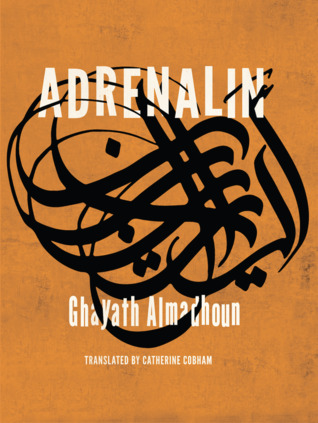
There is an eerie and uncomfortable synchronicity in coming to Ghayath Almadhoun’s Adrenalin while, on the TV, a reporter stands against the skeletal structures of the besieged Yarmouk Camp in Damascus, once home to 160,000 Palestinian refugees, now a ghostly battleground where Syrian government forces are closing in on the last remaining Islamic State fighters in the capital region. That is because this devastated neighbourhood is also the birthplace of the Stockholm-based, Palestinian poet whose first collection to be published in English is one of the titles long listed for the 2018 Best Translated Book Award. From a part of the world that has been producing poetic visionaries for more than a millennium, Almadhoun offers a powerful twenty-first century testament that reinvents earlier forms and imagery to create a vivid, contemporary lament for the futility of war and the costs it extracts.

I was going toward death when the fighters stopped me. They searched me and found my heart on me. It was a long time since they had seen a heart with its owner. One of them shouted ‘He’s still alive,’ and they decide to condemn me to life.

—from “Schizophrenia”

His is a poetry about dying or not dying or being dead already too many times to count. About that which death can neither ennoble, nor ensure. In history, in the recent past, and in the ever present. In the world he conjures up, massacre and Damascus are personified, grief and angst are objects that can be purchased, new or second hand, and “suicided” is a verb. Employing a mix of prose poetry and free verse, the images he draws are coloured with unexpected juxtapositions and observations. It is a poetic reality at once modern and ancient, speaking to displacement as does the poetry of an earlier generation of Palestinian poets, but bound with the more recent flow of  refugees who have fled the Middle East and North Africa seeking new lives in Europe.

He is among those refugees, whether he fled or was lured away by love, the place he left behind lies in ruins. Yet, he is aware that the safe quiet space he has found in Stockholm confers upon him a privileged perspective and particular responsibility to be a voice for those people and places who have been rendered mute by conflict. And that elegy extends beyond Damascus, and yet is ever beholden to her—at once his mother and his first lover—and to his Palestinian identity. Take, for example, “Schizophrenia” a poem written following a visit to Ypres on the 100th anniversary of the first chemical weapons attack. Among the visitors to the reconstructed city he notes the contradictions and the burdens his presence represents:

I am the Palestinian-Syrian-Swedish refugee, wearing Levi’s jeans invented by a Jewish immigrant from Germany in San Francisco, filling my camera with pictures like a Russian peasant woman filling a bucket with milk from under her cows, nodding my head like someone absorbing a lesson, the lesson of war: I am the Palestinian distributed over many massacres, standing here naked, trying to wear my poem in the hope that it will hide my wounds, confusedly gathering pieces of me from here and there in order to become a witness.

As this series of poems and collected facts will go onto illustrate, the gas attacks of one hundred years ago, the recent sarin attacks on Damascus, and all of the wartime deaths  rendered by chemical means in between have taught us nothing. Nothing at all.

Almadhoun’s poetry is a potent blend of defiance, passion and melancholic nostalgia. It is a heady mix that produces work of raw beauty. Throughout this collection, his beloved birthplace is never far from his imagination, a bond evoked most intimately in “The City,” where Damascus is portrayed as a multifaceted female figure, timeless and complex:

She is the earliest cemetery, which people have celebrated as evidence that memories are real. I pass her, a stranger to myself, so she passes me without recognising my face. I distinguish her in the faces of strangers who have belonged to her, so she and I are briefly deluded into believing we are one. She is old like a fossil and I am new like the end of history, I hold on to her dress like a child and she holds on to my heart like a woman and we commit a poem, I the dreamer hunting down verse and she reality giving birth to children and not raising them. I the ephemeral and she the eternal, everlasting, I the fatalist stuffed with transcendental truths, she the heretical realist. There is no consolation for me, and no harm done to her, except that by chance we are lovers

The most striking quality of the poems that comprise Adrenalin is the urgency that comes through. These are fiercely intelligent political pieces that invite historical figures, philosophers and other poets into the conversation. Deeply rooted in the intertwined tragedies of recent Palestinian history and the Syrian civil war, it offers an urgent, compelling commentary presented in a style and manner that even those who tell themselves they don’t read poetry will find remarkably accessible and compelling.

Finally, if you would like an opportunity to experience Almadhoun’s poetry in the best way possible—hearing him read it himself—I strongly recommend this poetry video in which  he reads from “Details,” one of the most powerful pieces in the collection. Presented with Catherine Cobham’s piercing translation, against visual and musical accompaniment, this is the best endorsement for this book that I can think of.

Adrenalin by Ghayath Almadhoun is translated from the Arabic by Catherine Cobham and published by Action Books.