
Making every word count: The Questionable Ones by Judith Keller

A police car drives slowly along the streetcar tracks in front of the central station. The officers scrutinize the waiting pedestrians through the window. Most of those waiting here are out of the question. But some do come into question. These are the questionable ones.

This simple story, “Casting,” not only provides the title for Judith Keller’s collection of micro fictions, now available in English translation by Tess Lewis, but is a perfect representation of what this young Swiss writer is able to achieve with an economy words and a sensitivity to the multiple meanings that potentially blossom from familiar expressions. A quick glance at this book of short (sometimes very short) stories can be misleading. Some pieces are barely two sentences, a number extend for a page or two, while a few stretch to seven or more pages. One might then wonder how much a of story such an abbreviated form can contain, but as Keller knows well, the careful choice of words and the confidence to leave open space for the reader is key.

Arranged into sections named after stops on the Zurich tram line, the stories in The Questionable Ones offer snapshots into the lives, passions and idiosyncrasies of a variety of characters. Absurd, often humorous, sometimes reaching toward the political, Keller’s micro fictions reflect recognizable human emotions and actions, frequently relying on common expressions taken to their literal extreme, or language that is inherently ambiguous. Of course, this reliance on meaning, especially in such a confined literary space, presents a particular challenge for a translator.

The publisher’s webpage for this book features links to a published interview and a video conversation between the author and her translator, both recorded in April 2020 when the pandemic had intervened in Keller’s plans to attend a festival and a residency in New York City. Although both cover her literary influences—including Robert Walser and Ilse Aichinger—and the reasoning behind her unusual decision to study German as a foreign language in Bogota, Colombia, the video is particularly enlightening. It not only offers anyone interested a taste of Keller’s mini fictions, read by the author herself, but zeroes in on some of the difficult decisions her translator faced when the choice of an appropriate word to convey the nuances implicit in the original was not obvious. At this point, the translations were not necessarily fixed in their final form, so several times, Lewis and Keller discuss possible options for critical words in particular pieces. After all, if every word counts in the initial composition, the same is true for the translation. Further, the opportunity to witness the writer and translator openly examining the subtleties of meaning together is inspiring.

Keller’s playfulness with words and capacity to see things from a slightly odd angle allows her to pack more into a few sentences or a few pages in ways that longer, more conventional fiction might not. Less is more. Each piece is left open for interpretation, encouraging the reader to imagine a larger tale. They are at once sketches and revealing portraits of ordinary people trying to make sense of life, one way or another. As well, the spare prose, focused on the most essential, if unusual, qualities of  character and setting leads to some wonderful images. Take for example, the opening of the two-page story “In a House”:

A band of light lay on a hillside as if a glance from half-closed eyes had fallen from above. On the hill stood a house and in it lived a man whose movements were slow. He slowly raked the leaves. He had a wife and two sons. His wife looked like an owl with her brown and golden eyes. She had taken to standing behind herself and sending her body on ahead and calmly watching what happened to it. Their marriage was a muted one.

The only obvious connection between the stories that comprise The Questionable Ones and the tram stations that denote each section—Bucheggplatz, Schwert, Micafil and so on—is the recurring piece, always called “High Time” that closes out each sequence. The circumstances change, but each instance, begins with a “far-fetched woman” making her way through the city, by day or by night, often reaching the relevant tram station and, ends with the acknowledgement that she, or someone else, has been “waiting for it to be high time for a good while now.” This variation on a theme within which what “high time” is meant to refer to is never revealed, adds an intriguing continuity to this irresistible collection of microfictions.

The Questionable Ones by Judith Keller is translated from the German by Tess Lewis and published by Seagull Books.

Remembering prewar Prague: House of the Nine Devils: Selected Bohemian Tales by Johannes Urzidil

This fine collection of stories by Prague native Johannes Urzidil, recently published in English translation by David Burnett, House of the Nine Devils, opens with—and takes its title from— a fantastic tale of a haunted house in the city’s Lesser Town that hides a dark mysterious past going back centuries. Although most of the stories that follow move away from this more explicitly gothic energy, they are filled with strange coincidences and unlikely adventures that lead their protagonists, all echoes of the author himself, into encounters that are coloured with the unique atmosphere of the capital of the Kingdom of Bohemia in the early twentieth century. As the narrator’s father story tells his son in the opening story:

“But this Prague, where you too were born, is an old city of magic. This is where the rabbis had their sorcerer’s apprentices and where the emperors kept their alchemists. Many things come together here — East and West, Jew and Christian, Czech and German, North and South — and where many essences converge, many wondrous, inconceivable things come to pass: things, words, characters and occurrences  that have never been seen before. It’s a breeding ground for spells and magic powers.”

And so it is. In the hands of a master storyteller, even a young boy can find himself encountering all kinds of unusual people and mysteries in this charmed city.

Johannes Urzidil (1896–1970) was the son of German nationalist and “passionate” railway official born in a rural part of western Bohemia, and a Jewish woman from Prague who died when he was just four years old. His father was a Catholic who never practiced his faith and believed in taking his son to various houses of worship to demonstrate that all religions were equal. Nonetheless, he insisted his boy practice Catholicism. His second wife, Johannes’ stepmother, was a staunch Czech nationalist, and their volatile marriage together Urzidil’s own fraught relationship with the woman he refers to as “ his step” adds much colour and humour to many of the stories collected here.

Urzidil published his first poems at age seventeen and began to associate with members of the so-called Prague Circle where he became friends with Kafka, Franz Werfel, Max Brod and others. In his Afterword, translator David Burnett, reports that he “had the honor of holding one of three funeral orations for Kafka in 1924, predicting his future fame.” Through the 1920s and early 30s, he worked as a translator and press attaché for the German Embassy while continuing to publish poetry, essays and criticism. He co-founded and managed the German Writers Union of Czechoslovakia until political tensions led to his resignation in 1933. By this time, despite his German background, his mother’s Jewish heritage and his marriage to the daughter of a rabbi, made it difficult for him to find work and, eventually, unsafe to remain in the city of his birth. He and his wife escaped in 1939, first to England, then to the US where they settled in New York City.

For Urzidil, fiction writing did not become a serious pursuit until later in life. His breakthrough work, The Last Beloved, a collection of autobiographical stories, was published in Munich in 1956 when he was sixty years-old.  His final decade of life, the 1960s, were very prolific. Of his seventy-odd stories, many blending elements of fiction, biography and essay, about a quarter were set in America, a handful in assorted European settings, but the majority of his best loved works take place in prewar Prague and Bohemia. It is from these stories across five German publications that the pieces in House of the Nine Devils are drawn. They are arranged in a roughly chronological order—by setting, not publication date—in an attempt to create a “more coherent whole” or a kind of fictional memoir, reflecting the degree to which Urzidil’s family and life experiences fed his writing.

Perhaps because he came to storytelling so late in life, Urzidil’s stories have the warmth and wry-humour of an older relative recounting tales of his youth, playing up the unexpected twists and turns. His narrators’ seemingly innocuous adventures—looking for a lost wallet, delivering messages, dropping in to visit with friends—put them in the paths of bored police officers late on New Year’s Eve, a fated opera singer, a suicidal railroad inspector, or a murderous fugitive. As he tells us in “The Last Tombola”:

People were always using me to drop things off. I was always running through streets and from floor to floor with notes, letters, and messages for other people. That’s pretty much my life. And whenever you have to drop something off, awful things always seem to happen.

This longer story begins with its young protagonist being charged to deliver a report to his father’s visiting superior with whom his family had dined the night before. He will soon learn that Herr Pernold has hung himself from his Grüss Gott suspenders, an event that sets off a richly complicated (and funny) tale of mystery, morality, concerns about renumeration, and ripe opportunities for humour at the boy’s step mother’s expense, something that first arises in the opening paragraph as the narrator notes that his delivery assignment will take him to The Imperial Hotel on Na Poříčí:

Na Poříčí is Czech for “on the riverbank,” which is fair enough for the Moldau flows nearby. Still, I had an instinctive aversion to this Prague street, its two chafing affricates reminding me of the sand-yellow paletot that hugged the hips of my stepmother around the time my father was courting her. I had witnessed this courtship and once heard her say, “It chafes me; I bought it on Na Poříčí.” “Good,” I remarked, because I felt this lady couldn’t be chafed enough. “Who asked you?” asked my father. “I asked me,” I answered. He was about to give me a royal smack in the face, which usually accompanied by the words, “When duty calls, feelings must be silent.” Yet this time he abstained from getting violent, not wanting to appear ungallant in front of the lady. He looked at me instead like Cronus before he ate his children.

This kind of sly, smart humour is one of the most wonderful features of Urzidil’s stories. And indicative of the relationship he, or rather his protagonist, has with his father with whom, for the cost of a slap in the face, he is allowed to voice what they both often think about his step’s moaning and complaining which only increase after the marriage. It is a recurring motif in many tales, one grounded in the author’s real life, as he reveals in the two, biographical essay-like pieces that round out the collection wherein he talks honestly about his beloved father and the difficult woman who became his second wife.

Prague in the first decade of the twentieth century is vividly evoked in so many of the tales in this collection, as are the social dynamics of the life of a lower middle-class family, the tensions that exist between Germans and Czechs, and the sense (at least to a young boy) that the Austro-Hungarian Empire is eternal. Then there are stories set during the First World War and, notably, “One Last Deed,” which depicts the dangerous environment in the city for men like Urzidil during Nazi occupation through an account that finds the protagonist taking refuge in the hovel of an eccentric former schoolmate.

The particular charm of Urzidil’s fiction lies in the warmth and charisma of his narrators, effortlessly spinning entertaining tales. Gathered together, the stories collected here do, as intended, read like a loose memoir recounted with a healthy measure of creative license. The boy, his railway official father, and his cantankerous stepmother provide the continuity. Like other natural story-tellers who regularly dip into the same well—perhaps a fictional community, or the life of a recurring alter ego—Urzidil has the ability to make each story feel fresh and unexpected. Hopefully more of his fiction will be translated in the future.

House of the Nine Devils: Selected Bohemian Tales by Johannes Urzidil is translated from the German by David Burnett and published in a handsome hardcover edition by Twisted Spoon Press.

The ties that bind and confine: Mothers and Truckers by Ivana Dobrakovová

Meet Svetlana, Ivana, Olivia, Lara, and Veronika, the protagonists who carry the five stories that comprise Slovak writer Ivana Dobrakovová’s collection, Mothers and Truckers. They are each, to a greater or lesser extent, caught up in the tangled webs of memories, failures and desires that occupy their thoughts and drive their actions, often to potentially counterproductive ends. Memorable and intense, these stories pull the reader into the interior lives of five very different, complicated, and not always likeable, women trying to navigate the expectations of family and society for better or worse.

Born in Bratislava in 1982, Dobrakovová studied English and French translation at Comenius University before moving to Italy where she works as a freelance translator of Italian into Slovak, notably of Elena Ferrante’s Neapolitan novels. The present collection, her third, was awarded the 2019 EU Prize for Literature and is her second work to be made available in English (following her novel, Bellevue which was, like this,  also published by Jantar in Julia and Peter Sherwood’s translation). Her stories here tend to be on the longer side—two are about 50 pages in length and one is almost 70—and clear or suggested mental instability is a common theme, one that reflects, she says, an interest arising from the fact that her husband and sister are both psychiatrists. It is a quality that lends the three central, longer stories a particular claustrophobic, compelling power.

“Ivana,” the near-novella length piece, offers the most explicit portrayal of the impact of serious mental illness with its tragic and endearing narrator, a thirty-one year old woman who lives with her mother. Ivana, in a sometimes disjointed and exuberant narrative, recounts her childhood love of horses and the long hours she spent at the stables to the cost of her education, all the while hinting at the horrifying trauma that marked the sharp shift in her personal destiny. In the meantime, she has met R., a journalist and local celebrity, through the one friend who has not long since abandoned her. This has given her a renewed interest in life, even if she risks threatening peace with her overbearing mother, this budding relationship largely bound to fantasy, and her own mental stability which is being carefully contained:

It’s taken my psychiatrist in Tehelná Street years to fine-tune my medication, to find the right level between my mood swings and make sure I was neither too subdued and slowed down or too hyper and upbeat, that I was under control, hers, Mum’s, my own, that I didn’t get so high that I would have to be dragged down to earth, or get so low that I would need to be helped back onto my enfeebled legs, in a word, so that I would be myself again, albeit within some sensible, clearly defined limits, myself but not too much myself.

Ivana has a wonderful sense of self-deprecating humour and, although she is pretending to be working on a novel and hiding the truth of her circumstances from R., she demonstrates a canny ability to vividly unfold what is ultimately a very painful story.

Olivia’s eponymous tale, the first of two stories set in Turin, presents a conflicted narrator obsessed with the news story of a teacher who was seduced by a young student to very unfortunate ends. She is also a teacher, albeit it one who was married and, in her own estimation, still attractive for her age. Surely she would not be so gullible. As her monologue proceeds, she reveals herself to be lonely, bitter and excessively paranoid about germs. As she tries to justify the situation in which she has found herself at the age of thirty-nine, she cannot quite accept the part she has played in her own life. And she prides herself in the fact that, unlike Gloria, the victim in the news reports, she is not living with—heaven forbid—her parents. Like all of the protagonists in Mothers and Truckers, relationships with parents, especially mothers, are fraught. Even though she has long been out of the house, Olivia’s mother still manages to intrude on her life almost daily, by phone, WhatsApp, Facebook, more so now that she is once again “single.”

Because my mother, by contrast, is present. Far too present, in fact. The usual story. She compensates. My mother spreads like mildew around the window. She devours everything that happens to find itself in her way. Overpowers it, supresses it. She’s everywhere. When I’m with her, it’s as if she was twice my size, with me being just a kind of external appendage  to her body that has never managed to cut itself off.

The third longer story, “Lara,” is also set in Turin, but her mother is dead and sorely missed. One has to wonder if her presence might have mediated what this unhappy, brutally self-centred mother of two has become. Lara’s internal monologue is perhaps the most exhausting and disturbing. She’s a complicated, damaged woman who questions her own mental functioning, but seems powerless to stop the very dangerous path she is on.

Together, the three central stories in the collection confirm Dobrakovová’s ability to inhabit distinct, multifaceted women caught in complicated predicaments that offer no easy resolution. The intensity of their internal monologues is fueled by a fluctuating style and form. At times, thoughts unwind in long sentences, strung together with commas while other passages feature short, staccato sentences. She also relies on a strong sense of space, her characters traverse the environments in which they live, in memory or in real time, in Slovakia or Turin, places she knows well. By contrast, “Father,” the opening story is a somewhat simpler tale of a man who largely neglects his family in pursuit of impossible, if relatively humble, dreams until alcohol and madness take a toll, but the final tale, “Veronika,” the only third person narrative, paints the portrait of a student who is embarking on a path that is bound to become difficult, even threatening, as she loses herself in chat room flirtations on the pretext of improving her French. As a whole, this volume is an immersive and intense reading experience.

Mothers and Truckers by Ivana Dobrakovová is translated from the Slovak by Julia and Peter Sherwood and published by Jantar Publishing.

Rain like this doesn’t wash away the filth: Hawa Hawa and Other Stories by Nabarun Bhattacharya

The gleaming wet road, the rusty tin roof of a motorcar repair garage, behind it an old paint-peeling stunned-still old house and a chimney precariously propped up with haphazard wires—the sky can see all this. And, not as clearly, the burnt-black tin-backed shops and buses and the in-between blocks of darkness that were Matador sheds and not the half-rotten bellies of fish but the shells of banged-up taxis. There were crumbling and dead accident cars too, their mouths full of dirt. The sky view mists over every now and then, for it has been raining continuously.

This is the setting of “Last Night,” one of the pieces in Hawa Hawa and Other Stories, the recently released collection of inventive short stories by Bengali writer Nabarun Bhattacharya. As the angry rain beats down on the trash-filled water logged street, two young men are fighting. They are unevenly matched, a condition mediated by sheer intoxication, but they are each intent on doing damage to the other. And in a very unexpected way they are also best friends.

Bhattacharya (1948-2014), the son of writer and activist Mahasweta Devi and actor and playwright Bijon Bhattacharya, worked as a journalist from 1971 to 1993, before turning his attention to writing fulltime. His magic realist tales tend to feature eccentric characters drawn from the shadows—dirty cops, nostalgic former revolutionaries, unsavoury figures and an assortment of anxious souls. His Calcutta is gritty, pungent, dark and unforgiving. The scenes that unfold, on these streets and beyond, range from sharp political and social satire to strange meditations on violence, madness and love. Set primarily in the 1970s and 80s, but reaching back as far as the 1940s, there are stories that play out against the early Communist-led peasant movements in West Bengal, the Naxalite uprising and the 1975 Emergency, as well as more intimate dramas set in family homes, trains and, of course, on the street.

Bhattacharya excels at creating memorable characters, and rapid, witty sequences of dialogue peppered with English words (indicated in the translation with the use of italics) and references to popular Indian films and songs. A number of his stories rely heavily on a steady back and forth between two people who happen to meet up and share some kind of common past or current circumstance. Others unfurl under surreal conditions, influenced by alcohol, madness or some impending fear. There is an immersive quality to these dark tales.

Take, for example, “Mole,” the story of a seemingly unrepentant cop with a patch of skin on his neck that begins to itch and become inflamed just before he murders someone—“murder” being an accepted language for the state-sanctioned killing his investigative role entails. The itch causes his restless right hand to fumble in his pants pocket where his pistol awaits. The sweat, the smells and the agitation grow. We follow him on a mission to a nightclub. Once the job is done he kicks at the corpse bouncing on the floor of the police van and emotionally decompresses as he returns to the station. A bleak and grim premise perhaps but for the banter in the office (with its water tank filled with bombs to be deactivated), the pointed parenthetical commentary on authorized violence, and the insatiable demons that haunt the protagonist:

Back home, he usually takes a bath, uses soap—puts some ointment on the itch—the sweat from his body and the dirty soap-lather swirl into the drain and disappear. He rubs scented oil on his hair. He is very sleepy, but sleep never comes without dreams. Dreams have eyes, they ask questions, they laugh, they beat on drums. Their limbs are ripped and shredded, bits and pieces bloody. His family has told him he sometimes talks in his sleep, groans, slurs out orders. Sometimes he scratches his back so furiously that he wakes up in the morning to find it bleeding.

There is a deeply embedded hallucinatory fear that follows him down the darkened Calcutta streets and adds a spark of troubled humanity to his situation.

Fear and superstition mark several of the tales, most tragically perhaps in “A Piece of Nylon Rope” in which two men meet outside a hospital on a rainy night. The narrator is there to look in on a colleague who had a stroke at the office, while the other is waiting for news of his son who suffered a serious football injury. The latter, Jagadish-babu, has a uncertain confidence despite the poor prognosis. He feels his fate has turned. He explains that he was already inclined to seeking fortune tellers and good luck charms when he learned that what he really needed was to get a piece of a hanging rope:

‘Hanging rope?’

‘Yes. Suppose someone hangs themselves to death. If you can get a piece of that rope and keep it with you, then boom!—whatever you want is yours. All the evil eyes on you, the vexing, the hexing—the whole fucking lot will vanish. Khoka’s injured so badly. But do you see any fear in me?’

Jagadish shows the narrator the length of nylon rope he has acquired and carries with him everywhere, but admits that the good fortune it promises comes with a steep price. He cannot be alone, for fear the suicide victim will return and demand the rope back. For a man with a trusted talisman, he is a nervous wreck.

Several of the stories in Hawa Hawa, including the title tale and “Mole,” highlight the brutality of the West Bengal police, while another demonstrates the inability of a newly elected politician to protect an old friend and revolutionary comrade. Elsewhere we meet a child with a cruel streak, the brother of an accused murderer who holds to his belief in his innocence, a businessman offering the perfect suicide—for a price—and a gangster who prophetically spends the evening with a headless prostitute. Inequality, injustice and the abuse of power are common themes driving the world that Battacharya wanted to bring to the surface through his darkly humorous, weirdly engaging fiction. And if his comfortable contemporary Bengali audience was disturbed by what they found in his work, he was hitting his mark.

Notably, this translation is the work of a young translator, Subha Prasad Sanyal, and his ability to bring Battacharya’s subversive and playful writing to life is impressive. He pays careful attention to rhythm and tone. As mentioned, the English words transliterated in the original Bengali text are italicized, yet many Bangla terms are left intact where context is sufficient to imply meaning, a choice that helps maintain a distinctive narrative feel. Meanwhile, any cultural, political and place references that enhance understanding are explained in the Translator’s Note.

Hawa Hawa by Nabarun Bhattacharya is translated by Subha Prasad Sanyal and published by Seagull Books.
A compilation of shadows: Ninth Building by Zou Jingzhi

From childhood till now, I’ve spoken many bold words. Publicly or in private, I’ve proclaimed the kind of person I wanted to be, though it never happened in the end. I feel like someone has somehow taken my place, leaving me to become the person I am now.

When I’m around too many people, I lose myself. In an unfamiliar city, among crowds of strangers, I keep having to stand still—not to ask directions, but to find myself. Even when I’ve done that, I’m still lonely, so I head back to my hotel and listen to the sound of rain.

These lines, drawn from the melancholy and poetic Introduction to Ninth Building by acclaimed Chinese writer, poet and playwright Zou Jingzhi, speak to a fragmented sense of self, a “compilation of shadows,” that has long accompanied him, appearing unbidden on the street or haunting quiet nights. This book, originally published in Chinese in 2010 and now available in Jeremy Tiang’s excellent English translation, is an attempt to give these shadows some of the depth, context and meaning distorted by the experience of growing up during the years of the Cultural Revolution. As Jingzhi says in an interview on the site of the 2023 International Booker Prize for which his book has been nominated:

 In the early 1990s, my childhood felt like it had been a gust of wind behind the trees. I used to spend my days being lost: What should I write? Whatever I wrote was wrong. It was impossible to get rid of my childhood back then. So I just wrote like that. I wrote for myself. I wrote to let go of my childhood.

Ninth Building is a cohesive work with a common narrator, but it is presented as a series of vignettes or very short stories, set between 1966 and 1977, arranged in a roughly but not strictly chronological order. Time, in its experiencing and remembering, has a somewhat fractured quality. After all, the Cultural Revolution was an unnatural period of disruption and upheaval and, as Jingzhi’s stories so clearly demonstrate, many hours of unstructured tedium. The first section “Ninth Building,” takes its name from the housing complex in Beijing where Zou is living with his family when the Revolution begins. He is about thirteen or fourteen at the time. The first story “Eight Days” is a diary format tale set in November 1966 that describes the eagerness and concern with which a group of boys set out to obtain Red Guard armbands. It is not clear that they understand just what they signify, only that they don’t want to be seen without one. Many of the pieces in this part demonstrate the haphazard way that the adolescents try to make sense the objectives of this movement sweeping the country, rejoicing in the death or humiliation of old women labelled part of the “landlord class,” unaware that many of their own families would soon be suspect. Yet amid the increasing levels of violence among their classmates and peers, there is a lot of idle time to be filled with a variety of friends and neighbours. Boredom had company.

There is a lot of humour in the first part of Ninth Building, some of it rather black, even disturbing, but much also reliant on the innocence of the protagonist and his young buddies (it is the 1960s after all). A wonderful early vignette (“Capturing the Spoon”) describes a night patrol during which the intrepid and enthusiastic guards observe, through a lighted window, a naked couple thrashing around in a bed. Alarmed, they rush to report this obvious, if strange, infraction, but the grown-ups from their compound’s “Attack with Words, Defend with Force” Unit are unmoved by this important information:

Nothing came of our waiting. We’d imagined they’d jump up immediately to stop whatever incorrect action was taking place. This was at the height of the Revolution, and the train we were on had switched to another track. What we’d seem didn’t fit the scenery on this route; red armbands and nakedness didn’t go together. The five of us had three flashlights between us, and for more than half a month now we’d stayed awake night after night, fully alert, wishing something would actually happen. Now something had, but the adults didn’t feel about it the same way we did.

The second and slightly longer part of Ninth Building, “Grains of Sand in the Wind,” opens in 1969 when is Zou sixteen and sent to the Great Northern Waste for “re-education through poverty.” He is one of the millions of “educated youth” sent to work in rural areas and learn from the peasant population. He will not return to the city until after the Revolution comes to an end in 1976. These are years filled with long days of back-breaking labour under harsh conditions, yet no more immune to extended periods of boredom than he knew in Beijing. But here the distractions, apart from the required performances of patriotic operas, were limited to gambling, drinking and practical jokes. Innocence is gone; the underlying tone is now one of resignation. Zou and his peers have come of age in a time when their lives and dreams of the future are suspended:

Youth is a concept whose meaning isn’t easy to grasp. You might as well try to wrap your mind around every era, every event. The word doesn’t really evoke any special memories for me. Perhaps I’ll have to wait till the age when every other sentence begins with “back then” before I truly understand it.

The vignettes set against the vast rural landscape are harsher, with more tragic elements. They are not devoid of humour or eccentric characters, but illness, injury and death feature regularly. Life is cheap. However, poetry and increasingly astute observations are woven into Jingzhi’s anecdotes and tales. As his narrator matures and grows more cynical, he also begins to recognize the seeds of his future as a writer that have been sown during these long years.

The Cultural Revolution was a period of great turmoil during which the power of radicalized youth was harnessed against the Communist Party hierarchy, but as illustrated by Ninth Building, the impact on many young people during this time was marked not by heroism or the glory of conflict, but by years of boredom, dislocation and numbly tedious labour. With its brisk pace and refusal to succumb to despair in spite of the countless temptations, this collection of brief vignettes makes for an entertaining and powerful read.

Ninth Building by Zou Jingzhi is translated from the Chinese by Jeremy Tiang and published by Open Letter in North America and Honford Star in the UK.

An explosion of strong female voices. Balkan Bombshells: Contemporary Women’s Writing from Serbia and Montenegro compiled and translated by Will Firth

First we meet Marijana, the daughter of a farmer who imagines a fantasy encounter with “A Man Worth Waiting For,” someone to sweep her off her feet, knowing well that the first facsimile of a “hard-working young fellow with house, land and cattle”—be that a forester with a cabin in the woods—who asks for her father’s permission to marry her will be sufficient to send her packing. Dreams will be put aside. Then we find ourselves in the midst of a feminist folkloric horror tale, followed by excerpts from an emotionally charged diary. And these three pieces, by Bojana Babić, Marijana Čanak and Marjana Dolić respectively, simply mark the beginning of a journey through some of the rich fictional landscapes envisioned by contemporary Serbian and Montenegrin women writers.

Anthologies can have many points of origin. This collection, Balkan Bombshells is, as compiler and translator Will Firth admits, the “fruit of happenstance.” The idea of an anthology was first suggested during a month-long stay in Belgrade afforded by a travel scholarship. An initial selection of short prose pieces by women from Serbia was made with the support of the KROKODIL Centre for Contemporary Literature and the organizers of the Biber contest for socially engaged short fiction. However, to ensure he’d have sufficient material for a book-length project, the scope was expanded to include the neighbouring, historically linked, country of Montenegro where Firth had many connections. The resulting multi-generational anthology of Serbian-Montenegrin prose is a collection of seventeen powerful pieces from both established and newer authors, many of whom are appearing in English for the first time. All of the writers are working in the language formerly referred to as Serbo-Croat(ian) that is now often described with the acronym BCMS (Bosnian/Croatian/Montenegrin/Serbian).

The stories gathered here, several of which are excerpts from longer works, feature a variety of voices and styles, a diversity that is highlighted by the organization by alphabetical order rather than region or theme. Many of the pieces afford snapshots into the lives of women caught in difficult situations, facing the dismal options available to them in working class communities or chafing against the traditional values of their parents. There is humour, Jelena Lengold’s “Do You Remember Me?” being a notable example that also calls attention to the loneliness of middle-aged city dwellers, and tales that are disturbing, strange and sad. As one moves through the collection there is a welcome, often unexpected freshness to each piece, perhaps because most of the authors are, as yet, not widely known outside their home countries. Three, including Lengold have been published by this collection’s publisher, Istros Books, but there are many I would love to see more from.

There are so many strong entries, but I was especially impressed by the metafictional “Zhenya” and the two more explicitly political pieces. Lena Ruth Stefanović’s smart and funny “Zhenya” begins in a backward village in Russia (the author studied Russian literature in Belgrade, Sofia and Moscow) but becomes, in the end, as the narrator/author openly imagines a possible future for her protagonists, as the most decidedly Montenegrin:

First, I’ll send them to my motherland, Montenegro, to warm up after the Russian winter. I’ll ask my parents to welcome Zhenya and Vova and to treat them as guests in our hearty, homey way.

Then I’ll send them on an excursion to Bari to pay homage to the relics of St. Nicholas, and maybe I’ll go along myself.

Along the way, a Russian flavoured fable is transformed into a vibant commentary about the evolving identity and literature of the people of Montenegro.

The most political offering comes, unsurprisingly perhaps, from the most established of the authors, Svetlana Slapšak, a writer, editor, anthropologist and activist with over seventy books to her name. Her story, “I’m Writing to You from Belgrade” is set in Toronto, where an immigrant family learn of the death of Slobodan Milošević. The protagonist and her husband respond to the news:

‘There will be no relief,’ Milica said. ‘But I’m afraid there will be fear because he died without being brought to justice…’

‘What difference does that make to us?’ Goran said after a brief silence. ‘The country we once lived in no longer exists. We have to tend to our memories so they don’t disappear in a puff of smoke, and that’s very hard here. Do you sometimes feel we’ve sailed to a distant shore, from which there’s no return?’

Later, while her daughter and husband debate the news, Milica reads a long email from a friend and former lover who is passing through the altered remains of their former homeland, observing the immediate response to Milošević’s death on the ground. It’s an incredibly effective, well-written approach to the complex emotions of exile raised the distant tremors of history and politics.

Finally, my favourite piece in Balkan Bombshells is political in a smaller, infinitely human manner. “Smell” by Milica Rošić is a short poetic tale about memory, the pain of war and the spiritual bond between three generations of women, Alma, Almina and Ina, or as the narrator runs her name together with that of her mother and daughter—Almaalminina. Grandmother and granddaughter never knew each other, the former died enroute to the border during the war long before Ina was born. A sudden and natural death, but one that leaves Almina with no option but to ask the soldiers to abandon her mother’s body in the forest. It is an action perfectly aligned with the character of her pragmatic mother, but one with its own lingering pain. “I cried like the rain” is her sorrowful refrain. But there is an unspoken, innate thread binding Ina to Alma without her mother’s direct intervention. Such a beautiful, poignant little tale.

So often anthologies, with all the best intentions, run the risk of collapsing under their own weight. This collection, even with seventeen contributors, only runs to 143 pages, offering just enough to give a reader an entertaining and intriguing introduction to a wide range of Serbian and Montenegrin women writers who will, with luck, reach a broader audience in translation over the years to come.

Balkan Bombshells: Contemporary Women’s Writing from Serbia and Montenegro is compiled and translated by Will Firth and published by Istros Books. More information about the authors included, see the publisher’s website.

“That’s how I remember it.” Postcard from London and Other Stories by Iván Mándy

Making the acquaintance of Iván Mándy, one of the most popular Hungarian writers of the post-war period, is one of the unexpected highlights of my reading year. Postcard from London and Other Stories, which gathers twenty-three stories and two novella excerpts, is the first comprehensive collection of his work to be published in English and, as with such larger volumes, there is always the risk of a certain sameness setting in. Yet, with Mándy, the appearance of the same characters and variations or extensions on related themes, is part of the appeal. His stories tend to tread the murky internal waters of his protagonists’ minds, so even when covering the same ground, one never really steps in the same stream twice.

Born in Budapest in 1918, Mándy’s parents divorced when he was young, leaving him in the care of his unconventional journalist father. He moved from school to school, but did not complete his formal education. Much of his writing draws on these early years of his life, channeled through his rather hapless alter ego János Zsámboky. He published his first work during the Second World War and, within a few years he was recognized with the Baumgarten Award. However, the advent of Communist rule in 1948 supressed his literary and editorial career until things started to loosen up in the mid-fifties. Through the sixties and seventies, his popularity grew as he published many novels and stories, often producing as much as a book a year. He died in 1995.

As a writer, Mándy focused his attention on life in the poorer communities of Budapest, on the eccentrics, the lonely and the misfits of society. But his stories often depend less on plot than on an ability to evoke mood, character and scene with a handful of words. Here, a room:

All around, the barren summer wasteland of the parquet floor. The carpets rolled up on the top shelf of the closet. Like defeated political dignitaries. Ousted statesmen.
“The Morning of the Journey” (1989)

This becomes especially apparent in his work from the 1970s onward. By employing techniques borrowed from radio plays and cinema, his narratives begin to explore the shifting textures of the narrator’s mindscape, as memories, desires and anxieties rise and fall away, carrying the voices of strange and familiar figures encountered in the past and present, sometimes leaving his protagonist treading an uneven border between daydreaming and waking states. Thus it is often less any question of getting from point A to B, than the uncertain effort of getting nowhere at all along a pathway strewn with ghosts and sly objects, as well as those surrounding individuals who are still negotiating the “real” world.

The stories collected in Postcard from London are drawn from Mándy’s writings published between 1972 and 1992, translated by John Batki. Along with a variety of assorted pieces, there are two main series of connected or related stories involving Mándy’s alter ego, János Zsámboky. The first set, mostly but not exclusively from the early 1970s, involve his parents—primarily his engagement with his memories of his erratic, unreliable father and his quieter mother. Their ghosts haunt him. In the opening story, “A Visit with Father,” as János is reluctantly preparing to visit his father in the hospital, he recalls his parents’ seemingly abrupt separation, his father’s second marriage, and more recently, his aging father’s decline into the delusional and suicidal behaviour that ultimately forced him to have the old man hospitalized. The second tale, “A Visit with Mother,” sees János once again preparing for a trip to the hospital, this time with a dress and stockings, for his final encounter with his proud and resilient mother who is lying in the morgue. These two stories are the perfect introduction to János’ somewhat anxious character, his parents, and the basic outline of their lives. Together they set the stage for “What Was Left,” the wonderful 50-page story that follows. Here our hero is sorting through documents, receipts, photographs and diary entries in an empty apartment, attempting to piece together gaps in his knowledge of his parents’ lives while Father and Mother engage him (and each other) from the beyond. Seamlessly slipping between, past and present, first and third person, Mándy weaves a portrait of a fractured family that is funny and bittersweet. This familial cast which also includes Olga, the second wife and her family, and Mother’s Aunt Vali (“with the balcony-sized bosom”) appears in a number of stories, but it is always Father who looms larger than life, determined to claim his space in his son’s imagination forever:

In my dreams, he still comes and goes, expostulates, protests. He lives his own life. Somehow, he gets wind of everything. Some old, netherworldly newspaperman must have told him that I got married after he died. In the corridor of dreams, he accosts me with a gentle reproach. ‘You didn’t even introduce me to your bride, kiddo . . .’ And he still stubbornly insists that I arrange for him to return home. ‘I’m fed up with prowling around.’
“The Original” (1974)

János’ wife Zsuzsi first appears, in this collection, in a story from 1974, “A Chapel, Afternoon” but it is in a later sequence of stories chronicling a trip to London (1989 and 1992) that Mándy’s alter ego reveals himself to have become an aging, distracted writer, unwilling traveller and obstinate companion to his sensible, patient partner. His mind is now even more prone to wandering. His dreams are fantastic, even horrific, channelling his waking fears; figures from his past—real or imagined—interrupt his conversations; and when left to his own devices he is inclined to turn the action of strangers into potential scenarios for future stories. He even encounters possible characters in his own visage as in this scene from “An Afternoon Sleeper” where he waits in a cold changing room in London:

Four mirrors around me, four mirrors and four faces. On one side, a sharp diplomat’s face. Not exactly glowing with confidence. And that deep, dark under the eyes. This diplomat is about to be relieved of his duties. Something is not quite right about him. His services are no longer needed. He’s being recalled. And God only knows what awaits him back home. . .

Facing me is a sly old greybeard. Winking. A dirty old man. Never did a stroke of work in his life. He chased little girls instead.

A superannuated actor. Face fallen apart. Eyes glazed. Forget about ever getting another part. Not even as an extra.

A haggard, leaden face. A night waiter. Not exactly seedy, but somehow unreliable. He has no steady customers. A very few strays, at the most.

The door of the booth opens.

A heather green jacket appears. Behind it, Zsuzsi and the silver-haired salesman.

Other protagonists make their way through various stories, but János continues to appear regularly, through to the end. As the above quote illustrates, Mándy can call a character into being with few brush strokes and create a situation within which he or she must respond to the everyday strangeness of life.

Finally, I would be remiss not to call attention to the way Mándy, influenced by his fondness for Buster Keaton, blurs the lines between material and human existence. Suitcases, articles of clothing and other objects are often animated, in passing, through the use of verbs or descriptions not typically applied to things. This is one of the many ways in which his prose echoes poetry, but in an excerpt from the novella “Furniture” he playfully takes this tendency one step further. Through a series of vignettes, with or without human co-stars, furniture—chairs, tables, living room suites—take centre stage. Unusual, perhaps, but not unexpected or out of place, in the literary universe Iván Mándy imagines into being. This welcome collection offers an excellent opportunity to explore that idiosyncratic space.

Postcard from London and Other Stories by Iván Mándy is translated from the Hungarian by John Batki and published by Seagull Books.
Welcome to Casablanca: Blood Feast by Malika Moustadraf

First, read the stories. Unsettling, allow them to assault your senses. Enter a world marred by poverty and illness, poisoned by the values of traditional patriarchal society, infused with everyday magic and superstition where women and men are trapped in roles defined by factors beyond their immediate control. This is the Casablanca of Malika Moustadraf’s fictional landscape, the space in which she ignites fires, large and small, and lets them burn. Finally, turn to the Translator’s Note and realize just how important and tragically small this remarkable work truly is.

Blood Feast (published in the UK as Something Strange Like Hunger) is a slender volume containing all of the stories the Moroccan Arabic-language writer wrote during her short life—fourteen tales, some only a few pages long. Together with one novel (Wounds of the Soul and Body) self-published in 1999, they form the sum total of her literary output. During her lifetime she was, through her writing, an out-spoken activist, with a style and thematic focus on gender, sexuality and class under patriarchy that challenged what was acceptable for turn of the twenty-first century female writers in her home country. Yet, until recently all of this work had long been out of print in Arabic and none was available in translation. Today she is recognized and celebrated as a feminist icon.

But, again let’s have a look at the stories. The first ten pieces were published in Arabic in 2004 as Trente-six, a project supported by the Moroccan Short Story Research Group. Her settings tend to be squalid, pungent and unpleasant. As are the people that inhabit them. Slang, harsh language, and cultural references abound. Her female narrators, are typically facing the consequences of severe gendered oppression, propagated by callous fathers, abusive partners, or the demands of unreasonable, outdated social norms. Her male narrators often echo the sexist attitudes of the system they were raised in, unable or unwilling to rise above it. And yet there is a defiance, a resilience, and a conscious weighing of the odds motivating many of her protagonists’ actions—even those that are unlikely to improve their situations. The narrator of “A Woman in Love, A Woman Defeated,” for example, visits a seer to find out how to make her husband return even though she herself wonders why she even wants him back. Looking out at her very pregnant cat, she says:

She left home a while back, chasing after a scabby tom who had seduced her, and then later she came back, rubbing herself up against me like nothing had happened. I did the same thing, left everyone behind and followed him. He wasn’t handsome. He looked like a little bald bear with a saggy paunch hanging down past his genitals, and he had a huge ass and a round face. I always hated men with huge asses and round faces. So how did I fall in love with him? Love is like that, it always shows up without an appointment. Love is like death, like illness, always arriving when we least expect it, at the most peculiar times and places. Love makes us behave like irrational children. Why can’t they just invent a vaccine against it?

Within the tight scope of her characteristically brief stories Moustadraf was able to paint claustrophobic portraits that often explored territory that was extraordinarily progressive, given the time when she was writing. The narrator of “Just Different,” for instance, is a gender non-conforming prostitute whose identity is never clearly defined. Perhaps an effeminate gay man or a transfemale or even intersexed person—that which is undefined leaves possibilities open— reflecting, on a quiet night working the street, back on childhood and their father’s brutal hostility toward any hint of feminine mannerisms. Later in this collection, among the four stories completed following the publication of Trente-six (three of which were published after her death), her protagonists appear to have somewhat more agency, and two even engage in online flirtation—probably, as the translator suggests, “the first ever published literary depictions of cybersex in Arabic.” One can only wonder what she might have produced if her health and economic situation had not conspired against her.

As it was, she died in 2006 at the age of thirty-seven, from the complications of chronic kidney disease and her inability to obtain the life-saving surgery she needed. The exact biographical details of her life are not well known but she seems to have been diagnosed with kidney disease and started on dialysis in her teens. She famously resented the fact that women writers were assumed to be only capable of writing autobiographical fiction, denying that they, like men, could have access to a robust imagination. However, the title story of the present collection, “Blood Feast,” can be read as a powerful exception to her rejection of autobiographically inspired themes. In this story, dedicated to her sister Karima from whom she received an unsuccessful transplant, the male narrator is struck with kidney disease shortly after his wedding. The bride is blamed, alternate understandings are sought, and the proclamation of the female doctor is met with distrust. But when he finds himself flat on his back in a putrid hospital, he becomes the unwillingly captive audience of his smoking fellow patient who imparts his wisdom about navigating the almost hopeless process of applying for financial assistance for the necessary treatments in a corroded semi-privatized system, a reality the author knew only too well.

Moustadraf faced her own host of impossible barriers in her journey, yet as her illness progressed, her literary spirit only burned brighter. Writing was her way of coping, one that paradoxically weakened her health when she had to go without medications to be able to afford to self-publish her novel. The challenges she faced, physically and artistically, to bring her work to light adds an important context and power to her bold voice, amplifying it far beyond her relatively small oeuvre. And at last she is getting her due, in no small part, thanks to the dedication of her translator Alice Guthrie who literally fell in love with her work when first invited to translate a piece for the online journal Words Without Borders several years ago. She has ensured that Malika Moustadraf is no longer forgotten.

Blood Feast by Malika Moustadraf is translated by Alice Guthrie and published in North America by Feminist Press. In the UK, this same collection was published by Saqi Books under the title Something Strange Like Hunger.

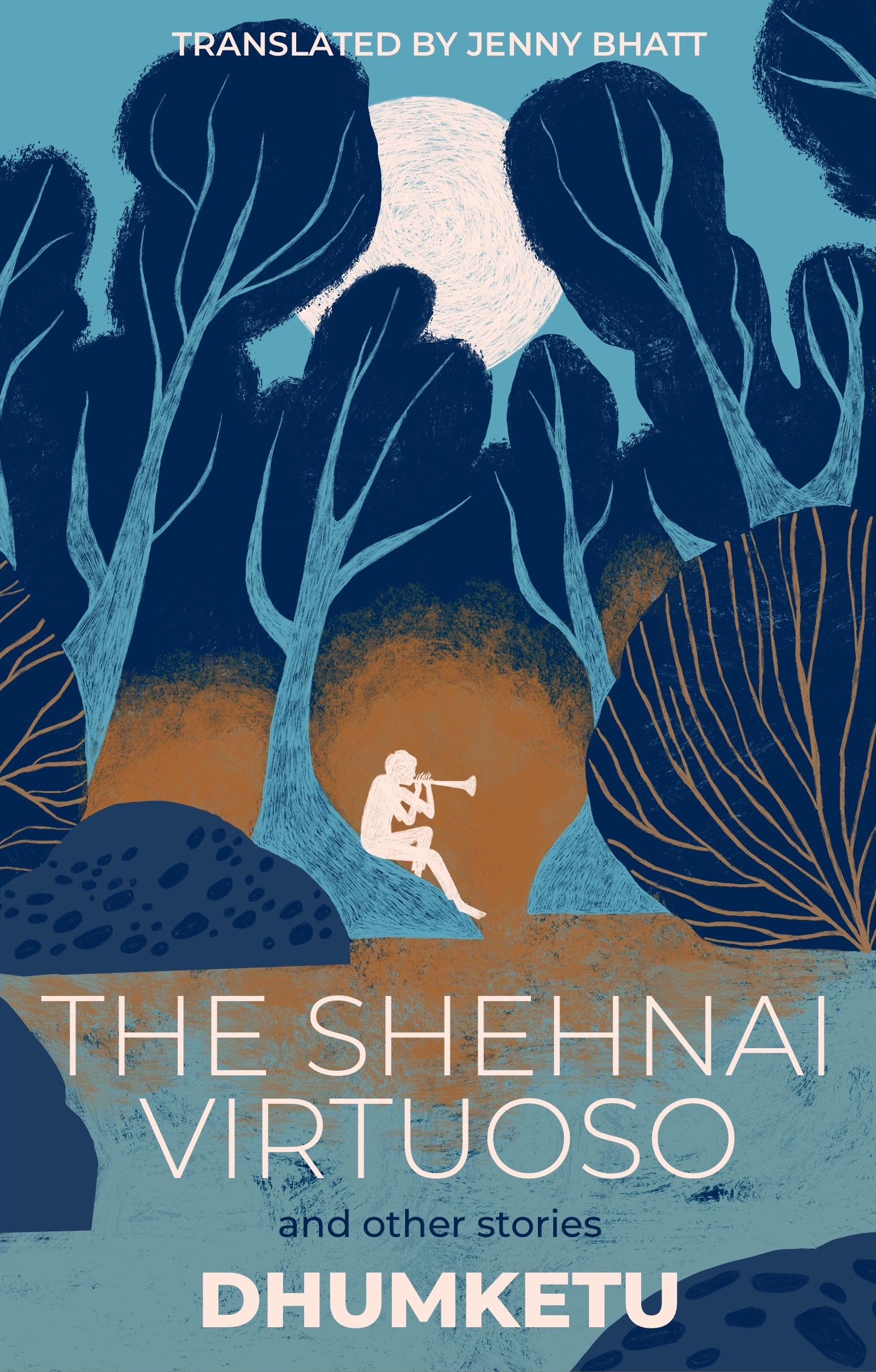
A storyteller from Gujarat arrives: The Shehnai Virtuoso by Dhumketu

The short story is that which, like a flash of lightning, pierces right through while establishing a viewpoint; without any other machinations, simply gestures with a finger to awaken dormant emotions; creates an entirely new imaginary world around the reader. The novel says whatever it wants. The short story, by rousing the imagination and emotions, only alludes to or provides a spark of what it wants to say. That is why the writer of the short story needs a reader who is impressionable, emotional, swift and intelligent; to such a reader, he will be forever in debt.

– Dhumketu, Introduction to his collection, Tankha I

It would be no exaggeration to suggest that the South Asian literature that commands the most immediate attention outside the sub-continent is that which is written in English—even within India, English-language authors occupy a considerable amount of shelf space. Yet, the Indian Constitution recognizes 22 official languages and there are hundreds of other spoken languages and dialects, including English. So one might imagine that we are only able to access the tip of a rich literary iceberg. However, with the recent International Booker win for Daisy Rockwell’s translation of Geetanjali Shree’s Tomb of Sand (Ret Samadhi), the first ever Hindi winner, a heightened awareness of the riches of translated and yet-to-be translated literature from across South Asia is spreading near and far.

How fortuitous then, that in this increasingly welcoming environment, a magical Guajarati storyteller has arrived on North American shores to share a broad selection of his well-loved tales with a wider contemporary audience, a journey made possible by an attentive and gifted translator. Writing under the pen name Dhumketu, Gaurishankar Govardhanram Joshi (1892 1965) was one of the most prominent and prolific Gujarati writers of the first half of the twentieth century. He produced work across a broad range of genres, but was especially notable as a master of the short-story, publishing twenty-four volumes during his lifetime. When one enters this newly-released collection, The Shehnai Virtuoso and Other Stories, it is best to prepare to settle in and be carried away—it is difficult to resist the temptation to “read just one more…”

In her helpful Introduction, translator Jenny Bhatt traces the evolution of the Gujarati short story and the influence of European, Russian and American literature on the form. However, Dhumketu (whose chosen name means “comet”) distinguished himself from his contemporaries in a number of important ways. Firstly, he invited the reader into the inner worlds of his characters through skillful use of plot, theme, action, setting and dialogue. A second critical feature was his “focus on people from all walks of life—rural to royal, young to old.” He also set many stories among the poor and lower classes and castes, characters often either overlooked or caricatured by other writers. Finally, his stories often depict strong-willed, independent women and sensitive men, granting them varied roles and circumstances within his work in a manner that was progressive for his time and, as a result, relevant for ours.

The Shehnai Virtuoso gathers twenty-six stories that span Dhumketu’s career, opening with his best-known work, “The Post Office”—the melancholy tale of a man who waits in vain for a letter from his daughter. This piece sets the tone for a varied collection that touches on a wide range of deeply human themes. Although the majority of the tales are set in rural Gujarat, a few are set elsewhere, like Darjeeling, Karnataka, and an ancient kingdom in what is now Bihar.

Throughout, Dhumketu demonstrates an uncanny ability to pull a reader right into a story with little fuss, a skill that seems to become even tighter and more focused over the course of his career, and thus over the course of this volume. And even though there are definitely some themes that recur, the perspective, approach and atmosphere shifts from story to story, keeping his tales fresh and engaging. Nonetheless, he knows the innate value of timeless themes—jealousy, greed, heartbreak, loss—exploring them through the adventures of devious, manipulative personalities, ill-fated lovers, tragic heroes and quiet, isolated souls who express themselves most fully through music.

Not openly active in the political struggle for Independence that marked his time, Dhumketu did not shy away from allowing his characters, narrators and plots illustrate and express important ideas of freedom and matters of social injustice, recognizing perhaps that literature provides room for more complex and nuanced presentations to emerge, even in short form. The play of power and status, born of wealth, class and caste, is an intrinsic element of many of his stories—the vulnerability of the simple soul and the tragedy of the combination of beauty and poverty held a particular appeal—but he resists proselytizing. Rather, wonderfully wise and pertinent observations are regularly woven into his narratives that he trusts his readers to understand.

Another striking quality that emerges in some of the most powerful tales in this collection is Dhumketu’s capacity for an exceptional evocation of the depths of sorrow and loss.  The title story, for example, is one of several tales featuring gifted, yet mentally damaged musicians who suffer a loss that impacts and colours their ability to play and the soul wrenching effect of the notes their instruments produce. “The Shehnai Virtuoso” is a simple account of traveller who happens to stop in an unremarkable village on what happens to be a most fortuitous night—the death anniversary of the son of a talented shehnai (an oboe-like instrument constructed of reed and wood or metal) player, the only time when the devastated father picks up his instrument. No one in the village misses this annual moonlit performance. Our cynical narrator expects little when suddenly:

Through the air, such despairing, lamenting harmonies emanated from the sad tunes of the shehnai player that just single note of his falling on the ear felt like a language only the soul understands! As if today, having the opportunity to hear that language, the soul had rendered the entire body and all the senses and had overtaken the mind.

Oh to be present on that forested night! But for my money, one of the most moving stories from this rich and varied collection, is “The Prisoner of Andaman.” This is the tale of a man who returns to his native village after serving twenty years in prison for murder. Visaji, eager to see his home and friends again is met by the harsh realization that he has been forgotten, only his crime remains to distinguish him. The love that is “brimming over in his own heart” after so many years of penance and exile, is met with hostile indifference. Dhumketu portrays his growing anguish so acutely—“it felt as if his legs had broken. His heart was wounded”—that it is impossible not to share his pain, no matter his past.

In selecting the stories that comprise this collection, translator Bhatt wanted to showcase the range of Dhumketu’s work and encourage an appreciation of his chronological progression as a writer, so she chose one story from each of his published collections, plus two. As such she has created an excellent and entertaining introduction to this important Gujarati author—not an easy task over a longer volume like this. Her keen translation incorporates common expressions  and terms, explained in footnotes and a brief glossary only if necessary, thus preserving the flavour of the culture and the communities of Dhumketu’s fictional world.

The Shehnai Virtuoso and Other Stories by Dhumketu is translated by Jenny Bhatt and published by Deep Vellum. An earlier edit of this collection was published in India in 2020 as Ratno Dholi: The Best Stories of Dhumketu (Harper Perennial).

The stars used to be on our side: Lucky Breaks by Yevgenia Belorusets

There is a very eerie atmosphere that envelopes the stories in Yevgenia Belorusets’ collection, Lucky Breaks. This is a collection that examines the impact years of covert military action on civilians, in this case the conflict in the impoverished Donbas region of eastern Ukraine that has been ongoing since 2014. But, by terrible coincidence, the release of this work in English came on the heels of Russia’s full scale invasion of Ukraine and these tales of loss, displacement and trauma have suddenly been cast into sharper relief. This slender volume has become more vital than it already was. As I write this I am following the author’s daily diary updates from Kyiv and her words have become an essential aspect of my emotional connection to a situation that seems to so difficult to understand. That is in no small part because she is deeply interested in ordinary people whose stories are so often unheard, caught up in events they did not choose and cannot control, detailing her character’s situations with a measure of ironic humour and serious respect for the remarkable resilience that keeps them going against the odds.

Fate delivered her to Kyiv. She didn’t know what to do about it. She came from Donetsk, where she had lived her whole life in her parents’ small one-family house. She had enough money in her purse. That’s what they say, “in her purse,” although her actual purse was empty, full of wind. The wind part, really, is a hyperbole. She simply possessed something in her name, that’s it. That’s how they say it around here, “to her name,” although her name had nothing to do with it; she was not a name brand. In short, she had some inviolable reserves that she had to unseal and start systematically spending.  (from “The Lonely Woman”)

Belorusets is a photojournalist and writer whose work is informed by political activism. Her intention is to call attention to communities that have been traditionally underrepresented in the media. Her writing is an extension of this practice. In her collection Modern Animal (reviewed here) she worked with people she had interviewed during her years in the Donbas to reimagine their painful experiences in stories and allegories involving animals. In her “Note Before the Preface”, she indicates that in this volume, her activity with the tales she tells is still a form of documentation, not of the conflict itself, but “the surmounting of the conflict through a dialectical process—by means of phantasmagoria, narrative, conversation, and the disclosure of certain situations to the viewer.” Alongside the stories there are two photographic sequences: But I Insist: It’s Not Even Yesterday Yet and War in the Park. The grainy black and white images are not labeled and are not related to any of the stories, rather the three threads are presented as a means of showing how different contexts collide and unsettle narrative certainty. I will also mention, and I don’t know if it is intentional, but the font used is unusually small, effectively slowing the reading process and forcing the reader to remain longer in each of these relatively short stories.

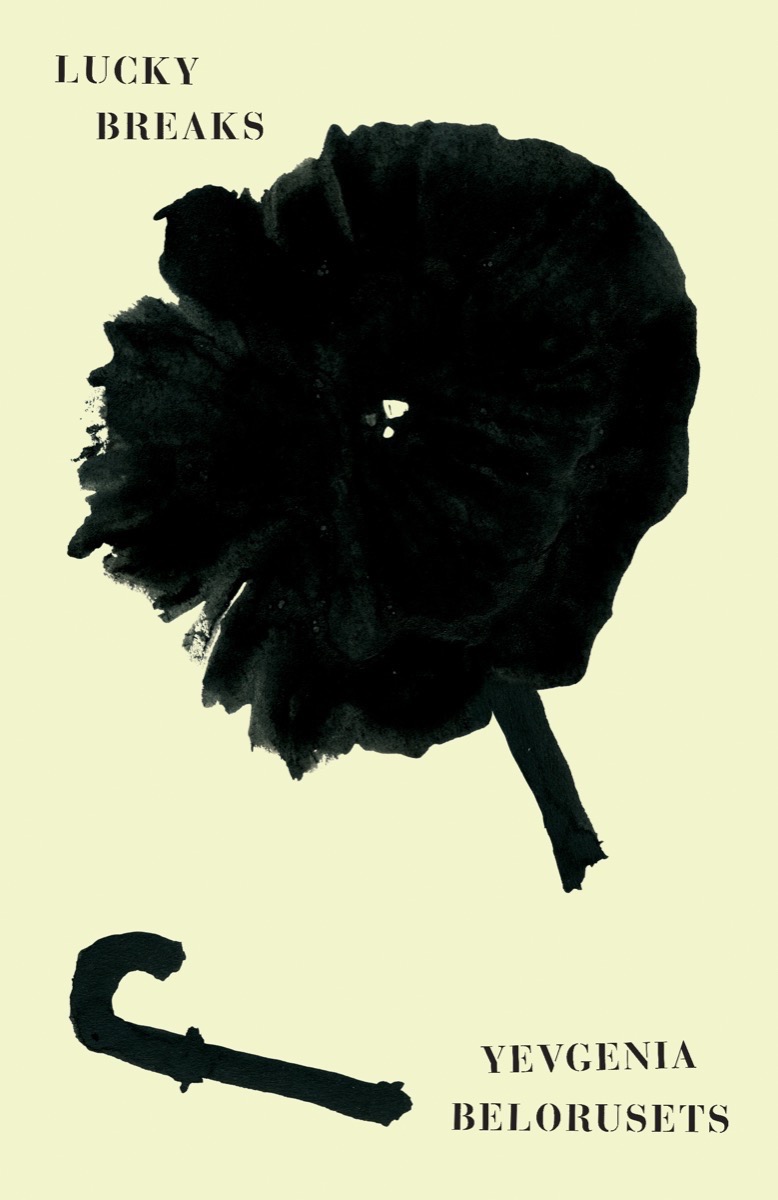
The protagonists of Belorusets’ stories are almost exclusively women, told either directly through the character’s voice, presented as conversations or interrogations, or recounted as the experiences of someone the narrator knows or knows of. As such, the author’s own voice may be reflected in some of the accounts. Refugees and others displaced by war are common. Many find themselves lost and disoriented in Kyiv, longing for a past life or trying to build some kind of existence in the city. They look for work where they can find it. Others belong to an uncertain fate. Like the story of a florist so attuned to her art that she hardly exists outside her shop in Donetsk, but what happens to her when her home and shop are destroyed? Some characters arrive in Kyiv bearing the scars of the traumas they’ve endured, like the woman who keeps trying to rid herself of a broken black umbrella she carries only to rush to retrieve it, scolding it, pouring her pain into this tattered object. There are dreamers and horoscope readers and a woman who visits a cosmetologist as one might a therapist, in the belief that her hands can somehow massage, however temporarily, the griefs she carries right off her skin. Through their troubled, often eccentric circumstances, the characters who inhabit these thirty-two stories contribute to a narrative of life under hostilities in a state of persistent, slow burn. The heat has since been turned on full and these tales become at once more affectionately folkish and more disturbingly real. The stakes are even higher. One recurring character advises the narrator that she wants her identity hidden, and challenges her motives for recording her story at all:

“At least this is why it’s better for you and me if no one knows about me. I could be called to account, couldn’t I? But is there anything I can change? Not only can I not change anything, I don’t dare to. You’re taking my words down, you must be counting on something. Maybe a tearjerker about how we’re all full of hope for a new future, or how the country that we loved became our prison. We’re left to eke out a life in small towns, to die in plundered hospitals, in dirty public wards, or in empty little apartments where there’s no hot water for months and the lights go out at night. Someone will want to hear about us, and then you will be the one invited to a grand festive table, you will be the one they’ll raise a toast to.” (from “Lilacs”)

In allowing such passionate, disaffected voices to come through, Belorusets has, in Lucky Breaks documented a mood existing in Ukraine before  the barrage of headlines that have come to dominate our understanding of her country. That is what a documentarian does. And she is still doing it as bombs fall.

In his informative Afterword, translator Eugene Ostashevsky describes Belorusets’ writing as being most indebted to the early stories of Nikolai Gogol and early Soviet era avant-gardist Daniil Kharms. Elements of the supernatural and the absurd normalized within the realm of the everyday and a concern with narrative fiction appear in her work. Ostashevsky also discusses her controversial choice to write in Russian which raises political and logistical challenges for a Ukrainian writer in a country where most people can speak both languages, but Ukrainian is increasingly favoured and protected. He does admit, however, that her Russian is subtly different from that spoken in the Russian Federation: “it is based on the rhythms and intonations of the Russian of Kyiv and Kharkiv, and continues the Russian-language line of Ukrainian literature.”

Despite the grim subject matter that underlies (and sometimes surfaces) in this collection, Lucky Breaks is filled with warmth and humour. Belorusets’ characters exhibit much the same mix of anxiety and resolve that can be seen in the people she meets today as she wanders the streets of Kyiv and compiles her journal that is, at this time, being translated and shared with followers around the world on a daily basis. However, I can only hope that a wartime diary is not required too much longer.

Lucky Breaks by Yevgenia Belorusets is translated by Eugene Ostashevsky and published by New Directions in North America. It will be released in the UK by Pushkin Press in May.