“wrestling words, terror at the morning gray”: Territories of the Soul / On Intonation by Wolfgang Hilbig

Ah, yes, to enter Hilbig territory, be rural or urban, is to travel a terrain that is at once suffocating and strangely comforting. With each new work to emerge in English translation it is, for an admirer of his melancholy poetics, like coming home:

—Then comes the city of S., our destination almost, laagered on the valley floor, admitting no beam of spring sunlight; it resembles, in fact, a reservoir for all the wet the clouds cast down when they’ve finally gained the surrounding heights. I would have to continue further southward, continue further southwestward, until the actual sea, I think, if I wanted to breathe a sigh of relief . . . here in this valley you remain imprisoned, unarousable, and held to the earth here by an apparently stronger local gravitation, you walk stooped through the city with its churches, descend even lower, to where the empty markets stand, assembled against a yellow prefab administrative circus, such a scene has a sundial on its dome—, but there is no sun here.
From “Adieu”

No one creates an atmosphere quite Wolfgang Hilbig.
Territories of the Soul / On Intonation, pulls together short works from two collections published in the closing years of the GDR—eight stories and two poems—translated by Matthew Spencer and published by Sublunary Editions. Hilbig was born in Meuselwitz, Thuringia in 1941, and grew up in the industrial wilderness of postwar East Germany. He began writing poetry while working as a stoker, but his literary sensibilities were never going to fit with the socialist realism the GDR wanted its working-class poets to produce. Yet, although he migrated to West Germany in 1985, his spirit and his themes tended to remain anchored in the East.

The stories in this slim volume offer a classic cast of Hilbig characters—tloners, dreamers, misfits at odds with themselves and the world around them. They are also often writers, or aspiring writers, even if their literary endeavours take place after work, or in secret on the job if possible. And the workplaces many of them are bound to, like Hilbig himself in his early adult years in the GDR, are mines and factories in set grim, urban or rural wastelands. His work can evoke an atmosphere so heavy and gritty one can almost taste it; his protagonists wander landscapes marred by sludge, refuse, and discarded armaments, their restlessness fueled by anxiety, remorse, and regret. The narrator of “Adieu,” quoted above, has just walked out on his only child, knowing he is wrong, and wondering “how does love become just a thing I rob from another, become a thing I can feel only by denying it to another.” It’s an uncomfortable monologue, made more so by the weight of the speaker’s tortured conscience.

One  of the strongest pieces here is the second title story, “On Intonation.” It opens with a chilling description of a stormy, wet night, viewed from the cockpit window of the nightwatchman’s station above an open-pit mining operation. The narrator is filling in for a missing watchman, a task he put himself up for thinking it would provide him the necessary space, away from the heat of the boiler room, to address a long pressing concern:

What I needed to work out—I had known this for years—was a kind of self-assessment, which would either certify me as a worker or as a true writer; however, since my presentiment was that I had insufficient reasons to properly continue writing, I had so far neglected this decisive memorandum; and yet I needed to fix these details in written memory, so I could exhibit them as proof against myself. —Meanwhile, I had come to a conclusion: I had to note down some urgent thoughts about the intonation of these modern lyrics . . . so I could implicate myself in evading duty.

And, yet, although he had been thinking about this question for some time, he finds himself, at his little makeshift desk, unable to find a word to replace intonation—his thoughts are frozen, he is unable to write the words he is convinced will prove he cannot write. But through this night, as he makes his rounds and struggles with his creative despair, his monologue turns on its own existential exploration of the lyric. The speaker, fearing that he lacks what he needs to be a writer, finds, in spite of himself, that he does.

This compilation, which includes work originally published in 1986 and 1990, is a particular treat for fans of Old Rendering Plant and The Tidings of the Trees—not only for its misanthropic souls, distinctive landscapes, and the occasional hint of gothic horror, but for those long winding and unwinding sentences that seem to pull the narrative into dark corners, resisting but unable to avoid a splash of milky light now and again. Even better, it may serve as the perfect introduction for those who have not yet encountered the addictive terrain of Wolfgang Hilbig.

Territories of the Soul / On Intonation by Wolfgang Hilbig is translated from the German by Matthew Spencer and published by Sublunary Editions.
Beautiful scavenger: We the Parasites by A. V. Marraccini

“I’m boringly good,” A. V. Marraccini confesses. “Except when I write critique, I guess.” I am also boringly good, even when I write critique—or so I thought before I read We the Parasites. Now, I’m not so sure.

What I will admit, off the top, is that I have been staring at this hot pink volume waiting patiently on one of my overcrowded bookshelves for the better part of this year. As someone who has written and edited critical essays without any of the prerequisite training many of my literary friends seem to have, I was afraid that a book about criticism would be thick with the names of all those critical theorists I have not read and likely never will, and page after page I would be smiling and nodding politely, off in the corner, with no idea what was going on. I needn’t have worried though; for the most part, none of those folk were invited to this party. However, I was still concerned that, given what I’d heard about this book, I might yet be stranded outside my comfort zone.

You see, Marraccini puts her cards on the table right at the beginning. After describing the mechanics of the relationship between the fig and the fig wasp that burrows deep into the fruit flesh in a somewhat haphazard partnership that enables the reproduction of both fruit and insect, she finds a distinct affinity, as a critic, with the latter:

The critical gaze is tearing apart, clawing into the soft, central flesh of the tree bud.

The critical gaze is also erotic; we want things, we are by a degree of separation pollinating figs with other figs by means of our wasp bodies, rubbing two novels together like children who make two dolls “have sex”, except that we’ll die inside the fruit and someone else will read it and eat it, rich with the juice of my corpse.

And although the wasp/fig process involves, to unequal ends, male and female wasps and figs, there is an element that is, for our parasitic critic, inherently queer and, thus:

Criticism, too, is queer in this way, generative outside the two-gendered model, outside the matrimonial light of day way of reproducing people, wasps, figs, or knowledge.

Okay, I think. I will need to be convinced. The idea of digging into a work appeals quite naturally. That is what I do when I write about a book, whether in a literary journal or, at least most of the time, here on this site. I inhabit the words of others in order to write, but try to stay out of my own way in my writing so that my reading experience seasons but does not obviously alter the flavour of someone else’s. And erotic? Well, that is not something that comes naturally to me, nor does queer even though I’m hard-pressed to know what I am if not queer. I have a fraught relationship with matters of sexuality and identity. It’s complicated. Yet, I am intrigued. And, as We the Parasites demonstrates, reading—or viewing, since Marraccini is an art historian—with the body can be a messy endeavour. But I’m getting ahead of myself.

Deciding to give this much-praised work the benefit of the doubt, I held my anxieties to the side, burrowed into the flesh of this curious text (I know, I know) and, my god, what an excellent read! (Please excuse the abandonment of all the niceties of proper critical reviewing and even accept an errant exclamation mark, because this book is one that invites you into the critic’s heart, mind and bed in a way that is completely, even joyously unexpected.) It is wise and funny and, best of all, it draws its references from the most unlikely places. My limited acquaintance with the stalwarts of the Western canon was no barrier to my enjoyment and, much to surprise, the two years of Classics that preceded my eventual academic journey through Biological Anthropology and Philosophy, was finally of some use. I not only have The Illiad (who doesn’t?), but I also could pull long untouched copies of Xenophon’s The Persian Expedition and Arrian’s Anabasis off my shelf and feel so clever. Not to worry, though, there’s always Google which you will need to see Twombly’s The Age of Alexander for this particular discussion, unless you have a photographic memory. But my point is, really, that you don’t need any special background to enjoy the musings that arise in this book; Marraccini writes with such enthusiasm, even about work that she views with some skepticism, that anything that is not offered within the text itself will have you happily popping online for a quick refresher.

The parasite analogy, if at first odd, sparks the author’s playful love of the dark and yet speaks with striking accuracy to the nature of the critic’s task—burrowing into and feeding off of the work of (mostly dead) writers and artists, to produce a reading or a response that brings light to the spaces darkened by time. However, if the wasp burrows into the fig, the tape worm finds it way into its animal or human host, consider the fish-louse that swims into the gills of its victim, severs the roots at the base of the tongue and eats away at the flesh until it becomes the tongue itself. This offers Marraccini an image, graphically detailed, that corresponds to the way that she has, when appropriate, stolen the tongue of Homer, or John Updike, or whomever. Strange? Maybe, but it aligns with the experience I’m often referring to when I say that I write about books to “open up” a potential reading (or readings). It’s even more relevant when one has the runway (that is, the venue and necessary word count) for an in-depth critical essay. If not stealing, we are perhaps echoing a voice, while our “I” self remains in the shadows.

In this extended essay in which the subject is criticism itself, Marracinni draws on a wide range of sources and images from classical history and mythology, to poetry, prose and, of course, art. Cy Twombly is her main man on that last front. One can move from Updike, to Centaurs, to Genet and Rilke, but it seems there’s a Twombly painting or series for almost every season and, in her explorations, she manages to carry us right down into the layers of crayon and paint. This affinity between artist and critic is so vividly rendered I wish I could have read this before my only direct encounter with his work at MOMA in San Francisco, but that would require bending time.

Our parasite, in inhabiting the works of the artists she consumes, also develops a strange relationship with the notions that arise out of that connection—a who-did-that-idea-come-fromness—that emerges in unlikely settings. Like dreams. Like when a nocturnal lecturer pontificating about the attributes of a strange painting-carpet he insists is a Twombly says No one wants queer art to be queer any more, Marraccini acknowledges, “to be clear, (that) is my brain saying that, and yet me in the dream is somehow intimidated by his prognostic authority” and she wakes up in a puddle of sweat. This is, for me, the kind of uncanny thing that only occurs when one is so deeply engaged with an idea or a book or an artwork or an artist, that the boundary between the ruminations of the sleeping self and the waking self is breeched. Blurred.

The question then is one of embodiment. Is the reader/viewer/critic inhabiting the work, or is it the other way round? Is this a risk of reading/viewing with the body? Marraccini writes about longing and desire, how they can be awoken or perhaps interfere with the engagement. Yet desire is not necessarily realized (at least not without breaking a law). And she does write about the body, her body, but typically in the most clinically frank way about the myriad way the body and its discontents can betray one. To be a parasite it one thing, to host one is something one would rather not entertain, thank you. Yet there are illnesses, physical and mental, that many of us live with and to pretend that they never mediate the way we read a poem of look at a piece of art would be an act of denial.

Finally, Marraccini is writing all of this against the backdrop of the early months of the pandemic, when London was eerily quiet and she could wander at will under the cover of darkness. (We are both naturally nocturnal creatures, it seems.) She captures the eerie otherness or suspended unknown of that period of time so well:

The whole world is so new now, there will surely be a spate of essays like this one, about The Before and After, or there will be no After and there will still be essays anyway.

I love this sentence. There surely was a spate of essays—as nonfiction editor for 3:AM Magazine, my inbox saw four or five new pandemic inspired essays arrive nearly every day. Meanwhile, a temporary medication change made it increasingly difficult for me to make my way through them as 2020 wore on, and by the end of the year I was no longer editing or entertaining the idea of pitching or writing any more essays myself. Whether there actually has been an After, as year four of Covid dawns, there are still essays, but I’m not writing them. However, reluctant queer, recalcitrant parasite that I am, perhaps I should be, duly inspired by this idiosyncratic, astute and undeniably queer essay. This is an original and very entertaining book.

We the Parasites by A. V. Marraccini is published by Sublunary Editions.

There is always a coming storm: Disembodied by Christina Tudor-Sideri

(W)ere it not for the troubling discoloration of my skin, one could even think that I am merely sleeping out in the open; it is only September after all, and is not September the perfect month for resting under the bruised sky?

Novels narrated by the dead are not an entirely unique literary phenomenon, but typically the deceased speaker takes the reigns to unravel a mystery, look back on a life, or observe future happenings from beyond the grave. Disembodied by Christina Tudor-Sideri opens with the statement, “I died on the twelfth of September, at the height of happiness,” but proceeds as uncertain meditation on this strange state of being no more, yet continuing to be. It could be described as an exercise in imagining experience unguided by expectation that begins when a woman slips out of life while sitting in the garden beneath a chestnut tree and becomes, ultimately, a kind of existential post-mortem of the self.

Disembodied is a novel with only an intimation of plot. It is a speculative journey, reader with writer—one in which the destination is no more evident to the former than the latter. But that is not to imply that this is a ghostly narrative that wanders widely and recklessly, rather it is one in which that narrator is still bound somehow to her own corpse, neither really inside nor outside. It is not what she might have anticipated, to be consciousness still tethered to a body, immobile yet somehow sensible, slowly embarking on a new relationship with reality, tangible and intangible.

She is a woman becoming a memory. An unstable and fragmented one.

Memories visit, moments from childhood and from the most recent tasks left unfinished in her nearby house. But critical biographical details escape her—she can’t remember what she might have once done for a living and, although she can recall people from her past, she can bring no faces to mind. She can sketch out a pattern of decisions that led her to move to an isolated location, she can talk of illness and pain, but death has disconnected her from the compass of time:

There are moments in which it feels as if months have gone by, that it has been months, even years since I fell here, and there are others when I am certain that it happened mere seconds ago, moments when I think I will get back up and return to my day as if nothing had happened, and I wish I knew now a little something about brain activity after death, about how consciousness is connected to the physiological functioning of the brain and how death severs that connection—about the very process of death, if not something, then everything, in great detail.

Being dead is not, in itself, a problem for our narrator. It is as if its early arrival—she figures she is probably in her mid-thirties—is something she anticipated, a probable outcome of an illness she had accepted, even sought to meet in solitude. And yet to be incompletely disembodied was unforeseen. She feels, or imagines she feels rain and falling leaves touch her skin. At times her body seems to be preparing to return to nature, while at other times she longs to move, weighed down by the burden of the illusion of breathing, an embodied remembrance that feeds the sensation that she could simply arise and return to her day. It remains, then, for her to reflect on life and death, the abstracted joys and sorrows that don’t quite fit into a complete picture, unable to shut out a parade of fragmented memories—experienced or read in a book or caught in a dream. “At rest” there is no rest.

Here in the presence of no other human being, with eyes that burn like embers in my skull, eyes that I don’t even know whether they belong to me or how I would recognize them if someone were to hold a mirror above, under this chestnut tree that looks nothing like the one I once knew, in this garden that I have seen in my dreams over and over again, long before ever actually finding the house, I let words crawl out of my mind and out of my mouth, only to waste them on speaking of something I have not thought of in years, to waste words and to waste myself on suffocation one final time.

Her questions become increasingly existential, focused on the matter of what kind of matter might account for this continued consciousness. A soul? An awareness that does not depend on functioning senses? The philosophical expansiveness becomes a kind of freedom, a freedom without answers, only more questions, but even as she drifts she cannot escape the pull of the longing to be. Again and again she returns to anchor herself, under a tree, in the garden. The tangible remnants of recent life, her nearby house, her library, a cup of coffee, an unfinished letter call to her.

There are echoes here of Tudor-Sideri’s first book, Under the Sign of the Labyrinth, a memoir/meditation on embodied experience that draws on myths and traditions of the Romania of her childhood to explore what it means to exist in corporeal form, wounded, mortal. But this is a philosophical/fictional exercise that extends beyond what we can know, open-ended and unrestrained. As she explains in a collection of interview fragments gathered in Minor Literature[s]:

I felt an urge to allow myself more: to play with something different, more permissive, although permissive is not necessarily what I mean – I needed a larger playground, as simple as that. And the novel, a dash of fiction, allowed me to do so. I did not plan anything, I did not know where I would arrive, I had nothing in mind aside from the beginning, which I pulled from a dream, same as a few other scenes […]

This openness and resistance to any specific genre, allows her to entertain the kind of problems that rarely trouble the typical post-death narrator and present a most intriguing possibility—that dying might not be exactly the release we imagine. The narrative style—a single, unbroken paragraph—enhances the claustrophobia of the speaker, often troubled that her thoughts and memories won’t release her. I might have preferred an occasional line break here and there, but when I think about it that’s a question of my comfort. A dead narrator doesn’t need to stop to catch her breath.

Disembodied by Christina Tudor-Sideri is published by Sublunary Editions.

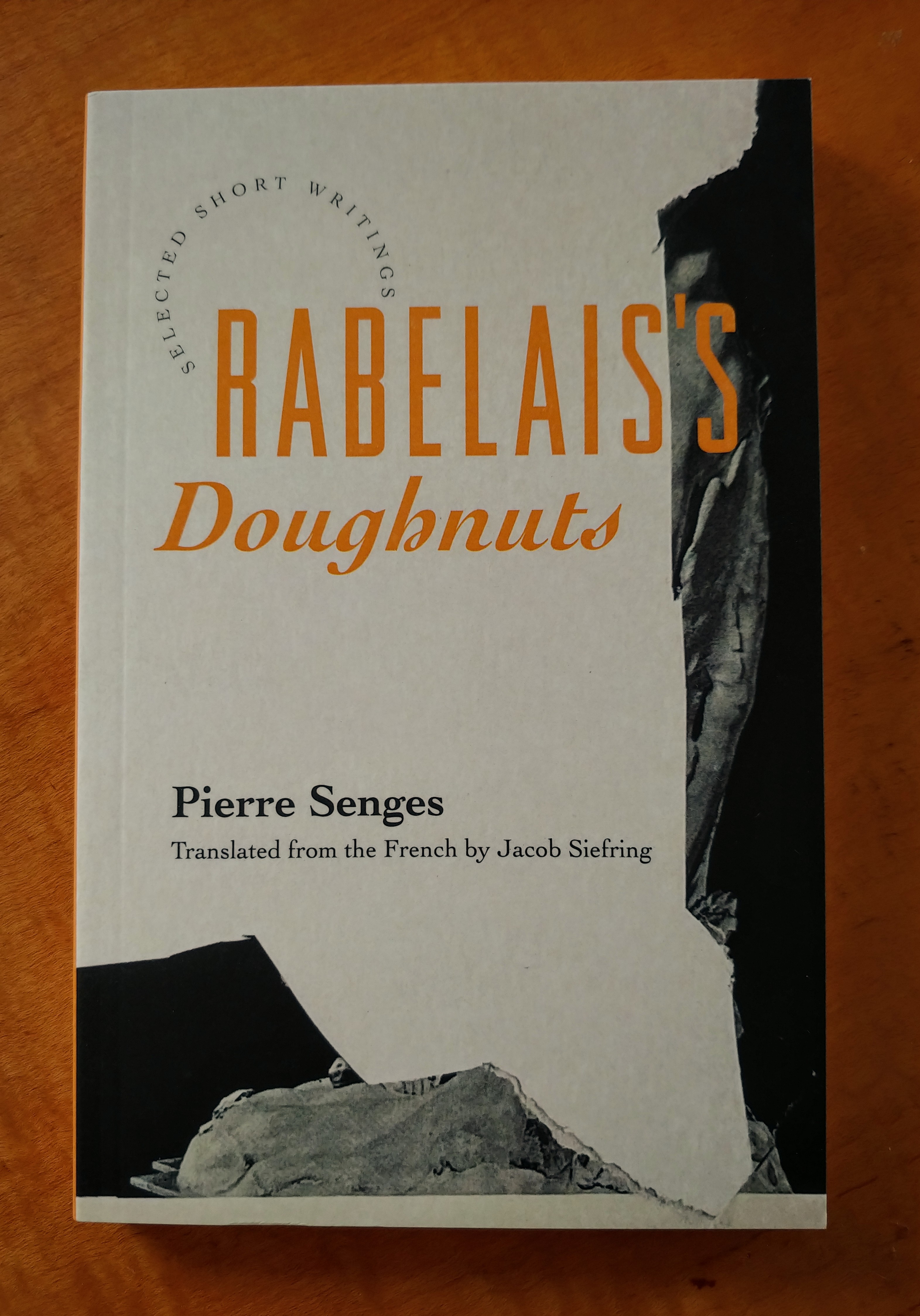
Seven (slightly vain) exercises in style: Rabelais’s Doughnuts by Pierre Senges

French writer and playwright, Pierre Senges, is a most subtle conjuror who casts a sidelong glance and exercises a sharp pencil to bring literary, historical, and contemporary notions together in unexpected intermixtures of fact, fiction and philosophy. An erudite alchemist, he spins extravagant, satirical, richly intertextual essays and imaginings that exploit that hallowed ground between the actual, the probable and the impossible. He may be dancing in the footsteps of Borges and Calvino, but Senges is the choreographer of his own inimitable style.

I have read and reviewed several of Senges’ works—the brilliant The Major Refutation, a conspiracy theory for the ages, the collaborative Geometry of Dust, and the chapbook Falstaff: Apotheosis—but on the menu today is an assortment of his idiosyncratic musings, half a dozen plus one tasty treats gathered together for the first time as Rabelais’s Doughnuts. Translated, like the other works, by Jacob Siefring, a veritable Senges evangelist, this slender volume is published by Seattle-based Sublunary Editions, their third contribution to the mission to bring more of the prolific French writer’s oeuvre into English. Six of the seven titles included in Rabelais’s Doughnuts were previously published in a variety of online and print journals over the past decade, but Siefring’s translations have been revised for this collection.

It tends to be difficult to succinctly summarize a Senges story/essay without tripping over one’s words. The most straightforward pieces here are two that involve Michelangelo’s famed painting Last Judgement. The first, “Last Judgment (detail),” is one of my favourites, revolving around a real person and situation that I was unaware of and would have thought to be entirely fanciful were it not for our friend Google. (One of the great joys of reading a writer like Senges is that he inspires a reader to look up an individual or a circumstance to find out what he is referencing—for those more cultured than myself that might be unnecessary, for those to impatient to seek out the subtext it could be frustrating, but in my mind it is a bonus.) This first Michelangelo piece considers the fate of Daniele Ricciarelli (called Daniele da Volterra or “il Braghettone”) who was commissioned to add tasteful coverings to several of the unsuitably exposed figures in the great artist’s masterpiece. With a certain empathy, Senges considers the task, the betrayal of his master, to which Daniele Da Volterra is committed:

When he draws, he draws, when he paints, he paints: depending on the point of view, the veils of the Braghettone benefit from his skill as the author of a Descent from the Cross, which has since become famous (famous as a reference, not as a celebrity). Or rather, it’s quite the opposite, one hundred and fifty veils fastened like so many pairs of underwear on the men and women of Judgement Day, all stretching towards their salvation or damnation, and disregarding as they would disregard a prune a nakedness that is more or less suited to the gravity of the occasion, one hundred and fifty veils are a valuable exercise for a painter.

The other Michelangelo related piece, “Measure of All Things,” imagines its way into the mind of the influential and critical writer Pierre Aretino who wrote an open letter to the artist offering his opinion on The Last Judgment.

Other works sing the dubious praises of the six hundred page novel, riff on one of Heinrich von Kleist’s prescient anecdotes about possible long distance communication, dragging it piecemeal into our modern world of the internet and Amazon, muse about writing exercises, and take on the character of a counterfeiter baring his sorry soul, such as it is, to a client. Figures from history and literature appear throughout, sometimes even providing a framework for Senges’ wide-ranging reflections. “Many Ways to Stuff a Watermelon” is a perfect example. He wanders through the libraries of a host of real and fictional characters, from the scant collections Russian writer Sigizmund Krzhizhanovsky granted his impoverished characters, to the actual library an aging Giacomo Casanova found refuge in, this tribute to libraries great and small will resonate with anyone who collects more books than they can ever hope to live long enough to read. In this, one English writer’s despair at the incalculable extent of available material speaks volumes (so to speak):

The reader’s tininess signifies the brevity of our lives: it follows that the impossibility of reading everything takes the measure of our mortality, provoking frustration and vertigo at the same time—to Thomas De Quincey, in any case, one hundred thousand forever unknown volumes brought forth tears which he compared to those of Xerxes countenancing the death of his soldiers: not some “fanciful case of misery”, but “as real a case of suffering as ever can have existed.”

Senges’ elaborate language and dry wit allow him to take a small idea and expand it into an intelligent, extravagant exercise, one that takes chances but always steers close to the truth, or a truth, digging freely into the past to make astute observations about the here and now. If you are new to his work (or well acquainted), this short collection is a an ideal way to meet (or spend more time with) this witty, intelligent writer.

Rabelais’s Doughnuts by Pierre Senges is translated from the French by Jacob Siefring and published by Sublunary Editions.
Rumors, riddles and other stories: Anecdotes by Heinrich von Kleist

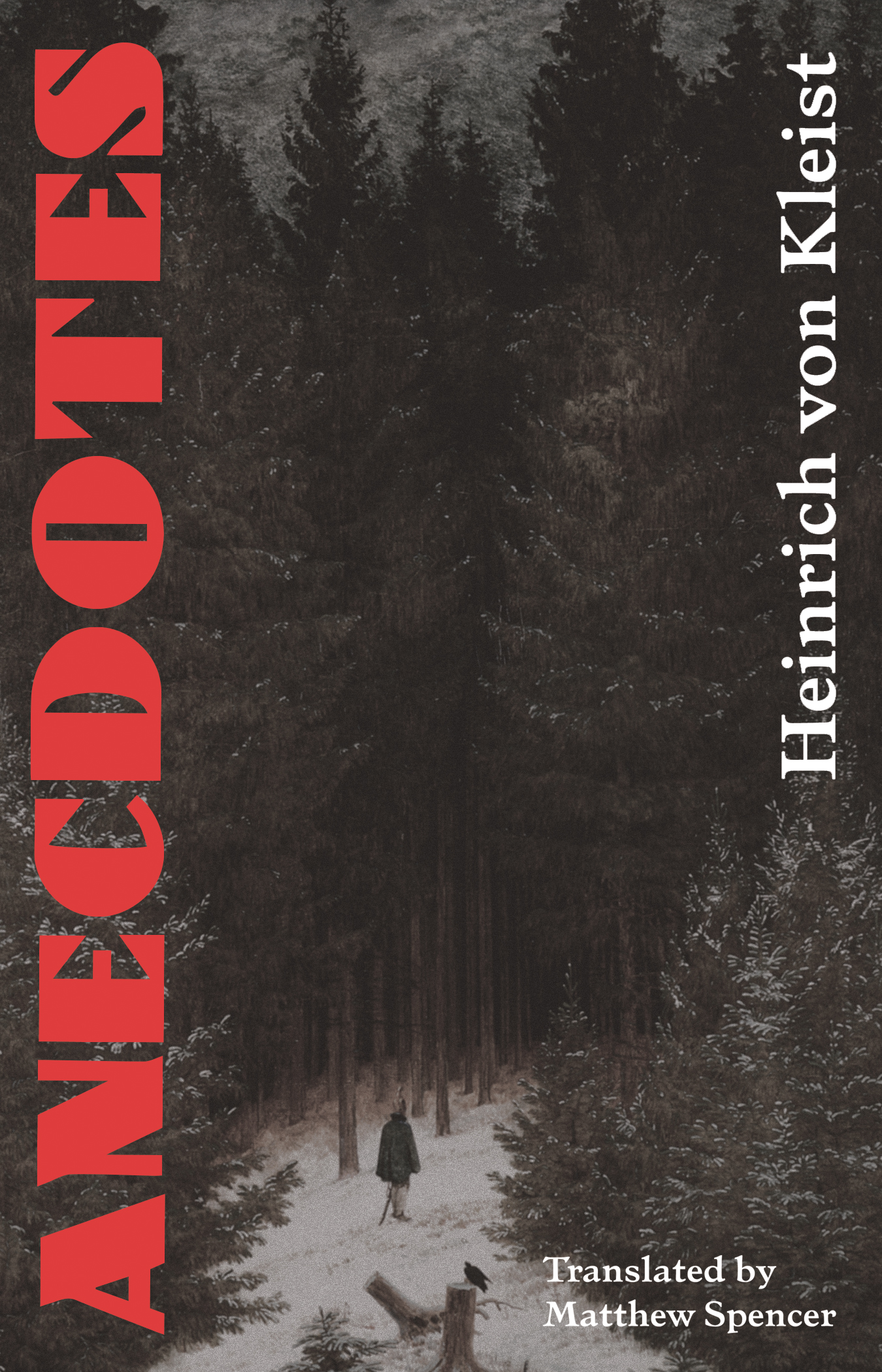
Sublunary Editions, the humble publishing venture started by Joshua Rothes in Seattle, Washington in 2019 has, over the past few years, expanded from a simple monthly newsletter featuring new works and/or translations, to a quarterly journal called Firmament, the Empyrean series of obscure/hard-to-find literary treasures, revived, researched and restored, and a growing catalogue of original and translated novellas, stories, poems and hybrid works. Best of all, the books are all small, shorter volumes easily tucked into a bag or jacket pocket to read on the go.

Their most recent offering, Anecdotes by Heinrich von Kleist is a perfect example of the kind of work that sets this small publisher apart. In his tragically short life, Kleist packed a lot of living—writer, dramatist, soldier, possible spy, and during his final year, newspaperman. When he died by suicide at the age of thirty-four, he left behind a profoundly influential body of work. This collection of short stories and anecdotes originally published on the pages of the Berliner Abendblätter, were written over the course of one year, between 1810 and 1811, the span of time from the daily newsheet’s inaugural issue to their author’s death. As such they represent the first extensive collection of Kleist’s short work in English translation and an important, exciting addition to the Sublunary line-up.

Born in Frankfurt an der Oder in 1777, Kleist lived during a particularly unstable era in European history. Conflict with France was the major political concern for the German states throughout his adult years, and he served in the Prussian Army, spent some time in prison, and became an early supporter of German nationalism. He would come to be known as one of the finest literary stylists of his time, but during his lifetime he realized little of that acclaim. His daily compositions for the Abendblätter, from which the pieces in Anecdotes are drawn, provide a somewhat different insight into his gift for wit, satire and social commentary. Kleist was the editor and chief contributor to this publication and, as translator Matthew Spencer notes in his Introduction, this forum shows him to be “studiously evenhanded” taking aim at his subjects from all sides. At least while he was at its helm, the paper showed great promise. But it would not last long and might well have disappeared from memory altogether if not for a fortunate circumstance:

while Kleist began, through his plays and novellas, his posthumous ascent into the literary canon, the anecdotes remained largely underread, out of print. Much of the Abendblätter would have been lost if not for the Brothers Grimm, who collected issues specifically for the anecdotes, considering them small masterpieces of vernacular literature.

Although the critical value of these stories, witticisms and anecdotes, was debated by many, future admirers like Franz Kafka and Robert Walser, found in them an inspiring comic spirit to treasure.

The works collected in this volume run from the absurd to the tragic to the ribald, and are at times, remarkably timely. Some read as historical accounts, some as mock news items, and others as entertainments. Healthy doses of sarcasm drive home subtle and not so subtle attacks on military culture and the art of war. Folk tales and fables take clever turns. A few may miss the mark (or may have not survived the distance from their original context), but most of his tales are quite funny—even if darkly so. Where a little extra background is needed, Spencer includes brief historical or linguistic footnotes.

The pieces gathered here range from very short amusing accounts, bizarre Ripley’s Believe-it-or-Not type reports, to imagined news stories and, even, in one instance, a letter to the editor (crafted by Kleist himself of course) responding to a “reported” proposal for a cannonball postal delivery service. The postal system, it seems, is a an ongoing concern going back centuries. Another anecdote echoed almost a century and a half later with the play Twelve Angry Men, is “A Strange Case in England” which records the debate among a dozen jurors in a murder case but which ends with an unexpected twist.

As much as I enjoyed the anecdotes, my favourite pieces were the last two, somewhat longer stories, “A Ghostly Apparition” and “Saint Cecilia or the Power of Music.” Both are more along the lines of gothic tales but demonstrate Kleist’s ability to tell a solid, entertaining story. While the original issues of the Abendblätter would have included more conventional “news” and “information”, the selection for this project was guided by literary interest. As such, Anecdotes provides either an excellent first introduction to Kleist or a welcome treat for English language readers who already know him well.

Anecdotes by Heinrich von Kleist is translated by Matthew Spenser and published by Sublunary Editions.
Washing the wounds of time: Under the Sign of the Labyrinth by Christina Tudor-Sideri

Listen closely. If ever there was a book that reads as if the author is present, whispering over your shoulder, it is Under the Sign of the Labyrinth, recently released from the defiantly original independent publisher, Sublunary Editions. In this unclassifiable memoir/meditation Christina Tudor-Sideri carries her readers into an intimate, embodied anamnestic rumination on what it means to exist, exploring the myths and legends that form us, and the way our wounds shape who we become.

She begins with trauma, understood as something that “lives in the body of all things”—eternal, essential—and  proposes that to write trauma is to look deep into your inherited and personal histories, to examine your memories, to seek your self. A process that can, it seems, risk being traumatic itself:

Each word becomes a scream. Starving trains pass by my window with the heaviness of a dark eternity that cannot be erased once I travel back in search of what wounded me. Light becomes diseased. The genesis of poetry is expunged. Pain has a momentum of its own yet again, unceremoniously within the hollow and cold urn that entombs it.

A chill, a distinct darkness, and a slow pensive dawn colour this existential pilgrimage of a wounded poet philosopher as she allows her memories to guide her. It is a journey mapped in memory, literature, mythology—rendered visible in the blood coursing beneath the surface of her skin. Tudor-Sideri invites us back to the Romanian village where lived as a child, a formative world of forests, a river, and a place inhabited by the ghosts of wild mad men and women and the spirits of the children once housed in the local preventorium. She describes a childhood lived on the edge of ancient wisdom, magic and mystery. Drawing on traditions, images and lost historical practices she crafts an uncustomary quest in search of a way to understand and articulate the nature of being in the world.

The labyrinth, a symbol found widely in Eastern Europe and in Mediterranean cultures, is essential to this philosophical odyssey—imagined and reimagined as a physical embrace and as a metaphorical pathway toward the monsters that lie at the heart of memories, dreams, and lived experiences. Toward the self.

As I penetrate the labyrinth, touching the wall with my fingers, its outside becomes the silk fabric entombing my body—I become the pulsating core of the labyrinth inasmuch as it becomes the fabric shrouding me in my journey towards the center. I descend into the darkness of my being. I retreat from the world into the cavernous depths of memories that have blended with my viscera. In the dark, my mind dwells on the creature residing within—the monstrous I and the shadow it projects.

In following the lead of this powerful imagery, Tudor-Sideri calls on folklore, mythology and philosophy as she examines where self-reflection can take her—even if she does not wish to go—and explores the uncertain necessity of healing the wounds we bear.

Although Under the Sign of the Labyrinth contains some of the qualities of memoir and concerns itself with memory, it actually reveals little of the author’s life. Rather, she draws on her own sensory and emotional experience, because, after all, she can only speak to herself, but there is an intentional universality at heart. The “I” enwinds with “we.” The questions she is asking cannot be answered with what, but with how. Her fundamental inquiries—“What does it mean to write trauma/to write the self?”—are not directed at self-psychoanalysis. The bleeding out on the page is allegorical. This existential reflection, born of flesh and bone, extending beyond death and decay, is an extended dance between body and mind. For Tudor-Sideri:

Existence is always corporeal—we bleed, we ache, we become our wounds… The physical manifestations of our becomings and experiences leave traces on the world and on ourselves—the body marks the mind. We hold each other, and the mind marks the body.

In turn haunting, beautiful and gently macabre, the multiple threads of this essay are ultimately woven together as its poetic ramble reaches a thoughtful conclusion. Christina Tudor-Sideri’s work, according to her bio, examines “the absent body and its anonymous rhythms, myth, memory, narrative deferral, and the imprisonment of the mind within the time and space of its corporeal vessel.” There are many points at which these themes intersect with the kind of questions that trouble me, so I personally found this text to be filled with a wealth of ideas and inspiration. However, I have no doubt that anyone venturing into this intelligent, meditative prose poem will be richly rewarded.

Imagining the exotic: A Luminous History of the Palm by Jessica Sequeira

As a child of the temperate zone, there is no way that the palm tree can ever be redefined as ordinary. Raised and nurtured amid aspen, spruce and pine, the palm was that magical backdrop to postcard perfect white sands and crashing waves, the defining feature of the gawdy Hawaiian shirt, the label of Malibu Rum. When I was growing up, the closest I ever came to the real thing was the handful of leaves I brought home from church on Palm Sunday (the most crowded mass of the year my mother insisted, nothing like getting something free to put bums in the pews). I would take my leaves home and carefully tuck them behind the cross that hung above my bed. At the end of the year, as another Palm Sunday approached the old leaves were to be burned, but somehow we never were allowed to witness that ritual, if it even occurred in our house.

My first encounters with palms growing where palms can grow were in thoroughly domesticated urban settings—first in San Francisco and years later in Cape Town where many of the variants I met were shorter, bulky affairs, but they still made my heart soar. The first truly natural palms I encountered were entirely unexpected, stunted bush like desert palms tucked into sudden lush eruptions aside (typically) dry river beds along the Larapinta Trail in Australia’s Red Centre. But it was in India where I was finally able to embrace palms that matched my imagination—casually lining the roadside, reaching their tousled heads above city skylines, growing free in open spaces. And although it is the perennial green that has drawn me to the country more than once in the depth of our bleak midwinters, palms hold a special allure. They symbolize, for me, the exotic like no other tree.

No surprise then that I was immediately attracted to Jessica Sequeira’s new book, A Luminous History of the Palm, the latest miniature masterpiece from Sublunary Editions. Here the palm is the common thread that binds a collection of imagined anecdotes, microfictional histories interspersed with brief meditations on luminosity—what it is and how it makes itself manifest in the way one entertains, orders and translates meaning in the world. Quite simply, this book follows a trail of associations, luminous associations, through time, across the globe, where the palm figures in some way, whether close at hand or only, as I once knew them, imagined from afar:

A luminous history seeks to make connections beyond the surface level of great events and statistical data. To do so it takes a symbol, any symbol, as a seed to create anecdotes.

The luminous begins from the small and everyday, the particular and the peculiar.

It is a very simple and delightful notion, perfectly suited to this sort of slender, pocket-sized book. Each anecdote gives voice to a fictional character, from a healer in Yemen, to, among others, a Thai rice farmer engaged in an illicit flirtation,  an opera singer performing for a young Mozart, a plastic surgeon in Australia and ultimately a cyclist in Chile, who may or may not be the author herself. Perhaps we have gone from the distant to the immediate, but  along the way a window has been opened on a wide variety of personalities and locales. The palm is sometimes an important element, but more often it passes by, almost unnoticed in the scene. Every story is different, nothing is predictable although it would be remiss if the original procession forever reproduced on Palm Sunday was not also among the histories—and of course, it is.

If the palm is the unifying theme, however quietly it might slip into any individual narrative, the meditations on luminosity and reflections on the project unfolding hold the work together. They give it depth, make it special and are, in themselves, worth returning to repeatedly for the inspiration they offer—for their ability to illuminate creativity:

To be luminous is not the same as to be enlightened. Enlightenment comes from the outside and implies progress. To be luminous is to generate affections and affiliations from the heart, belly and bowels of a situation in time, and form part of an organic system that is possibly infinite. It is to avoid abstraction, at least at the start, to prefer the concrete and the sensual, the soft light forged by the bodies of stories as they crush together in violence or embrace.

 This is the promise and excitement on offer. As the author, our luminous historian, describes her compact treatise: “it can be read as a series of small portraits through time, all of which include a palm tree. Or it can be read as a revolutionary tract.”  I would argue it is not a question of either/or—this little book can, and should be read as both. Sequeira explains that she chose the palm for its vital presence, but she invites the reader to repeat the exercise with a plant or animal of their own choice. The soil is fertile, she assures us; all we need to do is plant a seed. This is, then, a book with no end but infinite potential beginnings.

A Luminous History of the Palm by Jessica Sequeira is published by Sublunary Editions, purveyor of fine short texts, and available here.

Older than yesterday, younger than God: 926 Years by Kyle Coma-Thompson and Tristan Foster

The universe is a big empty space, small clusters of stars and planets stretch across impossible horizons and, even if you are lucky enough to find yourself on one of the statistically unlikely chunks of rock that might just support (apparently) intelligent life, the chances that you will gather around yourself a few precious like-minded souls to nourish your own creative dreams and endeavours within spitting distance is another statistical unlikelihood, though much less unlikely than finding enough oxygen and water available to allow for your own existential possibility. Period.

Imagine, then, the good fortune that led one somewhat cynical Australian writer in Sydney to chance upon the work of an American (sorry but I have no idea what his temperamental tendencies are) writer from Louisville, Kentucky in the 17th issue of The White Review. What started as writerly admiration grew, thanks to the magic of email, into a friendship and now, some three years or so later a book-shaped collaboration. Twenty-two pieces of micro fiction. A literary game of call and response. A sideways glance into 926 cumulative years of human existence.

Each story, or vignette, is titled after the central character and his or her age. One imagines each author taking turns, challenging the other, triggering the next effort. Perhaps there were complex rules, elaborate algorithms. Perhaps a roll of the dice or a measure of blind faith. I don’t know. Entering one world after another, spaces filled with souls that seem somehow disconnected from their lives—from their jobs, their relationships, their health, or from the simpler beings around them—a curious reader (okay, I’m guilty) might be inclined to look for points of reference loosely linking one story to the next. Yet, the opportunity to slip in and out of a variety of experiences is its own reward. A connection to the unconnected. Like 47 year-old Larry Hoavis, sitting in his rural backyard, reflecting on the radio towers in the distance, their lights flashing in the darkness:

Why does it feel lonely, sitting and watching? Nature in its subtle power and monotony, pre-Internet to the core, unconscious of its enormity. No one. No one even knows he’s here. The house at his back. Divorced. His ex elsewhere , how he loved her, hurt her, himself. Why’s it beautiful, why’s it comforting, that no one knows? The crickets bleeping in the grass around him, the corn growing before him. Far lights pulsing like heartbeats, waiting for lives and bodies to grow around. Loneliness, it’s inarguable isn’t it? Crowns a person like some kind of common wisdom. Then overthrows him.

Each moment, painful, precious, perfect.

926 Years by Kyle-Coma Thompson and Tristan Foster, the American and Australian co-conspirators, is the second small book to emerge from Joshua Rothes’ Sublunary Editions (I reviewed the first, Falstaff: Apotheosis here, and interviewed Rothes for 3:AM Magazine here). The collaborative effort—not just between the authors but with the editor/publisher—gives this project its energy and sets a wonderfully realistic and realizable model for creating literature that is fresh and original. One that invites and encourages other like-minded spirits to imagine their own projects and help make this lonely habitable rock a little less lonely.