Pride Month reading 2023—None of the Above: Reflections on Life Beyond the Binary by Travis Alabanza

I have long been ambivalent about Pride, but the rising waves of anti-LGBTQ, and especially anti-trans, sentiment seen over the past few years has made me very concerned. As a transgender individual who is white and fits visibly into the accepted gender binary, I have been able to stand in the shadows for a long time. For more than two decades. In fact, when I was a single parent supporting two children in a world without any legal protections on the grounds of gender identity, keeping my gendered history hidden was essential. On the occasions that I dared to out myself to a co-worker, job loss invariably followed. But, for the most part, especially outside of the LGBTQ world, I have encountered very few problems because I am older and exceptionally ordinary in my presentation. I pass so well that often I am not heard or believed when I try to tell someone that I am transgender.

For British writer and performer Travis Alabanza, on the other hand, none of the above applies. So when I heard about their Jhalak Prize-winning book None of the Above: Reflections on a Life Beyond the Binary, I knew I’d found my perfect read for this year’s Pride Month. And, even though our ages, lives and experiences differ greatly, I related more closely to many of the ideas they explore in this thoughtful and articulate examination of what it means to exist as an openly gender non-conforming person of colour in a world that is bound to the binary, than in most of the more “conventional” trans-themed books I’ve read. This is a bold and honest work that rides on a shifting current of hurt, uncertainty and self-affirmation against an unspoken pressure for trans identified people to be determined, self-assured, and often stubbornly binary in a world that increasingly strives to deny our validity. There is little room for doubt, less for admitting how exhausting it can be.

In our journey to ‘own our gender’, is it ever really our own? Or does it rely on us conditioning those around us to act and be a certain way too?

None of the Above is neither a typical memoir, nor an explicit defense/explanation of non-binary identity. It is, rather, something in between—a personal account structured around seven statements that have had a particular impact on Alabanza, as a youth and as a public figure, exploring their identity, sexuality and gendered expression. As they dissect these statements, there is a persistent question of how long an obviously gender-defiant presentation can be maintained before it simply becomes easier to move toward a more “acceptable” or “proper” presentation of transness. Of course, given the ongoing escalation of hostility directed at trans women, it’s not clear that such a progression toward hormones and surgery would be easier.

With chapter titles such as “So, When Did You Know?”, “But I Mean, Proper Trans”  and “This Ain’t A Thing We Do Around Here, Son,” Alabanza talks about growing up poor in a council project, their first joyful expressions of femininity, and their development of a successful career as a performer and theatre maker. The questions and comments they encounter come from curious, well-meaning friends, neighbours, fellow performers and critical journalists. Yet, in exploring their reactions and possible responses to these statements that weigh so heavily, there is a willingness to open up their experiences to concerns that intersect with those of others who may be white and/or cisgender. After all, the rigid strictures associated with the gender binary impact people who are not trans in many ways even if they also drive transphobic attitudes. The same gender binary can force trans people to consider medicalization as the measure of “true” transness and look at the openly queer and non-binary as troublesome distractions. For trans people of colour all of these contradictory forces are heightened.

Often what is projected onto those who are visibly gender non-conforming and non-binary, is that our existing, and claiming transness, will ruin it for those wanting (and deserving) a quieter life. Gender non-conformity and being outside of the gender binary cannot be seen as quiet: it is seen as purposefully choosing to cause trouble. To those so wanting a life of peace, others’ disruption can feel like a threat to that fought-for sanctuary.

This is a book that strives to come to terms with the feeling of being at odds with the gender one is assigned at birth, but not feeling comfortable identifying as a man or woman. It’s not a new phenomenon—I have friends who have identified as “gender neutral” for decades. What has changed, for better and for worse, is a wider public forum for people to see and be seen defying or transcending gender. I am grateful I transitioned before the advent of social media, but without the internet I would have had no community. Likewise, without the fabulous gender-bending musicians of the 1970s, I would not have survived my teens. As it was, I was thirty-eight before I finally had an understanding of the differentness I’d always known. But, even though my ultimate path was quieter and more conventional (to a point), my strongest connections have always been with those who stand at the intersection of masculine and feminine. So, for me, there was much food for thought in None of the Above that is beyond the scope of this brief reflection/review. Perhaps it will emerge elsewhere. Meanwhile, I will say that, for readers inside and outside the trans community, this is a very valuable and entertaining read (though one that might anger some on both sides).

None of the Above: Reflections on Life Beyond the Binary by Travis Alabanza is published by Canongate in the UK and will be published by The Feminist Press in the US in October.
Pride Reading—Two: This Body I Wore by Diana Goetsch

The second trans-themed nonfiction book I chose to read this month is, in contrast to my first (My Life in Trans Activism by A. Revathi), a literary memoir, but the transgender journey it details differs from the one that is commonly told because the details of the author’s actual transition are minimal and confined to the closing chapters. It is, rather, the story of one woman’s fifty-year-long odyssey to finally come to acknowledge what she had sensed from a very early age—that despite being born male, she was, and always had been female. So why did it take so long to acknowledge the truth? This Body I Wore is Diana Goetsch’s answer to that question, an eloquent chronicle of life that conspired to cloud the reality haunting her relationships and filling her closets for so long.

Goetsch’s account opens with her early unsuccessful attempts to form romantic or sexual relationships and her first forays out into the culture inhabited by cross-dressers. She is in 1980s New York City. The push-pull of her attraction to women and women’s clothing is exciting and confusing. She graduates college, lands a teaching position at the prestigious Stuyvesant High School and soon finds herself juggling secrets, while trying to build friendships and find a girlfriend.  By her early thirties she seems to be dropping all or most of the balls. That leads her back into her past to begin to trace the roots of her predicament.

The childhood described in This Body I Wore is one marked by little affection and an unhealthy measure of abuse. The youngest of two boys, Diana—or rather Doug (and briefly I am using male pronouns, this book spans decades of evolving and context specific usage)—is told by his mother that he was an “accident,” that is, unintended and unwanted. He grows up on Long Island, an athletic, sports-minded young man who seems to become increasingly and inexplicably unpopular. Although he is determined to keep his secret fascination with girl’s shoes and dresses and feminine undergarments to himself, it’s almost as if others sense a difference. Friends fall away. Doug cannot understand why; by the end of high school, unable to secure a college placement he feels left behind. I wonder how many trans people have experienced similar sensations of being out of step? I know I did.

The bulk of this memoir follows Diana’s efforts to build relationships with a series of women, most of whom she comes out to as a cross-dresser and with whom she explores social outings as female, but again and again her own male body becomes a barrier to full sexual expression. A trail of broken hearts and extended periods of loneliness carry her into middle age. Professionally, she spends a number of years teaching in a youth correctional facility, begins writing and publishing poetry, and tries to build a career as a writing teacher. Meanwhile, she increasingly dedicates her weary spirit to Buddhism, attending retreats and developing her practice to a point where she finally finds a way into her deepest self. Throughout the course of more than two decades she moves in and out a female identity that can be outfitted and carefully applied, then washed away and returned to the drawer. The decision to move forward is liberating, and increasingly magic as it gradually becomes her normal, everyday existence.

I enjoyed this book very much, it is a poetic and finely crafted tale. I will confess that I was reluctant to take it on. I have an uncomfortable reaction to memoirs, especially those with recreated dialogue and the inclusion of the stories that belong in equal part to those who come in and out of the story. Goetsch handles this well, with respect, but I did at times wonder about the women whose lives were exposed along the way. However, my greater concern was, as I mentioned in my previous Pride post, a general anxiety about trans stories, fiction or nonfiction, which I can never entertain as an impartial reader. As a transitioned man it’s impossible not to read myself into and against the stories of others and very often I find it an alienating and depressing adventure. Yet, This Body I Wore was a pleasant surprise.

Trans women and trans men typically have rather different trajectories, in both the coming to a decision to transition and in the treatment available. At least twenty or more years ago, the accepted norm for a “transsexual” man was a childhood as a tomboy, attraction to women, and commonly, for lack of any other place to seek an understanding of oneself, questioning sexuality or living as a lesbian. By contrast, my early reaction to the feeling that there was “a boy inside me” was not a desire to be male but the fear that my body carried signs of my wrongness, something I hoped I could learn to overcome. Although I could not believe it, I was pretty and reasonably feminine, not athletic or a tomboy or attracted to girls, but the gender insecurity was deep and increased as I grew older. I married and eventually had children, pushing to the back any careers or opportunities that I feared might reveal the truth about me. In the absence of any notion that trans men existed or what testosterone could accomplish, it would take thirty-eight years and an incredible emotional and mental toll before I knew I was not alone. Within two years of realizing the male feeling I’d fought against was me I was starting to transition. But my extended confusion, the searching for clues, the fear of revealing or even exploring what was happening, mirrors in a way the cross-dresser to trans woman scenario much more closely than the tomboy to butch to trans man route. In truth of course, transgender people are as diverse as any other people with unique social, cultural and emotional journeys to finally come home, but it is not uncommon for us to wonder, and debate, what it means to be “trans enough”.

It also struck me after finishing this book how flat Goetsch’s depiction of Doug seemed through the mid-section—the long adult years of exile. When Diana finally comes out to herself an entirely fresh energy enters the narrative, her excitement and growing confidence is palpable. Not surprising when I reflected on my own early years post transition. Once I was passing consistently and had established a new career and identity, I was forced to live stealth in my professional life so as to be able to keep a job and support my children—that is, I came out only to disappear into a closet. Still, the daily validation as a man and the thrill of no longer having to try to feel female, cast an unreal light on the past. It’s as if that life belonged to someone else as it drifted into the distance. No matter how lyrical the language, how vulnerable the account, I sensed a similar estrangement permeating the text. It makes sense and at the same time it’s refreshing because transgender memoirs can sometimes be combative and defensive. Goetsch avoids a tendency to overwrite her former existence; I imagine her maturity and her Buddhist grounding are at play. Transitioning later in life brings up such a sense of lost time, a mourning for what might have been, and that comes up here too, but briefly and with empathy and grace. In my own experience, transition is an ongoing adjustment and reframing for oneself in relation to a life lived across time and gender lines that leads to an understanding that those years “before” are not lost but a fundamental part of the person we become that a compatible sex/gender history could never afford.

This Body I Wore by Diana Goetsch is published by Farrar, Straus & Giroux.

Pride Reading 2022 – One: A Life in Trans Activism by A. Revathi

I have touched on the question of Pride before here on roughghosts. Each year as June comes around I face the increasing onslaught of rainbow enthusiasm with trepidation. It brings up a lot of complicated emotions for me as someone who technically falls within the LGBTQ spectrum but has never managed to find a home within that space. I am not ashamed of who I am, but I feel no thrill of connection with the notion of Pride and have some very painful memories of the rejection and intolerance I’ve encountered from within that “community.” However, every June I promise myself that I will face my anxieties head on with some sort of nod to the season, and, since my city does not celebrate Pride until late August, it’s more of an abstract goal. I don’t have to be out there, so to speak. I can read my way through.

This year I decided to read three books, two from India, one from the US. Two of these books are trans-specific, one of the Indian titles and the American work, both nonfiction. I don’t think I’ve read any trans-related nonfiction for at least twenty years, since the time when I myself was exploring transition and beginning my own journey. The works I have on my shelves and the common language and perspectives typically held within the transgender male support networks that saw me through the early years tend to be, to a new, vocal generation, offensively outdated. Distance and experience shape each trans person but, unfortunately, true diversity is not always applauded within groups of marginalized people who tend to be just as capable as any other group of fracturing along lines of race, class, sex, sexuality and gender, and insisting that those who are not like them do not belong. Trans people seem to be centre stage right now, inspiring plenty of negative and positive reactions in the process, but my own feelings about all of this, more than twenty years post-transition, are conflicted. I will just say that I am glad I came out and transitioned before the advent of social media.

The first book on my list is one I’ve been curious about for years, A Life in Trans Activism by A. Revathi, a trans woman and activist from India. Published in 2016, this book is a follow up to her popular memoir, The Truth About Me (2010). She does include an overview of her own basic life experiences: growing up longing to be a girl, running away from home to join a hijra community, her family’s often violent reaction, her eagerness to have surgery—castration for which she was awake—the dynamics within hijra society and the necessity to engage in begging and sex work for lack of other options. The world she describes is one which provides support but is also strictly hierarchical and sometimes cruel. It is an honest account, nothing is idealized, but she expresses pride in herself as woman and has tirelessly advocated for hijra and other transgender communities.

Revathi’s account of her work within not-for-profit agencies dedicated to supporting sexual and gender minorities, is quite telling. Initially she was welcomed to help expand their mandate, but it was often a fraught relationship in which, as a non-English speaking trans woman, she still battled the stigmas faced by hijras and other gender different persons. As her advocacy opened up to include the concerns of lower caste, dalit and adivasi (tribal) populations, the persistence of class biases even within organizations devoted to marginal groups ran deep. She spent a decade working with an agency in Bengaluru, an experience which offered a dignified, if less lucrative alternative to sex work, and taught her how to effectively advocate for trans people,  fight for their (and her own) basic rights—ID cards, passports—provide crisis support and legal resources, speak to international audiences, and much more. However, in the end it became clear she would never gain real respect from her co-workers. As she says:

We say that we work for the non-English speaking working class, for sexual and gender minorities. But I realized that as a director you are respected only if you are upper class and English speaking.

After leaving the agency, Revathi was again faced with the question of making a living without returning to the only avenues typically available to hijra. She decided to write a book. Sharing her story brought her attention and increased opportunities to speak for transgender people. Her memoir, originally published in her native Tamil, has subsequently been translated into English and a number of other Indian languages. Although a current of financial insecurity, family conflict and the tragic loss of friends and “chosen family” members runs through her life, I found her enthusiasm and heartaches to be endlessly moving. She seems to be forward looking, ever seeking to improve her own life and that of her community even when it has meant resisting the norms of traditional hijra culture. At the same time she alludes to moments of devastating despair along the way. Although my own experiences were not complicated by the extremes of class inequality and poverty faced by so many trans people in India, it was not and has not been easy. Discrimination, loss and isolation are very real for many of us. But what really excited me about this book is the extensive coverage of trans men who not only tend to be less visible, but lack the type of support network available to hijra who in turn frequently look at them with distrust, refusing to accept them as men. Revathi admits that she also had to overcome her own initial skepticism about the validity of the female to male experience—no surprise, I’m aware that many people, even trans women, still do not know we exist.

Included in My Life in Trans Activism are five profiles of trans men, transcribed from interviews the author collected, and two autobiographical pieces. I recognized these stories, but within the Indian context poverty, social class and the severe expectations and limitations placed on girls and women, especially in villages and small towns, vastly increase the challenges faced. The two personal essays were of particular interest to me, especially “Emperor Penguins” by Gee Imaan Semmalar who was involved in the theatre at the time of publication of this book but is now (I just had to search) a PhD candidate at the University of Kent. His account is striking because his mother, like mine, was supportive and his top surgery botched. Similarly, a long, lonely search for other trans men, a difficult decision to transition, then saving and searching for surgeons within a nascent resource network were challenges familiar to me, but this passage spoke clearly to concerns that never go away:

Health care (or the lack of it) is one glaring example of how trans people across caste along with the millions of poor dalits, Muslims, and adivasis of this subcontinent are denied basic rights. And so, every time a speeding ambulance goes past me on the streets, I relive my worst nightmare—of being in an accident and taken to a hospital on time, unconscious, with nobody to ‘explain’ why my body looks the way it does.

Health care where I live, even in an emergency, has been remarkably safe and respectful, but over the past few years I began to travel. I’ve made several trips to India where I am keenly aware of the relative security looking like a man affords me on streets where I sometimes see few women alone. But the thought of an accident or illness that would send me to hospital with a body that would instantly betray me is unsettling. I do have friends in the country who are aware of my status but I don’t think any realize what a predicament I could find myself in.

My Life in Trans Activism has an accessible, colloquial quality. Revathi was unable to physically write the book due to back problems, so she told her story in Tamil to Nandini Murali who translated it into English. Both women describe their working relationship as a special friendship and as such the narrative retains a natural conversational feel. What comes through repeatedly is Revathi’s passion and vision. She has observed divisions arise among members of the trans community within organizational settings, a not uncommon phenomenon within the wider LGBTQ community as well, but she continually speaks to unity that respects diversity, among trans people:

I believe that we are who we are. Being a transgender is all about who you are deep inside, not how you appear on the outside. Whether we call ourselves male to female trans persons, female to male trans persons, gender queer, we have to negotiate our transitions and our place in the world and struggle against oppression.

This is then, in many senses, a manifesto, one that ends with hope for a better world in which differences no longer tear people apart. Unfortunately, I’m afraid that may yet be a long way off.

A Life in Trans Activism by A. Revathi, as told to Nandini Murali, is published by Zubaan. Tilted Axis in the UK will be releasing this book in the fall of 2022. I imagine it may be updated as some of the legal circumstances impacting sexual and gender minorities in India have changed in the past few years. If so I will be curious to know her response to the current state of affairs.

Blue Monday meditation: Thoughts on writing a life (again)

I took a long walk today for the first time since crippling pain seized my lower back on January 2nd, followed by a week of temperatures in the -28 to -35C range that kept me close to home for the first half of the month. Now, with temperatures above zero under heavy grey Chinook sky, it felt good to be moving again.

Since Christmas I have had to guard against a seasonal tendency to slide toward despondency; on occasion I even found myself drawn down dangerously dark corridors. I am ever more aware of growing old, feeling isolated from the culture around me, and concerned that I have lived a life completely out of step with the rest of the world.

I’ve always been anachronistic when it comes to television or movies or music, but nothing makes me feel stranger than the complete alienation of my own experiences as a differently gendered person from the transgender dialogue that has become so prominent recent years. I don’t understand it. I feel that it has taken my voice away, invalidated my reality as someone who transitioned twenty years ago without the supports, protections, or pronoun politics of today. And worse, I fear it has stifled my ability to be honest about the costs of the path I’ve chosen.

So what about my reality? Does it have any weight at all? And when does a lived story begin to take shape, begin to make sense?

Over the past few years I have asked myself these questions, entertained scenarios, crafted neat narratives tracing crisis to closure. But every time I imagined I was nearing not only an answer but more critically a direction to guide my desire to examine this life in writing, something would happen to unspool the thread I’d been so carefully winding.

An unforeseen opportunity would arise; an unexpected twist of fate would knock me off balance.

I have long wondered what to do with this existential morass, slowly and steadily accumulating more days, months and years as I found myself unable to do more than collect, in fits and starts, stray notes in a random collection of books and files. Hidden, tucked into closets, real and metaphorical.

The other day I finally started writing in earnest. I would like to confess that at last a path has opened up before me, that a map has made itself clear, a puzzle into which all the various pieces of my story have suddenly fallen into place.

But, of course, life doesn’t work that way.

Life is not a novel. It cannot be edited; it can only be lived. And if any narrative construct can be observed, it can only be seen in retrospect, buried under all the diversions, denials and delusions we rely on to get through the responsibility of living in the moment—the messy business of being in the world.

And is that evolving target I am writing toward. All that I have been. All that I am. Whatever I may yet be.

We all have a cruel month, mine is June

June lengthens, rising toward the longest day of the year. This is my most painful, impossible month and this year my awareness of the layering of repeated circles around the sun is taking on a new intensity.

Like a film flickering at the edge of my field of view, Junes of the past keep rolling in and out of focus. This week. Convergence.

Twenty-two years ago today, I was released from a period of involuntary hospitalization. The psychiatric ward was a strange place, with strange characters from the requisite Jesus dispensing wisdom in the dining room, to the young orthopaedic surgeon on suicide watch. I recall my time on the unit as the first opportunity I’d had in years to worry about no one but myself—and plenty of medication to ensure that I didn’t do too much of that either.

I was a manic patient in the process of coming back down to earth.

*

Eighteen years ago this week I had my first shot of testosterone. My partner of twenty-one years moved out the next morning. I cried for fifteen minutes, dusted myself off and moved on into a new reality. A single parent. A shape-shifter, slowly masculinizing.

Out of madness and into manhood. Or something.

Five years ago this week—summer solstice, 2014—I summited the heights of mania, once more, after a long steady climb over the crumbling rocks of my own sanity. I can only imagine the spectacle I’d become over the final months at the office. I remember trying to hold together an agency that seemed to be coming apart at the seams, everyone looking to me to fix things and ultimately taking the fall when I lost my grip. Nobody intervenes with a madman if that madman is doing a job no one else wants.

Nobody catches him when he falls or helps pick up the pieces. No one sends flowers.

The undignified end of my career forever unresolved. June 20, 2014, a day I can barely remember. A day I will never forget.

Exactly one year later I sought my own closure. Booked a trip to South Africa—the first and sadly only chance I would ever have to spend time with a close friend, queer and bipolar like me, but down a much deeper darker road, one with no escape, as it would turn out.

I timed my arrival so I would be in Cape Town on June 20, 2015. Imagining that I would invert my fortunes by marking winter solstice in the southern hemisphere. That I would stand and face the sun going down and bring to a close a difficult twelve months. Put it all behind me and move forward into a renewed life.

Reinvent myself again.

But of course, closure is a myth and life writes its own lessons. I would have to come to terms with death first. Very nearly my own within a month of returning home. Then my mother’s, my father’s, my friend’s.

I was torn open. Again. I’m still pulling myself together.

*

This June, for all the added hours of daylight, it’s darkness I am fighting. The malaise, the murky waters of the bipolar cycle were never my habitat until these past few years. To feel my spirit and energy ebb as the seasonal shift ushers colour into this dead brown world is difficult to bear. With the added rainbow intensity of Pride Month, ever reminding me of everything I cannot find within my own queered reality, I keep falling further into the dark corners of my own imagination.

All month I’ve been pushing against this current of discontent.

I can’t stop thinking ahead. This October brings my 59th birthday. Next year I turn 60. I don’t even know how I got here. No other milestone has pressed down on me like this one. I have a number of friends who are over 60, but not one of them is facing their seventh decade alone.

Alone. That is what I didn’t expect at this age. Or if I suspected it, I didn’t think it would hurt like hell. Alone is not a lack of people in your life. It is a lack of something you know is missing, that you cannot even fully define so it’s hard to know how to fill it. A close friend? A lover? Something to give your life meaning?

For me feeling alone is something pervasive. Embodied. Written into the physical and gendered trajectory of my existence. Here. In June. Once again.

*

June lengthens, rising toward the longest day of the year.

Passing rain. An image that stirs, the shifting light, sun, darkening skies and sun again, on a wet and glittering world. This is summer. Not quite but almost.

I simply have to hold fast.

A constant procession of ghosts: A reflection

August has passed, it seems, with little to show for itself. Smoky skies and an air quality rivalling that of some of the most polluted cities of the world curtailed much outdoor activity here. Further to the west, where the smoke originated and forests burned, it was worse. Now, as skies clear, temperatures are dropping and summer’s fading fast. Leaves are turning yellow. Autumn nears.

Two years ago today, September 1st 2016, a dear friend took her life. A second attempt after years of trying to fight off crushing bipolar depression. Unable to work and living on savings, treatment often meant driving to a public hospital, an hour each way. She lived in a small village in the Eastern Cape Province of South Africa. We only met once. I spent a week with her in 2015, but from the moment we first met online, it was as if we had known each other forever. We could joke and riff off each other, falling into a regular routine as a dysfunctional divorced couple that often fooled others. In truth, we were bound by queerness, books, and bipolar disorder. Soul mates shipwrecked in our own lives.

But, of course, I couldn’t save her.

In the months before Ulla died I held a certain distance. I was reeling from the recent death of my mother, followed closely by that of my father. Knowing that she was fragile, and, after three years, still grieving her own mother, I was unable to reach out to her to seek or offer support. We were both drowning, but her sea was darker and more deadly. It had been for a long time.

With my parents’ sudden and tightly timed deaths, I had imagined the possibility of an exercise of writing immediate grief—echoing Barthes and Handke—but the burdens of being an executor distorted and distended the mourning experience and, for the most part, these losses remain unwritten. Then again, my parents were in their eighties with long lives, well-lived, behind them. My friend’s death, at forty-six, was more complex. I knew it had to be addressed, not simply for myself but for a community of followers who responded to her actions intently and personally. It took three months to salvage words and craft a 300-word piece which was published, with my own photographs, in late November of 2016. Each time I come back to this eulogy I realize how much of my immediate grief is contained there, perfected and concise.

Who, and what, in the end, do we write grief for? If we are looking for catharsis, a way to move beyond grief, we may be disappointed. Perhaps grief simply moves with us, evolving and softening over time.

If Ulla’s death sits especially heavily at this time of year, at the moment there is an extra weight. Earlier this month, my son’s best friend lost a difficult battle with opioid addiction. He had been at our house quite a bit in the last weeks, and although clean at the time, he was really struggling. My son is devastated. He’s been seeking refuge in alcohol and routinely breaks down in a flood of tears and despair. His sister and I feel a loss too; Dylan was a common presence in our lives over the past twelve years, but to be honest, in recent times I wasn’t always happy to see him on the doorstep. He and Thomas have both, at twenty-eight, been fighting their own mental health and addiction issues for a long time. And they were not always good for each other. They could be up all night arguing—usually about politics, but sometimes about really “important” matters like the difference between a canon and fugue. Things could get violent. One morning Thomas broke his hand on Dylan’s head (and glasses). But music was their real bond. They wrote and recorded songs together and spent hours busking on street corners over the years. They believed in each other when neither could believe in himself.

As a parent it is agonizing to watch my child in pain and know that his is a mourning song I cannot write.

*

As September begins, I am aware more than ever that we are surrounded by a constant procession of ghosts. I’ve bought a two-bed flat and, at the moment, I’m deeply engaged in the process of emptying out closets, cupboards and rooms of accumulated stuff so that, by October 1st, my house will be empty and I will be settling into a much smaller space. The sheer volume of junk that needs to be dumped, donated, or moved is overwhelming. And with it, reminders of the losses of the last few decades keep resurfacing when I least expect it.

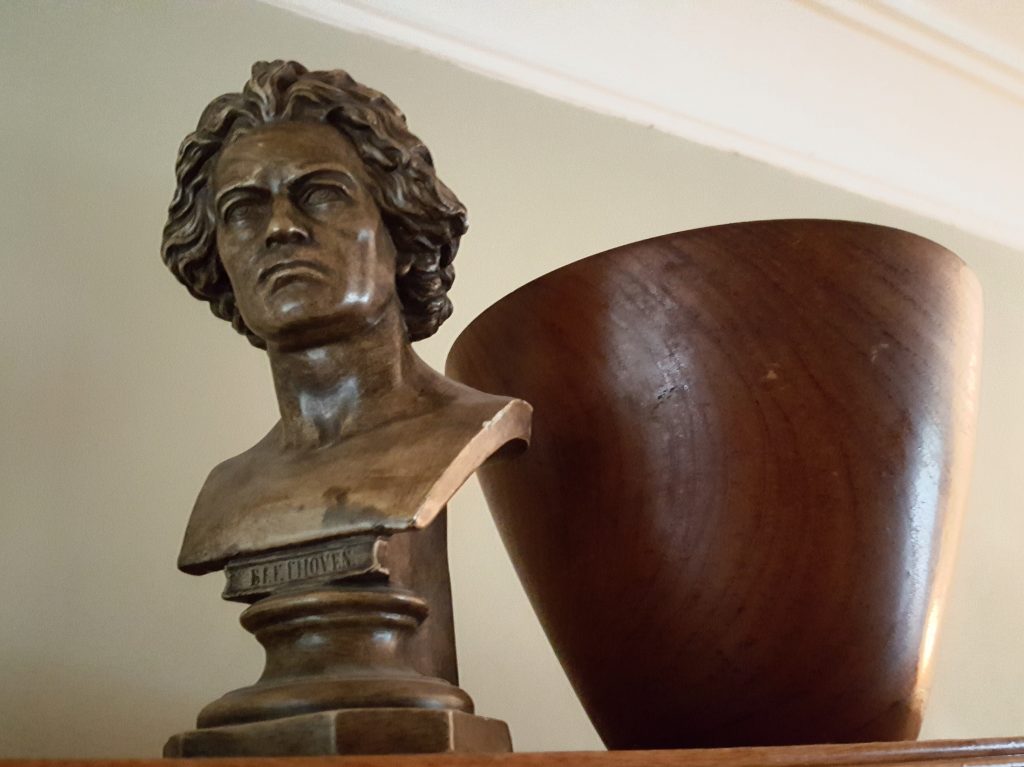
Out in my unfinished garage where I have amassed a mound of old, damaged furniture and broken objects waiting for pick up, I found a windshield propped against the wall. I have no idea what it was for or why it is there, but I know it was something my father must have picked up and forgotten. I’m surprised how much of him I couldn’t part with after his death—his Russian literature, a bust of Beethoven, a grandfather clock—all tangible reminders of a man who was so elusive, so hard to know.

Of my mother, there are few objects I wanted to bring home but her presence permeates so much of my life. Especially the one I tried to live in her image. As a girl and woman. Packing up children’s clothing for donation I find the beautiful outfits she crafted for her precious granddaughter—lined coats, fancy dresses—her attentions to Ginny’s wardrobe becoming ever more feminine as I, her only daughter, transitioned to male. I also unearth all the outfits I myself made for both my children in their early years when I was still determined to play the part birth had granted me. A part that, ultimately, has nothing to do with gender at all. I truly enjoyed creating beautiful things for my children. It just didn’t alter the sense that I wasn’t female.

And so, this house is also haunted by ghosts of myself, the selves I wanted to be, the self I became while living here. The self I still don’t know what to do with. I haven’t even uncovered the boxes filled with all my childhood photographs or angst-ridden adolescent writing. But documents with my old names, once-treasured possessions, and even a wedding dress have been revealed. Some will be retained, others hastily stuffed in bags and carted off to Goodwill.

Then last night, another more recent, unresolved ghost emerged. In a closet I found a manual from a leadership workshop I took a number of years back. At that time I was confident, more secure in my sense of self than I would ever be. My transition, in my mind, was complete and a success. But within a few years, my brief, yet promising, career in not-for-profit management would be destroyed by circumstance and my own mental illness. A loss I still have not come to terms with and yet it seems like something that belonged to another person. As if my life has just been a series of reincarnations that seem to leave me no wiser or further ahead.

And no more certain who I am.

And then there is my own addiction: books. Spread through three rooms, with most shelves double stacked, I shudder to think how many boxes there will be. No mercy for old magazines and outdated textbooks. They are bound for the recycling bin. But every time I scan my bookcases to collect charity sale donations, my decisions about what to hold on to shift. My anthropology and ecology texts are now gone, but my philosophy, classics and ancient Near Eastern history volumes remain. I notice that so many of the books I bought during my years of bookstore employment in the early 80s are still valued, even if I didn’t appreciate some for decades after purchase, whereas the literary bestsellers I devoured in my thirties and forties have been, and are, regularly pruned and sent off to new homes. Some of the obsessive tangents reflected in my collection are held dear, others are an embarrassment.

The books we read, and perhaps even more tellingly, the books we buy with the intention to read them, reveal a lot about who we are, who we want to be, and who we want others to imagine we are. More ghosts in our own lives.

And I suppose moving is one more opportunity to encounter, reshape, and even resolve a few of those ghosts—our own and those of others whom time, distance, or death have taken away.

Maybe even grieve.

To sing the song unsung: A personal answer to Singed by Daniela Cascella

The voice soundless and then, records unheard, song unsung, voice also unsung
dipped enshrouded ensheathed enlandscaped tongueless tongueless tied no story no record.

Daniela Cascella is a literary ecstatic. She engages with the word—written, spoken, sung, depicted—at an essential point of being, at that place where the spirit, soul, or daimon resides.

She listens into the silences, to the whispers and echoes, to the frayed edges of meaning. As a native Italian who writes in English, she attends to the spaces between languages, bending and folding her adopted tongue to affect fractured layers of intent. To open yourself to reading her is to be challenged to read and write with a new sensitivity to sound, voice and significance.

If I sound like an enthusiast, I am. Daniela (if this was a review rather than an answer I would refer to her by her last name—I will honour her instead, as Brazil honours Clarice) has been a vital friend and mentor over the past year and half since I first came to know her. As an essayist, my primary goal is to reach toward an articulation of the ineffable, to give voice to an existence, not between languages, but between gendered experience in a way that gets closer to an expression of being as I understand it than the common dialogue surrounding trans identity allows. I have no idea if that is an attainable goal, but Daniela’s essays and meditations thrill, inspire and ignite me.

Inspire and ignite me.

Ignite.

Her latest book, Singed, takes its title from permutations of sing: sing, singed, sung. It opens with the account of a fire. A few months ago the room at the top of our house caught fire. A large number of books and cds were lost to the flames. I first read of these burned books from a PDF of the text. I responded with horror; I felt wrenched with every title. Returning to this accounting on the printed page a few weeks later, I sensed an exaltation, a calling forth, a rising to a challenge, a refrain to be reclaimed amidst the losses. And that is what Singed is. As Daniela sifts through the ashes and embers, sings through the ashes and embers, she calls forward precious voices—Clarice Lispector, Teresa of Ávila, Laura (Riding) Jackson, Elfriede Jelinek, Marlene van Niekerk, Isak Dinesen, Fleur Jaeggy, Ingeborg Bachmann and more—chanelling their words and their attempts to speak to otherness. Hers is a reading as inhabiting the spaces between words.  The observations she makes and questions she asks, hang in the air, inviting her reader to ponder the unspeakable and challenge the constraints placed on how we’ve been taught to read and to write.

Woven through her literary explorations, are reflections on music and art. These excursions help frame, and reframe, a multi-dimensional engagement with the written word. Hearing, seeing, and speaking are essential activities, as are silence, emptiness, and unfinished forms. A sigh, for example, Clarice’s in particular, which Cascella (at this moment, this feels like a review) first encounters listening to Lispector’s last recorded interview, inspires an intuitive and rhythmic engagement with the works of other writers, a series of echo and dub sessions on the page. The experience of reading and writing a review of Marlene van Niekerk’s The Swan Whisperer, a short tale in which a young student loses himself in his endeavour to transcribe the language of swans, leaves her spellbound, speechless and wordless, unable to write for months. Of that interlude she says:

Today I know that the silence I experienced was a deep working of the stuff that makes writing be. It was the encounter with the substance that eludes you and that causes such physical turmoil when you grasp it in other words, in words you read in a poem or hear in a song, and you recognize their subject as yours.

And the connections she draws when writing across languages are illuminating, especially for those of us who are unilingual. In an essay about Fleur Jaeggy’s as yet untranslated novel, Le statue d’acqua, Cascella writes:

Where did the spirit of the world hide that night its reservoir of dreamers?

The porous blank portions between the words in The Water Statues soak up Jaeggy’s discomfortable writing. They enfold the space of space, or as Gass wrote of Rilke’s Innerweltraum, the space made by Being’s breathing… Not just the space we call consciousness, but the space where we retire in order to avoid a feeling… These spaces are always palpable as though space were smoke, or the mountains of the heart where the last of the hamlet of feeling may be discerned. The blank spaces host echoes, speech where speech ends, the voices of ancestors. Jaeggy herself has acknowledged, in discussing herself hearing writing in between German and Italian, that German is the language of her dreams…

Voices and echoes, and echoes of voices.

Repetition of a refrain.

Call and answer.

If reading Daniela Cascella’s work—including her earlier books, En Abîme and F.M.R.L.— has nurtured in me an alertness to sound in language and imagery, and an awareness of voice, more explicitly a desire to voice what is known without words, Daniela, as a friend and fellow writer, has personally encouraged me to incorporate more photographs (or a photographic sensibility?) into the presentation of my writing—a process I am still just beginning to explore.

But take this image:

July, 2015, mid-winter in Cape Town. This is the Company’s Garden, with the iconic façade of Table Mountain looming in the background. On that white columned building in the distance, if you could see it, is a poster advertising William Kentridge’s multi-media installation, The Refusal of Time. That is the South African National Gallery and this is my last full day in the city. I made my way through the gallery in near isolation and as I passed into the room containing the Kentridge exhibit, the recorded rhythms of metronomes and bellows were triggered and seemed, in the moment, to be contained within this dark space where I experienced the entire presentation alone, surrounded by noise and images, free to wander and absorb the full sensory explosion unhindered. Later, as I explored the rest of the gallery, I realized that the sounds and rhythms of the exhibit resounded and echoed through the entire building, enhancing my sensory appreciation of every photograph, painting and artwork I saw. I cannot think back on that visit to the gallery without hearing and feeling, the steady cadence, the heartbeat, of The Refusal of Time.

But that’s not all, and this where I answer Daniela Cascella and Singed. When we first connected, we shared our mutual appreciation of Marlene van Niekerk—The Swan Whisperer and her monumental novel, Agaat. It is a trace of the latter work I carried with me during my stay in Cape Town. Every time I came into the bowl from my B&B in Sea Point and saw Table Mountain stretching out before me, I could not help but hear the awed voice of the young Agaat after a trip to the cape with her mistress: “I saw Table Mountain.”

I saw Table Mountain.

 That young girl’s voice echoed in my head. Agaat’s voice became my voice. The voice of a past part of myself.

I saw Table Mountain.

 That afternoon, I sat in the café in the Garden, with Kentridge’s metronomes and Agaat’s wonder punctuating every breath, and started to write. I was, I believed, at the beginning of a process of writing my way back through the year that had just passed, from the breaking point of a serious manic episode to the renewal of a sense of self identity and an clear understanding of the unfinished business of being differently gendered in the world. A neat, circular journey  that would, in the writing, lead to healing.

As if.

Life (and death) still held lessons I could not, in that moment, anticipate.

Today, the pen still hesitates on the page. Small forays have been made, but I am only beginning to learn to listen to the voices I am trying to transcribe, the voices of the selves I am and used to be—girl, woman, man.

Somewhere, in the distance, I am calling back the beat of the metronome and a child’s voice: I saw Table Mountain. That child is me. In Cape Town I believed I could rewind time, solstice to solstice, one year back to the day I left my job,  and move on from there.

No.

I need to go back farther. Back into my past and listen for that child’s voice, the child who had a feeling, but no words to express it. To gather what one can know in absence of language, to salvage words from the margins of memories. Attend to that distant silence.

So much has passed in the two and a half years since I took this photograph. I almost died, then both of my parents faded rapidly and were suddenly gone, and the friend who drew me to South Africa committed suicide.

Just when I thought I was ready to write, my life caught fire and burned for over a year. Now it is time to sift through the ashes and embers, re-enter the remembering, and embrace the discomfortable, pen to paper.

Singed by Daniela Cascella is published by Equus Press.

Ever tried. Ever failed. You know the drill. August 2017, the month that was.

As August draws to a close, and September opens, I have some thoughts about the pressures of prescribed reading and the complicated emotion of loss.

Joseph Schreiber 2017

At the outset of the month I pulled out a selection of potential books to choose from for Women in Translation month. I knew that with several review related reading projects underway I was unlikely to get to more than a few titles. I managed three: one of my must-reads (Carmen Boullosa’s Before), one that was somewhat disappointing (Kjersti A. Skomsvold’s The Faster I Walk, The Smaller I Am), and one late addition (Isabelle Eberhardt’s The Oblivion Seekers). However, I found that many of the books I tried to pick up did not work at all for me— that is, they were not right for right now. Feeling that I ought to try to manage one more before the month was out I found myself frozen, almost unable to read anything… I had to stop and remind myself what such reading projects are all about.

Raising the awareness of the fact that fewer female writers are translated is important, as is celebrating the terrific authors who may not be well known. It never hurts to look at one’s reading habits and challenge one’s self. But it is another thing to get stressed and defensive. And that is what happens when I start to measure my reading by gender. I will admit, more male than female authors line my shelves. I have addressed this fact before in other posts. I also wrote about how for the better part of two decades I read almost exclusively female writers in an essay for Literary Hub last year. For a long time, I hoped that by filling my head with female voices I would find my own. And, of course, I never did. The sense of myself as male was unassailable. Seventeen years ago I set off on a course to realign my presented and internal gender. And here I am.

At this point, I like to think that the gender of the authors I read is secondary, although I will admit to a growing need to connect with gender-queered and gender non-conforming perspectives. Most specifically I am drawn to writing that is challenging, exploring style and form. In recent months, some of those writers have, in fact, been women in translation—Fleur Jaeggy, Can Xue, Marie Ndiaye. Before next August rolls around again I am certain there will be more. And I know for a fact I will be turning to some intriguing experimental female writers writing in English. But, as a person with a differently gendered history, gender is a complicated, messy space of being. Whenever I start to feel the burden of gender pressing on me from the outside, the existential anxiety (and anger) that haunts me is stirred.

So, let me read—as and how I need to read.

But my own self-imposed reading ambitions are not the only pressures that have weighed on me this past month. My brothers and I listed our parents’ house and it sold within one week. With the possession date looming we made several trips to clear the house out and, on the final visit, I found my mother’s nail file. She carried this file with its ivory coloured handle and tattered red plastic sheath for decades. Just looking at it I see her hands. It is perhaps the single most important keepsake I have. More than anything it reminds that she is well and truly gone.

When I first came out to my mother, back when transgender was just beginning to draw some serious public attention, she asked for some time to process what I had shared, but promised that she loved me unconditionally. And she never let me down. She was my advocate, my best friend, the one person I could call for comfort and reassurance, no matter what. I was otherwise alone. There were no local supports, I faced the challenges of being a single male parent of two children with learning disabilities, I experienced a breakdown, the loss of a career, and a life-threatening health crisis. Even though she was unable to travel far near the end, she phoned me every week without fail, and I spent as much time as I could with her and my father in their final months.

When my parents died last year, my mother’s death opened an intangible void.

My parents’ house. Our last day there.

I did, however, still have one faint, yet vital lifeline—a friend in South Africa, the closest queer friend I have ever had. Bookish and bipolar, like me, she was a sort of soul mate even though we only met in person once when I visited her in 2015. But as I was tumbling, she was falling further and farther. One year ago today, September 1, Ulla took her own life. Images of the rugged Indian Ocean shoreline near her home have been seeping into my dreams. As we spread our parents’ ashes before leaving their property for the last time, all I could think of was Ulla’s being spread on the beach. I couldn’t touch the urn. My son spread my share.

Eastern Cape, South Africa

Suddenly I am doubly aware of how alone I am. How alone I have been and how weary I am.

The intersection of Pride Week, rather than providing a distraction, exacerbates the sense of loss. I cannot imagine anything lonelier than a mass of shiny happy people. I did excuse myself from the volunteer commitments I had made and now I am free to avoid the parade as I usually do. I also happened to have a doctor’s appointment so I spoke to him about my recent depressive dips and my frustration with the reality of long-term trans loneliness that nobody talks about, that isn’t fashionable, that doesn’t fit the script.

Sometimes loss feels less like a temporary passage, than a layering, compounded, defining quality of life.

Welcome to my closed space reality:

All of old. Nothing else ever. Ever tried. Ever failed. No matter. Try again. Fail again. Fail better.

And so on.

Note: I should have included a link to the requiem I wrote for my friend. This piece was published at Sultan’s Seal last November, is constructed of salvaged language, and features photographs from my visit to South Africa.

Looking back in anger: A personal reflection on World Bipolar Day

You might as well haul up
This wave’s green peak on wire
To prevent fall, or anchor the fluent air
In quartz, as crack your skull to keep
These two most perishable lovers from the touch
That will kindle angels’ envy, scorch and drop
Their fond hearts charred as any match.

Seek no stony camera-eye to fix
The passing dazzle of each face
In black and white, or put on ice
Mouth’s instant flare for future looks;
Stars shoot their petals, and suns run to seed,
However you may sweat to hold such darling wrecks
Hived like honey in your head.

—from Sylvia Plath, “Epitaph for Flower and Fire”

I have known mania, and the imagery in this poem sparks with an intensity that excites and disturbs. When I encounter the words of one of the many poets known (or thought) to share (or have shared) the same affliction, I often find an undercurrent that causes me to flinch for just a second. Not that it diminishes the beauty or power of their words in any way—it is rather an echo in the dark, a faint recognition flashing by.

Image copyright Joseph Schreiber, 2012

It is World Bipolar Day, and this is the first time I have stopped to recognize the fact. I have spoken in, and around, my own bipolar diagnosis, but I have never addressed it formally in my writing. Even now I find myself uncomfortable discussing it. On the one hand, I am fortunate. I respond well to medication. I am, to use that distasteful term, “high-functioning.” But I do harbor a deep anger toward this condition that was part of my life many years before I finally careened through a brutal month of manic psychosis and found myself committed, and ultimately diagnosed, at the age of 36. I was, in classic bipolar fashion, the last person to suspect that I had a mental illness. Even though I, and those around me, knew something was terribly wrong, the stigma and lack of understanding around mood disorders—not to mention the radically impaired insight the sufferer has when they are ill—stands as a barrier to timely intervention. And then there is the matter of actually accessing care. One almost has to crash completely—by which time it can be too late.

Between my first manic episode in 1997 and the second in 2014, I experienced more than sixteen years of stability. I transitioned, became a single male parent, built a career out of nothing, and eventually became the Program Manager at an agency dedicated to working with survivors of acquired brain injury. I loved my job. Looking back, I can now see how the last few years of that period were marked by an increasing tendency toward hypomania. With my psychiatrist’s support I cut my medication back. And then things started to fall apart at work—things beyond my control, but it fell to me to try to pull things together. Then I started to fall apart at work, until I spiraled into full blown mania. Not psychotic, but it matters little. The damage was done.

The agency I worked for, dedicated as they are to supporting clients with disabilities including co-morbid mental illnesses, treated me with distrust bordering on contempt. My only contact with them has been conducted through a workplace advocate and my insurance worker. When return to work was discussed they refused to consider any possibility that I could work there again. Almost three years later with long term disability finally at an end, they still have my personal belongings.

Nine years of employment and dedication to that job now stand as a gaping hole in my life—a life already filled with gaping holes. And that is one of the reasons I hesitate to talk about mental illness (although I have never hidden my diagnosis). What can I say? Bipolar is not my identity any more than transgender is. Both fuck up your life. Leave wounds that do not heal. Find you fumbling through mid-life with little to show for your years but a lot of things you can’t talk about. And periods of time you cannot even remember.

So this is why I find it hard to write about my experience with mental illness. There was a time, following my diagnosis, that I devoured everything I could find, just as, a year later I hunted for books on gender identity. Two pieces of a puzzle I had inhabited—the periodic mood swings and the persistent, life-long feeling that I was not the female person everyone else knew me to be—had finally fallen into place. I had two, if you wish to be specific, explanations that come neatly labelled and defined within the covers of the DSM. It was, for a while, a source of relief.

Today I rarely read any literature that deals with mental illness or gender. But I am aware, more than ever, of being doubly stigmatized. And, most painfully, within the spaces where you would expect acceptance—in the human services profession and within the queer community. Thus the anger.

And what is this anger? Grief. The deep griefs I carry, layered now with more recent bereavements. It has become, for me, an existential bitterness that plagues me, an inauthenticity that defines the way I intersect with the world.

The legacy of mental illness is this: after diagnosis I was advised not to dwell on the disease, not to talk to others with bipolar; I was not deemed “sick” enough to warrant outpatient support or psychiatric follow up. I was left, like so many others, to flounder in the dark. It would take seventeen years and a spectacular career-destroying crash before I was able to access proper psychiatric and psychological support. I am still lucky. I am stabilized. And the forced detour into what may become an early semi-retirement has afforded me a space to write.

Now I need to find a way to write my way through this weight of grief. And begin to heal.

I’ll leave the last word to Sylvia Plath, with the final (fifth) stanza of the poem quoted above:

Dawn snuffs out star’s spent wick,
Even as love’s dear fools cry evergreen,
And a languor of wax congeals the vein
No matter how fiercely lit; staunch contracts break
And recoil in the altering light: the radiant limb
Blows ash in each lover’s eye; the ardent look
Blackens flesh to bone and devours them.

—You can find out more about the International Bipolar Foundation here, and a prose poem I wrote to honour a dear friend who lost her desperate and brave battle to bipolar last year can be found here.

Literature as Liberator: My contribution to the 2016-17 Seagull Books catalogue

Earlier this year I was invited by Naveen Kishore, the publisher of Seagull Books, to write a contribution for their 2016-2017 catalogue. Now the Seagull catalogue is never an ordinary publication. It is a lavishly illustrated volume featuring the stunning artwork of Sunandini Banerjee, and contributions from a wide range of writers, translators, and this year, a handful of humble book bloggers, myself included. When I agreed to try to put something together, Naveen sent me this year’s “Provocation”:

Soul he said. Soul as the prison of the body. Soul I asked? What about the ones who don’t believe? In soul. Or God. Or religion. The ones that understand the body for what it is. Accept its one-way journey towards the inevitable. The body as decay. Gradual ruin. Eventual crumbling. We all know this. Or those that think the ‘inner core’, or what I presume is a ‘substitute’ for the notion of ‘soul’, is actually just an ever changing, evolving, fermenting mass of literature that grows. And grows. And knows freedom. And fear. And emotion. And love. And death. And every kind of existential angst that any soul worth its weight in gold would know! What about me? I asked. Or you for that matter. We who write and read and write and continue to both read and write while our bodies grow old and tired. But the mind. The mind remains in a state of excitement. Constantly radiant. Its brilliance grows with every new thought. What if we substitute ‘literature’ for ‘soul’ in your proud statement so that it now reads ‘Literature as the prison of the body’. Thing is that this doesn’t hold. Literature cannot be a space that restricts movement. Or freedom. At least it shouldn’t be. It is meant to be a liberating presence. Like its close companion. The dark. For me the dark is important. The dark as a substitute for soul? Maybe. Darkness is essential for literature of meaning to grow and take root.

The body. The soul. Literature.

2016-11-09-17-33-54I knew immediately what I would write. I took themes that were spinning through my head, scratched out on notepads—unformed, but increasingly urgent ideas that I wanted to find a way to address in words—and placed them within the framework of an analogy I have long used to describe my experience of feeling that I did not belong in the body I was born in. This piece represents the first creative expression of the self, of my self, that I dared to offer for publication. Although I had addressed my gender-different history, my queerness, in the occasional blog post and review, I had never sought to open some of the deeper elements of being that have come to define—and trouble—my long-term experience of living in the world as a gay transgender man.

2016-11-09-17-28-08In the meantime, between writing and submitting my Seagull “response” and finally holding the published catalogue in my hands earlier this month, I published two critical pieces of writing. Your Body Will Betray You (Minor Literature[s] May 6, 2016) explores the body and being, while A Reader’s Journey Through Transition (Literary Hub October 25, 2016) takes a look at the urgency with which I attempted to read myself to a place of self understanding. I’m proud of both of these essays, but I must confess, there is a certain weariness that comes with writing so honestly about oneself, not to mention a creeping discomfort with being laid bare, as such. This is a reflection of my ongoing personal struggle with the value and efficacy of being out, and with the inevitable fatigue that comes with constantly having to come out, again and again.

If I had thought writing myself out in the world would help, I’m not sure it has. But then again, we are constantly reading and writing ourselves into being. It is a process, not an end. Like transition.

So, after a little consideration, I’m ready to reproduce my Seagull Books contribution here. Rest assured this is not an excuse not to request a copy of this amazing catalogue for yourself. A Seagull Books catalogue is a work of art and celebration of literature.

The seeds of both of my later essays are evident in the following parable, but this piece attempts to articulate my own experience of feeling “wrongly gendered.” You will note that it is not a question of outward expression—being differently gendered, as I know it, comes from inside, not from wanting to play with the toys or wear the clothing of the other “sex.”

Here, then is my contribution to the 2016-17 Seagull Catalogue, with endless gratitude to Naveen Kishore:

Literature as liberator, you suggest.

I am, I want to reply, inclined to agree.

But I would caution you that words can confine us, as readily as they can set us free. We can become entangled in meanings, lose ourselves in definitions, search in circles for explanations when all we know is that the words we hear don’t seem touch the heart of what or whom we seem to be. False trails can mislead, lead away from understanding, especially if the destination you seek is not marked on any of the maps you can find. You wander blind.

And, you speak of the transience of the body, its trajectory toward decline, deterioration and decay.

I would argue the body cannot be so easily discarded.

Let me reframe the imagery.

Accept, for the sake of argument that the body is the fragile housing of the mind and the mind is the intersection of the heart and the brain; and, as such, both are essential to the experience of being in the world. The soul then, or that spark by which we know we are alive, can be thought of as being-in-motion. And literature—the stories we tell, the stories we turn to—is an essential element of the process of understanding ourselves in the world.

We are reading and writing ourselves into being.  Always.

Let me tell you a story.

Imagine, for moment, a darkened room. The sole illumination is a candle burning against the insistent gloom.

A boy inhabits this space; it is the only space he has ever known. And he has known, for almost as long as he can remember that everyone he encounters, every person who stands at the threshold and beckons, is expecting someone else, someone he can only pretend to be. He decorates his room, he carries his candle into the corners to try to understand what secrets they might contain, he worries that his insecurities might be exposed. But, of course, it’s dark, and others tend to see only what they want to see.

As the boy grows, his room becomes a more distorted, distressing, disorienting place. He wonders what lessons he missed, why he is unable to learn to exist comfortably in this strange space.

He assumes he is at fault.

If only his candle burned brighter. If only his room was not so dark.

He continues to decorate and redecorate his room. He scours the books that line the shelves, listens to the music that fills the hollows. Somewhere, somewhere far away he senses there is an answer to his otherness but its truth escapes him. He seems to fall off the axis the wrong way. So he puts away the stories of his childhood, the ones he tried to emulate with his own tales of ordinary boys on heroic journeys to fight dragons, and tries to draw a new character, the one he is supposed to be. If he can tell this character’s story, find her voice, perhaps he can write himself into the woman everyone else anticipates, the woman everyone else sees.

But he cannot find the voice.

He puts down his pen, files the unfinished stories and poems. Or throws them away.

He goes to university. He reads more books. The unease intensifies, the books can only take him so far—he continually reaches a place where the road ends, where the bridge is washed out, where the trail fades away into the underbrush. And then he falls in love. If he can’t fix the persistent otherness, perhaps he can hide—in plain sight.

The years pass. And still his room is an alien space.

He plays by every rule he can imagine. Marriage. Children.

Until, one day, he finds a book. It’s not the answer, but it shatters something deep within, it whispers in the darkness, and the candle flickers briefly. So he reads more. He encounters words that catch him up, that lead him on. He reads more. The words, the words threaten to tear apart his world. He tries on stories; wonders if they fit, if they’ll finally help him understand the room that has, over the years, come to feel more like a prison than a body.

He longs to make his way home to a place he’s never been.

He reads more.

And at last he comes to understand that the only way to make sense of himself in the world—to touch the centre of his very own being-in-motion—is not to deny the man inside but to renovate the room. To step out of the shadows and acknowledge the person he has always been, celebrate him and let him live. The candle still burns, but the room is now bathed in natural light.

So yes, literature can illuminate the corners, crack the walls, break down the door to bring the essential being—the soul, if you like—into the light.

I know this in my bones. The story I just told you is mine.