“Ask the light to be clement”: Portrait Tales by Jean Frémon

This book arrived unannounced. An author unfamiliar to me, but on the very first page ten previous titles are listed, complete with translator and publisher. Then, on the title page, a personalized salutation from the author himself and the explanation of how this lovely little book found its way to me—the name of the translator: John Taylor. Over the years, through John’s translations, I have come to know of a number of writers and poets who have quickly become indispensable additions to my library. And now, another.
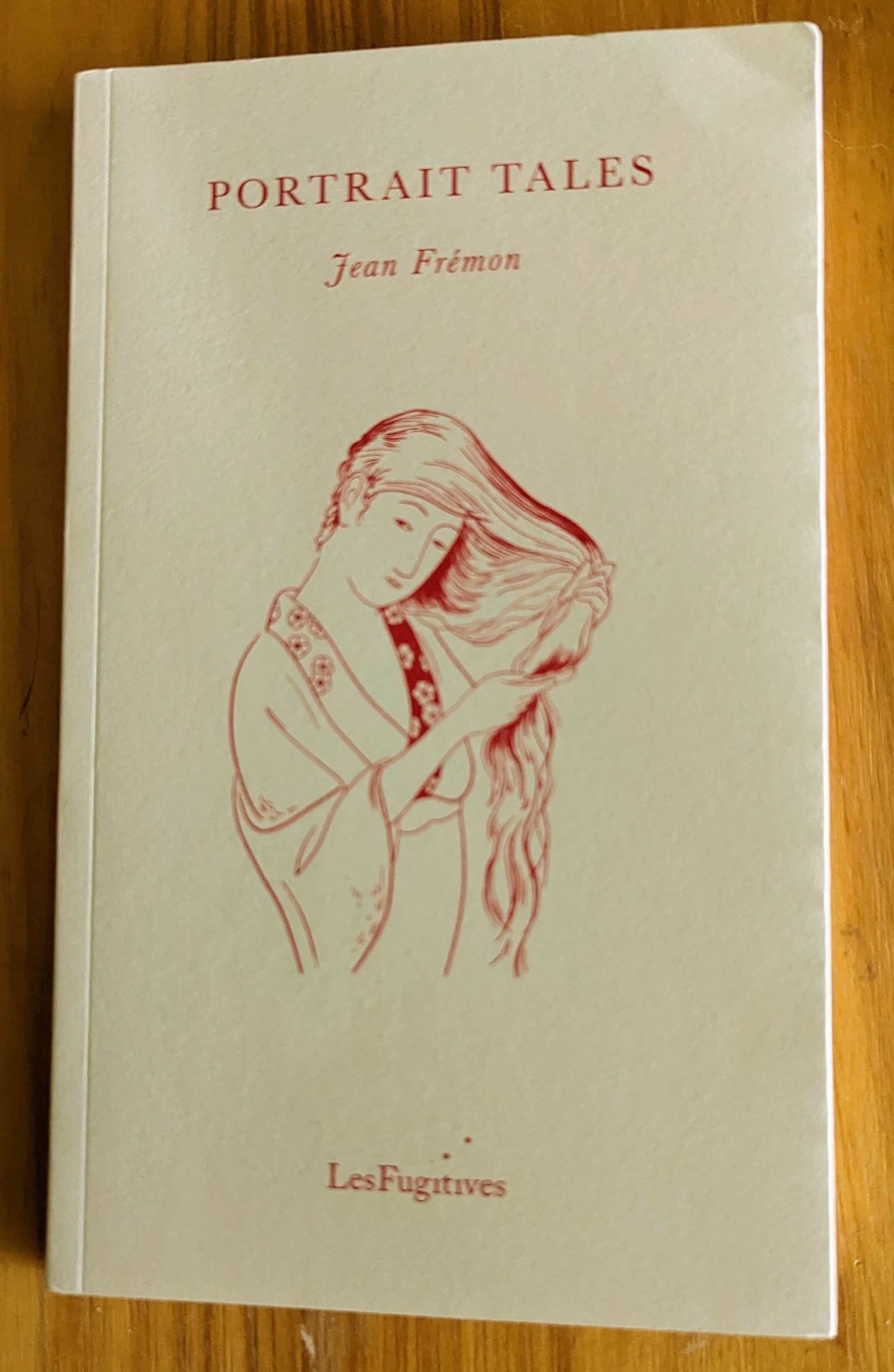
Jean Frémon is French author who, in the words of the publisher of this volume, Les Fugitives, “has been contributing to a trans-genre tendency in contemporary French letters since 1969.” By day, he is the president of Galerie Lelong, by night a prolific writer of poetry, fiction and essays on art, or, quite often, work that blends all three forms. He has published over twenty books in France and the present text, Portrait Tales is a selection of narratives on portraiture originally published in his 2020 book Le miroir magique. His tales explore well-known and little-known works and artists alike, and demonstrate Frémon’s extensive knowledge and deep appreciation of art whether he is playfully fictionalizing his subject or examining artistic techniques or revealing the historical consequences faced by those who allowed their likenesses to be captured against religious or cultural mores.

These short narratives cover a wide range of subjects. He begins with Lucian Freud’s singular, and less than flattering, portrait of Queen Elizabeth II, travels back in time and across the world to close with a remembered conversation with Louise Bourgeois, the only artist to appear twice and someone he worked closely with as a gallerist. In between—although reading the pieces in order is not prescribed, freedom of movement as in an actual gallery is encouraged—we are invited to learn about an Indian ambassador who paid the ultimate price for allowing Élisabeth Vigée-Lebrun to paint his portrait in defiance of Koranic law and entertain a meditation on the legendary impossibility of rendering a likeness of a young Jewish prophet named Jesus.

We travel back to Imperial China and Japan, to trace changes to ideas and styles of portraiture and conventions about what can or cannot be captured.  Meanwhile in Europe, a number of factual or elaborated tales unfold. Frémon details, for example, the obsessiveness of Maurice Quentin de la Tour who worried his pastel portraits into being and the revenge of a young sculptor who becomes enamoured with the woman he is commissioned to portray.  One of the shortest and most charming essays, is a sketch of the life and remarkable art of seventeenth-century Italian painter Sofonisba Anguissola:

Having withdrawn to Palermo, Sofonisba continued to paint. There is a self-portrait of her at age seventy-five. She is sitting in an armchair, in a three-quarter profile, her arms on the armrests. A large white ruff surrounds her oval face, which she has not tried to make look younger; her cheeks are hollow, her lips thin and tight; two large folds surround her mouth; but the pose is dignified and her bearing is not without nobility.

Ever confident in her ability to capture life in her many noble subjects and in herself, Frémon closes his sketch with an account of her submission to another artist’s pencil, the young Van Dyk, when he visits her at the age of eighty-nine. Her only instruction to him: “Ask the light to be clement.” It almost feels like each of the artists, or artistic moments  Frémon considers here, is presented in a clement light. It is an intrinsic element of his tone.

Varied in spirit and style, every piece in this slim volume is a gem, enlightening and entertaining. As I was reading, I frequently found myself stopping to search the internet to find the portrait or artist in question, if such a record was available. That is a compliment, of course, not a criticism. A sign of a good book is, for me, one that sends a reader down the odd rabbit hole or two, expanding the experience of reading beyond the pages of the text.

Portrait Tales by Jean Frémon is translated from the French by John Taylor and published by Les Fugitives.

Holding the fort: The Stronghold by Dino Buzzati

Fortezza Bastiani was neither imposing with its low walls nor beautiful in any way. Its towers and ramparts weren’t picturesque. Absolutely nothing alleviated its starkness or recalled the sweet things of life. Yet Drogo gazed at it, hypnotized as on the previous night from the base of the gorge. And an inexplicable ardor penetrated his heart.

As newly commissioned officer Giovani Drogo makes his way to the mysterious fortress on the mountainous northern border of his homeland, he is unable to imagine what lies ahead. When he chances upon Captain Ortiz who is heading in the same direction, he is surprised to hear that the older man has already spent eighteen years at the Fortezza, and speaks of it in less than glowing terms. And yet, as the structure finally comes into view, the young lieutenant is struck by a strange attraction. He also notices, in the captain’s face, a curious mix of joy and sadness. The complicated motion he observes on this day, is one he too will succumb to.

The Stronghold, the best known work by Italian journalist and writer Dino Buzzati (1906–1972), is a tragic tale of how easily youthful ambition and dreams of glory can be lost to the slow erosion of time. Travelling a fine line between the realistic and the fantastic, this novel is a slow, steady march toward an ending as inevitable as it is unexpectedly unkind. When Drogo first arrives, he quickly learns that Fortezza Bastiani’s glory days are long gone. Young soldiers tend to volunteer simply because two years at this bleak outpost count for four, effectively jumpstarting their military careers. But something’s wrong. Drogo did not volunteer, he was assigned. He argues that a mistake has been made, he requests a release from his commitment. His superior responds with apparent empathy, encouraging him to stay for a mere four months for appearances’ sake. Then something can be arranged, a visit to the fort’s doctor to receive a diagnosis that will assure his reassignment. Four months in, however, he will decide to stay. He will have fallen under the spell of the fortress, the towering mountain range that cradles it and its proximity to that vast unknown desert where an enemy may well lurk, preparing to strike. The possibility of glory is a powerful drug.

Through Drogo’s mind passed the memory of his city, an indistinct image—streets thunderous under the rain, plaster statues, dampness in barracks, dreary bells, faces weary and haggard, endless afternoons, attics dirty with dust.

Here, however, the vast mountain night was advancing, clouds in flight over the Fortezza, miraculous omens. From the north, from the invisible north behind the walls, Drogo felt that his own destiny was pressing.

Buzzati skillfully balances finely drawn scenes—Drogo’s first return to the city, the excitement and speculation when figures are perceived moving out of the distant mists of the frontier, or an ill-fated expedition to mark the boundary—against the passage of months and years and decades. An aching, sorrowful mood rests over the stark beauty of the harsh landscape that so captivates the men who dedicate their careers to this mostly forgotten frontier. And, as much as we know his fate is sealed, it is difficult not to feel for the young man with the confidence of a whole life ahead of him as he ultimately finds himself following the pattern of the other officers who spend their entire careers walking the halls and ramparts of the isolated fort, caught up in the swell of self-importance, routine, and vague purpose.

Originally published in 1940 as Il deserto dei Tartari, the novel was widely praised, relieving the doubts and insecurities that had dogged its author throughout the creative process. Although Buzzati was drawing on some of his own experiences covering conflict and inspired in part by his appreciation for Kafka’s The Castle, this work is not an explicitly political. The country is never named, nor is the neighboring land of desert. The enemy exists primarily in the minds of the soldiers. The questions it raises, the author suggests, about “hope and the life that passes fruitlessly” are existential in nature. Yet, when the first English translation by Stuart Hood appeared in 1952, the chosen title, The Tartar Steppe, encouraged readers to understand it in relation the Cold War and fear of the USSR. Meanwhile, in Italy, it would come to be seen as a critique of fascism. The novel’s openness to interpretation is indicative of its strength as a timeless and recognizable fable, one that can apply to both the personal and political.

This new translation by Lawrence Venuti—now with a title reflecting the original title the author wanted—attempts to allow for the historical interpretations without losing the humanist qualities earlier readers connected with. It also leaves intact some Italian greetings and terms, to situate the narrative in a particular culture and add a “political edge” in certain scenes. Otherwise, Venuti aims to adopt an English that would be accessible to a broad anglophone audience. His Afterword is quite illuminating, deepening an appreciation of Buzzati’s aims, this fine novel’s reception over the years and his approach to translation. It is one of two works by Buzzati recently added the New York Review of Books Classics catalogue.

The Stronghold by Dino Buzzati is translated from the Italian by Lawrence Venuti and published by NYRB Classics.

Remembering prewar Prague: House of the Nine Devils: Selected Bohemian Tales by Johannes Urzidil

This fine collection of stories by Prague native Johannes Urzidil, recently published in English translation by David Burnett, House of the Nine Devils, opens with—and takes its title from— a fantastic tale of a haunted house in the city’s Lesser Town that hides a dark mysterious past going back centuries. Although most of the stories that follow move away from this more explicitly gothic energy, they are filled with strange coincidences and unlikely adventures that lead their protagonists, all echoes of the author himself, into encounters that are coloured with the unique atmosphere of the capital of the Kingdom of Bohemia in the early twentieth century. As the narrator’s father story tells his son in the opening story:

“But this Prague, where you too were born, is an old city of magic. This is where the rabbis had their sorcerer’s apprentices and where the emperors kept their alchemists. Many things come together here — East and West, Jew and Christian, Czech and German, North and South — and where many essences converge, many wondrous, inconceivable things come to pass: things, words, characters and occurrences  that have never been seen before. It’s a breeding ground for spells and magic powers.”

And so it is. In the hands of a master storyteller, even a young boy can find himself encountering all kinds of unusual people and mysteries in this charmed city.

Johannes Urzidil (1896–1970) was the son of German nationalist and “passionate” railway official born in a rural part of western Bohemia, and a Jewish woman from Prague who died when he was just four years old. His father was a Catholic who never practiced his faith and believed in taking his son to various houses of worship to demonstrate that all religions were equal. Nonetheless, he insisted his boy practice Catholicism. His second wife, Johannes’ stepmother, was a staunch Czech nationalist, and their volatile marriage together Urzidil’s own fraught relationship with the woman he refers to as “ his step” adds much colour and humour to many of the stories collected here.

Urzidil published his first poems at age seventeen and began to associate with members of the so-called Prague Circle where he became friends with Kafka, Franz Werfel, Max Brod and others. In his Afterword, translator David Burnett, reports that he “had the honor of holding one of three funeral orations for Kafka in 1924, predicting his future fame.” Through the 1920s and early 30s, he worked as a translator and press attaché for the German Embassy while continuing to publish poetry, essays and criticism. He co-founded and managed the German Writers Union of Czechoslovakia until political tensions led to his resignation in 1933. By this time, despite his German background, his mother’s Jewish heritage and his marriage to the daughter of a rabbi, made it difficult for him to find work and, eventually, unsafe to remain in the city of his birth. He and his wife escaped in 1939, first to England, then to the US where they settled in New York City.

For Urzidil, fiction writing did not become a serious pursuit until later in life. His breakthrough work, The Last Beloved, a collection of autobiographical stories, was published in Munich in 1956 when he was sixty years-old.  His final decade of life, the 1960s, were very prolific. Of his seventy-odd stories, many blending elements of fiction, biography and essay, about a quarter were set in America, a handful in assorted European settings, but the majority of his best loved works take place in prewar Prague and Bohemia. It is from these stories across five German publications that the pieces in House of the Nine Devils are drawn. They are arranged in a roughly chronological order—by setting, not publication date—in an attempt to create a “more coherent whole” or a kind of fictional memoir, reflecting the degree to which Urzidil’s family and life experiences fed his writing.

Perhaps because he came to storytelling so late in life, Urzidil’s stories have the warmth and wry-humour of an older relative recounting tales of his youth, playing up the unexpected twists and turns. His narrators’ seemingly innocuous adventures—looking for a lost wallet, delivering messages, dropping in to visit with friends—put them in the paths of bored police officers late on New Year’s Eve, a fated opera singer, a suicidal railroad inspector, or a murderous fugitive. As he tells us in “The Last Tombola”:

People were always using me to drop things off. I was always running through streets and from floor to floor with notes, letters, and messages for other people. That’s pretty much my life. And whenever you have to drop something off, awful things always seem to happen.

This longer story begins with its young protagonist being charged to deliver a report to his father’s visiting superior with whom his family had dined the night before. He will soon learn that Herr Pernold has hung himself from his Grüss Gott suspenders, an event that sets off a richly complicated (and funny) tale of mystery, morality, concerns about renumeration, and ripe opportunities for humour at the boy’s step mother’s expense, something that first arises in the opening paragraph as the narrator notes that his delivery assignment will take him to The Imperial Hotel on Na Poříčí:

Na Poříčí is Czech for “on the riverbank,” which is fair enough for the Moldau flows nearby. Still, I had an instinctive aversion to this Prague street, its two chafing affricates reminding me of the sand-yellow paletot that hugged the hips of my stepmother around the time my father was courting her. I had witnessed this courtship and once heard her say, “It chafes me; I bought it on Na Poříčí.” “Good,” I remarked, because I felt this lady couldn’t be chafed enough. “Who asked you?” asked my father. “I asked me,” I answered. He was about to give me a royal smack in the face, which usually accompanied by the words, “When duty calls, feelings must be silent.” Yet this time he abstained from getting violent, not wanting to appear ungallant in front of the lady. He looked at me instead like Cronus before he ate his children.

This kind of sly, smart humour is one of the most wonderful features of Urzidil’s stories. And indicative of the relationship he, or rather his protagonist, has with his father with whom, for the cost of a slap in the face, he is allowed to voice what they both often think about his step’s moaning and complaining which only increase after the marriage. It is a recurring motif in many tales, one grounded in the author’s real life, as he reveals in the two, biographical essay-like pieces that round out the collection wherein he talks honestly about his beloved father and the difficult woman who became his second wife.

Prague in the first decade of the twentieth century is vividly evoked in so many of the tales in this collection, as are the social dynamics of the life of a lower middle-class family, the tensions that exist between Germans and Czechs, and the sense (at least to a young boy) that the Austro-Hungarian Empire is eternal. Then there are stories set during the First World War and, notably, “One Last Deed,” which depicts the dangerous environment in the city for men like Urzidil during Nazi occupation through an account that finds the protagonist taking refuge in the hovel of an eccentric former schoolmate.

The particular charm of Urzidil’s fiction lies in the warmth and charisma of his narrators, effortlessly spinning entertaining tales. Gathered together, the stories collected here do, as intended, read like a loose memoir recounted with a healthy measure of creative license. The boy, his railway official father, and his cantankerous stepmother provide the continuity. Like other natural story-tellers who regularly dip into the same well—perhaps a fictional community, or the life of a recurring alter ego—Urzidil has the ability to make each story feel fresh and unexpected. Hopefully more of his fiction will be translated in the future.

House of the Nine Devils: Selected Bohemian Tales by Johannes Urzidil is translated from the German by David Burnett and published in a handsome hardcover edition by Twisted Spoon Press.

The ties that bind and confine: Mothers and Truckers by Ivana Dobrakovová

Meet Svetlana, Ivana, Olivia, Lara, and Veronika, the protagonists who carry the five stories that comprise Slovak writer Ivana Dobrakovová’s collection, Mothers and Truckers. They are each, to a greater or lesser extent, caught up in the tangled webs of memories, failures and desires that occupy their thoughts and drive their actions, often to potentially counterproductive ends. Memorable and intense, these stories pull the reader into the interior lives of five very different, complicated, and not always likeable, women trying to navigate the expectations of family and society for better or worse.

Born in Bratislava in 1982, Dobrakovová studied English and French translation at Comenius University before moving to Italy where she works as a freelance translator of Italian into Slovak, notably of Elena Ferrante’s Neapolitan novels. The present collection, her third, was awarded the 2019 EU Prize for Literature and is her second work to be made available in English (following her novel, Bellevue which was, like this,  also published by Jantar in Julia and Peter Sherwood’s translation). Her stories here tend to be on the longer side—two are about 50 pages in length and one is almost 70—and clear or suggested mental instability is a common theme, one that reflects, she says, an interest arising from the fact that her husband and sister are both psychiatrists. It is a quality that lends the three central, longer stories a particular claustrophobic, compelling power.

“Ivana,” the near-novella length piece, offers the most explicit portrayal of the impact of serious mental illness with its tragic and endearing narrator, a thirty-one year old woman who lives with her mother. Ivana, in a sometimes disjointed and exuberant narrative, recounts her childhood love of horses and the long hours she spent at the stables to the cost of her education, all the while hinting at the horrifying trauma that marked the sharp shift in her personal destiny. In the meantime, she has met R., a journalist and local celebrity, through the one friend who has not long since abandoned her. This has given her a renewed interest in life, even if she risks threatening peace with her overbearing mother, this budding relationship largely bound to fantasy, and her own mental stability which is being carefully contained:

It’s taken my psychiatrist in Tehelná Street years to fine-tune my medication, to find the right level between my mood swings and make sure I was neither too subdued and slowed down or too hyper and upbeat, that I was under control, hers, Mum’s, my own, that I didn’t get so high that I would have to be dragged down to earth, or get so low that I would need to be helped back onto my enfeebled legs, in a word, so that I would be myself again, albeit within some sensible, clearly defined limits, myself but not too much myself.

Ivana has a wonderful sense of self-deprecating humour and, although she is pretending to be working on a novel and hiding the truth of her circumstances from R., she demonstrates a canny ability to vividly unfold what is ultimately a very painful story.

Olivia’s eponymous tale, the first of two stories set in Turin, presents a conflicted narrator obsessed with the news story of a teacher who was seduced by a young student to very unfortunate ends. She is also a teacher, albeit it one who was married and, in her own estimation, still attractive for her age. Surely she would not be so gullible. As her monologue proceeds, she reveals herself to be lonely, bitter and excessively paranoid about germs. As she tries to justify the situation in which she has found herself at the age of thirty-nine, she cannot quite accept the part she has played in her own life. And she prides herself in the fact that, unlike Gloria, the victim in the news reports, she is not living with—heaven forbid—her parents. Like all of the protagonists in Mothers and Truckers, relationships with parents, especially mothers, are fraught. Even though she has long been out of the house, Olivia’s mother still manages to intrude on her life almost daily, by phone, WhatsApp, Facebook, more so now that she is once again “single.”

Because my mother, by contrast, is present. Far too present, in fact. The usual story. She compensates. My mother spreads like mildew around the window. She devours everything that happens to find itself in her way. Overpowers it, supresses it. She’s everywhere. When I’m with her, it’s as if she was twice my size, with me being just a kind of external appendage  to her body that has never managed to cut itself off.

The third longer story, “Lara,” is also set in Turin, but her mother is dead and sorely missed. One has to wonder if her presence might have mediated what this unhappy, brutally self-centred mother of two has become. Lara’s internal monologue is perhaps the most exhausting and disturbing. She’s a complicated, damaged woman who questions her own mental functioning, but seems powerless to stop the very dangerous path she is on.

Together, the three central stories in the collection confirm Dobrakovová’s ability to inhabit distinct, multifaceted women caught in complicated predicaments that offer no easy resolution. The intensity of their internal monologues is fueled by a fluctuating style and form. At times, thoughts unwind in long sentences, strung together with commas while other passages feature short, staccato sentences. She also relies on a strong sense of space, her characters traverse the environments in which they live, in memory or in real time, in Slovakia or Turin, places she knows well. By contrast, “Father,” the opening story is a somewhat simpler tale of a man who largely neglects his family in pursuit of impossible, if relatively humble, dreams until alcohol and madness take a toll, but the final tale, “Veronika,” the only third person narrative, paints the portrait of a student who is embarking on a path that is bound to become difficult, even threatening, as she loses herself in chat room flirtations on the pretext of improving her French. As a whole, this volume is an immersive and intense reading experience.

Mothers and Truckers by Ivana Dobrakovová is translated from the Slovak by Julia and Peter Sherwood and published by Jantar Publishing.

“I have ghosts inside my head”: The Enlightenment of Katzuo Nakamatsu by Augusto Higa Oshiro

The feverish paragraph that extends across the first six pages of Augusto Higa Oshiro’s The Enlightenment of Katzuo Nakamatsu opens rather innocuously, with the titular character walking through the Parque de la Exposición in Lima, Peru on a pleasant afternoon. Suddenly the restrained and mild-mannered professor experiences a terrifying break with reality:

In the eternity of the instant, in a manner of speaking, the green of the afternoon flickered out, the park’s babbling was erased, as if the world had taken flight, the pebbled paths disappeared, no serene gardens, or laughing families, or murmuring young couples, or ponds full of fish: the only thing in the air now was the sakura tree, its branches and its luminous flowers. And in that fragment of afternoon, from that imperturbable beauty, Nakamatsu noticed, sprang a death drive, a vicious feeling, like the sakura were transmitting extinction, a shattering destruction.

The ominous atmosphere that descends on him triggers a panic attack that sends him raving through the streets of the city. Or perhaps he’s dreaming, it doesn’t matter, for his nightmare is only just beginning.

Not long after this first premonition of death, Nakamatsu finds that he has been forced to retire from his position at the university due to his age. He is fifty-eight. This leaves him with empty hours to fill as his anxieties and paranoia continue to grow. He returns to working on a novel based on the life of a friend of his father’s, Etsuko Untén, traces an endless network of named streets and alleys, and visits the cemetery where he pauses at the graves of his mother, father and his long dead wife. Self-exiled from his siblings and fellow members of the Japanese-Peruvian community, he seems to be engaged in a battle with his own Asian identity. Throughout his long days, he continually seeks to clear his mind of thoughts, exercise discipline over his imagination. When he doesn’t wish to go out, or watch TV, he crochets squares for a blanket that will never be finished, losing himself in the rhythms of the task. But hallucinations find him all the same.

They arrive as the sounds of birdsong and nature emanating from his bedroom. When he goes to investigate he finds himself surrounded by a chorus of song and babbling water so impossibly realistic that he is momentarily swept away:

It might have been a brief second, five minutes perhaps; in reality Nakamatsu, surprised, withdrawn into himself, couldn’t pinpoint exactly how long the happening lasted, the miracle occurred again and again over the next two weeks, intermittently, whether in the morning, in the afternoon, or at any hour of the night, and every time he was left astonished by that sensation of unusual beauty.

But astonishment eventually turns into uncertainty, and Nakamatsu begins to doubt his sanity. Soon he is back out seeking escape on the streets. At night he is troubled by horrific dreams, and as they intensify he grows increasingly despondent. And estranged. He purchases a felt hat, long coat and walking cane, affecting the 1940s style of both his father’s friend Utsén and his favourite poet, Martín Adán who had waged his own battles with alcohol and madness. Under this new guise, Nakamatsu’s wanderings become nocturnal and more torturous. He takes to hanging out in the dark corners of the city where prostitutes, addicts and homosexuals gather, always watching from the sidelines, engulfed by his own darkness, ever struggling to find a point of stillness.

This hypnotic novella moves with a steady, tumbling pace, intensifying as it traces the protagonist’s descent into madness. There is, at first, an odd uncertainty to the narrative, a speculative quality, that is explained when the narrator is revealed as a colleague of Nakamatsu’s who has taken upon himself to prepare this report. Because he is not exactly a friend, his account carries a slight tone of cynicism that only serves to heighten the crumbling state, mentally and physically, of a man who has long cut himself off from a natural support system, pursued and driven mad by the strangled ghosts of his father’s generation—the Japanese labourers who found themselves stranded in a distant hostile land where many managed to build lives and futures, but some never managed to adapt.

Born and raised in the working class centre of Lima in 1946, Higa Oshiro was the son of immigrants from Okinawa. His early writing was inspired by the neighbourhood in which he grew up, but after spending a year and a half doing factory work in Japan, he began to explore the experiences of the Japanese-Peruvian community, aliens in their New World home yet alienated from their ancestral land. The Enlightenment of Katzuo Nakamatsu, originally published in 2008, belongs to this latter period of his career and represents his first publication in English translation. Sadly, Higa Oshiro died on April 28, 2023, just two month shy of its May 30th release. Translator Jennifer Shyue’s Afterword describes her 2019 meeting with the author and his warm support and generosity so hopefully we can look forward to further translations of his work.

The Enlightenment of Katzuo Nakamatsu by Augusto Higa Oshiro is translated from the Spanish by Jennifer Shyue and published by Archipelago Books.

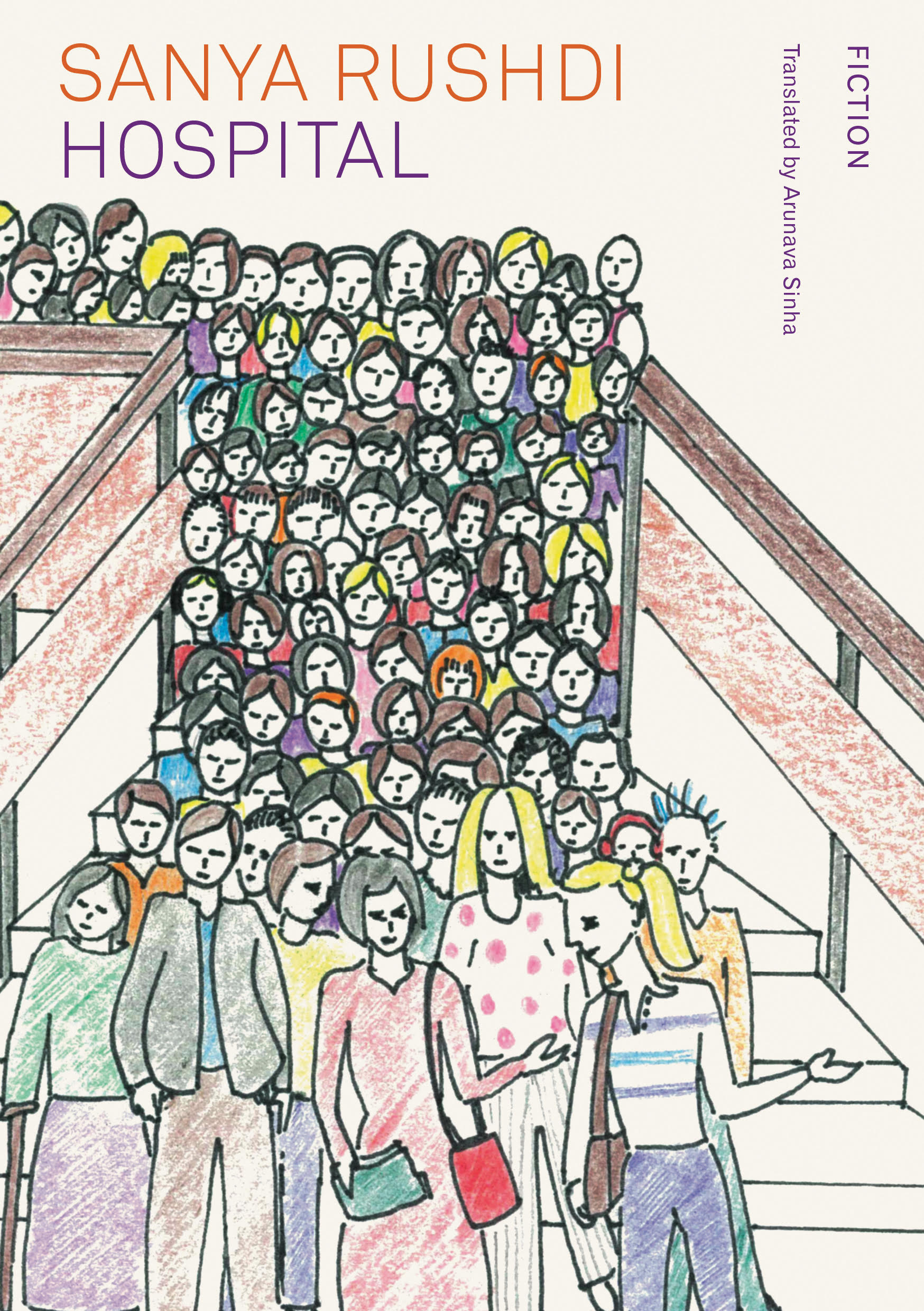
The boundary between the psychiatric ward and the real world: Hospital by Sanya Rushdi

But why have we turned to the right? That’s where the psychiatric ward is. Of course, there must be examples in history of those who, in an effort to protect their non-mainstream alternative thinking, pretended to be who they were not in order to shield themselves from politics. This may be a similar arrangement. Even as I’m wondering about this, a wheelchair emerges from somewhere and I am told to sit in it. I refuse, saying I’d rather walk. They say if I don’t sit in it on my own, they will make me. So I sit.

Books and movies about mental illness and psychiatric wards frequently play to either the horror or mystique of madness, while language related to psychiatric conditions—bipolar, psychotic, schizophrenic—is often applied carelessly to describe a range of circumstances that have nothing to do with actual diagnoses. Around the world, the stigma of mental illness is difficult to shake. A heart attack will bring friends and family to your hospital bedside; a serious breakdown can leave you isolated and alone, at home or if you are sick enough, confined to a psychiatric unit. From the outside, a worse fate cannot be imagined but, in reality, once the shock of finding oneself hospitalized subsides, the world behind the locked doors tends to contain a community, at once strange and familiar, within which one can recover. Days pass with a certain routine that gradually returns structure to a life that has been temporarily, or periodically, upended, distorted, weighed down or wired up. Hospital, by Bangladeshi-Australian author Sanya Rushdi, takes you into that environment as seen through the eyes of a patient experiencing psychosis.

Based on real-life events, this debut novel is set in Melbourne, originally written in Bangla and translated by Arunava Sinha. Rushdi’s protagonist, is, like the author, a Muslim woman named Sanya. Years earlier, psychosis interrupted her PhD studies in Psychology. Now, with her third episode pointing to a diagnosis of schizophrenia, she finds herself at odds with her family, a community mental health team, and everyone who seems to be conspiring to force her to comply with the medical model of treatment that she distrusts. She acknowledges her past psychosis, but is unable understand that the curious coincidences, obsessive behaviour, and lurking paranoia might signal that she is sick again. That is the cruel nature of serious mental illness—what one experiences from the inside is increasingly at odds with what others observe from the outside. As her psychosis progresses, the world is simultaneously terrifying and brilliant, but Sanya resists all efforts to encourage her to access care willingly, so ultimately she arrives at the hospital under police escort.

Sanya’s narrative is restrained and oddly lacking in affect, even when she describes her tears and outbursts. She is continually trying to observe herself and logically reason her way through whatever arises. However, her reasoning is often disjointed and confused. She is constantly seeking symbols of significance, spends a lot of time trying to figure out the secrets behind the thoughts and actions of others, questions why certain song lyrics keep coming to mind, and fitfully attempts to draw strength from her faith. Rushdi’s ability to present this state of fractured association and allow her protagonist’s processing to slowly become more coherent as the story progresses is very impressive. Madness has a logic of its own as anyone who has experienced depression, mania or psychosis knows well.

Rushdi captures this shifting state of awareness by combining Sanya’s internal monologue, readings, and diary entries with the use of a dramatic format to capture external dialogue. This allows a record of what is said apart from what Sanya hears or wants to hear. It is also especially effective for reflecting the banter between the residents on the ward. On her first day in the hospital, one of the patients, an older man that Sanya describes as “so handsome,” exposes himself to her as she passes his room. Her self-appointed tour guides try to explain:

Michael: Please don’t be upset. He does these crazy things, but he has a beautiful heart. Give him a day or two and you’ll see what a lovely person he is.

Me: I’ve seen it already.

Glen and Michael laugh.

Glen: Yes, many of the girls are crazy about him.

Me: They need a reason to be here, after all.

Glen and Michael laugh again.

Initially, most of the men Sanya meets seem exceptionally attractive to her—a charged energy between the sexes is not uncommon on the unit. She becomes obsessed with a few of the male patients during her early weeks in the hospital, while other women barely register unless she senses that there might be something between one of them and a man she fancies. At such moments, jealous and conspiratorial thoughts immediately engulf her. At one point, when a doctor suggests she seems to be spending too much time following the male patients around, she becomes defensive. She will leave that session with another drug, lithium, added to her regime as a mood stabilizer and eventually these persistent passions will start to subside.

With her education in psychology and her prior experience with psychosis, Sanya feels she is in a good position to determine whether or not she is sick this time. She blames her family for sending her to the hospital and is resistant to drugs.  She argues that a particular type of language-focused talk therapy would be preferable, but, if she wants to be released, she knows that medication is part of the game. Convinced of the value of language, she pours her thoughts into her diary, filling pages with arguments that are, at the height of her psychosis, bound by incoherent and tenuous  connections. Reasoning and recognition are slow to return.

I read this book very slowly, although it is neither long nor difficult. But as someone who has been hospitalized for manic psychosis, I was impressed and sometimes shaken by Rushdi’s ability to draw on her own experience to craft such an uncanny portrait of psychosis from the inside. Her protagonist appears very logical and rational, and within her own inner construct she is, but from the outside, it is clear to her family and the medical personnel that she is unaware or unwilling to believe that she is ill. She lacks insight. It is almost like being separated from the rest of the world by a one way mirror. On her side, are her fellow patients who form among themselves a community, an island.  She remains convinced that language is the answer to her survival and recovery. And perhaps she has a point there, as Rushdi has demonstrated through her own use of language to create a work that is masterful, moving and tightly controlled.

Hospital by Sanya Rushdi is translated from the Bangla by Aruava Sinha and published by Seagull Books. In Australia, Hospital is published by Giramondo.

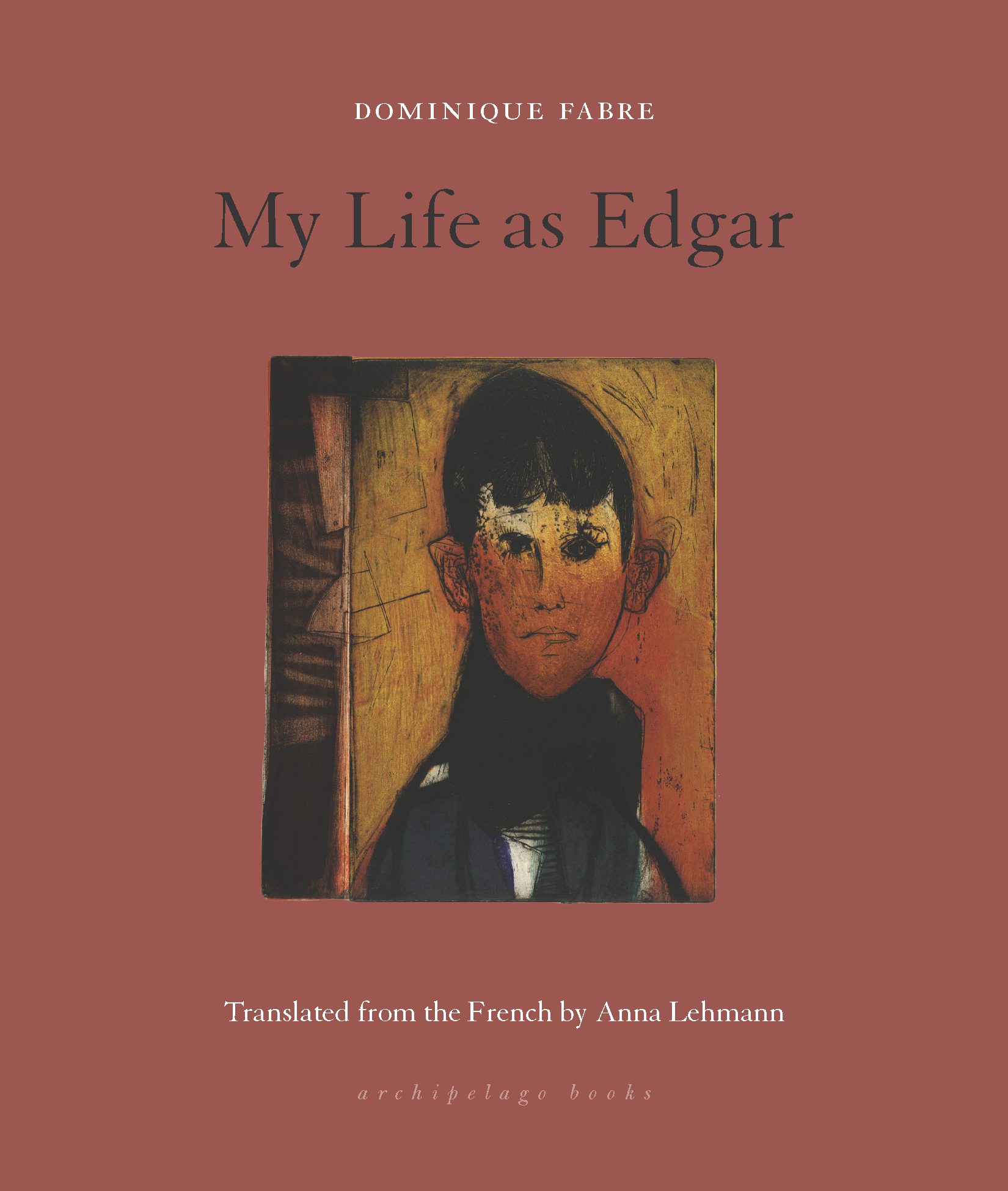
Not all there: My Life as Edgar by Dominique Fabre

With a child narrator it is always a challenge to strike the right note, the right balance of insight and innocence, but when the child in question has a developmental disability it can be even more difficult to create a believable, engaging voice. Or, as in Dominique Fabre’s My Life as Edgar, it can be an opportunity to present the world through an unusually sensitive, yet unfiltered lens. As is clear from the opening sentences, Edgar has a clear sense of what it is that sets him apart from others, even if he and those around him are never really certain just how far apart that truly is:

I was a quiet, unassuming child, but I had features of a kid with Down syndrome—a kind of coldness around the eyes, pale lips, big cheeks, a big butt, though my chromosomes weren’t really to blame. I could hear people around me say He’s not all there, is he? in soft voices, secretively, only I had ears, phenomenal ears, Micky Mouse was deaf compared to me, nature didn’t do me any favors, except for my ears.

When we first meet Edgar it is 1964, he is three going on four and living in Paris with his single mother, Isabelle. Life is pleasant. They go to the park, she takes him to visit a psychiatrist he is fond of, and when she goes to work he stays at a day home. But things start to change when a married man comes into his mother’s life. Suddenly his small world becomes a little uncomfortably crowded, perhaps too crowded. Before long, Edgar is sent to live with a foster family in Savoy. He will remain there for the next seven years, his care paid for by monthly cheque. He will talk to his mother on the phone weekly, write her letters, carefully copying the examples his caregiver prepares for him, and, on occasion, she will come to visit. But in a sense, out in the country he has more attention, freedom, responsibility and companionship than he had at home in Paris. He is even allowed to go to school. With Auntie Gina and Uncle Jos, and the other kids of unwed mothers who pass through their home, he has a second family and freedoms that urban life would never have afforded a young boy who is “not all there.”

On the surface, Edgar’s story is simple, but his telling of that story is neither simple, nor direct. The first section, recounting life in Paris with his mother, has a certain charm. He understands more of what is going on around him—or at least he appears to—and reports his observations and responses with a clarity that belies his age. However, this is a relatively focused period of his life that he may well have replayed in his mind many times over the years that he lived apart from his mother, because, with the second and longest section, the tone changes. Unfolding as an internal monologue addressed to his psychiatrist, Madame Clarisse Georges, he confesses: “I’m still not all there, but I know how to hide it well. I’m grown up now. I’m still quiet and unassuming too, but I’m not sure that won’t change.” He is eleven—a good year for him, he says—it is the year he will return to the city. But he admits that the years before that were also good, and he wants to talk about them. So he sets out to “dive into the past without remembering much actually.” And, sometimes, remembering too much.

As one might expect, Edgar’s efforts to fill in the gaps in his memory leads to a narrative that can be rather disjointed. He reports what comes to mind, moving back and forth in time, from event to event, often unaware of the larger context of what he sees and hears. His foster mother is of Italian descent, while his stepfather apparently doesn’t like Italians “even though he married one and she’s not the first, but I only know that because I let my ears listen.” Uncle Jos is a man who has chosen Stalingrad over the Catholic Church and works for the local municipality:

[H]e has road workers from the Department of Roads and Ditches who are all the time filling the holes of the world so it won’t spill over on all sides. Sometimes at night he goes out in his underwear, wearing his Damart thermals, when the roads collapse  and no one can get through.

His narrative is peppered with stock expressions seemingly incongruous with that of a young child, especially one who is supposedly “not all there.” He talks about his mother’s “dark and traumatized gaze” and accepts that he is the “village idiot.” He calls Italians Dagos and talks of cuckolds without understanding that the terms are being used in a derogatory fashion. His language absorbs and reflects the prejudices and politics of 1960s working class rural France.

As a narrator, Edgar has no filter. He tells what he remembers, the significant and the insignificant alike, from the quality of his bowel movements (especially after the weekly polenta dinner) to the excitement of the Revolution of 1968. What he reveals is often quite telling, even funny, but he his always very serious in his accounting. His is a monologue that invites one to read between the lines, revealing much about the society and the family units within which he exists. And his observations can be quite profound as when he describes his stepfather’s relationship with his adult son on a day when his own mother has come to visit:

They also fought about the Algerian war. I’d often heard the story since being here. Uncle Jos had tried to break Ricardo’s leg so he wouldn’t go back and help the French get killed over there in the colonies, but his leg had held up against the hammer blows, so Ricardo returned to Algeria covered in gauze and bandages. Since then, the two of them didn’t talk much. Me, if we had to go to war for independence, I think I’d go see Ricardo, not Uncle Jos. It feels weird, Madame Clarisse Georges, I’ll always know more about Uncle Jos and Auntie Gina than about Edgar and Isabelle, and all the rest. But today, in case you’re still alive and don’t mind listening to me, I’m like a separated Edgar, I’ve already lived a long time.

In the final section, Edgar, now eleven, returns to Paris and after a few weeks with his mother, is sent off to boarding school. He navigates the dynamics of this new environment for a while, but ultimately  will try to take control of his life in a world which has repeatedly pushed him off to the sidelines.

Dominique Fabre is a writer who is interested of illuminating the lives of people on the margins. This is a brave little book that I suspect may have missed the mark with some readers who fail to connect with narrator. Edgar, for all his concerns about the gaps in his memory, is an endearing child trying to tell his own story as best he can. In the process, he unwittingly tells a much larger tale about the lives of children whose parents are unable, or unwilling, to care for them, the systems in which they find themselves—day homes, boarding schools and foster families—and the value of consistency and support, wherever one may find it.

My Life as Edgar by Dominique Fabre is translated from the French by Anna Lehmann.

In the end, only the laughter remains: Austral by Carlos Fonseca

“Only someone who knows he is condemned can clearly see the path to salvation.”

Carlos Fonseca is a writer who delights in spinning complex webs that blend history, fiction and a distinct fondness for archival elements to create a framework within which important ideas and themes can be explored. As with his earlier works, Colonel Lagrimas and Natural History, his new novel Austral reaches across time and space to craft a unique literary environment complete with eccentric characters and grand schemes that gradually reveal the secret of their connections. But this time, the key to the puzzle the narrator is seeking to understand lies closer to home than he suspects when he is first drawn into this most unusual mystery.

Julio Gamboa’s world is unravelling when an unexpected summons arrives from his past. His distant past. The letter, postmarked in Argentina, bears an unfamiliar name, but the contents inform him that his friend Alicia—or Aliza as he had known her—Abravanel has died following a long illness that had, ultimately, left her almost entirely mute. However, as the letter writer, Olivia, assures him, she remained perfectly lucid to the very end. And, in passing, she entrusted a most important task to Julio, even though it had been more than thirty years since they last spoke or saw one another. An invitation to visit Aliza’s home in Humahuaca accompanies this curious missive and, with winter taking hold of Cincinnati and the future of his recently fractured marriage uncertain, Julio imagines not only a welcome reprieve, but a potential return.

Julio had met Aliza as a teenager in his native Costa Rica. To him she was exotic—a British girl bursting with poetry and stories of punk music who had run away from home at seventeen in pursuit of freedom and adventure. By contrast, he was cautious and uncertain, reluctantly committed to trying to meet his parents’ expectations that he pursue an academic future. Knowing that a scholarship awaited him, Julio and Aliza headed off on a last road trip up through Central America, finally ending in Guatemala during the volatile years of the early 1980s. That is where they parted ways, Julio leaving an angry and disappointed Aliza behind. Over the decades that followed, he moved to the US where he studied, got married and eventually settled into life as a professor of literature. Aliza, on the other hand, stayed in Latin America, changed the spelling of her name and began to write and publish novels in Spanish. When a stroke left her with a progressive form of aphasia, she moved to a commune in northern Argentina to try to complete the last installment of an ecologically themed tetralogy. But that goal had perhaps been too ambitious so her focus changed and she turned her attention to a new project. When she died, she left that manuscript with the explicit instruction that Julio was the only person who could edit it.

Upon his arrival in Humahuacha, he is given Aliza’s text—memoir or fiction, he is left to decide—and he begins to read a most remarkable account of Karl-Heinz von Mühlfeld, an anthropologist who travelled to Paraguay in the 1960s seeking the ruins of New Germany, the failed utopia founded in 1886 by Elisabeth Nietzsche, sister of Friedrich, and her eugenicist husband Bernhard Förster. But Karl-Heinz’s intended research takes a different turn when he meets Juvenal Suárez, the last surviving member of an indigenous tribe and only living speaker of the Nataibo language. Over several subsequent visits, the anthropologist’s efforts to record and preserve this soon-to-be-lost language increases while his sanity deteriorates. Aliza’s father comes into the picture a number of years later when he is invited to meet with the anthropologist in the Swiss sanitarium where he lives. He is inspired to carry the torch he believes the older man is attempting to pass him—a destructive path that left him ever changed but may have kindled his daughter’s attraction to Latin America.

As Julio makes his way into Aliza’s manuscript, titled A Private Language, he is impressed by the richness of the writing given the author’s declining ability to communicate while haunted by the notion that he is dealing with a work somehow composed in a “private key”—a text that “all could read but only one person could understand.” As her chosen reader, he feels that Aliza is offering him precious insight into the girl he once knew, but wonders what deeper message she might be sending him after all these years. Then, at a party, he learns of a companion piece she was working on, a dictionary of sorts. It is suggested that an indigenous man who visited the commune daily might know more. The following day, as Julio sets off by bus for Salinas Grande in search of this man, Raúl Sarapura, he is beset with his own linguistic anxieties:

Though he wouldn’t say so, he was bothered by that sense of foreignness that fell over him every time he came back to Latin America. That feeling of never really returning. An anxiety over belonging that occasionally even translated into grammatical errors and pronunciation mistakes, making him feel that little by little he was losing his language, and the last traces of his past along with it.

He returns bearing Dictionary of Loss, a notebook filled with almost child-like collages featuring images and entries with meanings, etymologies and commentaries for various words. If the key to understanding one text, and Aliza herself, lay in the other, and it was now Julio’s task to find the key to unlock the secret buried within this dual project.

Such a journey, of course, will lead Julio into a labyrinth lined with historical, philosophical and literary references, all somehow inextricable from his memories of his time with Aliza. But from his sofa back home in snowy Cincinnati, the logic connecting it all eludes him. Until he realizes that the roads he seems to be wandering down all lead to Guatemala, to the site of a village destroyed during the genocide, where a man he read about in the Dictionary, has constructed a memory theatre containing images, objects and recorded recollections—a space where fellow survivors of the war can honour their lost community and, through sharing memories, heal their trauma. Julio is certain that this is where he will find the answers he needs to complete the posthumous request his friend has made.

Austral is, clearly, a book about language, about the relationship of language—on an individual and societal level—to memory and legacy. It offers much to contemplate, but at the centre is the question of what can be done, in the face of the loss of language, to preserve the memory of a person or a people. Language does not exist in a vacuum, it needs to be spoken or read or committed to memory. Language is a link between the past and the future. A key image, repeated twice in the text, drawing on the work of Swiss linguist Ferdinand de Saussure (1857 – 1913) depicts a sketch of two rivers, one representing thought and the other representing language. The caption reads: “The trick, then, would be to learn to pass from one bank to the other without ceasing to speak.” For Saussure, language was a social phenomenon, in Austral the isolation of one speaker from a social network that has completely disappeared is mirrored by the potential loss of the ability of another speaker to navigate an existing system because the tools make that language possible have become inaccessible to her. But where an attempt to record a dictionary to preserve a dying language without a community fails, a dying speaker losing language is able to employ a community to reach an audience of one.

Fonseca, like his protagonist, is also from Costa Rica although he spent much of his adolescence in Puerto Rico, and Austral marks his first return to Central America in his writing. He notes in an interview that it meant a lot to finally feel comfortable “narrating from a region that I recognise as home but which I left long ago.” It may have taken three novels to get back there, but, having read and loved both of his previous works, I would suggest that this

is perhaps his strongest, most focused and most rewarding to date. Sometimes you can go home again.

Austral: A Novel by Carlos Fonseca is translated from the Spanish by Megan McDowell and published by Farrar, Straus & Giroux.

It’s raining light: Second Star and Other Reasons for Lingering by Philippe Delerm

In the waiting area, they’ve installed a piano. There’s one in each of the big Paris railway stations now, but you never know how that will go. In the Gare du Nord the other day, an older woman set her suitcase down beside her and then played, with great application, Jesu, Joy of Man’s Desiring before melting back into the crowd, aware that no one had stopped to listen. She left without looking around, suitcase in hand, a little smile on her lips, of annoyance or contentment.
(from “En Route Virtuosos”)

French writer Philippe Delerm is a thoughtful documentarian of the quotidian experience. His signature pieces, one or two pages long, zero in on the small details of familiar actions or activities. Some might be thought of as meditations, others like character sketches or vignettes, and yet others like prose poems. Each one welcomes the reader in, sometimes addressing “you” directly, to consider a task, interaction or activity with a degree of attention you might otherwise overlook or disregard. It takes a special talent, after all, to celebrate the special satisfaction of washing windows. But that’s just one of the many subjects Delerm entertains in Second Star and Other Reasons for Lingering, a collection of sixty brief essays, drawn from his most recent collections of “literary snapshots”—The Troubled Waters of the Mojito and The Ecstacy of the Selfie—and translated by Jody Gladding.

Delerm approaches his topics with a careful eye, gentle wisdom and a little humour. They may be best appreciated a handful at a time, allowing space for the lingering the book’s title suggests. His subjects range from the whimsical to the profound and cover a considerable amount of territory from seasonal meditations, to the dissection of the enjoyment of a clementine, a slice of watermelon or a raw turnip.  Looking to the past, he ponders the watch pocket from the days of the pocket watch while in our futuristic present he contemplates the fingertip memory our cellphones now afford us. Delerm excels at creating scenes into which he invites you to imagine yourself gazing at a glass of whisky, directing a reluctant shopping cart or rolling up your sleeves. He takes you out onto the streets of Paris, visits Venice, spends time on the beach. Many of his “snapshots” capture familiar, common everyday moments, but, even in places and activities you’ve never experienced, he manages to kindle recognition because it is the intricacy of experience itself rather than the specific place or act. And, in doing so, we are inspired to take extra notice of our own small moments.

Like a prose poem, Delerm’s meditations tend to move toward a final moment that balances the prosaic with the profound—and sometimes this arises in the most unexpected context. Take for example, “The Embarrassment of Vaping” which suggest that vaping, if not hidden, lacks that certain mystique once associated with cigarettes:

There’s none of that with vaping. At first it was thought to be harmless, quite an insult to a self-destructive ritual. Doubts were raised, which have yet to spawn a new mythology. That’s because of the gesture. So sad in its asceticism, its privacy, surly Epicurean reduced to Jansenist. Someday maybe they’ll be a Gainsbourg for vaping. Although it’s hard to imagine. In the meantime, we have to go on living, or else smoking. Because smoking kills. But then living does too.

In other pieces, sentiment is clearly the guiding force, leading to a moving portrait as in “Memory of Forgetting” which looks in on a blind woman, newly moved to the Alzheimer’s unit of  a nursing home. Disoriented and frustrated, she tends to become irritated easily. When she informed that her husband has come to visit, she is surprised to learn that she has a husband, excited when she is told he has photos of her that he looks at often. She asks if she can meet him:

She’s happy to come sit beside his man who, five minutes earlier, she wasn’t the least bit aware of. She hums along with the Schubert impromptu and you’re amazed at her incredible memory for melodies, for songs.

Her face has relaxed and become almost radiant, ecstatic. For someone doing so badly, how can she still be so well? Why must she suffer the same anguish in her room again tonight? She’ll remember that she lost something, she won’t know what. They say it’s hell. But there isn’t a word for it.

Philippe Delerm is capable of taking the smallest sensations and observations and turn them into quiet meditations that fit within a frame that is never too tight or too large. It is fine skill, representative of a form or genre that he created over two decades ago. Now, with this attractively presented collection, English language readers can experience its charms.

Second Star and Other Reasons for Lingering by Philippe Delerm is translated from the French by Jody Gladding and published by Archipelago Books.

Rain like this doesn’t wash away the filth: Hawa Hawa and Other Stories by Nabarun Bhattacharya

The gleaming wet road, the rusty tin roof of a motorcar repair garage, behind it an old paint-peeling stunned-still old house and a chimney precariously propped up with haphazard wires—the sky can see all this. And, not as clearly, the burnt-black tin-backed shops and buses and the in-between blocks of darkness that were Matador sheds and not the half-rotten bellies of fish but the shells of banged-up taxis. There were crumbling and dead accident cars too, their mouths full of dirt. The sky view mists over every now and then, for it has been raining continuously.

This is the setting of “Last Night,” one of the pieces in Hawa Hawa and Other Stories, the recently released collection of inventive short stories by Bengali writer Nabarun Bhattacharya. As the angry rain beats down on the trash-filled water logged street, two young men are fighting. They are unevenly matched, a condition mediated by sheer intoxication, but they are each intent on doing damage to the other. And in a very unexpected way they are also best friends.

Bhattacharya (1948-2014), the son of writer and activist Mahasweta Devi and actor and playwright Bijon Bhattacharya, worked as a journalist from 1971 to 1993, before turning his attention to writing fulltime. His magic realist tales tend to feature eccentric characters drawn from the shadows—dirty cops, nostalgic former revolutionaries, unsavoury figures and an assortment of anxious souls. His Calcutta is gritty, pungent, dark and unforgiving. The scenes that unfold, on these streets and beyond, range from sharp political and social satire to strange meditations on violence, madness and love. Set primarily in the 1970s and 80s, but reaching back as far as the 1940s, there are stories that play out against the early Communist-led peasant movements in West Bengal, the Naxalite uprising and the 1975 Emergency, as well as more intimate dramas set in family homes, trains and, of course, on the street.

Bhattacharya excels at creating memorable characters, and rapid, witty sequences of dialogue peppered with English words (indicated in the translation with the use of italics) and references to popular Indian films and songs. A number of his stories rely heavily on a steady back and forth between two people who happen to meet up and share some kind of common past or current circumstance. Others unfurl under surreal conditions, influenced by alcohol, madness or some impending fear. There is an immersive quality to these dark tales.

Take, for example, “Mole,” the story of a seemingly unrepentant cop with a patch of skin on his neck that begins to itch and become inflamed just before he murders someone—“murder” being an accepted language for the state-sanctioned killing his investigative role entails. The itch causes his restless right hand to fumble in his pants pocket where his pistol awaits. The sweat, the smells and the agitation grow. We follow him on a mission to a nightclub. Once the job is done he kicks at the corpse bouncing on the floor of the police van and emotionally decompresses as he returns to the station. A bleak and grim premise perhaps but for the banter in the office (with its water tank filled with bombs to be deactivated), the pointed parenthetical commentary on authorized violence, and the insatiable demons that haunt the protagonist:

Back home, he usually takes a bath, uses soap—puts some ointment on the itch—the sweat from his body and the dirty soap-lather swirl into the drain and disappear. He rubs scented oil on his hair. He is very sleepy, but sleep never comes without dreams. Dreams have eyes, they ask questions, they laugh, they beat on drums. Their limbs are ripped and shredded, bits and pieces bloody. His family has told him he sometimes talks in his sleep, groans, slurs out orders. Sometimes he scratches his back so furiously that he wakes up in the morning to find it bleeding.

There is a deeply embedded hallucinatory fear that follows him down the darkened Calcutta streets and adds a spark of troubled humanity to his situation.

Fear and superstition mark several of the tales, most tragically perhaps in “A Piece of Nylon Rope” in which two men meet outside a hospital on a rainy night. The narrator is there to look in on a colleague who had a stroke at the office, while the other is waiting for news of his son who suffered a serious football injury. The latter, Jagadish-babu, has a uncertain confidence despite the poor prognosis. He feels his fate has turned. He explains that he was already inclined to seeking fortune tellers and good luck charms when he learned that what he really needed was to get a piece of a hanging rope:

‘Hanging rope?’

‘Yes. Suppose someone hangs themselves to death. If you can get a piece of that rope and keep it with you, then boom!—whatever you want is yours. All the evil eyes on you, the vexing, the hexing—the whole fucking lot will vanish. Khoka’s injured so badly. But do you see any fear in me?’

Jagadish shows the narrator the length of nylon rope he has acquired and carries with him everywhere, but admits that the good fortune it promises comes with a steep price. He cannot be alone, for fear the suicide victim will return and demand the rope back. For a man with a trusted talisman, he is a nervous wreck.

Several of the stories in Hawa Hawa, including the title tale and “Mole,” highlight the brutality of the West Bengal police, while another demonstrates the inability of a newly elected politician to protect an old friend and revolutionary comrade. Elsewhere we meet a child with a cruel streak, the brother of an accused murderer who holds to his belief in his innocence, a businessman offering the perfect suicide—for a price—and a gangster who prophetically spends the evening with a headless prostitute. Inequality, injustice and the abuse of power are common themes driving the world that Battacharya wanted to bring to the surface through his darkly humorous, weirdly engaging fiction. And if his comfortable contemporary Bengali audience was disturbed by what they found in his work, he was hitting his mark.

Notably, this translation is the work of a young translator, Subha Prasad Sanyal, and his ability to bring Battacharya’s subversive and playful writing to life is impressive. He pays careful attention to rhythm and tone. As mentioned, the English words transliterated in the original Bengali text are italicized, yet many Bangla terms are left intact where context is sufficient to imply meaning, a choice that helps maintain a distinctive narrative feel. Meanwhile, any cultural, political and place references that enhance understanding are explained in the Translator’s Note.

Hawa Hawa by Nabarun Bhattacharya is translated by Subha Prasad Sanyal and published by Seagull Books.