Looking back in anger: A personal reflection on World Bipolar Day

You might as well haul up
This wave’s green peak on wire
To prevent fall, or anchor the fluent air
In quartz, as crack your skull to keep
These two most perishable lovers from the touch
That will kindle angels’ envy, scorch and drop
Their fond hearts charred as any match.

Seek no stony camera-eye to fix
The passing dazzle of each face
In black and white, or put on ice
Mouth’s instant flare for future looks;
Stars shoot their petals, and suns run to seed,
However you may sweat to hold such darling wrecks
Hived like honey in your head.

—from Sylvia Plath, “Epitaph for Flower and Fire”

I have known mania, and the imagery in this poem sparks with an intensity that excites and disturbs. When I encounter the words of one of the many poets known (or thought) to share (or have shared) the same affliction, I often find an undercurrent that causes me to flinch for just a second. Not that it diminishes the beauty or power of their words in any way—it is rather an echo in the dark, a faint recognition flashing by.

Image copyright Joseph Schreiber, 2012

It is World Bipolar Day, and this is the first time I have stopped to recognize the fact. I have spoken in, and around, my own bipolar diagnosis, but I have never addressed it formally in my writing. Even now I find myself uncomfortable discussing it. On the one hand, I am fortunate. I respond well to medication. I am, to use that distasteful term, “high-functioning.” But I do harbor a deep anger toward this condition that was part of my life many years before I finally careened through a brutal month of manic psychosis and found myself committed, and ultimately diagnosed, at the age of 36. I was, in classic bipolar fashion, the last person to suspect that I had a mental illness. Even though I, and those around me, knew something was terribly wrong, the stigma and lack of understanding around mood disorders—not to mention the radically impaired insight the sufferer has when they are ill—stands as a barrier to timely intervention. And then there is the matter of actually accessing care. One almost has to crash completely—by which time it can be too late.

Between my first manic episode in 1997 and the second in 2014, I experienced more than sixteen years of stability. I transitioned, became a single male parent, built a career out of nothing, and eventually became the Program Manager at an agency dedicated to working with survivors of acquired brain injury. I loved my job. Looking back, I can now see how the last few years of that period were marked by an increasing tendency toward hypomania. With my psychiatrist’s support I cut my medication back. And then things started to fall apart at work—things beyond my control, but it fell to me to try to pull things together. Then I started to fall apart at work, until I spiraled into full blown mania. Not psychotic, but it matters little. The damage was done.

The agency I worked for, dedicated as they are to supporting clients with disabilities including co-morbid mental illnesses, treated me with distrust bordering on contempt. My only contact with them has been conducted through a workplace advocate and my insurance worker. When return to work was discussed they refused to consider any possibility that I could work there again. Almost three years later with long term disability finally at an end, they still have my personal belongings.

Nine years of employment and dedication to that job now stand as a gaping hole in my life—a life already filled with gaping holes. And that is one of the reasons I hesitate to talk about mental illness (although I have never hidden my diagnosis). What can I say? Bipolar is not my identity any more than transgender is. Both fuck up your life. Leave wounds that do not heal. Find you fumbling through mid-life with little to show for your years but a lot of things you can’t talk about. And periods of time you cannot even remember.

So this is why I find it hard to write about my experience with mental illness. There was a time, following my diagnosis, that I devoured everything I could find, just as, a year later I hunted for books on gender identity. Two pieces of a puzzle I had inhabited—the periodic mood swings and the persistent, life-long feeling that I was not the female person everyone else knew me to be—had finally fallen into place. I had two, if you wish to be specific, explanations that come neatly labelled and defined within the covers of the DSM. It was, for a while, a source of relief.

Today I rarely read any literature that deals with mental illness or gender. But I am aware, more than ever, of being doubly stigmatized. And, most painfully, within the spaces where you would expect acceptance—in the human services profession and within the queer community. Thus the anger.

And what is this anger? Grief. The deep griefs I carry, layered now with more recent bereavements. It has become, for me, an existential bitterness that plagues me, an inauthenticity that defines the way I intersect with the world.

The legacy of mental illness is this: after diagnosis I was advised not to dwell on the disease, not to talk to others with bipolar; I was not deemed “sick” enough to warrant outpatient support or psychiatric follow up. I was left, like so many others, to flounder in the dark. It would take seventeen years and a spectacular career-destroying crash before I was able to access proper psychiatric and psychological support. I am still lucky. I am stabilized. And the forced detour into what may become an early semi-retirement has afforded me a space to write.

Now I need to find a way to write my way through this weight of grief. And begin to heal.

I’ll leave the last word to Sylvia Plath, with the final (fifth) stanza of the poem quoted above:

Dawn snuffs out star’s spent wick,
Even as love’s dear fools cry evergreen,
And a languor of wax congeals the vein
No matter how fiercely lit; staunch contracts break
And recoil in the altering light: the radiant limb
Blows ash in each lover’s eye; the ardent look
Blackens flesh to bone and devours them.

—You can find out more about the International Bipolar Foundation here, and a prose poem I wrote to honour a dear friend who lost her desperate and brave battle to bipolar last year can be found here.

Thoughts on writing about Witness by Robert Rient for Minor Literature[s]

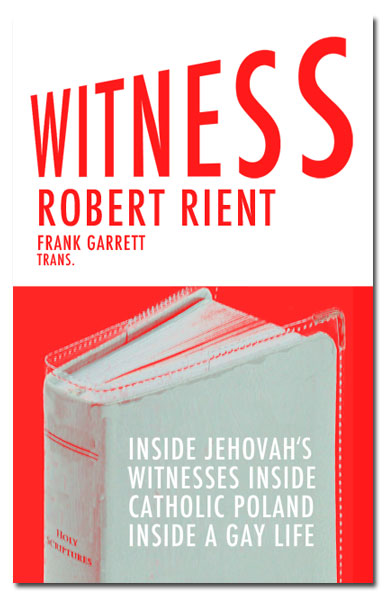
For all its sins, Twitter is still a terrific way to connect with readers, writers, translators and small publishers and, in the process, hear about books you might otherwise miss. Witness by Polish writer and psychologist, Robert Rient, is a case in point. I came to know of it by way of the translator, Frank Garrett, and was immediately intrigued by this story of a man who grew up gay and Jehovah’s Witness in Catholic Poland. I ordered the book and, as soon as it arrived, I had a quick look and immediately knew it was the type of book for which I would want to pitch a critical review.

I am intrigued by original approaches to memoir writing, that is, rrient-witnessintentional writing about ones’ own experience. In Witness, the story is carried by Luke, the writer’s younger self—the boy and young man torn between his faith community and his sexuality—and Robert, the grown man who marks his break with his past and his rebirth as a whole person, true to himself, by taking a new name and identity. Woven through these two narratives is a fascinating look inside the Jehovah’s Witness church. As someone with a dual identity history, albeit different in nature, I found a lot to admire in the telling of this story, as well as in Robert’s honesty and the powerful transformation he chooses to make to mark his move forward into a new authentic life.
My review is now live at Minor Literature[s]. Thank you to Tomoé Hill for entertaining my contribution.

Minor Literature[s] has been repairing its archive so I have reproduced my review here:

Witness by Robert Rient (trans. Frank Garrett)—Joseph Schreiber

Not yet fourteen years old, Luke Zamilski is waiting his turn to climb into a garden swimming pool set up in the middle of a large stadium. Thousands of people fill the stands. He has endured months of interrogation by the elders of his church congregation. He has memorized the precepts of his faith and the Biblical justification and ammunition afforded each one. He is ready. With his baptism, Satan will come to know of his existence, but Luke is eager and enthusiastic because he also knows that, on this day, he will be granted a clean slate. With this expurgation, he trusts that Jehovah will remove the thorn that has been working its way into his flesh through these early years of puberty.

Or maybe not.

Luke’s story begins with the dramatic retelling of a fire that destroys his family home when he is just shy of his fourth birthday. As part of the small Jehovah’s Witness community in Poland, the aid and support of fellow church members is immediate, as is the curiosity and derision of their Catholic neighbours. When the family is eventually settled into a new house, Luke is given a used briefcase in which he is to store his important papers should he ever need to escape a similar circumstance in the future. That same case will also go on to hold his precious diaries, his poetry, and eventually, he tells us, his porno mags, letters, newspapers and more. A place to contain both his documented and his hidden life. Thus, this event sets the stage for the account of a life that is destined to be doubly isolated. He is cut off from the normal social activities and celebrations of his peers by his “feline faith”, and then, as he struggles with his sexuality, he risks being denounced by his church community for falling prey to a sin thought to be worse than murder.

Witness, by Polish psychologist and writer Robert Rient, is at once an original and engaging chronicle about growing up gay, and a disturbing look deep into the manipulative and damaging environment of a religious organization that shares many similarities with other fundamentalist Christian churches, and yet is its own strange entity. However, this is not a case study or a psychological essay. It is, rather, an autobiography in three voices.

Luke carries the immediate and emotional core of the narrative. He agonizes over his inability to refrain from masturbating, and the curse of the ‘thorn’ he carries. He begs to be relieved of his affliction and prays for the imminent arrival of Armageddon, for release from worldly temptation and the corruption of Satan. He throws himself into the church, preaching and witnessing, and yet he is also drawn to the arts, to writing and drama, and eventually chooses to study in the city of Poznan after graduation from high school. There he will vacillate wildly between fanatical commitment to his faith, a desire to succeed in his studies, and a dangerous entanglement with drugs, alcohol and self-harm. Guilt and shame dog him, throughout his youth and on into early adulthood, intensified by the very real threat of disfellowship from the church, and rejection by those he knows and loves. His desperation becomes intense. At the age of sixteen, for instance, he makes the very Biblical pledge to cut off his offending appendage:

I take a knife from the kitchen. I go upstairs to the second story. I enter the bathroom, turn on the light. I drop my pants to the floor, pull down my underwear. I apply the knife to the base of my penis. Wait. I’m scared of the pain, that I’ll bleed to death. I gently drag it across the skin. It stings. It leaves a red line on the flesh. I won’t do it. I’m too weak even for that.

His first confidant is Robert, whom he ‘meets’ at the age of eleven. Somewhere between an alter-ego and an imaginary friend, Luke first summons Robert ‘out of nothing,’ a new identity to step in when the waters become too rough, someone to pick up the pen and write in his journal the thoughts and feelings that he dare not own. Robert carries the second narrative voice, looking back from the present with a certain, almost clinical, detachment at his troubled younger self, providing a grounded counter perspective. His measured tone speaks to his own hard-won peace, but a fondness and affection seep through, along with an abiding sense of loss. Although his parents will ultimately stand by him, and his older brother who also leaves the faith, the rejection of the friends and relatives who stay behind is cold, harsh and unforgiving. The cost is very real.

The third narrative, “Witnesses,” details the inner machinations of the Jehovah’s Witness enterprise—bringing to light textual materials, facts and figures, and unwrapping many of the arcane and disturbing beliefs promulgated within their organization. What is revealed is a misogynistic, sexually repressed, hierarchical system that denies celebration of holidays and birthdays, but permits limited alcohol and abortions (Armageddon is ever imminent after all), and encourages the physical discipline of children as a sign of affection. The church is widely spread across the globe and supported by vast quantities of written materials, most recognizably The Watchtower and Awake!, which are translated into a multitude of languages and distributed by members who are required to spend long hours knocking on doors and standing on street corners.

What we have then, is a memoir presented as an uncanny collaboration between the author, Robert, and Luke, the boy and young man he used to be, along with an exposé of the secretive church ‘they’ were born into. As an affectation, it would risk sounding overly theatrical, but this approach allows a much deeper, more genuine narrative to develop. In Luke’s account, supported by frequent excerpts from his diary, we hear of his youthful enthusiasm for his faith, his anguished attempts to fight his homosexuality, and his pull toward all the temptations and possibilities of a ‘worldly’ existence. By contrast, Robert’s perspective sounds at once insightful and limited. He wants to fill in the gaps, seek out the views of Luke’s former friends, and try to analyze, interpret and defend his fate. He knows how the story will end. In describing his first encounter with Luke, Robert says:

I suppose we already knew that we would meet again and that I would have to live. That he had to die. I didn’t kill him. But had he not died, I wouldn’t have been. Everything that happened to him, every torment, was convenient for me. His weakness and self-loathing were my justification and my provocation. Besides, he wanted to die. He talked about it again and again. I have evidence. I am the witness regarding this matter.

As the narrative alternates between the three voices, the mood shifts. The Witness sections are delivered with neutral authority. At times Luke’s actions are used to illustrate a point, and occasionally the reader is addressed directly, as, for example, in: ‘There exists an informal list of banned books which includes the one you’re reading.’ Both Luke and Robert speak in the first person, and refer to each other as ‘he.’ At times, when appropriate, first person plural is also employed. Luke longs for the comfort of his alternate identity most when he feels isolated and depressed, leaving Robert effectively sidelined, observing from a distance much of the time—a tone that comes through clearly in his sections, setting them apart from Luke’s. As Luke battles addiction, the loss of self-esteem, and suicidal thoughts, one can sense a growing friction between the two voices, as if Robert is slowly coming into sharper focus within their dual existence.

At the end of this powerful account of transformation and rebirth, Robert Rient emerges from the restraints of a religion that rejects his very being, and comes, over time, to accept and love himself as he is. It is his conscious disassociation that provides protection and allows him, with the support of friends and his academic training in psychology, to survive the very tumultuous break with his faith. Once the internal division is no longer required, he sheds his name and identity, along with his past, to claim a new wholeness. And in telling his story in this way, with equal respect for his past and present lives, Rient is able to capture a conflicted, painful journey with a fresh authenticity that reaches beyond the specifics to touch the universality of the experience of striving to be true to one’s self.

It is of note that Frank Garrett’s translation effectively captures the shifting tenor of the narrative, something which is essential to the success of this multilayered approach. He also includes a guide to assist with the pronunciation of the Polish names in the text, and in his afterword, he details the choices that were made with respect to language, and the challenges of accessing the original resources required to render this unique memoir into English.


Of reality and imagination: To Begin at the Beginning by Javier Marías

In the opening paragraph of her “Postface” to Javier Marías’ recently released contribution to the Cahier Series, To Begin at the Beginning, famed translator Margaret Jull Costa confesses that every time she starts to work on a new Marías novel, she thinks: “I can’t do this.” His work, with its long, convoluted sentences, and its precise, but shifting, language lies ahead of her at the outset of each project, and until she gets back into the flow she feels a sense of anxiety. I must admit that similar sort of uncertainty faces me as a reader. I wonder, am I ready to commit to Marías again right now? Unfortunately, with a few efforts since I was first swept away by A Heart So White many years ago, the answer has been no, not now.

beginSo imagine my delight with this short, reflective essay about the art of taking the stuff of life—the truths and myths that arise from one’s own family history—and using, even re-using them, to tell stories, create literature. I found this Marías, talking about his family, and his approach to the art of writing, so wonderful to read that I’ve mentally added his trilogy to my list of books to read. And that is one of the absolute joys of the Cahier Series: the opportunity to meet, or meet again, a writer or translator, and spend a little time with them as they explore writing or translating, or the intersection of both, in unique and original ways.

Marías, the highly-respected Spanish novelist and translator, sets out in this piece to explain his desire to devote his energies to writing “inventions,” and why, even when he borrows elements from real life, so to speak, he is inclined to break them up, and blend them into his fictional characters and creations rather than putting them in, unaltered.

2017-01-15-02-12-11 He begins by trying to set himself apart from writers who make every effort to make their fictional offerings appear factual, and expresses his dismay whenever presented with the expression: Based on real events. His inevitable reaction? “I’m filled with a feeling of tedium and anticipatory boredom, of distrust and resistance, of suspicion and even scepticism,” he says, going on to be more exacting:

‘What is so strange and unbelievable, so extraordinarily random, arbitrary, and corny about this story that, even though it’s already happened in real life, they still want to tell me about it, even warning me that I have to believe it whether I like it or not, because this is how it was, this is what actually happened?’

2017-01-15-02-13-49Of course, in the essay that follows, he goes on to share aspects of his own family history, reaching back to his Cuban great-grandfather, pulling out some of the stories that have made their way into one or more of his novels. This abbreviated family history is fascinating in its own right (inadvertently causing one to think that any story “true” or otherwise can be magic in the hands of the right storyteller), but his discussion of his process of re-imagining and working people and incidents from the past into his fictions—and the decisions he has faced when handling elements of the real within the world of invention—is equally compelling.

2017-01-15-02-10-09Marías reports that, when he writes, he applies the same principle of knowledge that is at play in life. He does not know if what he writes at page five of a novel will prove to be a good idea at page 200 any more than we can know if what we do at age twenty will seem to have been wise from the vantage point of forty, and so on. In writing, one has the advantage of editing, adjusting events back and forth between earlier and later portions of the work, giving meaning to the capricious and superfluous, as required, so that “what had no meaning at the beginning does have meaning at the end.” Subject as it is to the unforeseeable variables that mould reality, he contends, life makes a very poor novelist. Imagination is a critical mediator—and one of the essential keys to literature— filtering the invented and the actual, rendering everything equal.

To Begin at the Beginning, the twenty-eighth addition to the Cahier Series, offers an opportunity to spend a little time in the company of a renowned novelist and his chief translator. Illustrated by the works of Cuban artist Wilfredo Lam, it will likely be appreciated by Marías’ committed readers. For those who have little or no experience with his novels, it serves as an ideal introduction, or, as in my case, an inspiration to read more.

The Cahier Series is a joint publication from the Center for Writers and Translators of the American University of Paris and Sylph Editions.

Looking ahead to 2017: Finding light in the darkness

It may be a reflection of the year we have just endured as a global community, or the uncertain variables that cause 2017 to look like such a grey zone, but many people I know seem to be afraid to make any resolutions or commitments moving forward. A month or so ago, when I was still buried under a black cloud of grief and depression, I could not even imagine the utility of existing into the new year. I was in a peculiar space. I was receiving enthusiastic feedback for my work as a writer and critic—even selling a few pieces—but I felt empty and hollow inside. I could stand back and observe my malaise, but I could not bring myself to find an essential light to believe in.

Then, as suddenly as it had settled in, the darkness lifted. My parents are still dead, my friend is still gone, and I have not yet found a job. However, the stubborn, stupid optimism I always cherished as part of my character has returned. Wiser and soberer perhaps, and not at all naïve about the very real threats that the coming year holds. But with good books and the comradery of the many people I have come to know and respect, at home and afar, over the past couple of years, I resolve to try to read and write and photograph my way through 2017, come what may.

31760687801_ea5acb48c8_b

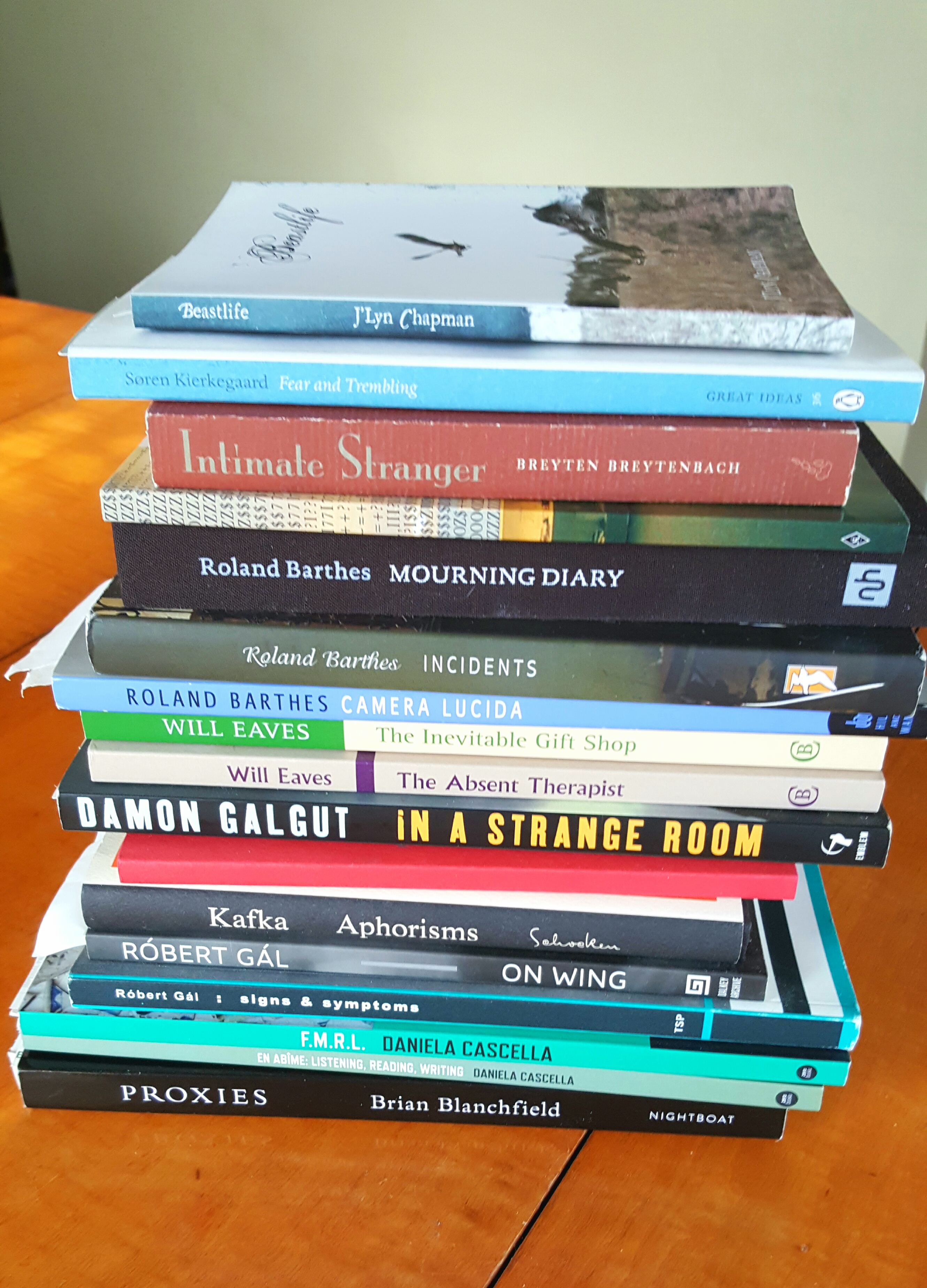
I have been making piles around the house lately and considered photographing them but have decided against being that committed in a public way. Suffice to say there is a healthy stack of fiction including a fair number of recent releases or purchases to which I am adding other titles I feel most guilty about ignoring to date. I have also been reading a good deal of poetry lately, new and classic, so I keep those handy. And then there is a growing collection of essays and memoirs which reflects my own interest, as a writer, in the variety of ways that personal experience or observation can be addressed. As much as I flirt with ideas of writing fiction, I seem to fall back into essay, at least as a starting point. If I end up taking a piece in the direction of storytelling or prose poetry, all the better, but the process has to be dynamic. I am learning to let my writing follow its own course as much as my reading does.

And this leads me to what might be thought of as my resolutions:

Reading: Some surprises surfaced when I added up my completed reads from 2016. I discovered that I read more German literature, than I had expected—11 titles, not including some Sebald that I am presently dissecting or the Kafka that I am always reading. I read 12 English language works (more actually, I have several essay collections and other books in process) and 8 translated from French. As for the balance of the translated literature I read, Spanish, Catalan and Portuguese accounted for a total of 10 books with many more waiting, while I read three Slovene, two Czech, and one each from Dutch, Korean, Arabic, Bosnian, Italian, Icelandic, Hebrew, and Polish.

Contrary to my previous pattern, I only read one South African, title though I added more and still have an embarrassing number of books crammed on to my bookcase. I had also intended to read more Arabic and North African lit and, again, failed. There are also a few key independent publishers I did not read from this year. So, all of these considerations will, if nothing else, be reflected in the piles I build. As to what I read—well, I’ll see…

Writing: I want to continue writing critical reviews but I am being very selective. Looking ahead I am especially excited about writing about new releases from Can Xue and Fleur Jaeggy for Numéro Cinq, while I also have a couple of other interesting reviews booked or underway. I continually debate the value of critical writing (this month the “Top of the Page “at Numéro Cinq features seven reviews—including one of my own—that I selected to highlight some books and reviews that impressed and inspired me). So often critics seem to be held in disdain and yet to write about a book sensitively and intelligently is challenging and creative—but it can be draining. Nonetheless, I have learned so much from the writing and from being edited, all of which has helped make me a better writer. Now that I am also involved with The Scofield as an editor I have further opportunities to continue to grow and contribute to the vital community of online literary magazines.

On the other hand, I am hoping to shift the focus of my blog a little, away from attempting to “review” books that I read (unless it seems appropriate). Rather I would like adopt a more personal reflection on the reading experience—try to pinpoint why the writing works, what ideas are generated, or simply celebrate reading for reading’s sake. I don’t ever want to feel obligated to write about everything I read, but at the same time I am increasingly reading books written by writers who are becoming friends and mentors. I want to be able to write about this work, in an informal, yet valuable way.

Finally, with what I call my “creative work,” I have several projects in mind or in process. One is an experimental, constraint-based project in honour of my father which may or may not lead to anything of interest to others. Otherwise, as much as I thought I was done with writing about the body, it seems that there is still a lot of unfinished business or baggage. It is inextricable from either my interest in being and authenticity, or my now expanded and complicated grief work. I am fortunate to have been approached by several online journals/sites that have invited my contributions and I am very excited about being able explore some ideas in smaller creative spaces to see where they take me. At the same time, I have a few other topics that I want, or even need to examine within, shall we say, a more conventional personal essay format.

Photography: After a long hiatus, I am inspired and eager to return to photography. A dear friend has kindly suggested —insisted— that I should incorporate more images into my writing. This possibility excites me and offers not only a direction for myself as a photographer, but also provides an opportunity to repurpose older shots, cropping and radically reprocessing images that were average and turning them into an integral part of a larger project.

So, even though it is impossible to know what the new year holds, I want to aim to face 2017 ready to build on what I have learned over the last two years which have held, for me, some of the most difficult and most rewarding moments of my life. It is really the only way I can think of to navigate what is bound to be a most interesting and surreal time.

The enigmatic fiction of Roger Lewinter: Story of Love in Solitude and The Attraction of Things

It is unusual to come to the end of a book and be completely at a loss as to how to write about the reading experience one has just had, and yet feel compelled to make some sort of attempt, however indirect or uncertain that might be. And that is exactly how I find myself now, having just finished Roger Lewinter’s novella The Attraction of Things. Together with Story of Love in Solitude, a very brief collection of three short stories, these two recent releases from New Directions (translated by Rachel Careau) serve as an English language introduction to the French writer and translator’s beguiling, meditative, and sometimes simply perplexing, fiction.

lovesolitudeThe latter volume, originally published in 1989, is one of the most unusual and strangely captivating books I read all year. The stories are focused and contained, reading almost like prose poetry, but they offer a taste of Lewinter’s idiosyncratic unspooling sentences that can wind around seemingly unrelated clauses before finding their way, from beginning to end, by such a circuitous route that one often feels inclined to retrace the pattern back to its source. It is an experience akin to untangling a long garden hose, or, more appropriately, following the designs of a richly decorated tapestry such as the Kashmir shawls that Lewinter’s narrator—whose writing and translating projects mirror the author’s so directly that the line between fiction and memoir appear to blur—obsesses over in the story “Passion” and throughout the course of the longer novella. Even attempting to write about Lewinter’s prose invites a tendency to add divertive notes, set off with dashes, not entirely unlike the style he employs.

See? Already it feels as if I am spinning my wheels. The reward though, especially in the shorter pieces, lies in the attention to detail and emotion, often of a detached or self-reflective nature, that is granted the events, objects or individuals with whom the narrator is engaged. The simplest story, the opening titular piece of Story of Love in Solitude, lasts for less than three pages and concerns the persistent presence of a spider. It captures so acutely the type of everyday irritation that quickly turns to a sense of loss when the routine is broken and an odd affection is realized after the fact.

athingsThe other two stories are more complex in the attractions and obsessions they entail and introduce characteristics that are present—and I want to say, more inclined to cause a measure of frustration—throughout the novella: Lewinter’s tendency to use explicit dates and translation projects to track time while he dismantles and reconstructs the chronological (in)consistencies in his stories—one which involves an epic battle against insect infestation and fate to save two camellias, and the other, which traces the protagonist’s drawn out and ultimately fruitless obsession with a young man he observes in the market. What makes these set-pieces work is the way that, for all his musing and meandering, Lewinter writes with an almost symphonic intensity, building tension into his narratives, and bringing each one to a charged conclusion. These small discursive journeys relate ordinary events that are oddly familiar, sensitive, and moving.

The same forces are at play in The Attraction of Things, which is the earlier of the two works, originally published in 1985, and, again, the overlap of characteristics between the narrator of the novella and, at the very least, the literary career of the author, create the sense that this is one voice, an alter-ego or fictionalized version of Lewinter himself. As he states, Attraction is:

…the story of a being who lets himself go toward what attracts him—beings, works, things—and who, through successive encounters, finds the way out of the labyrinth, to the heart, where passion strikes. This is the story of a letting go toward that passion.

The path that this being follows is one that appears to be characterized by an attempt to avoid deep emotional engagement with people by allowing objects—78 RPM records, Kashmir shawls, porcelain collectibles—to distract him. Against this pursuit of things, his mother and father become ill and eventually die, he allows a relationship with a woman to drift away, and lets a man take advantage of him. His passivity approaches denial of mortality, commitment, and sexuality. The flea market and the lure of things is a refuge. So too, is his work, which primarily involves immersing himself in the words of others.

Lewinter, the author and his narrator alike, has translated Karl Kraus, Elias Canetti, Robert Walser, and Rilke among others. But of special significance perhaps, is his deep association with the work of Georg Groddeck (1866-1934), the German physician widely regarded as a pioneer of psychosomatic medicine. If nothing else, this presents a possible context for understanding the manner in which the protagonist and his parents each face, and deal with, illness and physical ailments. There is a strong self-determination and stubbornness shared by the three family members that is, at the same time, a source of frustration to the son in his own distracted state. It is also interesting that Lewinter—separating him from his narrator is becoming redundant in this context—mentions writing about the connection between Bosch and Groddeck in an essay on paradise in psychoanalysis (Groddeck et Le Royaume millénaire de Jérôme Bosch—1974). Immediately this adds a new dimension to the obsession with Kashmir shawls—the colours and designs integrating cardinal points, black hearts, and angels—that runs throughout the novella and resurfaces in the later story “Passion.” To what extent are the textiles collected, cherished and hung on the walls an attempt to reflect a dream of paradise? But, most critically, when winding one’s way through the elliptical sentences that stretch on and on, often for a page or more, the narrator’s absorption with the work of a man who envied Freud’s discovery of psychoanalysis offers a way to “read” Lewinter’s distinct style of writing.

Any quotation from either book that captures a fragment of one of the gloriously nested sentences, would fail to do justice to the effect, or serve as a necessary sample for discussion, so permit me one longer, complete quote (by happy coincidence, this passage, which I selected as I was reading, happens to end a longer excerpt that was reproduced on Lit Hub):

The health of my father, since the previous September, had been deteriorating, the drugs having less and less control over the tremor that was now paralyzing him in spurts, disjointing his day with gaps to which, not wanting to hear of another hospitalization, he reconciled himself, and which I likewise trivialized; while, returning after the three months’ interruption occasioned by Antigone to Le chercheur, I finished the word-for-word translation in June, to find myself confronted with the difficulty unresolved, since I still didn’t know how to convey in French what showed through in the German, in my version rendering, as I was aware, only a state of amazement, not, in its magnetization, the torrent  of a life; and, the more I advanced, the more I was losing my way, when, on August 13, I had to have my father admitted, despite his refusal—“because you die there”—, to Thônex so that they could try, by gradually changing his medication, to stabilize his condition; but it was the balance found upon the death of my mother, three years earlier, that was undoubtedly slipping away.

Lewinter’s narrative clearly fits into the broad category of stream of consciousness writing. It is not as loosely unformed as some variations; the insertion of exact dates and concurrent writing and translation projects provides a structural formality and logic to the account. Not being well acquainted (yet) with the pioneers of the nouveau roman, I am not as well equipped as another reviewer (see John Trefry here) might be to draw refernces from that direction—my reading is necessarily instinctual and informed by the spaces where I related with particular poignancy to the larger story. The way the narrator’s mind wanders is reminiscent of the way we talk to ourselves and allows him to capture something somewhere between unarticulated thoughts and formal discourse. This is the private debate, the ongoing perseveration, the way we justify our obsessions with objects or people, our impatience with others—especially with those closest who invariably raise the most complex emotions—and any other shortcomings we care to catalogue and excuse as we structure our own internal narratives. As we articulate ourselves into being.

As the narrator’s equilibrium is slowly undone, that is, as his father’s deteriorating health challenges him to break down his own defenses, he is forced to finally open himself up and truly embrace the man he must admit he has never really understood. Father and son, mirrors in more ways than either wishes to recognize, are drawn, both resisting the pull, into a full acknowledgement of their affection for one another. And what is the first thing our narrator does to mark this breakthrough? He looks for an object to commemorate the occasion. There is constant interplay between emotional exhilaration and exhaustion that drives The Attraction of Things, at the level of the sentence and across the text as a whole, that to no small degree, contributes to the state in which a reader emerges at the end. In the span of 79 small pages one has experienced something at once fantastic and draining.

Not unlike a session on the analyst’s couch. And very much like the experience of trying to untangle and make sense of our own lives.

Lewinter is not going to be for everyone. If I was uncertain in the early chapters of Things after loving the smaller pieces in Story of Love, I became increasingly engaged as the father’s health deteriorated, in part because there were echoes of my own father’s decline and death over the first six months of this year. At times I almost had to laugh out loud at the older man’s stubborn resolve and refusal to give in to a weakening, crumbling body—my father was exactly the same. Now, having taken the time to write about this novella, I have come to respect and marvel at what it demonstrates about how an essentially ordinary, even mundane story can be told—no, orchestrated—and granted an operatic arc that creates an experience a reader will have a hard time shaking. There is a lot in this slender volume.

In the end, I am not certain I have articulated or elucidated anything especially profound about these two small books. To date, there is one more piece of fiction in Lewinter’s oeuvre and, as I understand it, Rachel Careau is still dedicated to translating his works. I know I will be watching for more.

Story of Love in Solitude and The Attraction of Things are published by New Directions. Each book is bilingual, with the complete French text following the English.

Another winter solstice is upon us: 2016 – The year in review

Winter solstice. The longest night of the year.

Moving forward, the days grow steadily longer and, in less than two weeks, we will leave a dark, disturbing year behind us.

But it would be reckless to imagine that 2017 will be brighter. However, with luck, we can be forewarned, forearmed, and determined not to relax our guard. We can stand together against the rising tides of hatred, and remember what is truly at stake.

11229294674_e5844929df_z1

Since I started this blog two and a half years ago, winter solstice has become my annual check-in point. Last December, I reflected on the key elements of a year that began with a move to writing seriously about books and culminated with my first review for Numéro Cinq. Against that trajectory, I wrote about my trip to South Africa, and the pulmonary embolism and cardiac arrest that followed within a few weeks of my return. I imagined that the eventful year I had experienced would not likely, for better or worse, be exceeded this year.

Cue 2016.

This has been a year of heartache, anger, and dismay. Around the world and close to home. I watched the violence in Syria, the outcome of the Brexit vote, and the spectacle of the American election, among the other tragic and unexpected events that have unfolded. And as economic uncertainty and anxiety has grown in my own hometown—a city that lives and dies with the price of oil—the crime and homicide rate has risen sharply this year. It does not feel like the same community any more.

Then there is the lengthy roll call of the writers, artists, and performers who have left us. But to be honest, I cannot say that I have felt these losses as acutely as many others… I’ve been distracted by the immediate, personal losses that marked this year. My mother, my father, and one of my closest friends, all gone within the span of two months. And my grief—that most fundamental human emotion—is complicated, inarticulate, and wearing.

It will take time.

11592010455_89917d80e3_z1

But, 2016 has also been a time of amazing growth and opportunity for me as a writer. I don’t know how often I resolved, with the dawn of a new year that: This year I will write. Last December, with that first critical review under my belt, I could not have imagined that I would have, in addition to regular contributions to Numéro Cinq, published reviews at 3:AM, Minor Literature[s], The Quarterly Conversation, and The Rusty Toque. And I would not have dared to dream that I would see my essays and prose pieces published on line and in print, or that I would be invited to join the editorial team of The Scofield. As 2017 approaches, I have a handful of reviews scheduled and several prose projects underway. I’m also feeling inspired to return to photography after a lengthy hiatus, and to see how I can incorporate photos into my written work.

I have much to look forward to, in spite of, or rather, against the new darkness that threatens.

Art and literature are more important than ever at times like this.

So, this seems to be an appropriate time to look back over this year’s reading, and highlight the books that stand out for me.

I’ve read about 50 books to date, a little more than half of what I read in 2015. I don’t even want to hazard a guess as to how many books I bought, received as review copies, or brought home from the library. I feel, as usual, like I fell short of my intentions. However, I have to remember that I was writing, working on critical reviews, and dealing with considerable life stresses over the past twelve months.

More than ever before, I read like a writer this year. That is, I was especially attuned to voice, structure and approach to storytelling. Consequently, the books that made my year-end list tend to reflect this focus. Of course, any “best-of list” leaves out many excellent books. I’ve managed a baker’s dozen here, and it’s probably a reflection of the increased number of off-blog reviews I wrote that this year’s list is predominately composed of new releases. I was surprised to see that once I’d made my selection.

In reverse chronological order, my top reads of 2016 include the following:

Story of Love in Solitude by Roger Lewinter (France), translated by Rachel Careau
I will write about this collection of three short stories once I have completed The Attraction of Things. My verdict is still out on that title, but this tiny book is simply wonderful.

The Inevitable Gift Shop by Will Eaves (UK)
Fragmentary, cross genre writing that works fascinates me. Billed as a “memoir by other means”, it is Eaves’ unique tone that makes this blend of memoir, literary criticism, and poetry so compelling. His thoughtful reflections on reading and writing made this an ideal meditation to turn to after a year of reading critically and exploring my own literary voice.

gravediggerThe Absolute Gravedigger by Vítěslav Nezval (Czech Republic), translated by Stephan Delbos & Tereza Novická)
I have found myself turning to poetry more and more as the world seems increasingly unstable and, well, surreal. This newly translated collection of poetry by one of the best known Czech Surrealists should be essential reading at this time. Originally published in 1937, the darkness he could see on the horizon are all too familiar once again.

The Country Road by Regina Ullmann (Swiss), translated by Kurt Beals
I read this collection of short stories when I was in a very low mood. But in the spare, sombre prose of these tales I found a beauty that, rather than deepening my depression, brought strange comfort. Admired, in her lifetime, by the likes of Rilke, Mann, and Musil, Ullmann’s work is mostly forgotten today. This volume, released in English translation in 2015, is a rare treasure—one that I encountered at just the right moment.

panorama-coverPanorama by Dušan Šarotar (Slovenia), translated by Rawley Grau
For me, as a reader and a writer, one of the most important books I read this year is this literary meditation on migration, language, landscape, and loss. This novel finally broke through my own stubborn determination to hold to a sharp delineation between fiction and nonfiction, and has made me re-evaluate potential approaches to themes I wish to examine. What Šarotar achieves here with his own unique take on what might be deemed a “Sebaldian” approach, is the creation of an atmospheric, captivating, and intelligent work.

The Passion According to G.H. by Clarice Lispector (Brazil), translated by Idra Novey
Oh wow! In a way, I am glad I didn’t read Lispector before writing and publishing my essay “Your Body Will Betray You,” because she is exploring the process of coming into being so beautifully that I might not have been able to write at all after reading this. Employing an unconventional narrative, Lispector’s G.H. experiences a vivid, metaphysical crisis triggered by the sight of a cockroach. The result is a remarkable, thoroughly engaging read. I have at least three more of her books waiting for the new year.

Proxies by Brian Blanchfield (US)
I bought a number of essay collections this year and currently have several on the go. This collection impressed me not only for the way the essays were composed—written without consulting outside sources—but for some of the ideas explored, and for reinforcing the value and possibilities of the personal essay/memoir form. I also greatly appreciated his guiding caveat: Permitting Shame, Error and Guilt, Myself the Single Source.

SergioSergio Y. by Alexandre Vidal Porto (Brazil), translated by Alex Ladd
This book is significant and important for dealing with gender identity and transition in a sensitive and original way. I am, as a transgender person, critical of much of what passes as literary writing on this subject. This is a most impressive work with a startling and unique approach. As I noted in my review, Sergio Y. is novel that approaches the transgender experience from the inside and the outside, allowing for the comfort with names and pronouns to vary, over time and from person to person, reflecting the complexities of relationships that others, even loving family members, can have when an accepted and assumed identity is challenged. That is the book’s greatest strength.

surrThe Surrender by Scott Esposito (US)
This book was on my radar from the moment I first heard of it. Again, despite my typical gender related skepticism, I was drawn to this transgender-themed memoir/film critique/literary diary. I wanted to know how Scott would present his story—one that is not commonly heard. Although his journey is very different than mine, we share a certain sensibility. This is a brave and most wonderful book by a man who has long been one of my heroes. He has since become one of the many literary friends I have come to know and cherish this year.

Layout 1

Atlas of an Anxious Man by Christoph Ransmayr (Austria), translated by Simon Pare
This book was a total surprise when it arrived courtesy of the good people at Seagull Books. This most unusual travelogue, a series of brief “encounters” across the globe, contains some of the most stunning descriptive language I have ever read. Each episode begins with the words “I saw…” and ends with a wise, evocative observation. From the North Pole, to South America, from deep inside the mountains of New Zealand, to a parking lot in San Diego, this is a journey that will not be easily forgotten. Highly recommended.

Quiet Creature on the Corner by João Gilberto Noll (Brazil), translated by Adam Morris
My third Brazilian book on this list is this enigmatic novella that led to one of the most entertaining literary discussions of the year. What is it about? Well that is the challenge. I had to read it three times before I could begin to get a handle on it. The narrator, a young man who finds himself in a strange situation that is rapidly growing stranger, is, in his oddly passive tone, almost more disturbing than whatever might be happening. Opaque and surreal, this book gets under your skin.

The Crocodiles by Youssef Rakha (Egypt), translated by Robin Moger
This novel still holds fast in my memory although I read it back in February. It is, as I described it in my review, a prose poem of simmering power, unwinding across 405 numbered paragraphs, tracing a torturous path from the first stirrings of poetic assurance within a trio of young men in the 1990s to the doomed protests of the Arab Spring. It is a dark, intense exploration of youthful political idealism, that builds on repeated images, themes and refrains to create a compelling narrative force as it moves toward its stunning conclusion. Again, this is another work that is increasingly relevant in today’s world.

On-the-edgeOn the Edge by Rafael Chirbes (Spain), translated by Margaret Jull Costa
Finally, the very first book I read in 2016 is probably my favourite book of the year. I wrote about this novel at length for Numéro Cinq and I regret that it has not generated more discussion. In what is essentially an extended monologue with brief cameos from other characters, Chirbes creates a memorable, engaging, and tragic character in seventy-year-old Esteban, a man who has lost absolutely everything in the economic collapse of 2008.  Thoroughly human in his wisdom, his resolve, his shortcomings, and his despair; this is a powerful and important book that deals frankly with many of the critical issues—including migration, xenophobia, and economic decline—that are more vital than ever as we step into 2017.

Beginning to write through grief: A reflection & link to my poem at the Sultan’s Seal

I am, as many know, dealing with a multi-layered, complex grief—my mother, my father, and one of my closest friends—all lost within the last six months. When my parents died in July, I entertained an immediate grief project, my own mourning diary, an echo of Roland Barthes. I started with a subdued passion, an ache as intellectual as emotional. In truth, my emotions were, I can now see, constrained and intellectualized.

I was numb.

Others reached out to me in those early weeks, sharing their own stories. The terrain of grief is rocky, I was warned. The journey long. The pain uneven. But, although I am in mid-life, a loss of this nature—doubled and complicated—was something I had never faced.

Then my friend took her own life sometime on September 1st. Even though I knew, in my heart, that such an event was almost inevitable, the pain and anger tore me apart. I knew she had tried every available option she could afford to fight an erratic and devastating variation of bipolar disorder, and I fully respected her decision and her right to make it. But suddenly my world was a darker, lonelier place.

And she had lived half a world away.

Again, the first thing I thought of was to write. This time, my distance from her demanded and informed my need to write—and I knew exactly what I wanted to do. I wanted to gather words and sentences from her writing and our communications, and together with some photographs from my trip to visit her in South Africa, create an elegy.

An offering.beach

Drawing inspiration from a prose piece by Breyten Breytenbach, and the sound driven writings of my friend, Daniela Cascella, I set to work. And I knew exactly where I wanted to publish this memorial if I was able to realize my vision—The Sultan’s Seal, a most wonderful space created and curated by Egyptian writer, Youssef Rakha.

The result, “And I will Tell You Something,” was published this past weekend. Three hundred words, five images and almost three months shaping, reshaping, listening and accepting the silence that emerged. This is perhaps the most emotionally demanding piece I have ever written. Yet, now five days after my words were finally set free in the world, I feel a tremendous sense of rightness. An element of peace. I still ache, but, with this prose poem, I feel I can begin to heal.

And I hope that others may find something in it too.

Literature as Liberator: My contribution to the 2016-17 Seagull Books catalogue

Earlier this year I was invited by Naveen Kishore, the publisher of Seagull Books, to write a contribution for their 2016-2017 catalogue. Now the Seagull catalogue is never an ordinary publication. It is a lavishly illustrated volume featuring the stunning artwork of Sunandini Banerjee, and contributions from a wide range of writers, translators, and this year, a handful of humble book bloggers, myself included. When I agreed to try to put something together, Naveen sent me this year’s “Provocation”:

Soul he said. Soul as the prison of the body. Soul I asked? What about the ones who don’t believe? In soul. Or God. Or religion. The ones that understand the body for what it is. Accept its one-way journey towards the inevitable. The body as decay. Gradual ruin. Eventual crumbling. We all know this. Or those that think the ‘inner core’, or what I presume is a ‘substitute’ for the notion of ‘soul’, is actually just an ever changing, evolving, fermenting mass of literature that grows. And grows. And knows freedom. And fear. And emotion. And love. And death. And every kind of existential angst that any soul worth its weight in gold would know! What about me? I asked. Or you for that matter. We who write and read and write and continue to both read and write while our bodies grow old and tired. But the mind. The mind remains in a state of excitement. Constantly radiant. Its brilliance grows with every new thought. What if we substitute ‘literature’ for ‘soul’ in your proud statement so that it now reads ‘Literature as the prison of the body’. Thing is that this doesn’t hold. Literature cannot be a space that restricts movement. Or freedom. At least it shouldn’t be. It is meant to be a liberating presence. Like its close companion. The dark. For me the dark is important. The dark as a substitute for soul? Maybe. Darkness is essential for literature of meaning to grow and take root.

The body. The soul. Literature.

2016-11-09-17-33-54I knew immediately what I would write. I took themes that were spinning through my head, scratched out on notepads—unformed, but increasingly urgent ideas that I wanted to find a way to address in words—and placed them within the framework of an analogy I have long used to describe my experience of feeling that I did not belong in the body I was born in. This piece represents the first creative expression of the self, of my self, that I dared to offer for publication. Although I had addressed my gender-different history, my queerness, in the occasional blog post and review, I had never sought to open some of the deeper elements of being that have come to define—and trouble—my long-term experience of living in the world as a gay transgender man.

2016-11-09-17-28-08In the meantime, between writing and submitting my Seagull “response” and finally holding the published catalogue in my hands earlier this month, I published two critical pieces of writing. Your Body Will Betray You (Minor Literature[s] May 6, 2016) explores the body and being, while A Reader’s Journey Through Transition (Literary Hub October 25, 2016) takes a look at the urgency with which I attempted to read myself to a place of self understanding. I’m proud of both of these essays, but I must confess, there is a certain weariness that comes with writing so honestly about oneself, not to mention a creeping discomfort with being laid bare, as such. This is a reflection of my ongoing personal struggle with the value and efficacy of being out, and with the inevitable fatigue that comes with constantly having to come out, again and again.

If I had thought writing myself out in the world would help, I’m not sure it has. But then again, we are constantly reading and writing ourselves into being. It is a process, not an end. Like transition.

So, after a little consideration, I’m ready to reproduce my Seagull Books contribution here. Rest assured this is not an excuse not to request a copy of this amazing catalogue for yourself. A Seagull Books catalogue is a work of art and celebration of literature.

The seeds of both of my later essays are evident in the following parable, but this piece attempts to articulate my own experience of feeling “wrongly gendered.” You will note that it is not a question of outward expression—being differently gendered, as I know it, comes from inside, not from wanting to play with the toys or wear the clothing of the other “sex.”

Here, then is my contribution to the 2016-17 Seagull Catalogue, with endless gratitude to Naveen Kishore:

Literature as liberator, you suggest.

I am, I want to reply, inclined to agree.

But I would caution you that words can confine us, as readily as they can set us free. We can become entangled in meanings, lose ourselves in definitions, search in circles for explanations when all we know is that the words we hear don’t seem touch the heart of what or whom we seem to be. False trails can mislead, lead away from understanding, especially if the destination you seek is not marked on any of the maps you can find. You wander blind.

And, you speak of the transience of the body, its trajectory toward decline, deterioration and decay.

I would argue the body cannot be so easily discarded.

Let me reframe the imagery.

Accept, for the sake of argument that the body is the fragile housing of the mind and the mind is the intersection of the heart and the brain; and, as such, both are essential to the experience of being in the world. The soul then, or that spark by which we know we are alive, can be thought of as being-in-motion. And literature—the stories we tell, the stories we turn to—is an essential element of the process of understanding ourselves in the world.

We are reading and writing ourselves into being.  Always.

Let me tell you a story.

Imagine, for moment, a darkened room. The sole illumination is a candle burning against the insistent gloom.

A boy inhabits this space; it is the only space he has ever known. And he has known, for almost as long as he can remember that everyone he encounters, every person who stands at the threshold and beckons, is expecting someone else, someone he can only pretend to be. He decorates his room, he carries his candle into the corners to try to understand what secrets they might contain, he worries that his insecurities might be exposed. But, of course, it’s dark, and others tend to see only what they want to see.

As the boy grows, his room becomes a more distorted, distressing, disorienting place. He wonders what lessons he missed, why he is unable to learn to exist comfortably in this strange space.

He assumes he is at fault.

If only his candle burned brighter. If only his room was not so dark.

He continues to decorate and redecorate his room. He scours the books that line the shelves, listens to the music that fills the hollows. Somewhere, somewhere far away he senses there is an answer to his otherness but its truth escapes him. He seems to fall off the axis the wrong way. So he puts away the stories of his childhood, the ones he tried to emulate with his own tales of ordinary boys on heroic journeys to fight dragons, and tries to draw a new character, the one he is supposed to be. If he can tell this character’s story, find her voice, perhaps he can write himself into the woman everyone else anticipates, the woman everyone else sees.

But he cannot find the voice.

He puts down his pen, files the unfinished stories and poems. Or throws them away.

He goes to university. He reads more books. The unease intensifies, the books can only take him so far—he continually reaches a place where the road ends, where the bridge is washed out, where the trail fades away into the underbrush. And then he falls in love. If he can’t fix the persistent otherness, perhaps he can hide—in plain sight.

The years pass. And still his room is an alien space.

He plays by every rule he can imagine. Marriage. Children.

Until, one day, he finds a book. It’s not the answer, but it shatters something deep within, it whispers in the darkness, and the candle flickers briefly. So he reads more. He encounters words that catch him up, that lead him on. He reads more. The words, the words threaten to tear apart his world. He tries on stories; wonders if they fit, if they’ll finally help him understand the room that has, over the years, come to feel more like a prison than a body.

He longs to make his way home to a place he’s never been.

He reads more.

And at last he comes to understand that the only way to make sense of himself in the world—to touch the centre of his very own being-in-motion—is not to deny the man inside but to renovate the room. To step out of the shadows and acknowledge the person he has always been, celebrate him and let him live. The candle still burns, but the room is now bathed in natural light.

So yes, literature can illuminate the corners, crack the walls, break down the door to bring the essential being—the soul, if you like—into the light.

I know this in my bones. The story I just told you is mine.

A dream beyond sorrows: A personal reflection

One year ago I read and wrote a review of Peter Handke’s brief meditation on the life and death of his mother, A Sorrow Beyond Dreams. With my birthday several days behind me and Canadian Thanksgiving coming next weekend, it seemed to me an appropriate moment to stop and take stock of the past twelve months.

8040751642_2c979863e1_zIt has been time of growth and a time of grief. Neither are quantifiable experiences, neither can be parcelled off, measured and checked like the items on a to-do list. Growth, like grief, can only be appreciated in retrospect and, perhaps most critically, as experiences that are bound together in the business of living, of being in the world.

Moving back a year, my simple Handke review led to a Twitter encounter with Douglas Glover, the mastermind and driving force behind the online magazine Numéro Cinq, who invited me to try my hand at writing a review for the magazine and, cliché as it sounds, that changed everything.

Since my “debut” if you like, I have become a regular contributor at NC, and have gone on to write book reviews for a number of other sites and online publications. I confess that I still struggle with a little of an impostor syndrome, ever worried that a lack of formal training in literature or creative writing will catch me up—out me as a pretender.

So far, so good.

Writing, or rather, the courage to put my own creative or critical writing “out there” for others to read, is something I could not have imagined doing until fairly recently. The response has been very encouraging; and the growing friendships and respectful connections with other readers and writers has far exceeded my modest expectations. I am ever excited by the works, ideas and reading suggestions of others. The community afforded by online connections is invaluable.

But moments of isolation and loneliness persist, feeding waves of existential anger and grief.

Five months ago I published my first piece of essay/memoir writing. It is honest and raw—the product of more than a year of worrying words onto the pages of notebooks. Some of my anger and grief is channeled through this essay, and there is a relief in having released this fragment of my truth.

Within two months, though, I would begin to know an entirely new grief.

In July, in the span of less than two weeks, both of my parents died. The circumstances that swept them from us were not entirely unexpected, but the rapid intersection of the two events has left me numbed. And then, in early September I learned of the death, by suicide, of one of my closest friends. Hers was a fate, again not unexpected, but long feared and, in a strange and painful way, respected and understood.

8084371103_590f71e383_zWhich brings me full circle, to Handke’s essential, heartbreaking memoir. A novice to loss on the magnitude of that which has marked these past months, I imagined myself crafting a response of immediate grief, as Handke attempts. But I realize I am voiceless. At least for now. Articulating my grief will take time. At the moment I cannot even sort it out inside.

So with Thanksgiving coming, I am thankful for outlets for writing, new friends who support and inspire, books, words and, yes, even grief.

And for the opportunity to continue to grow.

That is my dream for the year ahead.

Dreams and Stones by Magdalena Tulli

I am very pleased to have my first review published at The Quarterly Conversation. Dreams and Stones by Polish writer, Magdalena Tulli, is a poetic meditation on the city as an organic entity, essentially an urban cosmology. I read it through twice before writing my review and in my second encounter its nonlinear, cyclical quality was even more apparent. Thinking about it now, two months later, its fantastic, mythic qualities still have a strong hold on my imagination. But there is more that haunts me when I think about this book.

dreamsstones

I had been aiming to submit this review in mid-July, my first reading was in late June, but before I could put pen to paper, so to speak, my father had a stroke and car accident and my mother became ill and died. As one might imagine, I struggled to write, let alone read. During times like this words fail us. But, as my father’s death neared I returned to this short book, for distraction, comfort and, above all, to know that I could still write. The ability to sit down and pull together a critical review was an important turning point. In times of immediate crisis and grief when family members find themselves trudging back and forth to the hospital, the advice is to try to return to some measure of routine. The answer, for me, was to write.

Dreams and Stones is translated by Bill Johnston and published by Archipelago Books. My review, originally published at Quarterly Conversation is reproduced below:

“There are more things in heaven and earth,” Hamlet famously says to Horatio, “than are dreamt of in your philosophy.” So might Polish writer Magdalena Tulli be imagined to warn readers entering her enigmatic first novel, Dreams and Stones: to be prepared to open your minds to an urban cosmology that envisions the city—its evolution, destruction and rebirth—in the light of two seemingly opposite notions of the world. Paragraph by paragraph, Tulli’s images are startling and fresh, and they become the building blocks of a fanciful metropolitan vision that overflows with both magic and sorrow.

Born in 1955, Tulli is one of Poland’s most original contemporary writers. She has received three nominations for the prestigious Nike Prize, and four of her novels translated into English to date, including In Red which was longlisted for the 2012 Best Translated Book Award

Recently re-issued by Archipelago Books in paperback (they published a hardcover edition over a decade ago), Dreams and Stones truly defies simple classification. From the opening passages, the contemplative poetic imagery reads like a re-invented Book of Genesis, sketching out the life cycle of the metaphorical tree upon which a fruit ripens, falls to the ground, and germinates; it holds in its core the seeds of a great city and the parameters of the human system that surrounds it. This archetypal city is fundamental to the vision of the world that Tulli proposes, but herein lies the tension that motivates and propels the narrative: Tulli’s calmly disconnected narrator ponders, never committing to one conception over the other, how the world is to be understood: as a tree or as a machine? Is the city borne of the dreams of its citizens? Or is it grounded in the faith and certainty of its master builders?

Be it natural or mechanical, the city is created by an inextricable combination of thought and the appearance of objects. Necessity and a restless urgency drive this process onward. Tulli’s narrator describes the lines of the city as ordained to appear through the pens of the draftsmen, inspired by the builders’ unshakable belief in one possible truth.

Though it remains a supposition it is not hard to interpret. It proclaims that it is not the power of germinating seeds and not the pressure of juices circulating between the roots and the crown that give the world life, but that it is set in motion by motors, gears, and cogs, devices that keep the sun and stars rotating, pull the clouds across the horizon and drive water along the bed of the river. The clarity and simplicity of this notion may prove salutary. They will make it possible to dismantle, repair and reinstall every broken component—so long as the world is composed only of separate and removable parts . . .

However, as the narrator goes on to speculate, how can one be certain the world is a machine when it resembles a tree in so many respects? This continual pull between the two poles of this dichotomy suggests that the way one chooses to view the world influences, even governs, the way one attempts to exist in it. Both views, it is argued, are true. And both have their limitations.

Tulli spins webs of interconnected realities and counter-realities. As a tree has a network of roots that spread, like the branches of its crown, in the dark depths of the soil, the city and every object in it ideally has its counterpart. But as the inexorable progress of the mechanized world rushes forward, the city is easily separated from the counter-city and, like a tree cut off from its roots, everything begins to spiral out of control, break down, fall apart. The builders that once seemed so assured failed to leave room for fate, chance, and fatigue—not only of materials but of the legions of flesh and blood workers required to build, repair, and maintain the metroplis in its glory.

Eventually time begins to run short and the power required to hold the counter-city at bay outstrips demand. The city, and the framework of the world that surround it, enter a period of cosmic decline. Here the narrative registers a distinct shift in tone:

No one knows where sorrow comes from in a city. It has no foundations; it is not built of bricks or screwed together from threaded pipes; it does not flow through electric cables nor is it brought by cargo trains. Sorrow drifts amongst the apartment buildings like a fine mist that the wind blows unevenly across the streets, squares and courtyards. There are long streets and short ones, there are broad ones and narrow ones. The gray of some bears a trace of ochre while others are bluish from the sidewalks to the roof tiles. Each of them has its own peculiar shade of sorrow.

The city of thoughts is now precariously maintained in the dreams of its inhabitants, their memories. The city of sorrow grows increasingly disordered and fragile. When war threatens to level it forever, the survivors, like their forbearers who constructed the original city, attempt to reconstruct one of memories. For, as the narrator assures us, “nothing in the world—even imaginations—can be destroyed completely and finally.”

Although Tulli never names the city at the heart of her story, recent Polish history, the massive destruction of Warsaw during the Second World War, and the systematic rebuilding and redesign of that place all seem to be woven into Dreams and Stones; but, these threads need not be traced in a linear fashion. This is a fable, one that essentially folds back on itself, a poetic meditation on the soul and heart of a city built, rebuilt and kept alive in the imaginations of its people. A metropolis that is connected to the rest of the outside world, to those shifting, almost fantastic municipalities that exist elsewhere, and yet stands as a self-contained ideal. One has to be aware though, that such an ideal can become distorted over time. Warsaw was reconstructed, with great attention to detail on the one hand, but altered to accommodate the new pressures of a steadily increasing population on the other. Memories and the rebuilt reality do not always align:

It is possible to imagine a city perfect in its entirety, a city that is the sum of all possibilities. In it nothing is missing and nothing can perish, every china teacup comes from somewhere and is destined for somewhere. But precisely this absolute city is eaten away by the sickness of never-ending disasters. Change invariably brings confusion to the lives of the inhabitants. One has to pay attention so as not to drive accidentally onto a bridge that was demolished years ago, so as not to sit on the terraces of torn-down cafés once known for their unparalleled doughnuts.

An obvious counterpart to Dreams and Stones can be found in Italo Calvino’s Invisible Cities. Tulli has translated Calvino and admits to his influence. But in so far as this book can be understood as referencing Warsaw, it retains a sharply central European feel. I was especially reminded of Pavel Brycz’s  I, City.[1] Originally published in Czech in 1998, Brycz    honors the history and people of the industrial city of Most in northern Bohemia, by giving the narrative voice to that place, setting the stage for a melancholic meditation on an urban center widely understood, at the time, to be in a state of unemployment, decline, and despair. In Tulli’s urban landscape it is the city’s inhabitants who maintain, generation after generation, the idea of their home, even as its proud stone edifices are turned to rubble. In I, City, the concept is reversed. It is the city that retains the memories and affections for its people and its past—it dreams, keeping its spirit alive despite repeated historical destruction, occupations, and finally as its neighborhoods are leveled to mine resources and replaced, not by stones, but by prefabricated concrete slabs.

While Tulli regards Dreams and Stones as a novel, her translator, Bill Johnston, respectfully disagrees. He sees it as prose poem.[2] It is, essentially, a series of images and reflections, and there are no individual characters apart from the measured and detached narrator. Yet either way, novel or poem, the piece is endowed with an overwhelmingly orchestral quality. The dynamic life of the city, builds up speed, slows down, becomes erratic, falls into an abyss, and is reconstructed anew. Tulli is playful with her imagery, intentionally pushing her metaphors to the edge. Even the moods—pride, sorrow, nostalgia—that course through her streets are imbued with a mythic intensity. This motion and fluctuating energy, combined with the fundamental philosophical tension at its core, gives the work its flow, draws the reader in, and, in the end, offers a richly provocative experience that invites and rewards rereading.

[1] Brycz, Pavel. (2006) I, City. (J. Cohen & M. Hofmeisterová, Trans.) Prague: Twisted Spoon Press (Original work published 1998) – Link to publisher page for book: http://www.twistedspoon.com/city.html

[2] Interview with Bill Johnston on Magdalena Tulli. Polish Writing. Retreived from https://web.archive.org/web/20111106183056/http://www.polishwriting.net/index.php?id=125