In the footsteps of the man pretending to be me: Under Our Skin – A Journey by Joaquim Arena

The first large group of captured and enslaved Africans arrived in Lagos, a maritime town on the southern coast of Portugal on August 8, 1444. The shipment of 235 men, women, and children marked the establishment of the earliest slave market in Europe, and a segment of that initial African population would end up in Lisbon. A century later, Black Africans would not be an uncommon sight in the city, as colonial Portugal became a major player in the growing trans-Atlantic slave trade. A street scene painted in 1570 depicts a busy plaza in the capital in which half of the people pictured are Black, some socializing, others working, and in the middle of it all, a Black knight passes through on his horse. This image, and the conference where he first sees it, will serve as a catalyst for a journey that will take Cape Verdean-born writer and journalist Joaquim Arena into the Portuguese countryside following the family history of an older woman he befriends who is the descendant of a freed slave. Alongside this narrative, runs the author’s meditation on his own personal history in light of the death of his estranged stepfather.

The hybrid essay is a delicate balance—a common focus must lie at the root of seemingly disparate threads or it feels awkward and forced. With his first nonfiction effort, Under Our Skin: A Journey, originally published in Portuguese in 2017,  Arena manages to weave history, memoir, and travel writing, into an idiosyncratic and entertaining exploration of the early roots of the Black African diaspora in Europe. The thematic mix along with the inclusion of grainy black and white photos will remind some of Sebald (to whom he has been compared), but although both writers blend a personal story with historical and landscape writing, Arena’s story is not fictionalized and his literary style, if at times digressive, is generally more direct.

Under Our Skin opens with Arena’s first encounter with Leopoldina, a retired school teacher, at a conference on Lisbon’s history to which he, much to his surprise, has been invited to represent the ethnic minorities of the city—he, a man of mixed race born in Cape Verde and raised in Lisbon who had until recently been living back in his homeland. While discussing the painting described above, Chafariz d’El Rei, this striking older woman rises to speak,  seemingly with a particular sense of intimacy, of the Blacks, slaves and Moors who would have been living in Portugal in the sixteenth century. Several weeks later, Arena and Leopoldina happen to meet again on a train. They are both returning from an exhibit entitled Blacks at the Heart of the Empire and, as they talk, she confesses that since her retirement, research into the history and social conditions of Africans in Portugal has become a passion of hers. He’s inclined to wonder if this hobby has a personal meaning. Her response: “It’s in the blood.”

Since he is back in Lisbon, at least for the time being, Arena begins to visit Leopoldina on a regular basis, to help her out with occasional tasks and listen to her stories about her family which she can trace back to her great-great-great-grandmother Catarina, a slave in the first Count of Belmonte’s estate. She was apparently treated so badly that she took advantage of an opportunity to escape with a group of slaves who disappeared one morning early in the nineteenth century, making their way south across the Rio Sado valley to settle near the village of São Romão where they found farm work alongside poor white and Black families already in the area. Leopoldina, who would be born there a hundred years later, came to understand her bond to Catarina through the memories and accounts passed down by her female descendants and now she shares this history with her new, younger friend. However, when Leopoldina has a stroke, she asks Arena to go one step further. Unable to speak, she puts her thoughts down on paper, as strength allows, expressing regret that she cannot be buried in her village cemetery because it has been closed for years:

These words make me realize just how much of her life has been spent, that few joys remain for her, and she knows it. I think of her village as a corner of the universe and about time deferred, about permanence and eternity, about all the moments that contribute to a life. I feel an incredible longing for the Sado valley, a nostalgia for heaths, woodland, and rice fields I’ve never seen.

She starts writing again: “Will you go there for me . . .?”

Against Arena’s account of his friendship with Leopoldina, her family’s past and the journey it inspires, is the story of his own family history. Chapters numbered in alphabetical form tell the first story while the latter unfolds in unevenly alternating chapters designated with Roman numerals. Arena’s is a distinctly Cape Verdean story. It is also a search for identity. Born on the island of São Nicolau, to a local woman and a Portuguese temporary worker, Arena grew up with only an imagined picture of his birth father who left when he was two. Four years later he found himself bound for Lisbon, as part of a migration of Cape Verdeans drawn to the city in the early 1970s with the strange man his mother intends to marry. But as a child he initially greeted this new land with a sadness and longing for his island home while his new stepfather, a seaman, essentially remained a stranger who disappeared for months at a time. Now, after years living back in Cape Verde, Arena has returned to Lisbon to help settle his stepfather’s affairs. Can the city’s streets lead the middle-aged man to the boy he once was and, in the process, to himself?

These intertwined journeys, one through the landscapes, villages, and historical sites in an area south of Lisbon reaching, ultimately, all the way to the site of that fateful landing in 1444  and the other exploring the author’s own heritage, as a mixed race Cape Verdean, both include fascinating detours to include eccentric relatives and Black historical figures who started life as slaves, only to find themselves rising to positions of influence in European and Russian society—even if such transformations had their limitations. Arena’s journalistic skills are evident in his ability to transition between historical details and present day encounters. Although they do not explicitly play off one another, the two strands of his journey are necessarily connected, or rather, it seems as if he needs to trace Black African history in Portugal to complete a piece of himself that is missing, a piece that connects him back to a distant African homeland that generations of Cape Verdeans have sought to deny. Cape Verde was discovered and settled by the Portuguese to serve as a base for cross-Atlantic slave trade and, as a result, most of the local population are mixed race and were, historically, afforded a better education than other colonized populations in mainland Africa. This enabled them to play a more active role in the structures designed to exploit African peoples. Such a legacy can foster a complicated relationship—or rejection of a connection—with others of African origin.

Of course, following the stories of others, tracing their lives, and visiting the places they lived is one piece of a much larger puzzle. To understand himself, Arena will also have to come to terms with his own experiences growing up in Portugal and attempt to understand those closest to him, even the one man he feels most estranged from. The journey he will take extends far beyond the Lisbon city limits and reaches far back in time, and it’s conclusion is as rewarding and as nebulous as any historical/existential exploration can be. But it does make for a very rich reading experience.

Under Our Skin: A Journey by Joaquim Arena is translated from the Portuguese by Jethro Soutar, and published by Unnamed Press. It is Arena’s first work to appear in English.
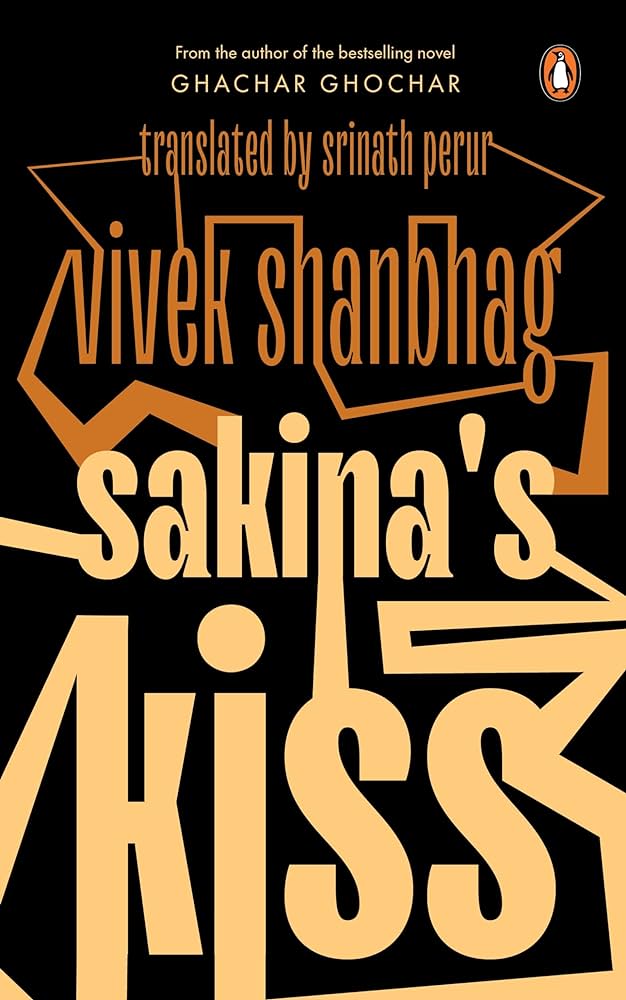
A knock at the door: Sakina’s Kiss by Vivek Shanbhag

Kannada author Vivek Shanbhag’s eagerly anticipated new novel opens with the statement: “There are no coincidences, only unseen chains of consequences.” It is a random quote that his middle-aged protagonist once scribbled down for future reference, accidently recovered during a search for something else altogether. Inspired by his finding, he rushes out to the kitchen to share it with his wife who is much too busy with dinner preparation to entertain his interruption. He is fully aware of this but intends to impose on her attention regardless when he is, in turn, interrupted by a knock at the door. That unexpected intrusion will mark the advent of a series of events that threaten to overturn Venkat’s comfortable complacency and not once over the following days will he heed the wisdom he was about to share with his wife on that fateful night.

As with Ghachar Ghochar, the widely acclaimed novella that, in English translation, introduced Shanbhag to a wide audience within and beyond India, Sakina’s Kiss also explores the impact of shifting dynamics within families, and is narrated by a man who is unable, perhaps unwilling, to understand the women in his life. But this time the cracks that threaten familial peace and security run along political, gendered, and generational fault lines and, although uncertain outside forces come into play, Shanbhag again resists any neat resolutions to the mysteries that arise.

Our hero is Venkat. Born and raised in a small rural community he comes to the big city somewhat conscious of his origins, and through his engineering studies and on into his career he works to cultivate the confident, sophisticated manner he wishes to project. He enters the workforce at a time when the necessity of dealing with foreign clients meant that offices tended to be places where Western styles and tastes were favoured and traditional Indian social factors such as caste advantages were publicly downplayed. When the insecure young manager happens to encounter a man whom he begins to see as a kind of secular guru, he is inspired to adopt a steady diet of self-help books as a roadmap to the life he hopes to craft for himself.

And, Venkat does achieve a respectable degree of professional and financial success but, as his narrative reveals, there is an underlying insecurity despite his expressed self-confidence. His wife, Viji, by contrast, appears to be the more rational, empathetic partner in their relationship even though we only see or hear her perspectives through Venkat’s report and, by the time this story opens, the couple has long since drifted into a rather distanced coexistence. When, early on, he launches into a rather detailed account of their arranged meeting, courtship and honeymoon, his descriptions are so oddly matter-of-fact and one-sided that it’s little wonder their marriage is strained decades later. She is also a successful professional and their combined incomes allowed them to purchase a decent two-bedroom apartment in Bengaluru where they still live with their adult child, a daughter who is now twenty-two and working toward an arts degree at university, much to her father’s dismay. He had, of course, favoured the sciences, but Rekha is a free-thinking, rather rebellious young woman. It is primarily around her that the troubling events at the heart of this novel revolve.

When two young men claiming to be friends of Rekha’s appear at the door desperate to reach her, Venkat explains that she is out in his home village, staying with her great uncle in a location where there is no landline or cell signal available and that they will have to wait until she calls to check in before their message can be passed on. The following day, a Sunday, the same young men return and when they receive the same response from Venkat, they leave and send in a couple of thugs to impress upon him the urgency of their need to contact his daughter. A strange story about two rival gangs, one led by the publisher of a sensational tabloid, the other led by the former owner of a poultry shop unfolds and somehow, in the middle of it, it appears that their sons are both smitten with Rekha who, curiously, is never mentioned by name. None of it makes any sense, but the messengers definitely look unsavoury. Neither Venkat nor Viji know what to make of it all, but when, on Monday, they learn that Rekha apparently left the village on the bus to Bengaluru on Saturday night, panic sets in.

Venkat’s narrative alternates between an ongoing account of current events and chapters that attempt to fill in the background, as he tries to explain and make sense of his marriage’s evolution, his daughter’s increasing radicalization, and the strange history of his politically active uncle Ramana. Buried family secrets and complicated levels of willful blindness and stubborn pride cloud his observations and limit his insight. He seems especially frightened of anyone who expresses individualistic or idealistic goals. For example, when Rekha becomes enamoured with the ideas her college English teacher espouses—“patriarchy, the myth of sexual purity, the shackles of marriage and so on”—Venkat responds defensively. Upon learning that this admired teacher secretly smokes on campus:

I began to criticize all smokers so I could ridicule him indirectly. I suppose I was trying to show that my contempt for Surendran was not without reason. This was a strange kind of envy. Or fear. Or something. Along with the feeling Rekha was escaping my orbit was the restlessness brought about by her infatuation with the words and ideas of this fool.

He makes a vain effort to expand his own world view to little avail. His fears only fuel his continued efforts to assert his role as the “man of the house.” This naturally causes his daughter to become even more defiant towards him while pushing her closer to her mother. That gulf only continues to grow.

There are many loose threads and potentially explosive elements in this novel, but with a narrator who is unable to step back and attempt to see the big picture, a number of “what ifs” remain just out of sight. Venkat comes close at times to wondering if he could or should have done something more with respect to the various dilemmas he has faced, yet, for all his self-help book consumption, a personal awakening eludes him. Even more critically, his fragile masculinity will not allow it. Unable to navigate a changing social and political terrain, he now finds himself excluded from his wife and daughter’s confidence and haplessly sliding into a potentially dangerous situation.

Sakina’s Kiss is, again like Ghachar Ghochar, a deceptively easy read with an unsettling undercurrent that leaves more questions than answers. Shanbhag excels at creating ordinary male characters who are unable or unwilling to fully appreciate shifting social dynamics or their role in them. As such, his narrators end up granting the women in their lives an insight that they are at a loss to understand. They find themselves in situations that are at once funny and tragic—how they will manage in the end is uncertain. In a way, his first two translated titles remind me of the work of South African writer Ivan Vladislavić who has perfected the myopic middle class male character who finds himself in over his head in a world that is changing around him.

Sakina’s Kiss by Vivek Shanbhag is translated from the Kannada by Srinath Perur and published by Penguin Random House India.

A tale of two travellers, You and I: In the Presence of Absence by Mahmoud Darwish

Allow me to see you, now that you have left me and I have left you, safe and sound like pure prose on a stone that may turn green or yellow in your absence. Allow me to gather you and your name, just as passersby gather the olives that harvesters forgot under pebbles. Let us then go together, you and I, on two paths:

You, to a second life promised to you by language, in a reader who might survive the fall of a comet on earth.

I, to a rendezvous I have postponed more than once with a death to whom I had promised a glass of red wine in a poem. A poet is at liberty to lie, but he only lies in love because the heart’s promises are open to alluring conquests.

The celebrated Palestinian poet Mahmoud Darwish was aware that his own death was nearing when he composed In the Presence of Absence, an intimate synthesis of memory and meditation that not only turns its attention to the past, but looks ahead to contemplate what words can carry into a future that he knows he will not see. It is a self-elegy, an established genre in classical Arabic poetry, re-imagined, reshaped and realized through a unique “convergence” of prose and poetry in which, as translator Sinan Antoon puts it in his Preface: “[t]he living ‘I’ bids farewell to its imagined dying other in a sustained poetic address divided into twenty untitled sections.” Presented as a dialogue between the poet’s present self and his absent self, each section explores a particular experience or theme.

Early on, Darwish invokes his younger self, a mischievous child caught up in the magic of the natural world, lured by curiosity toward adventure and injury. However, another love was also nurtured at a young age: the love of language. The third section is devoted to the endless possibilities that the future poet discovers in the wonder of letters and words. It will become his life:

You become words and words become you. You do not know the difference between utterer and utterance. You will call the sea an overturned sky and the well a jar to preserve sound from the world’s tinkering and the sky a sea hanging from clouds.

There is something that assumes the obscure. It cannot be smelled, touched, tasted, or seen. It is what makes childhood a sixth sense. They called you the dreamer because you often gave words wings invisible to grown-ups.

Darwish devotes several sections to this time of dreams and dreaming before, at the age of seven, dreams turn into nightmares. The Nakba’s destructive force drives him and his family from their homeland under the cover of darkness at a time when his absent self was:

Still too young, you could not imagine your own death. You did not yet grasp that children could die.

Life will go on but, but this sudden, unprecedented displacement  will cause him to hate the second half of his childhood and foreshadow the circumstances that will shape the rest of his life.

In the Presence of Absence is not a memoir in the familiar sense of the word, but significant life experiences—imprisonment, exile, heart surgery, a visit to his mother—shape his reflections. Yet, at times, he turns to more open meditation on themes like love, loss, dreaming and what it means to return. These meditations turn on the poetic as poetry is always, for Darwish, more than a vocation, but an essential means of making sense of the world. Ever the dreamer, his dreams are soaked in a melancholy that reveals itself in imagery bound to a land and a life forever lost:

Longing is the absent chatting with the absent. The distant turning toward the distant. Longing is the spring’s thirst for the jar-carrying women, and vice versa. Longing allows distance to recede, as if looking forward, although it may be called hope, were an adventure and a poetic notion. The present tense is hesitant and perplexed, the past tense hangs from a cypress tree standing on its rooted leg behind a hill, enveloped in its dark green, listening intently to one sound only: the sound of the wind. Longing is the sound of the wind.

The more you delve into your loneliness, like that tree, the more longing takes you with motherly tenderness to its country, which is made of transparent, fragile fibres. Longing has a country, a family, and an exquisite taste in arranging wildflowers. It has a time chosen with divine care, a quiet mythical time in which figs ripen slowly and the gazelle sleeps next to the wolf in the imagination of a boy who never witnessed a massacre.

Darwish plays presence and against absence through this text, the image surfaces and reshapes itself in endless variations, including the confrontation with his own absence when he visits the ruins of the village he was born in. For, to articulate an absence that is present or a presence that is absent is not only the task of this self-elegy, it is, for Darwish, a poet’s role. This is, then, more than anything, a book about language—as a means to express, to understand, and to exist in a world that has been torn apart. His prose is rich with metaphor and sensual, even sexual, imagery, but the pain of a man who was denied the ability to live freely within the land of his birth, and witnessed, by the time of his death in 2008, the impact of sixty years of occupation and conflict on the Palestinian people, is never far from the surface.  It is, sadly more timely than ever.

Sinan Antoon’s translation honours the poetic energy of this work, aiming, he tells us, to preserve, where possible, the pulse and rhyme of the original. Endnotes supply necessary context, as required. This text, like Journal of an Ordinary Grief and Memory for Forgetfulness, is classified as poetry, but, as poetic as these works are, I prefer to consider them closer to prose lest a potential reader who is apprehensive about poetry be inclined to avoid them. Darwish’s meditative, incantatory prose is neither elusive nor intimidating. He writes from the heart and with the heart his words are best met.

In the Presence of Absence by Mahmoud Darwish is translated from the Arabic by Sinan Antoon and published by Archipelago Books.

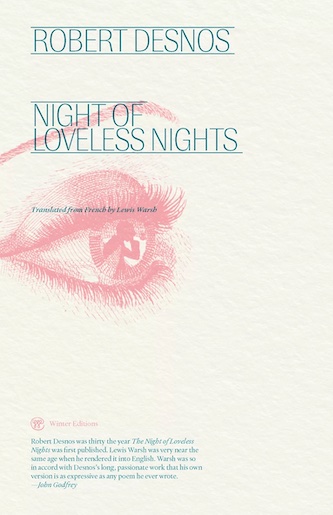
The heart’s nocturnal lament: Night of Loveless Nights by Robert Desnos

On the tree trunks the same two initials are always carved. By what knife, what hand, what heart?

 In 1973, Issue 10 of The Ant’s Forefoot, a New York City based poetry journal (originally started in Toronto) was devoted to one single epic poem—Lewis Warsh’s translation of Night of Loveless Nights by French poet Robert Desnos. As such, it was the first English publication of a book by Desnos, more than forty years after its original limited French release in 1930. The chemistry between Desnos, one of the early Surrealists and Warsh, a member of the second generation of the New York School of poets produced an translation that is attentive and sensitive to the original despite the fact that Warsh was born the year before the Desnos’s death. The context of the creation of Night of Loveless Nights is as fascinating as the story of its first appearance in English. Long out of print, this translation has now been rereleased in a special fiftieth anniversary dual-language volume from Winter Editions, complete with an afterword by poet David Rosenberg, the editor who originally gave Warsh’s translation a home.

Robert Desnos was born in Paris in 1900. He published his first poems in his teens and, in 1921, he was introduced to the Paris Dada group and André Breton through poet Benjamin Péret. He became an active member of the Surrealists and demonstrated a particular gift for automatic writing. But he began to move away from Surrealism due to political differences and this led to a falling out with Breton. By 1929 the rift was more or less complete as Desnos  joined Georges Bataille’s journal Documents. During the Second World War, he was active with the Resistance and, in February 1944, was arrested by the Gestapo. He died of typhoid in Terezin in occupied Czechoslovakia in 1945.

Desnos began writing Night of Loveless Nights, which he titled in English, in 1926 and completed it in 1928–29. It was inspired, like several other pieces he composed during this period, by his hopeless romantic obsession with night club singer Yvonne George. Although his love was not returned, he remained devoted to her through her increasingly crippling addiction to drugs and alcohol, to her death from tuberculosis in 1930. His epic unfolds over one anguished and feverish night filled with sleepless dreams, slipping in and out of opium delirium and infused with blues and jazz tones. Lewis came to Loveless Nights with little translation experience and less than full confidence with French, but he connected with the imagery, irony and rhythms of Desnos’s verse and felt he could carry it into English.

In his afterword, American poet and Biblical translator David Rosenberg recalls how he and his friend Warsh were both drawn to Desnos’s  poetry over that of his contemporaries:

We were twenty-somethings when we took the French avant-garde poets in primarily the 1920s, from Max Jacob to Pierre Reverdy, as our forefathers of deadpan, no less than Louis Armstrong: it was the decade in which American jazz riveted Paris. Stein, Breton—they were too pragmatic for our sensibilities, though Stein was in our blood and manifested later. But Robert Desnos. . . was in-between; he seemed to push through surrealism and come out the other side as a literal dreamer, in search of reality and lost love. Desnos’s dreamer was parallel to a soul, disembodied—not the disordered mind’s “we must change life” of Rimbaud. Desnos was more grounded by loss.

Warsh was a regular contributor to Rosenberg’s The Ant’s Forefoot when he shared with him his Desnos translation for potential inclusion in the magazine’s upcoming issue. As they read it together over a shared joint, Rosenberg marvelled at its length and wondered if it would be feasible to turn an entire volume over to a single text. Excerpting it did not seem to be an option; it had to be reproduced in full. Desnos’s original publication was a collaborative effort with painter Georges Malkine who provided illustrations to accompany the text. Financial constraints and devotion to a minimalistic aesthetic guided the layout and production of the English edition which included archival photos provided by Lewis. The cover featured original artwork by Rosenberg himself, which is reproduced in the present fiftieth anniversary edition. Otherwise, the materials and production techniques employed in issue 10 of The Ant’s Forefoot are now lost with a graphics art scene that no longer exists. But the Winter Editions anniversary edition now has the advantage of extra space—the French text runs alongside Warsh’s English version, allowing a bilingual reader to appreciate how poet meets poet in this now-classic translation.

Night of Loveless Nights opens with vivid imagery that leans toward the surreal, but with the long initial section of rhymed quatrains, Desnos is adopting a classical form. Warsh does not attempt to reproduce the rhymes, but focuses on staying to true to the mood, tone and important motifs that will recur throughout the long dream-soaked night that follows. One can almost smell the foul air:

Hideous night, putrid and glacial,
Night of disabled ghosts and rotting plants
Incandescent night, flame and fire in the pits,
Shades of darkness without lightning, duplicity and lies.

Who sees the rivers crashing inside himself?
Suicides, trespassers, sailors? Explode
Malignant tumors on the skin of passing shadows,
These eyes have already seen me, shouts resound!

Quatrains like these carry much of the poem, broken first by a section of landscape inspired prose poetry and then by stanzas that vary in length and form. Desnos then returns to the stricter quatrain format before falling into longer, often incantatory, free verse  as the night stretches on and the speaker wearily and warily faces the brightening sky and his growing fatigue.

Desnos never names the object of his desire, but his longing and unrequited passion is laid bare. His romantic desperation is tangible:

I give everything to you, down to the heart of the ghosts,
Submit it to my fatal and delicate torment
Leave in order to disappear in two lines of a book
Without having invoked the evening of lovers.

I am tired of fighting the destiny which conceals me
Tired of trying to forget, tired of remembering
The slightest perfume which rises from your dress,
Tired of hating you and blessing you.

Although Desnos had, perhaps, as Rosenberg suggests, “pushed through surrealism,” it is not entirely behind him here. Beyond a surreal quality to much of the imagery, Warsh’s translation retains a suggestion of Desnos’s experiments with automatic writing and especially something he called “sleep writing,” especially later in Loveless Nights where the verses become freer, the poet seeming to riff on an image, such as in an extended chant-like passage featuring hands which in part reads:

Hands that stretch hands that soften
Is there a sincere hand among them
Ah I no longer dare to shake hands
Lying hands loose hands hands that I mangle
Hands clasped in the prayer of one who trembles when I look him I the eye
Is there still a hand I am able to shake with confidence
Hands on the lover’s mouth
Hands on the heart without love
Hands cut by false love
Hands founded on love
Hands closed to love
Hands dead to love
Hands straining for love
Hands rising for love

And on it goes. It feels, when one reaches this passage, that the poet is drifting off while writing, until the hint of dawn at the windows pulls him back to attention. To read this poem is to accompany the lovesick speaker into the haunted and lonely night, but somehow the dark beauty and the underlying sense of opium-enhanced irony keeps it from feeling impossibly bleak. It is as if Desnos is aware that the depth and futility of his romantic and sexual obsession is the real drug that fuels his poetry and keep his pen on the page.

The fiftieth anniversary edition Night of Loveless Nights by Robert Desnos is translated from the French by Lewis Warsh, and published by Winter Editions.

Reimagining the question “Why translate?”— River in an Ocean: Essays on Translation, edited by Nuzhat Abbas

I started reading River in an Ocean: Essays on Translation, a generous and provocative collection of reflections on what it means to live, and work, between languages, places and social and cultural identities and realities, as I was preparing to visit India for the first time in four years. I finished it as violence escalated in the Middle East, with the latest and most violent episode of a conflict that has been part of my consciousness for all of the more than six decades I have been on this planet. It marks the evolution of a troubled history that has taken on added depth and meaning for me through the words of Palestinian poets and writers, that I have been able to access through the work of translators. As a result, my recent travel, not only the open conversations with friends about the schisms we are witnessing in our own nations and communities, but the experience of navigating a vast, multilingual country without the ability to easily communicate in so many everyday situations, combined with the explosive events that have absorbed so much of my emotional attention these past weeks, has enhanced my response to the essays contained in this anthology.

Nuzhat Abbas, founder and director of trace press, has described this project, the Canadian publisher’s first anthology, as one that arose out of a desire to “NOT center whiteness” and to examine translation outside the Western conventions that tend to influence what literature deserves to be translated, and by whom. It is a project of decolonial feminism, one that might not always be a typical context for a reader like myself who, like so many other readers, translators and publishers I know, is passionate about translated literature which, in the broader publishing world, is still undervalued and even suspect. Yet, to listen to the voices of translators from the Global South for whom translation is inextricable from essential questions of identity, history, land, dislocation, gender and sexuality offers an invaluable opportunity to expand one’s understanding of what translation can be. Here, crossing linguistic borders is not simply a possible professional endeavour, it is a way of being in the world, of understanding where one comes from and how one belongs.

In her Editor’s Translation to River in an Ocean, Abbas poses the following guiding questions:

What, and where, is the time and place of translation, and of literary translation, in particular? Of the translator as writer, as attentive listener, as co-creator, responsible to what [Gayatri Chakravorty] Spivak calls “the trace of the other within the self”? Or of the editor-publisher as convenor and gatherer in the project? This anthology emerges from such a questioning, and from curious and communal conversation, to offer a space for the soundings of different trajectories—connecting spaces, times, languages and bodies with origins in East Africa, the Middle East, South and Southeast Asia.

With each one of the essays that follow, these and other questions rise, open up, revolve and return, leading the writers toward a fuller sense of self. No two essays are alike, each is unique in form and expression, yet they all speak to a longing to find, not only Spivak’s “traces of the other within the self,” but reflections of the self within the words of the other.

The collection opens with Khairani Barokka’s buoyant and provocative dual language essay “Ava Kabar, Penerjemah?” Paragraphs in Indonesian are followed by the English translation, moving back and forth between tongues, as Barroka directly addresses her fellow translators, asking if they are alright. Her concern is with the emotional and physical well-being of the translator who is marginalized by race, country of origin, illness or disability. In the second essay, Palestinian-born translator Yasmine Haj begins with the notion that translation is an activity we all engage in from our earliest moments as we learn to communicate with those around us, those who can answer our basic needs. But she moves on to reflect on how her first language, Arabic, remains distinct from the other languages that she has come to know—Hebrew, French and especially English:

To survive, we must translate, almost everything into English—sometimes even the rhythm of our thoughts. And so, it becomes the way we think, the way we write, the way we talk to ourselves. The way we dream. And so, Arabic remains a dreamless jumble of love, melancholy, nostalgia, and an inability to properly express ourselves or anything for that matter—an obsession with accents, stumped travels and halted communal growth, mother tongues and beautiful people that we could never meet.

If, in some sense, Arabic is everything that is lost, translation is a way of remapping a history— personal, political, cultural—and of finding and feeling one’s way along a path filled with uncertain obstacles and unexpected discoveries.

The contributors to this anthology include both emerging and seasoned translators, and their approaches to the central theme—why translate?—include epistolatory essays, memoir and, at times, embedded photographs and documents. Their stories are deeply personal, poetic reflections. A passion and commitment to the power of language shines through, as do the many complex dynamics that arise when one’s identity and experience crosses the boundaries between the Global South and the West.

I can attest that there is not a single essay in River in an Ocean that does not turn in a fresh, fascinating and meaningful direction, but to attempt to summarize each offering in a few sentences would be counterproductive. Rather, I will highlight a few pieces that hint at their range, beginning with Suneela Mubayi’s evocatively titled “The Temple Whore of Language.” Born in New York to an American mother of Jewish origin and a Hindu-Kashmiri father, Mubayi was raised between the US and New Delhi by a host of relatives. She (the pronoun in her bio) claims: “I put the trans back into translation.” In addition to providing an excuse to avoid her own writing, she says that she “inhabits” translation because, as someone who is mixed race and nonbinary, her identity is unsettled:

I translate because I am not stably anchored—neither in my origins, nor in my cultural affiliations, sense of belonging, or in my gender. To translate, for me, is to experience being an outsider, a trespasser, a poser— and to be able to revel in that condition.

As a trans person myself, unsettled on somewhat different grounds, I understand this internal sense of balanced imbalance well. For Mubayi, this unsettledness, along with political factors—9/11, the Iraq war and the Palestinian condition—leads her to learn Arabic, a language to which she has no ethnic or geographic connection. As a translator, her linguistic engagement with the language is informed by her unique perspective as a person who exists on the margins of more than one axis of being, and, as such, leads to some very interesting observations.

By contrast, in her essay, “A Tally of Unfulfilled Longing: Translating Dalit Poetry,” Gopika Jadeja returns, as a translator, to her native language, Gujarati, but crosses another distinct boundary. Her own mother, denied an education, was determined that her daughter have an English education. It was not simply a concern for her future, but the more immediate need to have someone at hand to translate what she could not read. This planted the seeds of her daughter’s future occupation, however:

What I choose to translate is perhaps a world that is not hers, and yet hers. I choose to translate Dalit and Adivasi poetry from western India. As a Hindu upper caste woman in postcolonial India, choosing to translate Dalit and Adivasi poetry raises more questions than it answers—both from those whose works I translate and from myself?

What she realizes, once she begins to read and translate this literature, is the full existential impact of the accepted social hierarchy on those at the very lowest rung. This leads to many open ended questions about the relationship between translation and what can be considered decolonial—especially when translating literature from marginalized communities.

In varying ways, translation as a means to engage with one’s cultural and ethnic identity seems to underlie most of the responses to the why translate question, especially for those who were born in or have immigrated to the West. In “Elegiac Moods—Letters to Agha Shahid Ali,” Rahat Kurd, the Canadian-born daughter and granddaughter of Kashmiri women, engages in a moving correspondence with the late Kashmiri-American poet and translator. She opens her first letter:

Dear Shahid,

I’m bound to begin with translation. Whether I’m working within only one language or between two, if I want to convey an experience or an impression, to inscribe the meaning of a text or an event, I will always have to draw on abstractions, memories, dreams, and fears, and hope to make myself intelligible.

Calling on his poetry, especially those he wrote for his mother, she speaks of the enormity of the loss she senses in his words, the loss of a homeland that has, in more recent years, fallen further into a state of crisis. Although Agha Ali was writing in English, Kurd recognizes translation as a “strong, changeable current” running throughout his poetry, especially the sequence of poems that recount the journey to bring his mother’s body home to India, “From Amherst to Kashmir.” Her intuitive tracing of translation as a vital force in this work had me pulling my own collection from the shelf and returning to these poems anew. She goes on to share her own journey to understand how translating can be a means of responding to and resisting the loss that estrangement from one’s past can bring.

The other contributors to this anthology include Kenyan-born, Ugandan-raised poet and scholar Otoniya J. Okot Bitek, Nedra Rodrigo who was born in Sri Lanka, Ugandan Canadian writer Iryn Tushabe, Tamil poet and translator Geetha Sukumaran, Norah Alkharashi, originally from Jeddah, Saudi Arabia, and Lisa Ndejuru who was born in Rwanda, raised in Germany and came to Canada in her teens. The current of their translations flow between languages, with varying motivations and objectives. As well, the majority of the women involved in River in an Ocean currently live and work or study in Canada and recognize themselves as settlers on traditional Indigenous lands, a reality that adds an extra dimension to the decolonial vision at the heart of this vital project.

River in an Ocean: Essays on Translation is edited by Nuzhat Abbas and published by trace press.