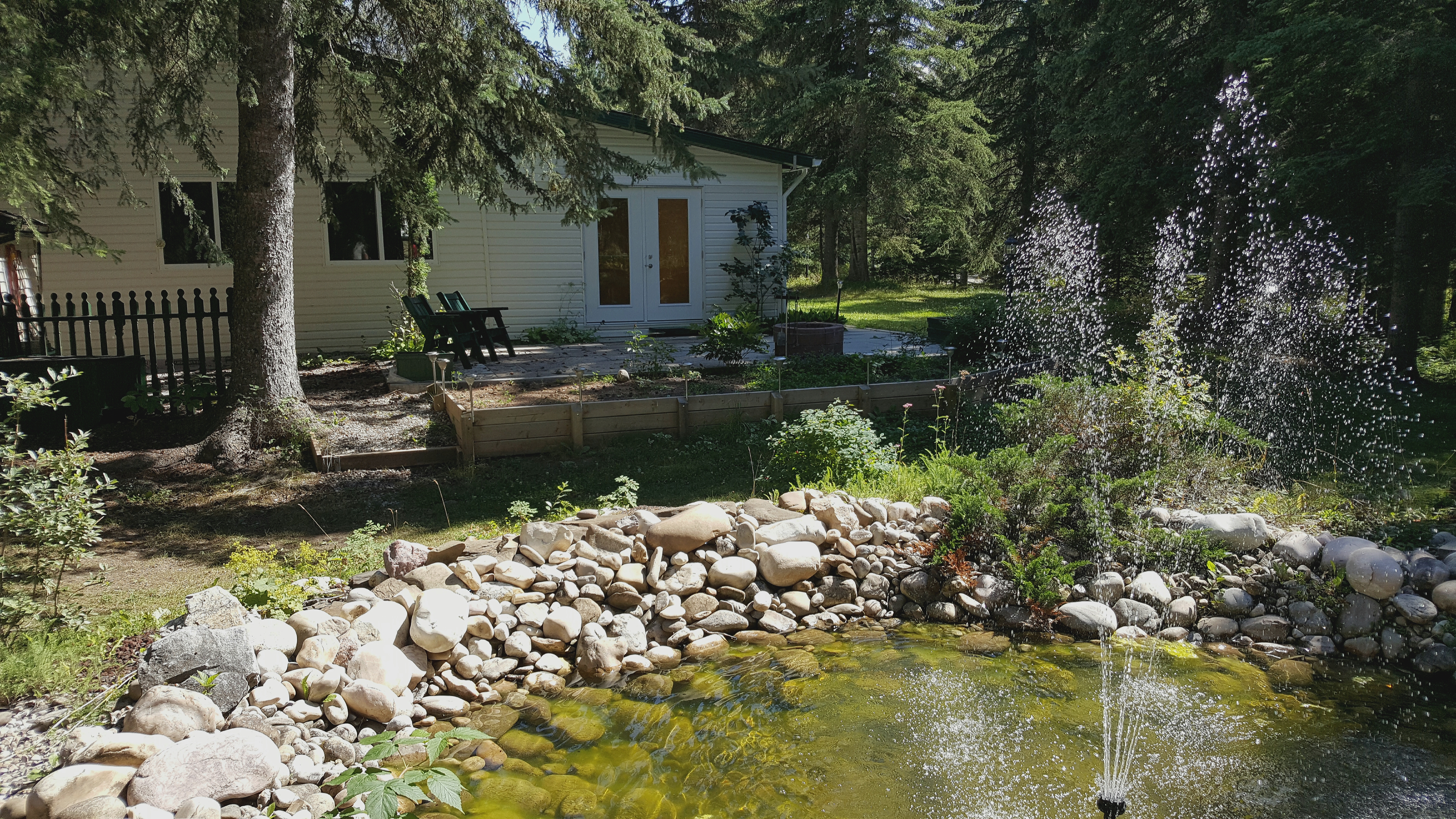
Brief notes on returning home from travel and a link to my photo essay at RIC: Journal

Kolkata is not a place that inspires indifference. It has been almost exactly one month since I left it behind, and yet my thoughts and imagination are still occupied by the city, the people I met, and the experiences I had.

Now that I’m home, with the endless winter so very slowly melting away, I am once again confronting that familiar heaviness that weighs me down and reminds me how hollow and lonely life here can be. Perhaps it is this perennial inability to fit in that drives the restless traveller on. I don’t know.

In the meantime, I’d like to share a photo essay, just published at the wonderful RIC:Journal. This is, in words an images, an attempt to hold my first encounter with India close just a little longer.

You can find my piece here. With gratitude to Saudamini Deo.

Ferries, trains and yellow cabs: Navigating Kolkata in good company

I headed to India without any clear expectations about what I might find in Kolkata. The trip seemed to arrive much faster than I could prepare myself. But just as well. I like to approach a place with an open mind, content to inhabit a small corner, tracing and retracing pathways until they become, for the moment, familiar. I anticipated a fair degree of wandering, alone and unguided. However, as fortune would have it, nearly every day I was out with a friend or acquaintance, for a walk, coffee, or a meal. The opportunity to see fragments of the city through the eyes of others—life-time residents and more recent arrivals, regular visitors and newcomers—opened up varied angles and perspectives I would never have glimpsed as a lone, foreign observer.

A kaleidoscopic view of a kaleidoscopic city.

Love it, hate it, or a complicated mix somewhere in between, it is difficult to imagine Kolkata leaving anyone indifferent. I suppose one could sit still or tread carefully from one established tourist venue to another, but quite honestly it is a city that, despite initial appearances, is more welcoming and safer to move through than one might imagine. It invites personal engagement.On my own, walking remained my default mode of locomotion and, over the course of two weeks I came to know a couple of routes well, especially the stretch of Sarat Bose Road, from my home-stay to Minto Park, a diverse, commercial street. The only public transport I would entertain was the Metro, the aged but determined subway line running across the city from north to south. There was a station close by and one morning I squashed myself into a crowded car to travel north to meet a friend outside the Central station. Together we wandered through the book-lined roads and alleys of the College Street area before joining her husband to enjoy cold coffee at the legendary Indian Coffee House which has, over the past seventy-five years, served as an important gathering place for leading intellectual, cultural and political figures.

Kolkata, at least in the older central part of the city, is conspicuous in its absence of a cluster of gleaming high-rises and commercial office towers. It appears to the outsider like an accidental city. Yet it was once the centre of an empire. Scratch the surface and a cosmopolitan quality still lingers. It has a rich artistic and cultural heritage, but the weight of history and ghosts of the past are tangible. The scars of years of decline and neglect mar the surface.

Layers of existence and subsistence share the same spaces in a manner unimaginable in other major cities. Sidewalk vendors and luxury hotels. Modern buildings beside crumbling ruins. It is a place where anyone with a burner and a pot, a few shoemaking tools, or a pair of scissors can set up business. No one is swept off the street, tucked away out of sight. A dynamic urban ecosystem exists here. At once vibrant and decaying, often side by side. As a friend of mine said, there is a place for everyone in Kolkata: “there is food for every budget. There’s space for every fatigued body and there is transport for every pocket.”

My final weekend in the city was spent in the company of this same friend who had come up from Bangalore for a few days. Together we rode ferries, hired tricycle rickshaws, and experienced the prickly hospitality (or hostility) of an assortment of Yellow Cab drivers. We started out on Saturday morning with a ride across the Hooghly River to Howrah where a rickshaw driver carried us up to the railway station. There we bought platform tickets and my friend shared his enthusiasm for train travel. He led me through a third tier A/C car, insisting that I must, at some point, experience India by rail. (I’m not quite yet confident to attempt that on my own, but challenge registered, and accepted.)

We made several more transits across the river on Saturday, with a longer ride between the Dakshineswar Kali temple and Belur Math on Sunday. These passages introduced an entirely different space and pace. The Hooghly is a wide, languid, opaque green waterway. After the sensory crush of the city, time seems suspended, but even here echoes of the past persist. A mix of magic and sadness.

My friend and I covered a lot of ground over two days, in kilometres and in conversation. At his insistence my experience of Kolkata included small pleasures I would not have otherwise entertained—water from unripened coconuts, delicious fresh squeezed sugar cane juice, and peanuts and puffed rice served in bags crafted from folded newspaper. And his personal perspective on the intersection of municipal grandeur and deterioration helped me begin to frame what I’d observed during my sojourn. A walk after dark through B. B. D. Bagh (Dalhousie Square), the seat of the provincial government and central business district, was a powerful experience, inspiring and haunting in equal measure.

And what would a trip to Kolkata be, in the end, without cab rides? Yellow cabs, even.

And so I left the city carrying the intensity of the place—its mass of contradictions—as a kind of thickened stew that will take time to sift through and clarify. Calcutta. Kolkata.

I remember jammed roadways. Taxis—yellow, white and, Uber. An endless chorus of bleating car horns. Brightly coloured buses jammed with passengers. Three wheeled auto-rickshaws scooting by. Bicycles and motorcycles, sometimes with a single passenger, but more often couples, even families—father driving, mother behind sitting side saddle in a sari, and a youngster on the handlebars—typically all without helmets. The whimsical magic of the Seagull Books office, the enthusiasm of the students at the school, the ambitious and inspiring Peaceworks project. Ngūgī wa Thiong’o in conversation at the Victoria Memorial, under the open sky, surrounded by that monument to colonial glory. Towering tombs, and stalls overflowing with books. The century-old residence where I stayed and my eager, affable host, Nandu.

Coffee. Conversation. Friends.

Until we meet again.

Sifting through my experiences in Kolkata: Leading a class at the Seagull School of Publishing

I’m home from India and slowly recovering from jet lag and food poisoning. It’s the latter, acquired, most likely, on my last evening, that is really dragging the transition out—blurring the kilometres between there and here. In a strange way, the exhaustion and muscle fatigue feels like a metaphorical and physical rinsing of Kolkata out of my system.

It won’t work. I’ve been infected. By the city—and a country—that I want to return to and explore further.

For the moment though, a little distance is required so I can review, focus, and calibrate the experiences of the past two weeks. Then I can begin to weave it into words. I anticipate essays, interviews, and other projects to emerge in the coming months.  But for now, back to this space, roughghosts, to share a little more of my visit over the next few posts.

I did not travel overseas until I was in my mid-fifties. Not having had the opportunity when I was younger, I think I’d become resigned to the notion that it was something I’d never be able to afford. It is, strangely, loss that has made it possible. I live very modestly, I travel alone, and the internet has opened up a network of people to connect with across the globe. So I never feel lonely when I arrive in a strange place. Perhaps I travel to escape the loneliness of home.

My decision to go to Kolkata was spontaneous. It arose out of a chat with Naveen Kishore, the publisher of Seagull Books, sometime last fall. His enthusiastic response to my idle comment that “someday” I would visit, set my plans in motion. And, while an opportunity to see the store and office and meet the staff was the draw, and Ngūgī wa Thiong’o’s planned appearance in the city determined my timing, I ended up with so much more, not only from the Seagull experience but through my exploration of the city on my own and with friends.Rather than attempting to craft a whirlwind tour through a number of Indian centres, I opted to stay in place for two weeks. Cost and available time were the primary limiting factors, but I tend to prefer to be able to exist in a city for a while if I can, rather than dash through. It was a fortuitous decision. Calcutta is not only extremely affordable, but it takes at least a week to begin to learn how to “see” the city, and that has nothing at all to do with getting around or visiting tourist sites. It was only toward the end of my visit that I was beginning to appreciate how deeply my time in Kolkata stands to inform my understanding of Seagull, not just the publishing venture, but the entire Foundation for the Arts. I still need time to reflect and follow up with further conversations before I’ll be ready to write any major essays.

However, there is more. I headed to India with the idea that I would spend time engaging with my endless memoir project—reading, writing, reflecting. Yet I worried that left alone with my own literary ambitions I might be exposed to myself as a fraud. Despite my successes and accomplishments over the past few years, I still struggle with self-esteem. I feel old. Late. Writers that emerge in mid-life or later are a relative rarity in this world that celebrates the promise of the young—the 30 under 30, 40 under 40—and undervalues the possibility of those of us for whom life and circumstance have delayed entry into the creative literary environment.My anxiety was increased with the prospect of giving a presentation at the Seagull School of Publishing. When, Naveen suggested I could do “a session” with the students, I assumed he meant drop in, talk for twenty minutes or something. No stranger to public speaking, facilitation, or educational settings, I have always talked about subjects with which I had some degree of knowledge—developmental projects, brain injury, even bird feeding—but when Assistant Editor, Sayoni Ghosh, advised me that they wanted me to talk about my career (“career”??) in writing, editing, blogging, and online publishing I was taken aback. And the details? I would be leading a masterclass running from 10:30 to 1:30 with a fifteen-minute break for tea at noon.

Excuse me? What of my so-called career could I stretch into three hours?

Yet, as I started to create an outline for this effort, a strange thing happened. I knew that I had always been a naturally strong writer, something that had served me well in academic, professional, and volunteer settings since college, but I hadn’t fully appreciated the extent to which I’d been writing, editing and designing newsletters, publications, and even detailed annual reports for years—typically without the technical resources that should have been employed in the circumstances. My early efforts at one job were produced on a Smith-Corona typewriter with a simple word processing function that allowed me to print out blocks of text (and several different heads that could be exchanged for varying the font style). These blocks were then cut and carefully taped onto 11×17 inch sheets of coloured paper, photocopied and folded to produce eight-page monthly newsletters that, for the era, looked as good as professionally printed products. I fussed to avoid any telltale shadows, took care not to repeat themes or designs. In a later position, I would eventually move on to Microsoft Publisher, working under-resourced on top of my regular job responsibilities to create promotional, educational, and fundraising documents that my not-for-profit employer refused to invest in adequately. Why? Because I could not abide by the amateurish materials they had relied on before I arrived.

The difference today is that I am finally engaged in projects that are personally and creatively rewarding. I have learned to call myself a writer. Perhaps I will someday believe it.In the meantime, on the morning of February 14th, my date with masterclass destiny arrived. The previous day the students had spent the morning with German translator and musician Wieland Hoban, who has translated a number of works for Seagull, most proudly Correspondence: Ingeborg Bachmann and Paul Celan. That afternoon they’d enjoyed the warm wit and wisdom of Kenyan literary giant, Ngūgī wa Thiong’o—a session I’d also been invited to attend.

And then me. No pressure, eh?

Although my carefully created Powerpoint presentation—primarily photographic images and links to websites—baffled me and was abandoned, three hours passed easily with lively discussions of online publishing, blogging, and writing critical reviews. My intention was to promote the idea that in today’s environment, creative engagement is possible, easier and more rewarding than ever, and that it is never too late, even if one’s life or career goes sideways as life and work realities can. To that end I did briefly share my story, my gender-distracted diversions and delays that interfered with my earlier creative writing ambitions for so long. I hoped to help the students to appreciate the truly international nature of a literary community (or circles of communities) that exist and how actively engaging in that world opens opportunities on personal and professional levels no matter “when” or “where” one might be.

In keeping with the spirit at the core of a project like Seagull which started very simply, expanding slowly and organically over time, I also wanted to talk about very small indie publishing efforts. So I told them about my friend John Trefry and Inside the Castle, and how a desire to get his own first book into print has grown into a spirited little publisher, still a singular enterprise out of his own Lawrence, Kansas home, but boasting an impressive roster of authors and published titles. And to illustrate that limited resources should not restrict quality or design, I brought along a copy of Douglas Luman’s The F Text. Much to my surprise and pleasure, one of the students fell in love with it and worried that she wasn’t sure she could obtain a copy. So I gave her mine. And signed it. Which was weird, but cool.

Yesterday the same budding editor contacted me to let me know that she had written about my class for the Students’ blog on the Seagull School webpage! I feel an odd mixture of embarrassment and pride. And relief that my session was of value to the students. I’m also insanely excited that Mihika created a little erasure poem out of an excerpt from my piece, Your Body Will Betray You. What a gift!

Leading a masterclass like this is the last situation I ever expected to find myself in, and I would wager I am the real beneficiary of the opportunity. Gradually I’m learning to believe that others believe that I have something to offer.

One of the many, many precious gifts I am bringing home from Kolkata.

Out on the streets of Kolkata: A little exploration

While my first twenty-four hours or so in the City of Joy were intense—a mixture of everything and nothing I’d imagined—I now, just over halfway through my stay, greet each day with a blend of ease and exhilaration. How quickly one slips into the rhythms, growing accustomed to the roar of traffic and bleating horns. With each venture out, I have found myself fitting into the flow, making my way through the congestion to explore the city. Every time I emerge from my residence out onto Sarat Bose Road, I am filled with a sense of enthusiasm about where my wandering will take me. I have kicked around by myself in strange towns and cities, from Alice Springs to Cape Town, but none as intensely engaging as Kolkata.

Of course, this is a city that refuses to stand by idly. It commands a degree of attention whenever you step out on to the streets, and I do mean on to the streets; one navigates the roadways on and off the sidewalks as need be, and crosses any significant intersection with caution. In some places, smartly dressed traffic controllers aid the safe passage across busy thoroughfares, but only to some effect. I’ve learned to line myself up with other pedestrians and rely on their instincts. But even those only go so far. I’ve seen one man so busy on his cellphone that a van backed up into him. Only slightly startled, he quickly regained his balance and continued both his journey up the side of the road and his conversation without skipping a beat.
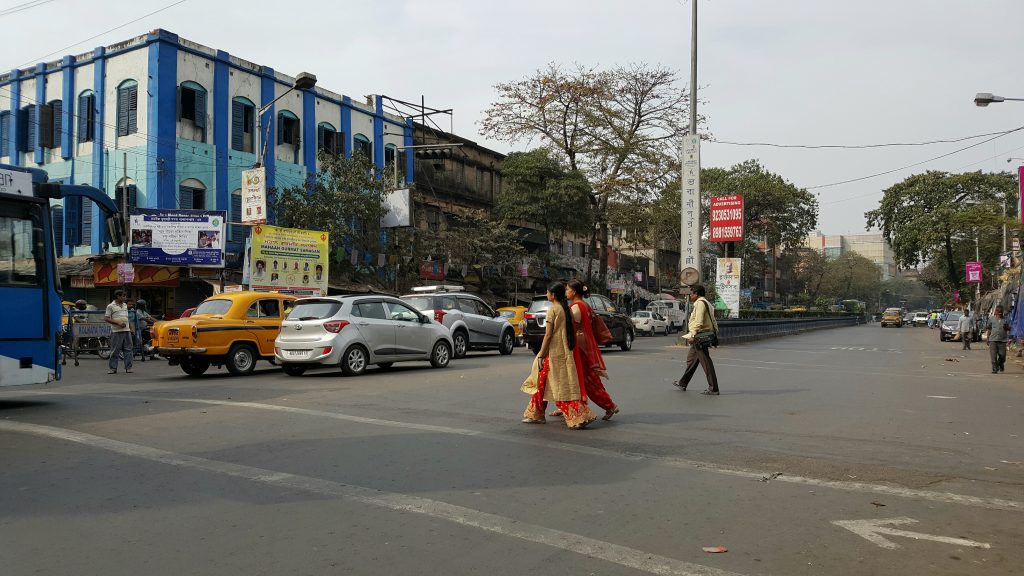
Some seem to engage with the roadways with uncanny confidence. Naveen Kishore, the esteemed publisher of Seagull Books, for example, appears to command the unceasing stream of traffic on S.P Mukerghee like Moses parting the Red Sea. Making the same crossing on route between the Seagull School of Publishing and the offices with their newest editor, a recent arrival from Goa, is a more tenuous exercise. We get half way across and crouch in the middle until an opening appears. On my own, I’ve been known to go out of my way to effect an easier passage, perhaps with lights, which is, even then, not a guaranteed free pass.
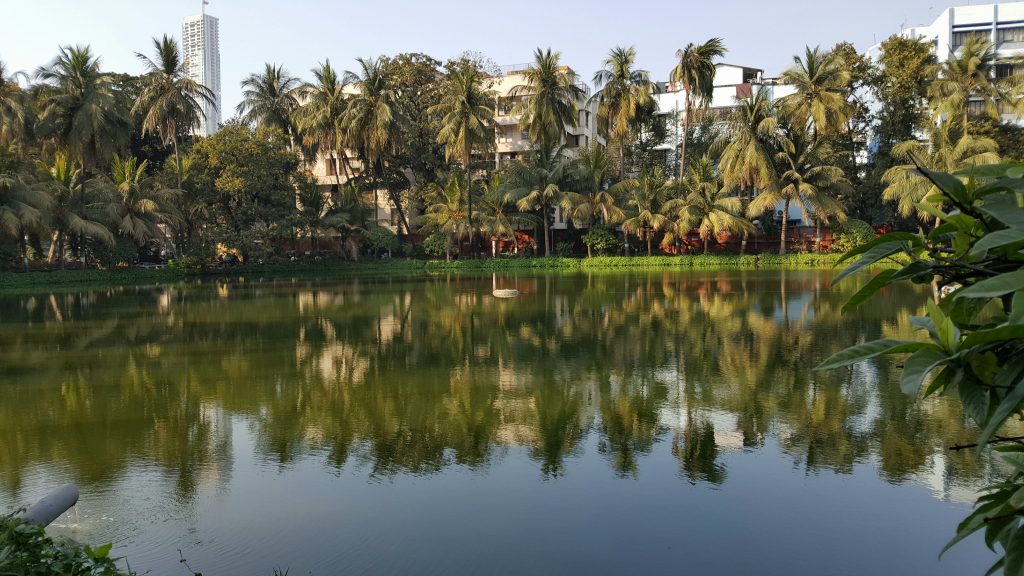
On my first weekend in Kolkata I began to explore. On Saturday, after a day spent mostly indoors working, I took the advice of one of the three men who tend to affairs at the residence where I’m staying that I should go to Minto Park. A little oasis in the middle of a noisy city, with a hectic corridor and a high level overpass running along one end, this space, maintained by the adjacent Belle Vue Hospital, is dominated by a large rectangular pond, lined with palm trees, a pathway and shallow green space. Once inside, all thoughts and memory of the boisterous mayhem of the roadways is, I want to say, not simply forgotten, but almost erased. One remembers the solitude and serenity, not the noise. Returning again almost a week later I noticed that, although the city sounds are acute when you first enter the park, they are all quickly reduced to a distant background murmur once you begin to walk around the pond. Or so it seems. In memory, only stillness remains.

The following day’s random explorations led me to the Victoria Memorial Hall, the grand marble edifice and surrounding gardens constructed in the early 1900s to honour the memory of the Queen. On a Sunday, the building and grounds were overflowing with visitors—local families out for the day, others bussed in from afar—squeezing through the passageways of the hall and spilling out onto the grounds. The colourful splash of bright saris added to the spectacle played out amid such formal colonial sensibilities. Hardly a day for actually absorbing any of the contents of the museum itself, I found it the perfect space for people watching. The relaxed mood of the milling crowds caused me to reflect on how much more fractious such a mass of human beings might be at home. (Mind you, this observation preceded my rush our ride on the Metro.) I have since returned to the Victoria Memorial for a very different evening event on the premises, one with entirely different intention and tone.

But that’s for another post.

Monday was the day for a couple of classic Calcutta experiences. I met up with a fellow book blogger, Chelsea McGill who has lived in the city for five years now and is a passionate defender of its charms, at the famous Flury’s—the tea shop and bakery dating from the 1920s that endeavours to maintain all the elements of Imperial elegance. The location, Park Street, is for the reluctant tourist, the most comforting of spaces I’ve encountered so far, where colonial meets modern architecture and business establishments are opened by courteous doormen. But it does blunt a measure of the in-your-face experience that, for me, makes this city so unique. Until, that is, one slips into the South Park Street Cemetery.
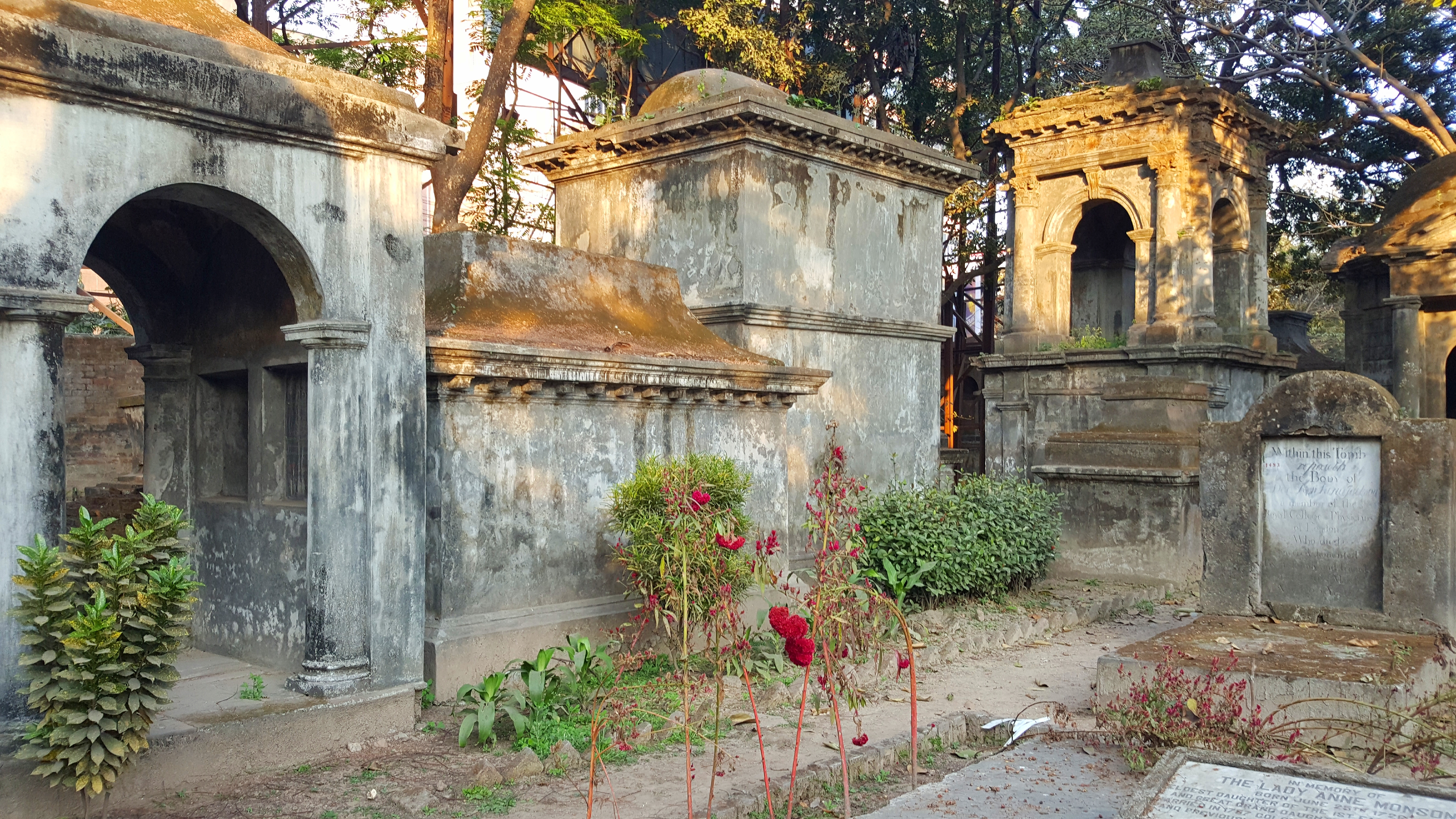
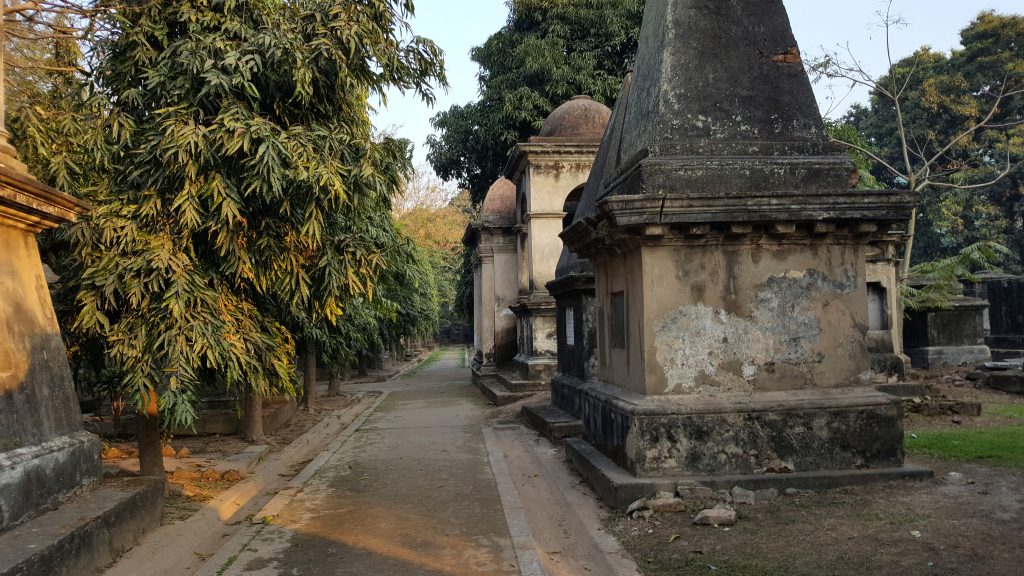
No more than a mark on a map for me before I entered the lush, high-walled enclosure, the place caught me completely off guard. Beneath a tall canopy of greenery, rows of aged-darkened, weather-beaten graves, crypts, mausoleums and obelisks mark the final destination of the British officials, traders, and civil servants drawn to the city in the early years of the East India Company. The inscriptions speak to the men, women and children whose sojourns were cut short by illness and other inclemencies of the tropical environment, as well as those who survived to make the mark in the expanding empire. The grandiosity of the structures is almost overpowering. The weight of the souls resting so far from their home shores is tangible in the hot spring air. The history contained in these stones is palpable. And lingering behind it all, the ghosts of more recent years: the criminals who once used the cemetery as a hideout and the homeless who sought refuge from the elements in the columned structures before the area became a protected heritage site. On the day we were there, I’d say that romance was in the air, evidenced by the many couples making out behind the sepulchres.

Finally, after enjoying my first experience of tea served by a street vendor in a tiny clay cup, I made my way back to my residence. Feeling the heat and the grime settling into my pores, and facing an endless steam of rush hour traffic—cars, buses, taxis, motorcycles, bicycles, the occasional rickshaw driver, and even a horse—I discovered that the streets are elastic. They shrink and stretch with one’s energy and fatigue accordingly.The street I’ve walked the most and know the best, serviceable more than spectacular for the experience, can seem absolutely endless at the end of a good, but tiring day.

So, that was Monday. The flavour of my time in Kolkata  again shifted greatly over the next few days. I had the most remarkable and inspiring opportunity to meet and listen to one of the preeminent literary greats of our time, an experience made even more powerful by its placement here, and now, in the City of Joy.

But more about that later. My notebooks are filling up faster than my ability to transform my observations into posts (and fight with the vagaries of composing on an iPad). More soon.
First days in India: This is the real thing

In the lead-up to my trip to India, I imagined that I would have the time to compose a reflective post about writing and all the anxiety and excitement I feel about having almost two weeks away from home to read, explore a new city, take photographs and, of course, write. As fate would have it, I didn’t have any time for such careful reflection. Coming into the final stretch, in the days preceding my flight, I was beset with the sudden demise of two MacBooks, the second less than twenty-four hours after I brought it home, in the middle of all the work that had to be completed before I could leave.

Just as well, because I had no real idea how the arrival in such a strange, vibrant, and somewhat overwhelming environment would impact me.

I arrived in Kolkata on Wednesday evening after two eight or nine hour flights, separated by a nine hour layover in London during which I met with up Susan Curtis-Kojakovic, the tireless force behind Istros Books, and a further two hour flight from Delhi. I’d been travelling for nearly two full days. I emerged from the airport to noise and sweltering heat and a line up of waiting drivers, none of whom carried the sign I was looking for. A cab driver insisted, repeatedly, that he could take me to any hotel I wanted. I’m sure he saw me as his mark. I tried to make a phone call but could hear nothing, yet when I tried to go back into the building to find a quiet corner, the soldier with the AK-47 across his lap had other ideas.

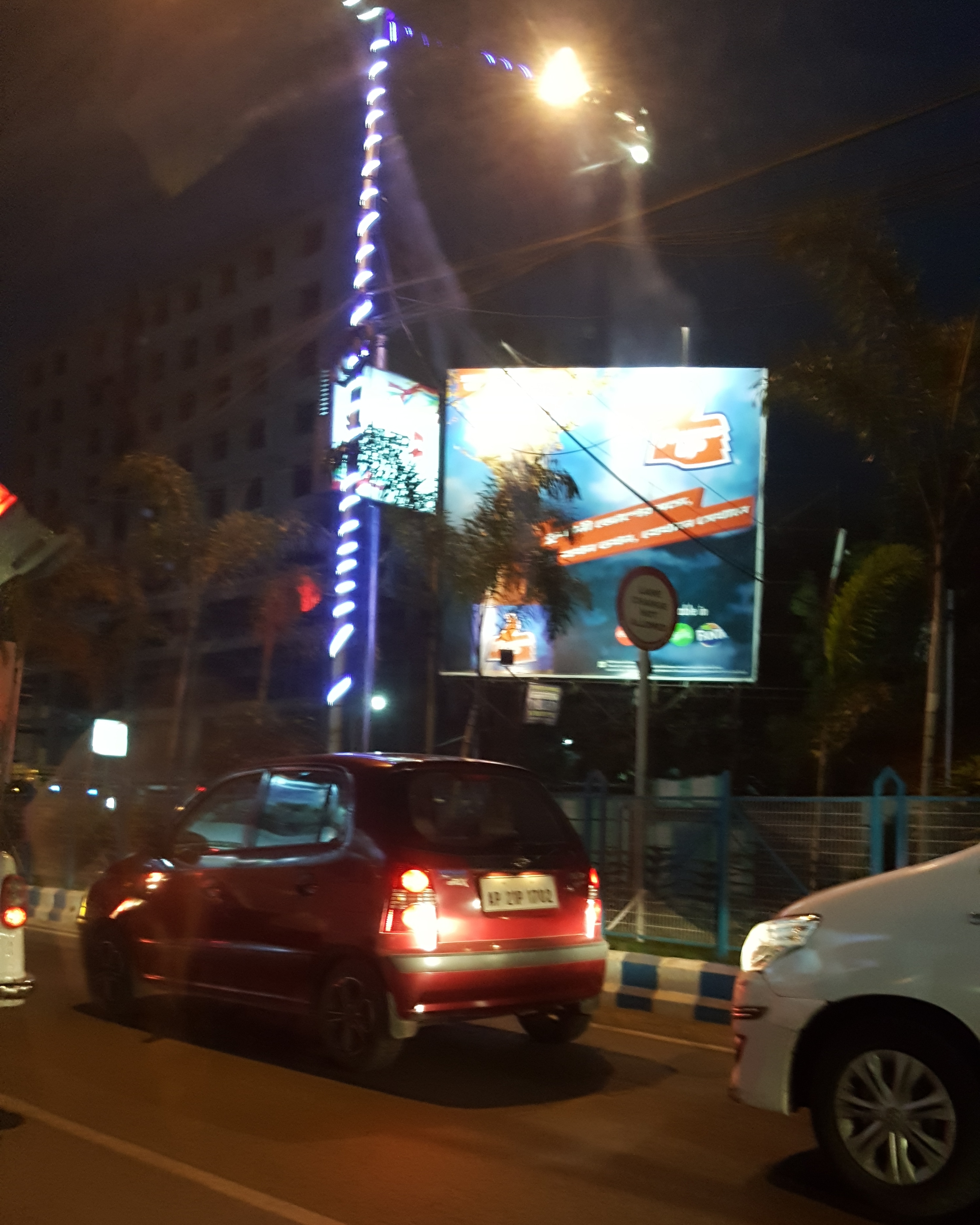
Finally united with my driver who had been waiting at another gate, I made my way into the city. A ride on a river of noise—horns blaring, vehicles squeezing into any space available, lane or not, candy-striped light standards wrapped in strings of lavender and royal blue lights, and clusters of weary men lining the route. Here and there one of the city’s ubiquitous dogs eased its diseased frame to the ground. Every time the traffic flow slowed to a stop, people appeared from behind posts or over low cement barricades to pick their way across the sea of cars, buses and motorcycles. Enterprising street merchants arose to snake between the lanes. To conserve gas the driver would cut the engine until everything began to inch forward again.

It occurred to me, as if I hadn’t quite registered the fact, that I am well and truly in India. This is not a picture postcard. This is real life.

And now, on my third full day in the city, I have barely read a word, no less finished any one of the books I so ambitiously packed, but every morning I have written for several hours. No, I’m not deeply engrossed in the project I planned to devote my energies to, but there is still time. More than a week yet. Rather, I am simply absorbing and transcribing the sounds, smells, tastes and sights I’ve encountered so far. The incessant stream of traffic, punctuated by car horns, that roars up and down the busy street outside the heritage home where I am staying has become a comforting backdrop—an urbanized antidote to those recordings of babbling brooks.

No empty shelves at the Seagull office—if not books than beasts and birds..

On the first morning, in a somewhat quieter locale, I gathered my earliest impressions, mostly aural, of my initial encounter with Kolkata. Later that day I made my first trip to Seagull Books—my first opportunity to meet the staff and tour the nearby school and headquarters of their Peaceworks project. It was all a little overpowering to finally be present in a place I’d long seen captured in photographs. But the real shock if you like, the disconnect I failed to anticipate, was the street level reality of the area in which they are based. In my western naivety I had imagined something, well, less “heart of Calcutta.” But no, this is the real thing. The road on which they are located is a busy thoroughfare lined with sidewalk vendors, beggars, and homeless men, women and children. As I quickly discovered, one rarely actually walks on the sidewalks in this city—they are either crowded with people and structures, or in a continual state of disrepair. I have, in very short order, become accustomed to walking along the edge of the roads, having vehicles pass within an inch of my life, and being, to date, the only obvious foreigner—non ethnically South Asian person if you like—that I have seen.

Many of the people I interact with have no more English than I have Bengali. Uncertain tourists would likely feel ill at ease in these surroundings, but I am loving it! The house manager at this B&B fills me with multi-course Bengali meals at every opportunity. I used a fork for a day but now eat with my hands like everyone else and, knock on wood, I have had none of the usual traveller’s discontents I was fearing. And the bed, a firm 12cm mattress on a wooden platform suits me fine—I’m sleeping soundly. And now that I’ve finally worked out the vagaries of the limited water service, hey, it’s all good.

20180210_145501
One of the coulorful side streets.

The opportunity to spend time at Seagull is a particular honour. Yesterday I managed the five minute walk there and back on my own without getting lost, and had time to sit by myself in the office and gather my preliminary impressions of the place, the groundwork for what I hope will be several articles and interviews to come out of this experience. Next week there are some really exciting things going on…

But for now, I think I ought to walk off a little of the special Bengali breakfast that was prepared here this morning (there is some kind of photo shoot taking place in the house today). So, back out into the noise, colour and congestion that is Kolkata.

Another winter solstice: A dark year ends brightly

2017 has been a difficult year for many, personally and globally. It has become my custom to stop on this day—the shortest of the year, 7 hours, 54 minutes to be exact—and tally an account of sorts for the year just passed. That typically also includes some variation on a “books of the year” theme. This time I will refrain from the attempt to gather a formal list, but will work in some of my literary highlights.

My year began on a very low note.  2016 had been a year marked by significant creative achievement tempered by great personal loss. With the advent of the new year, I was awash in a mix of complicated emotions. Toward the end of February, probate was finally granted on my father’s will and I received the first part of my inheritance. This relieved the serious financial concerns that had been haunting me for months, but paradoxically, I felt worse than ever. As a wave of loneliness, threatened to completely overwhelm me, I sat down and composed a short blog post that, much to my surprise, garnered more views on the first day than any post I’ve ever made. Clearly I was not alone in my loneliness.

I don’t think I can say that post changed my life, but it represents the beginning of an awareness of the extent of the very real community that can develop online. Most tangibly it led to an invitation from fellow blogger Tony Messenger to take part in the annual extreme walk for charity he organizes in central Australia. And of course, because nothing is as perfect as we would like, I picked up an extreme cold somewhere between Calgary and Alice Springs, so I didn’t walk very much (or very fast), but to have almost two weeks out in the heart of the desert was an experience I’ll never forget. And the beginning of a deeper level of grieving for my parents. At the moment, much of the journey is, like so many of my photo files, unprocessed.

These things take time.

And, having travelled halfway around the globe, I had to at least stop into Melbourne and Sydney and catch up with some Twitter and online friends along the way. Every encounter was wonderful, and contributed to shrinking a large, lonely world a little, even if just for a few hours.

Brighton Beach, Melbourne
Glebe, Sydney
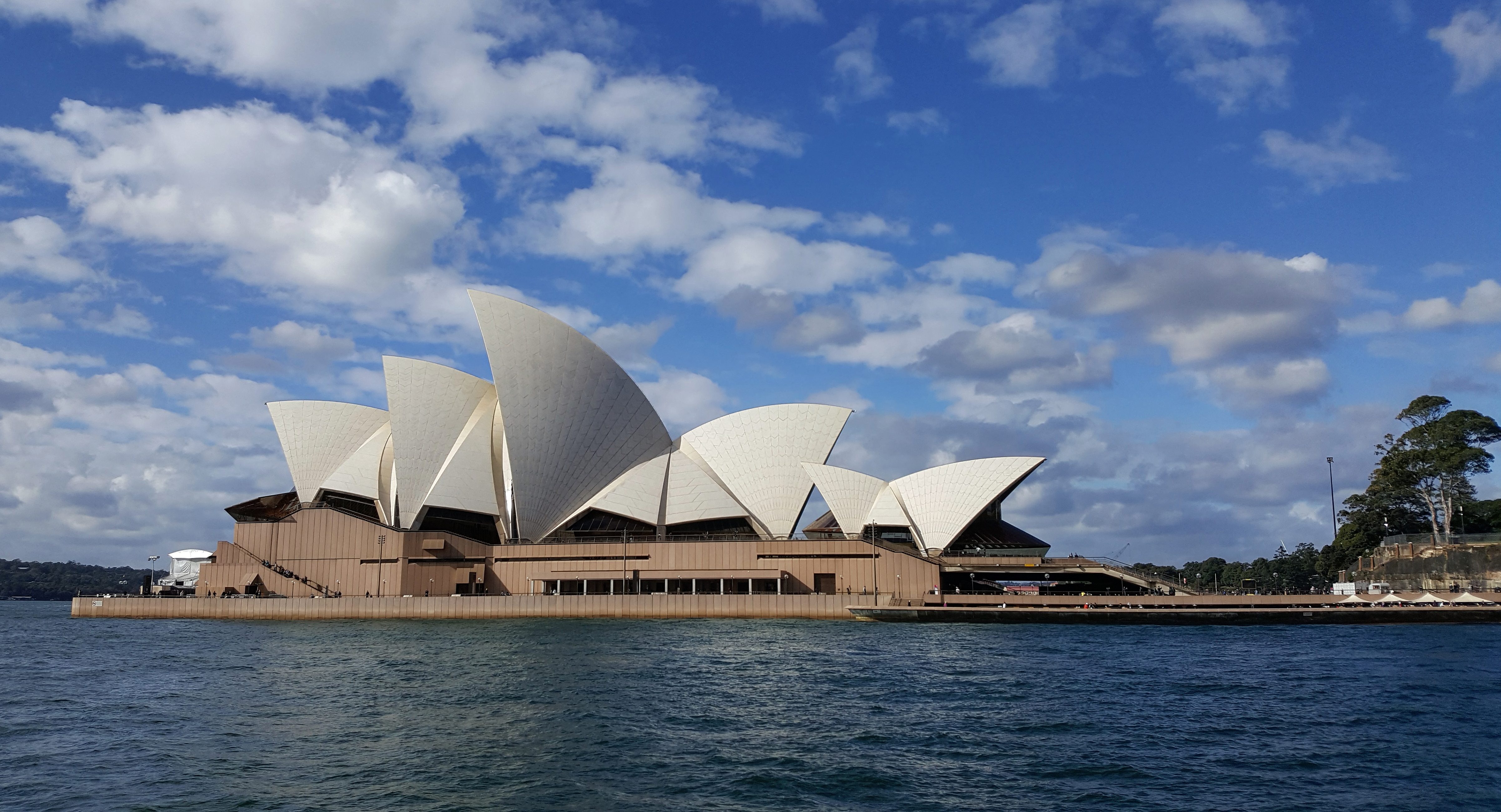
Sydney icon

Over the course of the summer, my brothers and I managed to get our parents’ home fixed up and ready to go on the market. They lived on an acreage outside a small village in a region of the province where the real estate market had been dormant for over a year due to the depressed oil industry. However, things were just starting to turn when we listed the house in late July. Within a week we accepted an offer. Now there are still some estate matters to clear up (and lots more stuff to dispose of), but with a measure of closure we can all start to move forward.

My highlight of the autumn was my city’s annual reader’s festival, Wordfest. I volunteered as a driver for the first time and had a blast. One has an opportunity to engage with authors in a completely different way when driving them around town. And this year’s event featured a strong line-up of Indigenous writers and an excellent poetry cabaret. But by far, my singular thrill was an opportunity to witness the phenomenal M. NourbeSe Philip performing from her experimental epic Zong! I had several opportunities to speak to her privately, and she was generous, supportive, and enthusiastic about my own writing project.

However, when I think back over 2017, I feel like I have been less productive as a writer. I would like to think that the work has been germinating… In truth, 2016 saw the publication of a couple of pieces that had been fermenting for a few years. This year it has been harder to find the focus, but I feel that shifting. I also limited critical writing off my blog, again an energy and concentration issue, but I am very pleased with the reviews I did publish. I’ve also been editing more, an invisible but very highly rewarding activity. And I’m excited to see where my new role with 3:AM Magazine will take me in the year ahead.

And so, at last, to the year in reading. I read many great books—and acquired many more that I’ve not yet gotten to—but here are some of the highlights:

This year I read, for the first time, several writers I have been meaning to get to for a while—Fleur Jaeggy, Ingeborg Bachmann, and Gerald Murnane—and I was in no instance disappointed.

I collected and read an embarrassing amount of poetry. These are a few of the collections I’ve been spending time with:

And somehow I’ve ended up with a healthy selection of contemporary Australian poets (with a few more still on the way):

Meanwhile, a couple of Canadian Indigenous writers really caught me off guard and I have since gathered earlier works by each to catch up on:

As a memoirist (or memoirish writer), I paid special attention to a variety of excellent (and different) memoirs:

And although I can say with confidence that almost every book I read this year was published by an independent publisher, I took special pleasure in supporting some very small indie outfits:

I also like to think that reading should be both intelligent and fun,so with that in mind, these are a few books that really surprised and delighted me:

And finally, I loved every single book released by Two Lines Press in 2017, including two of my absolute favourites novels of the year:

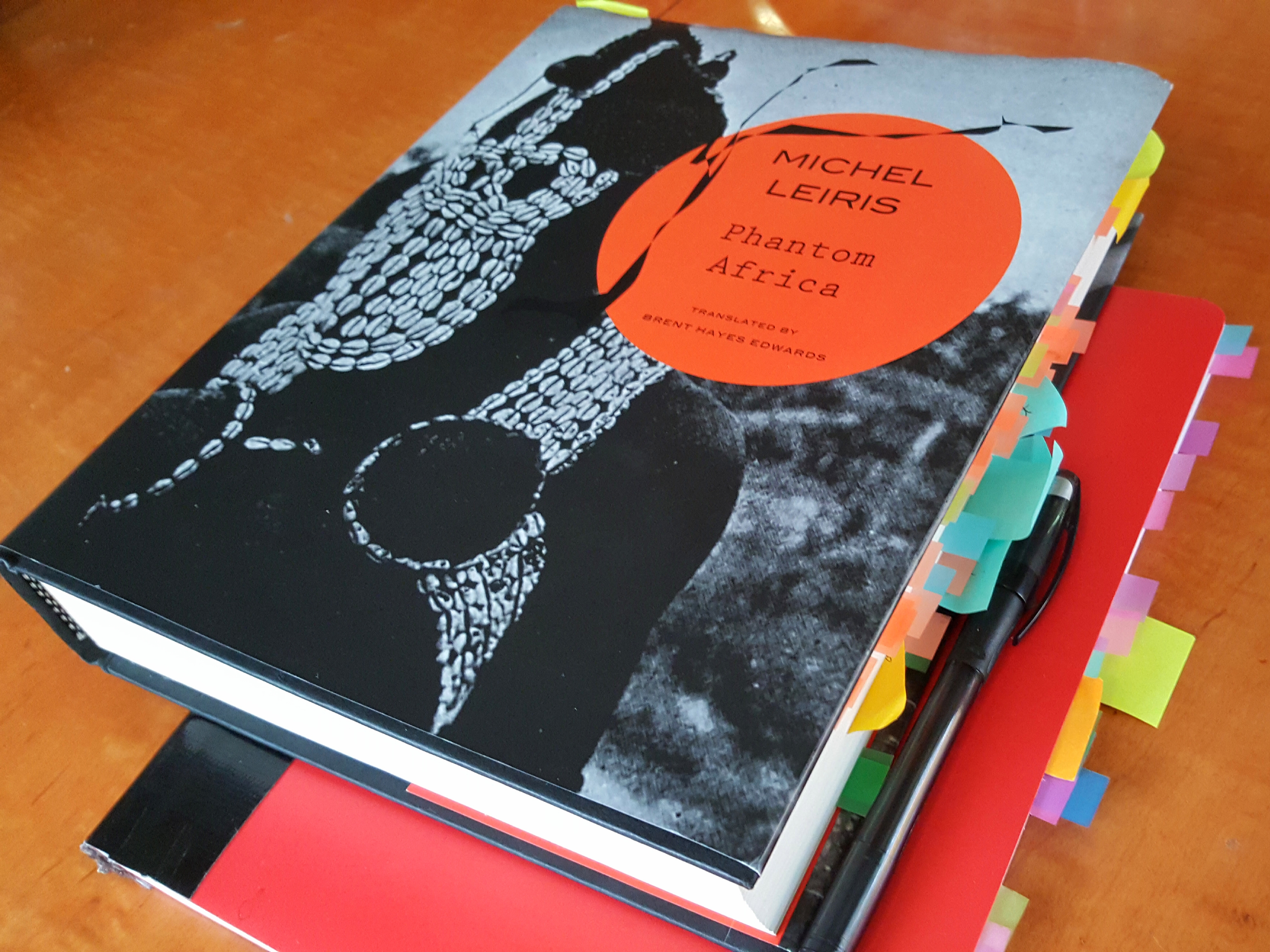
Last, but not least, 2017 is the year I became rather obsessed with French author Michel Leiris. I read the first part of his autobiography, Scratches, which I will write about soon, and purchased the next two parts (the last part has not yet been translated), along with his essays, fiction and correspondences. But, by far, the most demanding and rewarding reading experience I had all year was his monumental journal Phantom Africa. (With the exception of most of the poetry, I wrote about every book pictured here on my blog or for other online magazines. Links can be found on my Review Index 2017 page.)

Now, as the year is coming to a close, I am, of course, still reading. I’m also writing, and looking forward to an upcoming trip to India where I hope to be able get even more writing done. But the true reason this winter solstice is brighter than those of the past few years is that, as of tomorrow, my son who is just about to turn twenty-eight, will have been sober for two weeks. After eight years of heavy drinking and all of the discord, danger, and stress that loving an alcoholic entails this is something I feared I’d never see. I don’t know why he suddenly stopped. I have not asked. I am simply being supportive and hoping that this is the beginning of a new future for him.

So, at least for the moment, it’s all good. I hope everyone else finds a little goodness in the days ahead.

Reflections on the challenge of writing the self, and a link to my essay at RIC Journal

I was lonely child and adolescent. I lived in a rural area, outside a small, but growing, city. There were no children my age in my neighbourhood, and although I had two younger brothers, I spent countless hours alone. A misfit of sorts, I found comfort in the world of words, spending hours reading and writing stories and poems. It was a way of imagining myself elsewhere, fashioning a time or place that I might fit into. However, as I neared my late teens, I became increasingly aware of an inability to inhabit, in reality or in my imagination, the kind of person I wanted to be.

If I couldn’t find my own voice, how could I grant a voice to characters?

So I stopped writing, hopeful that with a little more experience, I would have more to draw from. Gather stories to build on. Live a little first.

But I had no idea how strange and complicated my life would become, so monstrous, too untidy to reduce to words. Ultimately I found my way out of one fiction—the one I was living trying to be the gendered person I was born—and constructed another fiction around myself so that I could exit with some semblance of an ordinary, coherent history.

And then, when my re-orchestrated life was blown apart a few years ago, I was determined that I could no longer afford to hide. Nor could I continue to put off writing. But by then, the only story I had to tell was not the stuff of fantasy or imagination. It was my own. Raw and simple.

For a while I clung to the idea that the only way I could talk about myself was to create a character to carry the weight, bare the secrets, share the pain I was not prepared to own. But every word I wrote circled right back to me. And sounded forced, hollow, and false.

It took me a while to come to a level of comfort with the idea of writing work that I still often refer to as memoirish. I consider everything I write—no matter what form it takes at the end—to be nonfiction because it originates from my experience. But if asked, I simply say I write essay/memoir. I write of the self. On the one hand, I am always afforded a subject. But on the other, it is the most dangerous, difficult, and draining form of writing to do well. Boundaries are critical. The challenge is to touch on the essential and temper the detail.

Because all of my work comes back, in the end, to a lifetime disconnect between body and identity that has shifted but never resolved, I tread a very fine line indeed.

Two days ago, my most recent personal essay was published at RIC Journal. It is a meditation on photography, the body, Barthes, and grief. I wrote it in January for a specific publication and panicked. It was too raw. I didn’t know if it was finished or meant to go further. The thought that it might be part of something larger terrified me. So I put it away.

A few months ago, with my renewed intention to work once again toward a larger memoir project, I pulled it out. With a little distance, I saw it as is complete if rather unclassifiable. Now it is out in the world, another step forward in the ongoing process of writing myself into being.

This piece had no title when I sent it to Saudamini Deo at RIC Journal. As it is presented the first line of the epigraph—my favourite quote from Barthes’ Mourning Diary—has become the title. And it feels perfect.

My essay, “I am either lacerated or ill at ease,” with my own original photographs, can be found here.

Update: Not much writing yet, but there’s always tomorrow. Right?

The calendar may say otherwise, but with the snow and sub-zero temperatures of the past week, autumn seems to be no more than a hazy memory. More than one month into my year of writing fearlessly, precious little Writing has taken place. But’s been a positive, inspiring time all the same.

My city’s annual readers’ festival, Wordfest, was held in mid-October and this year I volunteered as a driver for the first time. What a fantastic way to meet and engage with authors! Whether I was driving children’s authors out to school events, or picking a New Yorker columnist up from the airport, I thoroughly enjoyed the conversations that arose. The programming was impressive as well, including a strong representation of Indigenous writers. But my personal highlight, without question, was the magnificent M NourbeSe Philip. I had three opportunities to talk to this most remarkable woman—a Caribbean-born Canadian poet, writer, playwright, and former lawyer—at some depth. We talked about poetry, writing, and our adult children. She was generous and supportive, especially when I shared with her the nature of my writing about the body. And her performance of excerpts from her seminal, experimental poem Zong! was one of the most powerful readings I have ever attended.

Since the festival ended, I’ve been busy. I worked during our municipal election—an absolute nightmare—we are one of the last paper ballot hold outs, turnout was unexpectedly high, and by midnight during the third recount I found that I was completely incapable of counting to fifty! Add feline dental surgery, writing reviews, editing, and a public speaking engagement (on the intersection of faith and my queer identity, in case you’re curious, a rather uncertain junction to be fair), I have found it difficult to carve out a creative space of my own. But, it’s all good. I even had the opportunity, earlier this week, to attend a book launch for fellow Albertan and Twitter compadre, Steve Passey. To be honest, I went to heckle him, but he’d stacked the house with his friends and family so I decided to be polite. (Just kidding, of course, it was a great night—with wine and cupcakes, what more could you want!)

But, in the midst of all this, the most unexpected and welcome surprise came in the form of an invitation to join 3:AM Magazine as Criticism/Nonfiction Editor. There was a time when just publishing something at 3:AM seemed an impossible dream, and my first effort appeared after the most brutal editing experience—one that almost caused a me to have writerly crisis of faith. I had over-read and over-written a complex postmodern novel. However, I learned so much from the process of working it into shape and I was, in the end, very proud of the result. I firmly believe that being edited myself, editing for The Scofield, and the workshops and training I’ve taken along the way, have all helped make me a stronger writer. And it’s an excellent way to encounter great writers, engage with exciting writing, and help bring it to the attention of others. I look forward to being part of the 3:AM team, I expect it to be both rewarding and inspiring.

So now, to attend to writing. With winter making its presence felt early, it seems the ideal time to settle down and get to work.

Writing into a new season with renewed hope: A reflection

Writers are the scattered or lost tribe of the world. They originated from one belief—even the tenants have been lost—shared rituals and music, and the same place, which was an oasis port on the edge of dark badlands. Because of a history of roaming and Diaspora long, long ago, the individual members became stultified in separate languages and they took on as protective colouring the customs and the beliefs of the populations among whom they lived. They may have given their hearts to the people. But when they meet they recognize one another by a look in the eyes as if squinting against the sun, and by the clumsy gestures of hands. Their hands are uncertainly looking for sugar signs of sharedness. This they will see, maybe with mortification, remorse and shame: That they are indelibly marked by the same stubborn illusions, the same shortcomings making their fit into life an awkward one, the same yearning for projecting connectedness and for initiating transformation.

— Breyten Breytenbach (from Intimate Stranger)

I entered September on a low note, still trying to stay a step ahead of the tendency to slide toward darkness that has been haunting me these past few years. At times I thought I had finally shaken it, only to have another challenge rise up. Last October, bereaved three times in the span of a few months but unable to begin to untangle my grief, I hit the lowest point I can recall since my teens. And paradoxically (because depression holds to its own logic) I had just sold several essays and had two pieces finally emerge in print.

Now, almost a year later, I sense a change.

I feel that I am beginning to heal, and that I am ready to begin to grieve.

The past six months have brought adventure, a degree of closure, a measure of financial security, and the recognition that with true friends, the ones that really matter, distance is not a barrier. However, I have not found a job and I have not written much beyond a few select critical reviews and a few short creative pieces. I talk about finally being ready to write, to focus on a larger project, but now that I no longer have any kind of regular income, writing can feel like a frivolous pursuit. Yet, as much as I was briefly tempted by a professional position I was interested in, I don’t really want to go back to my former line of work, even if that was a viable option and I’m not sure it is.

So, I have made an exciting—and a little unnerving—decision. From the money I recently inherited, I have put aside enough for the next twelve months. It’s a modest sum but my life is not extravagant and I now own my house. Of course, being a pragmatist, I’ve also left a decent amount for emergencies (the cat’s dental work to start) and with luck, a little travel. But rather than seeing this as a stopgap until I find a job, I am considering this as: Paying myself to write.

 My goal is to attend to writing as I would any other job. I’ve joined the Writers’ Guild, increased my volunteer commitments in book and writing related areas, and have several opportunities for contract work of various types. I want to continue to gain practical experience and build on the connections I have.

I made this decision several weeks ago, but only shared it privately with a few people. I needed to know if I could keep on task and keep my mood positive before making my commitment public. Before putting it out there.

And so now it’s public.

Today I turn fifty-seven, another fact I hesitate to share. I’m not sure how I got here so fast, but I don’t want another year to pass without making a serious effort to finally do the only thing I’ve ever wanted to do. To write. To believe in myself.

It is not easy. I realize now that every day I need to work to keep from slipping back into a negative spiral. To that end, I have taken a cue from Michel Leiris whose work has been a near obsession for me of late. I’ve just finished reading his monumental work Phantom Africa which is a journal he kept over the course of a two-year ethnographic expedition from Dakar to Djibouti in the early 1930s. He simply records the events of the day and his feelings about his experiences, in so much as he has time to do so. He does not edit himself, his moods fluctuate, his doubts, frustrations, and erotic dreams are all noted. I decided to follow suit and keep a journal of this year myself. My past journaling efforts have fizzled pretty swiftly because I assumed I had to be profound at all times, to only record my sculpted thoughts. Now my aim is to comment on my successes, or shortcomings for the day, and set a goal for the next. When time or inspiration allows I go further, write about the things that are worrying me, speculate, even dream a little. I don’t confine myself to reading and writing concerns, but they are always central.

So far so good.

I hope to stay open to possibility. To read and write to purpose and potential. I have certain projects in mind, call for submissions I want to answer, but I want to kindle and nurture other ideas and see where they take me.

To trust words.

Ever tried. Ever failed. You know the drill. August 2017, the month that was.

As August draws to a close, and September opens, I have some thoughts about the pressures of prescribed reading and the complicated emotion of loss.

Joseph Schreiber 2017

At the outset of the month I pulled out a selection of potential books to choose from for Women in Translation month. I knew that with several review related reading projects underway I was unlikely to get to more than a few titles. I managed three: one of my must-reads (Carmen Boullosa’s Before), one that was somewhat disappointing (Kjersti A. Skomsvold’s The Faster I Walk, The Smaller I Am), and one late addition (Isabelle Eberhardt’s The Oblivion Seekers). However, I found that many of the books I tried to pick up did not work at all for me— that is, they were not right for right now. Feeling that I ought to try to manage one more before the month was out I found myself frozen, almost unable to read anything… I had to stop and remind myself what such reading projects are all about.

Raising the awareness of the fact that fewer female writers are translated is important, as is celebrating the terrific authors who may not be well known. It never hurts to look at one’s reading habits and challenge one’s self. But it is another thing to get stressed and defensive. And that is what happens when I start to measure my reading by gender. I will admit, more male than female authors line my shelves. I have addressed this fact before in other posts. I also wrote about how for the better part of two decades I read almost exclusively female writers in an essay for Literary Hub last year. For a long time, I hoped that by filling my head with female voices I would find my own. And, of course, I never did. The sense of myself as male was unassailable. Seventeen years ago I set off on a course to realign my presented and internal gender. And here I am.

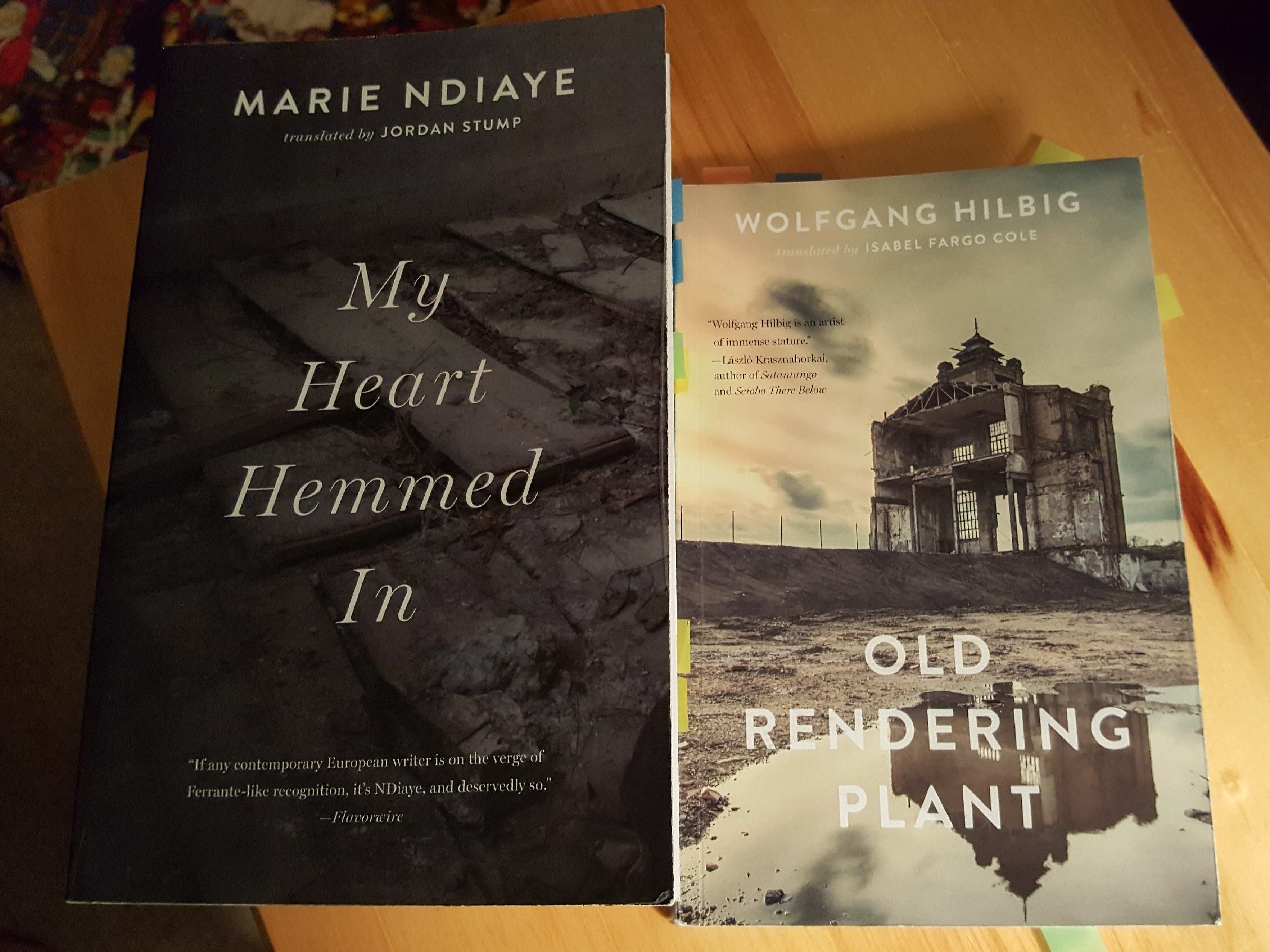
At this point, I like to think that the gender of the authors I read is secondary, although I will admit to a growing need to connect with gender-queered and gender non-conforming perspectives. Most specifically I am drawn to writing that is challenging, exploring style and form. In recent months, some of those writers have, in fact, been women in translation—Fleur Jaeggy, Can Xue, Marie Ndiaye. Before next August rolls around again I am certain there will be more. And I know for a fact I will be turning to some intriguing experimental female writers writing in English. But, as a person with a differently gendered history, gender is a complicated, messy space of being. Whenever I start to feel the burden of gender pressing on me from the outside, the existential anxiety (and anger) that haunts me is stirred.

So, let me read—as and how I need to read.

But my own self-imposed reading ambitions are not the only pressures that have weighed on me this past month. My brothers and I listed our parents’ house and it sold within one week. With the possession date looming we made several trips to clear the house out and, on the final visit, I found my mother’s nail file. She carried this file with its ivory coloured handle and tattered red plastic sheath for decades. Just looking at it I see her hands. It is perhaps the single most important keepsake I have. More than anything it reminds that she is well and truly gone.

When I first came out to my mother, back when transgender was just beginning to draw some serious public attention, she asked for some time to process what I had shared, but promised that she loved me unconditionally. And she never let me down. She was my advocate, my best friend, the one person I could call for comfort and reassurance, no matter what. I was otherwise alone. There were no local supports, I faced the challenges of being a single male parent of two children with learning disabilities, I experienced a breakdown, the loss of a career, and a life-threatening health crisis. Even though she was unable to travel far near the end, she phoned me every week without fail, and I spent as much time as I could with her and my father in their final months.

When my parents died last year, my mother’s death opened an intangible void.

My parents’ house. Our last day there.

I did, however, still have one faint, yet vital lifeline—a friend in South Africa, the closest queer friend I have ever had. Bookish and bipolar, like me, she was a sort of soul mate even though we only met in person once when I visited her in 2015. But as I was tumbling, she was falling further and farther. One year ago today, September 1, Ulla took her own life. Images of the rugged Indian Ocean shoreline near her home have been seeping into my dreams. As we spread our parents’ ashes before leaving their property for the last time, all I could think of was Ulla’s being spread on the beach. I couldn’t touch the urn. My son spread my share.

Eastern Cape, South Africa

Suddenly I am doubly aware of how alone I am. How alone I have been and how weary I am.

The intersection of Pride Week, rather than providing a distraction, exacerbates the sense of loss. I cannot imagine anything lonelier than a mass of shiny happy people. I did excuse myself from the volunteer commitments I had made and now I am free to avoid the parade as I usually do. I also happened to have a doctor’s appointment so I spoke to him about my recent depressive dips and my frustration with the reality of long-term trans loneliness that nobody talks about, that isn’t fashionable, that doesn’t fit the script.

Sometimes loss feels less like a temporary passage, than a layering, compounded, defining quality of life.

Welcome to my closed space reality:

All of old. Nothing else ever. Ever tried. Ever failed. No matter. Try again. Fail again. Fail better.

And so on.

Note: I should have included a link to the requiem I wrote for my friend. This piece was published at Sultan’s Seal last November, is constructed of salvaged language, and features photographs from my visit to South Africa.