In the dark days of winter, searching for words

Normally January and February are my favourite months. The days are growing longer, minute by minute; the days cold and crisp, the ground a snow-covered white, the sky a bright clear blue. A perfect time for reading.

13204111743_c2952b7f51_b
Copyright JM Schreiber, 2014

More than one week into the new year, I have a strange sensation akin to trying to make my way on one of those moving sidewalks that traverse the passageways of major airports. However, because the direction of the sidewalk and I are at odds, I’m making little progress. Lately my weeks have been punctuated by trips to visit my father, 1 1/2 to 3 hours each way, depending on whether or not we pick up my mother. Weather dictates travel, scrambling the best laid plans, and now that my father has moved on to the rehabilitation unit his stubborn determination has returned – for better and, sadly, for worse. Through it all, my mother, now so tiny in her old winter coat, is entertaining the thought that he might someday return home – home to a setting that neither one of them is really well enough to live in anymore. The potential challenges that lie ahead are fraying the less than stellar relationships between myself and my brothers, and these are still the early days. Meanwhile I have dealt with car repairs and a burst hot water pipe. And I don’t even want to venture into the messy, potentially violent eruptions that have threatened peace in my own house as my son struggles with an addiction to alcohol.

To say that my reading has been scattered would be an understatement.

I am afraid that, anxiety and exhaustion aside, I seem to be responding to an internalized sense of guilt that reading, and writing about reading, has no value if it does not generate an income. If your life does not presently include income generating activity – a circumstance that was not by my design but has afforded me the time and energy to read and write – then my literary pastime is even more self-indulgent. Or at least that is what my family members (and their voices that echo in my head) are telling me.

Of course I have been reading, but my focus is off.

I have just emerged from Rafael Chirbes’ forthcoming On the Edge, a testament to internalized guilt, regret and resentment if ever there was one; fuel for my abiding mid-life angst. I’m preparing a review for Numéro Cinq. Otherwise most of what I have read lately is not quite carrying me through. I find myself distracted and picking at pieces, reading on line journals and stabbing aimlessly at collections. As I said, my focus is off.

§ Finish Your Thought!

As in death, we are equalized in thought when we think that every mind in its effort to comprehend the world must come upon the unthinkable.

§ Think for Yourself…

…not others. There is no such thing as thought to spare, only to share.

Matches_Cover_Front_Mockup_07182015-216x346That said, I find that I do have an appetite for aphorisms and fragments. Perhaps that is the ideal antidote for a scattered new year. I am dipping in and out of S.D. Chrostowska’s MATCHES: A Light Book, over 500 pages of illuminating meditative thoughts about the contemporary quality of thinking, reading, and writing. This is not a work intended to be read from cover to cover over a few sittings, rather it is ideal for slow, thoughtful engagement. Light the match, let it burn for a moment, reflect for a while – return again and again, over time. The perfect companion I hope, to lead me back into reading when I feel I am straying and, more critically direct me to writing when fear I am losing my way.

§ New Line of Thought

Every new line of thought is a departure.
Or a new way of arriving where one already is.

11161999254_aee46c0c32_b
Copyright JM Schreiber, 2013

MATCHES: A Light Book is available from Punctum Books.

My father’s library: A very personal reflection

Originally published in December, 2015, I have updated this essay with an addendum.

I was standing in my father’s library last night, looking for a book I could not find, but as I scanned the titles I began to read the shelves as life lines, like the lines that always creased his forehead and fanned out from the corners of his eyes as he squinted through the windshield or glanced up into the rearview mirror of the car. For as long as I can remember, my father never drove without a grimace. The shelf lines are deep and distinct. His love of classic literature represented in tattered hardcover volumes with faded lettering on the spines. His life long obsession with Russia marked with rows of history books, discourses on Stalin and Marxism taking up more space than I’d remembered. And the Soviet literature, of course. Then his more recent forays into western American literature, Ivan Doig, Wallace Stegner. I wonder when he ever took the time to read. When other men might have eased into a life of retirement, my father resisted. Retirement is, like false teeth or hearing aids, for old men. He is 87.

My father is one of those men who, living by Dylan Thomas’ dictum not to go gentle into that good night, has spent his life fighting death with massive doses of mega-vitamins, a deep-seated distrust of doctors, and the belief that if one keeps on working, dedicating oneself to physical labour day after day after day, the Grim Reaper will never get a foothold. Ever. That means continuing to struggle with wheelbarrows full of wet cement, devising new projects, and never turning his back on a beloved old Mercedes that has broken his heart and nearly cost his life a few times. No matter how bent and weary, despite occasionally falling into the wood stove (“it’s nothing”), my father shuffled on defiantly until last Sunday morning when he fell and suffered a massive stroke in the simple human act of putting his pants on, as we all do, one leg at a time.

Yesterday, Christmas Day, was my first opportunity to get up to see him. Fate was not conspiring to make it easy – unless I am reading it wrong – but my car collapsed before I even made it out of town. For better or worse, we were across the street from an established mechanic shop and outside the house of a family who kindly took us in out of the -21c weather until we could make arrangements to get up to my parent’s house, a little cottage in the woods outside a village about 2 hours north of the city I live in. Long story short but one of my brothers was able to drive us, when attempting to rent a car proved impossible. From there I drove my mother, in her car, to Red Deer where my father is hospitalized – a further hour each way.

My first reaction to seeing my father helpless and restrained to his bed was, naturally, heartbreaking. But as my daughter and I took turns holding his hand, stroking his now smooth forehead, witnessing the genuine joy in his eyes – so pleased to see us even if he won’t remember – I realized that I have never, in my life, felt closer to this complicated and difficult man. Meanwhile, my son, hung over and fighting a panic attack, held back, not ready yet to come close. And that’s okay. They have had their own challenges over the years (the long hair and beard chief among them), but he and my father are, in their way, remarkably close. They have gone to the opera together and Thomas has already been given some of his grandfather’s most precious books.

6927247731_1be746041a_z
A childhood favourite of my father’s. My son keeps it safely in a plastic bag.

My father has never been an easy man, but as I grew older I was able to appreciate how harsh his own upbringing was, and to recognize in him the mood disorder we both share, even if he denies its existence. I learned to leave him space, to meet his outbursts without taking them too deeply. After all, how could I, the intellectually inclined, queer black sheep of the family, not love a man who worked in construction camps in remote Ontario, learning the electrical trade organically, until he could save enough to money to do what his family always discouraged – move to New York City and enroll at Columbia in his late twenties. He studied engineering, but he should have been an academic if he could have justified the path. His greatest thrill was reviewing opera and classical music performances for the student newspaper. His love of all things Russian also stems from this era – I am not entirely certain of the exact genesis, but seem to think it may have involved a woman. Hard to imagine,as my father never struck me as the romantic type but he did, in his younger years, bear a striking resemblance to Humphrey Bogart. Maybe there was smoky Russian woman in his past.

As it turned out, he never finished his degree, in those days it wasn’t necessary for an engineering designation. When he met and married my mother in 1957, school was abandoned for full-time employment and, over time, they would move to rural western Canada where he would pine for the New York of the 1950’s while simultaneously looking for more and more remote locations in which to settle. These last few years, working away in defiance of death in a cottage outside of Caroline, Alberta, have probably been some of his happiest. And now we don’t know what the future holds. In the months ahead as my brothers and I seek to find accommodations for our parents, I want to make sure I can look after the library, because unlike the countless carefully labelled jars of salvaged nut and bolts that insulate his workshop, for me, this is where his heart lies.

I want to curate it for him. Whether or not he is ever able to read again, I know he would want the company of some of his books if possible in the future. And I want to trace and record those shelf lines in his honour.

Update: My father did recover to return home, against his doctor’s orders and, for a time managed better than expected. On July 5, 2016 he suffered a stroke and was involved in a head-on collision (as to which came first it will never be known). Remarkably he survived the initial trauma and the stroke, but further complications continued to arise in hospital and he passed away on July 20.

In the midst of all this, my mother was taken to the hospital on July 6 due to infected sores on her feet. When she arrived her oxygen levels were less than 60%. Her lungs had been so restricted by long term effects of osteoporosis that the exchange of CO2 was severely impacted. A respirator failed to reverse the situation, and she passed away on July 9, 2016.

Within two weeks, we lost them both.

Winter solstice (again): 2015 – The year in review

I tend to run solstice to solstice, so this seems as good a time as any to pull together my thoughts about the year that was. I debated the conventional “best of” list affair, but somehow that is not reflective of the way I read or engaged with literature this year. I began the year still finding my footing as a book blogger, my earliest reviews tended to be less critical, more personal. By the end of the year I feel I have endeavoured to establish a more critical but, hopefully still accessible approach. Off my blog, it was an honour to cap off 2015 with my first review on Numéro Cinq where I have been invited to join the masthead. I am most thankful to Douglas Glover, the fine editor of this fine magazine, for having faith in my ability to write.
8294617299_b22c0cd186_z(1)I read and write about books as a an effort to strengthen my own skills both as a reader and a writer, but behind it all is a writing project of my own that has been struggling its way into being, seemingly with an infinite number of forays down paths leading to dead ends. So the following is a review of the year and, along the way, a nod to some of the books, new and not so new, that kept me company.

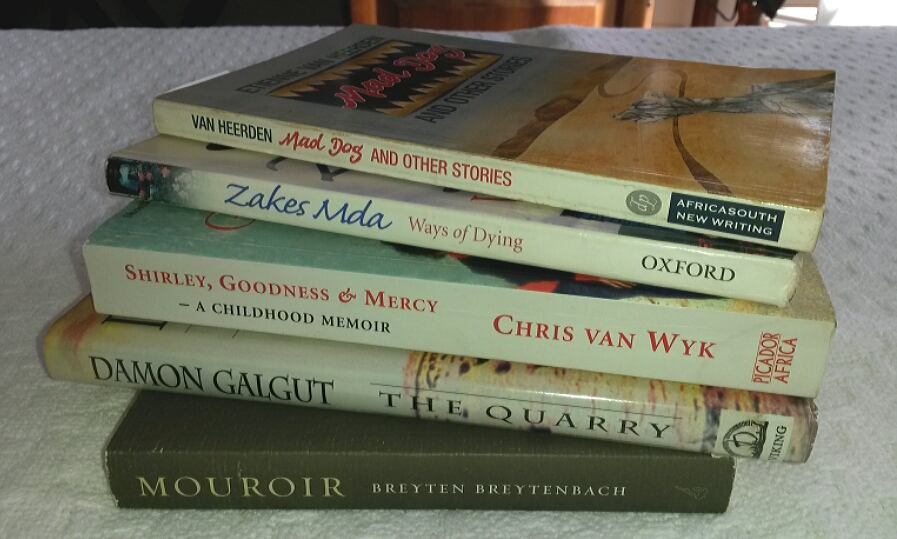
Reading in translation: I have typically read widely, but I never stopped to focus specifically on literature in translation, or, for that matter, to even think of much that I did read as being translated – sounds odd, I know, I think I just thought of myself as someone who tended to read internationally. Joining a shadow jury for the IFFP and then devouring as much of the BTBA long list as I could manage was, for me, a significant turning point in the way that I saw and focused my reading. My books are now shelved (or stacked) by original language. Apart from English I read books in 20 languages over the past year; German, French, Afrikaans, Czech and Spanish topped the list.
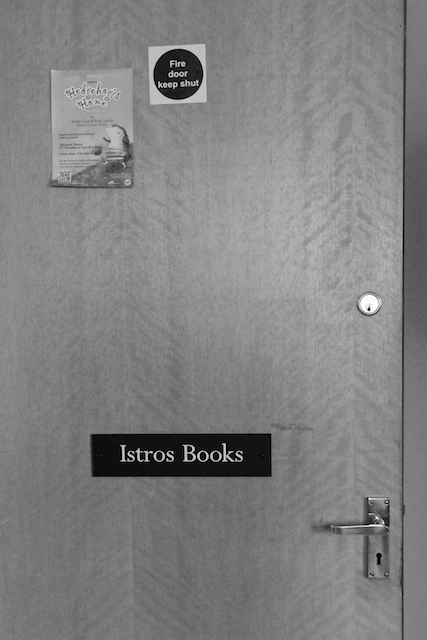
istrosIndependent and not-for-profit publishers: This year I became more conscious about looking to and supporting independent publishers. I was already well aware of Istros Books, a small UK publishing house dedicated to bringing Balkan and Central European writers to an English speaking audience, but this year I had the pleasure of meeting with publisher Susan Curtis, and visiting her closet sized office in the heart of London. She has been a most supportive influence in my development as a reviewer, and because I believe in their books and trust her instincts as an editor, I always look forward to their new releases. I also became conscious of other publishers including And Other Stories, Twisted Spoon, and Two Lines Press, just to name a few. I would reckon I bought few books from major publishers over the course of the past year, and trust me, I bought a lot of books!

2015-10-22 11.21.29Seagull Books: Here I have to credit (or blame?) Anthony of Times Flow Stemmed for bringing Calcutta based Seagull Books to my attention in recent months. I may be late to the party as they seem to have a core of passionate devotees. A book from Seagull is, quite simply, a finely crafted treasure, a reminder why books will never be supplanted by their electronic versions. They are also willing to take on authors or works that other publishers often balk at as witnessed by their impressive German, Swiss, French and African literary offerings, but any publisher who can transform a child’s tale by Thomas Bernhard into a huge, gorgeous picture book for all ages is alright by me!
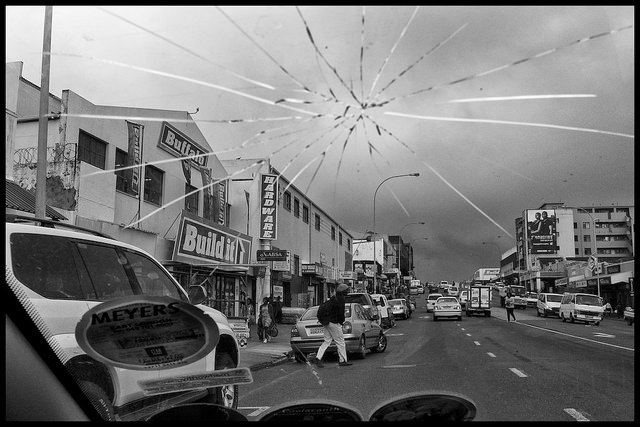
23818667295_d1e4f92c94_zSouth Africa: I have had a significant interest in the literature of South Africa for a number of years but this spring, feeling especially isolated and unhappy in my present circumstances, I decided, rather suddenly, to visit the country for the first time. I aimed for the solstice, effectively trading what would have been summer solstice here in the north for winter solstice in the southern hemisphere. I spent time with a dear friend in the Eastern Cape, then kicked around Cape Town and dropped a small fortune on books.

An ending does not give a life meaning: On my last full day in Cape Town, I sat in the Company’s Gardens, took the notebook I had carried and scribbled in, back to front as is my habit, throughout my journey; opened it to the first page and began to write. I felt I had reached a point, perhaps of closure, a space in which to truly start to pull together my endless personal writing project. I was certain I could, from that vantage point, look back over the months to June of 2014 when I walked away from my job, wildly manic after a period of unbearable workplace stress, and finally begin to give shape to that story I had been trying to tell for so long. I was at an end, of sorts, so I thought, and now I could work back.
14344933323_66912ab5a8_zBut I was wrong: Just over two weeks after I returned home, a pulmonary embolism I had unknowingly developed, a souvenir most likely of my recklessly long flight back, triggered cardiac arrest – in my sleep. The quick response of my son, who happened to be home, saved my life. I nearly reached that “end”, not the one that I imagined would be the point at which I could render my particular life experience and write some meaning into it, but an end final and complete. One that would have left me mute, distorted in the memories of those who have known me. The story would no longer be mine.

So what of writing? That is most critically the end to which I read, seeking ways into a story, or stories, I that need to be able to explore – to ultimately put behind me. I can write easily about other people’s words but I choke up on my own. And so the following list of books are those which spoke to me this year as a reader and a writer. I read over 90 books and enjoyed many including: the long overlooked Hansen’s Children by Ognjen Spahic, Ivan Vladislavić’s Double Negative, While the Gods Were Sleeping by Erwin Mortier, Can Xue’s The Last Lover, Marlene van Niekerk’s monumental Agaat, not to mention her wonderful Swan Whisperer from the Cahier series, and  Primeval and Other Times by Olga Tokarczuk. I have, by the way, excluded from this accounting a host of writers I expect to like and therefore read regularly, often repeatedly, including Bernhard, Sebald, Borges, Coetzee, Damon Galgut, and, added to the group this year, Bohumil Hrabal.

But the following books were, for me, the most vital. Thbirdse order is chronological, as read:

The Alphabet of Birds (And Other Stories) S J Naudé (Afrikaans/tr. SJ Naudé)
* This debut collection, of long, simmering, often disturbing, stories is simply some of the most sensuous work I have ever encountered. The characters are typically groundless, searching South African ex-pats, uncertain residents trying to find their place, and or those suspended somewhere in between.

atavisms


Atavisms (Dalkey) – Maxime Raymond Bock (French/tr. Pablo Strauss)
* The thirteen stories that make up Atavisms reach back hundreds of years, stand in the present, and spin into the future to explore the Québécois experience – at the personal and the political level. Bock skillfully employs a variety of genres to create what reads, in the end, as a mulit-facetted yet cohesive whole. Most impressive.


The Elusive Moth (Open Letter) – Ingrid Winterbach (Afrikaans/tr. Iris Gouws & Ingrid Winterbach )
* This novel about an entomologist in search of some way to fill or heal an ache that even she is at pains to articulate becomes an evocative exploration of memory, loss and anxiety. The story unfolds through scenes that repeat motifs, imagery, and fragmented conversations; set against racial tensions building in the small town where she has come to conduct research. The result has an unforgettable cinematic, art film feel.

 On Wing (Dalkey) / Signs & Symptoms (Twisted gal_on-wingSpoon) – Róbert Gál (Slovak/tr. Mark Kanak/Madelaine Hron)
* As I have tossed my own writing goals between fiction and memoir, happy with neither, I had sensed that an experimental approach might be part of the mix. However I had been frustrated with many of the works I had encountered – at least in so far as they spoke to me in a meaningful constructive way. With On Wing and then Gal’s earlier Signs & Symptoms I finally encountered works that I could enter into with my own observations and begin to map out ways of talking about the essentially philosophical issues I want to address. Re-engaging with philosophy years after my formal studies in the field, has also been critical to framing the way I view the essentially ontological questions I wish to articulate. So I am most grateful to Róbert for both his writing and his encouragement.

A Sorrow Beyond Dreams (Farrar Straus and Giroux) – Peter Handke (German/tr. Ralph Manheim)
* This 69 page memoir, Handke’s finely wrought tribute to his mother written within months of her suicide at the age of 51, not only paints a careful and delicate portrait of a woman trapped by her circumstances, but offers reflections on the challenges of telling a true story – distilling an entire life to the essential elements – when it might be easier to simply make up stories, to, say, write a play. A whole life is messy to write about with elegance. Handke succeeds.

dreamhorsesA Dream of Horses & Other Stories (Roundfire Books) – Aashish Kaul
* This is a collection of dreamscapes populated by seekers of truths, purveyors of words, storytellers and readers. Most of the protagonists are writers, negotiating the fine balance between truth and imagination, struggling to capture the point of intersection in words. At least in my own experiences as a writer, or would-be-writer, that is what spoke to me throughout this melancholy, impressionistic book. And that is why it has to be on my list.

Vertigo (Dorothy Project) – Joanna Walsh
* Short story collections dominate my favourite books this year. It was an intentional focus, again with an eye to becoming more confident with medium. To that end, I recognize that the stories I am drawn to tend to have narrative arcs that are less pronounced, or more subtle, than some may like. The writing is typically more evocative, more ambiguous, more difficult to define and pin down. Like Vertigo – brutally sharp, spare and gorgeous, cutting to the quick of everyday life – an exquisite piece of work.

Dry Season (Istros Books) – Gabriela Babnik (Slovene / tr. Rawley Grau)
* I read many fine and challenging works from Istros Books this year, but the most stunning and devastatingly original has to be the EU Prize winning novel Dry Season. This tale of a love affair between a 62 year-old Slovenian woman and a 27 year-old man from Burkina Faso breaks every expectation, weaving African magical realism into a layered metafictional narrative that culminates in an ending so unexpected that it suddenly throws everything into a new light. Or does it?

sleepSleep of the Righteous (Two Lines Press) – Wolfgang Hilbig (German/tr. Isabel Fargo Cole)
* 2015 saw the release, for the first time in English, of two works by the late German author Wolfgang Hilbig – both championed and translated by Isabel Cole (The other, I, from Seagull Books is waiting on my shelf.) The magic of this collection, set in East Germany before and after re-unification, lies in the atmosphere created by the long sentences that flow, like a stream, back and forward again. Starting grounded in a harsh reality the narratives slip into a subtly surreal, gray-toned, world where reality blurs at the edges and memory takes on a haunting, dark quality.

Adventures in Immediate Irreality (New Drections) – Max Blecher (Romanian/tr. Michael Henry Heim)
* It may well be that my most memorable read of the entire year is one of the last – an impulse buy if I can be honest. A prisoner of the plaster body casts that were the standard treatment of spinal tuberculosis, Blecher’s creative imagination penetrates the experience of being in the world at the level of minute, intimate detail and manages to capture with acute sensitivity those moments of reality in flux and flow. I don’t know how unique this way of interacting with the world is, but as someone who has always had a discordant, dysphoric relationship with his own body, there is more for me, personally, in this book than I can begin to express. A fine closure to a year of excellent reading experiences.

Finally I am most grateful for the conversation and company of the book bloggers and twitter literary folk with whom I have been so fortunate to engage over the past year. I have a dearth of book lovers in my real life. I was at a Christmas party the other night and a game was played in which we were each to share our three worst Christmas gifts – two true and one lie. I was saddened how many people included books among their worst gifts ever. Breaks my heart. Bless you all for keeping me (somewhat) sane.
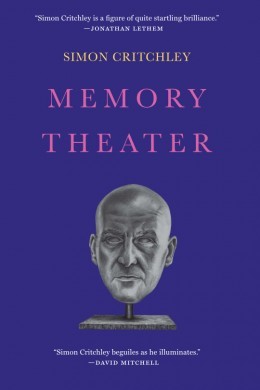
Of that which is remembered: Memory Theater by Simon Critchley

Philosopher Simon Critchley’s curious fictional debut, a detour down a pathway that blurs the lines between essay, fiction, and what might  almost be considered speculative memoir; opens with one miserable protagonist pursued by a relentless insomnia and an abiding fear of death. Our narrator, who shares both name and profession with his progenitor, has been been possessed by terror and sleeplessness for three years by this point and is, quite frankly, “exhausted with exhaustion”. And rightly so, he has put himself through quite the ordeal. In the tale that follows in the brief novel, Memory Theater, he invites the reader to join him on a journey that combines a reflective review of the history of the philosophical fascination with memory and a strange discovery that fuels his own descent into madness.

Memtheatre

The story begins with the protagonist’s decision to relocate to New York from the UK in search of a more accommodating academic environment. However, first he must clear out his office at the University of Essex, and in the process of sorting through his books and papers, he comes across a stack of five boxes tucked away, half hidden. Upon investigation he discovers that they contain the unpublished papers and notes of his friend and former teacher, Michel Haar, who had passed away the previous year. In keeping with his friend’s predilection for astrology, the boxes are labeled with zodiac signs, from Capricorn to Gemini. For some reason Taurus is either missing or absent.

In the boxes he finds letters, manuscripts, maps. He is especially entranced by a treatise entitled “Le théâtre de mémoire selon G. W. F. Hegel”, an original reinterpretation of Hegel’s Phenomenology of Spirit, informed by the notion of the memory theatre as explored in the writings of historian Frances Yates in her classic book, The Art of Memory – a reading of Occidental history as a quest to develop mnemonic systems to capture, contain, and retrieve knowledge.

“Artificial memory machines litter history. Human beings seem to be persistently seduced by the idea that a theater, a palace, or a machine might be constructed that would hold the sum of knowledge in a way that would permit total recall. All that we would need to do in order to obtain absolute knowledge would be to enter the theater or machine and commit to memory everything therein.”

At this point, Critchely’s hero sets off on an overview of the philosophical attempts to realize this ambition, starting with the ancient Greek poet Simonides and moving forward through to the ambitious efforts of Guilo Delmino Camillo in the first half of the 1500’s to obtain the funds to construct a full size theater based on a model he reportedly built and described, culminating ultimately with speculation that the Globe Theatre may have been conceived with similar designs.

The notion of the memory theater enchants the protagonist, especially his friend’s reading via Hegel of memory, not as a static arrangement of information set out on the steps of an amphitheater and viewed from the stage, but as a series of moving images, a history of the Spirit coming into being… memory as process, to be viewed from any spot in the theater. Yet he is troubled by his own experience of memory loss as a result of an accident earlier in his life, recalling that: “My self felt like a theatre with no memory. All the seats were empty. Nothing was happening on stage.”

Overwhelmed by his findings, he retreats to rest for the night before opening the fifth and final box. That night he is visited by a fantastic dream in which he floats through a Gothic cathedral. Magical, vast and vivid in its imagery this dream sequence marks the transition of the novel from the drier, firmer ground of of the academic essay turned memoir, into a space where the impossible is possible. It also provides our first indication that our narrator is more unstable and neurotic than his philosophical lecturing may have suggested.

The following day, on his way back to the university the dream haunts him:

“I… thought about my dream of the Gothic cathedral as a vast memory theater. The medieval love of the figural, the dramatic, and the grotesque was not, then, evidence of either some tortured sexual repression or the liberation from such repression, as we moderns arrogantly assume, but is simply a powerful and vivid aid to recollection.”

But the metaphor quickly expands… a town, a city, the globe, the night sky. He comes to wonder if everyone is their own memory theater, tossing and playing with the idea until he arrives at the office and opens the Pisces box. Inside, at the bottom of the container, he finds a stack of circular charts reproduced on stiff cards. He takes them to be astrological charts but, at closer inspection, he realizes that they are, in truth, memory maps: circular diagrams working inward from biographical details, through an individual’s works to, at the very centre, the date, location and cause of death.

Making his way through the charts, he finds that Michel had drawn up a map for each of his favourite thinkers, and then, moving further along, for various colleagues and contemporaries. What might seem a fancy is rendered prophetic by the fact that a few of the charts assigned to individuals who themselves died after their creator’s death were chillingly accurate in their predictions of the exact details of the subject’s demise.

And then, the fictional Simon finds his own map. The central circle is inscribed: “le 13 juin, 2010, 1551h, Den Bosch, hémorragie cébébrale.” His reaction is cool, cerebral hemmorhage when he would have expected lung cancer. “But where the fuck is Den Bosch?”

Moving on to the United States armed with this knowledge, our protagonist seems to be relaxed and comforted by the certainty of a date and time for his own impending passing. He is productive, and as happy as any philosopher obsessed with dying is likely to be – that is, until the missing link, the box marked Taurus arrives.

Inside he finds a small wooden model of a memory theater, presumably after that which Camillo was purported to have created. And then things get very weird. He begins to experience extreme phantom pains, he starts to hallucinate, anxiety consumes him, he becomes isolated and ultimately ramps up into full blown mania. Tracking down Den Bosch, home of one Hieronymus – master of a memory theater worthy of the totality of heaven and hell if there ever was one – he relocates to the Netherlands and begins to construct a life sized memory theater of his own. A place to die and become god-like at once.

It is quite impossible for me to imagine what it would be like to come to this work without an interest in philosophy. There is a glossary that closes out the work that lists the key personages and concepts that appear in the preceding pages so detailed knowledge is by no means a prerequisite. But it would not hurt. I confess that I arrived with some background, including a degree in philosophy and my own yellowed copy of Frances Yates’ The Art of Memory.

I have also had a longstanding interest in the nature and limitations of memory. I spent a decade working with adult survivors of acquired brain injury; an opportunity to become well acquainted with the range of memory impairments afforded by accident or illness. Our clients included several individuals with severe anoxic injuries that left them with no ability to transfer episodic experience into short term, and ultimately, long term memory. Two had been professionals, one a young lawyer, the other a doctor, prior to injuries that had occurred decades earlier. Given a chance to expound facts from their respective areas of expertise, recall was impressive, if outdated. But leave the room and return a minute later and neither would know they had ever seen you before. With a ten second memory, a memory theatre is an absurd notion, it’s more like a room at the end of a long tunnel with blank walls. A tunnel that grows ever longer over time.

I imagine that this background is, in part, what drew my attention to this book when it was released in the UK by Fitzcarraldo last fall. At the time though, I could not know what would lie between my initial awareness of Memory Theater and my opportunity to read it. With respect to the obsession with death that entertains Critchley, fictional and, apparently, actual as well; I cannot say it ever was a source of particular concern for me. That is until a few minutes after midnight on the 27th of July this year – the anniversary of a marriage which is long over but never ceases to be the harbinger of strange occurrences for me. I had fallen asleep, still exhausted and fighting what I assumed to be prolonged jet lag after a long flight home from South Africa, when a pulmonary embolism nearly claimed my life. By an eerie set of coincidences, my adult son heard me struggling to breathe and was able to call for support and start chest compressions in time.

I was fortunate. No prosaic dance with death that one, no necronautical conceit. I had prepared for the fact that my plane could fall out of the sky or that I could be mugged on the streets of Cape Town (which I very nearly was), but to die in my sleep at that moment? No I was not ready to accept that fate. And apart from the days immediately before and after the event, I survived with my memory intact.

So of what worth the notion of a memory theater? We cannot look forward, we can only look back, and, if there is time, the theater I wish to construct is one that I write into being – for myself and for those I love.

Memory Theater is now available in North America through Other Press.

Nothing less than the big questions: A reflection on Signs & Symptoms by Róbert Gál

“He who seeks, shall be found out.

What is not worth speaking about, is not even worth keeping silent about.

Consciousness is a disease of the spirit.

If life were bearable, there would be no death.”

This is not a review in the formal sense, but an attempt to formulate an answer to the question: So what do you think of Signs & Symptoms?

symptomsSimple, yes? Well, yes and no. It cannot be answered in this forum without an overview of the book in question so it will look suspiciously like a review. So be it. A few weeks back I read and reviewed a book entitled On Wing by poetic Slovak philosopher Róbert Gál, a recent release from Dalkey Archive Press. Signs & Symptoms was an earlier work translated into English and published by Prague-based Twisted Spoon Press in 2003. My copy and the question above, are courtesy of the author.

First of all, the book itself is beautiful to look at and to hold. Textured covers, French flaps, thick paper and an ethereal series of black and white photographs created specifically to accompany this work. But more about those later.

The text consists of three separate pieces unified by recurring themes. The first section “Epigraffiti”, is a collection of single-line aphorisms composed between 1995 and 2000. There is a distinctly pessimistic tone here in these simple observations about life, death, God, truth and the measure of possibility against faith, hope and the experience of time:

“Where possibility ends, there the past begins.

Reality is a long-forgotten possibility now being fulfilled.

The future never happened.”

A reflective neurotic, sometimes bitter, despondency prevails. Although this is the simplest section to read, I emerged feeling a slight heaviness in my chest. If this work begins, as the author’s note suggests from a “bottom”, a low place, this earliest segment sets the stage.

The centrepiece of the book is the second section, “Signs & Symptoms” which is, in turn divided into four parts or “circles”. The first circle sets off with a series of short prose pieces which open with an anecdotal feel – fragmented stories and conversations that lead into speculative statements. The philosophical observations soon take over completely.

“Panic is the emotional tremor of a short circuit, a protracted slide into permanent irritation. Not daring to say YES is symptomatic of fearing an expected NO. The moment before is firmly decided on taking a risky leap beyond. Signs speak through expression.”

The second and third circles, still maintain the short fragmented format but engage in much more intense, condensed ontological arguments, frequently requiring careful reading and re-reading. Here we are bluntly confronted with statements about the nature of being, existence as measured in hope, pain and desire. The real meaty stuff. This is where a few reviewers I found fell off the map a little. Me, I grabbed my journal, finding in these sections fuel for honing some of the ontological truths I have encountered in my particular experience of being in the world. Observations that I hope to be able to articulate in a writing project of my own.

Finally, the “fourth circle” opens up the atmosphere again, relaxing the intensity with some very striking observations about the reality of human relationships to the self and others.

The book closes with a section entitled “Postludia”, a collection of single sentence aphorisms and fragmented prose pieces. Distant echoes of themes from the earlier sections resurface here but the atmosphere is quieter, wiser, more poetic. If the author’s intent, as he indicates, is to re-imagine Romanian philosopher Emil Cioran, as avant-garde jazz musician John Zorn brought the music of Ornette Coleman “into the present” on his album Spy vs Spy, then it is in this final part of Signs & Symptoms that the contemporary feels especially close at hand and the work as a single experience reaches a sense of completion.

“‘Create a mask in your own image,’ runs the imperative of assimiliation.”

or

“Sympathy means that everyone is to blame for everything. And this excuses us, mitigating our guilt.

Nonethelss, such a purification takes entire lifetimes to carry out…”

Against this philosophical text which, taken as a whole, strikes me as On Wing did, with an inherent musicality (albeit discordant and experimental at times), the illustrations – a series of nude self portraits by Slovak photographer Lucia Nimcová – play against the text like a sort of dance. As illustrations they are intentionally metaphoric, but I found that the contrast of remote or removed images, frequently showing no head or face, against tight close ups, foster a separate and unique philosophical monologue that works well to complement or contradict the text, both being valid and desirable effects.

So, if it isn’t apparent, I would have to say that I found this to be an absorbing and challenging read. It is coming to me just at the right time for a number of reasons. But there is, of course, a fundamental universality to questions about the nature of existence or man would not have been pondering them for millennia. At this moment I am not looking for answers, I am rather focused on exploring and refining a way of posing questions to others.

There was a time, almost 30 years ago I shudder to think, when I completed a degree in Philosophy. It was not my first degree and I proved adept at synthesizing the most complex ideas and re-framing and defending them. I graduated summa cum laude. But I was neither fighting with ideas nor digesting them. On one of my last days I ran into a professor who asked after my plans. I told him I had taken the LSAT and applied to law school (I didn’t go but that’s another story). He nodded and said to me, “Your work is very strong, you can write very well, but you have no questions. A philosopher needs to have questions burning inside him.”

I agreed. He was right. Well, no, I did have questions but they were buried so deep and so close to my identity that I had no words to express them at the time. I did not know you could. As the years went by and those questions finally did break through and my life took paths I had never imagined, I often thought how desperately I would love to be able to go back and do a graduate degree in Philosophy. I had questions, by God! I still do. But by then I was in no position to return to school, I was a single parent and Philosophy is not exactly a fast track to a solid career. Neither is writing, the medium to which I am turning to explore my present questions, but at least I can do it on the cheap.

Signs & Symptoms is a text I suspect I will return to again as I go forward. The translation by Madelaine Hron handles the spirit and the complexity of the material smoothly. With my reading of On Wing, I marveled at the magic maintained in that translation. Here I realized that, of course, translation has long been an intrinsic element in the spread of philosophical ideas. In literary discussions some readers reject works in translation as necessarily less than the original insisting on engagement solely with texts in languages that one can read directly. How myopic to close one’s self off to the exchange of ideas! A book like Signs & Symptoms would have precious little impact knocking around in the borders of a small country like Slovakia where it was first published. Translation into English has set it free to engage a wide and diverse range of readers. A good thing indeed.

So that, Róbert, is what I think about this book. And thank you.

To write one’s self: reflections on the stories we have to tell

IMGP2473 - Version 2

Don’t write yourself
in between worlds,

rise up against
multiple meanings,

trust the trail of tears,
and learn to live.

             – Paul Celan


I have resisted the act of writing my self. Writing about myself. The conceit of imagining that my own experiences hold a value, interest or point of connection for others. I wanted to tell stories, inventions, creations that were removed from the inexorable ordinariness of my own life.

IMGP2477 (1)I am not sure I have that gift. I fear that all the stories I have that are worth telling are real. Not true stories. I do not believe there is an objective truth to the stories we tell ourselves or others. But they are real.

For many years I worked as a storyteller. Not in the conventional sense of the word. I worked with survivors of acquired brain injury and their families. Whether I was meeting with clients, advocating with professionals or leading support groups stories were my medium. I had hundreds of stories, I had a facility for remembering the broad details of the experiences of our clients and their families. Tales of courage, tales of horror, tales of the ordinary and the everyday. I was able to pull out an example whenever I required one to offer warning, hope, validation. And I was able to do so without revealing identifying details.

IMGP2465 (1)As always I was the master of ambiguity. After all that was how I engaged with the world myself. But what is essential in a professional capacity is crippling in a personal sphere.

I have touched at the edges of my own stories, in so far as I am learning to articulate them, in this space from time to time. And I am beginning to wonder whether it is a folly for me  to assume that I have the capacity to make up stories, to entertain with carefully constructed lies.

Or if this mess of a life that has piled up in front of me like heavy wet snow against a plow has to be cleared, examined, transformed into words on a page before I can even begin to figure out if there might be something here that someone else might want to read.

IMGP2461 - Version 2 (1)In the coming days I will officially be two months out from the night a blood clot very nearly took my life. My chest still feels tight, bruised and cracked ribs are slow to heal completely, but I can finally get out and walk with comfort – something that was still impossible a few weeks ago. Rat poison is my friend.

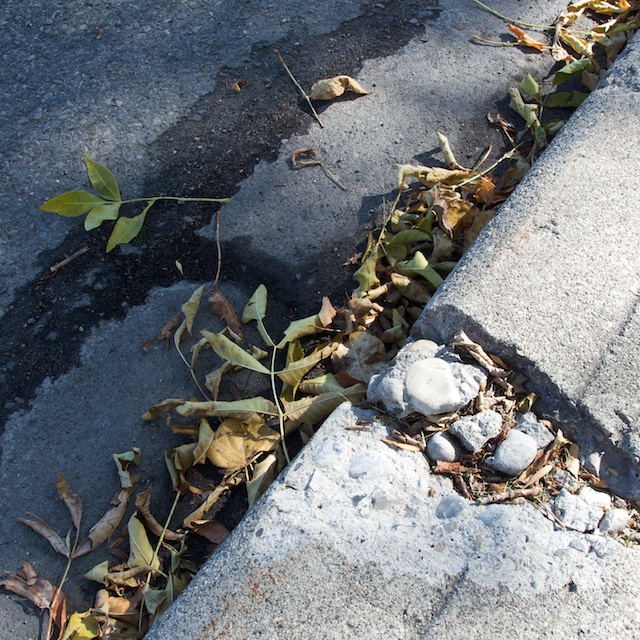
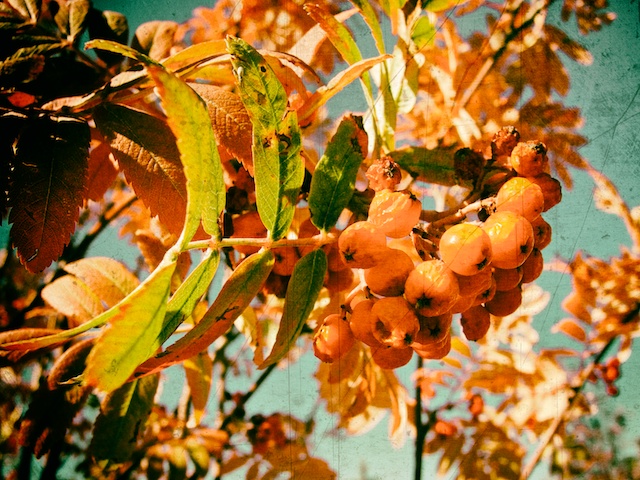
I took my camera out into the neighbourhood this afternoon. The foliage is turning colour, the sky is crystal blue, yet I found my attention turning to the cracks in the road, the fallen leaves in the gutters. I photographed the little things that caught my eye and tried not to think too much.


Reflection: Fishing for memories denied

It is rare that I indulge in sharing a significant quotation simply because it speaks to the space in which I find myself but I keep returning to these words from Intimate Stranger by Breyten Breytenbach (Archipelago Books, 2009).

“Writing is fishing for memory in time. Viscous. Time black. Sometimes you see it flitting just below the surface – memory – miming time. Memory takes on the blackness of time. Memory will be time surfacing. Use word as bait. Beat the water. Beat the weird beat of baited words. Bloated. Wounds. The bleeding words like wounded boats on a black sea. Let the fleet wash up. The coast is the beginning of the sea’s wisdom. It comes with the territory.

Words have their own territory, they return home as in a song. The fish only discovers the water once it is removed from it. This land is a memotory.

But not peaceful. Memory as trigger for territory and tongue. The mind is full of bloody pieces staked out by tongue. Is there room enough? Memory killing memory.”

initmateThis book, a selection of meditations on reading and writing, was waiting for me when I returned home from the hospital just 10 days ago. I have been keeping it close and dipping in and out of it. Breytenbach is a South African poet, writer and painter but his life, his work, his vision is borderless. In this collection he offers practical advice, shares poems and reflections on the power of the word, drawing on his own experiences as well as the wisdom of a legacy of gifted writers.

Memory is the foundation of writing. One draws on experience when putting pen to paper – poetry, fiction, memoir alike. And it is memory that is weighing me down, threatening to drag me beneath the surface; a memory that haunts and obsesses me because although it involves me, I will never access it.

I have lost a space in time. Like a bruise it bleeds beyond the boundary of the injury, reaching backward and forward from the instant a clot in my lung threatened to stop my heart. Days are absolutely gone, the day or two before the incident, the day or so in ICU and the first days after waking. But I can’t let the blackness go. I cannot let it wash out to sea. I want to hold the moments, hours, days in my hands but I cannot. They do not belong to me. They are about me. They will never be mine.

I have read my discharge summary until I know it inside out. I have pestered my anxious son with questions. What was it like to find me in distress? How did you get to the hospital? How did you feel? Stupid questions. I am struck with shocked disquiet to realize that my family did not know if I would survive.

If I had not survived the blackness would be complete. Viscous. Time black. Inanimate from my perspective. My own memories lost. The sole distorted possession of those who knew me, no longer mine.

Sands are shifting. I have some fishing to attend to before the next high tide.

Indian Ocean, Eastern Cape, South Africa Copyright JM Schreiber 2015
Indian Ocean, Eastern Cape, South Africa
Copyright JM Schreiber 2015

Easing back into reading

As soon as I was coming around a few days after my recent near death encounter (and I don’t mean that in any mystical tunnel of light sort of way) I told my kids that I wanted them to bring me books. I could barely stay alert long enough to get an entire sentence out but I wanted books. They obliged me. Wisely I asked for one of the few books on my shelves which might count as a mystery – Lost Ground by South African author Michiel Heyns – which has proved to be fine company indeed though I have only been able to read attentively for a few days now. They also brought along one of my endless stream of incoming purchases, a gem from Twisted Spoon chosen for Women in Translation Month – Primeval and Other Times by Polish writer Olga Tokarczuk. A surreal and fantastic work it looks good but I may have to push it a little further down the month. Reading is tough work after cardiac arrest. Go figure.

Now that I am at home, facing three blood tests each week and a host of other medical appointments all over the city when I have been told I can’t drive for 6 months, I find myself reading and re-reading my discharge report. I am living on warfarin – rat poison – afraid of bleeding too much or worse, clotting too easily and having a stroke. The devious little pulmonary embolism that triggered this whole adventure (a likely souvenir of a hellish 24 hours of flight time packed tightly into 28 hours on my recent return from Cape Town) is still sitting in my lung and will, they say, eventually be absorbed. My left leg is swollen and bruised due to a hematoma, a probable complication of the resuscitation process. I watch people jogging by outside on this hot summer day and feel like some sort of Frankenstein creature, dragging this heavy black and blue leg around.

Even though my friends have been amazing – I had a steady stream of visitors throughout my hospital stay and have no shortage of offers for rides around town – I feel a despair settling in. I don’t know where to turn, where to dig into the towers of books surrounding me. I wonder what would have happened had I slipped off this mortal coil two weeks ago. What would my family say about all these books on which I have squandered my limited funds? For heaven’s sake my open shelved coffee table loaded with books and stacks of journals – Granta, Paris Review, Music & Literature – came apart when the paramedics tried to pull it out of the way. I feel overwhelmed rather than excited about diving in to all the new books I have acquired in the past month. I had to buy an extra bag, after all, to get my haul of books home from South Africa and now they too sit on the shelf taunting me.

Will the magic of reading come back with my health?

2015-08-09 17.37.38I have also wondered if this experience is that final kick in the behind that I need to get serious about my own writing. I’m in my mid-50s. I’m not getting younger. Coincidentally while in the hospital I signed my first contract for the publication of an essay in a book coming out next Spring. It is a niche project – a collection aimed at gay, bisexual and transgender men – but my first professional publication credit all the same. So how much life with all its mess, joy and agony does one have to drag his or her sorry self through before there is enough fodder for a story? I wrote throughout my youth, being a writer was always my dream, a strength in every course I completed in university and every job I have ever held. But when it came down to creative writing I always insisted that I had to live a little first.

At this moment I feel that I lived so much that I don’t know where to begin. And now I have almost died too.

One miserably roughed up ghost, rising from the ashes once more

Sometimes you fool yourself. You believe that you are invincible. You know that bad things happen to good people. You know that they have even happened to you. But time and time again we are caught off guard reminded of the wisdom of Monty Python’s idiom: Nobody expects the Spanish Inquisition.

14701351714_280be514fc_z
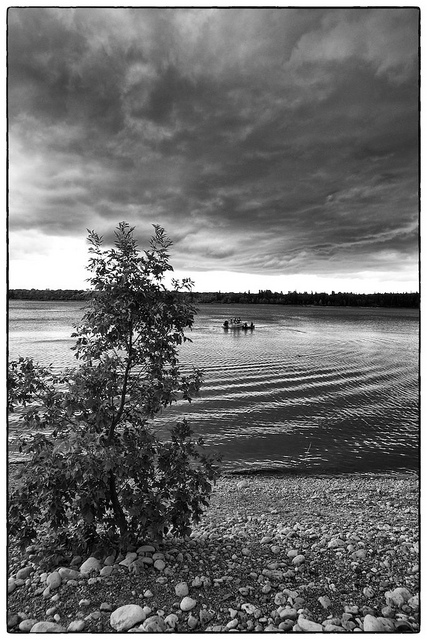
Copyright JM Schreiber Storm clouds over the Reservoir, Calgary, AB

If I had had more experience traveling I might not have made the mistakes that may very nearly have cost me my life this past week. I thought that by focusing my first visit to South Africa to longer stays in two areas, I would limit my travel time. But instead I ended up with long plane flights and interminable bus trips. Next time, and I definitely hope there is a next time  – *the hematologist looks at me askance* – I hope to take longer and fly between major centres once I get to South Africa. The buses have a certain charm and I definitely got to meet and talk to people in a way I might not have otherwise, but to top off my three week excursion with a three leg flight home with very short turnarounds was a major miscalculation  on my part. It sounded great. But I had no idea exactly how tight a three hour stop over is, especially if you have to clear customs. Longer stop overs would have helped. Baby asprins, compression stockings. Everyone has recommendations now.

Yet although I was tired and swollen upon my return, it would take a few weeks before my journey caught up with me. Last Sunday night, or rather, early Monday morning, two and half weeks after I returned home, all swelling and fatigue seemingly gone, I suffered a pulmonary embolism. Well actually, it was not clear what had happened at first. I have very little memory of that day or an evening event I had been to with friends. My 25 year-old son, a creative, troubled but wonderful soul, heard me moaning. Thomas came upstairs to find me disoriented. He called Emergency and started chest compressions.

The kid saved my life. In one of those odd ironies, or twists of fate, toward the end of my time away, Thomas had suffered a couple of acute panic attacks so severe that he twice was taken to the hospital. In the second situation he was referred on to a psychiatric nurse he liked and she suggested a 4 week outpatient program he had just started. Mind you my little detour has interrupted  his plans but they will contact him as soon as there is a good point for him to join back in. Me, I will be in the hospital for at least another week, but the more “functional” I am, the more I can spend time reading.

So good with the bad. Who knows? Maybe the two truly are bound more tightly than we realize.

Looking back over my shoulder at three weeks in South Africa

It is coming up on two weeks now since I left South Africa. I was missing the country before I left; I am missing it now. When I passed though customs at the airport the official who stamped my Canadian passport sighed and shook his head. “Everyone is going to Canada these days,” he said. What could I say? Only that morning I had only read a newspaper article about young South African families eager to find a new home abroad – the US, Australia, Canada.

I suppose if I was raising young children in a city where so many single family dwellings have the appearance of bunkers with high walls, spiked gates and coiled razor wire, I too would be looking to distant shores. Over the course of my limited stay in Cape Town I regularly walked between my B&B in Sea Point and the downtown core. The occasional house perched on the slopes of Signal Hill without such enclosures was a source of fascination. What manner of brave or reckless soul lives here?

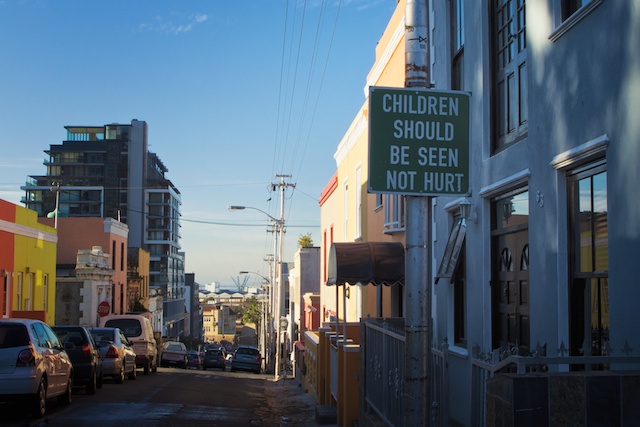
A sign on a narrow cobblestone street In the Bo Kaap district of Cape Town - Copyright JM Schreiber
A sign on a narrow cobblestone street In the Bo Kaap district of Cape Town
– Copyright JM Schreiber

I can’t say that I felt uncomfortable as I wondered the streets or rode the buses. I did quickly learn to make prudent choices, especially after a couple of unnerving encounters set me off my guard. My bad. I don’t make the same mistake twice. Aside from a night out with a friend in Green Point, my stay in the city was quiet, skirting most of the major tourist sites, sticking to bookstores, museums, galleries. Despite the cool weather tourists flocked to the Waterfront and Table Mountain but no one chanced more than a passing glance while I sat mesmerized by the full 30 minutes of William Kentridge’s installation The Refusal of Time at the South African National Gallery. I seemed to find hollow pockets in the city, safe but open empty spaces. And it felt right. I had come to South Africa, after all, to find myself.

What I found surprised me and is only beginning to take form in my thinking now that I am back home. My interest in South Africa is a curious blend of sociological, historical and literary factors but it has always been mutable and undefined. It just is. It stretches back to the early 1980s when I first encountered South African ex-pats while I was at university, continued forward, from the outside, as the world watched the steady and difficult move to independence. Being able to visit the country and, for the most part, simply talk to people and observe has marked the beginning of a process of reconciliation for myself – on a deeply personal level on the one hand, on a socio-political level on the other.

Eastern Cape morning - Copyright JM Schreiber
Eastern Cape morning
– Copyright JM Schreiber

With respect to the former I will simply say that my decision to actually visit South Africa this year was sudden and born of the intense loneliness that sweeps over me regularly. One day when that wave crashed upon me I stopped and realized that the one person in the world that I really needed and wanted to talk to, the sole person who could understand the strange mixture of illness and queerness that I have been struggling to sort out lately, lives across the globe – in South Africa, Eastern Cape province. And, with some money I had needed to access that was not worth reinvesting at today’s interest rates I had enough to get there. So I went.

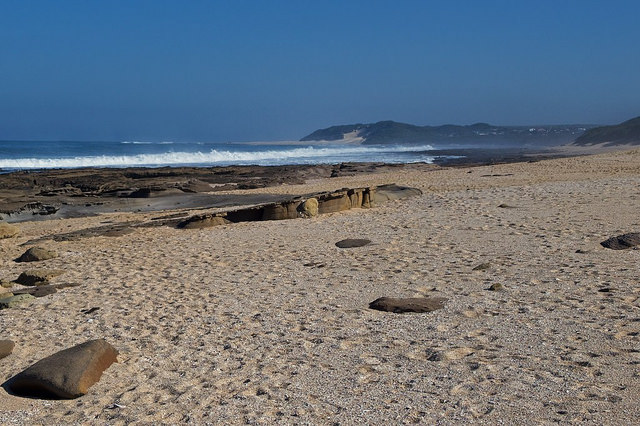
Arriving at my friend’s home in a small village perched on the edge of the Indian Ocean, I was stunned by the beauty of the unfolding landscape, green flecked with the orange of aloe in bloom, the wide open blue skies, and the crystal brilliance of the waves crashing upon rocky shores. I was at peace. I felt grounded. I felt I had come home to somewhere I had never been. My friend and I settled into a comfortable routine as if we had known each other forever. Although at ease in silence, we never ran short of things to talk about. When it came time for me to prepare to head back to Cape Town, her dog worried after me as I packed my bags in the same way that my own cats had fretted over my suitcases back in Calgary. In a little over a week I had been accepted as family.

Indian Ocean, Eastern Cape - Copyright JM Schreiber
Indian Ocean, Eastern Cape
– Copyright JM Schreiber

Oddly I never felt lonely in South Africa, even though I spent much of my time alone. Strange that that feeling oppresses me in the city that I have lived in or near for most of my life, or this country where I have lived for over five decades. At one time I was immensely proud to be a Canadian but I feel increasingly discouraged and estranged from this land. Oh, of course, it has its beauty and, compared to so much of the world, its benefits are innumerable. But there are concerns, inequities, a steady erosion of freedoms, unresolved historical debts to our First Nations and now a rapidly declining economy against a growing racism and xenophobia to think about.

While I was in South Africa, whenever anyone would ask me where I was from, eyes would light up and I would be met with statements like: “Ah Canada, that’s like the perfect country, isn’t it?” Perhaps I am less than patriotic (which is in itself a rather Canadian thing to be), but I felt it was worth engaging people in honest discussions. After all in early June the final report of our very own Truth and Reconciliation Commission was released. For over 100 years First Nations, Métis and Inuit children were routinely removed from their homes and placed in Residential Schools. The cumulative impact of the abuses, trauma and cultural disintegration has been significant and devastating for Aboriginal communities. If I wanted to engage in conversations about colonial legacies it is not to compare or absolve anyone. But no country is perfect. The question for a citizen is, what am I willing to speak to? I can only speak to my experience in Canada and listen to South Africans. Which is a good start.

Sunset over the Atlantic, Cape Town - Copyright JM Schreiber
Sunset over the Atlantic, Cape Town
– Copyright JM Schreiber

But not even two weeks home and I feel shiftlessness starting to seep in again. On the positive, I returned to the promise that some healthy changes may be emerging in the life of my troubled son, opportunities that might not have arisen had I not put a continent and hemisphere between us. And on my last full day in Cape Town I sat in the Company’s Gardens and finally began to write in earnest in the notebook I had been scribbling in throughout my visit. That has continued. Yet I am aching for that indefinable other that drew me to South Africa in the first place… the landscape, the people, my friend, the oceans.

Yes, the oceans. Landlocked here in a vast country that spans 5½ time zones, it really is little wonder I feel so alone.