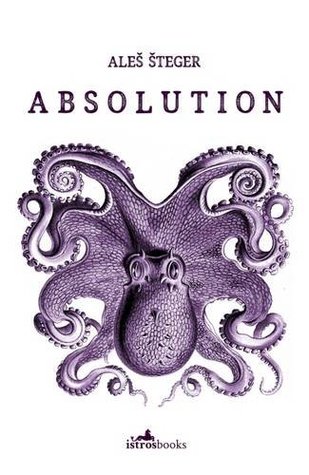
The supernatural power of forgiveness: Absolution by Aleš Šteger

Absolution, by Slovenian poet and writer Aleš Šteger, begins with a dramatic flourish, alluding to the staged performative quality of the story that is about to unfold. Like a grandly conceived morality play, the stage is set:

Silence. Darkness. The stage curtains open, and all we see is a man. He hunches behind the high collar of his winter coat, hands buried in its pockets, black briefcase dangling off his right wrist. He sways a little. The pavement has not been shovelled. The man tries to balance his way along a narrow, already beaten track. He nearly falls. Behind him stretch unkempt art nouveau façades, and in the pallor of the streetlights drizzling rain turns into snow. The few passers-by are quietly spat out by the dusk, only to be swallowed again a moment later, just as quietly. The whole time the silhouette of a woman has been at the man’s heels.

It is Carnival time in the Slovenian city of Maribor. And, with a passing nod to The Master and Margarita, the devil makes a brief cameo in this opening scene. But the man with the briefcase is a more mysterious, strangely possessed visitor than the costumed Beelzebub who stumbles on the icy street.

Returning to his hometown, after sixteen years of exile, Adam Bely is a man with a mission. Together with Rosa, his beautiful Cuban-Austrian companion, he immediately sets to tracking down a series of prominent residents, claiming to be collecting interviews for an Austrian radio special about the city which has come to be known, as the “European Centre of Culture.” Each person they meet with is hypnotized or subdued by force, prodded for information about their current and past lives, and then “absolved”—a process which sets free a host of trapped souls—ultimately leaving the “victim” either dead or a raving shadow of their former selves.

Šteger’s fantastical Maribor is striving to be an ideal model of perfected sterility, but it is a false façade—as false as the masks donned by revellers during Carnival. Corruption runs deep and close to the surface. The threat that Bely has come to confront is the Great Orc, a network of “thirteen bodies inhabited by hundreds, thousands, millions of souls which protect the world from change.” These bodies belong to a cluster of powerful, influential individuals, but none of the members know the identity of all of their twelve cohorts. The octopus is the creature that symbolizes and binds this network. Bely is determined to absolve all of the members, effectively freeing the city from a most unusual curse. His conviction is derived from his involvement with Scientology. Although he claims to have left the sect, he still holds to Hubbard’s contention that people are but human animals inhabited by “flocks of murdered souls.”

I have to confess that I am at a loss to know exactly what Šteger was hoping to achieve with this novel. It is either a piece of speculative fiction, or a parody of the same. The characters are caricatures, intentionally so, but there is something decidedly odd and distasteful to the tone and execution. This is not my genre, so either I am missing the point, or this ambitious idea has missed the mark.

It must be noted that Šteger is a very gifted poet. The translation of his collection The Book of Things won the 2011 BTBA award for poetry and his wonderful collection of short prose pieces, Berlin, was long listed for the 2016 BTBA fiction award. And when he steps away from the forced dialogue and strange plot, poetic moments find their way into the text of Absolution, but for a reader coming to this book from his earlier work, those traces are few and far between.

I am not comfortable writing negative reviews. I am always ready to admit that a book that does not work for me, might be perfect for someone else. After all, this book was well received in Germany. And, for all its awkwardness, there are some very interesting ideas here. In my mind, the most striking is the sense of the compounded layers of death the lie beneath so many cities in Europe. It is tempting to reframe the human costs of centuries of conquest and war in Judeo-Christian shades of good and evil. To take an angle like Scientology (which notably emerged from the mind of the creator of some pretty questionable science fiction) is at least daring, if not entirely successful. When Bely and Rosa visit one of their target citizens, Magda Ornik, the Director of the Maribor Funeral Home, she reflects on the artificially symbolic nature of any designated cemetery:

“First, our entire country is nothing but one big burial ground. We all know that whenever you start digging with a shovel you’ll hit a grave or even a mass grave. The Romans, the Middle Ages, the Ottoman invasions, the First World War, the Second World War, the post-war massacres. Slovenia is at a crossroads. Everything comes together and mixes here, and every era provides its share of the dead.”

As a reader living in Western Canada, where the ground beneath my feet contains a long but much more sparsely distributed human history, the densely compacted strata built of the detritus of war and peace (a dramatization of Tolstoy’s novel also features in Absolution) is virtually unknown. Perhaps, then, Bely’s drive to free his city from the weight of so many murdered souls does not seem so far-fetched. As he says:

“I believe in beginnings. Every moment could be the start of something new, something fateful. If I didn’t believe that it’s possible to change the course of our destiny at any given moment, then I’d no longer be on this planet. And I’m still here. Here and now.”

Absolution by Aleš Šteger is translated from the Slovenian by Urška Charney and Noah Charney, and published by Istros Books in collaboration with Belatrina Academic Press.

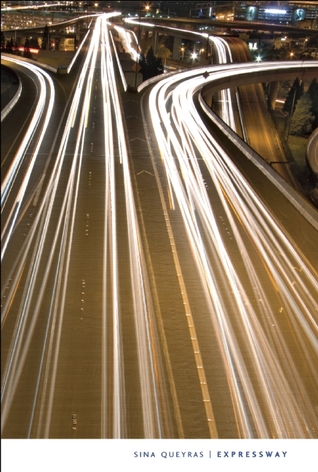
Multi-lane manifesto: Expressway by Sina Queyras

My hometown does not do expressways very well. In places where it would be obvious to have them, we are late to the game. And each one is a crap shoot, even if you know it well. The first time you have to exit and cross three lanes of traffic in very short order, your head swivelled 180 degrees, just to travel from the expressway to the road you were trying to access you have to wonder: did anyone try this out before they opened it to the public?

When I was still in university I had a summer job where I sat in a building the size of an outhouse, just off the Trans-Canada highway and tourists, just entering the city limits, could pull over and ask for directions. This was long before the era of google maps, GPS, even cell phones. We’re talking printed maps and a highlighter pen. I did my best to give instructions but, to be honest, there was—and still is—so little consistency I was often at a loss to say more than: Watch for the signs. I developed a theory that year that I still hold to. I reasoned that every civil engineering student at risk of a failing grade was given a chance to redeem themselves by designing a single interchange along one of the major thoroughfares. And that’s why no two are alike and some simply defy the imagination.

Canadian poet Sina Queyras completed her 2009 collection Expressways while here at the University of Calgary on a residency. I’m curious as to whether our ad hoc roadway system coloured this poetic critique of the social and ecological impact of the spreading network of asphalt arteries and veins that criss-cross our nations.  Her poems speak to the memory of a romanticized landscape of the past on a collision course with an increasingly isolated, technologically driven future. The opening piece “Solitary” sets the tone, with the call to consider what is a risk with the continued push to interconnect places, at the cost of connection to the land and to one another. The final stanzas read:

Wagon train, trail of tears, what aggregate composition,
What filleted history, what strata, what subplates,
What tectonic metaphor, what recoil, what never

Having to deal with the revulsion of self, only
The joy of forward, the joy of onward, then endless fuel:
The circles, the ramps, the fast lanes, the clover leaf,

Perspective of elevation, the royalty of those views,
The Schuylkill, the Hudson, the Niagara, the skylines,
The people in their houses, passing women, men

Dressing, men unearthing, smoke pluming, what
Future? What the apple tree remembered? Not
Even the sound of fruit. If a body is no longer a body,

Where is memory? If a text is no longer a text,
Where is body? If a city is no longer a city, what road?
If future no longer has future, where does it look?

She snaps her cellphone closed: no one. Alone.
The century is elsewhere. She turns her back.
Swallows her words. She will do anything for home.

As ever, I am not an effective critic of poetry. I like it, I read it. Sometimes, but entirely by accident, I write it. But I do know when poet’s work works for me. This collection is a strong, cohesive, and passionate manifesto evoking the poem as a means to challenge the ethics of the expressway—in its concrete and abstract context. A call to recognize what is at stake:

This poem resembles urban sprawl. This poem resembles the freedom to charge a fee. The fee occurs in the gaps. It is an event. It is not without precedent. It is a moment in which you pay money. It is a tribute to freedom of choice.
(from “Acceptable Dissociations”)

At times Queyras echoes of the Romantic poets, even borrows their words. The text of Dorothy Wordsworth’s Grasmere Journals provides the material for “Lines Written Many Miles from Grasmere” which, falling mid-way through the collection, casts a pastoral mood, a look back to the dream of a simpler time, closer to nature. But it is an ideal. The Industrial Revolution was, by 1800, set the groundwork for the technological and economic developments that would ultimately allow for the building of major roadways, and the vehicles to fill them. Other pieces are firmly bound to the present, most notably “Crash” which is assembled from fragments salvaged from google searches. Others stare directly at the future—here darkly, there with a vision of reclamation.

Expressway works as a rhythmic, lyrical cautionary tale. A call to undo harm. But, roads seem to be growing wider, interchanges multiplying. Especially here in North America where spaces are wide and the car is still king. That is, Queyras argues no reason not to strain to hear above the din of the traffic.

I am weary. I walk and walk and meanwhile the expressway hums . . .

What for weary? We all hum.

I am weary. I have so little hope.

Weary, maybe. But, no hope? For that there is never an appropriate time.

Sina Queyras lives in Montreal. Last fall I had the opportunity to hear her read from her latest work. This reflection/review was written in recognition of National Poetry Month in Canada and the US.

Expressway is published by Coach House Books.

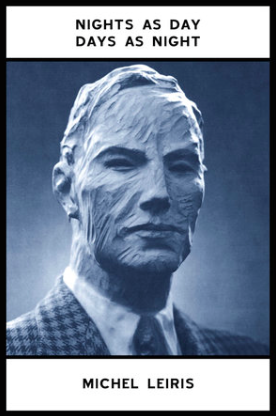
Dream on: Nights as Days, Days as Nights by Michel Leiris

I am lying in bed exactly as I would in reality, except that my forehead is pressed against the white powdery wall of a large cylinder made of lime, a cistern of sorts, exactly my height, and which is nothing other than myself, actualized and exteriorized. I feel this other exterior forehead pressing against my own, and thus I imagine my head is pressing against the very substance of my mind. [Undated]

A curious thing happened as I ventured into the dream writings of French author, Michel Leiris. I expected, perhaps, a surrealist-inspired fascination with the stuff of dreams, the settings, the strangeness, and the symbolism of nocturnal (or aided hallucinogenic) adventures. And there are, among the fragments and the longer descriptive accounts he collected between 1923 and 1960, many vivid images and observations. But this is not a self-indulgent, introspective endeavour. Nights as Day, Days as Nights demonstrates a psychoanalytical restraint, and an observational interest in the quality of dream life (and its echoes in the half-awake and “real life” realms). Consequently, as I made my way through his recorded recollections, I could not help but reflect on my experience of dreamed realities. In sharing Leiris’ journey, I caught glimpses of my own.

Born in 1901, Michel Leiris is widely regarded as a pioneer of confessional literature, known for his extensive autobiographical writings. He was drawn into the sphere of the surrealists early in his literary career, and although he broke with them before long, their influence would linger. He was also an accomplished ethnographer, who participated in anthropological missions into Africa in the 1930s, and worked at the Musée de l’Homme in Paris for much of his life. Given this context, his dream writings which, remarkably, span almost four decades, were nurtured in a rich, fertile soil. But, as translator Richard Sieburth indicates in his introduction, Leiris preferred to classify these notes, collected and published in 1961, among his poetic works, casting a different light on his lifelong exploration of the self. In his essay “Dreaming, Writing,” written to accompany the original release of Nights, Maurice Blanchot remarks that the reserve that Leiris shows in his transcribing of his dreams—not attempting to dissect them—should be respected in the reading. What he offers here is literary, not autobiographical or analytical: “These were once dreams, they are now signs of poetry.”

For Leiris, language plays an important role, not only in the translation of the remnants of dreamed (or fantasized) experience, but in the very substance of dreams. At times he plays linguistic games to escape or alter the events unfolding in his sleeping imagination, at other times he may reflect on the words used to his record remembered scenarios:

 The word rêve (dream) has something cobwebby to it, as well as something akin to gossamer veil that clogs the throats of persons suffering from the croup. This is no doubt due to its sonority and to certain formal connection between the v and the circumflex accent that precedes it (this accent being nothing more than a smaller, inverted v); hence the idea of interlacing, of a finely woven veil. Dreams are spiderlike, given their instability on the one hand and their veil-like quality on the other. If dreams are like the croup, it is probably because they are linked to the notion of nocturnal disturbances (like those bouts of false croup from which I suffered during the night as a very small child). [July 27–28, 1924, Real-life]

Leiris’ dreams are, essentially, recognizable to anyone who remembers their own dreams (since some people seem to be unable to do so). We have all likely had dreams that were bizarre, where a reality we think we know is distorted or shifts, situations that are sexually tinged, or charged with anxiety, or so terrifying that we awake with a start. And what about those dreams that feature people or places that are familiar, but oddly out of time? Or the multi-layered dreams, those that seem to descend or surface to different levels of consciousness—dreaming you are awake, only to discover you are still asleep? The beauty that comes through (and it is not always beautiful in the aesthetic sense of the word), is the sensitivity with which Leiris records his experiences. He is capturing the thoughts, images, memories or ideas that come to him, whether he is awake, half-asleep, or sleeping—his dream life is not confined to one realm of the day—with little intervention or commentary. He may muse about an interpretation of some aspect, but only in passing. Most offerings are presented raw, so to speak, and in vivid detail:

By a pool, a row of giant toads the size of chimpanzees, all covered with moss. They would appear to be part gorilla, and their colours range from green to gray to brown. The finest specimen—to the extreme left of the row—is bottle-green with huge eyes like frosted lightbulbs. They are all getting ready to dive into the water and crawl back into their shells (?). It occurs to me that if I dressed up in knickerbockers and wore a large green felt cap, I would look like a toad. [September, 1933]

Having a record, albeit at times sporadic, that spans a significant period of one man’s life, from roughly the age of twenty-two to sixty, offers insight into another important quality of the dream space. Figures from his “waking life,” as he puts it, appear—and for Leiris this is a fascinating cast, he knew Georges Bataille, Georges Limbour, Picasso, Simone de Beauvoir, and countless other well-known writers, poets and artists. But it is his wife, Louise Godon, whom he calls “Z,” who is the abiding presence throughout, whether she is out with him, waiting to meet him somewhere, or comforting him when he awakens with a scream. Other, often anonymous, women may attract his attention in his dreams, but she is never far away, so it seems, from his heart or mind.

Of course, events in the real world also infiltrate the realm of dream and fantasy. During the war years, Leiris’ accounts show a striking amplification of military imagery and themes of impending death, ranging from the allegorical to the theatrical to the disturbingly realistic. This is to be expected, but these records collected and presented, chronologically as they are, map the interior response to exterior terror, in real time. The dreamer, now in mid-life, evolves during these years. He almost seems to become a more astute listener to his own anxious imagination. The entries recorded in the post-war years feature longer, more detailed, but no less surreal, narratives.

When Michel Leiris organized and published this collection in 1961, he would still live, and continue to dream, for another twenty-nine years. Alongside his autobiographical writings, he engaged in a rigorous and formal journal keeping project that spanned seventy years (1922-1989), but Nights as Days, Days as Nights stands as a particularly engaging poetic gift. The invitation to spend time in someone else’s dreams may seem odd, after all, our own dreams are typically of less interest to others than they are to us. But Leiris has a rare ability to transmit these imagined episodes in a way that is not only interesting, but encourages us to recall the way we experience ourselves and others in our own dreams, to become alert to the recurrences, the insecurities, and the wonder that lingers. As such, this very personal project becomes universal, enriching the nights and days of those who are open to it.

Nights as Days, Days as Nights by Michel Leiris, translated by Richard Sieburth, with a foreword by Maurice Blanchot, is published by Spurl Editions.

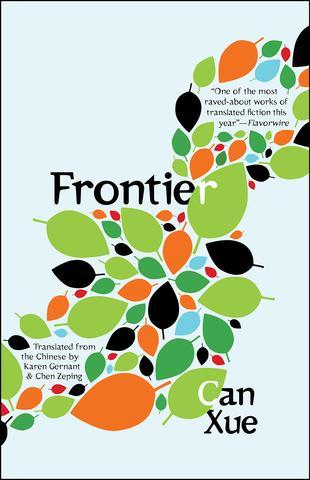
Initial thoughts on Can Xue and a link to my review of Frontier at Numéro Cinq

In the month or so since I wrote the following review, I have been thinking about Can Xue, about what it is that sets her work apart—that makes it so difficult and so addictive. There is nothing intrinsically complex about her language. Her characters are intriguing, interesting. But one can easily feel unmoored within the scope of her imagination. Borders shift; the signposts we look for as readers are missing or misleading.

But once one accepts this condition, the possibilities are endless and exciting.

After reading Can Xue, I went on to read João Gilberto Noll and Michel Leiris. In the light of this subsequent reading there is more I would like to explore with respect to the dream-like narrative/anti-narrative, but that will have to wait until after my next Numéro Cinq review.

In the meantime, here’s a taste of my review of Can Xue’s Frontier, please click through the link at the end to read the rest. A second link leads to an excerpt:

Life In a Northern Town | Review of Frontier by Can Xue — Joseph Schreiber

It can be said that Chinese experimental writer, Can Xue, inhabits a strange and elusive territory in contemporary literature. With an idiosyncratic approach to writing, she has created an impressive body of work that effectively explores a geography of the spirit—mapping, if you like, the space where the real and the surreal, the personal and the political, and the magical and the mundane meet. Her 2008 novel Frontier, newly released from Open Letter Books in a crystal clear translation by Karen Gernant and Chen Zeping, has been eagerly anticipated by her admirers. Yet, for intrigued newcomers, it may well offer an excellent introduction the dazzling, and baffling, world of Can Xue.

Born in 1953, in Changsha City, Hunan Province, South China; Can Xue is the pseudonym of Deng Xiaohua, who took her intentionally gender-neutral penname from a Chinese expression that refers to both the dirty snow that refuses to melt and the pure snow remaining at the top of a high mountain. This inherent duality is very fitting. In the years leading up to the Cultural Revolution, both of her parents came under suspicion for their journalistic activities and were sentenced to hard labour. Consequently, their daughter was unable to continue her education beyond elementary school. Despite the brutal hardships her family experienced and her own ill health, Can Xue showed great resilience. With her schooling cut short, she turned to reading. Largely self-taught, she read fiction, poetry, and discovered the joys of classical Western and Russian literature, eventually going on to study and read in English. At the same time, she married, started a family, and worked as a tailor before publishing her first work in the mid-1980s.

Continue reading here:

Read an excerpt here:

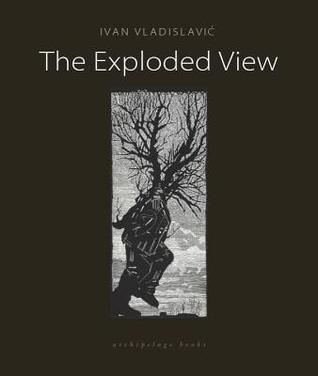
Out of place in a half-made world: The Exploded View by Ivan Vladislavić

Egan always found it strange to set foot for the first time in a place he knew from the plans. It was like folding out of two dimensions into three. You could almost hear the creases popping as you broke through the barrier. Sometimes it was disenchanting. You had convinced yourself, looking at the neatly inked blocks on the paper, at the street names, the community facilities, the cookie-cutter trees, that the place was rather pleasant. You imagined gardens, shady avenues and parks. And then you got there and found rows of impossibly small houses, not a leaf in sight, dust everywhere, shadowless walls, and the immense blue well of the sky, which reduced the world to sediment.

The end of Apartheid and the process of reconciliation offered great hope to the people of South Africa. It was, and still is, held up as a major achievement, a model to other nations, even if the dream has become tarnished in the realization. The plans always look better, more achievable, on paper. The Exploded View by Ivan Vladislavić, newly released by Archipelago, was originally published in South Africa in 2004, one decade after the first free elections. This collection of four loosely interlinked stories examines the uneasy space in which individuals living in and around Johannesburg find themselves as they try to adjust to—or exploit—a new social order where the shifting dynamics are not clearly defined. Too many loose edges exist, lines blur.

Vladislavić’s protagonists are ordinary men: a statistician, a sanitation engineer, a conceptual artist, and a contractor. Each one is a little neurotic, bearing hints of a vague identity crisis—the doubts of early mid-life in a world where the rules are changing. Their stories overlap with respect to place, a gated suburban development and a restaurant figure more than once, but each of the main characters is marked by particular degree of isolation.

“Villa Toscana” follows the misadventures of Les Budlender, a statistician seconded to help redraft the first non-racial census questionnaire that, in 1996, had caused great confusion. Shuttling between a diverse group of volunteers, and the Development Committee, his job is to help fine-tune a new form. And that brings him to a gated, faux Italian residential complex on the outskirts of the city where he meets a young Afrikaner named Iris. He is smitten; she is oblivious and eventually irritated by his increasingly odd behavior. Awkward, obsessive about detail, he tries to quantify everything as if comfort can only be found in numbers. He demonstrates a hyper sensitivity to his surroundings that, in the presence of Iris, is magnified and, in the end, unlikely to serve him well. But it allows for some striking descriptive passages:

She seated him in the lounge and went to make coffee. The rooms in Villa Toscana were small, square and white. The furniture, sparse and spindly though it was, seemed too large. He had the unsettling impression that he had strayed onto a page in a book, one of those picture books that were more interesting to adults than the children they had apparently been written for. He had lost all sense of proportion. He stood up, half expecting that he would have to stoop, and raised his hand above his head, measuring the distance between his outstretched fingertips and the ceiling. At least a metre. Probably, there were municipal regulations. Why did it seem so low?

The second and, for my money, standout piece in the book, “Afritude Sauce,” features Egan, a sanitation engineer on a business trip. He is out to visit a new RDP (low-cost subsidy) housing project called Hani View where there have been problems with the water and sewage system. He begins to sense that he is a prop in some sort of municipal drama. It begins with a seemingly staged (and photographed) demonstration of the inadequacy of the construction and, quite comically, the toilet facilities in one of the houses, and continues later that evening at dinner with a group of local business and council men at Bra Zama’s African Eatery. He tries to pride himself in being progressive, as a white man with a group of black men—the only racially mixed group in the room:

Mazibuko was right, Egan thought, it was going to be an experience. And he had an odd sense that it would be a significant experience too, that he would remember this evening, that he would look back on it. He could already see himself looking back on it, from a tremendous distance, and understanding, at last, what it was all about. He wishes he was there now, at that reassuring remove, on a height, filled with the wisdom of hindsight.

However, as the night progresses, he is increasingly at a loss to decipher how he fits into the political posturing that gradually leaves him sidelined as the conversation shifts into Sotho and he drinks too much for his own good. Later, back at his hotel, his embarrassment and irritation builds to a level of frustrated paranoia.

“Curiouser,” is the sole story with a black protagonist, in this instance an educated, middle-class artist, who has made his name with installation art pieces. Simeon also faces questions of identity, albeit from another angle. Questions about what is, or is not, appropriate for him to present in his art take on a different tone because of his colour. His own sense of himself is, to a significant extent, a private performance. Yet, when forced to consider the possibly illegal source of a large quantity of masks and curios he has purchased, it is clear that he, too, has an uncertain sense of how, or where, he fits in.

Finally, the collection closes with “Crocodile Lodge,” where the elements of the “new South Africa” meet with a devastating and brutal intensity. A contractor who specializes in erecting billboards for construction sites, caught in congested traffic reflects on his childhood love of Popular Mechanics, as he makes his way back to the location where he had been working earlier to try to find his missing cellphone. He remembers how the plans he absorbed from the magazine had shaped his idea of America and his ability to imagine the diagrams into virtual three-dimensional structures, from the smallest detail of a house, to the landscape outside:

Even the pines on the shore he exploded into their parts, so that each needle quivered beside a sheath in a stalk, each cone burst into separate scales, and each trunk shucked its bark like a coat. The world, disassembled as precisely as a diagram in a biology textbook, sucked in bracing breath and expanded. The universe was expanding, we were causing it to expand, by analyzing it.

This affinity for seeing how things fit together, for appreciating the “exploded view” had never left him though he wondered about its value in the modern world. Indeed, a new kind of awareness, alertness is required, when the world is in flux. Each of the protagonists in this collection find themselves out of step to a greater or lesser extent.

These stories, which could well be considered a novel in four parts, showcase Vladislavić’s great strength—an ability to burrow into the very human idiosyncrasies of the ordinary man. His attention to thoughts, mannerisms, and subtle details allow him to create, even in relatively confined spaces, characters that are honest, and slightly flawed, in a way that one can easily recognize and relate to. And his power of description applied to settings—interior, exterior, or imagined—carries an almost photographic quality. Well demonstrated in longer works like The Folly or Double Negative, this uncanny ability is likewise evident in his short fiction. The Exploded View is a welcome addition to the growing body of Vladislavić’s work to be made available outside South Africa, and, if you have yet to encounter his writings, is as good a place to start as any.

Truth, lies and wild allegations: The Major Refutation by Pierre Senges

In an age when climate denial, an increasing distrust of immigrants, and the epithet “fake news” dominate the headlines, the eloquent arguments ventured forth in the pages of the anonymous Refutatio major (c. 1517–1525) play neatly against the public consciousness, reminding us that, even now, there are still those who hold to a view that the world is flat and the moon landings were fabricated. But none of our contemporary doubters or conspiracy theorists who peddle their “alternate facts” would deny the existence of the New World. . . However, in the decades that followed Christopher Columbus’ fated encounter with a land mass that would soon turn long held assumptions about the geographical reality of the world on their heads, what sort of skeptics might have crawled out of the woodwork?

Well, if you accept the premise French author and playwright, Pierre Senges, is prepared to offer alongside his spirited “translation” of this curious treatise claimed by no one but attributed to Antonio de Guevara, we have a Renaissance-era Latin document that purports to call into question the veracity of the reports, artefacts, and individuals ferried across the ocean from this distant new land by a steady stream of seafaring Spanish and Portuguese adventurers, colonists, and missionaries who have disappeared and reappeared over the watery western horizon since the reported discovery of the Mundus novus. And what an imaginative and persistent defense is waged in this apparent “Epistle to Charles V,” now translated into English by Jacob Siefring as The Major Refutation.

The new world, an enchantment? however when John Day, a good sailor no doubt, but a geographer of little import, announces that somewhere to the west islands have been found where “grass grows,” he is either smirking with deceit, or mocking our rulers, to whom he extends an offer of six square yards of lawn in the guise of a vast kingdom. These men go off into the horizon, where they lose their heads, exert themselves furiously, ravish Indian women, move mountains and entire populations, drown a thousand sailors in their wake, and then come back to us, swearing in magnificent syllables that grass grows on these lands and that in their environs, by the grace of God, rain falls from on high.

Senges is a prolific French writer, but to date little of his work is available in English. With a spirit akin to Borges and Calvino, Senges frequently exploits the possible, potential, and unfinished spaces that exist in history or literature. That porous line between fact and invention is blurred with a nimble oratorical style that lends itself to work with a sharp satirical, critical, and philosophical edge. Throughout the text, the personages and recorded events are real, but it’s the dogged determination to prove that the celebrated New World is an elaborate hoax that forms the heart and soul of this wildly entertaining feat of double imposture.

The magic of The Major Refutation lies in the delight the author (or his surrogate, shall we say) takes in language. The biting, sarcastic humour is infectious. One can imagine our Franciscan chronicler writing with a healthy measure of unholy abandon in this passionate entreaty to Charles V, king and Holy Roman Emperor. Antonio De Guevara (1480–1545), the imagined author of the manuscript at hand, was in truth, no stranger to writing in the voice of another—he infamously penned a text he tried to pass off as original by Marcus Aurelius. Granted free reign he openly attacks anyone, his clerical brethren notwithstanding, who comes within his sights in his effort to prove that the so-called New World is nothing more than a grandly orchestrated act of fraud and collusion. The concessions granted with respect to dominion over the distant vistas fail to impress him:

To the observer, these textual games and universal decrees sitting alongside and contradicting one another, these privileges to a single treasure granted to so many, these supposedly definitive treaties that are deprecated before the year is even up, that manner of signing at just two streets’ remove a couple of decrees that mutually refute one another, all the while perceiving that the world carries on under the weight of such numerous paradoxes, to the solitary witness all of this looks as much like naiveté, as much like a superior ruse. Because to adopt a proprietary attitude towards invisible islands is either proof of blindness, become lately a fashion of the courts & palaces, or it is a deliberate strategy, dictated by the crafty to the envious; to delude the people, it would hence be a question of acting as though the chimerical continents were so valuable they were worth the price of humiliations on their behalf, worth the aristocrats sharing trading posts and territories, like barkers sharing stalls in the marketplace.

With an stirring echo of florid baroque language, The Major Refutation calls in the prominent personages of the day, and implicates the state, merchant bankers, and the Church in the creation and perpetuation of the myth of the new world. Queen Isabella, Columbus’ sponsor, is a favourite suspect to whom the author returns repeatedly. He imagines ingenious means by which the entire enterprise could be facilitated —insisting that once beyond the horizon ships turn south to Cape Verde to hold over before sailing back with gold smuggled out of Spanish coffers and returned again. Of course, the unspoken value of fostering belief in a far off land of untold wealth and opportunity is not lost on him:

The principal reason for the invention of the new world would surely be to send off into the ocean a portion of our great surplus of useless men, who fill our countrysides, our cities, and betwixt the twain our faubourgs, with the speed of a spreading plague. . . . The new world and the enticing advertisements which speak of it so fantastically invite all these beggars & jobless, worthless players to board dinghies, strap a sail to their torso and head due west, without demerit. A steady stream of disfigured men, ugsome-faced knaves and scrawny blackguards have thus quit terra firma, this world for its beyond, in prestigious and ruined galleons.

From the opening “Editor’s Foreword” that places the Refutation into historical context, to the scholarly “Afterword” that vigorously defends the case for Antonio de Guevara, confessor to Charles V, as the probable author while considering less likely alternate candidates, Senges is essentially presenting a carefully designed meditation on the nature of truth—on that which is credible and that which is contrived, on belief and doubt. Selecting de Guevara as his preferred composer, a historical figure with an attempted forgery to his credit, and allowing him to imply that his faith in his own argument is perhaps less than genuine, adds depth to the layers of a deception designed and executed as one thoroughly intelligent and entertaining whole.

Of course, the release of the of “English Version of Refutatio major” in late 2015, ten years after the “original” French version, is especially timely. Conspiracies abound. In saecula saeculorum.

The Major Refutation by Pierre Senges, translated by Jacob Siefring, is published by Contra Mundum Press. And, for the record, the book design and typesetting is exceptional.

Imaginary Cities by Darran Anderson (originally published at TQC)

I’ve been busy reading and writing reviews lately, but everything seems to be directed at the future, scheduled for publication at online literary journals. It’s all good, but you put so much work in and then have to wait to share your thoughts and engage in conversation about the book. My review of Darran Anderson’s monumental Imaginary Cities, published earlier this week in the Spring 2017 issue of The Quarterly Conversation is a case in point. This extended essay on the idea of the city, in all of its possible and impossible incarnations, does not readily lend itself to the confines of a critical review… I know, I’ve had a look around. Originally published in the UK in 2015 (Influx Press), my piece has been written in anticipation of the North American release from University of Chicago Press next month. As I struggled to beat this essay into submission, I cast an eyeball at prior reviews. After all, it is already a well-known and well-loved work. And I was relieved to see that the best anyone can do is skim the surface of Anderson’s rambling, eclectic, and immensely readable tome.

The original publication where this review appeared seems to be offline or closed so my work is reproduced below:

Imaginary Cities by Darran Anderson.  University of Chicago Press. $22.50, 576 pp.

Imagine a city that you cannot contain, a city that forms and reforms itself around you constantly, a city that continues to change while your memories remain lodged in a reality that moves further into the past every day. That is the city of a man with a ten-second memory. I know such a person. Severely injured in an accident more than thirty years ago, this man, a former client, is unable to lay down new memoires. He lives in the continual present, working from a frame of reference decades out of date. But in the moment he is a highly intelligent, logical thinker—he was a young lawyer at the time of his injury. To see him today, his memory impairment is not immediately apparent. He is meticulous about his appearance, well-spoken, and polite. He tries to cover for his confusion as much as possible.

For many years, this man has spent several hours a week volunteering at a downtown law firm. The purpose is to provide him with social stimulation, stave off boredom. He goes to “work” in a suit, briefcase in hand. A special needs taxi delivers him to and from his placement. One day, a storm slowed all traffic, and his ride was late to pick him up. In the driving snow he began to walk toward the last home he could remember. But he had not lived there in years, and downtown, with its signature landmarks, had shifted in the meantime. The city around him no longer conformed to the one he had known, but on its streets he was invisible, a business man like any other, lost in a truly imaginary city.

As one navigates the sprawling streets and avenues that spread out across the pages of Darran Anderson’s ambitious guidebook to the metropolitan ideal—past, present, and future—there is likely to be more than one occasion of disorientation, an invitation to entertain an entirely new way of understanding the possibilities of the urban reality. In this sense, Imaginary Cities is a map that encourages you to get lost. Subtitled A Tour of Dream Cities, Nightmare Cities, and Everywhere in Between, this journey is an open-ended inquiry into the myriad ways that the idea of the city has been conceived in history, art, literature, social theory, and architectural design—for better or worse.

Unlike the standard guidebook, Anderson offers his traveler no pictures, maps, or diagrams. This is intentional. Side trips are encouraged as the fancy strikes, and generous footnotes are provided for those who wish to follow up on quotes and references. (Of course, there is also the ease of stopping into Google for quick access to an image, biography, or further background material.) Anderson’s extended essay feels like spending time with an entertaining, well-read explorer who has traversed the cities of the imagination and returned with exotic tales that stretch back into pre-history and out into the solar system. We are in the presence of a modern-day Marco Polo who understands that “all cities can, and should be read.” His aim is to help us learn to trace these narratives ourselves.

Our guide is an Irish writer living in Scotland. He is neither an academic nor an architect, but his focus of attention lies in the intersection of culture, architecture, and technology. In a recent podcast, Anderson traced the genesis of this project to long-standing fascinations with cities and with the point at which reality and myth meet. As he became increasingly obsessed with architects and started looking through their plans, he found that beyond their iconic structures, each had drafted countless schemes and designs that would remain, for a variety of reasons, unrealized. With a different set of circumstances, then, the skylines and urban landscapes we know now could have been very different—as they once were in the past and will be in the future. The modern city is in flux and can perhaps best be understood only through a shifting kaleidoscope of angles and perspectives.

Dividing his book into seven sections, Anderson manages to pull together a wide range of interrelated ideas—from sources as diverse as myth, archaeology, art, film, urban studies, science fiction, architectural design, and many others—into a thematically structured, meandering discussion, at once densely packed and tangential. Yet the quality that makes this project so impressive also makes it very difficult to adequately capture in a review. It is a slippery beast. The themes explored are neither exhaustive nor exclusive. Amorphous, the content exceeds the boundary of the pages. Each section necessarily offers more, and less, than it promises—echoing so many of the architectural, community, and metropolitan schemes that come in and out of focus along the way. Dreams cannot be contained—in their fulfilment sacrifices must be made.

Nonetheless, it’s inspiring to see just how much Anderson manages to squeeze into his thematic discussions. For example, the section, “The Tower,” with its twenty-seven chapters, starts with the quixotic. We meet Tommaso Campanella, whose proposed “City of the Sun”—with its utopian vision of a center devoted to intellectual engagement and physical pleasures—landed him in a dungeon as a guest of the Church during the Inquisition. But his mind could not be confined and he continued to construct his designs in his imagination. He was not forgotten, and his ideas would continue to the inspire the civic utopias of his contemporary Francis Bacon and, later, Ivan Ilich Léonidiv, who dreamed up urban plans to try to save himself under Stalin. None of these imagined designs were realized, but that did not lessen their influence.

Subsequent chapters introduce Le Corbusier, the ambitious and eccentric pioneer of Modernism; stop by Mega-City One, the vast metropolis of the Judge Dredd comics; spend time contemplating the Ideal City in Renaissance art and philosophy; and spare a few minutes glancing at various attempts to envision a New Jerusalem before turning to the unfortunate, even tragic, communities founded by messianic leaders and madmen. And at this point, the journey is just getting started. From the ziggurat to the skyscraper, “The Tower” will examine the titular subject both on its own and as an integral part of the cityscape. In later sections, many of the projects and personalities met here will reappear in other contexts.

Ever avoiding the temptation to belabour a point with exhaustive detail, Anderson prefers to paint with broad strokes as he explores concepts and themes. But he continually manages to punctuate his narrative with pointed observations that bring us back, from wherever he has wandered, to moments and ideas we instantly recognize, tying his discursions back into the book’s multifaceted main thread. In the chapter, “Cinematic Dystopia of the Everyday,” for instance, he moves from the surreal silent cityscapes of Metropolis and The Cabinet of Doctor Caligari to the futuristic noir of Blade Runner, then to the soullessness of the consumer-driven society depicted by French director Jacques Tati in his ambitious film Playtime, for which he constructed a set to mimic a modern city:

Tati foresaw it all. Everywhere looks sedately impressive and like nowhere in particular. People are inherently lost. Traffic crawls in barbiturate carousels. The shocking thing watching it back now is not how contrived his sledgehammer and slapstick satire is, but how pertinent. The open plan office floors with their individual cubicles are rife now. The large glass facades, echoing the quiet desolation of Edward Hopper’s paintings, are everywhere. This is life as a glistening empty waiting room and it is a life we are increasingly forced to live all over the globe.

Here we are reminded that, as what once was presented as part of a dystopic (or, for that matter utopian) vision arrives, it soon becomes commonplace. It is easy to forget that the future is now, or rather, to quote William Gibson, “The future is already here—it’s just not evenly distributed.”

The wide, eclectic sweep of Anderson’s project is fueled by an infectious sense of endless curiosity. One of the book’s greatest assets—perhaps the key to its success—lies in its author’s thoughtful, engaging tone. His lyrical, aphoristic prose offers a wealth of memorable lines. This is where his inner Marco Polo, channeled through Italo Calvino’s Invisible Cities, serves him well. He is an intelligent, witty, and consummate storyteller, never afraid to speculate, raise questions, and entertain ideas without the pressure to define and prove an overarching theory. But there is a persistent theme that runs through the book. It arises naturally from the earliest formations of human settlements and is so fundamental that it has essentially become part of the psycho-topography of the urban space, reflected in our mythologies, stories, and art. That is the endless tension between utopian aspiration and dystopian despair.

One might imagine that these are two opposite ends of the spectrum, but Anderson suggests that utopias and dystopias each imply the quality of the other, that is, every utopia contains its own dystopia and vice versa. Cities are fundamentally heterogeneous places. From their earliest incarnations, such as Uruk in Mesopotamia, they were marked by the production of an agricultural surplus and the development of social classes. Utopian visions with their idealistic, often philosophical or Puritanical agendas—the dream of a world without difference or inequity—tend to deny the very qualities that make city life possible, let alone vibrant and interesting. As a sort of heaven on earth, a utopia is rarely imagined for all, just as hell might be said to exist for those who want to imagine other people burning in it. And it is no question which scenario tends to capture the popular imagination. More visitors follow Dante and Virgil down into the depths of the Inferno than sign on for the subsequent treks through Purgatorio and Paradiso.

In the end, Imaginary Cities, is much more than a book. It is an ongoing project that invites participation. It opens conversations, challenges assumptions, exposes contradictions, and invites readers to lose themselves in the cities they live in, visit, and encounter in their dreams. And the discussion does not end when the final page is turned. Darran Anderson’s Twitter feed, @Oniropolis is a wonderful source of fascinating of images, links, and retweets guaranteed to keep the magic flowing.


Thoughts on writing about Witness by Robert Rient for Minor Literature[s]

For all its sins, Twitter is still a terrific way to connect with readers, writers, translators and small publishers and, in the process, hear about books you might otherwise miss. Witness by Polish writer and psychologist, Robert Rient, is a case in point. I came to know of it by way of the translator, Frank Garrett, and was immediately intrigued by this story of a man who grew up gay and Jehovah’s Witness in Catholic Poland. I ordered the book and, as soon as it arrived, I had a quick look and immediately knew it was the type of book for which I would want to pitch a critical review.

I am intrigued by original approaches to memoir writing, that is, rrient-witnessintentional writing about ones’ own experience. In Witness, the story is carried by Luke, the writer’s younger self—the boy and young man torn between his faith community and his sexuality—and Robert, the grown man who marks his break with his past and his rebirth as a whole person, true to himself, by taking a new name and identity. Woven through these two narratives is a fascinating look inside the Jehovah’s Witness church. As someone with a dual identity history, albeit different in nature, I found a lot to admire in the telling of this story, as well as in Robert’s honesty and the powerful transformation he chooses to make to mark his move forward into a new authentic life.

My review is now live at Minor Literature[s]. Thank you to Tomoé Hill for entertaining my contribution.

Minor Literature[s] has been repairing its archive so I have reproduced my review here:

Witness by Robert Rient (trans. Frank Garrett)—Joseph Schreiber

Not yet fourteen years old, Luke Zamilski is waiting his turn to climb into a garden swimming pool set up in the middle of a large stadium. Thousands of people fill the stands. He has endured months of interrogation by the elders of his church congregation. He has memorized the precepts of his faith and the Biblical justification and ammunition afforded each one. He is ready. With his baptism, Satan will come to know of his existence, but Luke is eager and enthusiastic because he also knows that, on this day, he will be granted a clean slate. With this expurgation, he trusts that Jehovah will remove the thorn that has been working its way into his flesh through these early years of puberty.

Or maybe not.

Luke’s story begins with the dramatic retelling of a fire that destroys his family home when he is just shy of his fourth birthday. As part of the small Jehovah’s Witness community in Poland, the aid and support of fellow church members is immediate, as is the curiosity and derision of their Catholic neighbours. When the family is eventually settled into a new house, Luke is given a used briefcase in which he is to store his important papers should he ever need to escape a similar circumstance in the future. That same case will also go on to hold his precious diaries, his poetry, and eventually, he tells us, his porno mags, letters, newspapers and more. A place to contain both his documented and his hidden life. Thus, this event sets the stage for the account of a life that is destined to be doubly isolated. He is cut off from the normal social activities and celebrations of his peers by his “feline faith”, and then, as he struggles with his sexuality, he risks being denounced by his church community for falling prey to a sin thought to be worse than murder.

Witness, by Polish psychologist and writer Robert Rient, is at once an original and engaging chronicle about growing up gay, and a disturbing look deep into the manipulative and damaging environment of a religious organization that shares many similarities with other fundamentalist Christian churches, and yet is its own strange entity. However, this is not a case study or a psychological essay. It is, rather, an autobiography in three voices.

Luke carries the immediate and emotional core of the narrative. He agonizes over his inability to refrain from masturbating, and the curse of the ‘thorn’ he carries. He begs to be relieved of his affliction and prays for the imminent arrival of Armageddon, for release from worldly temptation and the corruption of Satan. He throws himself into the church, preaching and witnessing, and yet he is also drawn to the arts, to writing and drama, and eventually chooses to study in the city of Poznan after graduation from high school. There he will vacillate wildly between fanatical commitment to his faith, a desire to succeed in his studies, and a dangerous entanglement with drugs, alcohol and self-harm. Guilt and shame dog him, throughout his youth and on into early adulthood, intensified by the very real threat of disfellowship from the church, and rejection by those he knows and loves. His desperation becomes intense. At the age of sixteen, for instance, he makes the very Biblical pledge to cut off his offending appendage:

I take a knife from the kitchen. I go upstairs to the second story. I enter the bathroom, turn on the light. I drop my pants to the floor, pull down my underwear. I apply the knife to the base of my penis. Wait. I’m scared of the pain, that I’ll bleed to death. I gently drag it across the skin. It stings. It leaves a red line on the flesh. I won’t do it. I’m too weak even for that.

His first confidant is Robert, whom he ‘meets’ at the age of eleven. Somewhere between an alter-ego and an imaginary friend, Luke first summons Robert ‘out of nothing,’ a new identity to step in when the waters become too rough, someone to pick up the pen and write in his journal the thoughts and feelings that he dare not own. Robert carries the second narrative voice, looking back from the present with a certain, almost clinical, detachment at his troubled younger self, providing a grounded counter perspective. His measured tone speaks to his own hard-won peace, but a fondness and affection seep through, along with an abiding sense of loss. Although his parents will ultimately stand by him, and his older brother who also leaves the faith, the rejection of the friends and relatives who stay behind is cold, harsh and unforgiving. The cost is very real.

The third narrative, “Witnesses,” details the inner machinations of the Jehovah’s Witness enterprise—bringing to light textual materials, facts and figures, and unwrapping many of the arcane and disturbing beliefs promulgated within their organization. What is revealed is a misogynistic, sexually repressed, hierarchical system that denies celebration of holidays and birthdays, but permits limited alcohol and abortions (Armageddon is ever imminent after all), and encourages the physical discipline of children as a sign of affection. The church is widely spread across the globe and supported by vast quantities of written materials, most recognizably The Watchtower and Awake!, which are translated into a multitude of languages and distributed by members who are required to spend long hours knocking on doors and standing on street corners.

What we have then, is a memoir presented as an uncanny collaboration between the author, Robert, and Luke, the boy and young man he used to be, along with an exposé of the secretive church ‘they’ were born into. As an affectation, it would risk sounding overly theatrical, but this approach allows a much deeper, more genuine narrative to develop. In Luke’s account, supported by frequent excerpts from his diary, we hear of his youthful enthusiasm for his faith, his anguished attempts to fight his homosexuality, and his pull toward all the temptations and possibilities of a ‘worldly’ existence. By contrast, Robert’s perspective sounds at once insightful and limited. He wants to fill in the gaps, seek out the views of Luke’s former friends, and try to analyze, interpret and defend his fate. He knows how the story will end. In describing his first encounter with Luke, Robert says:

I suppose we already knew that we would meet again and that I would have to live. That he had to die. I didn’t kill him. But had he not died, I wouldn’t have been. Everything that happened to him, every torment, was convenient for me. His weakness and self-loathing were my justification and my provocation. Besides, he wanted to die. He talked about it again and again. I have evidence. I am the witness regarding this matter.

As the narrative alternates between the three voices, the mood shifts. The Witness sections are delivered with neutral authority. At times Luke’s actions are used to illustrate a point, and occasionally the reader is addressed directly, as, for example, in: ‘There exists an informal list of banned books which includes the one you’re reading.’ Both Luke and Robert speak in the first person, and refer to each other as ‘he.’ At times, when appropriate, first person plural is also employed. Luke longs for the comfort of his alternate identity most when he feels isolated and depressed, leaving Robert effectively sidelined, observing from a distance much of the time—a tone that comes through clearly in his sections, setting them apart from Luke’s. As Luke battles addiction, the loss of self-esteem, and suicidal thoughts, one can sense a growing friction between the two voices, as if Robert is slowly coming into sharper focus within their dual existence.

At the end of this powerful account of transformation and rebirth, Robert Rient emerges from the restraints of a religion that rejects his very being, and comes, over time, to accept and love himself as he is. It is his conscious disassociation that provides protection and allows him, with the support of friends and his academic training in psychology, to survive the very tumultuous break with his faith. Once the internal division is no longer required, he sheds his name and identity, along with his past, to claim a new wholeness. And in telling his story in this way, with equal respect for his past and present lives, Rient is able to capture a conflicted, painful journey with a fresh authenticity that reaches beyond the specifics to touch the universality of the experience of striving to be true to one’s self.

It is of note that Frank Garrett’s translation effectively captures the shifting tenor of the narrative, something which is essential to the success of this multilayered approach. He also includes a guide to assist with the pronunciation of the Polish names in the text, and in his afterword, he details the choices that were made with respect to language, and the challenges of accessing the original resources required to render this unique memoir into English.

Light in form but not impact: Grief is the Thing with Feathers by Max Porter

When God, disgusted with man,
Turned towards heaven,
And man, disgusted with God,
Turned towards Eve,
Things looked like falling apart.

But Crow Crow
Crow nailed them together,
Nailing heaven and earth together-

So man cried, but with God’s voice.
And God bled, but with man’s blood.

Then heaven and earth creaked at the joint
Which became gangrenous and stank-
A horror beyond redemption.

The agony did not diminish.

Man could not be man nor God God.

The agony

Grew.

Crow

Grinned

Crying: “This is my Creation,”

Flying the black flag of himself.

– Ted Hughes, “Crow Blacker than Ever”

I am carrying three griefs—three “conventional” griefs, if there is such a thing. I carry more, I am a walking inventory of grief, but the three “expected” griefs are those that I, and others, anticipate; I lost both of my parents and one of my closest friends within the span of two months last summer. And yet, no two griefs, no two losses are alike. Grief is the Thing with Feathers, Max Porter’s bravely unconventional novel about the impact of a woman’s sudden death on her husband and young sons, is a book that speaks to me—not as a bereaved child, my parents were in their eighties and ailing—but in the loss of my friend Ulla, who ended her life burdened by an unremittent depression and her own private, unresolved griefs.

She would have loved this book. It would not have saved her, but it might have granted her the comfort of wings, even for a moment.

crowTo appreciate the invention and spirit of Feathers, it is useful but not necessary, to have an acquaintance with Ted Hughes and his work Crow: From the Life and Songs of the Crow. These poems, composed primarily in a span of time bookended by the suicides of his wife, Sylvia Plath, and his partner, Assia Wevill, give inspiration to the corvid character, who inserts himself into the lives of the grieving family. The father is a Hughes scholar, fumbling his way through the completion of a manuscript about the poet’s crow poems in the disorienting aftermath of his wife’s death. Guiding him and his young sons as they struggle to make sense of a world and a family missing such a central figure—partner and parent—is a crude, boisterous, grandiose incarnation of Crow in all his mythological glory. Real or imagined, it matters not. This surreal surrogate houseparent has arrived to ease, tease and prod the troubled family toward healing. He will stay for as long as he is required.

This short novel blurs the lines between prose, poetry and drama. It is narrated by three voices. There is Dad, who, aches for the loss of his friend and lover, and in his uncertainty about the nature of his new role in his fractured little family, questions the possible delusional nature of the presence of Crow. But he recognizes the essential value of his feathered wisdom:

There is a fascinating constant exchange between Crow’s natural self and his civilised self, between the scavenger and the philosopher, the goddess of complete being and the black stain, between Crow and his birdness. It seems to me to the be the self-same exchange between mourning and living, then and now. I could learn a lot from him.

The boys, unnamed and ageless, offer contrasting individual reactions, challenging one another as siblings will, while in unison they form a sort of mini Greek chorus. They fill in gaps, and respond to the loss of their mother with their own magical thinking, express deep concern for their father, and exhibit childish delight with the company of the crusty black bird in their midst:

Once upon a time there were two boys who purposefully misremembered things about their father. It made them feel better if they forgot things about their mother.

And Crow, who, in all his trickster enthusiasm, offers folktale wisdom, philosophical asides, and an abiding concern to preserve the spiritual safety of his charges as he ushers them through the initial stages of grief. At his best he is loud and irreverent:

Gormin’ ere worrying horrid. Hello elair, krip krap krip krap who’s that lazurusting beans of my cut-out? Let me buck flap snutch clat tapa one tapa two, motherless children in my trap, in my apse, in separate stocks for boiling, Enunciate it, rolling and turning it, sadget lips and burning it. Ooh pressure! Must rehearse, must cuss less. The nobility of nature, haha krah haha krap haha, better not.

(I do this, perform some unbound crow stuff, for him. I think he thinks he’s a little bit Stonehenge shamanic, hearing the bird spirit. Fine by me, whatever gets him through.)

From the description of this book alone, I was uncertain how well it would work, or more precisely, how accepting I would be of the premise. I have seen reviewers comment that it is clever, but not an accurate depiction of grief. What is an accurate depiction of grief? Loss is personal; grief is unique. Grief, in this instance, is personified as “that thing with feathers.” Mythology and fable meets the urban reality of contemporary life and becomes something other. And that, I would argue, is exactly what the shock of bereavement (whether it is sudden or foreseen) feels like. Grief is jagged, distorted, time-out-of-placeness.

What insures the success of this original approach to a subject so often steeped in unbearable sorrow and self-pity, is not the absence of these emotions—they are present in measure—but rather the careful sifting of language, tone, and spirit in the magical or surreal elements. Porter employs the poetic energy of Hughes’ poetry, ramping it up and making it his own. Yet, Crow’s presence is more than that. He is aware of his role and his origin in the tale:

“Thank you Crow.”

“All part of the service.”

“Really. Thank you, Crow.”

“You’re welcome. But please remember I am your Ted’s song-legend, Crow of the death-chill, please. The God-eating, trash-licking, word-murdering, carcass-desecrating math-bomb motherfucker, and all that.”

“He never called you a motherfucker.”

“Lucky me.”

Hughes is the father’s hero and a project to anchor his recovery. The poet’s own complicated reputation is not ignored, nor is the shadow of Sylvia Plath’s death, yet there is a self-deprecating humour to Dad’s academic and personal obsession, echoed by Crow’s playful interchanges and his sons’ observations. Without these elements the entire set up would seem contrived, forced. With them, the reading experience is both a heartbreak and a delight.

My friend Ulla lost her mother a few short years after healing a bitter and long estrangement. Every morning she took her coffee and cigarette out to stand by the struggling thorn tree planted in her honour. She would pour a little coffee on the ground where her mother’s ashes had been spread—a daily ritual of connection. The spirit of Crow would have delighted her, I am certain. I regret I cannot share this book with her now. She too has turned to ashes, tossed to the sand and waves of the Indian Ocean along her favourite stretch of the South African shoreline.

Now, if you have read Grief is the Thing with Feathers, you will know why, in the end, this is a book that, for me,  speaks to my loss of one of my dearest friends.

Lament for a lost land: Journal of an Ordinary Grief by Mahmoud Darwish

A place is not only a geographical area; it’s also a state of mind. And trees are not just trees; they are the ribs of childhood. The tears flowed freely from my fingers as the bus passed quickly by. Upon our return, the sadness of my childhood came back. This dream standing before me, why didn’t I just wrap it around myself even once so I could say I have felt the joy that kills? The soldiers were guarding the dream, but I will enter it when they sleep.

2017-02-09-15-32-49Journal of an Ordinary Grief, the first of three major works of prose spanning the career of late Palestinian poet Mahmoud Darwish (1941-2008), is a work of intense, heartbreaking loss and pain. Yet this collection of autobiographical essays is more than simple memoir. He chronicles his family’s history, meditates on the meaning of homeland, and focuses on the horror visited upon Arabs in the occupied territories. He talks about being under house arrest, his confrontations with Israeli interrogators, and his time in prison. He talks of the life of the refugee and the exile. As the translator, Ibrahim Muhawi, points out in his Foreword, Darwish makes it clear that Palestine is his cause. He equates his self with his country; the pronouns he uses—I or you—can represent his own personal experience or those of his people. Here the poetic is merged with the political, and the memoir becomes a requiem for a nation, up close and immediate: “In Journal, as in all of Darwish, we are placed in the middle of an encounter between writing and history where writing gives shape to the homeland.”

He approaches the telling, as a poet, with a lyrical force that levels one powerful image after another. The opening piece, “The Moon Did Not Fall into the Well,” sets out as a dialogue, presumably between a father and son:

—What are you doing, father?

—I’m searching for my heart, which fell away that night.

—Do you think you’ll find it here?

—Where else am I going to find it? I bend to the ground and pick it up piece by piece just as the women of the fellahin pick olives in October, one olive at a time.

In the end we realize that this is the poet’s younger self interrogating his older self. The latter speaks of his family, driven into exile in 1948, only to return to find themselves exiles in their own land. Childlike curiosity meets the sorrow born of experience and loss, wisdom and despair.

Attention to the quality and shape of the sentence informs Darwish’s poetic prose. He frequently, and efficiently, employs a dramatic dialogue in a number of his essays. The title piece is largely composed of a series of “conversations”—commonly ironic in tone—that cast light on the political dynamics of racial discrimination and oppression. The impact is strikingly effective:

—Where are you from, brother?

—From Gaza.

—What did you do?

—I threw a grenade at the conqueror’s car, but I blew myself up instead.

—And . . .

—They arrested me and charged me with attempted suicide.

—You confessed, of course.

—Not exactly. I told them the attempted suicide didn’t succeed. So they liberated me out of mercy and sentenced me to life.

—But you were intending to kill, not to commit suicide?

—It seems you don’t know Gaza. Distance there is an imaginary thing.

—I don’t understand.

—It seems you don’t know Gaza. Where are you from?

—From Haifa.

—And what did you do?

—I threw a poem at the conquerors’ car, and it blew them up.

—And . . .

—They arrested me and charged me with mass murder.

And so it goes. Thus the reader/listener is brought into the heart of the political struggle. Later on in this piece, the narrator addresses his audience directly to illustrate the losses of basic freedoms he has experienced: You want to travel to Greece? You want to rent an apartment? You want to visit your mother on a feast day? Other voices enter and play devil’s advocate. There is bitterness and defiance running through the sections of this essay, but the language carries a frightening beauty: “They place you under arrest when you are committing a dream.”

The poetic spirit and sensibility with which Darwish explores the fate of Palestine, and what it means to live, as he does, as an exile in Israel, pushes this memoir closer to the heart, generating more emotional energy than a more conventional first-person narrative essay format would typically allow. As such, the reading experience becomes more intense as one moves through the essays. And, of course, this work is sadly as relevant today, as it was when it was first published in 1973—speaking not only to the roots of the ongoing tensions between Israel and Palestine, but to broader concerns facing Arab refugees forced out of divided and troubled homelands throughout the Middle East, and of those who dare to speak out who risk detention, or worse, in many states:

You write to your imaginary lover: “I wish you despair for you, my love, that you may excel for the desperate are creative. Don’t wait for me. Don’t wait for anyone. Wait for the thought; don’t wait for the thinker. Wait for the poem; don’t wait for the poet. Wait for the revolution; don’t wait for the revolutionary. The thinker may be wrong, the poet may lie, and the revolutionary may get tired. This is the despair I mean.”

By making individual experience universal, and personifying historical tragedy and loss, Mahmoud Darwish—though his poetry and his prose—stands witness to the fate of his people under occupation. “The homeland,” he claims, “is always at its most beautiful when it is on the other side of the barbed wire fence.” He grieves, and his grief is anything but ordinary.

Journal of an Ordinary Grief, translated by Ibrahim Muhawi, is published by Archipelago Books.