In that strange, that golden light: Psyche Running – Selected Poems, 2005–2022 by Durs Grünbein

And suddenly you saw it, far below
the coast road, after the twelfth curve,
stomach surging from the hair-pin drive.
En route for the south; so we sped on
perched above the drop, windows down.
Sorrento with its villas, its fan palms,
had been swallowed by the plug-hole
of the mirror in a great green swirl.
It hung in the haze, a hulk of bare rock.

The sea dead still. Not a trace of myth,
but for the yachts decked out in chrome
glinting in the sunlight. On a white hull
we made out ‘Nausicaa’ in faded letters.

Infectious energy, shifting, rising and falling. Durs Grünbein is a poet who writes as if regularly navigating the kind of winding roadway described here in “Island without Sirens” from his 2013 collection Colossus in the Mist. This poem, dedicated to Alexander Kluge, which begins with the promise of finding a site with rumoured Homeric association and ends with the view of an island not unlike a mass of barren lunar rock rising out of the water, is a clear reflection of what has made him one of the most important and successful contemporary German poets. Now his most recent release in English translation, Psyche Running: Selected Poems, 2005–2022, has just been shortlisted for the 2025 Griffin Poetry Prize (his second such honour for this prestigious award).

Born in Dresden in 1962, Grünbein moved to Berlin in his twenties to study theatre. Since the fall of the Wall, he has travelled widely and presently he lives in both Berlin and Rome. He has published more than 30 books of poetry, along with translations of classical and contemporary authors, essays, libretti, lectures, and collaborations with artists, composers and filmmakers. His prolific writings cover such a wide scope of literary form and history that he has, as translator Karen Leeder notes in her valuable Introduction, called himself an “unpoet.” Nonetheless, poetry remains central to his work, having won him widespread recognition and a number of major awards. The present collection offers an ample illustration of the breadth and appeal of his poetic vision.

The selections in Psyche Running represent nearly two decades of Grünbein’s output, drawn from ten volumes published beginning in his early forties through to the age sixty. As such, they trace the poet’s growth in mid-life and mid-career, his changes in tone, themes and exploration of form. This collection opens with work drawn from two books published in 2005. Both feature poetry inspired by history, though in very different contexts. Portraits of personalities and scenes from the ancient world figure in The Misanthrope on Capri while his focus turns closer to home with Porcelain: Poem on the Downfall of my City. The latter is a cycle of forty-nine numbered poems, a lament for Dresden, destroyed by Allied bombers in 1945. Yet, even in an elegy, Grünbein’s playful tendencies surface—something that was not necessarily received well by some readers:

Not a rowdy wedding-do. It was The Night of Broken Glass
or, what sharp-tongued folk called: the glazier’s lucky day.
And Ash Wednesday just a hop, skip and jump away.
Fools and Nazis—huzzah!—sure, they had a blast.
What’s that? Innocent? Disgrace came long ago.
Dresden shepherdesses, German bands, where are you now?

–  from “4”/ Porcelain

Twenty-four of the short poems from this sequence are included in this collection, but the complete work, with photographs and one additional poem, has been published as a separate volume, also translated by Karen Leeder and published by Seagull Books. My own review can be found here.

2007’s Verses for the Day After Tomorrow marks a turn to a more personal focus, exploring  themes of memory and human experience, then, after Grünbein began to spend more and more time in Italy, another shift occurs. With Aroma: A Roman Sketchbook (2010) and Colossus in the Mist (2013) classical elements appear, as do poems that draw direct inspiration from Rome and its environs. In a number of the pieces selected from these two works he demonstrates a wonderful sensitivity to the natural world, as in “Island without Sirens,” quoted above, and this magical evocation of a murmuration of starlings moving through the evening skies above Rome in “Aroma XLIX (Starling Swarms)”

How one envied them their nose dives, swooping down on
     gravel lanes,
or taking in Rome from a bird’s-eye view, conqueror style.
In fact, they only wanted a little urban updraft to be transformed
into currents and reflections, as their aureoles appeared
.     before
the rosé of the cloud-shading, in a sky painted by Turner.
It was a dance of veils, a stunt performed by thousands of
     points in synch:
something like the sound of bells, visible in silhouette above
    the domes.

The influence of  thinkers, ideas, and science on Grünbein’s poetic instincts takes centre stage in the next section, the first published translations from 2014’s Cyrano; or, Returning from the Moon. Each piece in this cycle of eighty-four poems, inspired by Cyrano de Bergerac, “takes its cue from a moon crater” Leeder tells us, “and pays homage to a thinker or philosopher known for their study of the moon.” The poems presented here were selected by the author and I, for one, would love to be able to read this inventive work in full. The mood changes once again with the next selection, the long poem “The Doctrine of Photography” from The Zoo Years: A Kaleidoscope (2015). Presented alongside postcards of prewar Dresden from Grünbein’s personal collection, this piece imagines into being scenes from daily life in the community as darker times close in:

Another spring. Imperial gardens on display:
for six months the magic of flowers
serves to ease the effects of the new
constraints, the new laws.
A hymn to existence, a scared hymn
to the beauty of nature around us,
the newspapers swoon in the
grandiose style of the times.
More powerful than any Olympiad,
closer to a feminine aesthetic sense,
like Hitler’s hands, eunuch-white.

A strong selection of poems have been chosen to represent the final two volumes collected in Psyche Running. Sparkplugs (2017) and Equidistance (published in 2022, marking the poet’s sixtieth birthday) build on imagery, sometimes dreamlike, drawn from science, nature, and everyday life to explore more introspective or existential themes that reflect an increasing awareness of aging and remembrance:

Do I know how many summers we have?
Whether we will recognize them as they were,
these  outdoor scenes, where we
slipped quietly past each other like angelfish
in that strange, that golden light?

I only know the day that keeps what
will happen next hidden behind glass.
Things grow more distant, swim up close,
in the film light. And the projector is me.

–  from “The Projector” / Sparkplugs

Altogether, this generous sampling of Grünbein’s poetic work over the better part of the last twenty years, fills in a long overlooked gap—Porcelain notwithstanding—in the availability of his poetry for an English language audience going back to Michael Hofman’s  2005 translation of a selection of poems from his first four collections, Ashes for Breakfast. Karen Leeder, who in addition to Porcelain also translated Grunbein’s Oxford lectures, For the Dying Calves (Seagull, 2022), has come to know the poet well over the years and has a deep affinity for his wry, vibrant spirit. Her informative Introduction and detailed notes provide an overview of the collection, her approach to this translation, and added detail, as required. Although he frequently draws on historical, philosophical, literary, and scientific sources, there is, in Grünbein’s perceptive, witty, and engaging verse, an irresistible quality that naturally invites a closer read. This volume, then, is not only an important addition to his available writing in English translation, but a wide ranging and vital introduction for anyone new to his work.

Psyche Running: Selected Poems, 2005–2022 by Durs Grünbein is translated from the German by Karen Leeder and published by Seagull Books.

To translate the human experience: Arabic, between Love and War edited by Yasmine Haj and Norah Alkharashi

We live in a world that is always in flux. Conflict, natural disasters, and political destabilization are continually reshaping our world and threatening our future on an intimate, community and global scale. An element of the universality of the human condition unites us in our response to these factors while privilege, culture, and history set us apart. To begin to understand where others have come from, what they have been through, their trials and their dreams, we must be able to speak to one another, learn to listen, and read their words. This is why translation matters.

The art of literary translation is often said to be both impossible and necessary. Impossible because no linguistic code is commensurable with any other—particularly so in the case of poetic language which, being among the most refined and expressive of literary forms, is expected to have myriad and complex nuances. Yet translation remains necessary. Without it there would be no conversation across linguistic and cultural barriers, no prospect of the mutual understanding that remains a prerequisite for the peaceful, emancipated life towards which we are all striving.

These are the words of translator and scholar Norah Alkharashi from her introduction to arabic, between love and war, a distinctive collection of poetry co-edited with Yasmine Haj and newly released by the independent Canadian publisher trace press. This anthology, which gathers the work of poets and translators from across the Arabic speaking world and its diaspora, arose from a series of creative translation workshops, facilitated by the editors, that allowed translators from varying backgrounds the time and space to explore the “processes of loss and unlearning encountered on their path to translation as critical creation.” This unique collaborative engagement ultimately led to the selection of thirty-seven thematically linked poems, presented alongside their translations—Arabic to English or English to Arabic—that comprise the first release in the trace: translating  [x] series.

The title and theme of this project illustrates one of the central challenges of the art of translation: how to reflect the nuances implicit in one language within the context of another. In Arabic, only one extra letter separates the word for “love” حب from the word for “war” حرب , a distinction that can have many implications in poetic discourse, especially when the two realities are often so deeply entwined in the lived experience of so many in the Arabic speaking world. Here the collected poems are divided into three sections: Love, Interval, and War, but the boundaries cannot be so clearly drawn. War frequently lingers in the background, even when a poet speaks of love; while love is a persistent life force even in the face of loss, loneliness, and displacement. And once again, the memory and fear of war haunts, even in the quiet in between conflicts—in the interval.

The poems of the first section, “Love,” tend to be tinged with sadness and longing, be it for for an imprisoned child or a lost lover:

I remembered you!
.              I remembered the silence growing slightly wet,
             and the trees that shaded us,
             and the fragrance drawing near.

             I didn’t know
that we were on the edge of everything
and that one word
alone was enough to wither a tree,
             that silence turns into shade,
             and the heart a safe haven for pain.

– from “One Word” by Ali Mahmoud Khudayyir
Translated from Arabic by Zeena Faulk

Meanwhile, the longest section, “Intervals,” casts the widest emotional net, speaking to the most fundamental elements of human experience—birth, death, hope, despair—in a world that can seem to turn without reason, or as the epigraph to this part says, those “liminal spaces where wars of flesh and love—ongoing, past, or yet to pass—have lingered. Holding hearts and words in limbo, with beats yet to be translated.” Lena Khalaf Tuffaha’s “Time Travel,” originally written in English, captures this unsettled sense succinctly:

. . . We travel because
motion is more comfort

than settling, calcifying.
We travel because it means

we haven’t gotten to where
we’re going yet, the story

is still being written and
our fractures aren’t done setting.

There is still a chance
we’ll turn out different

or better or—best of all—
like our parents without

knowing we’ve become
who they were. . .

Finally, it is sadly no surprise that the poems in the “War” section are the most direct and unequivocal. But they are not without a promise, however faint, and hope for a future free from the ravages of war:

I wish I could, I wish it were in my hands
to uproot injustice
and dry the rivers of blood
off this planet.
I wish I could, I wish it were in my hands,
to hold for this man, tired
in the path of confusion and sorrow,
a lamp of prosperity and serenity
and grant him a safe life.
I wish I could, I wish it were in my hands,
yet all I have at hand is a ‘but’.

– from “This Earthly Planet” by Fadwa Tuqan
Translated from Arabic by Eman Abukhadra

These are but three brief excerpts. The poems gathered here represent the work of fifteen poets chosen for translation by fourteen translators (some translate more than one poet or are also poets themselves), and together the contributors come from varied Palestinian, Iraqi, Jordanian, Saudi Arabian, Lebanese, Sudanese, Tunisian, Egyptian, Syrian, Canadian, American and British backgrounds. Some of the poets write in English (and are thus translated into Arabic), whereas some of the translators are scholars specializing in Arabic. This rich range of perspectives and differing Arabic literary traditions must have contributed to a vibrant workshop environment which is distilled in this elegant and vital anthology.

arabic, between love and war is edited by Yasmine Haj and Norah Alkharashi, and published by trace press.

I who dreamed of Africas: The Harmattan Winds by Sylvain Trudel

As for me, I didn’t exist until I was six months old, because up to then no one wanted to be bothered with such a case. Just my luck, I was not an official being, since there was no trace in the records of my coming into the world. Born by the side of the road like a natural disaster incarnate, I had not known the holy oil of baptism, and no one thought to scrawl my name on a government document or anything resembling it, nor even to take an ink print of my tiny foot for a hospital data sheet, even if it was as cute as a tiny goblet. In short, no one dared to believe in me even if I was born bottoms up, like everyone else.

Such is the misfortune of Hugues, abandoned in a shopping cart in a bog of bulrushes by the side of the road, only to be rescued and adopted by Céline Francoeur and her new husband Claude, granting them an instant family, or as he describes it, “they could have all of that indescribable joy, minus nausea or miscarriages, as long as no one went to claim me from the lost property counter.” Despite his unfamiliar appearance, his crossed, slightly almond-shaped eyes, it is not until he overhears his “adaptive” parents arguing over whether he should be told the truth, that the reality of Hugues’ origin story becomes known to him, forever shifting his perspective. Céline and Claude become his semi-parents, his brother and sister his semi-siblings, and his entire existence, in his heart, is rendered incomplete.

The Harmattan Winds, by French-Canadian writer Sylvain Trudel, originally published in French in 1986, is the dramatic, youthful account of a boy who does not know where he really comes from. However, there are two unlikely companions who give meaning and purpose to what might have otherwise been a lonely life in an isolated town in 1970s Quebec. One is a well-worn  collection of poetry by the fictional Gustave Désuet, a flea market find that Hugues carries with him everywhere, reading from it like a guidebook, memorizing the florid and overwrought verses which he admits he doesn’t always understand. He turns to it for comfort and enlightenment—and one also suspects much of his exuberant sense of drama, tragedy and romance are inspired by the poet’s example, even if his misunderstandings and misspelling lend his often enigmatic narrative an internal logic entirely its own. Hugues believes that Désuet, long dead by his own hand (and a rope), helped him to live his life.

He was sort of a paper tiger who one day took up his pen as you would arm to do evil, and poison dripped from his nib. A real viper, that tiger. He said that we, the rich of America and Europe, we’re living in the Accident, curled up in our accidental countries, and the Bible’s Apocalypse is a great idiocy because it has already begun and no one sees it, it’s ongoing right under our eyes that choose to run and hide behind their lids, but it’s there, and, in fact it’s us, yes, the Apocalypse,  it’s ourselves, we are the cataclysm of the poor, seeing that we kill them with one hand hidden behind our backs in the convenient darkness of our heads, so as to stay rich at their expense.

This accidental (that is, occidental) guilt inspired in our hero by his beloved poet, no doubt prepares him to embrace the second companion who suddenly comes into his life. When Habéké, an Ethiopian boy orphaned by famine and adopted by a couple from Montreal, arrives in town, Hugues is naturally drawn to him. They are the same age, and both are potential social outcasts amid the vagaries of early adolescence and the latent racism of the local community, but even though Habéké has already learned the essentials of his new life—to speak French, sing O Canada, and ride a bicycle—he carries within him the dark mysteries of a world beyond the Accident. An irresistible attraction.

I remember that I loved talking with him about Africa, and that is why I know some things today, for example that Africa is a stew of languages and that Habéké’s is full of burgeoning vowels or that in Africa men’s problems, due to their galloping demography, are both acute and grave, high-pitched and low, therefore circumflex, making Africa a kind of quotient, for it is, according to Habéké, the product of divisions between peoples, and over there that’s all there is, peoples. . . . There exist, however, little hooded hats made of soft rubber to rein in the ardor of the peoples, not well attuned to the circumflex dilemmas of Muslims or animists. And then those rubbers look like the moltings of snakes or little caimans, and I’m wondering what a man of this ilk would do with such a device, he who revers the companionship of sacred pythons and crocodiles.

But there is more. Habéké’s exotic wisdom, along with his distinctive appearance, set him apart from the world in which fate had landed him so far from his native land, and in this Hugues finds an echo of his own mysterious dislocatedness.  He sees in him a brother in arms and confesses his own truth: “I told him about my calamity in the bulrushes, my botched birth, my lost invoice, my semi-family, my other man’s eyes, and all and all.” An unbreakable bond is formed—one that sees them through all manner of adventure, outrageous schemes, and some incredibly close calls.

With the spirit of a fairy tale, yet at the same time grounded in small town Quebec (or Canada generally) in an age before video games, computers or many available television channels, this novella surges with energy. Hugues’ willingness to follow Habéké’s increasing desire to connect with his traditional heritage, arising from myth as much as memory, and bound to their mutual desire to escape, not only lands them in more than a few risky situations, but also ends up threatening the safety of two teenage girls they befriend.

Youthful narrators can be hit or miss, but the magic of this coming of age tale rests firmly on the imagination, determination, and entirely idiosyncratic worldview of Hugues and Habéké. The endless forests, rivers, and railway lines that surround them become the African landscape they dream of exploring, and the island of exile they imagine escaping to to live out their naïve utopian dreams. Fast paced and original, it is wonderful to finally have access to The Harmattan Winds in Donald Winkler’s lively English translation.

The Harmattan Winds by Sylvain Trudel is translated from the French by Donald Winkler and published by Archipelago Books.

The woman on page eight: Azorno by Inger Christensen

Believe me, I know how dangerous it is to dream of Azorno. Believe me, I know how dangerous it is. I have known Azorno long enough to realize that it’s not dreams that come true.

Danish poet Inger Christensen, in her essay “It’s All Words,” insists that: “ . . . poems aren’t made out of experiences, or out of thoughts, ideas, or musings about anything. Poems are made out of words.” To some extent, the same may also apply to her fiction. Words are formed into sentences, and the accumulation of these sentences appears to describe a certain reality—the environment of the story—within which a character or characters exist. But the world into which the reader enters is not always what it seems. Consider the phenomenon of the unreliable narrator. Christensen’s Azorno might then be considered a novella with multiple unreliable narrators, one of whom, Sampel, is a famous author and one, Azorno, the main character in his latest novel, and five women—Katarina, Randi, Louise, Xenia, and Bet Sampel—each of whom insists, at some time or another, that they are the woman the main character meets on page eight. Oh, and did I mention that each of these women is pregnant, by the same man?

What makes this clever experimental novella so engaging—and disorienting—is Christensen’s exploration of the interaction between language, perception, and reality, the primary theme driving all her writing. It is unclear who is actually narrating (and presumably writing) the novel we are reading. Phrases, descriptions, settings and circumstances continually repeat, evolving as the story unfolds, echoing through the apparent voices of multiple characters, the accounts they give, the letters they write to one another, and the experiences they have. Just when you think you know where you are, reality shifts again and you are forced to reorient yourself. Even the mysterious narrator does not seem to have control of the narrative:

How in the world to take control over the progression of a story that from the beginning has simply contained a concealed desire to communicate something that would catch their attention, but then turned out to be to their liking, to such an extent that they swallowed it raw and later had to throw up the indigestible remains and, in the company  of friends and acquaintances, regard them as the consequences of an incomprehensible but harmless disease. In this way I quickly lost touch with my story, and what began on my part as a downright lie could easily slide toward something seriously close to the truth.

We have, then, a puzzle, a narrative nested within narratives, not exactly like a Russian doll but bound with a logic of its own. Although there is a conclusion reached at the end of this structured maze of mirrored, reflected, and misleading sentences, one would almost have to leave a trails of breadcrumbs and work back from end to beginning to sort out just how all the pieces, so scattered at the outset, eventually fall into place. The temptation at first reading is to attempt to keep  track of the letters, conversations and accounts that build, one upon another, making note of the dates, places, objects and motifs that are layered one on top of another to try to determine exactly who the narrator is and which one of the characters is actually the author, especially if, as is sometimes suggested, another character’s voice is openly adopted by the writer to carry the narrative. It’s a slippery terrain. It may be best, perhaps, to simply let go and follow the story as it leads you through its own strange world, one that is simultaneously real and unreal.

Azorno by Inger Christensen is translated from the Danish by Denise Newman and published by New Directions.

No, it’s not complicated at all: Recognizing the Stranger by Isabella Hammad and One Day, Everyone Will Have Always Been Against This by Omar Al Akkad

Nine days before October 7, 2023, British-Palestinian writer Isabella Hammad delivered the Edward W. Said Memorial Lecture at Columbia University. Eighteen days after October 7, on October 25, 2023, Egyptian-born Canadian-American novelist and journalist Omar Al Akkad sent a tweet out on Twitter (X) that read: “One day, when it’s safe, when there’s no personal downside to calling a thing what it is, when it’s too late to hold anyone accountable, everyone will have always been against this.” Hammad’s lecture along with an Afterword penned in the early weeks of 2024 and Al Akkad’s “heartsick breakup letter with the West,” inspired, not by his social media post per se, but by his growing frustration and anger at the daily barrage of images of a people under siege, are two recent releases that present powerful, critical responses to the ongoing violence in Gaza and the West Bank. To genocide. Both address the failure of the West to respond to the humanity of the Palestinian people and the all too common tendency to look away, to plug one’s ears, or worse, to celebrate the destruction we’ve seen live streamed to the world.

Hammad’s Recognizing the Stranger: On Palestine and Narrative is a smaller, more focused work, given the context of its origin. Her primary interest is in the telling of stories. She speaks of literary devices, especially the moment of recognition, in the character and/or the reader, in which a certain understanding arises. Drawing on literary sources, she explores this technique, then suggests that the same kind of recognition can shake firmly held beliefs about real life political realities too. Humanize the perceived enemy. Ideally, Palestinians writing about their history and circumstances should spark a chord in their audience, but, although they have been telling their stories through poetry, fiction and nonfiction for decades now, too many still refuse to acknowledge the conditions of the occupation or their right to their land and culture.

We are at a moment when elementary democratic values the world over have eroded and in some places almost completely disappeared. I feel it as a kind of fracturing of intention. The big emancipatory dreams of progressive and anti-colonial movements of the previous century seem to be in pieces, and some are trying to make something with these pieces, taking language from here and from there to keep our movements going.

There is a measure of optimism in Hammad’s lecture, a sense that “(o)pen declarations of racism and fascism by the Israeli government, while no means new, are becoming audible to Western ears.” Of course, as we read this, we know her hope that the plight of the Palestinians is reaching a wider receptive audience is about to be dramatically undone. She addresses the terrifying fallout in Gaza in her Afterword. This small volume, then, bridges the time before and after the Hamas attack, reminding those who need it, that the circumstances the Palestinians have suffered are long standing and long ignored. History did not begin on October 7.

Recognizing the Stranger is very much of the moment, especially in the sense that it records a lecture given at a pivotal time, but it is framed within the framework of literary critique with a political and historical background. Omar Al Akkad’s work is likewise immediate and direct, urged on by the atrocities that he sees every morning when he turns on his computer. But he is addressing not only the genocide in Gaza as it is happening, but viewing it within a broader personal, professional and global framework. He is writing as an Arab man, born in Egypt and raised in Qatar; as an immigrant, first to Canada and then to the US; as a journalist with a decade’s worth of reporting on acts of terrorism, war, and unlawful confinement; and, perhaps most powerfully, as the father of young children. He repeatedly returns to the endless stream of images of children torn to pieces which weighs on him as a heavy anchor of pain and disbelief.

But this is not an account of that carnage, though it must in its own way address it, if only to uphold the most pathetic, necessary function of this work: witness. This is an account of something else, something that, for an entire generation of not just Arabs or Muslims or Brown people but rather all manner of human beings from all parts of the world, fundamentally changed during this season of completely preventable horror. This is an account of a fracture, a breaking away from the notion that the polite, Western liberal ever stood for anything at all.

The tone which rings clear in this quote from early in Al Akkad’s text, carries through to the end. He is blunt, he is angry, but he is not surprised. As he talks about his childhood in Qatar under a regime that censored and controlled everything coming in from the West and his family’s move to Canada when he was sixteen, there is the promise and the disillusion, perhaps in equal measure, that accompanies such a journey. As he brings in the sobering experience of reporting from front lines, prisons and other points of confrontation, he calls attention to the dehumanization of those that West see as disposable, even when, as in the case of Afghan soldiers, for example, they are supposed to be fighting beside the American forces. Of course, governments and news media never address any of this directly, rather they employ passive language and unmake meanings and outright restrict the use of certain words and phrases in the determination of who are the real victims, who are the aggressors (the “terrorists”), and who are acceptable collateral damage. In such a linguistic landscape, calling a thing what it really is becomes something that is not only undesirable or inconvenient, but as we have seen very clearly over the last eighteen months, it can cost individuals opportunities, jobs, degrees, and even their right to live or study in a country where they have legal status.

Al Akkad is well aware of the consequences of speaking out. He knows that his own career is at risk if not already irrevocably damaged. But he is unable to remain silent and his book is, as he says above, primarily directed at the myth of Western liberal values. He claims that in a world invested in the unmaking of meaning, the writer cannot be expected to turn away from the political, to only focus on the sublime. That is a luxury he cannot afford and, although he acknowledges that for some the cost of speaking out may be too great, there are many established writers and artists and intellectuals who have remained silent. Or have claimed that it is all too complicated.

One Day, Everyone Will Have Always Been Against This is an intensely personal essay, an exceptionally well-written plea for human compassion in a polarized and uncertain world. Al Akkad, although he is now an American citizen living and raising a family in Oregon, has a unique perspective to bring to this assessment of the current political dynamics, their development in a post-9/11 world, and what we, if anything, as individuals can do. It’s an empowering  if sadly realistic work that will speak loudly to those of us who have likewise been devastated by the brutal destruction of Gaza and the death and injury of so many children and their families. We need to hear articulate and passionate voices like his to know we are not alone, and trust that others who may have relied solely on Western mainstream media, if that, may also be inclined to listen.

At this moment in time, Hammad’s and Al Akkad’s books both stand in an unusual, disconcerting light. They address something that is still happening, that is not yet safely in that distant rear-view mirror if, in fact, it ever will be. And since they have been published, the tectonic plates that underlie the Western world have shifted in new and frightening ways that have not only exacerbated the ongoing  violence in the Middle East, but are rapidly revealing new fracture lines within former global alliances. New military concerns are emerging and censorship is more even more insidious, especially in the US. How it will play out is far from clear, but we cannot afford to let the new threats to peace and trade overshadow continuing genocide in Palestine, or, for that matter, in other ongoing conflicts in Ukraine and in the Global South. More than anything, we cannot afford to be silent.

Recognizing the Stranger: On Palestine and Narrative by Isabella Hammad is published by Alfred A. Knopf in Canada, Grove/Black Cat in the US and Fern Press in the UK. One Day Everyone Will Have Always Been Against This by Omar Al Akkad is published by McClelland & Stewart in Canada and Alfred A. Knopf.

The space between who you are and the role you play: Near Distance by Hanna Stoltenberg

If one could paraphrase Tolstoy’s famed opening line of Anna Karenina within the context of just one aspect of the family dynamic, the bond between mothers and daughters, one might suggest that all happy mother-daughter relationships are alike, yet each unhappy mother-daughter relationship is unhappy in its own way. Or would the contrast be peaceful and conflicted? Or close and distant? For Karin, the protagonist of Norwegian writer Hanna Stoltenberg’s debut novella, Near Distance, the situation with her adult daughter would fit, as the title implies, into the latter set of contrasts. She and Helene are not close. They both live in Oslo but rarely see each other and, at least for Karin, this does not seem to be a problem. She is content working at a job that does not ask much of her and keeping her relationships of any kind casual:

The days have a regularity she enjoys. She rarely listens to music; she usually reads novels and online newspapers or chats with men from the dating website and fixes dates she either keeps or cancels, depending on how she feels on the day. Sometimes she sees friends, old colleagues, goes to the cinema or has dinner. She has no problem finding things to talk about and is a good listener, but afterwards she often feels distorted by her own words and wishes she had stayed at home. It doesn’t bother her to be alone. As long as your basic needs are covered – food, shelter, the possibility of intimacy – how much difference is there really between a good life and a bad life?

Yet, as much as she may tell herself otherwise,  one senses that there is a deep discontent within Karin, something she is aware of, but unwilling to address.

She had never really wanted to have children when she was growing up, so motherhood caught her off guard. When she found herself pregnant in her first year of university, she dropped out to devote herself to her new role, believing, at the insistence of Erik, the baby’s father, that they could make it work. And for a while it did. Gradually Karin began to drift away, restless and disconnected, ultimately falling into a loose affair that would trigger the dissolution of her relationship with Erik and strain her bond with Helene. Now that her daughter is grown and married with two children of her own, they rarely talk to one another. Until late one night when Helene calls to ask if she can drop by. She must talk. It can’t wait. Karin bows out on the man she’s just gone home with and meets her at the bar.

Helene is distraught. She has learned that her husband Endre is having an affair with the leader of a meditation retreat centre he has been frequenting and does not know what to do. Her daughter’s circumstances and her appeal for advice and assistance will lead Karin to reflect on her own past and revisit her fragmented memories of her relationship with Helene from her earliest years to the present. Questioning what she knows and what she doesn’t know. Soon an opportunity to explore this uneasy mother-daughter bond in a new light arises when Helene asks her mother to join her for a weekend away in London. She has already bought the tickets and made the hotel reservations, so Karin can hardly decline. This time together will reveal some things about both women, where they are in their lives, and how they got there.

This spare novella is a closely observed, well composed character study, with a sharp focus on the kind of persistent internal unease that can drive someone into themselves and away from those they care about. Karin is extremely self-conscious. She is always aware of how she thinks she is being perceived, relying on what she calls her “external gaze” to regulate her behaviour in relation to others. Whether what she believes she is projecting (or hiding) is really being perceived as she imagines is difficult to tell, because her thoughts and experiences mediate the close third person narrative. Meanwhile, she tends to be hyper-observant of those around her, continually taking in and assessing other people—fellow patrons at the bar, passengers on the plane, strangers seen on a London street:

In the central reservation by a pedestrian crossing, two women are hugging each other. Karin watches them while the taxi waits at a red light. They are both wearing turquoise uniforms under puffa jackets; one has her dark hair pinned up with a clasp, and it looks like she’s the one being comforted. They have white slip-on shoes which makes Karin wonder if they’re maids, nannies maybe? She has the feeling of having intruded on a story more dignified, more authentic than her own.

Karin’s vigilant nature, isolated as she is in her own mid-life existence, allows for the creation of rich, intense—and yet spare—narrative. Stoltenberg’s cool, detached prose is translated to a perfect pitch by Wendy H. Gabrielsen. As the book progresses, the scenes which alternate between Karin’s past reflections and present circumstances become shorter and tighter, heightening the tension especially as she and Helene appear to be at risk of losing contact with one another in the middle of a London night. But this is not a book with a neat conclusion, nor is it certain how much either Karin or Helene have gained beyond a slightly closer connection. Are they too different in nature? Or perhaps too similar? An inescapable feeling of loneliness and distance lingers, but without judgement. For a young author, this is a very confident debut and it will be interesting to watch her develop in the years to come.

Near Distance by Hanna Stoltenberg is translated by Wendy H. Gabrielsen and published by Biblioasis.

Staying too literal is a dead end: Nevermore by Cécile Wajsbrot

It is the beginning of time. There was a before, of course, there was day, but everything begins, begins again at night. Genesis. The beginning of time. “Time Passes,” the second part of To the Lighthouse, can be read as a separate work, a text we can approach as we would an island from which, to be sure, the contours of the shoreline, of the mainland can be seen—but the only thing that counts is the exploration of the island. A creation story. Dividing light from darkness.

Only twenty pages long, the “Time Passes” section of Virginia Woolf’s novel is a bridge or passageway between the first and third, marking the passing of ten years during which a summer house on the coast of the Isle of Skye stands bereft of the human life that once filled it. It is empty, and yet it is not. The forces of nature observe, occupy, and lay claim to the house, its contents, and the grounds. Elsewhere war rages and several characters from the first section, including the central figure, Mrs. Ramsay, meet unfortunate fates, noted in brief, bracketed asides along the way. It is not until the end of this interlude that human life begins to reappear on the scene.

This poetic evocation of time and abandonment flows through Cécile Wajsbrot’s contemplative Nevermore, not unlike the Elbe to which her narrator returns regularly during her sojourn in Dresden. This intriguing, intelligent novel, follows an unnamed translator who has come to the German city to work on a translation of “Time Passes” from English into French. She is grieving the recent loss of a close friend and hopes that both the project and the unfamiliar location far from her home in Paris will help her heal:

I’m elsewhere, in another city, another country. The language of my internal thoughts is not the one spoken here. Are we ultimately impenetrable? Will I never know the internal life playing out here? Will I pass like a silhouette, a shade, without knowing anyone?

As someone who has valued her independence, her “untethered life” of freedom, she is seeking a temporary refuge within which she can disappear while she immerses herself in her work. Thus, “Time Passes” not only offers her purpose and direction, but exists as an incantatory exploration of the imperfect art of ferrying a piece of literature from one language to another. As she makes her way through phrases and passages that seem to echo the sense of absence that haunts her, she trials variations and fumbles with sound and meaning, attempting to sketch out a first draft.

However, the ongoing translation is but one thread in this wide ranging narrative. It is interwoven with historical, political, and artistic streams. Regular “Interludes” trace the history of the High Line in Manhattan, from its earliest days as an elevated freight rail line built to transport goods arriving at the Hudson River port and service the warehouses, factories, and slaughterhouses in the surrounding area. In use from 1934 through to 1980, the tracks lay abandoned and open to the ravages  of time and the elements until they were turned into an elevated park and promenade above the noise of the city nearly three decades later. As she repeatedly returns to this evolving space, she is interested in exploring the shifting economic, artistic and human forces that shape the environments we live in. Nothing is static.

Indeed, change is often catastrophic. Another theme that regularly resurfaces is the 1986 disaster at the Chernobyl nuclear reactor near Pripyat, Ukraine. The town was evacuated and a new community was built just outside the so-called Exclusion Zone. But as scientists, and eventually film crews and tourists returned to the abandoned town, they found that nature—flora and fauna—had continued to thrive and even take over some of the empty buildings and structures. The persistence of life in the absence of human care or interference, mirrors the scenes evoked by Woolf decades earlier in her depiction of the elements, insects and animal and plant life working its way into the empty house in “Time Passes.”

Then, of course, there is the very city in which the narrator has taken up temporary residence—Dresden. The history of its destruction and subsequent reconstruction is evidenced and memorialized everywhere. As a backdrop to the translation of a work that spans the Frist World War, a presence even if it is off-scene, so to speak, a city with such an indelible war-time history makes sense. The narrator takes long walks at night, following the river, thinking of death. At times, she seems to encounter some kind of presence and wonders if it is a ghost or a briefly animated memory of her friend. As the messages her family and friends back in Paris leave on her phone go unanswered, she even contemplates the possibility of extending her stay a little longer. She is seeking something even if she doesn’t know what.

There are also other important themes and elements that occupy our narrator’s thoughts in between her translation sessions at her laptop. Michael Powell’s 1937 film, The Edge of the World, for example, based on the evacuation of the Scottish archipelago of Saint Kilda, echoes the common image of abandonment while music, including compositions by Arvo Pärt, Debussy, Felix Mendelsohn and more, forms a sort of narrative soundtrack (all the sources and resources are included at the end). As someone who is, by virtue of her profession, attuned to the rhythms and musicality of language—a particular challenge with the text she is working on—it is not surprising that music should play such a fundamental, even transformative role in her immediate journey. This is, then a rich novel of ideas, one that incorporates its many varied digressions seamlessly into the progressive translation of Virginia Woolf’s “Time Passes” at its core.

But what about this activity so central to this work? How is the potential translation of an English text into French within a French novel realized in an English translation? As the narrator tests out possible variations for each passage she encounters, she often starts with a literal version, then troubles the grammatical and lexical limitations of a language that cannot always do what the source language can to reach some kind of structure that will later be fine-tuned. This often necessitates shifts and small sacrifices to capture not only the meaning, but the lightness, flow, and qualities of repetition in Woolf’s unconventional original. Again and again, we are offered insight into the processes a translator employs to bring a text to life. English translator Tess Lewis’s ingenious approach to this translation-within-a-translation makes these passages accessible to all readers regardless of prior knowledge of French. Each time Wajbrot’s narrator returns another sentence or two from “Time Passes,” Woolf’s text is presented in italics, while a third font (Helvetica Neue Light) is used for the possible French variations under consideration, translated into English (in the primary font) if necessary to highlight nuances between them. Meanwhile, Lewis cuts some of the more literal or less complicated translations to, as she says, sharpen focus on those alternatives that shed light on the process of translation. Of course, the translator-narrator is not only dealing with words, their sounds, lengths and order, but also questions of meaning and intention. Fortunately, with Woolf, there are manuscripts, different edits, letters, and diary sources that she can consult. As the narrator admits, the art of translation is not an exact science,.

This is, then, an ideal book for anyone interested in the process of translation—readers of translated literature, presumably—who enjoy wise, lyrical meditations on a wide range of unexpectedly interlinked subjects. But it is also the story of one woman’s coming to terms with loss and grief through deep engagement with a remarkable piece of literature. Perhaps the only way to truly heal.

Nevermore by Cécile Wajsbrot is translated from the French by Tess Lewis and pulished by Seagull Books.

Look closely, wait: Seeing Further by Esther Kinsky

Early in her latest novel, Seeing Further, German writer Esther Kinsky sets out the parameters for the narrative ahead, for the story she intends to tell, the theme she wishes to explore:

There are two aspects of seeing: what you see and how you see it. This investigation into seeing further will involve only the question how. It pertains to the place that the viewer takes. It concerns point of view and remove from things and images, from the action, proximity and distance, vastness.

She, or rather her narrator, goes on to discuss this aspect of seeing, especially in relation to the cinema, but also with respect to other means of framing what we can view—windows, binoculars, open vistas—but it is the shared experience of the cinema that holds special attraction for her. This fondness began in childhood and has accompanied her throughout her various travels and relocations over the years, even as she acknowledges that it is competing with the convenience and privacy of smaller personal screens. But, of course, this is Esther Kinsky, and if the cinema is a space ideal for an examination of the how of seeing, her strong sense of place, sensitivity to natural or manmade landscapes, and generous appreciation of unique individuals also allow for perceptive descriptions of what her protagonist sees around her and the people she meets.

The narrator is living in Budapest when she comes across an abandoned cinema that seems to present her with an irresistible opportunity in a village in the open flatlands of southeastern Hungary known as the Alföld.  She had set out on a weekend adventure with the intention of taking photographs, but found herself confronted with a landscape that defied the camera’s frame. A vastness that presented a certain unphotogenic emptiness. She finds a place to spend the night while a storm rages outside. The next morning, uncertain where she is, she to explore the small town in which she has awoken. It is a Sunday:

A few cyclists, most of them women, rolled quietly past and then turned around to face me and stared, which nevertheless did not upset their equilibrium; unperturbed they proceeded onwards, skilfully balancing on their shoulders or the handlebars of their bicycles their hoes, rakes and spades. I felt foreign under their gaze, cut free from all contexts of familiarity and belonging. A strange sensation, yet it pleased me.

In this strange community she is aware of a sense of having seen similar scenes before. A sort of memory or images called from the past—perhaps somewhere in the Po Basin area of Italy, perhaps in a book or a film. And then she finds the old cinema building. A relic of a time gone by, now standing forgotten: “A splendid cinema in a no-man’s land of possibilities.”

Back in Budapest, a city with a wealth of cinemas, she becomes absorbed in thoughts of the magic of film, and before long she is back in what she refers to as the mozi village, mozi being the Hungarian word for cinema. She walks back and forth in front of the abandoned building until someone inevitably stops and asks if she needs help. She tells him she would like to see the cinema and he asks if she wants to buy it. With little hesitation she responds that, yes, perhaps she would like to buy it.

This is, then, the story of one woman’s dream of reopening a cinema and rekindling an interest in the forgotten joy of gathering together to share the experience of watching a film, engaging the act of seeing further. Jószi, the cinema’s former projectionist turned bicycle mechanic gets caught up in her enthusiasm and becomes her accomplice. She devotes herself to getting the building cleaned, repaired, painted and ready for its revival. Parts are sourced for the projectors. It’s a slow process, one that involves her eventual relocation from Budapest to the village. An interlude tracing the life of the mozi village’s original projectionist and the founder of the larger, now disused cinema, serves as a history of film in the region, from the early days of silent films as a travelling attraction carried from village to village and projected in tents, to the introduction of talkies, the impact of the Great Depression, and the eventual expansion of cinemas from the cities into smaller towns where they became vital venues for community entertainment. But times have changed. And so have people.

There were no spectacles to help me decipher it all, but I could see, observe, look closely, wait. Wait and see. Yet I still had faint doubts about whether this cinema would ever again be a space where one could sit, look closely, see, wait and see, in order to learn something about what once took place here between the screen and the gaze. The consensus today was that everyone came from far away, from a world unaccustomed to the cinema gaze, all of them projectionists at their own private screens, who chose the cinema as an exception, who were accustomed to seeing in their own private space, alone or with a few trusted fellow viewers. The cinema was always a place to which you brought your own solitude, but it used to be that you did so knowing you would take your place among other solitary people; you travelled to the cinema, hungry for film, and left sated, brushing against the outside world along the way.

Slow moving and inevitably Sebaldian, with many original black white photographs, this is a work that combines the narrator’s love of the cinema and appreciation of the possibilities that watching a film with others on a large screen offers, with a fictionalized account of the birth, death and attempted resurrection of a small town cinema. Kinsky’s work is often called autofiction and although there is always a strong sense of place, landscape, and experience running through her narratives, it is not wise to conflate the author with her narrators. The setting of this work, the endless plains of eastern Hungary is familiar. Her more conventional first novel Summer Resort is set there, so Kinsky is no doubt drawing on a real-life sojourn in this region, perhaps in the mid-2000s, and an actual cinema project of some sort (as the photographs attest), but as ever, very little of the narrator’s (and by extension the author’s) personal background or history is revealed beyond a few childhood reflections. Why is she in Hungary? What does she do for a living? Kinsky’s narrators tend to shadow her own life, but clear boundaries are invariably retained. Autofiction, on the other hand, tends to be a much more self-focused, sometimes even self-obsessed medium. It is Kinsky’s ability to focus on her attention on familiar emotions—leaving, grief, loss, nostalgia—within a richly detailed landscape while maintaining a measured invisibility that makes her narrators and her novels so intriguing.

Seeing Further by Esther Kinsky is translated by Caroline Schmidt and published by New York Review Books in North America and Fitzcarraldo in the UK.

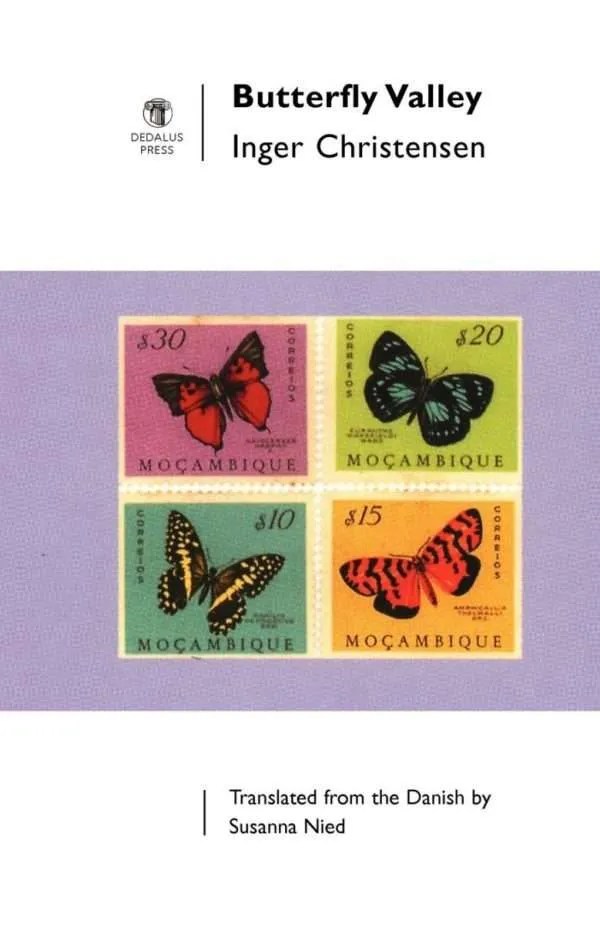
“somewhere I am suddenly born”: alphabet by Inger Christensen

I write like the wind
that writes with clouds’
tranquil script

or quickly across the sky
in vanishing strokes
as if with swallows

I write like wind
that writes in water
with stylized monotony

or roll with heavy
alphabet of waves
their threads of foam

(from “alphabets exist”)

In her essay “It’s All Words” (included in the collection The Condition of Secrecy), Danish poet Inger Christensen offers a very simple, yet possibly unexpected, statement about the nature of poetry:

But poems aren’t made out of experiences, or out of thoughts, ideas, or musings about anything. Poems are made out of words.

It’s through our listening to the words, to their rhythms and timbres, the entirety of their music, that the meanings in them can be set free.

This particular essay happens to be about her stunning work, alphabet, a book-length sequence of poems in which each piece builds on, remixes, revisits, and expands upon what has come before. It is project that began as process of collecting words and, as she was foraging through the dictionary, she happened upon what would become her form: the Fibonacci sequence.

The concept was introduced to the western world by the medieval Italian mathematician Leonardo of Pisa (later referred to as Fibonacci by 19th century scientists) in his Book of the Abacus in 1202, although the calculation originated with Indian poetics and mathematics as far back as 200 BC. This sequence in which each successive number is the sum of the two preceding it (0,1,1, 2, 3, 5, 8,13, 21, 44, 65, etc) describes an exponentially increasing mathematical pattern that often occurs in nature as in the spiral growth seen in certain plants.

By combining this formula, or “wordless universal poem of numbers,” with the human-made alphabet, Christensen conceived of a structure (or implied form) for an unfinished sequence of poems. A framework upon which she could weave “a kind of spell”:

A prayer that apricots, doves, melons, and so on could continue to exist in the world. And at the same time, a prayer that atom bombs, hydrogen bombs, dioxin, and so on could disappear.

And herein lies the special charm of alphabet. Fourteen chapters, running from [a] to [n], each containing a single poem or series of poems that total a corresponding number of lines from 1 to 740.

The first poem simply reads: “apricot trees exist, apricot trees exist,” the second: “bracken exists; and blackberries, blackberries; / bromine exists; and hydrogen, hydrogen” and so the essential pattern is set, introducing the existential aspect of the everyday matter around us—that which is good and beautiful, that which is toxic, and an element that can either be vital to life or destructive. As the poems become longer and more complex, these early images reappear and the alphabetic aspects are more or less evident. As each chapter expands there is, as in life, an increasing and startling diversity and variety to be found.

life, the air we inhale exists
a lightness in it all, a likeness in it all,
an equation, an open and transferable expression
in it all, and as tree after tree foams up in
early summer, a passion, a passion in it all,
as if in the air’s play with elm keys falling
like mama there existed a simply sketched design,
simple as happiness having plenty of food
and unhappiness none, simple as longing
having plenty of options and suffering none,
simple as the holy lotus is simple
because it is edible, a design as simple as laughter
sketching your face in the air

(“life”)

Christensen is a poet who delights in form, but prefers to set her own rules. Each poem has its own structure, but the use of repetition and recurring motifs contributes to the overall hymn-like quality of this work. She celebrates the beauty of everyday moments, delights in magic of the natural world and, as in her essays, shows an acute concern for the legacy of the atomic bomb and the nuclear fears of the Cold War (this book was first published in Danish in 1981). Her vision moves back and forth between these poles of existence threading words into verse.

Translator Susanna Nied had translated several of Christensen’s volumes of poetry before alphabet was even written (including her masterpiece It), so when this book was published in Danish, the poet sent her a copy. In an interview in Circumference, she describes how she sat down to read it as soon as it arrived. She read straight through and began to translate almost immediately without telling Christensen.

I did eventually show that preliminary alphabet translation to Inger, who pronounced it flot (high praise) and went over it with me, asking excellent questions, musing and reminiscing about how she had written the poems. We had a long tussle over whether the key verb should be “exist/exists” or “is there/are there.” Inger ultimately won, thank goodness, though it took me several months to capitulate. As we worked together during the six weeks I spent in Copenhagen, I recognized the content of alphabet in Inger’s daily life and in her memories. I recognized its cadences and phrases in her speech. Again, invaluable.

She goes on to describe working on the translation for years and, even once it was published she was still thinking of ways it could be improved. Nonetheless, the long working relationship between poet and translator is reflected in the care with which Nied realized the many intertwined and contrasting elements in this unique and engaging work.

I would like to imagine that this is an experimental poem (or sequence of poems) that is not only original, but accessible to those who might fear poetry. Meaning can be found, or revealed to a reader, in a very natural and yet personal manner. Sometimes the defining letter has a major role, other times less so. Her poems take off and move in unexpected directions before returning to call up familiar images in new ways. It’s a truly wonderful work and a fantastic, award-winning translation.

alphabet by Inger Christensen is translated from the Danish by Susanna Nied and published by New Directions.

I accept. I accept it all: Return to My Native Land by Aimé Césaire

At the end of the small hours delicately sprouting handles for the market: the West Indies, hungry, hail-marked with smallpox, blown to bits by alcohol, the West Indies shipwrecked in the mud of this bay, wickedly shipwrecked in the dust of this town.

At the end of the small hours: the last, deceiving sorry scab on the wound of the waters; the martyrs who refuse to bear witness, the fading flowers of blood scattered on the futile wind like the screeches of chattering parrots; an old life’s ingratiating smile, lips apart in deserted anguish, an old wretchedness decomposing in silence beneath the sun; an old silence broken by tepid pustules, the dreadful zero of our reason for living.

The image of his hometown that opens Martinician poet, playwright and politician Aimé Césaire’s Return to My Native Land, is brutal and unforgiving, a bleak portrait of destruction, despair, and disease. With its uncompromising vocabulary, relentless energy, and pointed repetition, a pulsating beat soon settles into the language. It will carry the reader—or listener, for these words beg to be heard—through to the end of this powerful and inspiring epic. Explored through the lens of surrealist poetry, this intensely personal journey to self-affirmation and biting deconstruction of the colonial condition became a rallying cry for the African diaspora. It is also one of the best known French poems of the twentieth century.

Césaire was born in 1913 in the town of Basse-Pointe, Martinique, the second eldest of six children. Although his family were of modest means, they moved to the capital, Fort-de-France, so he might be able to have a good education. It was a wise investment, as Aimé received a scholarship to the Lycée Louis le Grand in Paris. But the move to Europe was a sobering one as the young man came face to face with the fact that although he was a French citizen, the colour of his skin openly set him apart. It would serve as the beginning of an understanding of himself in relation to an African heritage and a legacy of slavery and colonial domination. With fellow students, Léopold Senghor from Senegal and Léon Damas from Guyana, he contributed to the development of the concept of “Negritude” or black consciousness, a revolt against colonial values that not only formed the foundation of an intellectual movement but shapes his celebrated poem.

Return to My Native Land (Cahier d’un retour au pays natal) first appeared in print in 1939, the year Césaire left France and moved back to Martinique with his wife and first child. Over the years it would undergo several revisions before the definitive French language version was published in 1956. The English edition reviewed here is a recent (2024) rerelease of the 1969 translation by John Berger and Anna Bostock, edited and introduced Jamaican writer and scholar Jason Allen-Paisant. In his introduction, Allen-Paisant writes of his personal history and connection to this work, noting that his appreciation grew slowly, ultimately bridging the seventy-seven years age difference between himself and Césaire:

In time, I became aware that this poem inspired movements of liberation and cultural assertion across Africa and its diaspora. But above all, Césaire’s poem was about my body. It was a sound in which my body was at home. This enchanting sonic power (its rhythms suggestive of the drum, of chanting, of ceremony) is hard to strip away. Still today, even now that I understand the meaning of nearly all its words, I connect with this poem through its sound.

Although Césaire found his poetic expression through surrealism, there is a broad narrative arc to Return to My Native Land. The early section speaks of the poverty and decay of his hometown, recalls childhood memories, and acknowledges the pull of Europe as means of escape. Leaving home is seen as the only way one can find oneself. It is to become part of a long history of dislocation:

To leave.
As there are hyena-men and panther-men,
so I shall be a Jew man
a Kaffir man
a Hindu-from-Calcutta-man
a man from Harlem-who-hasn’t-got-the-vote

Famine man, curse man, torture man, you may seize him any moment, beat him, kill him – yes, perfectly fine to kill him – accounting no one, having to offer an excuse to no one

The wandering man, homeless, trying to find a place and meaning , grows increasingly angry and bitter in a world in which his people are either hated, seen as wretched beasts, or loved as novelty and entertainment. At times the anger takes on a wider, universal tone:

Words? We are handling
quarters of the world, we are marrying
delirious continents, we are breaking down
steaming doors,
words, ah yes, words! but
words of fresh blood, words which are
tidal waves and erysipelas
malarias and lavas and bush-fires,
and burning flesh
and burning cities . . .

Know this well:
I never play except at the millennium
I never play except at the Great Fear

Accommodate yourself to me. I won’t
accommodate myself to you!

As much as this is a work that seems to sing off the page, it can be harsh and demanding. The language can be quite brutal and disarming, the images, often dark and visceral, as the poet confronts his own feelings of disgust, guilt, shame, and anger in his response to the world around him and the history that shaped it. But gradually he begins to find a strength and direction in himself and a vision of future he wants to see for his people. Self-acceptance does not lead to weakness but to defiance:

Make me rebellious against all vanity but docile
          to its genius
like the fist of our extended arm!
Make me the steward of its blood
make me the trustee of its rancour
make me a man of ending
make me a man of beginning
make me a man of harvesting
but also make me a man of sowing

The man who rises as the poem nears its close is one who accepts his biology but refuses to be defined by it. He is called and calls his people to rediscover and reclaim their humanity after centuries of dehumanization and trauma through a reimagined return to their African roots. That is the native land to which he has, in spirit, returned. In body, however, he will remain in the land of his birth and continue to explore these themes through his writing and plays, and put his passions into practice in political life. Aimé Césaire died in 2008 at the age of ninety-two, but Return to My Native Land, remains a critical call to action and profound anti-colonial statement that is now, eighty-five years after its first appearance and almost seventy years after the release of the definitive French edition, more important than ever.

Return to My Native Land by Aimé Césaire is translated from the French by John Berger and Anna Bostock, with an introduction by Jason Allen-Paisant, and published by Penguin Books.