“I had a dream”: The Vegetarian by Han Kang

“Dark woods. No people. The sharp-pointed leaves on the trees, my torn feet. This place, almost remembered, but I’m lost now. Frightened. Cold. Across the frozen ravine, a red barn-like building. Straw matting flapping limp across the door. Roll it up and I’m inside. A long bamboo stick strung with great blood-red gashes of meat, blood still dripping down. Try to push past but the meat, there’s no end to the meat, and no exit. Blood in my mouth, blood-soaked clothes sucked into my skin.”

The Vegetarian, a novel by Korean author Han Kang, confidently translated by Deborah Smith, met with resounding critical praise when it was released in the UK early last year. Despite being available in Canada in the UK edition, the book has received relatively little attention on this side of the Atlantic. However, its American release from Hogarth in a slightly different translation, should encourage a new round of well deserved attention.

vegetarianThis haunting allegorical tale of a woman’s gradual descent into madness that cracks and shatters the carefully composed order around her, starts out with a certain clean, almost antiseptic atmosphere of emotional detachment. It passes through the lens of an eerie erotic account of artistic obsession and ends with the force of an unbridled mountain creek, crashing and rolling down a steep rocky channel to a wildly uncertain end.

The opening chapter, “The Vegetarian”, is narrated by the moderately ambitious Mr. Cheong, a Seoul businessman who sets the bar fairly low and is intent on a smooth life, devoid of excessive stress or excitement. He marries accordingly, choosing the perfectly average Yeong-hye. Not exceptionally attractive, her quiet resourcefulness, and competent housekeeping and cooking skills please him. Yet he is, once his measured existence takes a turn for the decidedly strange; a man who proves himself remarkably self-centred. In his world it is all about him, even as it becomes apparent that his wife is struggling with something dark and troubling.

One morning, without warning, Yeong-hye is discovered, by her husband, standing in the glow of the open refrigerator at 4:00 AM. She is oddly lost, curiously absorbed by whatever it is she sees there. Her only explanation, when pressed, is “I had a dream”. Later that day, Mr. Cheong arrives home to find his wife removing and discarding all of the meat in the fridge. From that point on she becomes a committed vegetarian, much to her husband’s horror, dismay and shame. But this is not an effort to embrace a health trend, she becomes thinner and more withdrawn over time. Still he rationalizes away her behaviour, preferring to maintain a facade of normalcy. As readers we are afforded brief glimpses into her horrific dreams and visions. However it is not clear whether she actually makes an effort to try to talk to her husband – or if he would listen.

Finally, more out of frustration for what she is doing to him than concern for Yeong-hye’s well-being, Mr. Cheong seeks the support of his in-laws. They respond with an attitude of extended shame. When an ill-conceived attempt to stage an intervention at a family gathering fails, Yeong-hye’s father resorts to force and violence. In response his defiant daughter turns the drama of violence on herself.

The second part, “Mongolian Mark” adopts a third person perspective. The video-artist husband of Yeong-hye’s older sister In-hye takes centre stage. Time has passed and Mr. Cheong has filed for divorce. The vegetarian is now on her own, but her brother-in-law has developed an erotic obsession inspired by the knowledge, gleaned from his own wife, that Yeong-hye has never lost her Mongolian Mark, a birthmark common to darker skinned babies that generally fades a few years after birth. He is haunted by images of naked men and women, their bodies painted with luscious flowers, engaging in sex and ultimately he reasons that the only way to purge his fixation is to realize his artistic vision. But who to paint and film? The true source of his obsession, of course. As this chapter unfolds it becomes apparent that Yeong-hye has moved beyond the realm of normal grounded emotion. To satisfy his growing need to permeate her implacable surface, her brother-in-law will ultimately risk his relationship with his wife and child.

“Slowly she turned to face him, and he saw her expression was as serene as that of a Buddhist monk. Such uncanny serenity actually frightened him, making him think that perhaps this was a surface impression left behind after any amount of unspeakable viciousness had been digested, or else settled down inside her as a kind of sediment.”

The final section of The Vegetarian, “Flaming Trees” follows In-hye several years on again, her own marriage now dissolved, on her way to visit Yeong-hye at a psychiatric hospital in a remote mountainous area. The demands of running a business, caring for her young son, and attending to the needs of her sister have taken a toll on her. She is haunted by doubts, regrets and voices. Meanwhile Yeong-hye, convinced that she wishes to become a tree and is therefore no longer in need of any nourishment beyond water, has been slowly wasting away. By this point the narrative, at once so controlled and self assured, spirals into a dark, increasingly surreal tunnel from which it is not clear if anyone will emerge intact. The threads that have led the two sisters to this point are spooled back to earlier moments in their lives; casting light on the insistent destructive power of obsession, pride, and shame arising from the rigid social strictures that confine and restrict the individuals caught within them.

There is no question that this is a powerful work. The structure of the shifting perspectives is interesting and effective. However, if there is a difficulty for me in this book, it is a lack of clear cultural context. Elements of Korean social expectation and custom play a significant role in the way that Yeoung-Hye’s family respond to her increasingly bizarre behaviour but I would have liked to have had that aspect fleshed out a little bit further. Too much seemed to rely on what is assumed. The environment, that is a sense of place – save for that of the final section – seems largely unremarkable, generic. This is my first experience of Korean literature, but I tend to find the same challenges for me, as a reader, with much Japanese writing, so this may be more a question of personal inclination on my part than a specific shortcoming in the work.

Finally, as a mental health advocate, I did find the depiction of mental illness a little too out of step within what is clearly an allegorical tale, as if it was trying to be both surreal and authentic at once. By the end I could not help but imagine it as a Korean version of Miriam Toews’ All My Puny Sorrows; in both books one sister is faced with coming to understand or at least respect her mentally ill sister’s desire to let go of life, albeit one with restrained horror and the other with humour. Both novels, at heart, confront a brutal reality that is difficult to forget.

Wrapping up a month of healing with Thomas Bernhard and Wittgenstein’s Nephew

As I look back on a month which began, at least as I can best remember, in a hospital bed on the cardiac unit, it seems oddly serendipitous that my final read for August is a book that begins in the chest clinic of an Austrian hospital. I did not know much about Wittgenstein’s Nephew in advance beyond the fact that it dealt with madness, one of Bernhard’s common themes. I had ordered it, in all honesty, to reach the free shipment minimum on an Amazon order for a quality adaptor for my trip to South Africa. It’s long been on my wish list so I just tucked it in. I picked it up off the pile on my coffee table yesterday and could not put it down.

nephewBernhard is a favourite. I always find him, in his characteristic vitriol, to to be funny and wise. But this book is less caustic and more sentimental than I could possibly have anticipated. It is also a tribute to his real life friendship with Paul Wittgenstein, in truth a relative of the famous philosopher. In one singular paragraph that extends over a mere 100 pages, the narrator, one Thomas Bernhard, orchestrates a grand meditation on health and illness, sanity and madness, and the singular power of a friendship grounded in common interests and mutual intellectual respect.

As this novella opens Bernhard is recovering from surgery to remove a tumour from his thorax. While he lies in his hospital bed tormented by his roommates and ignored by the nursing staff, he comes to learn that his dear friend happens to be confined to the mental ward of the same facility, ironically in the Ludwig Pavilion. Paul, who may well have suffered from manic depression, is given to recurring bouts of madness. For Bernhard, the causes and courses of their conditions are analogous:

“Paul went mad because he suddenly pitted himself against everything and lost his balance, just as one day I too lost my balance by pitting myself against everything – the only difference being that he went mad, whereas I,  for the selfsame reason, contracted lung disease. But Paul was no madder than I am: I am at least as mad as he was, as he was said to be, though I have lung disease in addition to my madness. The only difference between us is that Paul allowed himself to be utterly dominated by his madness, whereas I have never let myself be utterly dominated by my equally serious madness; one might say that he was taken over by his madness, whereas I have always exploited mine. Paul never controlled his madness, but I have always controlled mine – which possibly means that my madness is in fact much madder than Paul’s.”

A blend of fiction and memoir, fans of Bernhard’s trademark crankiness will still delight in his rants against psychiatrists, German newspapers, simple minded people, literary prizes, actors and in the end, the cruel inevitability of death. But the beating heart of Wittgenstein’s Nephew is an ode to the life sustaining value of a true friendship. Paul is remembered as “the only man I had ever been able to talk to in a way that was congenial to me, the only one with whom I could discuss and develop any topic whatever, even the most difficult.” They shared a passion for music, an inherent restlessness of spirit, and a love of philosophical discussion and debate. A most rare and precious bond.

Ultimately, especially after the death of his wife, Paul’s spirit deteriorates. He starts to die long before his final breath is drawn, and as his friend witnesses this decline he finds it increasingly difficult to be in his presence. Bernhard pulls away, a rejection driven perhaps by the fear of dying engendered by those on death’s doorstop. This slender volume is a eulogy to a man of wisdom and spirit who could not maintain his grip on a world that is perhaps more mad and unstable than he ever was.

Thanks to the fallout from the clot sitting in my lung and the cardiac arrest it triggered, I am presently experiencing a faint taste of what chronic sufferers of lung disease like Bernhard might have known; yet, like Paul, I have also been diagnosed with a serious mental illness. At one point, Bernhard talks about returning home from the hospital and the reckless urge to do more than one is physically capable of managing. This leads to a rant about how the healthy fail to understand the chronically ill. This is an unfortunately valid observation, one that is especially true when the illness is psychiatric. A year ago this spring I suffered a serious manic break after 16 years of stability and although I am still “technically” employed, no one from my former workplace is allowed to contact me. I am a leper. Admittedly I have built a new community of support since that time, but I have had many more offers for assistance after my recent health problems than I can handle. It is quite a contrast. Last year I was prone to a few rants of my own about how I suspected that my employers would have been much more sympathetic had I had a heart attack.

A month out now from an event that still haunts my thoughts and emotions, I am gaining strength each day. Sometimes I overdo things and have to rest. A high level of smoke in the air from distant forest fires kept me housebound for week causing me to feel a little edgy. But I have read a decent number of books, including a few that may be among my best of the year thanks to the Women in Translation challenge. Winding up August with this heartfelt ode to friendship is perfect, after all there a couple long distance calls to South Africa on my cell phone bill. There were a few moments in those very early days in the hospital that there was only one voice I needed to hear.

Originaly published in 1982, Wittgenstein’s Nephew translated from the German by David McLintock was first published in 1989.

Solstice to solstice to solstice: A note from South Africa

Over the past year I have embarked on a journey that began, unexpectedly, with the recognition that I had allowed pressures at my job to consume me, to drive me to the very brink of a complete breakdown. It was summer solstice when I removed myself from the office, imagining at the time that I would soon be back and on track. I had no idea how sick I was and no real appreciation of how much I had sacrificed to work and children. Now, with work in tatters and children grown I wondered if I had really lived the full and rewarding life I imagined that I had. Finding myself (again) in mid-life has been difficult, dark and lonely – a task I felt ill prepared to take on.

But it has been the very best thing that could have happened.

From a very low point last December, winter solstice, my life has started to change in very real and important ways. A wonderful therapist and proper medical support have been crucial, while finding a supportive community has helped me start to move out into the world in an honest and authentic way. But, much to my surprise, blogging has opened up the world in a way I had not anticipated. I began with no clear objective, fueled with manic energy, spiraled into a little anxiety driven meandering as my world fell apart and solidified this year into a basically book focused blog.

Along the way I made a friend who has become a ballast for me – a touchstone, someone who understands the experience of navigating the storms of bipolar disorder because she rides them herself. Someone who is also queer. And an avid reader.

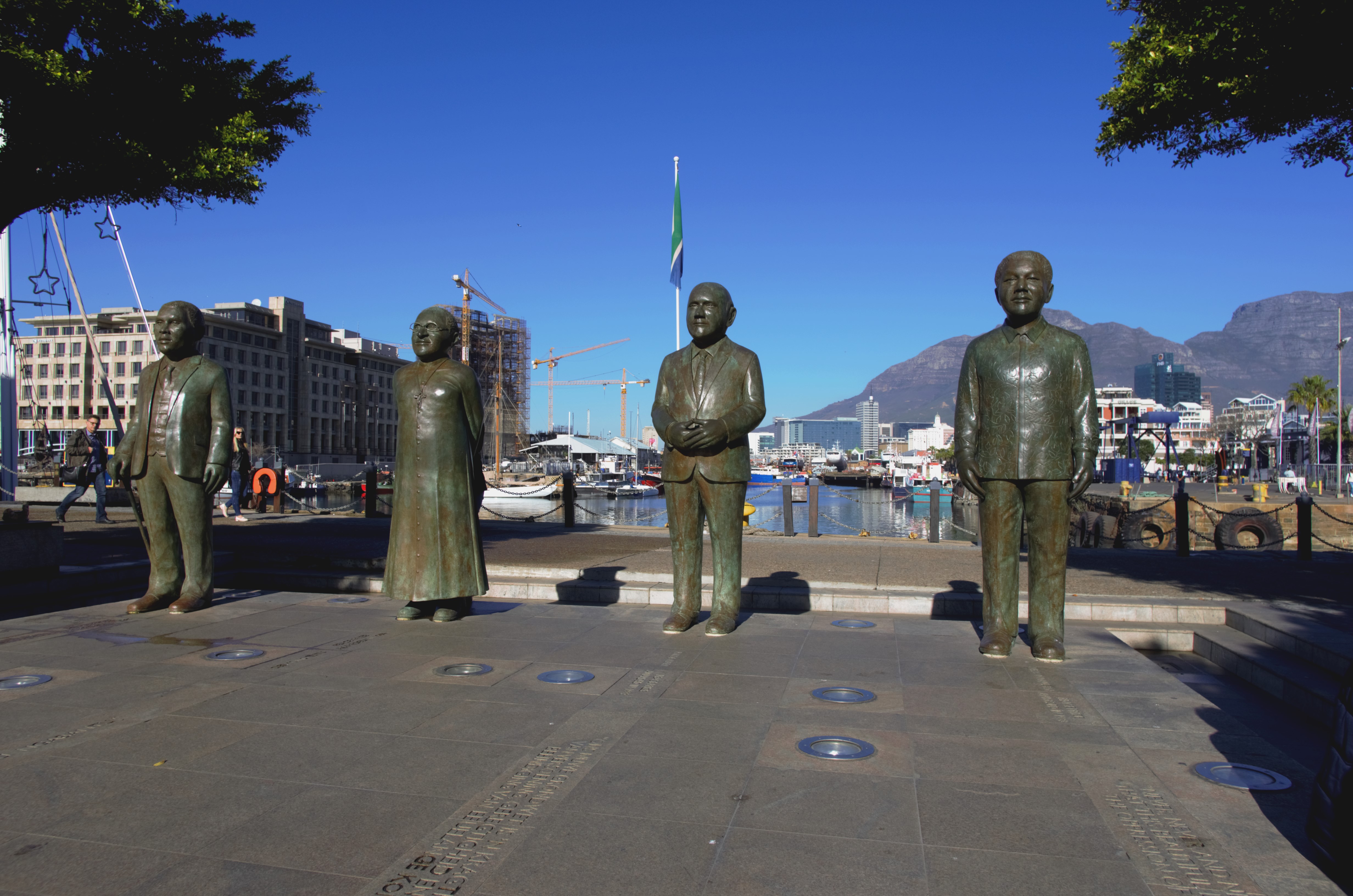
Nobel winners waterfront CT Indian ocean

However, getting together for coffee required a little planning. I live in western Canada, she lives in South Africa. And so I marked this past solstice, trading summer for winter, in Cape Town. Then I boarded a bus for the Eastern Cape province where I am now. I have long had an interest in South Africa, with the literature and history of this complicated and important place. The dust has not settled here.

My friend has given me a gift I will not soon forget. Our friendship has opened a space for us to explore our own personal journeys and to talk about our respective countries – to compare the differences and the similarities.

And I am also  guaranteed to arrive home with books.

Roughghosts is one year old today: Looking back and ahead

Today I received a notification from WordPress congratulating me on my first anniversary. Well happy anniversary to my alter ego roughghosts who was born on this day from a scarp of creative writing I uncovered in one of my endless unfinished notebooks. I never was very clever with user names; most of my aliases amount to little more than my initials and the first 5 letters of my last name.

Copyright JM Schreiber, 2014

I have become quite fond of roughghosts. It suits me, more than I might have imagined, or at least been willing to admit on May 31st of last year. To be honest, I created this blog to engage with other WordPress blogs and, I don’t know, maybe reflect a little, and explore some creative writing. At the time, a little voice I the back of mind said this looks like a rather manic move. After all I was under a soul crushing amount of stress at my workplace, had a major fundraiser and annual report due, and had not slept for more than a few hours a night since the previous November. But I shrugged it off, forged ahead only to crash and shatter into a thousand pieces a few weeks later.

Today, I have managed to rebuild myself to a point. There is still a lot more glue, stitching and healing required. Mania has subsided to a simmering depression with doses of anxiety and a pill that I do not like but is presently necessary as a sleep aid. And roughghosts the blog has evolved from a space to moan about the shock of realizing that, yes, I still have a mood disorder and all the fallout that a major breakdown entails, to a book based blog with a strong focus on translated and international literature.

Over the past few months I became involved with a jury shadowing the International Foreign Fiction Prize (IFFP), a challenging and highly rewarding experience. It taught me to read faster – still no speed demon, I – and read more deeply with a specific goal to being able to rate and write a constructive review for each book. I have started scribbling in margins and filling notebooks when I read. As a reader and a writer this has been invaluable. The camaraderie of reading and discussing the books together was an added bonus, introducing me to a great group of book bloggers. My subsequent expansion of activity on twitter has further enhanced this community of readers, publishers, authors and translators.

Then, close on the heels of the IFFP came the Best Translated Book Award (BTBA) with a challenging and exciting longlist and a selection of small North American independent publishers to discover. Adding to this embarrassment of riches for lovers of translated literature was the conjunction of the biannual International Booker and the writers I want to explore from that list of finalists. And, on top of all this, my longstanding interest in South African literature will be further nourished by a trip to that county in a few weeks with a list of books I hope to obtain.

I am, I hope, reading my way back to wholeness. Preparing to write my way back into the world, or rather document my very real journey into the world in a full and honest way for the first time in more than half a century of living.

This past week’s awarding of the 2015 IFFP and BTBA prizes saw the celebration of female authors and translators. The IFFP honoured Jenny Erpenbeck and Susan Bernofsky for The End of Days, a decision that coincided with our shadow jury’s esteemed choice. This is a most important book with a timeless theme spanning the whole of the 20th century. About an hour later the 2015 BTBA was awarded to The Last Lover by Chinese author Can Xue and translator Annelise Finegan Wasmoen. I encountered this book as a longlisted IFFP title and simply fell in love with the surreal, dream-like tale. Notably, Can Xue was also named that same day with six other women and two men as finalists for the Neustadt International Prize for Literature. I’ve been decidedly excited by this celebration of female writers and for those who know me, that is a huge shift in my own approach to literature.

Back in late January I wrote a pot in response to a discussion on the Tips, Links and Suggestions blog of the Guardian which had caused me to reflect on the abysmal ratio of female to male authors in my reading and on my shelves. However, my more explicit focus on literature in translation is slowly beginning to shift that balance. Especially if one considers how many of the works I read, if written by men, were translated by women. And I am taking serious note – not only should I endeavour to read more female writers, I can easily fall under the spell of Can Xue, Anne Garréta, Marlene van Niekerk, Olja Svačević or Valeria Luiselli, just to name some of the authors that have really impressed me of late. And I am pleased to report that an increasing number of the books I am currently reading or planning to read feature female writers and/or translators.

Copyright JM Schreiber, 2014

So, on my first anniversary as a blogger, I look back over an ad hoc journal chronicling an ongoing passage from a terribly messed up state, struggling to make sense of a sudden shock to my self esteem, my confidence and my identity to a place where I have a strong real life community, solid mental health support and a creative environment where I am proud of the work that I publish in this space. Moving forward I hope to explore further writing opportunities, continue to recover and, with luck, make my way back into productive employment.

And keep reading a lot of terrific, exciting and challenging literature from around the world.

Hard to remember when the world had colour

- Copyright JM Schreiber, 2012
– Copyright JM Schreiber, 2012

Granted midwinter in my part of the world is not the best place to find colour in nature. Branches are bare, grass is bunched and brown, snow is patchy and grey. But when I look back over the past year I can see how difficult it has been for me to register any enthusiasm to take my camera out. I walk a lot but I seem to want to stay in my head, maintain a fast pace, measure the rhythm of my boots against the ground. I circle the neighbourhood, walk with purpose on errands, but avoid the pathways and parks I have documented season after season these past few years.

Photography was a diversion, a relaxation and an isolated activity against a busy life at work and home. I would wander forest trails, across grassland parks or along the edges of rivers and lakes, framing and reframing the view and listening to recorded podcasts – discussions about books, philosophy, current events. It was a meandering, escapist pursuit. If I look back I have to wonder what I was escaping and where I had lost the capacity to dream.

Madness, mental illness if you prefer that term, brings back the capacity to dream because all the parameters are changed. For me it has brought words to the foreground but pushed the pictures to the background. Walking has become a means to expel restless energy, drive out the demons of anxiety and despair that keep reaching in. If I want to drown out the city noises I listen to music, the words in my head are my own.

Without being able to return to work at this time, I do feel a certain loneliness. But when I reflect on the years I devoted to a job that I believed validated and defined me, I realize that I was never more isolated than when I was working. Invisibility and an unwillingness to call attention to myself was not a measure of my successful transition. It was denial. To hide the fact that my past contained realities inconsistent with the man everyone knew, I believed I could not afford to allow anyone to get close. I captured colour in the outside world but painted myself with the blandest palatte possible.

A manic episode and all of the reckless behaviour and poor judgment it entails has left me with a professional legacy that I may never be able to salvage. I don’t even know if I want it back. Reclaiming my identity, being comfortable with my own history of sex and gender is a work in progress but I have to trust that it might lead me to a better more authentic place. It might even bring some colour back into my life.

Of memories, grief and melancholy: walking into 2015 with W.G. Sebald

Every year, rather than rushing through a book before the clock strikes midnight just to push up the book count of the year that is slipping away (an inclination likely idiosynchratic only to those who of us would rather read than party on New Year’s Eve), I prefer to walk into the coming year in the company of a great writer, allowing the experience to end one year and launch the next. My companion of choice to see out a year marked by loss, the resurgence of mental illness and a recognition of not only my own isolation, but my role in facilitating that condition; was the late German writer W. G. Sebald. More specifically his haunting and heartbreaking novel The Emigrants (translated by Michael Hulse). As a curious coincidence, the Word of the Day email from Meriam Webster that appeared in my inbox this morning for January 1 is:

emigrate \EM-uh-grayt\
verb  : to leave one’s place of residence or country to live elsewhere

sebald2If you have never read Sebald, his work almost defies simple description. It must be experienced. Adjectives from admirers abound: mesmerizing, beautiful, subtle, sublime. Long evocative sentences unfold into even longer reflective paragraphs – at times running for pages – enhanced with the insertion of grainy photographs of people, scenery, pages from notebooks, objects, sketches. The reader is pulled in, guided along through landscapes, recollections, side observations and historical reflections by a narrator who is present, patient and human in the face of the incompleteness afforded by memory and the passage of time.

The Emigrants may well be the most accessible of Sebald’s work that I have read, especially because it forms its structure around the apparent biographies of four men who have emigrated or been exiled from their homelands. Three of the four have a Jewish heritage and World War I and II form a critical backdrop to the four very different accounts. Our narrator encounters each of these men, in person, even if only as a child, but in most cases he pieces together part or all of their life histories through the recollections of others, and the diaries and memoirs that he acquires along the way. In some cases he even attempts to revisit the locations that impacted the lives of his subjects, finding only decay or even complete obliteration in his vain efforts to find traces of a past that cannot be revisited.

There is such a deep and abiding melancholy that runs through these pages, that I don’t think I could have chosen a better literary companion to mark the passing of this difficult year. But it broke my heart and drove me to tears on more than one occasion. The first two chapters end with suicide. In the first we meet the eccentric Dr Henry Selwyn who, by the time the narrator and his wife come to know him, has taken to dwelling in the garden of the house owned by his wife from whom he is long alienated. He confesses to a greater sense of loss over a friend who had disappeared into the crevice of a glacier years before than any regret for the dissolution of his marriage. A Lithuanian Jew who had sought to conceal his heritage after emigrating England, the gentle doctor would eventually put his hitherto unused rifle to final lethal use.

In the second chapter the narrator revisits a beloved childhood teacher, Paul Bereyter, upon hearing of his suicide. Through his own reflections and conversations with a French woman who became Paul’s friend in his later years, an attempt is made to piece together the roots of the melancholy that had been hinted at when Paul was an unconventional but enthusiastic teacher; yet grew with the realization that even being 1/4 Jewish was sufficient to make him an exile in his own country. Meticulous and pragmatic to the end, the former teacher carefully researches his decision to end his own life. But although you know it is coming, the recounting of Paul’s final day is none the less devastating for the reader.

The narrator then traces the history of his own great-uncle Ambros Adelwarth in the third section. I found this portrait at once the most moving and the most devastating. Here the emigrant destination is North America and, for a change we are in settings with which I have some connection. Eccentric and meticulous in presentation and decorum, Ambros rises quickly in the hotel industry of the early 1900s and, once he joins his siblings in the US, secures works with a wealthy Jewish family on Long Island. He is given charge for their son Cosmo, a young man driven to reckless excess and, as we will also see, its dark counterpart so recognizable to those of who are bipolar. Ambros and Cosmo embark on a tour of Europe and the Middle East, marked by gambling, daring aerobatic performances and a certain display of personal affection that raises the eyebrows of the elite that inhabit the rarefied world of wealth and glamour in the years just before the First World War.

With the outset of war though, Cosmo begins to plummet into despair and despite the best remedies that money and contemporary mental health care can buy, he will end his days in a private sanatorium. After staying on and looking after the family, Ambros retires to live in quiet isolation. But he is seemingly haunted by a deep unbearable grief. Suicide would be too messy, one imagines, for a man who dresses and presents himself as a formal gentleman to his dying day. Rather Ambros opts for voluntary commitment to the same sanatorium where Cosmo died, stoically submitting to an extreme regime of ECT as if the only way to truly destroy traumatic memory is through one bone blasting jolt at a time.

The final chapter, one which Sebald admitted was based on the amalgam of a landlord he once had and a well known artist; finds our narrator in Manchester, England. The city centre is in rapid decline. Here he meets Max Feber, an artist who, having emigrated from Germany, has for decades been single-minded in his efforts to find refuge through art. He devotes himself to this task seven days a week, drawing and erasing his work repeatedly, beyond the patience of his models. The narrator is curiously drawn to this anti-social, unusual character and they form an odd friendship but it is not until he revisits Max 25 years later that he realizes that there is here another story of loss to be fleshed out. But the lasting impression of the emigrant experience is as one in which both the realities from which emigrant has come and those to which he arrived (in this case in Germany and in Manchester) are both subject to decay, dissolution and the vagaries of memory and time.

Copyright JM Schreiber, 2011

I have never been one for family history. My mother’s family emigrated from Ireland to Brooklyn, New York in the mid 1800s, my father’s mother’s family would have arrived in Toronto from England probably around the turn of the 20th century whereas his father’s family were United Empire Loyalists, making him a 7th generation Canadian. My parents met in New York City in the late 1950s, an era to which my father repeatedly tried to return long after it had ceased to exist. My brother and I were born in New Jersey but, after exploring a variety of options, my family pulled up stakes and moved to western Canada away from everyone they knew and settled here when I was only a few years old, soon adding another son.

Apart from that rough sketch, I am not inclined to family trees, I have only two photos of myself as a child and by the time my own children were born I had developed such a strong aversion to having my picture taken that I sometimes worry that I may have failed to take enough photos of my own children when they were growing up. Many years ago I finally understood why the person I saw in pictures or in the mirror was so at odds with the person I knew myself to be and started on a journey to correct the discord. Having reached my intended destination I no longer know how I fit into my family tree. In a very fundamental way I am an emigrant who has become exiled in his own life, still seeking to define what that means for me.

As the richly imagined portraits in The Emigrants illustrate there is a melancholy, anxiety and despair that can haunt the emigrant experience. I found myself wondering about origin, that is, how much of the melancholy was carried into the experience and how much owed its origin to dislocation and loss? As a person with bipolar disorder recovering a from a serious breakdown, questions of cause and effect always simmer. In the end it is impossible to distinguish loss leading to despair from despair that enhances a sense of loss. Having experienced both this past year I enter 2015 with a cautious mix of anxiety and anticipation.

As the year draws to a close…

At the beginning of 2014 my world was rapidly spinning out of control. There were clear indications that the extreme stress and toxic work environment I was living under was taking its toll. I was clearly struggling to hold myself together but like any good manic depressive I could not step aside and recognize the crisis that was unfolding. No one else in my life had the understanding to step in either and, in all fairness, I am not sure how I would have responded.

Now, at the end of the year, I have been out of the office for six months. My future is unclear. I had loved my work with brain injured adults and their families. It was challenging, rewarding and I was well respected. At least until I went crazy.

As soon as I walked away from my job I realized the price I had paid to build a career from community field worker to manager in less than a dozen years. I had intentionally alienated myself from people. I have always been a person inclined to isolation, shy in a curiously outgoing way. Public speaking does not phase me at all. I could speak to a crowd of 300, riffing on a theme if necessary, but face to face small talk is uncomfortable. The thought of baring my soul to another person in real time, over a coffee perhaps, is almost unbearable. In my life I have made few friends and had only two significant love affairs. And somehow I had managed to convince myself over the past decade or so that in addition to the challenges of raising children on my own, the social interaction provided by my work with hundreds of clients and professional colleagues would suffice. Close friendships and romantic relationships were not required.

I was wrong. But what now? I am in my 50s. I have repressed the very uniqueness of my history, that which had always set me apart. The very queerness of my being in the world. The ostensible and hard won success of fighting to be true to myself in the world was turned to dust in an instant. The road ahead suddenly looked lonely and long…

Slowly I am recovering. Much slower than I expected perhaps, but this unplanned respite has forced me to explore, re-evaluate and reach out. My therapist (thanks Jane) has been an important sounding board. Blogging and making contact with both bipolar and bookish fellow travelers has been vital. It has allowed a space for cathartic dumping. A medium for strengthening my ability to clearly articulate my thoughts and reflections. It has given me confidence to move out into the world closer to home.

Thanks to the fact that I have not been working I was able to volunteer at our writer’s festival and meet writers I admired from around the world, all of whom are in my age range. Financial constraints encouraged me to cancel my TV since I was generally using it as a mindless distraction. Consequently, reading and music have regained the attention they deserve. And when it is not -20C, like it is at the moment, I make a point to get out every day, frequently just to read and write at a local coffee shop.

So here is a song and a haunting video to carry you into the new year. It goes out especially to my brilliant friend of Blahpolar Diaries fame (infamy?) whose typically colourful ode to the therapeutic value music inspired this post.

Solstice to solstice: Reflections on madness, identity and writing

It is winter solstice, exactly six months since I left my job. At the time, a year and a half of toxic work-related stress had taken its toll. Had been taking its toll for months. But by the time I managed to pull enough awareness together to face the harsh reality that the mental illness I imagined to be long stabilized had resurfaced in full manic glory, irretrievable damage had been done.

I left in shame. A shame that can not be absolved. I have been shut out, I have no idea what my relationship with my employer is, or if I have any income going forward. When I can eventually return to work I wonder where I will go. And so I enter the shortest day of the year reflecting on what I have learned and looking ahead.

Copyright JM Schreiber, 2012

I loved my job. I managed a small agency supporting survivors of acquired brain injury. I worked with a wide range of remarkable people and their families, walking beside them as they struggled to recover and rebuild their lives, to regain independence, to battle their own challenges and demons. It gave me refuge from the demands of single parenthood, provided human and social contact against my tendency to isolate, and confirmed my value as a man. But the price I paid was huge. I believed it was enough in itself and had not imagined it would end.

Suddenly I was tragically alone in the world. My closest friends were far away. In a city of over a million, there was no one I could call. No one to have coffee with, no place to go, no arms to lie in.

How had I managed that? Well temperament in part. But much more critically I began a transition from an externally female existence, to a more true, coherent identity as male at 40. I built my career in social services after that process began.

In transition I did not move from my neighbourhood, I remained actively engaged in ensuring that the schools my children attended were open and diverse, and experienced no rejection from my family. However to create a whole and consistent space in which I could live where no one knew my past, I guarded my history closely at the workplace. Over time I constructed walls, mastered the ambiguous answer whenever asked about my life, and even managed to successfully neuter and closet myself years after originally coming out.

Somehow this practice bled into my engagement with the community. Fourteen years on it came to colour my identity in the world.

This extended time of reflection from solstice to solstice, aided by a wonderful therapist, has been a time of learning to open and reclaim my identity. To understand how trans, gay and queer relate to me. To put it out in the world. To own it and to write it into being.

As the days grow longer I face an uncertain future financially. Yet slowly I feel the fire of anxiety and agitation that have marked this recovery from my breakdown losing some of its intensity. I have been filling notebooks with writing hoping that maybe some gems might emerge, for the sake of catharsis if nothing else.

Copyright JM Schreiber, 2012

So more than New Year’s Day, solstice holds the resonance of new beginnings for me this year. Happy solstice – winter to those of us in the the north, summer to my friends in South Africa and Australia.

The haunting memory of friendship lost – I Refuse by Per Petterson

April 7, 2016: The post below was composed when I was debating the extent to which I wanted to turn toward reviewing books. As a result it is primarily personal and reflective in nature. Since writing it my reviews rapidly moved to more serious and critical efforts, many of which now appear on other sites.

I recently wrote a piece for the Three Percent blog on why this book should win the Best Translated Book Award for 2016. It offers a more critical view of this work.

23626238The novel opens with the chance meeting of Jim and Tommy, two childhood friends, now in their mid-50’s on a bridge at the break of dawn. More than 30 years have passed since they last saw each other. Jim, the sensitive and more intellectually inclined of the two, has struggled with mental illness and, as we meet him, he has exhausted a year of sick leave after a brief and unsuccessful attempt to return to work. Tommy, who dropped out of school at 16 to work at a mill, has benefited from some shrewd investments and a head for numbers, to find himself in a high level financial position in the city. But his life, with his fancy clothing and new Mercedes, is hollow. Both men have failed marriages behind them and over the course of the day that follows this early morning encounter each one finds himself facing a deep sense of grief and loss over the close friendship they shared growing up in semi-rural Norway.

As spare and luminous as the northern landscape that grounds this exploration of time, friendship, family and dysfunctional parents – themes Petterson has returned to continuously – I Refuse follows a winding chronology and employs a variety of perspectives and characters to frame the peculiar circumstances that helped forge the original bond between Jim and Tommy, and the fractured pathways that each has followed after Jim’s attempted suicide at 18 initiates events that drive them apart. Brought to life through the blistering translation from the Norwegian by Don Bartlett (of Knuasgaard, Loe and Nesbo fame) this is simply Petterson’s broadest, darkest and most complex work to date. If his brilliant Out Stealing Horses has long occupied a space in my top ten all time favourite books, this new work is even more striking and mature.

Or maybe I am simply more mature myself.

At this moment in time, at roughly the same age as the men at the core of this novel, and currently engaged in my own pursuit of disability supports following an unexpected return of a mental health disorder after more than a decade of stability, I could relate to the essential theme of the slowly eroding and distorting impact of the passage of time on our selves and our relationships with friends and family. Apart from a failed marriage and a childhood in a similarly semi-rural setting; my life and circumstances are different than those portrayed here. But the true power of this work lies in the author’s skill and confidence in the reader to leave the space for ambiguity and hint at the possible dynamics that drive the characters without feeling the need to answer all the questions or resolve all the mysteries.

Kind of like the way we have to navigate life itself.

The lonely journey of life

- Copyright JM Schreiber, 2013
– Copyright JM Schreiber, 2013

I had become, with the approach of night, once more aware of loneliness and time  — those two companions without whom no journey can yield us anything.
Lawrence Durrell, Bitter Lemons of Cyprus

Five months have passed since I left my place of employment, deep in the manic vortex of a mental health disorder that had been stable for so long that I failed to recognize the indicators that work stress was taking a critical toll. The first thing I did was hire a psychologist, someone I believed would be able to help me address some of the serious realities that the return of bipolar symptoms threatened to expose. I trusted that her experience would provide a safe space for self exploration and I have not been proved wrong. Mind you I was pretty manic when I arrived at her office, but over the months we have worked together to unspool many of the challenges and concerns that I brought to our very first session.

At the core of our explorations over these past months has been the loneliness I feel and my persistent ability to reinforce the very barriers that maintain this loneliness. When there are people in my life on the superficial, safe level; I cherish being alone. Now that I am making some positive and healthy attempts to connect with others, loneliness seems to follow in the wake of each moment like a hangover.

I don’t know the extent to which my mood disorder has impacted this recurring sense of social isolation. Certainly the up and down waves of manic depression have been marked by episodes of outgoing behaviour, often in conjunction with poor judgement, followed by retreat to safety and protection. There are also temperamental and identity factors that have skewed my experiences. Now my son has shared with me personal concerns that mirror my own in a manner far closer than I ever expected but may help explain the much more severe social anxiety from which he has suffered all his life (and treated with alcohol in recent years). I am not even sure what to make of his situation but I also know that as an adult he has to find his answers on his own because I am weary enough carrying my own baggage.

I accept Durrell’s edict about loneliness and time as necessary for growth, but they can weigh heavily because no matter how much we achieve on our journeys, there always seems to be more open road ahead that, in the end, we can only travel alone.