In praise of small publishers

In honour of World Book Day, I thought I would take a few moments to reflect on my growing obsession for small publishers. Once you start to turn your attention to non-mainstream literature, follow literary journals and publications online, or seek out works in translation; the world of independent publishers invariably opens up. As readers we live in a global world, and we engage in discussions with fellow readers spread far and wide, so it seems natural that you will hear about intriguing works that are not available wherever you happen to live. Sometimes, it’s simply a matter of time but years can separate releases in North America from those in the UK and Australia. Here in Canada we sometimes end up in between the two. Some small publishers do not yet have distribution on one side of the planet or the other, some may never manage it, but I would argue it is still worth trying to support independent publishers no matter where they are, whenever possible.

Why? Small publishers uncover challenging, interesting works, take chances, bring long ignored literature back into circulation, or into translation. Or both.

2015-04-23 13.08.58My two favourite books last year introduced me to two small publishers: CB Editions with Will Eaves’ The Absent Therapist and Istros Books with Selvedin Avdić’s Seven Terrors. Sadly both are publishers without North American distribution. That does not mean, of course that their books can’t be sourced, but the magic of a browsing reader happening to stumble across one of their titles on a bookstore shelf is lost. The joy of random discovery is denied.

After paying extra attention to the IFFP and BTBA longlists this year, I will now be watching out for titles from Pushkin, Open Letter, Deep Vellum, Archipelago among many others. Becoming more engaged as a book blogger and negotiating twitter has caused me to be distracted by some irresistible “shiny objects” – treasures like the stunning A Gothic Soul which arrived earlier this week, in a package covered in Czechoslovakian stamps, direct from Twisted Spoon Press. Oh yes, I could have downloaded it from Amazon for almost a third of what I paid but that would have been a pale substitute for what is truly a work of art and devotion from a small not-for-profit press.

2015-04-23 13.10.55And then there is And Other Stories. I don’t know how I was so late to the party but it was the release of The Alphabet of Birds by SJ Naudé in January that put them on my radar. Dovetailing nicely with my interest in South African literature, their publication of this brilliant debut of stories translated from Afrikaans as well as their ongoing release of works by Ivan Vladislavić was an obvious draw. But as soon as I learned about their grassroots funding of initial releases with subscription support and their engagement of readers in the process of exploring potential writers from around the world… well, I was sold. I subscribed right away. My only regret is that temporary financial uncertainty led me to opt for a 4-book rather than a 6-book subscription. A number of other publishers utilize subscriber support models so I hope in the future to extend my support further and wider.

Today my biggest thrill comes from walking into one of our local indie bookstores and finding a gem on the shelves. Of course I still end up placing special orders, through the same stores or from overseas. And, when there seems to be no option I order e-books but my preference for paper copies has grown after an initial blush of affection for the digital. I am even the sort of person who, having truly fallen in love with a book read electronically or borrowed from the library, just has to own a hard copy.

There must be diagnosis for this illness. But I don’t want to be cured.

Some reflections on my first experience with (shadow) jury duty

The official shortlist for the Independent Foreign Fiction Prize was announced within the last 24 hours or so. A few hours before that, the shadow jury that I am part of revealed its selection of its six book shortlist. How do they match up? Only on two points. With The End of Days by Jenny Erpenbeck (translated by Susan Bernofsky) and Haruki Murakami’s Colorless Tsukuru Tazaki and His Years of Pilgimage (translated by Philip Gabriel). Personally I am pleased with the first title but would not have chosen the latter for either list. But that is the way it goes. The experience of reading alongside 10 other bloggers has been challenging, exciting and a terrific insight into the joys and frustrations of shadow jury dury. That includes: finding terrific new books, dragging oneself through books that – without obligation – would have been abandoned at page 30, and watching some books you want to champion proceed while others fall by the wayside.

iffpAnd we are not done yet. A winner, the shadow version and the real one, will be announced on May 27. We will see if we agree. The longlists are as follows:

The Shadow IFFP Longlist (with links to my reviews):
Boodlines
Marcello Fois (tr. Silvester Mazarella)

Colorless Tsukuru Tazaki and His Years of Pilgrimage
Haruki Murakami (tr. Philip Gabriel)

The Dead Lake
Hamid Ismailov (tr. Andrew Bromfield)

The End of Days
Jenny Erpenbeck (tr. Susan Bernofsky)

The Ravens
Tomas Bannerhed (tr. Sarah Death)

Zone
Mathias Énard (tr. Charlotte Mandell)
Added by jury members who feel it was an oversight
(I have yet to complete and review)

The official list, in addition to the Murakami and the Erpenbeck titles, includes the following:

By Night the Mountain Burns
Juan Tomás Ávila Laurel (tr. Jethro Soutar)

F: A Novel
Daniel Kehlmann (tr. Carol Brown Janeway)

In the Beginning was the Sea
Tomas Gonzalez (tr. Frank Wynne)

While the Gods Were Sleeping
Erwin Mortier (tr. Paul Vincent)

I believe that our shadow jury has presented a solid shortlist, but I must confess that my favourite overall title, While the Gods Were Sleeping, did not fare well on the shadow poll so I am secretly happy to see it receive the attention of the official shortlisting. Likewise I am delighted to see And Other Stories, one of my favourite independent publishers, make the cut with their first ever longlisted title.

So what have I learned so far?

– There is a great community of online book bloggers and I have “met” so many avid  readers of translated fiction (and other literature too)
– The jury process is one of compromise and strongly divergent opinions between readers based on taste and inclination
– I have never read so many books in such a short time – I can do it – but it is a relief to have the pressure off a bit (I do not envy the Booker judges their task!)
– Twitter can suck up hours of your life, but again, is a great way to engage with readers around the world (and with authors and publishers too which is very cool)
– My TBR pile continues to grow astronomically the more that I blog about books and encounter fellow readers and amazing indie publishers

Looking to distant horizons: A few reflections on reading from afar

It is not entirely clear in my memory, but by this time last year, the stress of trying to hold myself together in the face of mounting pressures in what had become a deeply dysfunctional workplace, was taking a serious toll on my emotional and mental health. I have not been able to return to regular work since last June. I have struggled to gather the energy to attend to many of the regular household tasks that seem to pile up week after week. My cameras, once my faithful companions, have hardly been touched. The unbearable sameness of my city fails to inspire and seems to be closing in on me despite a remarkably mild winter. But one activity has remained undiminished and if anything has flourished with the extra time I have these days. I am talking about reading.

A fraction of my shelves, some read, most not (yet).

Most of the books I read take me elsewhere. As I turn my blog focus more and more toward literary themes, it is clear that I have a few idiosyncrasies. I have a definite interest in South African literature. This owes its genesis in part to my own experiences knowing a number of South Africans over the years, from watching the momentous changes that have taken place in the country during my adult years, and in the understanding that the new South Africa faces challenges that create a context for important discussions that we need to continue to keep open. Discussions we can all learn from in our increasingly global reality. The same holds true for another area with which I have an increasing literary interest – central and Eastern Europe. The political turmoil of the past century has provided ample inspiration for a wide range of exciting  literature, which, thanks to an increasing number of industrious small publishers, is catching the attention of English speaking audiences. Slowly but surely.

Of course, at the core of all great literature, classic and contemporary, is the essential quality of the human experience. We are born, we grow old, we fall in love, we lose those we love, we battle darkness, we face fear, we hope, we reach for those moments of joy. And the more I open myself to the stories of others from around the world, the less alone I feel.

But then there is this nagging guilt. As a Canadian, why don’t I read more Canadian writers? Well I do, but so many leave me unsatisfied and rarely reach my blog. And those I am especially fond of have tended to come from elsewhere; that is, they are Canadian with a hyphen and frequently write from that transitional perspective. I don’t think it was always that way. Maybe I have just been land bound too long. Maybe I crave the exotic just a little after all.

Well until I can travel, I will keep my bags packed, my options open and and a healthy pile of books standing by from near and far.

Addressing injustice with the pen: Reflections on Rumours of Rain by André Brink

Earlier this month I attended an inaugural PEN Canada event in my city. The purpose of bringing such discussions to locales throughout the country is to turn the discussion about censorship and freedom of expression inward where, against the outrages we see in other parts of the world, we risk falling into a false sense of complacency. The empty chair at this debate was reserved for Raif Badawi, the Saudi man sentenced to 10 years in prison and 1,000 lashes for the “outrageous” crime of blogging. His wife and children have been granted refugee status in Canada but the Canadian government is curiously reluctant to speak out. Why? I can’t help but wonder if their foot dragging around any international injustices that involve refugees or foreign born Canadians (the non-white ones, that is) reflects the persistent attitudes of the Conservative government’s core grass root supporters. Funny how soon we forget that all non-Aboriginal Canadians are immigrants in this colonial landscape if you go back far enough. The subjugation and treatment of our First Nations peoples is often seen as justifiable, built into our collective history. That is no excuse, but somehow racial concerns carry an entirely new intensity when the matter is much more black and white, so to speak.

Or when we see it elsewhere.

RainThe recent passing of South African novelist André Brink led me to a long overdue reading of one of his classic novels, Rumours of Rain, which dovetailed nicely with the issues that have been in my mind since attending the PEN event. Published in 1978 and addressed directly to the injustices of apartheid, the echoes of this, and his other controversial novels of this period, have long reverberations that continue to ring  close to the bone in this increasingly global new world.

The power of Rumours of Rain lies in the narrative voice. Martin Mynhardt, a successful Afrikaner businessman, has stolen a rare week of solitude in London to exercise his literary ambitions while attempting to exorcise any measure of guilt in the unfolding of a recent series of events that have torn apart the lives of some of the people who were once closest to him. Driven solely by his own over inflated sense of self worth and an endless internal cost-benefit analysis, Martin is a ruthlessly blind apologist for apartheid. He imagines himself sufficiently enlightened to know what is best for his country and his family. He focuses his attention on the events surrounding a weekend visit to the family farm with his son where his goal is to convince his mother to approve the sale of the land, an urgent deal to which he is already deeply committed. But nothing is simple. Violence not only intrudes on his visit to the farm, but back home in Johannesburg, a violent series of riots is about to erupt in Soweto.

In a long winded, self indulgent, but oddly engaging account, he chronicles his complicated relationships with his best friend, his wife, his son, and his mistress. He honestly feels personally affronted by the revolutionary political passions he is witness to, especially in his friend Bernard – after all, he does not want them to reflect badly on him.  But he is unable to acknowledge any responsibility for the role any of his own action or inaction may have played in the end results; he can justify every selfish choice he makes in marriage, love, sex, business and friendship. No matter the cost.

Yet, in committing his story to paper, Mynhardt inadvertently succeeds in giving an eloquent voice to the very views he claims to disdain. He manages this by including transcripts from Bernard’s trial for treason, his son’s bitter reflections on his recent experiences with the army in Angola and through passionate exchanges with Charlie Mofokong, an educated black South African and childhood friend of Bernard’s whom he reluctantly employs to assist him in managing his mine interests.

Throughout the novel two interwoven refrains recur: Martin’s grandfather’s favourite Biblical passage “And have not love”(1 Cor:13) and the anthemic Nkosi Sikelel’ iAfrika.

What we end up is with is the voice of a deeply flawed, myopic (literally and figuratively) anti-hero; not surprisingly one who must have made more than a few attentive readers shift uncomfortably in their armchairs. Literature is often at its most effective when it gives voice to the under dog, but in skillful hands, like Brink’s, turning the narrative over to the less sympathetic side of the equation can have a resounding impact. Especially when we feel a moment of empathy with a man we want to despise, catch a glimpse of him in ourselves.

Fittingly, a month that started with a local PEN event, has ended with Freedom to Read Week in Canada. The opportunity to honour an author who used his voice, together with many of his fellow writers, to raise a chorus to question and challenge apartheid, seems appropriate. Today the intrinsic messages against racism, classism and greed still need to be heard by a wide audience.

The fiction of remembering, the realities of forgetting: New Finnish Grammar by Diego Marani

Copyright JM Schreiber, 2014

The damaged hero of Italian author Diego Marani’s first novel New Finnish Grammar, which was originally published in 2000, but only released in English in 2011 (translated by Judith Landry), is a mystery to himself and to those who find him. World War II is raging, when a badly beaten man is found on a dock in Trieste with no clue to his identification beyond a Finnish name sown into the collar of the naval jacket he wears. When emerges from a coma with, what would presumably be a severe traumatic brain injury, he has no memory and no ability to use language. He does know who he is or where he comes from but, by coincidence, the doctor who attends to him is a Finnish-German who has never overcome his own longing for his homeland. He becomes convinced that the best medicine for his amnesiac patient is to send him to Finland so that he can connect with what is assumed to be his land and language, and in doing so, retrieve the past that has escaped him.

maraniAs much as I wanted to love this book, this is where I started to have problems. Firstly, the storytelling approach is awkward. It is the doctor who takes on the task of
curating a selection of notebooks, journal entries and letters belonging to “Sampo”, our erstwhile Finnish patient, to both honour him and make amends. He frames and fills in the tale with his own reflections, corrections and assumptions. Somehow, we are asked to believe that a man with a brain injury severe enough to trigger such a complete loss of memory and language could manage to develop sufficient facility in a notoriously complex language to be able to report his earliest memories post injury, or even find his way around a strange city. Yes, his mastery of the language is never comfortable, he relies on his notebook and endless practice, and he is emotionally lost and eventually unable to find a grounding or the past he seeks. Meanwhile, the language and mythology of Finland were clearly chosen by the Italian linguist author as a template for the exploration of memory and identity, but I could just not suspend disbelief long enough to fully surrender myself to the story.

This is not to imply that there are not breathtaking moments in this novel. There is a heartbreaking sadness and loneliness that haunts our dislocated hero. As war closes in around him, he is the walking wounded, an invisible casualty in a place to which he so desperately wants to belong. But my practical side, the side that spent the last decade working with real survivors of traumatic and acquired brain injury, could not let go of the idea that the main character’s overall functionality did not mesh with his complete loss of identity and language. The assumption is that his memory loss is psychological in nature and that the return of language will release it. In reality though, his injuries would indicate traumatic causes and with such severe long term memory loss some elements would still typically remain intact, while short term memory would be greatly impacted hindering his ability to learn new things easily. A complicated “new” language? I find that especially hard to accept.

I suppose I will have to admit that I am not the ideal reader for this book. I don’t regret reading it and I am sure that there are moments that will continue to linger. Memory is one of the most fertile landscapes for a writer to explore. Even without the added impact of illness or injury, memory is a fleeting, nebulous and fundamentally subjective phenomenon. However, I opened New Finnish Grammar with too much experience with brain injury to fully appreciate the work. And, for that matter, I could not help but wonder how a reader with too much native experience with Finnish language and mythology would respond. Perhaps with an equivalent amount of skepticism.

I don’t know.

A love song for the loveless: Reflections on unrequited love – Arctic Summer by Damon Galgut

Copyright JM Schreiber, 2012

Valentines Day. It has been many years since I have had a true object of romantic affection. This annual occasion tends to come and go without my notice. Even my children are too old to warrant the heart shaped candies and chocolates I used to purchase. And yet I have to stop and wonder why I do not feel the absence.

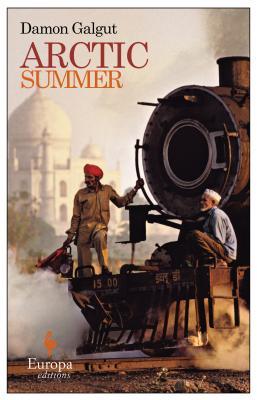
I am not sure it is coincidental, but romance does not seem to figure highly in the work I tend to read. Lost love, dysfunctional relationships, misplaced attempts to find affection, yes; but it tends to be the underlying elements of discord that create dramatic tension and literary interest for me. Tolstoy’s unhappy families and all that. So in thinking about today’s exaltation of romantic love I decided to turn to a book I read last year but did not review, a novel that holds, at its heart, the account of a deeply felt but unrequited love: Damon Galgut’s Arctic Summer.

In this fictionalized biography of EM Forster, Galgut re-imagines the eleven years of frustrated creative blockage that spanned the time between Forster’s initial conception of his “Indian novel” and the final product, A Passage to India. Along the way we meet Syed Ross Masood, the Indian man with whom Forster will fall passionately in love – a love that will shape, define and haunt his romantic sensibilities – but which will remain one that the heterosexual Masood is unable to return in anything but platonic terms. During the World War I years in Alexandria, Forster finally loses his own virginity at the age of 37 but his meagre intimate relations will remain a sorry, even pathetic, attempt to achieve the emotional and physical comfort he longs to find in another man’s arms. Sexually repressed and closeted until his death, he is, nonetheless, able to channel his affections and experiences in India into one of the finest English novels of the early 20th century. It would be the last work of fiction Forster would produce though he would live and continue to write and engage actively in the literary world for another 45 years.

arctic summerIn my first encounter with Arctic Summer last fall my reactions were mixed. I was a great fan of Galgut’s more typical pared down, ambiguous and haunting novels and I was immediately struck by the more claustrophobic atmosphere he had created to evoke the sensibility of the world in which Forster lived and wrote. At times I felt it weighing on me as a reader. Having the good fortune to hear Damon speak in person and meet him when he passed through my home town with our writer’s festival while I was in the midst of my reading, I was aware that he had found the process of writing a historical novel rewarding but not one he would be anxious to repeat. That awareness may have been a factor but I suspect there was also something more at play. After all, as readers, we enter into any work with our own issues, histories and expectations.

At the timel I was still struggling to break down the barriers that I had constructed over the preceding decade or so to keep those around me from getting close. By that point I was painfully aware that I had re-closeted myself in the world to avoid emotional risk and vulnerability. At one point, despairing of ever experiencing desire in the way he longs, Galgut’s Forster reflects:

“His own sterility was apparent to him and would soon, he felt sure, be visible to others. Curiously, he didn’t feel depressed at the prospect. He was almost intrigued by the idea of giving in to his oddness, turning into one of those remote, ineffectual creatures so warped by their solitude that they became distasteful to normal people.”

I was struck by that passage, I remember where I was when I read it and the page number in my paperback American edition is burned into my memory. Although I had been, oddly enough, a single male parent for years, through my determined unwillingness to express romantic interest or engagement with anyone, female or male, I had stubbornly sought to neuter myself in the world. Unpeeling those layers of defense and reclaiming an identity, especially one that falls outside the default mainstream, is not easy. Forster’s dilemma was hitting too close to home.

As I have since learned to re-embrace my identity and sexuality, I did briefly imagine that I was ready to open myself again to the possibility of falling in love. The result was in influx of a emptiness and longing. I began to feel the absence and did not like the void. So I have decided to turn my focus to building an emotional support network based on common interest and experience. It is, I realize, a much better place to start. If, somewhere along the way, the potential for romance arises I would not necessarily reject it, but it cannot be the grounds for meaning and value in my life.

Now, four months after I first finished Arctic Summer, I have occasioned to revisit A Passage to India, and have found myself dipping back in and out of Galgut’s novel simply to savour the restrained beauty and sensitive recreation of the writer’s inner personal and creative journey against the lush landscape of India. The work has simmered in my consciousness and increased in the power that it holds for me as a reader. I cannot help but wonder what might have happened if Forster’s love for Masood had been reciprocated. I am not sure he would have ever been able to even crack open the closet doors and I suspect that he might have ended up even more deeply torn between his homosexuality and his attachment to his mother. For better or worse he was able to channel his energy into writing, friendship and a long life.

Well lived? For his sake I hope so.

Gendering my bookshelves

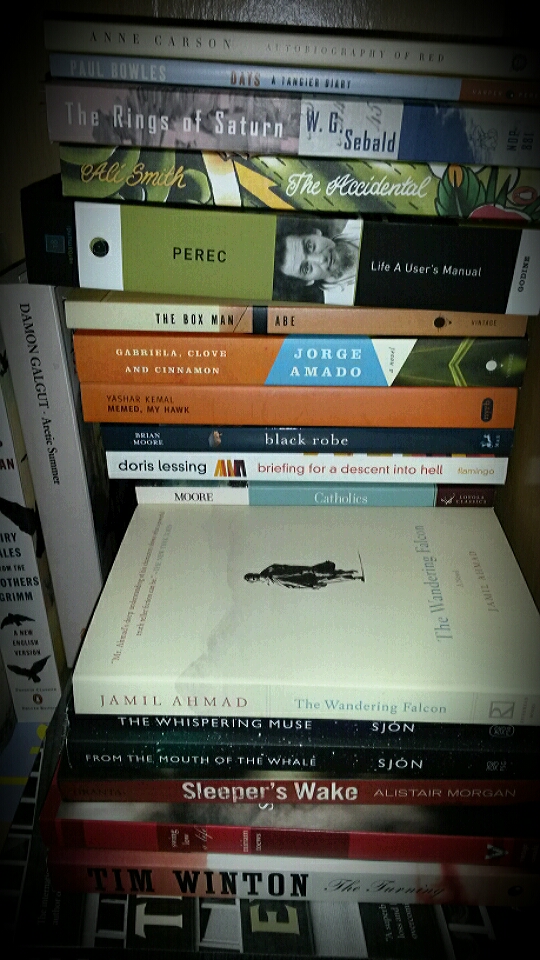
A conversation on another bookish refuge of mine about the gender of the authors we tend to read has been both informative and unnerving. It has had me standing before the random selection of bookcases in my house taking stock of the novels lining the shelves. I have conducted no scientific calculation but I would hazard to guess that over 90% of the fiction collected, read and to be read, has been written by male authors. And that is without even digging up my electronic files.

Random pile, one of many, mostly unread.

I console myself by calling to mind a number of women peopling my hypothetical list of intentional reads for the upcoming year. But I know myself. I am idiosyncratic and tangential in my reading proclivities. I find myself unable to create a stack or list of titles and systematically make my way through from top to bottom. And although I do not intend it, novels by women are frequently pushed down the line by something else that comes into view.

Perhaps there is a question of subject and style. I am presently reading with a strong critical intention to exploring a way of telling a story that I have to tell and, for better or worse, the authors who are coming to my attention tend to be men. That may be accidental rather than intentional on my part. But my bookshelves hold a record running back over decades and the gender imbalance is consistent (and, by the way, not reflected in my non-fiction collection which tends to have a much more equal divide).

Now I could launch a defense for this heavily weighted scale. I suspect I do know some of the reasons why I am drawn to certain tales told from a male perspective, reasons rooted in my own differently gendered history, but at the end of the day I am only accountable to myself for that reality. I do not believe that I eschew female novelists on the basis of gender alone, but there are certainly stories and themes that do not draw me in. And I do not feel obligated to read women writers to understand women better, I spent the better part of four decades trying to jam my own square self into that round hole and accept that there are things I am not programmed to learn. I have female friends. I have a beautiful daughter. And it is not like I never read or fall in love with books by female authors. I am open to the opportunity to explore more. But setting a quota is disingenuous.

And feeling guilty wastes precious time that could be spent reading.

Hard to remember when the world had colour

- Copyright JM Schreiber, 2012
– Copyright JM Schreiber, 2012

Granted midwinter in my part of the world is not the best place to find colour in nature. Branches are bare, grass is bunched and brown, snow is patchy and grey. But when I look back over the past year I can see how difficult it has been for me to register any enthusiasm to take my camera out. I walk a lot but I seem to want to stay in my head, maintain a fast pace, measure the rhythm of my boots against the ground. I circle the neighbourhood, walk with purpose on errands, but avoid the pathways and parks I have documented season after season these past few years.

Photography was a diversion, a relaxation and an isolated activity against a busy life at work and home. I would wander forest trails, across grassland parks or along the edges of rivers and lakes, framing and reframing the view and listening to recorded podcasts – discussions about books, philosophy, current events. It was a meandering, escapist pursuit. If I look back I have to wonder what I was escaping and where I had lost the capacity to dream.

Madness, mental illness if you prefer that term, brings back the capacity to dream because all the parameters are changed. For me it has brought words to the foreground but pushed the pictures to the background. Walking has become a means to expel restless energy, drive out the demons of anxiety and despair that keep reaching in. If I want to drown out the city noises I listen to music, the words in my head are my own.

Without being able to return to work at this time, I do feel a certain loneliness. But when I reflect on the years I devoted to a job that I believed validated and defined me, I realize that I was never more isolated than when I was working. Invisibility and an unwillingness to call attention to myself was not a measure of my successful transition. It was denial. To hide the fact that my past contained realities inconsistent with the man everyone knew, I believed I could not afford to allow anyone to get close. I captured colour in the outside world but painted myself with the blandest palatte possible.

A manic episode and all of the reckless behaviour and poor judgment it entails has left me with a professional legacy that I may never be able to salvage. I don’t even know if I want it back. Reclaiming my identity, being comfortable with my own history of sex and gender is a work in progress but I have to trust that it might lead me to a better more authentic place. It might even bring some colour back into my life.

Imagine: A church for those who don’t trust church

“Imagine”

Imagine there’s no heaven
It’s easy if you try
No hell below us
Above us only sky
Imagine all the people
Living for today…

Imagine there’s no countries
It isn’t hard to do
Nothing to kill or die for
And no religion too
Imagine all the people
Living life in peace…

You may say I’m a dreamer
But I’m not the only one
I hope someday you’ll join us
And the world will be as one

Imagine no possessions
I wonder if you can
No need for greed or hunger
A brotherhood of man
Imagine all the people
Sharing all the world…

Copyright JJM Schreiber, 2011
Copyright JM Schreiber, 2011

Church music? Apparently and rightly so. Last week I emerged from the church I have been attending, despairing that a deep ambivalence about my own ability to connect with faith may stand in the way of my search for community. This morning I remembered why, if there is a church that I can connect with, the one I have been attending may be as close as I can get. John Lennon’s Imagine, performed by a soloist set the framework for the reflections of the pastor.

Imagine? Yes, imagine hearing a pastor admit that in the 25 years since his ordination in the United Church of Canada, he never thought he would be looking at the works of Richard Dawkins and Sam Harris and think, maybe they have a point there. One does not have to look far to see how religion is perpetuating hatred, within families and communities, between ethic groups and countries. And it is not a new phenomenon. Is the problem religion? An atheist does not hesitate to answer, but what causes a pastor to ponder? And what does that mean for churches like Calgary’s Hillhurst United? My own anxieties about faith aside, it is a church that practices what it preaches: welcome and advocacy for the poor, the disadvantaged and the marginalized; outreach and full acceptance of everyone regardless of age, ability, sexuality or gender identity. Yet the pastor, John Pentland, is accustomed to meeting newcomers who share that they have no problem telling someone that they are gay, but don’t want anyone to know they go to church.

Is religion always at odds with all that could be positive and affirming about faith?

I am not sure yet. But I did spend Saturday at the church helping set up for a performance by Australian-Canadian queer trans artist, Sunny Drake. In the evening as the church hosted homeless families in the gymnasium, the pews of the Sanctuary were filled with a diverse audience treated to an outrageously funny performance about the trials and tribulations of a gay transgendered man trying to quit his addiction to romance. Honest in language and content that one would not generally not expect to find in a church, but together with the panel discussion that followed, this partnership with the city’s only queer theatre, Third Street Theatre, offers a vital opportunity to improve communication and understanding within and beyond the LGBTQ community. And yet another indication that at this church Affirming means much more than hanging a rainbow flag in the corner.

As someone who often feels as alienated within the LGBTQ community as within a larger community of faith, this weekend was an important indication of just what a church that seeks to embrace rather than exclude, can be.

Dreams and determination: A Man of Good Hope by Jonny Steinberg

It is, of course, a harsh coincidence, perhaps no more than that, but the first two murders of the year in my city took the lives of two young members of our 5,000 strong Somali community. The first of the two unrelated incidents occurred just ten blocks from my home in the early hours of New Year’s Day, the second the following day. To many here in Canada, Somalis, if they are thought of at all, are conflated with pirates.

I have watched with dismay, the rise of racism and xenophobia that has accompanied the increased visible ethnic diversity that has spread across the country, changing the face of a city that was, when I was young, predominately white. My city that is only 130 years old, most of us have come from elsewhere recently or within a few short generations. And those who were here before, our First Nations, still have to struggle to call attention to their circumstances. But we are lucky, this is a land of peace, a land of promise.

GoodhopeAgainst this context, a review in The Observer drew my attention to A Man of Good Hope, a new book by South African writer Jonny Steinberg. In my work I encountered and supported many young men from the troubled Horn of Africa, but the depth and complexity of the political and human realities that have been endured by many of the refugees who ultimately make their way to our shores are far beyond my imagining from my safe space. However, I was not quite prepared for just how difficult that journey can be.

The life of Asad Abdullahi, the young Somali man at the heart of this biography, is changed forever when his mother is shot by militiamen in Mogadishu when he is 8 years old. As he flees with relatives he begins a long, at times circular, journey of hopes and repeatedly dashed dreams. Lacking formal education he is gifted with determination, a proud sense of identity, an unflagging work ethic and an ability to assess any situation to determine where a living can be made. But at every turn there are losses, challenges and continued threats to life and limb that mount and threaten to drag him down. He is forced to grow up fast. Eventually he makes his way to South Africa seeking the wealth and security he hears fellow Somalis talk of only to find that even for the successful migrant, the end can be sudden and brutal.

Economic opportunities for newcomers like Asad, who are forced to live with temporary documents, are limited and often place them into the hostile and difficult environment of the townships where loyalties can turn on a dime. His beloved wife, unwilling to face the rising danger, heads home to family with his children. He stays, holding on to the dreams of America that have long called to him and endures the rising xenophobic violence perpetrated by black South Africans against the tide of incoming African migrants. His diligence will be rewarded, but not without great sacrifice.

Steinberg recounts, with care and compassion, a tale that has more breath taking twists than a thriller but exists on a plane on which dreams, hopes, memories and regrets blend to create a story that is at once deeply human and ultimately elusive. On a more immediate level, the view into the the ancestral dynamics of Somali history and culture that provides a background to Asad’s story has added, for me, extra poignancy to the recent New Year’s Day killing near my home. The victim shared the family name Abdullahi.