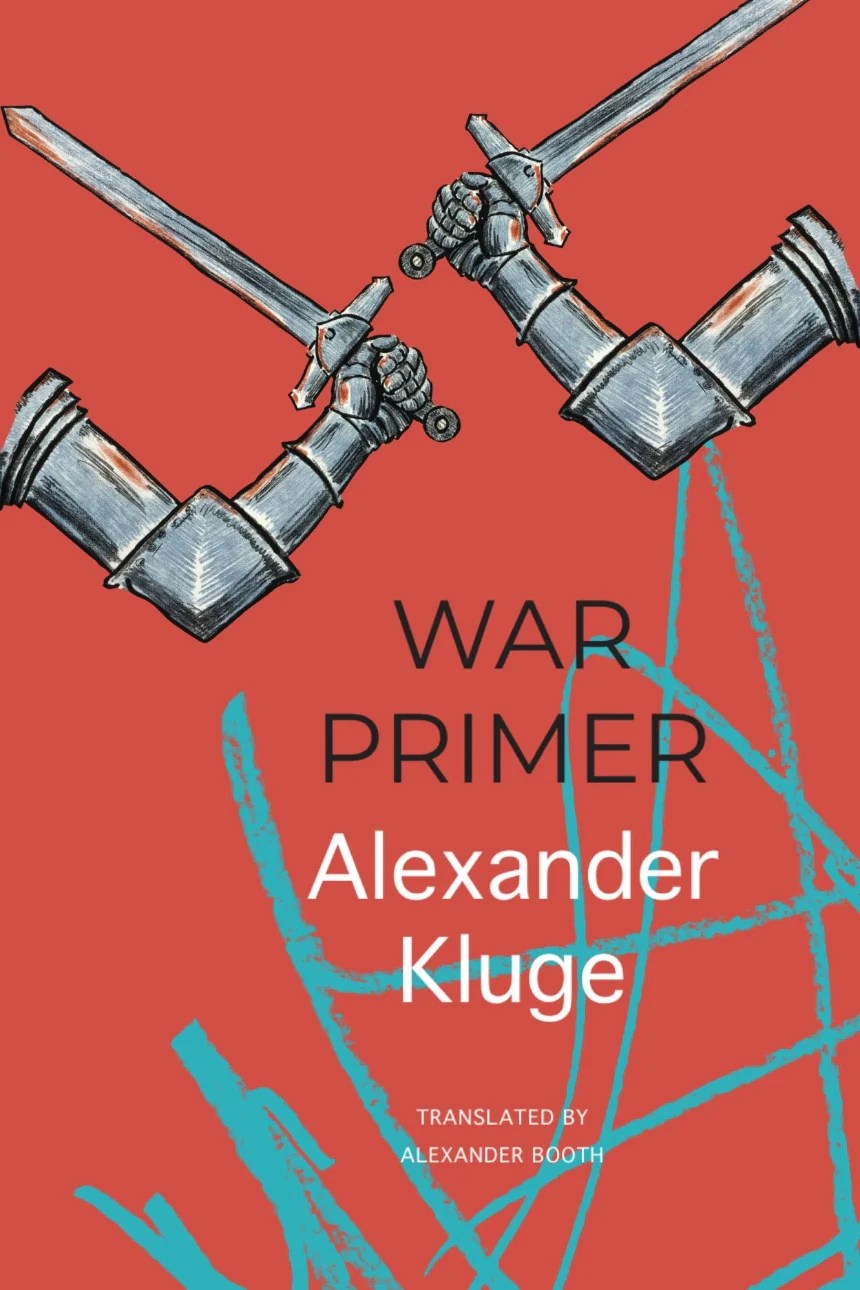
War is back again: War Primer by Alexander Kluge

When I was a pupil, we learnt to read and write with a primer. When war breaks out, Bertolt Brecht said, we have to learn to read and write again.

These words, which come from the acknowledgement at the close of Alexander Kluge’s War Primer, reference both the primer as a short introductory book on a subject or informative piece of writing, and Brecht’s famous War Primer, a series of short poems written in response to images the poet collected while exiled from Nazi Germany during the Second World War. Kluge’s own experience of the war, especially the allied bombing of his hometown of Halberstadt when he was thirteen,  has had a significant influence on his long career as a writer, philosopher, and filmmaker. And again it appears here in this slender volume, but the instigation for this work is Russia’s invasion of Ukraine in 2022—the return of full scale war to Europe. However, his multi-faceted look at  our stubborn propensity for conflict across the western world, is both wide and immediate, and conveyed via brief historical accounts, anecdotes, short stories, and imagined conversations, interspersed with images and film clips.

The book opens with a personal series of reflections. He thinks of his mother, born in 1908, considers how little he and his fellow students understood of the dangers mounting in late 1944, and recalls the last few months of the war and the burning of his hometown on April 8, 1945 (a subject to which he has devoted an entire book). As a boy whose sense of war was much coloured by the exploits of his tin soldiers on imaginary grounds, he could only have a thirteen year-old’s understanding of what the troops he was observing on those final days meant. From today’s perspective—in the case of this volume, his ninety-first birthday in February of 2023—his knowledge is much deeper, broader, and no less troubled.

Although some of the textual and visual material directly references the current conflict in Ukraine, the overall effect here is to create a mosaic of contextual commentary and musings about the nature of war, the military mindset, and the inevitable, often deadly, dance of diplomacy. Kluge’s short pieces approach moments or aspects of the First and Second World Wars, the US Civil War, the invasion of Iraq, and more. He examines the idea and illusions of armour from different angles, zeroes in on specific battles, and dramatizes often hapless discussions about the dynamics of power and peace. This is not a detailed exegesis, it is rather a collection of vignettes. Kluge’s characteristic approach to fiction that holds close to the borders of nonfiction, allows him to incorporate voices from the past in first person or dialogue. Yet, there are no solutions. As we continue to see, war is endlessly reinventing itself, and its small moments of hope always cling to a thread:

TWO SIDES TO A HAPPY ENDING

In the early days of the Ukrainian war, there was a report of a certain number of villagers, including young people and children, holding up a Russian tank. After a period of hesitation, the tank driver put it in reverse and rolled back out of the village.

This is an urban legend. It was already making the rounds during the Hungarian Uprising of 1956. During the 1991 coup in Moscow, the scene actually occurred several times and led to several tank divisions withdrawing from the city. In Beijing’s Tiananmen Square, however, the same kind of confrontation ended in a massacre.

The report in the case of Ukraine emphasized the bravery of the civilians who opposed the tank. But it takes two to tango, as it were, for an encounter to end happily: the determination of the residents, but also that of the young tank driver, perhaps all of 18, who put the tank in reverse.

The images that illustrate this book come primarily from Kluge’s original film montages, along with a few documentary photographs. QR codes link out to cinematic material of varying lengths, typically triptychs of these same images shifting against musical scores, but other material as well. Most are very short and worth viewing. Taken together, text, image, and sound make this very much is a primer for the twenty-first century. One that, sadly, seems to be still be a necessary resource.

War Primer by Alexander Kluge is translated from the German by Alexander Booth and published by Seagull Books.
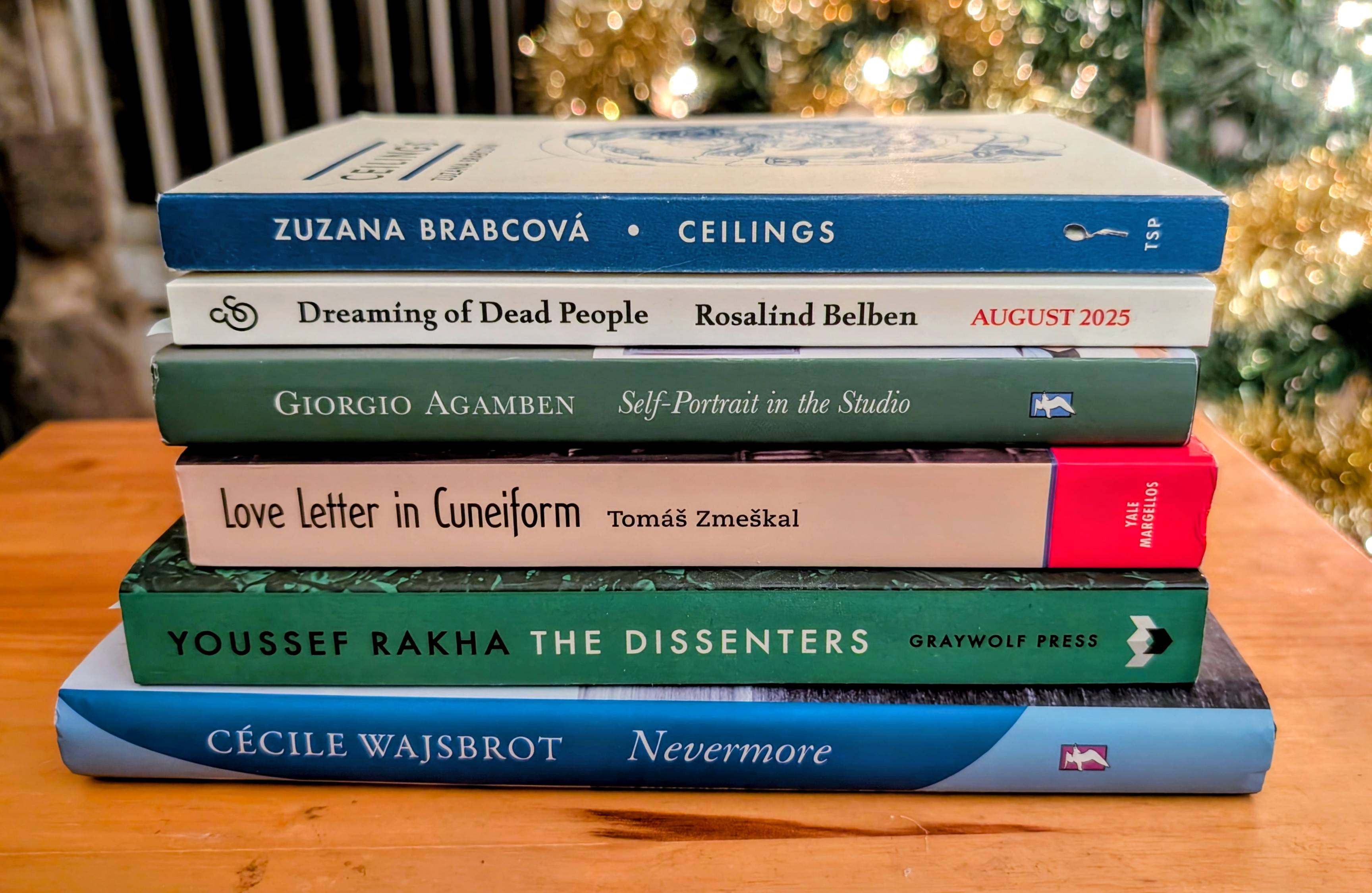
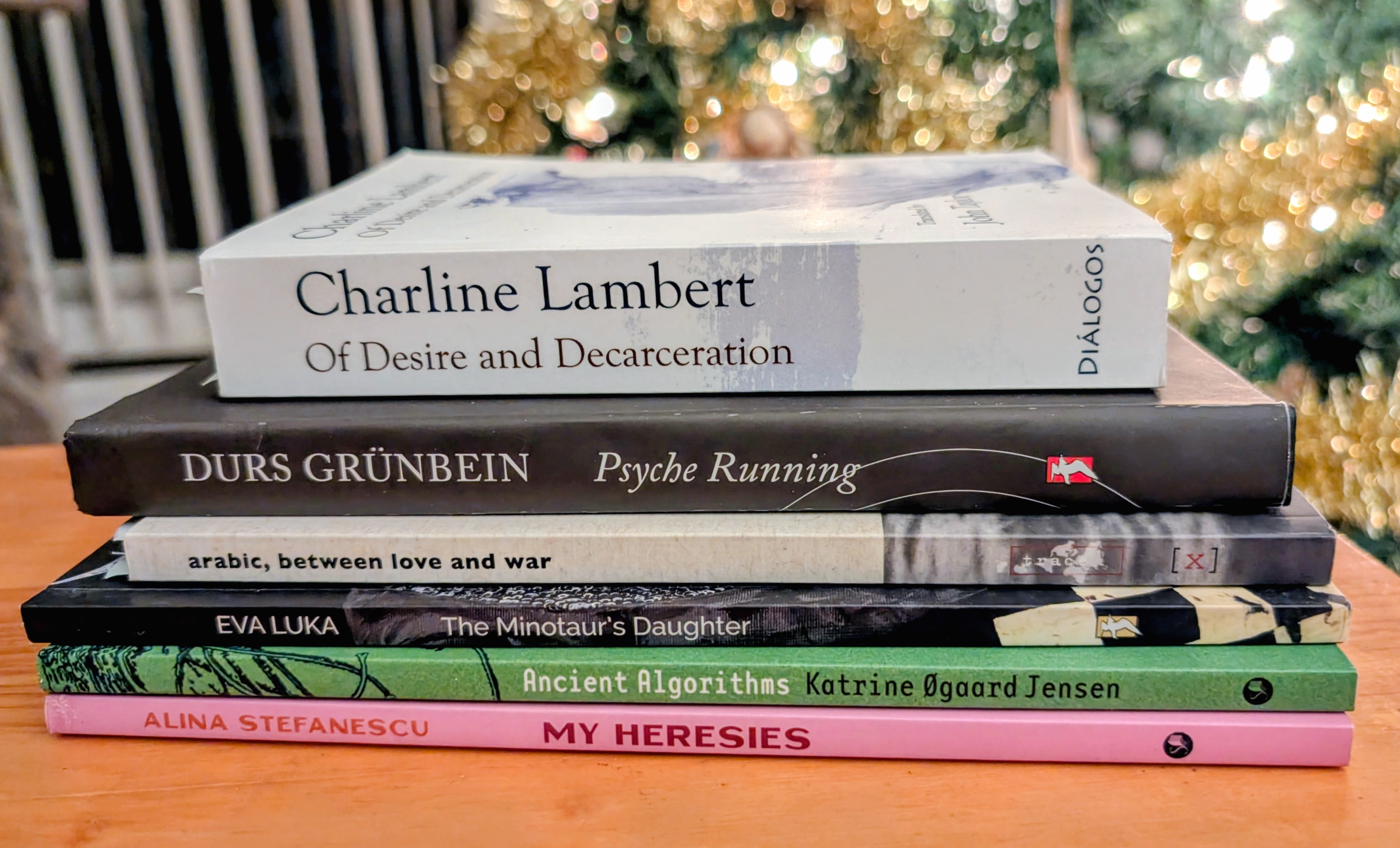
That day was a little bit odd: The Minotaur’s Daughter: Selected Poems by Eva Luka

That day was a little bit odd. After walking down the street
      I stopped in a movement,
at one particular moment of growing older.
And I sensed it (the moment of growing older) like a scientist
     over a microscope:
the precise split-second border between the former and the
      future me.
In that borderline, tangible second, I was nothing; only an echo
of a former self and the germ of the future, the old me.

It lasted for only that one moment. Then the air rustled like
     golden hay
and into the street a horse came.

(from “A Horse Came Into Our Street”)

Odd is one way to describe the poetry of Slovakian poet Eva Luka—deliciously, devilishly, delightfully odd. Her poems open up strange, shimmering vistas filled with fantastic imagery. Born Eva Lukáčová  in Trnava, Slovakia, in 1965, she studied English and Japanese, first in Slovakia and later in Japan. She began publishing poetry under her given name, first in anthologies and then, in 1999, with her first collection Divosestra (Wildsister).  For her second book, Diabloň (Deviltree), published in 2005, she adopted her nom de plume, along with what would become her practice of selecting a poem from each collection to provide the title for the work to follow. In this way, her poems speak to one another within and across collections which also include Havranjel (Ravenangel, 2011) and Jazver (I-Beast, 2019).

With The Minotaur’s Daughter, translated by James Sutherland-Smith, a selection of poetry drawn from her work to date, is now available in English for the first time. In his Afterword, Sutherland-Smith suggests that Lukáčová  may be one of the last great poets of resistance in Europe, citing her:

resistance to conform artistically and [a] resilience against the potential psychological pressures resulting from the circumstances of her life and times. Eva’s resistance to conform to being categorized within a specific poetic movement—particularly those associated with a single gender—reflects the individual nature of her work, and this artistic independence even challenges gender identity in the personae that inhabit her poems.

A transgressive spirit illuminates her poetry, extending beyond matters of gender, to explore questions of personal freedom, sexuality, and desire within a phantasmagorical landscape featuring eccentric figures, mythical creatures, and fabulous flora and fauna. She creates, with her poems, haunting, often dark, scenes or vignettes that can be as intriguing as they are disarming.

Unlike many similar selections that draw from across a poet’s oeuvre, the fifty-nine poems that comprise The Minotaur’s Daughter are not presented chronologically, or divided according to the individual volumes they come from. Rather, the assortment seems to be loosely thematic, with many of the earlier poems coming from more recent collections, and some of the Japanese inspired work from her first book coming later. And, because she sometimes writes companion pieces that appear one or two volumes apart—for example, “Wildsister,” the title poem from her first book, is later answered with “Wildbrother” in her third—here they are presented together. The impact is more powerful this way. It is also evident that Luka appreciates the poetic storytelling potential of triptychs and series, something that may have developed over time, as Sutherland-Smith seems to think that her upcoming fifth collection may include even more.

One of the most developed sequences in this selection begins with an ekphrastic poem inspired by Leonora Carrington’s painting  Portrait of the Late Mrs Partridge. In this piece, the speaker is the artist commissioned to capture the likeness of the wild-haired woman in her odd partridge skirt. He then becomes famous, but is ever haunted by the painting. Four more “Late Mrs Partridge” poems follow, addressing her body, her death, her husband, and finally her wake. Mrs Partridge herself voices all but her husband’s lament from beyond this life, even returning to her own wake, still nursing an internal flame, to drink a toast with the bereaved:

A man sits at the top table, his face,
wrinkled from the tertiary era, with an incalculable expression.
The atmosphere is gloomy, but still audible
is a ubiquitous slurping, gurgling and belching,
as if the whispered stories haven’t had as much power
as unstoppable bodily hunger and thirst.

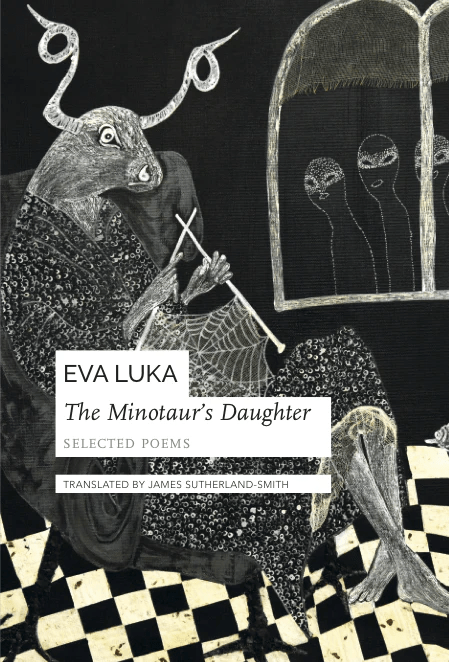
Leonora Carrington’s eerie, fantastic paintings appear again as the stimulus for five other poems in this translation (not to mention the poet’s own artwork which graces the cover). At times, Luka stands as an observer, as in “And Then They Saw the Minotaur’s Daughter”  where she watches  the “two well-behaved boys—somewhere between childhood and doubt” watching the noble horned woman-creature while spirit-like forms fill the room, Elsewhere she animates and engages directly with the scene, even imagining the central figure outside their fixed setting as in the Mrs Partridge quintet and  “Necromancer,”  a poem after the abstracted, surreal painting of the same name.

The images that dominate Luka’s poetry are drawn from nature—water, flowers, birds, reptiles, and animals—but, as with her human beings, the line between the real and the spiritual is fluid. They inhabit a shifting borderland and there is a pagan, pantheistic sensibility at play. Her animals inspire awe and fear, mythological figures speak, and a woman invites an angelic black bird (Ravenangel) into her bed in a dark sequence of desire, longing, and loss. Hers is a magical world, albeit one that accepts that mystery can be tinged with heaviness and pain. But it is not a relentlessly dark place; rather it exists in a kind of intermediate, and yet, ultimately familiar, space:

It’s incomprehensible, that border of yours
between the feverish night and the healing morning; as if you
      didn’t recognize
the differences between frenzied hyacinths and tamed hyenas.
      What you tell me
in the evening, no longer applies in the morning, and vice versa

(from “You and Me When the Cock Crows”)

One might describe the poetry of Eva Luka as akin to richly woven tapestries; the vignettes she crafts are vivid, often disturbing, but they tend to close with a note of promise, that is, with a measure of the resilience that characterizes her work. This quality is evident in The Minotaur’s Daughter. Her striking imagery is well captured in Sutherland-Smith’s translations, while his decision to break with the typical chronological ordering of a “selected poems” collection offers her first English language readers a deeply rewarding introduction to her singular poetic universe.

The Minotaur’s Daughter: Selected Poems by Eva Luka is translated from the Slovak by James Sutherland-Smith and published by Seagull Books.
“I never forgot. Everything is there. All I have to do is close my eyes.”: The Emperor by Mackenzy Orcel

I asked for none of this. I was waiting for the bus. I was waiting forever. I think I’ve been waiting since I was born. I sat on the floor for hours, fighting the urge to sleep. Looking beyond the clouds of dust that covered the horizon. The days went by, one looking just like the other. The bus wouldn’t come.

In an apartment in Port-au-Prince, Haiti, a man is waiting. He knows that eventually the police will find him. He has made no effort to hide. In fact, the crime he has just committed leaves him with an eerie sense of satisfaction. He has no regrets and is ready to serve whatever sentence he receives. He has known far worse confinement in his life, he is certain. Even freedom, such it was, offered a different form of slavery and only one brief respite of joy. As he awaits the inevitable, he revisits the events that have led him to this point, beginning as far back as he can clearly remember. The Emperor by Haitian writer Mackenzy Orcel is his story—fractured, pain-filled, and proud.

Our unnamed narrator does not know exactly how he came to be abandoned as a child, left alone by the roadside, but he does know that at some point he was swept up and taken into a rural community, or lakou, where a false vodou prophet—the Emperor—holds sway over a flock of worshippers, his sheep, who like slaves, work his fields and tend to his every need and desire. He demands absolute devotion, and punishes anyone who fails to fall into line. The narrator grows up in this unforgiving environment, identified by a number rather than a name, but he is not alone. He is  guided by the wisdom of a blind old man known as the Very Old Sheep, dedicated to the true traditions of voodoo, and aware of the risk of pretenders, and by his own internal compass,  a motivating force he refers to  as the Voice Within. Together they keep him from losing himself amid the brain-washed, weakened souls who surround the supposed holy man or seek his intervention with the divine:

Only the Emperor is granted the power of the word. To mould them to the shape of heart, his anger or his madness. What words capable of cauterizing wounds are not also accused of being lost or eternal? Yours were difficult to grasp. They reminded us of fond memories of the gods. Their goal was to intercede in our favour. To save us. To destroy us. To bring truth, morality and the past to an end. To transform others into obedient machines. A widespread and lucrative venture. You made a fortune off the penniless and their spoilt crumbs, their ill-gotten gains. You recreated an ancient formula.

Despite the very specific cruelties he dispensed upon his young sheep, it is the Emperor who inadvertently paves the way to his release from the lakou by forcing him to play a drum for the ritual dances. In drumming he finds expression, communication, that reaches others without words. He is punished for his disobedience, but is unable to conform. This ultimately leads to his expulsion from the community and, this time, the bus does come and carries him away to the city. He arrives in Port-au-Prince with no name, no education, and only a little cash he’d spirited away. Here he faces a new kind of brutality, but his past has prepared him for “its tyranny, its inhumanity.” He survives. He finds a job delivering newspapers, one of a crew of downcast men, working for a dishonest boss, but at least he is no longer captive. He is free. Until he falls in love.

With clean, clipped prose, finely translated by Nathan H. Dize, The Emperor is a  contemporary fable with gritty, violent undertones. The narrator’s fragmented monologue, largely addressed directly to the Emperor, moves back and forth in time, from the room where is waiting for that knock, knock, knock on his door, into his past, from his early experiences in the countryside to his hardscrabble life in the city, and, finally, to his criminal act. But it is not a strictly chronological account, nor is it always clear or consistent. It is uncertain how old he is; he seems to be both prematurely aged and preternaturally wise. Details from his time under the Emperor’s control continue to emerge throughout, a function in part of him being his primary audience. Yet, some of what he claims seems strange—there is a sense that he himself does not have as firm a grip on things as he thinks when he claims: “I never forgot. Everything is there. All I have to do is close my eyes.” One senses that he has never truly been free, the anger always simmering at or just below the surface of his narrative betrays him. And now he is waiting to surrender his liberty to the police, calm and unrepentant—he even has the evidence to prove his guilt sitting neatly beside him—but, perhaps, in a strange way, he is finally exercising his freedom by giving it up.

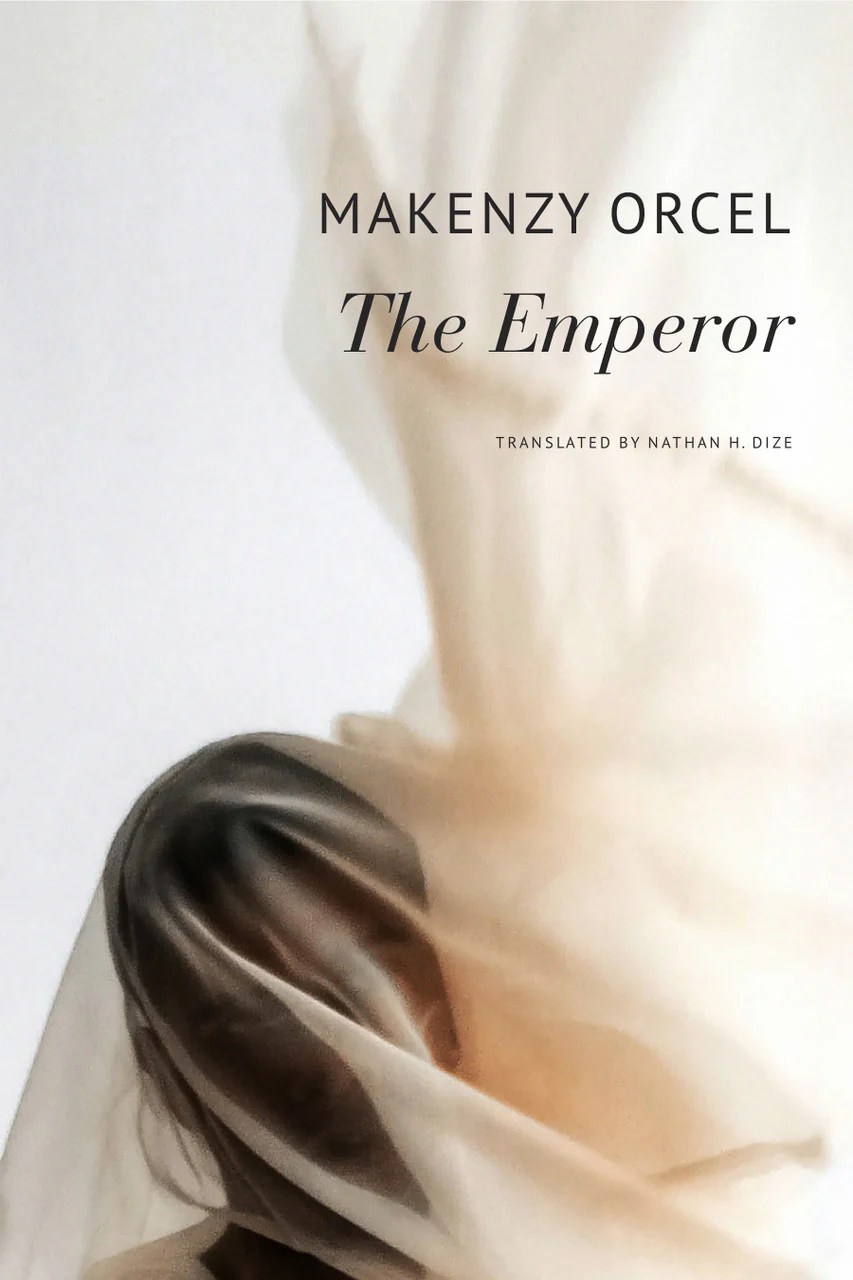
The Emperor by Mackenzy Orcel is translated from the French by Nathan H. Dize and published by Seagull Books.
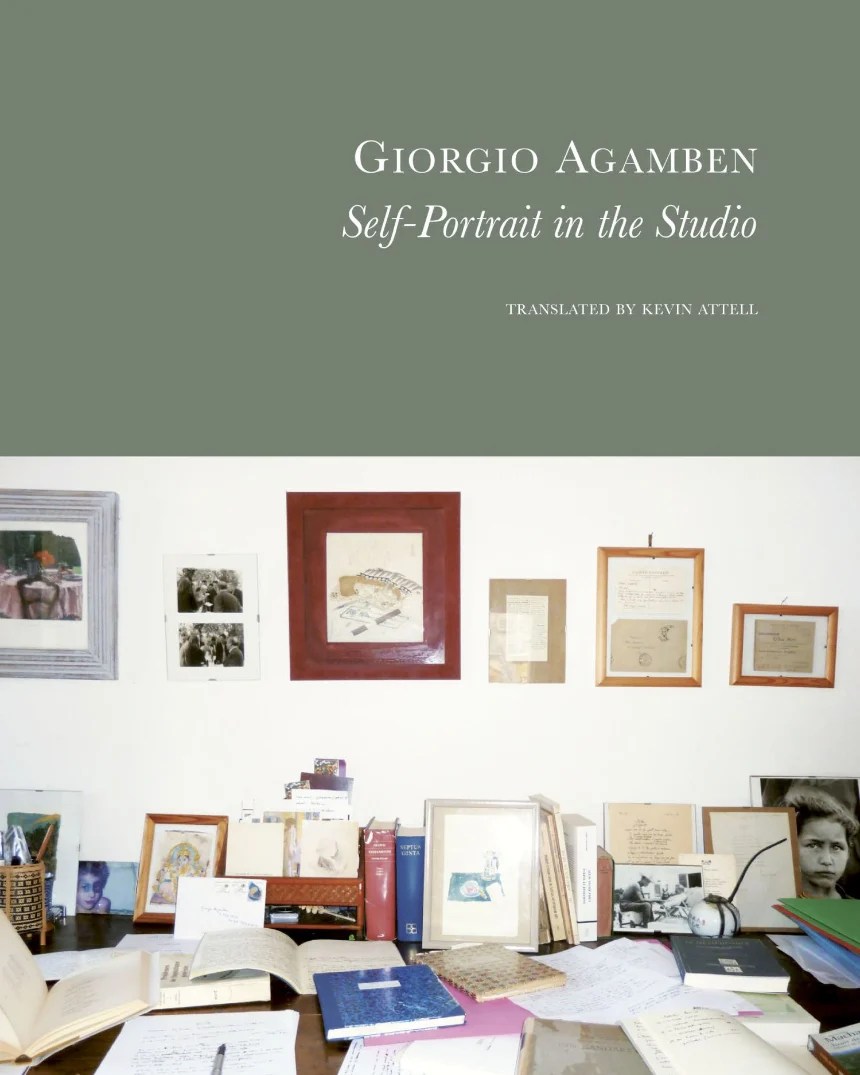
A mirror to a life: Self-Portrait in the Studio by Giorgio Agamben

A form of life that keeps itself in relation to a poetic practice, however that may be, is always in the studio, always in the studio.

Granted that what Giorgio Agamben calls a “studio” might be better understood by English language readers as a “study,” the ideal space is the same: some kind of a desk , plenty of shelving for books, and some room on the walls for  a few well-chosen prints or framed memorabilia. Over the years the Italian philosopher has occupied a number of studios, most rented or borrowed from friends, and each one, revisited through photographs often grainy or discoloured, contains the memories of friends and colleagues and others who have, through their writing, influenced and inspired him. With this slender, generously illustrated volume, Self-Portrait in the Studio, Agamben reflects on his own intellectual journey, which is, in his case, nothing less than a life journey, from the sixties through to the present day, via photographs, paintings, poems, beloved books, and precious friendships.

In this day of the ubiquitous selfie—that practice of intentionally placing oneself front and centre at any site of interest—one might expect a book with “self-portrait” (autoritratto) in the title to be a self-focused venture. Yet, although Agamben does appear with friends, mentors and fellow students in a number of  the included photographs, his motivation is to centre those whose words and ideas have touched him and the lessons they have passed on. In a parenthetical aside he addresses this objective:

(What am I doing in this book? Am I not running the risk, as Ginevra [his spouse] says, of turning my studio into a museum through which I lead readers by the hand? Do I not remain too present, while I would have liked to disappear in the faces of friends and our meetings? To be sure, for me inhabiting meant to experience these friendships and meetings with the greatest possible intensity. But instead of inhabiting, is it not having that has got the upper hand? I believe I must run this risk. There is one thing, though, that I would like to make perfectly clear: that I am an epigone in the literal sense of the word, a being that is generated only out of others, and that never renounces this dependency, living in a continuous, happy epigenesis.)

This desire to stay out of his own way goes a long way to explaining the surprisingly engaging nature of this book. It is not a  detailed or rigorous intellectual autobiography, but rather a chance to spend a little time with a philosopher who truly seems to delight in the exchange of ideas, someone who wishes to honour some of the friendships, writers and artists who have helped shape his own development over the years.  Of course, given that he is writing from the vantage point of his early eighties, there is also a clear appreciation of the fact that the themes and dreams of a life are ever necessarily unfinished. In his preamble he muses: “While all our faculties seem to dimmish and fail us, the imagination grows to excess and takes up all possible space.” There are regrets—for example, sorrow that he did not come to appreciate Ingeborg Bachmann’s poetry while she was still alive—but the text ends with a positive, and still forward looking, affirmation of life and love.

Progress through this book of memories is essentially chronological, Agamben employs objects in or associations with his various  studio settings as touchstones that trigger memories of a particular person or persons who came into his life, and, frequently, the poets or writers that any one connection might have him led to explore. The tapestry of a life of ideas ever expanding, moving from friendships with important contemporary literary and intellectual figures, to meditations on the ideas of those he came to know only through their work, and back again. He never devotes more than a few pages to any one individual, social group, or writer as he honours those who have influenced and inspired his own thought over time.

For myself, many of the individuals he talks about, including those he counts among his important friendships, were previously unknown to me (but easy to look up, of course), but others, especially the writers he feels a strong connection to—like Simone Weil, Walter Benjamin, Hölderlin, and Robert Walser—were not. Of particular interest is the way he considers our relationships to those we read carefully or enjoy close intellectual companionship—what is it to engage intensely with the ideas of others?

As he makes his way along this retrospective pathway, Agamben draws some striking connections that he measures himself against in assessing his own life. Notably, he comments on a piece written just three years before Walser’s commitment to the hospital where he would spend the rest of his life, in which he questions the idea that Hölderlin’s last decades were ones of misery, suggesting instead that his loss of his senses wisely  afforded him the time and space to dream :

The tower in the carpenter’s house in Tübingen and the little hospital room in Herisau: these are two places on which we should never tire of meditating. What was accomplished within those walls—the refusal of reason on the part of two peerless poets—is the strongest objection that has ever been raised against our civilization. And once again, in the words of Simone Weil: only those who have accepted the most extreme state of social degradation can speak the truth.

I also believe that in the world that befell me, everything that seems desirable to me and seems worth living for can find a place only in a museum or a prison or a mental hospital. I know this with absolute certainty, but unlike Walser I have not had the courage to follow out all its consequences. In this sense, my relation to the facts of my existence that could not happen is just as—if not more—important than my relation to those that did. In our society, everything that is allowed to happen is of little interest, and an authentic autobiography should rather occupy itself with facts that did not.

So where does that put his little exercise in self-reflection? In a class of its own. With Self-Portrait in the Studio,  Agamben, traces a rich network of interconnection, through personal contacts, study and research, and even, in some locations, a coincidental proximity to history, to produce a work that is entertaining, intelligent and humane.

Self-Portrait in the Studio by Giorgio Agamben is translated from the Italian by Kevin Attell and published by Seagull Books.
In that strange, that golden light: Psyche Running – Selected Poems, 2005–2022 by Durs Grünbein

And suddenly you saw it, far below
the coast road, after the twelfth curve,
stomach surging from the hair-pin drive.
En route for the south; so we sped on
perched above the drop, windows down.
Sorrento with its villas, its fan palms,
had been swallowed by the plug-hole
of the mirror in a great green swirl.
It hung in the haze, a hulk of bare rock.

The sea dead still. Not a trace of myth,
but for the yachts decked out in chrome
glinting in the sunlight. On a white hull
we made out ‘Nausicaa’ in faded letters.

Infectious energy, shifting, rising and falling. Durs Grünbein is a poet who writes as if regularly navigating the kind of winding roadway described here in “Island without Sirens” from his 2013 collection Colossus in the Mist. This poem, dedicated to Alexander Kluge, which begins with the promise of finding a site with rumoured Homeric association and ends with the view of an island not unlike a mass of barren lunar rock rising out of the water, is a clear reflection of what has made him one of the most important and successful contemporary German poets. Now his most recent release in English translation, Psyche Running: Selected Poems, 2005–2022, has just been shortlisted for the 2025 Griffin Poetry Prize (his second such honour for this prestigious award).

Born in Dresden in 1962, Grünbein moved to Berlin in his twenties to study theatre. Since the fall of the Wall, he has travelled widely and presently he lives in both Berlin and Rome. He has published more than 30 books of poetry, along with translations of classical and contemporary authors, essays, libretti, lectures, and collaborations with artists, composers and filmmakers. His prolific writings cover such a wide scope of literary form and history that he has, as translator Karen Leeder notes in her valuable Introduction, called himself an “unpoet.” Nonetheless, poetry remains central to his work, having won him widespread recognition and a number of major awards. The present collection offers an ample illustration of the breadth and appeal of his poetic vision.

The selections in Psyche Running represent nearly two decades of Grünbein’s output, drawn from ten volumes published beginning in his early forties through to the age sixty. As such, they trace the poet’s growth in mid-life and mid-career, his changes in tone, themes and exploration of form. This collection opens with work drawn from two books published in 2005. Both feature poetry inspired by history, though in very different contexts. Portraits of personalities and scenes from the ancient world figure in The Misanthrope on Capri while his focus turns closer to home with Porcelain: Poem on the Downfall of my City. The latter is a cycle of forty-nine numbered poems, a lament for Dresden, destroyed by Allied bombers in 1945. Yet, even in an elegy, Grünbein’s playful tendencies surface—something that was not necessarily received well by some readers:

Not a rowdy wedding-do. It was The Night of Broken Glass
or, what sharp-tongued folk called: the glazier’s lucky day.
And Ash Wednesday just a hop, skip and jump away.
Fools and Nazis—huzzah!—sure, they had a blast.
What’s that? Innocent? Disgrace came long ago.
Dresden shepherdesses, German bands, where are you now?

–  from “4”/ Porcelain

Twenty-four of the short poems from this sequence are included in this collection, but the complete work, with photographs and one additional poem, has been published as a separate volume, also translated by Karen Leeder and published by Seagull Books. My own review can be found here.

2007’s Verses for the Day After Tomorrow marks a turn to a more personal focus, exploring  themes of memory and human experience, then, after Grünbein began to spend more and more time in Italy, another shift occurs. With Aroma: A Roman Sketchbook (2010) and Colossus in the Mist (2013) classical elements appear, as do poems that draw direct inspiration from Rome and its environs. In a number of the pieces selected from these two works he demonstrates a wonderful sensitivity to the natural world, as in “Island without Sirens,” quoted above, and this magical evocation of a murmuration of starlings moving through the evening skies above Rome in “Aroma XLIX (Starling Swarms)”

How one envied them their nose dives, swooping down on
     gravel lanes,
or taking in Rome from a bird’s-eye view, conqueror style.
In fact, they only wanted a little urban updraft to be transformed
into currents and reflections, as their aureoles appeared
.     before
the rosé of the cloud-shading, in a sky painted by Turner.
It was a dance of veils, a stunt performed by thousands of
     points in synch:
something like the sound of bells, visible in silhouette above
    the domes.

The influence of  thinkers, ideas, and science on Grünbein’s poetic instincts takes centre stage in the next section, the first published translations from 2014’s Cyrano; or, Returning from the Moon. Each piece in this cycle of eighty-four poems, inspired by Cyrano de Bergerac, “takes its cue from a moon crater” Leeder tells us, “and pays homage to a thinker or philosopher known for their study of the moon.” The poems presented here were selected by the author and I, for one, would love to be able to read this inventive work in full. The mood changes once again with the next selection, the long poem “The Doctrine of Photography” from The Zoo Years: A Kaleidoscope (2015). Presented alongside postcards of prewar Dresden from Grünbein’s personal collection, this piece imagines into being scenes from daily life in the community as darker times close in:

Another spring. Imperial gardens on display:
for six months the magic of flowers
serves to ease the effects of the new
constraints, the new laws.
A hymn to existence, a scared hymn
to the beauty of nature around us,
the newspapers swoon in the
grandiose style of the times.
More powerful than any Olympiad,
closer to a feminine aesthetic sense,
like Hitler’s hands, eunuch-white.

A strong selection of poems have been chosen to represent the final two volumes collected in Psyche Running. Sparkplugs (2017) and Equidistance (published in 2022, marking the poet’s sixtieth birthday) build on imagery, sometimes dreamlike, drawn from science, nature, and everyday life to explore more introspective or existential themes that reflect an increasing awareness of aging and remembrance:

Do I know how many summers we have?
Whether we will recognize them as they were,
these  outdoor scenes, where we
slipped quietly past each other like angelfish
in that strange, that golden light?

I only know the day that keeps what
will happen next hidden behind glass.
Things grow more distant, swim up close,
in the film light. And the projector is me.

–  from “The Projector” / Sparkplugs

Altogether, this generous sampling of Grünbein’s poetic work over the better part of the last twenty years, fills in a long overlooked gap—Porcelain notwithstanding—in the availability of his poetry for an English language audience going back to Michael Hofman’s  2005 translation of a selection of poems from his first four collections, Ashes for Breakfast. Karen Leeder, who in addition to Porcelain also translated Grunbein’s Oxford lectures, For the Dying Calves (Seagull, 2022), has come to know the poet well over the years and has a deep affinity for his wry, vibrant spirit. Her informative Introduction and detailed notes provide an overview of the collection, her approach to this translation, and added detail, as required. Although he frequently draws on historical, philosophical, literary, and scientific sources, there is, in Grünbein’s perceptive, witty, and engaging verse, an irresistible quality that naturally invites a closer read. This volume, then, is not only an important addition to his available writing in English translation, but a wide ranging and vital introduction for anyone new to his work.

Psyche Running: Selected Poems, 2005–2022 by Durs Grünbein is translated from the German by Karen Leeder and published by Seagull Books.

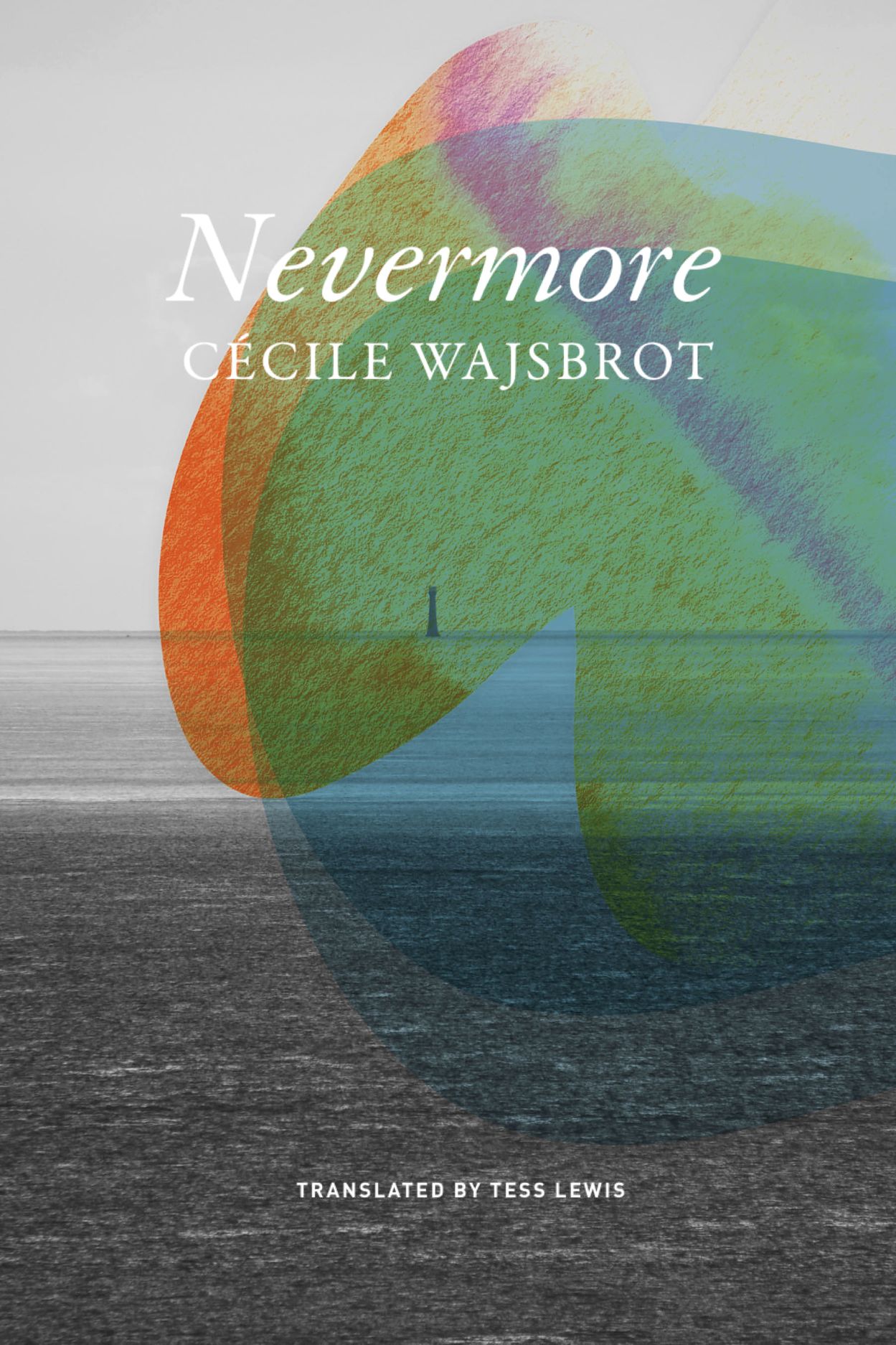
Staying too literal is a dead end: Nevermore by Cécile Wajsbrot

It is the beginning of time. There was a before, of course, there was day, but everything begins, begins again at night. Genesis. The beginning of time. “Time Passes,” the second part of To the Lighthouse, can be read as a separate work, a text we can approach as we would an island from which, to be sure, the contours of the shoreline, of the mainland can be seen—but the only thing that counts is the exploration of the island. A creation story. Dividing light from darkness.

Only twenty pages long, the “Time Passes” section of Virginia Woolf’s novel is a bridge or passageway between the first and third, marking the passing of ten years during which a summer house on the coast of the Isle of Skye stands bereft of the human life that once filled it. It is empty, and yet it is not. The forces of nature observe, occupy, and lay claim to the house, its contents, and the grounds. Elsewhere war rages and several characters from the first section, including the central figure, Mrs. Ramsay, meet unfortunate fates, noted in brief, bracketed asides along the way. It is not until the end of this interlude that human life begins to reappear on the scene.

This poetic evocation of time and abandonment flows through Cécile Wajsbrot’s contemplative Nevermore, not unlike the Elbe to which her narrator returns regularly during her sojourn in Dresden. This intriguing, intelligent novel, follows an unnamed translator who has come to the German city to work on a translation of “Time Passes” from English into French. She is grieving the recent loss of a close friend and hopes that both the project and the unfamiliar location far from her home in Paris will help her heal:

I’m elsewhere, in another city, another country. The language of my internal thoughts is not the one spoken here. Are we ultimately impenetrable? Will I never know the internal life playing out here? Will I pass like a silhouette, a shade, without knowing anyone?

As someone who has valued her independence, her “untethered life” of freedom, she is seeking a temporary refuge within which she can disappear while she immerses herself in her work. Thus, “Time Passes” not only offers her purpose and direction, but exists as an incantatory exploration of the imperfect art of ferrying a piece of literature from one language to another. As she makes her way through phrases and passages that seem to echo the sense of absence that haunts her, she trials variations and fumbles with sound and meaning, attempting to sketch out a first draft.

However, the ongoing translation is but one thread in this wide ranging narrative. It is interwoven with historical, political, and artistic streams. Regular “Interludes” trace the history of the High Line in Manhattan, from its earliest days as an elevated freight rail line built to transport goods arriving at the Hudson River port and service the warehouses, factories, and slaughterhouses in the surrounding area. In use from 1934 through to 1980, the tracks lay abandoned and open to the ravages  of time and the elements until they were turned into an elevated park and promenade above the noise of the city nearly three decades later. As she repeatedly returns to this evolving space, she is interested in exploring the shifting economic, artistic and human forces that shape the environments we live in. Nothing is static.

Indeed, change is often catastrophic. Another theme that regularly resurfaces is the 1986 disaster at the Chernobyl nuclear reactor near Pripyat, Ukraine. The town was evacuated and a new community was built just outside the so-called Exclusion Zone. But as scientists, and eventually film crews and tourists returned to the abandoned town, they found that nature—flora and fauna—had continued to thrive and even take over some of the empty buildings and structures. The persistence of life in the absence of human care or interference, mirrors the scenes evoked by Woolf decades earlier in her depiction of the elements, insects and animal and plant life working its way into the empty house in “Time Passes.”

Then, of course, there is the very city in which the narrator has taken up temporary residence—Dresden. The history of its destruction and subsequent reconstruction is evidenced and memorialized everywhere. As a backdrop to the translation of a work that spans the Frist World War, a presence even if it is off-scene, so to speak, a city with such an indelible war-time history makes sense. The narrator takes long walks at night, following the river, thinking of death. At times, she seems to encounter some kind of presence and wonders if it is a ghost or a briefly animated memory of her friend. As the messages her family and friends back in Paris leave on her phone go unanswered, she even contemplates the possibility of extending her stay a little longer. She is seeking something even if she doesn’t know what.

There are also other important themes and elements that occupy our narrator’s thoughts in between her translation sessions at her laptop. Michael Powell’s 1937 film, The Edge of the World, for example, based on the evacuation of the Scottish archipelago of Saint Kilda, echoes the common image of abandonment while music, including compositions by Arvo Pärt, Debussy, Felix Mendelsohn and more, forms a sort of narrative soundtrack (all the sources and resources are included at the end). As someone who is, by virtue of her profession, attuned to the rhythms and musicality of language—a particular challenge with the text she is working on—it is not surprising that music should play such a fundamental, even transformative role in her immediate journey. This is, then a rich novel of ideas, one that incorporates its many varied digressions seamlessly into the progressive translation of Virginia Woolf’s “Time Passes” at its core.

But what about this activity so central to this work? How is the potential translation of an English text into French within a French novel realized in an English translation? As the narrator tests out possible variations for each passage she encounters, she often starts with a literal version, then troubles the grammatical and lexical limitations of a language that cannot always do what the source language can to reach some kind of structure that will later be fine-tuned. This often necessitates shifts and small sacrifices to capture not only the meaning, but the lightness, flow, and qualities of repetition in Woolf’s unconventional original. Again and again, we are offered insight into the processes a translator employs to bring a text to life. English translator Tess Lewis’s ingenious approach to this translation-within-a-translation makes these passages accessible to all readers regardless of prior knowledge of French. Each time Wajbrot’s narrator returns another sentence or two from “Time Passes,” Woolf’s text is presented in italics, while a third font (Helvetica Neue Light) is used for the possible French variations under consideration, translated into English (in the primary font) if necessary to highlight nuances between them. Meanwhile, Lewis cuts some of the more literal or less complicated translations to, as she says, sharpen focus on those alternatives that shed light on the process of translation. Of course, the translator-narrator is not only dealing with words, their sounds, lengths and order, but also questions of meaning and intention. Fortunately, with Woolf, there are manuscripts, different edits, letters, and diary sources that she can consult. As the narrator admits, the art of translation is not an exact science,.

This is, then, an ideal book for anyone interested in the process of translation—readers of translated literature, presumably—who enjoy wise, lyrical meditations on a wide range of unexpectedly interlinked subjects. But it is also the story of one woman’s coming to terms with loss and grief through deep engagement with a remarkable piece of literature. Perhaps the only way to truly heal.

Nevermore by Cécile Wajsbrot is translated from the French by Tess Lewis and pulished by Seagull Books.

Looking back at a year of reading: 2024 edition

Each year when I review the list of books that I have read, I face the same challenge deciding what to include and what to leave out of a final accounting. As usual there are the books that I know, even as I am reading them, will be among my favourites for the year. Just as I know the ones I don’t like, the ones I won’t even mention or take the time to review. Basically, everything else that I have reviewed, was a good book.

This year, my count far exceeds a respectable “top ten” or “baker’s dozen” and there are some striking factors at play. One is that the ongoing  violence in Gaza has heightened my focus on Palestinian and Arabic language literature—long an area of interest and concern. Five of the Palestinian themed books I read made my year end list. As well, I have paired several titles, typically by the same author or otherwise connected, because the reading of one inspired and was enhanced by the reading of the other (not to mention that such pairings allow me to expand my list). Finally, as reflected by my top books, I read and loved more longer works of fiction this year than usual (for me). No 1000 page tomes yet, but perhaps I’m overcoming some of my long book anxiety.

And so on to the books.

Poetry:
I read far more poetry than I review, but this year I wanted to call attention to four titles.

Strangers in Light Coatsevokes by Palestinian poet Ghassan Zaqtan (Arabic, translated by Robin Moger/Seagull Books) is, perhaps, a darker than his earlier collections. Comprised as it is, of poems from recent releases, it actively portrays a world shaped by the reality of decades of occupation and war.

My Rivers by Faruk Šehić (Bosnian, translated by S.D. Curtis/Istros Books) is a collection particularly powerful for its depiction of a legacy of wars in Bosnia/Herzegovina including the genocide in Srebrenica. His speakers carry the burden of history.

Walking the Earth by Tunisian-French poet Amina Saïd (French, translated by Peter Thompson/Contra Mundum) is such a haunting work of primal beauty that I can’t understand why more of her poetry has not been published in English. Perhaps that will change.

Nostalgia Doesn’t Flow Away Like Rainwater by Irma Pineda is one of a number of small Latin American poetry collection from poets and communities that have not been published in English before. This book, a trilingual collection in Didxazá (Isthmus Zapotec) and Spanish with English translations by Wendy Call (Deep Vellum & Phoneme Media) was particularly special.


Nonfiction:
This year, my favourites include a mix of memoir and essay and a couple of works that defy simple classification.

The Blue Light / Among the Almond Trees by Palestinian writer Hussein Barghouthi (Arabic, translated by Fady Joudah and Ibrahim Muhawi respectively/Seagull). Blue Light chronicles Barghouthi’s years in Seattle as a grad student and the eccentric circles he travelled in, whereas Among the Almond Trees is a much more sombre work written when he knew he was dying of cancer. The two books complement each other beautifully.

French intellectual, critic, ethnographer and autobiographical essayist Michel Leiris is a writer who means so much to me that the occasion of the release of Frail Riffs (Yale University), the fourth and final volume of his Rules of the Game in Richard Sieburth‘s translation, was not only an excuse to pitch a review but an invitation to revisit the earlier volumes. Definitely a highlight.

I Saw Ramallah by Mourid Barghouti (Palestinian/Arabic, translated by Ahdaf Soueif/Anchor Books) is a moving memoir detailing the author’s return to his homeland after thirty years of exile. Reading it reminded me that I had a copy of Scepters by his wife, Egyptian novelist Radwa Ashour (Arabic, translated by Barbara Romaine/Interlink Books). This ambitious work blends fiction, history, memoir, and metafiction and I absolutely loved it, but my decision to include it here, like this, rests on the memoir element which complements her husband’s in its account of the many years he was exiled from Egypt—a double exile for him—especially the years in which she travelled back and forth with their young son to visit him while he was living in Hungary.

Candidate for the book with the best title, perhaps ever, Dostoyevsky Reads Hegel in Siberia and Bursts into Tears by Hungarian scholar  László Földényi (translated by Ottilie Mulzet/Yale University) was an endlessly fascinating collection of essays exploring the relationship between darkness and light (and similar dichotomies) through the ideas of a variety of writers, thinkers and artists.


Fiction:
As usual, fiction comprised the largest component of my reading and, as I’ve said, I read more relatively longer works than in the past. Normally I have a special fondness for the very spare novella and, of course, my list would not be complete without a few shorter works, including one more pair.

The Wounded Age and Eastern Tales  / Noone by Turkish writer Ferit Edgü—translated by Aron Aji (NYRB Classics) and Fulya Peker Cotra Mundum) respectively—who is sadly one of the writers we lost this year. His work, which draws on the time he spent teaching in the impoverished southeastern region of Turkey in lieu of military service, is filled with great compassion for the people of this troubled area. But his prose is stripped clean, bare, and remarkably powerful.

Recital of the Dark Verses by Luis Felipe Fabre (Mexico/Spanish, translated by Heather Cleary/Deep Vellum) is an award wining translation that seems to have garnered less attention than it deserves. This comic Golden Age road trip follows the misadventures of the body of John of the Cross on its clandestine voyage to Seville. Brilliant.

Celebration by Damir Karakaš (Croatian, translated by Ellen Elias-Bursać/ Two Lines Press) is an exceptionally spare, unsentimental novella about the historical forces that pulled the residents of Lika in central Croatia into World War II.

Spent Light by Lara Pawson (CB Editions) is a book I’d been anticipating since reading her This Is the Place to Be. Strange, at times disturbing, often hilarious and always thoughtful, this is one of those books that (thankfully) defies description.

If Celebration is historical fiction at its most spare, Winterberg’s Last Journey by Czech writer Jaroslav Rudiš (German, translated by Kris Best/Jantar Publishing) is the exact opposite. Ambitious, eccentric, and filled with detail, it follows a 99 year-old man and his male nurse as they travel the railways with the aid of 1913 railway guide. What could possibly go wrong?

Children of the Ghetto I: My Name is Adam by Lebanese author Elias Khoury who also died this year (translated by Humphrey Davies/Archipelago Books) is the final Palestinian themed work on my list. This is a challenging and rewarding novel about a man born in the ghetto of Lydda during the Nakba that examines complex questions of identity.

Star 111 by Lutz Seiler (German, translated by Tess Lewis/NYRB Imprints)is the autobiographically inspired story of a young East German would-be poet’s experiences among an eccentric group of idealists in Berlin in the immediate aftermath of the fall of the Wall. I was familiar with Seiler’s poetry before reading this, but I liked this novel so much that it lead me to follow up with his essays and the work of other poets important to him—the best kind of expanding reading experience.

Mauro Javier Cárdenas’ third novel American Abductions (Dalkey Archive) imagines the latest iteration of his hero Antonio in a future in which Latin American migrants are systematically sought out, separated from the children and deported. With a stream of single sentence chapters, he creates a tale that is both fun and uncomfortably too close for comfort. Quite an achievement!

Last but not least, my two favourite books this year are Hungarian:

In The End by Attila Bartis (translated by Judith Sollosy/Archipelago Books), a fifty-two year old photographer looks back on his life—his successes and his failures. He reflects on his relationship with his mother, his move to Budapest with his father in the early 1960s following her death, life under Communism and the secrets held by those around him, and the role the camera played in his life. Presented in short chapters, like photographs in prose each with its “punctum,” the 600+ pages of this book just fly by.

Like Attila Bartis, Andrea Tompa also comes from the ethnically Hungarian community of Romania’s Transylvania region and now lives in Budapest. Her novel Home (translated by Jozefina Komporaly/Istros Books) follows a woman travelling to a school reunion, but it is much more. It is a novel about language, about what it means to belong, to have a home and a mother tongue. It’s probably not surprising that my two favourite novels involve protagonists in mid-life, looking at where they are and how they got there. As to why they’re both Hungarian—I suppose I’ll have to read more Hungarian literature in the new year to answer that.

So that is my 2024 wrap up. I’d like to think 2025 will be better than I fear it will, but at least I know there are countless good books to look forward to.

Happy New Year!

‘I thought femininity was something that could be learned’: Antiboy by Valentijn Hoogenkamp

The unique challenge that arises when one attempts to write about what it feels like when the experience of gender fails to conform with cultural and societal expectations is rooted in the problem of a lack of consensus about terminology. Whether language and meaning are defined by individuals with lived experience or those looking in from the outside, there is no one way to talk about gender identity. There are the absolutists who see male and female / woman and man as fixed black and white entities among both those who identify as transgender and those who deny our existence. And then there are those accept and relate to the notion of a spectrum or continuum in lived expression (reflecting but not necessarily mirroring the intricacies of genetic variation). But transpeople are, first and foremost, people, and our understanding of ourselves not only evolves and changes over time, it is typically measured against those we encounter in the world. And often that can involve many years of wondering where to find our own selves reflected. Just like other people who, for some reason or another, feel a persistent sense that they do not belong.

Antiboy, by Dutch poet and writer Valentijn Hoogenkamp, is an attempt to articulate the strangeness, the sorrow, and the satisfaction that can accompany the quest for a more natural way of being. This very spare memoir, translated in crisp, poetic prose by Michele Hutchison, chronicles the author’s lifelong inability to find himself within the female body and life into which he was born. When a genetic mutation for a rare form of cancer (one that will claim his mother’s life) necessitates that he undergo a bilateral mastectomy, he finds an unexpected opportunity to explore his identity. Much to the consternation of others, he rejects breast implants and opts for a flat chest:

‘When I got the diagnosis, I pictured my funeral and that nobody there would really know me because I’ve never spoken up. And, in the conversations I had at the hospital, they kept telling me what most women would do in my situation,’ I say. ‘I kept wanting to look over my shoulder and see if that woman was standing behind me.’

‘Because you don’t feel like a woman?’

‘I thought femininity was something that could be learned.’

This is a searching text. Unsentimental and questioning, not stubborn and defensive like some other memoirs that venture into this territory. Hoogenkamp speaks not so much of a boy inside, but an absence where a girl or woman should be. An emptiness. The surgery presents the means to open himself to physical transformation—breasts being such fundamental indication of womanhood—but his decision to forgo implants is not random, there is precedent reaching back much further. He describes the childhood of a social outcast. Set aside. “No one to walk hand in hand to the gym with, to go around to the classes with on my birthday.” Girls playing together in the schoolyard seem strangely alien.

I can do this. I have the same arms and legs as them, I am approximately the same size. I can be one of them.

It should be easy. Natural. But it is not.

Sexuality is another avenue for exploration. Sexuality and gender can easily be conflated, both can be subject to labelling by others or rejection of an individual’s right to define themselves. Hoogenkamp has boyfriends and a female friend she has sex with—a female friend who will, in time, transition to male and provide a little guidance along the way. But his intimate partners prove less flexible than he would hope once he comes out as non-binary. And he allows himself to be used:

My sexual orientation was being wanted. I was sick to death of feeling unwanted.

Although Hoogenkamp finds a space to exist between genders (but adopting male pronouns), there is so much in this short book that resonated deeply with my own experiences growing up without any context for my sense of otherness, my attempts to understand myself through questions of sexuality, and my ultimate decision to transition more than twenty years ago. There are many ways of feeling and talking about a gender anxiety or disconnect, just as there are many ways of trying to describe how one knows that their sex and gender are aligned. At one point Hoogenkamp puts that question to a number of non-trans-identified men and women and finds many hard pressed to articulate an answer. But at a time when differences in gender identity are increasingly being denied or weaponized, it is more important than ever to listen to the varied personal experiences of transgender people.

Antiboy by Valentijn Hoogenkamp is translated from the Dutch by Michele Hutchison and published by Seagull Books as part of their Pride List.

The reversal of the currents: The Lockmaster by Christoph Ransmayr

Five dead. That is the fact the opens and haunts The Lockmaster: A Short Story of Killing by Austrian author Christoph Ransmayr. Five people are killed when a longboat carrying twelve capsized above the Great Falls of the White River when the sluice gates suddenly opened releasing a torrent of water that caused the vessel to lose control and shoot downstream, all while a crowd of festival goers watched from the sidelines. The lockmaster, who had for thirty years, proudly guided boats safely around the falls through a series of locks, made a valiant effort to manually close the gate, and was locally regarded as a hero. But when his son, a hydraulic engineer working on a project in Brazil, receives word of the event, he is not so sure it is an accident.

Set in some indeterminate future time, when sea levels are rising and inland regions are drying out, this novella depicts a world in which water is a precious resource to be defended by force. In many places the tensions over resources have ignited tribal wars or enabled the rise of brutal dictatorships while in Europe the political landscape has been shattered into a vast number of warring microstates each with their own flags, languages, cultures and long list of enemies. The narrator and his sister Mira, as the children of the lockmaster and his foreign wife, grow up in a socially isolated home situated above the falls. The waterways are their playground, but all of their education is conducted over screens, so they rarely engage with other young people. As a result, they develop an intimate relationship, something that is no longer taboo but nonetheless unsettling to imagine, especially because the narrator is still so thoroughly obsessed with Mira who has a rare condition that makes her bones exceptionally fragile.

One year after the incident at the festival, the lockmaster himself disappears. When an angler reports having seen a man in a boat dragged over the crest of the Great Falls, although no remains are found, he assumed to have drowned. At this point, the narrator is still in Brazil, the very tight, globally controlled restrictions surrounding major water projects forbid his departure even for a family emergency. His sister is left to tidy up their father’s affairs (their foreign mother had long since been deported from the small central European microstate in which they lived) and by the time he finally gets home, even his beloved Mira is gone, having married a dyke reeve and moved with him to the rapidly eroding shoreline of the Elbe estuary. Already questioning his father’s innocence in the collapse of the festival longboat, when the narrator reaches his next assignment on the Mekong River, he is certain that his father is both a heartless killer and still alive.

Five or seven or twelve cannot have made any difference to him—after all, the precise number of their victims did not bother the bomb planters and well poisoners who were, in those times, bent on drawing attention to themselves and their grand ideas in countries, tribal areas and microstates. Deaths meant fear; and fear meant open ears and open eyes. No one could fail to hear; no one could fail to see what a murderer did, even if he denied his deed.

With this crime, my father clearly wanted to defy the course of time and take himself back to overweening dreams where a lockmaster had been more, much more and more influential than the curator of an open-air museum on the White River could ever be.

The world of conflict, armies, mercenaries, and rebels within which the narrator moves in his work which has taken him to so many of the earth’s great rivers, colours his understanding of the tragic event at the Great Falls and his father’s presumed role in it. He vows to hunt him down and kill him.

This is a more focused effort than Ransmayr’s more sweeping work like Atlas of an Anxious Man, but it does highlight his broad global perspective and ability to evoke a vivid natural—or unnatural—atmosphere as his protagonist navigates the world of his present and remembered past. But the narrator is not a readily sympathetic character. He continually refers to his father as a “man of the past,” but his own refusal to accept that his fragile sister has had the audacity to marry someone else and not sit at the Great Falls waiting for him while he travelled the world, demonstrates that he too is caught in his own self-centred and, to be honest, somewhat disturbing incestuous longings. This is, of course, a fable. A dark speculative folktale. Neither the characters nor the political and environmental dimensions are fully fleshed out—but in such a fractured and volatile world, the protagonist’s insularity would be an expected coping mechanism. As such, the oddly discomfiting narrator is not only plausible, but he adds a suitably unnerving tone to the gloomy undercurrents already driving his story. And Ransmayr’s trademark spare, poetic prose adds a further chilled quality to the work.

The Lockmaster: A Short Story of Killing by Christoph Ransmayr is translated from the German by Simon Pare and published by Seagull Books.

God is in the details: Among the Almond Trees – A Palestinian Memoir by Hussein Barghouthi

Nothing comes to the surface in solitude except that which is already deep within us. I suddenly became aware of many fears. In front of me was a meadow, ploughed and moonlit, reaching all the way to the wall of the Monastery. And a human being, any human being, is afraid of emptiness. I was afraid to enter the meadow that was exposed from every direction. There were some olive saplings that looked like faint shadows, like ancient monks in their dark habits…

In his mid-forties, with the bittersweet weight of a cancer diagnosis on his heart and mind, Palestinian poet, writer, and philosopher Hussein Barghouthi made the decision to return to the village near Ramallah where he was born after what he describes as thirty years of self-imposed exile. If “bittersweet” seems an unlikely adjective for such a serious circumstance, it is appropriate only because Barghouthi was initially led to believe his symptoms might be indicative of AIDS—a condition he feared he would have most certainly passed on to his wife and young son. So when news that he was, in fact, dealing with cancer came, he greeted it with joy. At least at first. But as someone who had, by his own admission, “perfected ‘beginnings,’” his journey home would be an “imperfect ending.” Among the Almond Trees, his meditation on life, death and rebirth, captures his thoughts and experiences as this ending nears.

Barghouthi’s only other work currently available in English translation is The Blue Light, a weird and wild account of his years as a graduate student in Seattle in the late 80s and early 90s, interspersed with recollections from his childhood and earlier adult years. But with the off-beat urban terrain he frequents, the eccentric, marginalized characters he befriends, and the exploration of mysticism and madness that he pursues, it can best be described, as I noted in my review, as a memoir with hallucinations.  By contrast, Among the Almond Trees, composed around the same time, has a much more contemplative, grounded tone. This is still a work with strong spiritual, mystical and philosophical elements, but here he is focused on memory, family mythology, and the longing to understand himself within the cycles of life and death. All of this is deeply rooted in the land.

Having intentionally kept himself apart from the village of his birth for so many years, Braghouthi’s return inspires him to embrace his ancestral connection this location, with its mountains, valleys and trees. He is seeking to reinforce a spiritual connection to his family history, a line which reaches into the past and will extend into the future. Central to this exploration is Qaddura, an uncle of his family’s, who had adopted his mother when she was orphaned. Qaddura is a near mythical character, an imposing figure, known to have been a robber, who lived, it was said, with his brother in an abandoned Byzantine monastery on the mountain above the village. The stories of Qaddura and Snuffie, the woman who was married to both brothers in succession, run through this meditation, and the Monastery itself, as an actual ruin and as an inner mystical space, is an important image. The other key figure is the almond tree, notably the orchard outside his mother’s house.

This is, then, a lyrical monologue steeped in memory and emotion (including the occasional exclamation mark), woven with the history and folktales of his family and his people, insights drawn from Sufism, Buddhism, Egyptian mysticism and Western literature, and threaded with lines of poetry and song—especially that of Mahmoud Darwish and the Lebanese singer Feiruz. Much of the “action,” such as it is, takes place on moonlit nights, like the account of a nighttime pilgrimage Barghouthi makes to the Monastery during which he reflects not only on the importance of this site in his family lore, but on his childhood memories of the mountain, its promises and legends. Yet there are also the realities of the present day—the settlements ever expanding in the valley, the ongoing second intifada, and the disease spreading through his body that often keeps his moonlit wanderings closer to home:

As for why I am now recalling these tales of the Mountain while walking, as always, among the moonlit almond orchards around our house, barely breathing and facing the spectre of death because of a new swelling in my lungs—that is another matter. Perhaps with these tales I can breathe the air of other places and other times in order to sense another moonlit space inside my being and return to whatever inner monastery there was in my spirit that would grant me the strength of beginnings so as to face the cruelty of endings. For imagination is power.

Subtitled A Palestinian Memoir, Among the Almond Trees is, of course, more than one man’s search to come to terms with his “beginnings” to prepare for what is coming, it is the story of a husband and father thinking beyond his death, no matter how painful the idea may be. As someone with a longstanding interest in Buddhism and Sufism and ideas of reincarnation, Barghouthi looks to his young son Áthar, as a guide, so that he may “return to the dormant child” within, “so as to walk the earth as a child-prophet, if not in this life then in the next one.” He marvels at the enchanted eyes through which a child sees the world, and the ability to ask, as Áthar does, magical questions even when an Israeli warplane is passing overhead. Peace is, he knows, elusive, but when he decides he wants to build a house for his wife and son to live in, below the Mountain, he has come full circle and will be leaving them in the best place he knows of. Rather, he won’t be leaving them at all, he will be resting nearby, among the almond trees

As a poetic text rich with literary and traditional allusions, Among the Almond Trees benefits from (but does not strictly require) a detailed translator’s introduction and extensive footnotes. Ibrahim Muhawi, as a Mahmoud Darwish scholar and a folklorist, is perfectly suited to bring to the reader’s attention some of the finer details of the material Barghouthi is referencing. This is a short work—the text is only about 80 pages long—but filled with so much wisdom and beauty, even with the shadow of cancer looming over it, that it welcomes and rewards rereading on its own and alongside The Blue Light.

Among the Almond Trees: A Palestinian Memoir by Hussein Barghouthi is translated from the Arabic by Ibrahim Muhawi and published by Seagull Books.