A storyteller from Gujarat arrives: The Shehnai Virtuoso by Dhumketu

The short story is that which, like a flash of lightning, pierces right through while establishing a viewpoint; without any other machinations, simply gestures with a finger to awaken dormant emotions; creates an entirely new imaginary world around the reader. The novel says whatever it wants. The short story, by rousing the imagination and emotions, only alludes to or provides a spark of what it wants to say. That is why the writer of the short story needs a reader who is impressionable, emotional, swift and intelligent; to such a reader, he will be forever in debt.

– Dhumketu, Introduction to his collection, Tankha I

It would be no exaggeration to suggest that the South Asian literature that commands the most immediate attention outside the sub-continent is that which is written in English—even within India, English-language authors occupy a considerable amount of shelf space. Yet, the Indian Constitution recognizes 22 official languages and there are hundreds of other spoken languages and dialects, including English. So one might imagine that we are only able to access the tip of a rich literary iceberg. However, with the recent International Booker win for Daisy Rockwell’s translation of Geetanjali Shree’s Tomb of Sand (Ret Samadhi), the first ever Hindi winner, a heightened awareness of the riches of translated and yet-to-be translated literature from across South Asia is spreading near and far.
How fortuitous then, that in this increasingly welcoming environment, a magical Guajarati storyteller has arrived on North American shores to share a broad selection of his well-loved tales with a wider contemporary audience, a journey made possible by an attentive and gifted translator. Writing under the pen name Dhumketu, Gaurishankar Govardhanram Joshi (1892 1965) was one of the most prominent and prolific Gujarati writers of the first half of the twentieth century. He produced work across a broad range of genres, but was especially notable as a master of the short-story, publishing twenty-four volumes during his lifetime. When one enters this newly-released collection, The Shehnai Virtuoso and Other Stories, it is best to prepare to settle in and be carried away—it is difficult to resist the temptation to “read just one more…”

In her helpful Introduction, translator Jenny Bhatt traces the evolution of the Gujarati short story and the influence of European, Russian and American literature on the form. However, Dhumketu (whose chosen name means “comet”) distinguished himself from his contemporaries in a number of important ways. Firstly, he invited the reader into the inner worlds of his characters through skillful use of plot, theme, action, setting and dialogue. A second critical feature was his “focus on people from all walks of life—rural to royal, young to old.” He also set many stories among the poor and lower classes and castes, characters often either overlooked or caricatured by other writers. Finally, his stories often depict strong-willed, independent women and sensitive men, granting them varied roles and circumstances within his work in a manner that was progressive for his time and, as a result, relevant for ours.

The Shehnai Virtuoso gathers twenty-six stories that span Dhumketu’s career, opening with his best-known work, “The Post Office”—the melancholy tale of a man who waits in vain for a letter from his daughter. This piece sets the tone for a varied collection that touches on a wide range of deeply human themes. Although the majority of the tales are set in rural Gujarat, a few are set elsewhere, like Darjeeling, Karnataka, and an ancient kingdom in what is now Bihar.

Throughout, Dhumketu demonstrates an uncanny ability to pull a reader right into a story with little fuss, a skill that seems to become even tighter and more focused over the course of his career, and thus over the course of this volume. And even though there are definitely some themes that recur, the perspective, approach and atmosphere shifts from story to story, keeping his tales fresh and engaging. Nonetheless, he knows the innate value of timeless themes—jealousy, greed, heartbreak, loss—exploring them through the adventures of devious, manipulative personalities, ill-fated lovers, tragic heroes and quiet, isolated souls who express themselves most fully through music.

Not openly active in the political struggle for Independence that marked his time, Dhumketu did not shy away from allowing his characters, narrators and plots illustrate and express important ideas of freedom and matters of social injustice, recognizing perhaps that literature provides room for more complex and nuanced presentations to emerge, even in short form. The play of power and status, born of wealth, class and caste, is an intrinsic element of many of his stories—the vulnerability of the simple soul and the tragedy of the combination of beauty and poverty held a particular appeal—but he resists proselytizing. Rather, wonderfully wise and pertinent observations are regularly woven into his narratives that he trusts his readers to understand.

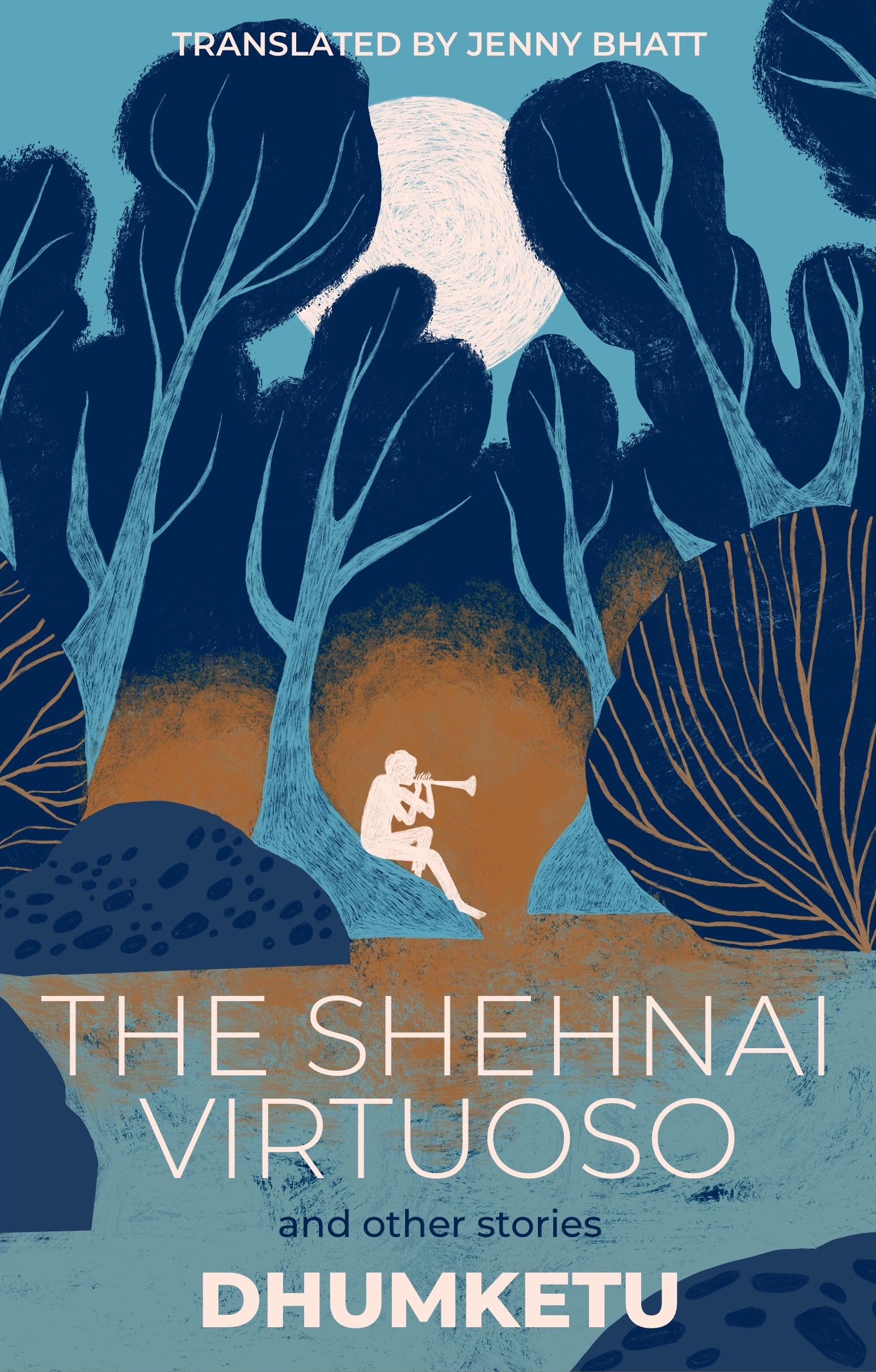
Another striking quality that emerges in some of the most powerful tales in this collection is Dhumketu’s capacity for an exceptional evocation of the depths of sorrow and loss.  The title story, for example, is one of several tales featuring gifted, yet mentally damaged musicians who suffer a loss that impacts and colours their ability to play and the soul wrenching effect of the notes their instruments produce. “The Shehnai Virtuoso” is a simple account of traveller who happens to stop in an unremarkable village on what happens to be a most fortuitous night—the death anniversary of the son of a talented shehnai (an oboe-like instrument constructed of reed and wood or metal) player, the only time when the devastated father picks up his instrument. No one in the village misses this annual moonlit performance. Our cynical narrator expects little when suddenly:

Through the air, such despairing, lamenting harmonies emanated from the sad tunes of the shehnai player that just single note of his falling on the ear felt like a language only the soul understands! As if today, having the opportunity to hear that language, the soul had rendered the entire body and all the senses and had overtaken the mind.

Oh to be present on that forested night! But for my money, one of the most moving stories from this rich and varied collection, is “The Prisoner of Andaman.” This is the tale of a man who returns to his native village after serving twenty years in prison for murder. Visaji, eager to see his home and friends again is met by the harsh realization that he has been forgotten, only his crime remains to distinguish him. The love that is “brimming over in his own heart” after so many years of penance and exile, is met with hostile indifference. Dhumketu portrays his growing anguish so acutely—“it felt as if his legs had broken. His heart was wounded”—that it is impossible not to share his pain, no matter his past.

In selecting the stories that comprise this collection, translator Bhatt wanted to showcase the range of Dhumketu’s work and encourage an appreciation of his chronological progression as a writer, so she chose one story from each of his published collections, plus two. As such she has created an excellent and entertaining introduction to this important Gujarati author—not an easy task over a longer volume like this. Her keen translation incorporates common expressions  and terms, explained in footnotes and a brief glossary only if necessary, thus preserving the flavour of the culture and the communities of Dhumketu’s fictional world.

The Shehnai Virtuoso and Other Stories by Dhumketu is translated by Jenny Bhatt and published by Deep Vellum. An earlier edit of this collection was published in India in 2020 as Ratno Dholi: The Best Stories of Dhumketu (Harper Perennial).
What are we going to do now? The Tomb Guardians by Paul Griffiths

Four was a good number.
So now we’re three. What difference does it make?
We knew where we were, then.
And now we don’t?

It’s an unusual premise. Three Roman soldiers, charged to guard the tomb of a “local rebel,” have awoken from their unintentional slumber to find one of their number missing and the heavy stone rolled away from the mouth of the cave where the body had been laid. Panicked, they try to assess their situation. How had they allowed themselves to fall asleep on the job? Where has their fellow guard gone? And how are they going to find a way out of this predicament without even fully understanding what is at stake?

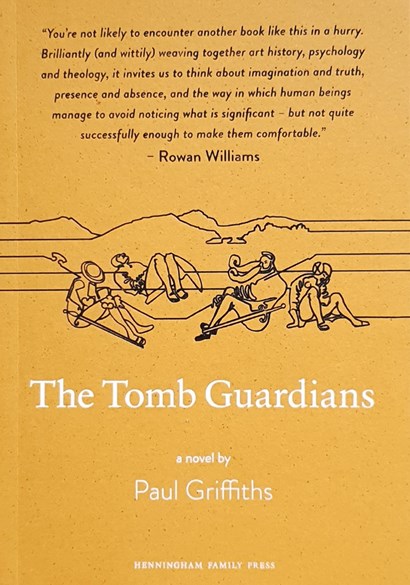
Their debate in its own right might offer material for a light comedy of errors, but our three guardians simultaneously exist, sound asleep, in individual portraits painted by sixteenth-century German master Bernhard Strigel and currently housed in Munich. Meanwhile, in the present day, an anxious lecturer is afraid that his pending presentation about these paintings, and their relationship to a fourth portrait, now in the UK, that somehow became separated from them, is falling apart at the seams. As he and a friend review his arguments about the artistic and theological questions raised by the images—included as four full colour plates—the subjects of the paintings try to imagine a way to get themselves out of an awkward situation, as uninformed bit players at a profound moment in Christian history. As the text weaves its way back and forth between these two conversations, further questions about history, truth and faith arise in clever, unexpected ways.

And it all works like a charm.

The Tomb Guardians, the latest novel from the prolific music critic, writer and librettist, Paul Griffiths, is inventive, witty and wise. This short novel, so simple in its conception and yet so extraordinary in its execution, should be read, on its own, in one or two sessions, rather than slipped in among other reads. It is not difficult, but is best met without distraction so as to appreciate the full effect of the two interlaced dialogues that drive this singular text.

The lecturer works his way through his presentation, responding to his friend’s interruptions and encouragements, beginning with the artist’s depiction of ordinary sleeping figures—unique in his oeuvre and the art of his time—and moving on to consider the possible inspiration to illustrate guardians at all. Most widely known official accounts beyond the Gospel of Matthew make no mention of any watch being set. At the same time, the soldiers, their conversation set apart in italics, have very little understanding of the circumstances that led to this assignment. They try to sort out what they do know and craft potential explanations, from the mundane to the supernatural, to offer their superiors should they be discovered in dereliction of duty or decide to report to their camp. Not surprisingly, consensus is hard to come by:

Whoa, can we please discuss this a bit?

“As to the –”

Yes, we should be very careful what we say here.

“As to the soldiers sent to stand guard, Matthew indicates that they didn’t just drift off but were shocked into sleep by the appearance of the angel.”

We can’t just say we fell asleep. Anyone would say we should’ve been taking it in turns. Anyone would say that.

“Now how does Strigel deal with this? Observe this fellow here, seated on the ground, resting his head on his left palm, while his right arm dangles.”

Did we try taking it in turns? Did any of us suggest that?
Wait.

“Look at him with his half-open mouth.”

We have to be very careful here, even in what we say just to each other, because you say something, and somebody else’ll remember it, and then little by little it becomes the truth, you know, it becomes the story, it becomes what we all of us remember, even if it never happened that way at all.

As the novel proceeds, the guardians’ musings range wider while the lecturer’s concerns begin to focus more on the likely intention behind the paintings’ commission, how they fit into the shifting religious politics of the Reformation and how one portrait came to be separated. The quoted passages from his presentation are framed within the comments and inquiries of his friend. Against the academic tone of his developing thesis, the guardians’ debate offers a critical and entertaining counterpoint. Speaking in anything but Biblical tones, they are as delightfully anachronistic as their Renaissance dress and weaponry. Together this dual-strand narrative forms a work that richly rewards return visits.

The Tomb Guardians by Paul Griffiths is published by Henningham Family Press.

The poet who learned to fly: The Butterfly Cemetery by Franca Mancinelli

In the years when written words were indecipherable signs, entrusted to a world that I couldn’t even reach on tiptoes, a book would be opened only for its illustrations or because my father’s voice was passing through it, over completely unknown roads, although his index finger seemed to trace them out, leaving short trails in which black letters, like objects in a magical night, came to life, silently spelling out in unison the same story which, open and ready to shift and change its pictures, my father was holding on his chest. It was his voice that brought the stories to us as we three were half-lying in the big bed where my little brother was staying up late, with his tiny ears that would soon close, containing a trail of sound and sense in the warm silence.

– from “The Enchantment of Death: Briar Rose”

If the first books read to us as children opened a world of strange symbols, hypnotic rhythms, and elliptical meanings, translations from foreign languages similarly open a doorway to landscapes and experiences at once distant and familiar. They introduce us to the images and words of writers we might not hear otherwise. Their stories. Their ideas. Their poetry.

The work of Italian poet Franca Mancinelli was first formally made available to English-speaking audiences through a small dual language collection of enigmatic, fragmentary prose poems, The Little Book of Passage, translated by John Taylor and published in 2018. These brief pieces which first appear to explore the vagaries of transit, packing, leaving, travel, soon begin to slide toward the examination of an existential space between internal and external reality—seeking form in that wordless, restless terrain of perception and experience. It was, and remains, a book that speaks to so much of my own sense of groundlessness. A collection containing Mancinelli’s two earlier volumes of poetry, At An Hour’s Sleep From Here: Poems (2007-2019), followed a year later. Once again her work is presented in a dual language format. Like her prose poems, her verses tend to be brief, spare, with an openness and space framing  unanswerable questions of identity, self and the insufficience of our connections with other beings.

Her newly released collection, The Butterfly Cemetery: Selected Prose (2008 – 2021), stands as an illuminating counterpoint and companion to Mancinelli’s poetic work. Her most important stories, personal essays and writings about the poetic spirit are gathered here, including several pieces which have not yet appeared in print in Italian, presented, as before in both languages, and completed with a comprehensive assessment of her work written by Taylor, her long-time translator. For someone who has read her poetry, this collection offers further insight into the creative heart and soul of the poet herself—and that is not to imply that she gives herself away, for Mancinelli is a poet who manages to address the intimate and the universal, by speaking from the essential boundaries of experience—because, in her prose, one can begin to feel how her poetic sensibilities were born and nurtured and share in her vision of where poetry comes from.

Of course, it is not necessary to be previously acquainted with her poetry to appreciate the stories and essays contained in The Butterfly Cemetery (although it may well inspire a reader to seek them out), because this work offers its own rich rewards. If Mancinelli’s poems tend to be very open and spare, in her prose there is a profound lyric intensity. Her writing breathes, deeply and slowly, as her images, ideas and reflections rise, disappear and surface again. The book opens with stories and essays that strike a personal note, evoking memories of childhood and early adulthood, some sentimental, some gently fictionalized, and others tinged with aching and longing. In many of these early pieces, one encounters a sensitive, wistful dreamer, as in the title story about a young child fascinated by butterflies who does not realize her desire to touch their wings will kill them, or the exquisitely simple “How the Fire Loves,” a fable of a little girl who escapes to the comfort of the fireplace after supper:

She had curled up alone on the sofa. The television was turned off, and she was watching the fire in the fireplace, shivering as if it were cold. The fire cannot be caressed by anyone. It is always a little distant from the others, in its own space, alongside newspapers and pieces of wood; they will be in its arms, until they become ashes. This is how the fire loves.

The second section moves further away from the childhood home and the confused pain of first love, to explore the self in relation to natural landscapes and urban environments. Mancinelli wanders, on foot, by ferry and by train, observing and meditating on the landscape and communities that have formed and influenced her. There is a branching out and a cycling back to the people and places of her homeland—the hills, fields, and the waters that have cradled her family for generations. The tension between the desire to leave, the pull to return and the attempt to delineate the fragile borders of a personal geography are recurring themes. One senses that the weight of existence in a land with such a long historical, artistic and intellectual legacy both grounds and troubles the questions of identity and belonging that emerge from the shadows cast by her words. She is ever aware, in her prose as in her poetry, of the importance of darkness as a fundamental source of growth and understanding.

And that brings us to the third and final section of The Butterfly Cemetery. Here, Mancinelli the writer turns her focus to the nature of her own personal, creative relationship with words, and, more specifically, with the existential origins of poetic expression. She writes about the absolute urgency with which she first turned to writing, beginning in adolescence, as a means of “speaking” that which she could not find a way to voice, isolated and alone on the edge of her circle of friends. Feeling she was yielding her words to others, she reclaimed them with her pen:

I wrote within myself, on my body so deeply that ever since, I have taken the road on which I now walk. If had brought that sentence to my mouth, today I would be another person. The part of my life that I have spent up to now would have been different. This is why for me, everything continues to be staked on words. With words I have an unsettled account. (“Yielding Words”)

She speaks about the process of writing poetry with honesty, from the tentative beginnings to the frustrated failures—the lines that will never take flight—in “A Line is a Lap and Other Notes on Poetry” and talks about being mistaken for a traffic policewoman as she stands on a street taking notes in the notebook she always has close at hand. But it is the vital connection to poetry as a “practice of daily salvation” that comes through in the most powerful of these essays. Mancinelli is attuned the essential quality of poetic language, tracing its existence to the moment before it comes into being. In the wonderful piece “Poetry, Mother Tongue” she suggest that writing is the act of trying to translate what is already written within us, of looking into the empty space between “the unknown and nothingness”:

I believe that poetry is a voice that passes through us. For this reason I always begin with a lowercase letter when I write. I’m not beginning anything. I’ve only caught something that I stammer into this broken language, which crumbles and breaks in silence.

Before the words there is a rhythm: a cadence that suddenly reaches us, in silence through a hollow space that we carry inside us.

There is a strong sense in Mancinelli’s view of poetics that writing itself is a dangerous act, one that calls us to face the dark and the difficult, one that takes us into our own “darkroom,” that place where we are most vulnerable. “Writing,” she tells us, “is a soul surgery that calls for a steady hand, and a deep place to which uncertainty and tremor can be convoked. It is an act of internal self-surgery.” And yet in the writing, there is a possibility of decentring and being set free. Poetry (and prose) that arises from within, although grounded in direct experience and observation, allows for space and a measure of abstractedness to guide writer, and reader, from the individual toward the universal.

But, to return, once more, to the ability of translation to open doors to those who lack the fluency to read a writer’s work in its original language, John Taylor’s collaboration with Franca Mancinelli, has brought one of the most compelling voices in contemporary Italian poetry to a wider audience. Unexpectedly that has also come to have a special resonance for me. Shortly after I read and reviewed The Little Book of Passage, I had the opportunity to meet and spend time with the poet in Kolkata when a visit I made happened to overlap with her poetry residency in the city. Her English far outpaced my non-existent Italian and although I felt no lack in our conversations, all of the subsequent interviews, poetry and prose that has become available in English has only deepened my appreciation and affection for her sensitivity and vision. Translation truly expands the world as we know it.

The Butterfly Cemetery by Franca Mancinelli is translated by John Taylor and published by Bitter Oleander Press.

At the threshold: City of Torment (and Prague, I See a City…) by Daniela Hodrová

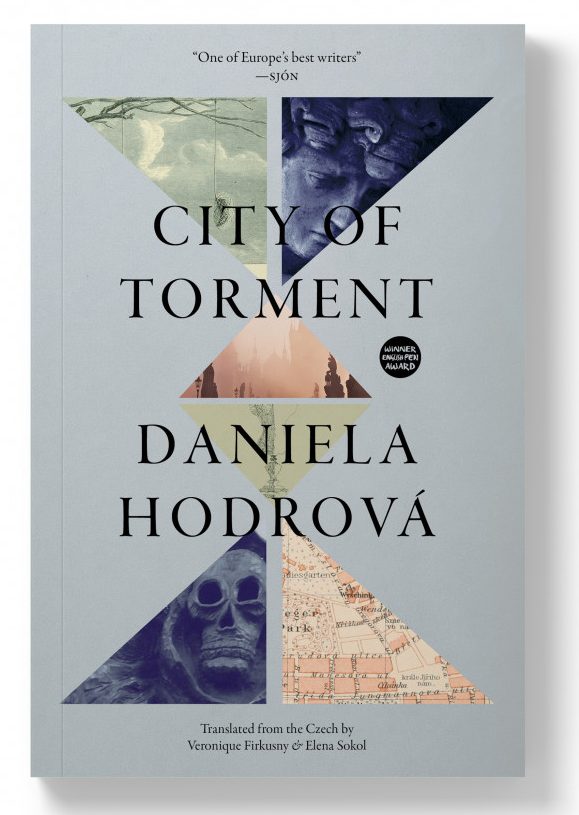
Founded, according to legend, with the prophetic proclamation of the mythical Princess Libuše, Prague rose from a hilltop settlement to become the political and economic hub of Central Europe. Forged in stone, blood and bone over a thousand years it is a place dense with history, a city that cannot escape itself, often depicted as a labyrinthine maze of magic, madness and despair. City of Torment, a loose trilogy by Czech author and theorist Daniela Hodrová, falls into the literary tradition of writers like Karel Hynek Mácha, Gustav Meyrink and Franz Kafka in its portrayal of the city as a distorted space within which the individual can become lost or disoriented. Her Prague is a layered, cyclical place in which spatial and temporal dimensions shift, trapping its living and the ghostly inhabitants in a grand circle game, one that plays out again and again in a number of distinctive settings or “stages” throughout the city centre. As such, the narrative that runs through the course of the three novels that comprise City of TormentIn Both Kinds, Puppets and Theta—is fragmented, kaleidoscopic and cumulative, peopled by characters that defy boundaries between life and death, human and nonhuman, animate and inanimate.

There is no succinct way to provide an outline of City of Torment as a cohesive work of fiction; it is akin to an organic, evolving entity that gradually takes on a life that even seems to confound its own author by the time we reach the third part. It was not conceived as a trilogy. Hodrová began the first novel, In Both Kinds, in December 1977 and finished it the following year, but, like the two novels that would follow, it could not be published until after the fall of the Communist government. This work, narrated by an omniscient third person narrator that occasionally takes on the direct voice of a character or an object, is centred around an apartment block across from the famed Olšany Cemetery, and those who reside in or pass through in the building and the graveyard. It opens near the end of the Second World War, as young Alice Davidovich throws herself from the window of the building’s fifth floor flat to avoid being taken away to the gas chambers, thus making a direct transit from the building to the cemetery. Alice, who will spend much of her after-life repeating a fruitless rush to meet her beloved Pavel, is the central female protagonist in this first book, and provides a critical yet curious continuity linking the women at the heart of each of the following texts.

A wide cast of eccentric characters populate the pages of In Both Kinds. The living, the dead (recently and long dead), and the few who have found themselves charmed (or cursed) with the ability to negotiate a space in between the two states, exist alongside one another. Souls trapped inside inanimate objects, or transformed into birds interact on both sides (with both kinds) and, naturally, many characters will make the passage from the world of the living to the community of the dead over the course of the novel. Their personalities and the events or activities marking their lived existences follow them to their graves. Clothing and objects—a sweater, a coat, a mother of pearl button, a Persian lamb muff—become talismans, symbols (but of what?). And woven into all of this are historical personages and events that appear or are referenced, exaggerated or confined by the mythology that has grown around them over time. It is a strange and wonderful ensemble piece, but hanging over it all is a disquieting sense of directionlessness.

This sensation becomes more pronounced in the second novel, Puppets (Living Pictures), composed between 1981 and 1983. Composed of one hundred and twenty-six “living pictures” or vignettes, this novel focuses closely on Sophie Souslik, a seamstress at the Realm of Puppets, and her parents and grandparents. Prague with its warren of streets and public squares forms a wider backdrop against which the action—much of it imagined, remembered and echoed—is staged. And staged is the appropriate word, Prague has become a city of marionettes. But something darker lurks here. Specific spaces and objects, like the courtyard with its rug beating rack or Sophie’s father’s office with its heavy black furniture and spinning chair, hold special powers and seem to become portals to painful personal and historical pasts, hidden or forgotten. There is a significant and welcome crossover of characters from In Both Kinds as well as new characters that sometimes act as alternate versions of previous actors. For example, Sophie is sometimes mistaken, at least briefly, for Alice Davidovich, and she also has a boyfriend named Pavel. Identities are frequently confused, experiences are repeated merging the familiar with the strange, and characters increasingly begin to change—humans metamorphize into insects and birds, while statues and household objects fall in love with people and long for release from their solid states. Still, an atmosphere of detachment colours the text.

With the third and final novel, Theta, composed between December 1987 and January 1990, the project that will become City of Torment begins to take form (the books will ultimately be published individually before being gathered together into a single volume). It opens with a variation on the first lines of Dante’s Inferno. Prague is now clearly depicted as its own special version of hell, a city of torment. The title, Theta, has a double meaning—it’s association with death, Thanatos, and its use, θ, as a proofreader’s symbol for “delete”—and as soon becomes apparent, “this novel” now exists an entity within itself. Here, the solitary, curious female protagonist, Alice and Sophie’s heir/doppelgänger, is Eliška Beránková (Lamb). But, not only is she less satisfied to stay within the confines of the text, Daniela Hodrová continually allows the boundary between herself and her creation to blur, even disappear. In a full metafictional turn, the author enters her own novel, and, at one point, Eliška steps out and tries to become a living being. Fiction and fact clash. Some new characters that initially appear to be entirely the product of the text grow more transparent. Others openly straddle the line between fact and fiction. For example, Hodorva introduces her real life husband, trying and failing to keep to the fictional name she assigns him. She grants Eliška imitations of her own life, consciously negotiating her two identities as the manuscript on her desk grows. Through her alter ego, Hodrová, the author, merges with the central figure who is descending into the city of torment in search of her own past.

If this all sounds like an overload—and these are densely packed works—Hodrová writes with a style that constantly refers back on itself, without being repetitive, so the reader does not lose track of who is who. Her narrative second guesses itself constantly (questioning meaning in parentheses) implying that nothing is certain, nothing is written in stone. There is, however, much more going on beneath the surface—historical, literary and place references that would likely be less of a mystery to those familiar with Prague—but for a visitor stumbling into her City of Torment with less background, the Appendix that closes out the work might not quite suffice. So I turned to Hodrová’s Prague, I See A City…, written after the completion of the trilogy, first as an alternative guidebook, but then released as a kind prologue/companion piece to her major work. A short, engaging, magical exploration of her hometown, this book is a perfect follow-up read, not only because it will fill in some of the biographic, geographic and historical details behind the novel, but because, written in 1990, in the aftermath of the Velvet Revolution it looks forward, however cynically, to new possibility, with hope of shedding the weight that had oppressed the previous decades.

As noted earlier, the first two novels of City of Torment are characterized by a certain flattened affect and sense of detachment. Composed during the restrictive Normalization period under the Communist government of the 1970s and 1980s, Hodrová was writing without knowing if, or when, it might be possible to release her fiction. It must have felt akin to writing into a void in a world where the dead seemed more alive than the living. The final novel was composed at the end of this period, a time of turmoil, and, when the government fell she stopped writing it, not knowing how a dynamic text informed by a city (or a city formed by a text) might now be altered. In Prague, I See a City… she says of this time:

A revolution of words, an almost fairground battle of words really did take place last year, though its tumult now reaches us only dimly. The city is once more slipping back into its sleep, its unconsciousness, its oblivion.

In those November days, something fundamental happened to the life of this city, to my life. I finished writing Theta at the very moment the battle broke out, for at that moment the city ceased, at least briefly, to be a city of torment.

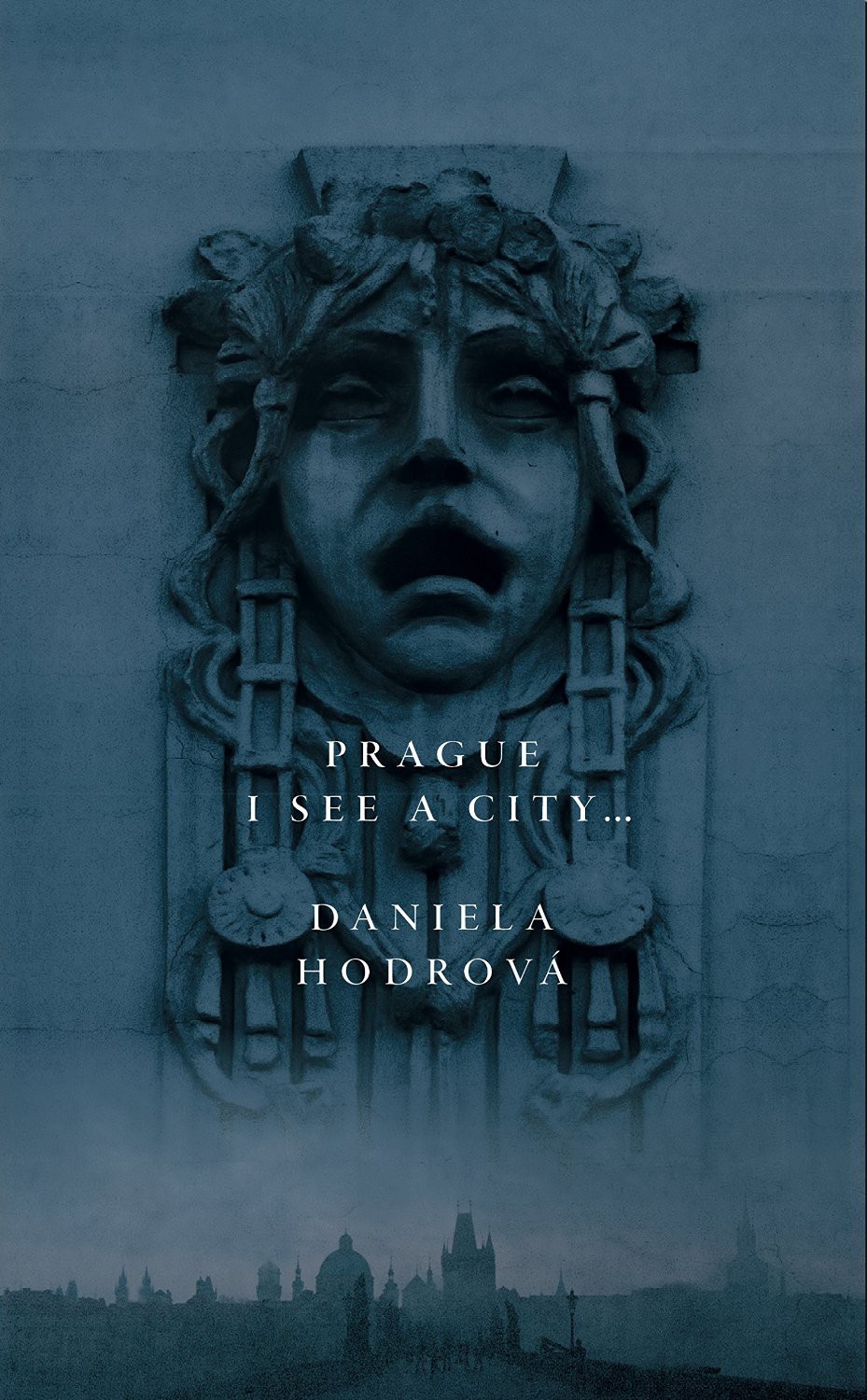
Far from a conventional travel guide, Prague, I See a City… serves as an immediate refocusing of Prague after the fall of Communist Czechoslovakia and as an introduction to Hodrová’s world-view. As she wanders her city, as if in a dream, the boundaries between the real and the imagined blur. The city she sees is perhaps on the cusp of a new beginning, but the weight of the past, historical and literary will not pass lightly. She reflects on her own childhood, comments on the novels of her trilogy, and visits museums, St Vitus Cathedral, Prague Castle and other sites, evoking the lives of long dead kings and more recent political environments along the way. Published before the recent complete translation of the trilogy, this book could easily be read first, and for its own merits alone, but it is just as effective (if not more so) read as an extended (and exceptionally entertaining) epilogue that offers a fuller understanding of both Hodrová’s literary vision and her idiosyncratic relationship with Prague.

In Both Kinds is a revised translation by Véronique Firkusny and Elena Sokol (an earlier English translation by Tatiana Firkusny and Véronique Firkusny was published in 2015 as Kingdom of Souls). Puppets is translated by Elena Sokol and Véronique Firkusny, and Theta is translated by Elena Sokol. Prague, I See a City… is translated by David Short.

Daniela Hodrová’s City of Torment, Prague, I See a City… and Kingdom of Souls are all published by Jantar Publishing.


And Usman keeps singing: Another Gulmohar Tree by Aamer Hussein

Aamer Hussein is a gifted storyteller. His clean, spare, emotionally sensitive tales explore, with just the right amount of detail, journeys, experiences and relationships that cross borders and cultures. His prose leaves his reader space to breathe in, room to recognize the sense of displacement, disorientation and disappointment his characters often encounter. This is especially true of Another Gulmohar Tree, a moving parable of love and marriage.

This novella begins, rather unexpectedly, with a series of short, fragmented fables. In one tale young man sits in the shade of a gulmohar tree to eat the midday meal his aunt has packed—stale bread and rancid buttermilk—which he shares with a strange talking frog. Tired after eating, he falls asleep, only to awake beside a pile of gold coins. In another, a farmer’s daughter is married to a crocodile king, soon her parents and a brother join her in his river kingdom. Much later, the providence of these tales will be made clear, but in the meantime, the narrative shifts to London in 1950. Here, a Pakistani man, a journalist on a year’s secondment, meets a British woman who is working as an illustrator. They are drawn to one another and begin to spend time together, Lydia showing Usman the sights of the city and keeping him company on his days off. Both are divorced after brief, unhappy marriages, both are lonely and ungrounded, but despite Lydia’s hopes, their friendship remains just that. Usman is forty-one, eleven years older than she is, London’s bleak winters and endless summer days bring him down and, in these early years following Partition, he feels an obligation to return to the newly independent country he has determined to make his own. Yet an uncertainty haunts him. In Lydia’s company he is at peace, but:

at work, or waiting at the bus stop to Oxford Circus or walking home from Marylebone Station, alone in the vanilla evenings that refused to shade into night, with his mind fixed on his return to Karachi, he’d ask himself questions to which he had no answer. What awaited him in the seaside city he had chosen as his home, he, a man who had no home because he’d lost his birthplace long ago and never learnt to belong anywhere else, what would he do with his life in that open city teeming with strangers like himself?

Two years after his return to Pakistan, Lydia follows on her own initiative, holding on to a few faint hints in Usman’s letters. She has prepared—even to the point of learning to speak  Urdu—intent on winning his love, which she already had won even if he hadn’t acknowledged it. They marry and set up home in a growing suburb of Karachi. Over the coming years she settles into the community with remarkable ease and good cheer, turning their humble little house into a home as they welcome three children into their family. Lydia who now prefers to be called Rokeya, fully embraces life in her adopted country while maintaining an ability to connect with other foreign-born (or foreign-focused) women when she wishes to. Over time, her husband begins to question himself, his career, his life.  He had once been a promising writer, but his dreams have faltered. He resents others who have found success (even plagiarizing his work to do so), and envies his wife who is devoted to their children, yet expanding her own creative and professional pursuits. Ten years into marriage, silence and unease starts to work its way into their relationship. Will Usman be able to see the beauty he has become blind to as bitterness and malaise has set in?

The outline of this tale is simple, but as ever, Aamer Hussein excels in the depiction of the attractions, affections and tensions that draw people together or threaten to push them apart. With Another Gulmohar Tree, he employs careful observation combined with literary restraint to create an unusual, intelligent, slyly romantic story, short enough to read in a day. And sometimes that is just perfect in itself.

Another Gulmohar Tree by Aamer Hussein is published by Telegram.