My laughter doesn’t go unvoiced: Like to the Lark by Stuart Barnes

It has been six years since I first read Australian poet Stuart Barnes’ debut poetry collection, Glasshouses. I don’t know how many times I have recommended the book in the meantime—whenever someone asks for suggestions of contemporary poets doing original work with form, or someone inspired by pop music, his is the first name that comes to mind. And now, with his second collection, Like to the Lark, he is continuing to expand the idea of form, exploring what it can do and where it can carry him. Ever open to queering the expectations of rhythm and rhyme, it is always exhilarating to engage with his poems—so much so, in fact, that one might not immediately appreciate just how much sorrow, grief and anger has led to the shaping of some of these words.

As with Glasshouses, Barnes is generous with notes acknowledging the poets, artists and resources with which he is in conversation in particular poems, but in this new collection he has also included a very informative section titled “Notes on Form” within which he talks about the forms he employs, including two of his own creation, and some of the relevant context and inspiration guiding his work. He opens by addressing what form means for him:

Like to the Lark’s working title was ‘Form & Function’, after Photek’s drum & bass record of the same name. Music and sound, form and transformation underpin the collection; its cornerstone is the sonnet (‘from Italian sonetto, “little song,” from Latin sonus “sound”’). ‘Form’, writes Felicity Plunkett, ‘is concerned with de- and re-arranging, working between what has gone and what is to come. It is about connection and generation.’ Form is Gwen Harwood’s ‘trellis’ and ‘fine pumpkins’. It is stave and symphony, wooden last and Ferragamo Rainbow Sandal, scaffold and Golden Gate Bridge. Every form flaunts its uniform, kaleidoscopic or otherwise.

Form, then, is not simply looking back to classic constructions. Even though Barnes’ first love and trusted space is the sonnet, he enthusiastically embraces both traditional and recent structural creations to erect the scaffolding within which he can seek to find expression.

Like to the Lark, which takes its name from Shakespeare’s “Sonnet 29,” opens and closes with ghazals that speak to the state of the world, in politics and nature. The poems in between often draw heavily on ecological imagery, but this is not imply that he believes poetry, especially in its formal variants, is necessarily bound to lofty romantic or natural themes. By contrast, he often delights in unlikely sources for his most traditional offerings. For example, he salvages material from consumer information for migraine and depression medication to craft sonnets (something he has done before) and engages in vigorous wordplay to create prose poems. Inspiration can be found in gritty pop culture motifs or a scroll through GRINDR. But such playful exercises mix with pieces that are, in turn, serious, bold, sentimental and vulnerable. As ever, the true power of Barnes’ poetry lies in the way form, subject matter and the influence of musicians and other poets intersect in his work.

Barnes has addressed life as a gay man and the reality of homophobia before, but Like to the Lark directly confronts issues that are not always welcome, even in queer poetry, such as the stigma of HIV/AIDS, grief and loss, and his personal experiences of rape. “Sestina: Rape” (which dispenses with the sestina’s traditional six end-words in favour of one word—rape—and words that are its true rhyme) is honest and angry: “No such thing as male rape / flared. No rape report, no rape / kit. When I spilt the pith of this rape / three sweethearts laughed in my face.” He admits that he bent the sestina’s strict six-word repetition pattern in an effort to try to desensitize himself to one especially painful word. It’s a practice he repeats with “Pain” and “Love” in a couple of other sestinas.

Given the intensity of emotion he wishes to express with respect to these difficult subjects, it is no surprise that the two original forms Barnes introduces in this collection, also appear in gay themed poems. The terse-set, a pun on the tercet, is composed of at least three tercets with a strict ABC rhyme, but each line is restricted to three syllables. The forced precision is playful but intense, ideal for the poems “Sketching Aids” and “Dinner with S. M. at Tandoori Den.” Both involve the same man, an ex-boyfriend, the first inspired by memories of their relationship in high school, the latter recounting a dinner years later, prior to his death from AIDS. The other new form, he calls a flashbang. This explosive, disorienting form appears in a poem called “Killing Bill or Whatever the Hell His Name Is (Battle Without Honour or Humanity),” that depicts the cruel reaction an HIV+ man receives from a lover. The first half erupts on the page (as best it can be reproduced here):

No one expected the second coming
out

—a burst rubber, a premature
BOOM!

PEP, you echoed. I’ll drive you to the local
clinic

first thing in the
morning.

His speechlessness a stun
grenade,

ignored calls
blast

mines. Minutes
later,

GRINDR’s miss-
iles.

Barnes writes that he was encouraged to invent new forms of his own through the experience of working with the duplex form created by American poet Jericho Brown. Described by Brown as “a ghazal that is also a sonnet that is also a blues poem,” the duplex seems a perfect fit for Barnes’ natural energies, allowing him plenty of room to riff on meanings and engage in punning and wordplay. Like to The Lark includes eight duplexes, with serious, fanciful and ecological themes. Four are voiced by native Australian plants such as Eremophila ‘Blue Horizon’ which opens:

I’ve always adored the deft desert,
its transformative blues and solitude.

I transform the bluesy solitude
of winter—I polish small gold trumpets

—gold tinted blue tongues polish off my trumpets
I raise my hands—lanceolate and blue.

New to the duplex myself, I really enjoyed these pieces. The other form that I particularly love in Barnes’ hands, is the terminal, an invention of Australian poet John Tranter that takes the end word of each line of a source poem to generate a new poetic creation. Here Barnes’ love for one of his key muses, Sylvia Plath, is reflected in two of his terminals. “The Pardoner” which borrows end-words and inspiration from her “The Jailer” is another poem addressing the poet’s experience with date rape, while the vivid “From the Morning” takes its end-words from Plath’s “The Swarm” and its title from a song by Nick Drake. Along with Plath and Drake, Barnes is, as usual, engaged in conversation with other poets including Shakespeare, Yeats, Auden and Gwen Harwood, and musicians including The Smiths, Kate Bush and, another important muse, The Cure’s Robert Smith.

The work of a mature and confident poet, Like to the Lark has me, as someone with little formal understanding of poetry, excited about the possibilities of—and less intimidated by—form. To the untrained reader and casual poet, it is easy to feel anxious about what makes a poem good, especially when caught between those who embrace and those disparage strict adherence to classical forms. But reading Stuart Barnes is proof that a poem can follow (or invent) rules without being unnecessarily opaque. Rather, poetry can be both fun and profound and, even better, inspire one to acquaint or reacquaint oneself with the inspirations that surface between (or at the end of) the lines.

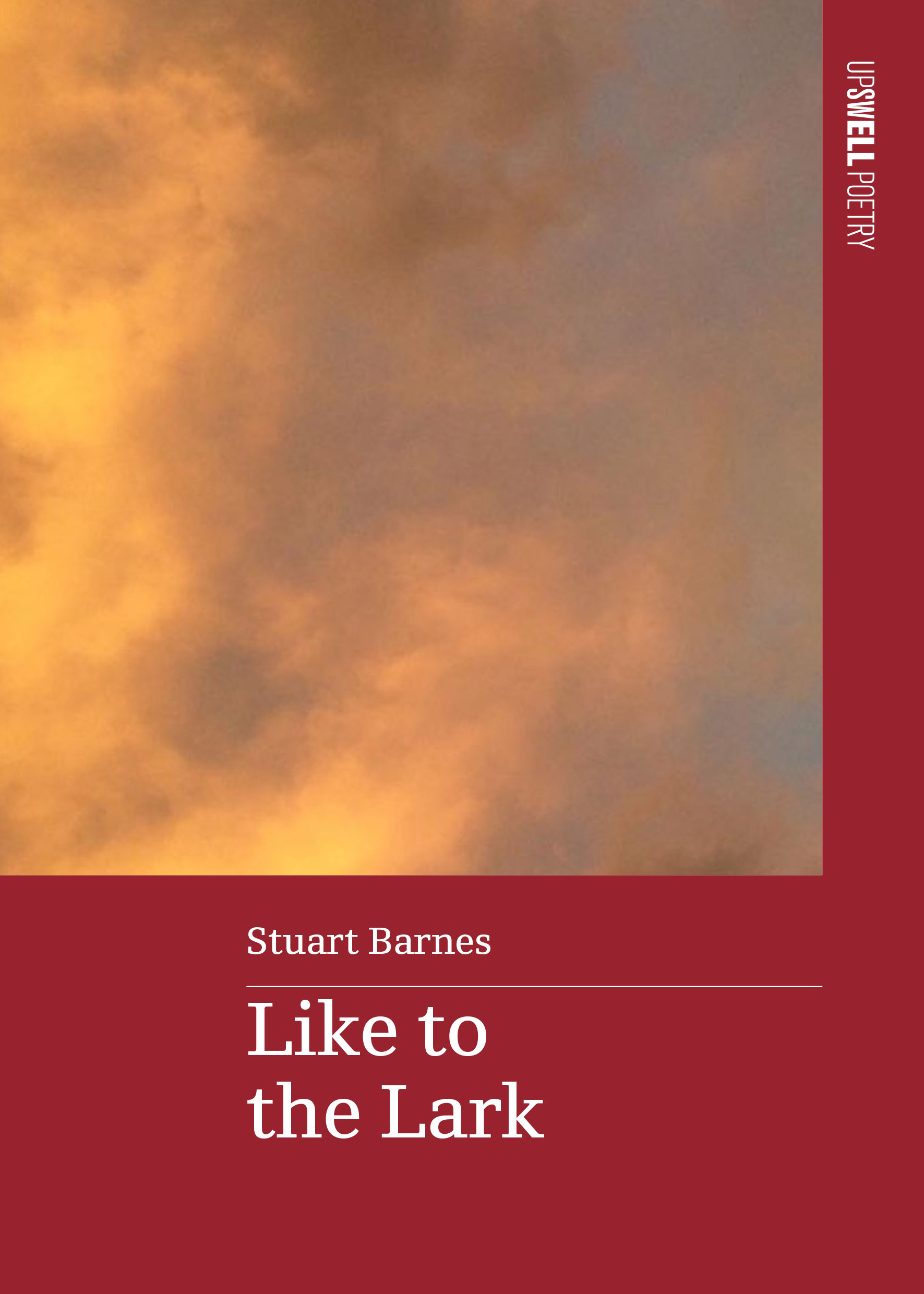
Like to the Lark by Stuart Barnes is published by Upswell Publishing.

A tale of two travellers, You and I: In the Presence of Absence by Mahmoud Darwish

Allow me to see you, now that you have left me and I have left you, safe and sound like pure prose on a stone that may turn green or yellow in your absence. Allow me to gather you and your name, just as passersby gather the olives that harvesters forgot under pebbles. Let us then go together, you and I, on two paths:

You, to a second life promised to you by language, in a reader who might survive the fall of a comet on earth.

I, to a rendezvous I have postponed more than once with a death to whom I had promised a glass of red wine in a poem. A poet is at liberty to lie, but he only lies in love because the heart’s promises are open to alluring conquests.

The celebrated Palestinian poet Mahmoud Darwish was aware that his own death was nearing when he composed In the Presence of Absence, an intimate synthesis of memory and meditation that not only turns its attention to the past, but looks ahead to contemplate what words can carry into a future that he knows he will not see. It is a self-elegy, an established genre in classical Arabic poetry, re-imagined, reshaped and realized through a unique “convergence” of prose and poetry in which, as translator Sinan Antoon puts it in his Preface: “[t]he living ‘I’ bids farewell to its imagined dying other in a sustained poetic address divided into twenty untitled sections.” Presented as a dialogue between the poet’s present self and his absent self, each section explores a particular experience or theme.

Early on, Darwish invokes his younger self, a mischievous child caught up in the magic of the natural world, lured by curiosity toward adventure and injury. However, another love was also nurtured at a young age: the love of language. The third section is devoted to the endless possibilities that the future poet discovers in the wonder of letters and words. It will become his life:

You become words and words become you. You do not know the difference between utterer and utterance. You will call the sea an overturned sky and the well a jar to preserve sound from the world’s tinkering and the sky a sea hanging from clouds.

There is something that assumes the obscure. It cannot be smelled, touched, tasted, or seen. It is what makes childhood a sixth sense. They called you the dreamer because you often gave words wings invisible to grown-ups.

Darwish devotes several sections to this time of dreams and dreaming before, at the age of seven, dreams turn into nightmares. The Nakba’s destructive force drives him and his family from their homeland under the cover of darkness at a time when his absent self was:

Still too young, you could not imagine your own death. You did not yet grasp that children could die.

Life will go on but, but this sudden, unprecedented displacement  will cause him to hate the second half of his childhood and foreshadow the circumstances that will shape the rest of his life.

In the Presence of Absence is not a memoir in the familiar sense of the word, but significant life experiences—imprisonment, exile, heart surgery, a visit to his mother—shape his reflections. Yet, at times, he turns to more open meditation on themes like love, loss, dreaming and what it means to return. These meditations turn on the poetic as poetry is always, for Darwish, more than a vocation, but an essential means of making sense of the world. Ever the dreamer, his dreams are soaked in a melancholy that reveals itself in imagery bound to a land and a life forever lost:

Longing is the absent chatting with the absent. The distant turning toward the distant. Longing is the spring’s thirst for the jar-carrying women, and vice versa. Longing allows distance to recede, as if looking forward, although it may be called hope, were an adventure and a poetic notion. The present tense is hesitant and perplexed, the past tense hangs from a cypress tree standing on its rooted leg behind a hill, enveloped in its dark green, listening intently to one sound only: the sound of the wind. Longing is the sound of the wind.

The more you delve into your loneliness, like that tree, the more longing takes you with motherly tenderness to its country, which is made of transparent, fragile fibres. Longing has a country, a family, and an exquisite taste in arranging wildflowers. It has a time chosen with divine care, a quiet mythical time in which figs ripen slowly and the gazelle sleeps next to the wolf in the imagination of a boy who never witnessed a massacre.

Darwish plays presence and against absence through this text, the image surfaces and reshapes itself in endless variations, including the confrontation with his own absence when he visits the ruins of the village he was born in. For, to articulate an absence that is present or a presence that is absent is not only the task of this self-elegy, it is, for Darwish, a poet’s role. This is, then, more than anything, a book about language—as a means to express, to understand, and to exist in a world that has been torn apart. His prose is rich with metaphor and sensual, even sexual, imagery, but the pain of a man who was denied the ability to live freely within the land of his birth, and witnessed, by the time of his death in 2008, the impact of sixty years of occupation and conflict on the Palestinian people, is never far from the surface.  It is, sadly more timely than ever.

Sinan Antoon’s translation honours the poetic energy of this work, aiming, he tells us, to preserve, where possible, the pulse and rhyme of the original. Endnotes supply necessary context, as required. This text, like Journal of an Ordinary Grief and Memory for Forgetfulness, is classified as poetry, but, as poetic as these works are, I prefer to consider them closer to prose lest a potential reader who is apprehensive about poetry be inclined to avoid them. Darwish’s meditative, incantatory prose is neither elusive nor intimidating. He writes from the heart and with the heart his words are best met.

In the Presence of Absence by Mahmoud Darwish is translated from the Arabic by Sinan Antoon and published by Archipelago Books.

The heart’s nocturnal lament: Night of Loveless Nights by Robert Desnos

On the tree trunks the same two initials are always carved. By what knife, what hand, what heart?

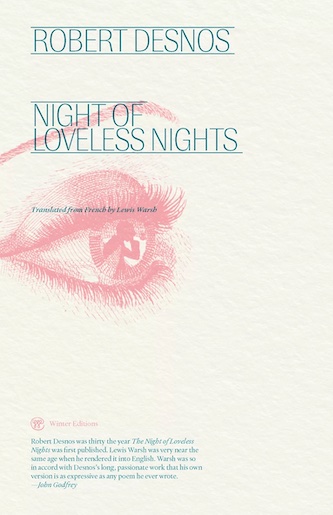
 In 1973, Issue 10 of The Ant’s Forefoot, a New York City based poetry journal (originally started in Toronto) was devoted to one single epic poem—Lewis Warsh’s translation of Night of Loveless Nights by French poet Robert Desnos. As such, it was the first English publication of a book by Desnos, more than forty years after its original limited French release in 1930. The chemistry between Desnos, one of the early Surrealists and Warsh, a member of the second generation of the New York School of poets produced an translation that is attentive and sensitive to the original despite the fact that Warsh was born the year before the Desnos’s death. The context of the creation of Night of Loveless Nights is as fascinating as the story of its first appearance in English. Long out of print, this translation has now been rereleased in a special fiftieth anniversary dual-language volume from Winter Editions, complete with an afterword by poet David Rosenberg, the editor who originally gave Warsh’s translation a home.

Robert Desnos was born in Paris in 1900. He published his first poems in his teens and, in 1921, he was introduced to the Paris Dada group and André Breton through poet Benjamin Péret. He became an active member of the Surrealists and demonstrated a particular gift for automatic writing. But he began to move away from Surrealism due to political differences and this led to a falling out with Breton. By 1929 the rift was more or less complete as Desnos  joined Georges Bataille’s journal Documents. During the Second World War, he was active with the Resistance and, in February 1944, was arrested by the Gestapo. He died of typhoid in Terezin in occupied Czechoslovakia in 1945.

Desnos began writing Night of Loveless Nights, which he titled in English, in 1926 and completed it in 1928–29. It was inspired, like several other pieces he composed during this period, by his hopeless romantic obsession with night club singer Yvonne George. Although his love was not returned, he remained devoted to her through her increasingly crippling addiction to drugs and alcohol, to her death from tuberculosis in 1930. His epic unfolds over one anguished and feverish night filled with sleepless dreams, slipping in and out of opium delirium and infused with blues and jazz tones. Lewis came to Loveless Nights with little translation experience and less than full confidence with French, but he connected with the imagery, irony and rhythms of Desnos’s verse and felt he could carry it into English.

In his afterword, American poet and Biblical translator David Rosenberg recalls how he and his friend Warsh were both drawn to Desnos’s  poetry over that of his contemporaries:

We were twenty-somethings when we took the French avant-garde poets in primarily the 1920s, from Max Jacob to Pierre Reverdy, as our forefathers of deadpan, no less than Louis Armstrong: it was the decade in which American jazz riveted Paris. Stein, Breton—they were too pragmatic for our sensibilities, though Stein was in our blood and manifested later. But Robert Desnos. . . was in-between; he seemed to push through surrealism and come out the other side as a literal dreamer, in search of reality and lost love. Desnos’s dreamer was parallel to a soul, disembodied—not the disordered mind’s “we must change life” of Rimbaud. Desnos was more grounded by loss.

Warsh was a regular contributor to Rosenberg’s The Ant’s Forefoot when he shared with him his Desnos translation for potential inclusion in the magazine’s upcoming issue. As they read it together over a shared joint, Rosenberg marvelled at its length and wondered if it would be feasible to turn an entire volume over to a single text. Excerpting it did not seem to be an option; it had to be reproduced in full. Desnos’s original publication was a collaborative effort with painter Georges Malkine who provided illustrations to accompany the text. Financial constraints and devotion to a minimalistic aesthetic guided the layout and production of the English edition which included archival photos provided by Lewis. The cover featured original artwork by Rosenberg himself, which is reproduced in the present fiftieth anniversary edition. Otherwise, the materials and production techniques employed in issue 10 of The Ant’s Forefoot are now lost with a graphics art scene that no longer exists. But the Winter Editions anniversary edition now has the advantage of extra space—the French text runs alongside Warsh’s English version, allowing a bilingual reader to appreciate how poet meets poet in this now-classic translation.

Night of Loveless Nights opens with vivid imagery that leans toward the surreal, but with the long initial section of rhymed quatrains, Desnos is adopting a classical form. Warsh does not attempt to reproduce the rhymes, but focuses on staying to true to the mood, tone and important motifs that will recur throughout the long dream-soaked night that follows. One can almost smell the foul air:

Hideous night, putrid and glacial,
Night of disabled ghosts and rotting plants
Incandescent night, flame and fire in the pits,
Shades of darkness without lightning, duplicity and lies.

Who sees the rivers crashing inside himself?
Suicides, trespassers, sailors? Explode
Malignant tumors on the skin of passing shadows,
These eyes have already seen me, shouts resound!

Quatrains like these carry much of the poem, broken first by a section of landscape inspired prose poetry and then by stanzas that vary in length and form. Desnos then returns to the stricter quatrain format before falling into longer, often incantatory, free verse  as the night stretches on and the speaker wearily and warily faces the brightening sky and his growing fatigue.

Desnos never names the object of his desire, but his longing and unrequited passion is laid bare. His romantic desperation is tangible:

I give everything to you, down to the heart of the ghosts,
Submit it to my fatal and delicate torment
Leave in order to disappear in two lines of a book
Without having invoked the evening of lovers.

I am tired of fighting the destiny which conceals me
Tired of trying to forget, tired of remembering
The slightest perfume which rises from your dress,
Tired of hating you and blessing you.

Although Desnos had, perhaps, as Rosenberg suggests, “pushed through surrealism,” it is not entirely behind him here. Beyond a surreal quality to much of the imagery, Warsh’s translation retains a suggestion of Desnos’s experiments with automatic writing and especially something he called “sleep writing,” especially later in Loveless Nights where the verses become freer, the poet seeming to riff on an image, such as in an extended chant-like passage featuring hands which in part reads:

Hands that stretch hands that soften
Is there a sincere hand among them
Ah I no longer dare to shake hands
Lying hands loose hands hands that I mangle
Hands clasped in the prayer of one who trembles when I look him I the eye
Is there still a hand I am able to shake with confidence
Hands on the lover’s mouth
Hands on the heart without love
Hands cut by false love
Hands founded on love
Hands closed to love
Hands dead to love
Hands straining for love
Hands rising for love

And on it goes. It feels, when one reaches this passage, that the poet is drifting off while writing, until the hint of dawn at the windows pulls him back to attention. To read this poem is to accompany the lovesick speaker into the haunted and lonely night, but somehow the dark beauty and the underlying sense of opium-enhanced irony keeps it from feeling impossibly bleak. It is as if Desnos is aware that the depth and futility of his romantic and sexual obsession is the real drug that fuels his poetry and keep his pen on the page.

The fiftieth anniversary edition Night of Loveless Nights by Robert Desnos is translated from the French by Lewis Warsh, and published by Winter Editions.

“I remain / in the baptism of this window.” All the Eyes that I Have Opened by Franca Mancinelli

from here ways parted
breathing was growing

in the collapse, something sweet
a hollow of time

all the eyes that I have opened
are the branches I have lost.

Ever since I started reading Italian poet Franca Mancinelli’s latest collection, recently released in a beautiful dual language edition, I have been haunted by the couplet from which the title was born—all the eyes that I have opened / are the branches I have lost. I have been more aware than ever of the eyes of the aspen meeting me on my daily walk, watching over me as in some sense I have always known them to, but now I was seeing my own journey reflected in their stare… the branches I have lost, and the growth that I have gained over the years.

I’ve always loved aspen, widespread as they are throughout North America. I found an adolescent refuge in the hidden depths of an expanse of aspen that spread across a wide, open field near my childhood home and, now, every day I look out at the clusters of aspen that mark the edges of the forest of Douglas firs I live above. Ever since I learned that they are typically colonial, that a growth of aspen are a single organism, I love them even more. An extended family in nature to balance my fragmented human one.

All the Eyes that I have Opened is a mature collection from a poet whose work I have read since her first English translation, The Little Book of Passage, arrived at my door courtesy of our mutual friend, her long-time translator John Taylor. A few months later, our paths would fortuitously crossed in Calcutta, so I can’t help but hear her voice when I read her words, even as her poetic voice continues to expand beyond the strictly personal to encompass an ever wider range of experiences and circumstances. The enigmatic title of this latest collection came to Mancinelli, as she explains in “An Act of Inner Self-Surgery,” a piece in her essay collection The Butterfly Cemetery, during a time of “inner devastation” when, walking through the woods she came upon a tree with a heavily scarred trunk. Despite many cuts and amputations the tree had healed and transformed itself, reaching ever upwards to the light:

I continued to walk with this voice that had been articulated in me, and one clear image: there are losses that you can weep over with all your tears, fight with every effort, yet they are necessary. We would give our life so that they won’t happen, yet they are guiding our sap toward the shape and the place that belongs to it.

This understanding is expressed most explicitly in an early sequence, “Master Trees,” which like many of the others in this book blends verse and prose poetry. The poet speaks of branches and pruning and seeing “the eyes of the trees,” of opening herself up “according to the light.” But growth is uneven:

the air was inert, traversed by trembling and quivering. It needed to withdraw, to set life aside, to push it towards areas where pockets of quietness opened. I thus grew in this maimed form. You can see in me how the nearby street burns.

Her ensuing engagement in the woods with the very bark of the trees is existential in nature. She emerges with her gaze freed. The following sequence, “All the Eyes that I Have Opened,” turns to experiences that have caused pain, abstracted in natural imagery that is often brutal yet from which new strength and determination seems to arise in the speaker. As ever, Mancinelli distills emotion, memory and experience into crystalline elements, moving from the intimate to the universal in rarely more than a handful of finely wrought lines. Drawing her metaphors from nature and the land, with eyes, sight, branches, darkness and light as recurring images throughout this book, she focuses her attention on a world—internal, external, and interpersonal—in which the dynamic tensions are always shifting, always in flux, and aims to capture its essence.

This collection, as Taylor points out in his introduction, sees an expansion of Mancinelli’s poetic universe, as she brings ancient and traditional sources into her work for the first time, including Saint Lucy (Lucia), the patron saint of the blind, often depicted with her eyes on a plate, whose own sight was restored by God. All the Eyes that I Have Opened also begins and ends with sequences in which the poet endeavours to give voice to the plight of migrants seeking a better life in Europe, meeting danger, cold, and closed borders along the way.

My body has an open texture from which hangs a thread. Someone at the other end, without even noticing, pulls it, and slowly I grow thin. The absence beckons me. I approach the spirits of the cold, that white wordless nucleus which governs this earth. I close my eyes as if pervaded by a flat colorless sea.  (from “Diary of Passage”)

These works stem from an interdisciplinary project she took part in which she and other artists traced a route through Croatia often used by refugees.

This is but a brief and rather personal response to this rich new collection. Every time I open it I find something else that catches my attention. I will be turning to it again and again, and thinking of these poems as I encounter the eyes of the aspen each day.

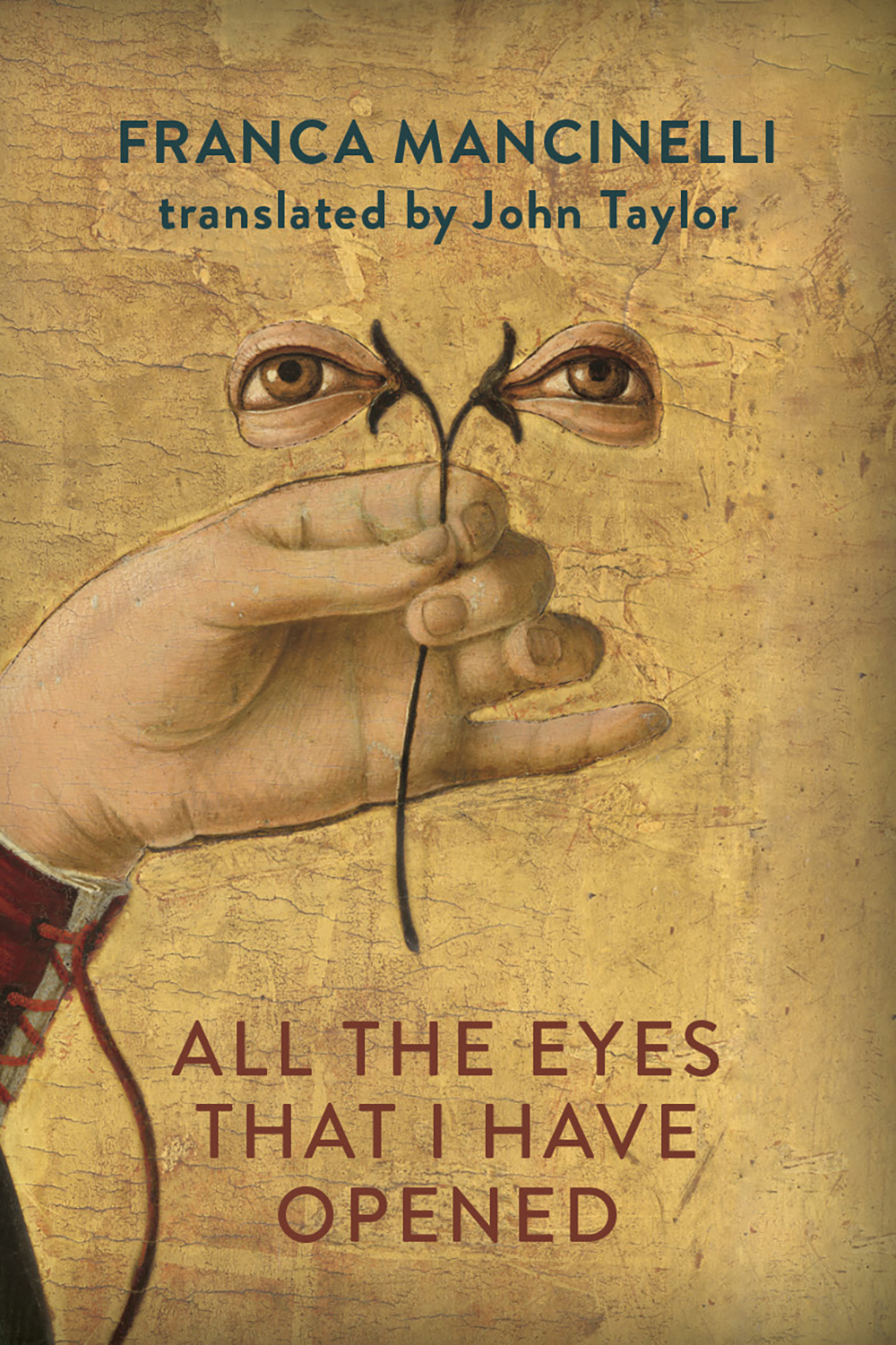
All the Eyes that I Have Opened by Franca Mancinelli is translated from the Italian by John Taylor and published by Black Square Editions.

Grief-tinted memories: Reflections on Mother Muse Quintet by Naveen Kishore

The loss of a beloved parent inspires a tumult of emotion and weaves complex webs of images that fragment and coalesce over time. It is, I have learned, a living grief, something that ties us to our own past in ways that shift and change in a manner that cannot be mapped or predicted.

Today, as I gather my thoughts about the latest poetry collection by my friend Naveen Kishore, my own mother has been gone for exactly seven years. On July 9th, 2016, my daughter and I sat at her bedside waiting for my brothers to make it to the city. When they arrived, we knew her respirator would be removed and we would say good-bye. She had been plagued by an increasing frailty for many years, but had remained mentally sharp until her final month which was marked by a rapid decline. Meanwhile, in another local hospital, my father lay unconscious following a stroke and head-on collision and, within a few days, a similar, if more prolonged vigil would commence at his bedside. But on this day, what I remember most vividly is my daughter gently tickling her grandmother’s arms as she had once done for her when she was a little girl. Her presence was a comfort to myself and my mother that day.

Over the five sections of Mother Muse Quintet, Naveen Kishore, the highly respected publisher of Seagull Books, honours his own mother, moving through the varying shapes and forms that memories take, and the way they continue to embrace and comfort us as we ourselves age. It is both a tender, personal tribute and a gentle lesson about opening ourselves up to capture our own memories on the page.

The first part evokes a son’s tribute to a mother who offered security and continuity to a young child, filling him with the stories and songs of her own childhood and family history and now, as the fog closes in around her, looks to him for guidance and assurance.

Build me a self. She pleaded. A whole one? I asked. One
I can call my own. Self. Again. She said. I looked at her.
Swiftly. Almost surreptitiously. My gaze. First taking in the
dignity. The earnestness. Hers. And of the request. The
controlled undertone. Not quite panic. Yet. And trust. The
faith. That I could. And would. Help rebuild. Not just her
self. But also her sense of being. Hers. No room for doubt.

In verse and in measured prose, this sequence introduces us to Prem (her son always called her by her first name) as a young girl in Lahore, as a confident woman, and as someone drifting away from the familiarity of her own reflection. And to giving up her ashes “to the care of the river.” But that is only the beginning. As the progression through the following parts of this quintet demonstrate, grief, which may begin long before death, unfolds as an ebb and flow of memories that are sometimes fragmentary or fleeting, other times taking shape in the imagining of one’s earliest years. Time loses its chronological dominion over our hearts as the beloved parent’s presence takes on a new form. They are deeply missed, but somehow always close by.

This is what I draw from Mother Muse Quintet. There are poems that often call to mind very detailed circumstances, as in the piece that records the poet’s grandmother’s prolonged illness and death and the strain it placed on his mother as she cared for her mother-in-law. Those are the moments we experience, even assist with as children, that take on a new poignancy after we have become the caregiver in turn. There are other open poems, words scattered across the page that reflect the way that the memories that stay with us down the years often become moods, qualities of light, seasons and colours. What arises can be an emotion without specific image or form, but you know who it is.

endings
endings unending
night      how you grow pale

breathe into         this parting
punctuated
by urgency

I would if I could night              sing you awake
among the          birdcall
the         barking of dogs

Not all of this volume is completely new to me. I have been privileged to receive a passage or two, shared, in earlier form, when it seemed appropriate. I treasure these in my “grief folder,” created after my parents’ deaths. There is so much of the mother connection/memory in this collection that I recognize, that triggers my own equally personal response. The final poems imply that Naveen also wishes to inspire others to write—to record their own memories, so we too may hold our loved ones as ever present as daylight and pale moons, as that essence we are forever aware of, lingering.

Mother Muse Quintet by Naveen Kishore is published by Speaking Tiger.

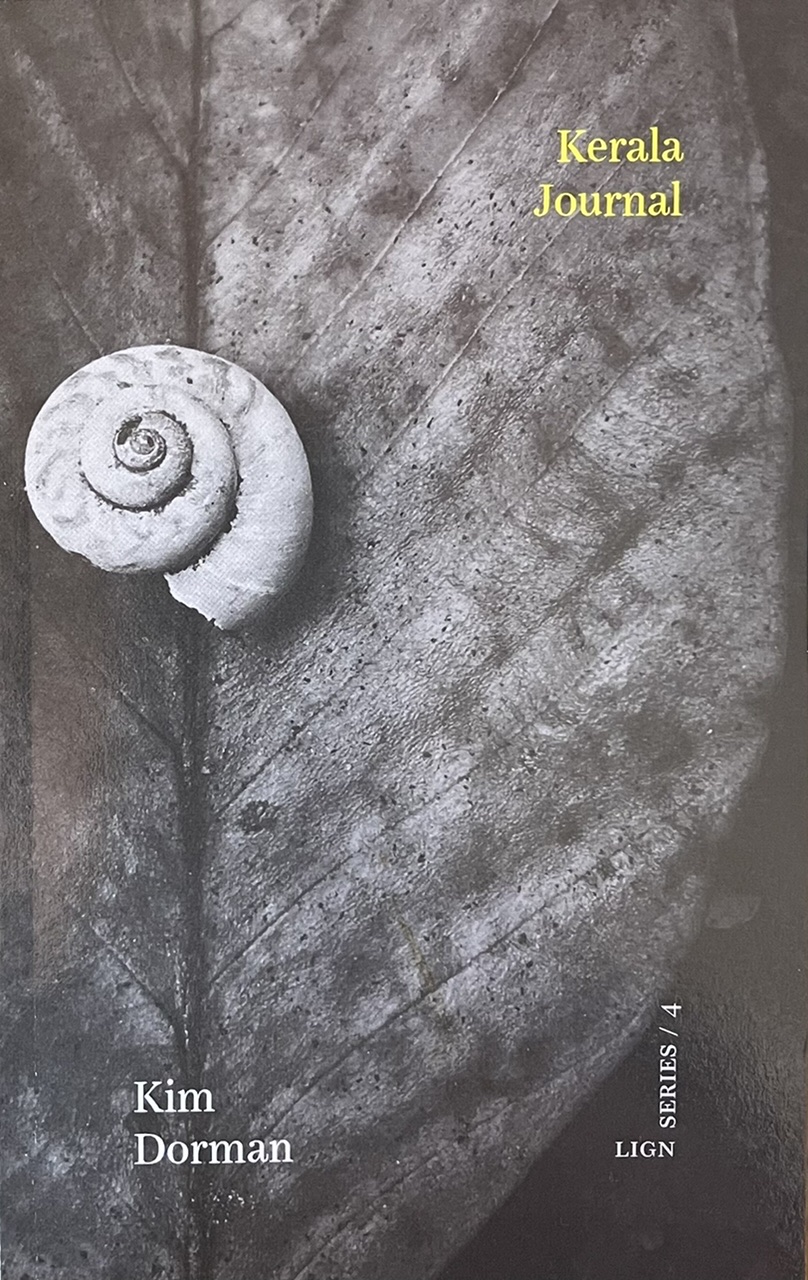
Some nights silver others pale gold: Kerala Journal by Kim Dorman

Rain drips on the
tin roof, frogs
& crickets chant.

The passing days
turn to years.

Lying awake in the
dark, I know the
taste of ash.

The images are simple, rendered with honesty and clarity. Darkness and light. Sound and silence.  Rituals of nature and moments in time.

American poet Kim Dorman was drawn to India as a child, and made his first visit to the country in 1976. He made several more journeys over the years until, after a long absence, he and his wife returned in 2019 to live in the southern state  of Kerala. Drawing inspiration from classical Japanese literature, especially Matsuo Bashō’s travel diaries, he focuses his attention on the small details and everyday routines and rhythms of life—his own and his neighbours—in this tropical environment. Kerala Journal is a collections of his poetic observations, recorded between March 2019 and January 2021.

A farmer clears his field with a sickle.
Fodder for cows.

On the road, a young family goes past
on a scooter.

Man, woman, child.

Certain images—night skies, dust on the road, rats in the attic, cawing crows—appear and reappear regularly, highlighting the rhythms that run through the days but as the poet, who admits to having three versions of Heraclitus among his books, knows well, one never steps in the same river twice. Time flows on.

Solitary path, dust.
Cockcrow sounds far:
All is lost, gained.
Sunrise on the river.

Yet, as Covid strikes, the world beyond the local community enters the immediate environment as newspapers bring news of migrant workers and their families slowly making their way to distant homes, while elsewhere a rhino ambles down an empty road meeting no one. Time during lockdown takes on a different shape for different people based on circumstance just as the reality of a pandemic heightens an awareness of mortality. I do notice that the poet seems ever more conscious of his age as this collection nears its close.

I was already in my late fifties when I first travelled to India and I had the great opportunity to visit a friend in Kerala twice in 2019. I am impressed with the Dormans’ decision to return there later in life. But I understand the perspective only age can bring. To fully appreciate a place takes patience and time and a quiet introspection. These poems observe without judgment. They inspire us to isolate and pay attention to the smallest details in our lives. And, sometimes, even the unexpected humour:

The chemist
hands me a bottle
wrapped in
newsprint—
the obituaries.

Kerala Journal by Kim Dorman is published by Xylem Books, an imprint of Corbel Stone Press.

A bell in the distance: ‘La Clarté Notre-Dame’ and ‘The Last Book of the Madrigals’ by Philippe Jaccottet

When Swiss Francophone writer Philippe Jaccottet died in 2021 at the age of ninety-five, he left two final manuscripts, finished in the final year of his life with the assistance of his friend, poet José-Flore Tappy. These two works, La Clarté Notre-Dame, a sequence of prose pieces, and The Last Book of the Madrigals, a selection of verses, have now been published together in John Taylor’s translation and, in them, we see the poet looking back over certain past experiences, ever asking questions of himself and the world he observes, even as his age weighs heavily on his thoughts.

The first work opens with a remembered outing with friends, when, as they walked down a gentle slope under grey skies, the silence or “deep absence” of the vast open space surrounded them:

Until the little vesper bell of La Clarté Notre-Dame Convent, which we still couldn’t see at the bottom of the valley, began to ring far below us, at the heart of all this almost-dull greyness. I then said to myself, reacting in a way that was both intense and confusing (and so many times in similar moments I’d been forced to bring together the two epithets), that I’d never heard a tinkling—prolonged, almost persistent, repeated several times—as pure in its weightlessness, in its extreme fragility, as genuinely crystalline . . . Yet which I couldn’t listen to as if it were a kind of speech—emerging from some mouth . . . A tinkling so crystalline that it seemed, as it appeared, oddly, almost tender . . .

This bell is the initiation and the subtle motif that binds a series of reflections that carry Jaccottet back to childhood, to earlier travels and, along the way, to inspirations and writings from his past. There is an element of reassessment to this sequence, a restless questioning of the poetic and the political, with frequent parenthetical asides. And though many of the passages date back to 2012, the image of being “at the very end of my life’s path” is ever present. Doubt, not of his accomplishments, but of their faithfulness to some kind of truth and ethical value, creeps into his musings.

There is a slowness, a patience, and willingness to set aside reflections for a time, to let them rest, that lends La Clarté Notre-Dame an organic wholeness in its final form, even if its genesis was more fragmentary. The vesper bells seem to effortlessly feed Jaccottet’s ongoing concerns about the situation in Syria, thoughts about his own poetic influences, memories of subtle details and interconnections arising from his long life of experiences and human interactions, and uncertainty about what lies beyond but, in the end, he is willing to close on an open, unfinished note. This is true to form. When asked what Jaccottet’s writing has to offer to a new generation of readers, John Taylor, one of his long-time translators suggests:

We have entered an age of unequivocal partisan discourse, of linguistic robotization, of tiny symbols standing for complex emotions. In total contrast to this, Jaccottet’s writing constantly shows nuance, attentiveness, perseverance, circumspection, and a genuine quest for essential truths. His hesitations and doubts are salutary because they bring us to a halt and help us to observe and ponder anew, sometimes against our own preconceptions and wishful thinking, as we learn to cast away chimeras but also not to abandon all hopes.

The Last Book of the Madrigals, Jaccottet’s final poetic offering is a return to verse, a form he had moved away from in favour of prose poetry in the 1990s. The dual language text opens with a piece entitled “While Listening to Claudio Monteverdi” which imagines an encounter with the most influential madrigalist of the early 17th century. It opens:

When singing he seems to call to a shade
whom he glimpsed one day in the woods
and needs to hold on to, be his soul at stake:
the urgency makes his voice catch fire.

Then by its own blazing light, we spot a moist
night-time meadow and the woods beyond
where had come across that tender shade
or much better and more tender than a shade:

now there’s nothing but oaks and violets.

The voice that has brightened the distance fades.

I don’t know if he has crossed the meadow.

Their long summer night together continues under the starry sky, becoming a transformative  experience for the speaker.

The poems that follow in this sequence draw on mythic, celestial and natural interactions. Other voices are invited into conversation with the poet on his journey, but an image of a writer nearing the end of his time recur—these are the last madrigals, an allusion to Monteverdi, perhaps—invoking the same sense of solemn awareness haunting La Clarté Notre Dame. After an encounter with an old blacksmith he asks:

Was he delirious when I heard him murmur:

‘If this lamp that is like a beehive
is removed from me,
if this perfume drifts away, companions,
you can carry off these quills and bundles of paper:
where I’m being led, I’ll have no more use for them . . .’

Later in another madrigal, as a summer evening falls, the poet again recalls the “blacksmith of volutes and flames,” whom imagines wishing away temptation only to then wonder of himself:

And he who still writes on the last staffs,
perhaps, of his life:

‘That unknown woman fishing in her lightweight skiff
has struck me as well.

I first thought it sweet to be her prey,
but now the hook tugs at my heart
and I don’t know if it’s the daylight or me
bleeding in these pearly waters.’

These poems are filled with beauty and longing, calling on the stars in the heavens for silent answers and anticipating the turning of the seasons toward autumn and winter. One can well imagine a chorus of voices carrying the final songs of a poet who looked at the world closely, listened to silences and distant bells, and sought the meanings in it all on the page. This volume with his two final works is not only a fitting literary addition to a life of great accomplishments, but can serve as an introduction for those who wish to read more.

‘La Clarté Notre-Dame’ andThe Last Book of the Madrigals’ by Philippe Jaccottet is translated from the French by John Taylor, with an Afterword by José-Flore Tappy, and published by Seagull Books.

One day you will meet yourself returning: Embark by Sean O’Brien

In these days of howling sunshine
when in the grove the aspens fret and pull
like maddened horses now silver now grey
in the curdling light, when the leaves of the cherry
are first all hands and then all birds
that point the way they cannot travel with you,
what then is to be done?

– from “Poem in German”

Every time I sit down to write about a book of poems, I am confronted with a wave of insecurity. Is it possible to write about poetry without the requisite vocabulary and knowledge to adequately assess the collection at hand? I have long argued that “ordinary” readers should be encouraged to read and engage with poetry, free from concerns about doing it “right.” After all, what does it mean to be “right” in one’s reading of any piece of literature? Even in the course of a single lifetime we never come to the same work in the same way, or as the same person. And yet, I am increasingly inclined to read poetry without any thought to whether I will or will not write about it because sometimes, no matter how much I enjoy a collection, I can find myself hopelessly at a loss when it comes to imagining how I might express my feelings.

Embark is the eleventh collection from well-known—albeit previously unknown to me—British poet Sean O’Brien. I ordered this book inspired by a couple of selections shared by someone on Twitter which is, I confess, one of my primary resources for finding poetry. Something about the pensive, gloomy tone of O’Brien’s poems caught my attention. Now, having read and reread this slender volume, I wanted to reflect on what strikes me in his work.

O’Brien’s publisher describes him as “‘Auden’s true inheritor,’ and one of our wisest poetic chronographers” and this, for a start, signals a return, for me, to a manner of poetry that has commanded less of my attention in recent years as I’ve read more inventive contemporary poetry and more in translation. I almost feel embarrassed to confess that his attention to metrical form, occasionally rhyming, and his use of popular or colloquial language, with a strong sense of place, feel familiar and welcome. His use of historical, literary and cultural references fall within a comfortable realm, at least in my reading. I was not left wondering what obscure references I might be missing.

Though poems should not mean but be,
all information tends to entropy:
What was the Word is emptied of itself

and speechless water rises through the stacks,
engulfing like a continental shelf,
implacable as death or income tax.

– from “Waterworks”

Of course, one of my key points of reference is simply one of age. O’Brien just turned seventy and, even if I’m eight years younger, the perspective that comes with living, looking back over the decades, colours the concerns, moods and tones that I recognize in his poetry. The ghosts of old towns, the crumbling decay and industrial detritus traced in the soil, water and stones, and the shadows of memory surface that again and again. His landscapes are charged with life, but his verses reflect an awareness of mortality and the absences that increasingly haunt us over time. This is the work of a mature poet, in age and in his confidence with language. But it is also very much of the present—climate change, disturbing political trends and the reality of the pandemic are all apparent here.

Rain is falling on the metal tables
piled with chairs, and gleaming
as it floods the blue brick gutters,

perfect and anonymous and beautiful.
Be careful what you wish for now
the very air has somewhere else to be.

The city has a headache
but it dare not speak its name –
the bitter patience that till yesterday

we learned from middle age –
and now the plague is blown
as lightly as a kiss across the street.

– from “A Last Turn”

There is a pensive, even bleak quality to many of these poems, but his imagery, his turn of phrase catches me in the moment, causes me to pause. But then there is this hint of guilt I feel when reading poems in English. As much as I love and believe in the importance of reading poetry in translation, aware of the challenges and decisions involved in translating verse (and O’Brien himself is a translator, having translated the poems of Kazakh national poet Abai Kunanbayuli), there is a special joy that comes from reading poetry in my native language that, oddly, I might never have considered before I became so passionate about reading in translation. Of course, O’Brien’s poems have also been widely translated into other languages, but all I can say for now is that I am glad I took a chance on this fine collection.

Embark by Sean O’Brien is published by Picador Poetry.

“How many lives go into a life?” Leaving by Cees Nooteboom, Drawings by Max Neumann

A man standing in a winter garden becomes aware of something not quite right—a cloud that seems too heavy, bare branches against an ancient wall, the refusal of neighbouring geese—an unspoken uneasiness that carries his thoughts back to the war:

The war that never stopped coming back,
a guest who’s known to all, a toothless
kiss, the language of intimate betrayal
around him now again, remembering a past

he couldn’t share with anyone.

This is how Dutch poet and writer Cees Nooteboom’s Leaving begins, its speaker in his garden thinking about family, war, times past. About those images that fail to fade. But as this three-part sequence of poems was coming into being, another guest, unexpected and uncertain, arrived and shifted the focus. His work would, in the end, acquire a subtitle: A Poem from the Time of the Virus. Without ever mentioning the virus itself outside of his Afterword, the shifting currents of the early months of its spread cannot be ignored even within the poet’s green refuge, for “Whimpering at the garden gate is the world, the / fuss of a newspaper.”

Heads and faces—remembered, imagined, dreamed—form a key motif throughout these poems, complemented by German artist Max Neuman’s series of drawings of abstract figures with spare features, completed in advance of news of the pandemic, for this, their second collaboration. The man in his garden is haunted by heads:

I saw heads, countless heads,
field marshals, lovers, travellers
from star to star. Each head its
own story, hidden in the folds

of the brain, alongside narrow streams
of blood, reeds on the banks, secret
landscapes no one can reach,
except for a lonely traveller

This leads into the second sequence, where the poet, the lonely traveller, wants to make sense of the darkness and strangeness of his visions  that surface from memory. All these heads. Who are these people, he asks, these creatures, these voices? As spartan as Neumann’s drawings, these poems propose questions that the poet cannot or does not want to answer. Can one look for meaning in life if, when looking back, one is confronted with forms, shadows, faces without mouths? The past seems intent on revisiting the man who knows that the end is nearing:

Life, the song of songs? Sure,
but underneath there is that other truth,
the truth of night and fog,
the test that lasts

until the end.

The third and final sequence, or movement if one wishes to read this poem as a musical composition, moves into a space of quiet and melancholy. Others—friends, brothers, lovers—have left the path once shared, one by one, “disappearing like ghosts.” The silence descending on the world is like a nothingness the poet has never heard before: “contradiction / surrounds me, an organ, / no keys, a song // whose sound has been sealed.” Yet, where the poet is troubled by the images that confront him in the second sequence, he is now coming to a place of peace with himself and others in the silence and isolation, and finds he is ready to take the road ahead and let the past be:

Now my feet are counting the road, I know,
looking back is not allowed. My steps measure time,
a dark and peerless poem, a beat
that can’t be slowed.

In the Afterword, Nooteboom who is not a writer to shy away from contemporary issues,  talks about how a poem comes to be, how influences enter and make themselves known, changing the direction in which the poet thought he was headed. It would be strange, he says, if the arrival of a mysterious virus were to be completely ignored; sometimes reality intervenes to help one write. And so we have this thoughtful, timely work, one that invites rereading and lingering on the words and the drawings.

Leaving: A Poem from the Time of the Virus by Cees Nooteboom with drawing by Max Neumann is translated by David Colmer and published by Seagull Books.

A romantic soul: May by Karel Hynek Mácha

A star has dropped from heaven’s height,
a dying star of dark blue light;
it falls through endless realms;
it dwells eternally in falling.
Its cry sounds from the grave of all,
a horrible shriek, a terrible scream.
“When will its falling end?”
Never—nowhere—there is no end.

There are many literary works that risk being ruined for readers simply because they are prescribed study in school, often presented in a rote manner that leaves its victims, er students, with few fond memories. No doubt, for generations of Czech students, Karel Hynek Mácha’s epic poem May might be remembered primarily as something they were required to read in school, old fashioned and difficult. But to come to this poem well into adulthood, without school-deadened experience and as someone whose first poetic passion was English Romantic poetry, this tale of romance, betrayal, patricide and brutal punishment is fascinating, as is the short, tragic life of its author.

Image from Twisted Spoon Press on Flickr

I was inspired to read this important Czech poem by my reading of Daniela Hodrova’s City of Torment earlier this year. Now recognized as the greatest Czech Romantic poet, Mácha is one of the many ghosts haunting this monumental trilogy and his story Márinka, which not yet available in English, forms an important part of the literary subtext of Hodrova’s work. May, however, has been published by Twisted Spoon Press in a handsome dual language volume translated by Marcela Malek Sulak with drawings by Jindřich Štyrský (1899–1942) that were specifically created for this poem.

Mácha was born in Prague on November 16, 1810 and educated in the two languages approved by the Hapsburg authorities, German and Latin. He would go on to study law at Prague University. Yet at heart he was a romantic who spent much of his time wandering the countryside, visiting castles and ruins, and embarking on extended walking tours across Moravia and Slovakia, even making his way to Venice on foot. His great inspiration was Byron.

Writing at a time when Czech poets were seeking to reclaim the Czech language from beneath to weight of two hundred years of imposed German, Mácha also chose Czech for his epic, but he rejected the current focus on folklore and myth as a means to define a new national identity and challenged the Czech language to stretch “to perform in innovative ways and borrowed from Italian landscape, Byronic themes, and local scandal” to fashion his tale of love and a passion denied by fate.

Image from Twisted Spoon Press on Flickr

The finished poem was not well received in Mácha’s circles, causing him to finance the publishing himself in 1836. He died of pneumonia later the same year, a few days shy of his twenty-sixth birthday and three days before he was to have married his lover, Lori, the mother of his child. He was buried in a pauper’s grave. His reputation grew over the decades following his death and a century later, in 1939, his remains were exhumed and he was granted a formal state funeral and buried in the Slavín Cemetery at Vyšehrad in Prague, his status as a national hero finally confirmed.

May consists of four cantos with two intermezzos. It relays the story of Vilém, the notorious “forest lord,” leader of a group of bandits, who is in love with Jarmila, a young girl who has been seduced by another man. In defense of his “wilted rose,” Vilém has killed her debaucher, unaware that his victim was his own father who had driven him out of his childhood home many years earlier. Sentenced to death, Vilém spends the night before his execution preparing to meet his fate:

“How long the night—how long the night—
A longer night yet comes for me!———
Perish the thought!”—The strength of terror
fells his thought.—
Profound silence.—A water drop,
falling, measures time once more.

The next morning, as a beautiful day dawns, the convict is led out to the hillock where a crowd has gathered. He surveys the landscape, bemoans that he will never see his beloved homeland again. The sword falls, and his head and broken limbs are left displayed on a pillar and wheel. Seven years later, a traveller, Hynek, encounters the site and Vilém’s remains. The following morning, the innkeeper in town tells him the tragic tale. Returning once more, many years later on the first of May, the traveller sits on the hillock until nightfall and sees his own and humanity’s fate reflected in Jarmila and Vilém’s story of love and betrayal.

Mácha’s attention to the beauty of nature in evident throughout this poem, from the opening lines of Canto I in which Jarmila waits in vain for Vilém to meet her:

It was late evening—first of May—
was evening May—the time for love.
The turtledove invited love
to where the pine grove’s fragrance lay.
The silent moss murmured of love,
the flowering tree belied love’s woe.
The nightingale sang rose-filled love,
the rose exhaled a sweet complaint.
The placid lake in shadowed thicket
resounded darkly secret pain,
embracing it within its shores;
the pristine suns of other worlds
were wandering through the sky’s blue band,
as fiery as a lover’s tears.

Holding close to his Romantic inspiration and instincts, nature reflects both the passion and the sorrow of his tale. The poem is well-paced and dramatic, speaking to particular style and time, of course, but with all the elements of an entertaining tragic romance. As Sulak explains in her Introduction, she tried to capture the exact meter of the original poem and, because Mácha paid close attention to sound when making language choices to capture his hero’s mental state, she tried approximate a similar affect with the words she used in Canto II, the prison sequence. Because Czech is a language with a much more flexible word order, an effort to reproduce the rhyming pattern was not made. These decisions help preserve the rhythm and flow, as well as the beauty and emotion that have made May such a well-loved poem.

May by Karel Hynek Mácha is translated from the Czech by Marcela Malek Sulak with drawings by Jindřich Štyrský and published  by Twisted Spoon Press.